
Genesis 45:9

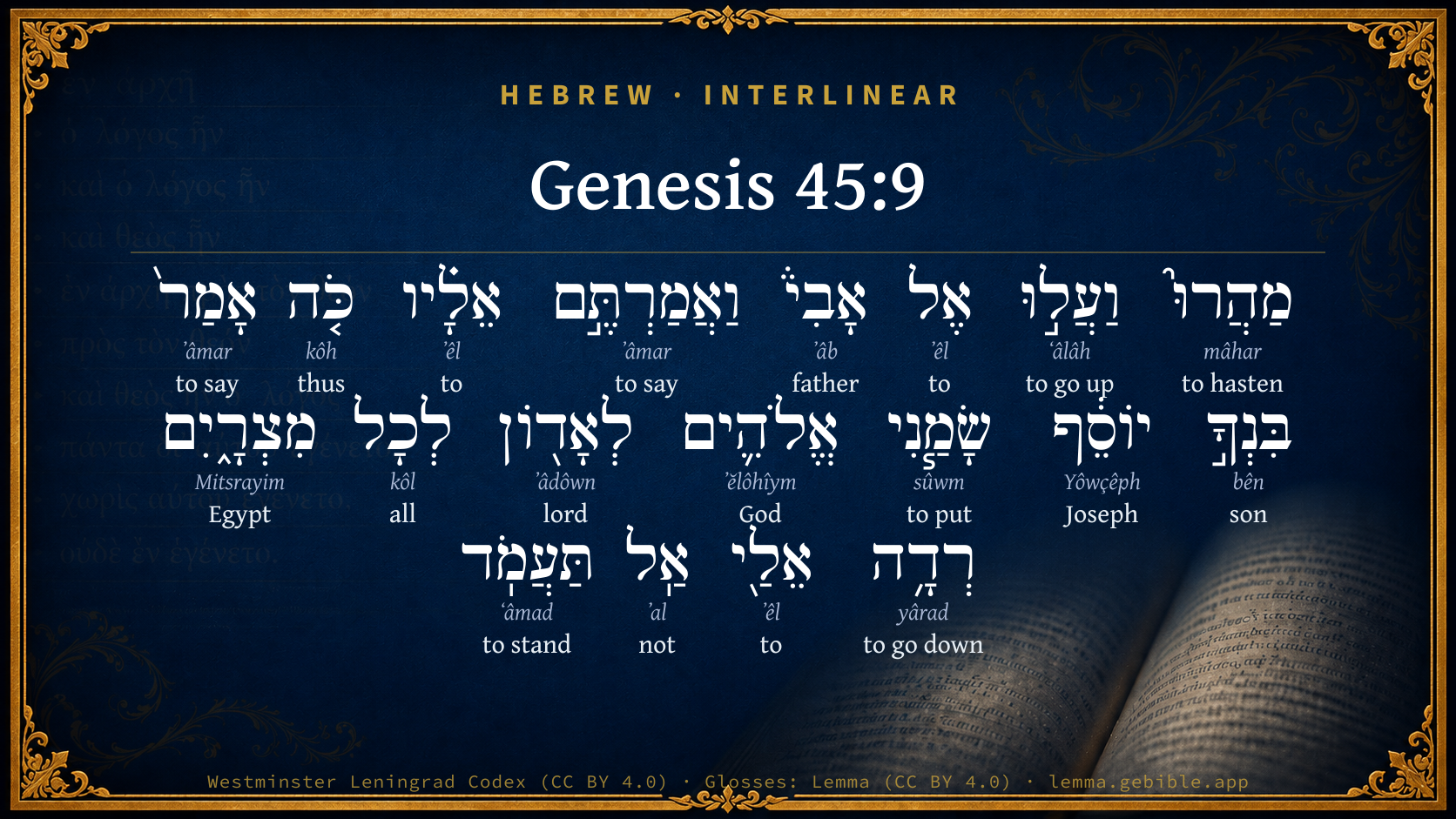
Hebrew (Westminster Leningrad Codex) Genesis 45:9 appears in the Hebrew Old Testament. The text above is from the Westminster Leningrad Codex. Each word links to its Strong’s number, a concise gloss, and parsing drawn from the Open Scriptures Hebrew Bible morphology. Click any word for its full Brown-Driver-Briggs (BDB) entry.
Download image
Cite this verse

Genesis 45:9 (World English Bible). Public Domain. Lemma interlinear Bible study tool, https://lemma.gebible.app/v/genesis/45/9.

Show BibTeX & RIS
BibTeX
RIS
English Translation
Hurry, and go up to my father, and tell him, 'This is what your son Joseph says, "God has made me lord of all Egypt. Come down to me. Don't wait.
World English Bible · Public Domain
Download a study sheet

One document with this verse’s original text, its word-by-word gloss line, the meaning frame, cross-references with their text, attributed commentary, and full source and license credits — printable, and it pastes into notes with its structure intact.

This verse Autodidact and up

Study sheet (.html) Plain text (.txt)

A passage Seminary Student

Up to 50 verses in one chapter. A passage sheet keeps up to 6 commentary sources and 12 cross-references per verse, in the order this page ranks them, and says so on the sheet whenever that leaves anything out. Ask for a single verse and you get the Autodidact verse sheet above.

Everything on this page stays free to read, with no account — the sheet is a download of what is already on screen, not access to it.

Want to remove ads? Support Godless Engineer
Compare translations 3

The same verse in 3 English versions, stacked beneath the original-language interlinear above. Click any original word for its lexicon entry.

Each is an independent rendering of the whole verse — the interlinear is not word-aligned to these translations.

Highlighted words mark where these versions differ — a whole-verse word diff, not a word-by-word alignment.

  • World English Bible Public Domain
    Hurry, and go up to my father, and tell him, 'This is what your son Joseph says, "God has made me lord of all Egypt. Come down to me. Don't wait.
  • King James Version Public Domain
    Haste ye, and go up to my father, and say unto him, Thus saith thy son Joseph, God hath made me lord of all Egypt: come down unto me, tarry not:
  • unfoldingWord Literal Text CC BY-SA 4.0
    Hurry and go up to my father and say to him, ‘This your son Joseph says, “God has made me lord over all Egypt. Come down to me, do not delay.

unfoldingWord Literal Text — © unfoldingWord, licensed CC BY-SA 4.0. Word-aligned USFM3 via Door43 (git.door43.org/unfoldingWord/en_ult).

Versions to compare (up to 4)

3 of 4 selected

Show all 18 translations

Every available English version of this verse, each an independent rendering of the whole verse.

  • World English Bible Public Domain
    Hurry, and go up to my father, and tell him, 'This is what your son Joseph says, "God has made me lord of all Egypt. Come down to me. Don't wait.
  • Berean Standard Bible Public Domain
    Now return quickly to my father and tell him, ‘This is what your son Joseph says: God has made me lord of all Egypt. Come down to me without delay.
  • Majority Standard Bible Public Domain
    Now return quickly to my father and tell him, ‘This is what your son Joseph says: God has made me lord of all Egypt. Come down to me without delay.
  • King James Version Public Domain
    Haste ye, and go up to my father, and say unto him, Thus saith thy son Joseph, God hath made me lord of all Egypt: come down unto me, tarry not:
  • American Standard Version (1901) Public Domain
    Haste ye, and go up to my father, and say unto him, Thus saith thy son Joseph, God hath made me lord of all Egypt: come down unto me, tarry not;
  • Revised Version (1885) Public Domain
    Haste ye, and go up to my father, and say unto him, Thus saith thy son Joseph, God hath made me lord of all Egypt: come down unto me, tarry not:
  • Geneva Bible (1599) Public Domain
    Haste you and go vp to my father, and tel him, Thus saieth thy sonne Ioseph, God hath made me lord of all Egypt: come downe to me, tary not.
  • Douay-Rheims (1899) Public Domain
    Make haste, and go ye up to my father, and say to him: Thus saith thy son Joseph: God hath made me lord of the whole land of Egypt: come down to me, linger not.
  • Young's Literal Translation Public Domain
    `Haste, and go up unto my father, then ye have said to him, Thus said Joseph thy son, God hath set me for lord to all Egypt; come down unto me, stay not,
  • Literal Standard Version CC BY-SA 4.0
    Hurry, and go up to my father, then you have said to him, Thus said your son Joseph: God has set me for lord to all Egypt; come down to me, do not stay,
  • Unlocked Literal Bible CC BY-SA 4.0
    Hurry and go up to my father and say to him, 'This is what your son Joseph says, “God has made me master of all Egypt. Come down to me, do not delay.
  • unfoldingWord Literal Text CC BY-SA 4.0
    Hurry and go up to my father and say to him, ‘This your son Joseph says, “God has made me lord over all Egypt. Come down to me, do not delay.
  • Darby Bible Public Domain
    Haste and go up to my father, and say to him, Thus says thy son Joseph: God has made me lord of all Egypt; come down to me, tarry not.
  • World Messianic Bible Public Domain
    Hurry, and go up to my father, and tell him, ‘This is what your son Joseph says, “God has made me lord of all Egypt. Come down to me. Don’t wait.
  • Webster's Bible Public Domain
    Haste ye, and return to my father, and say to him, Thus saith thy son Joseph, God hath made me lord of all Egypt; come down to me; delay not:
  • Free Bible Version CC BY-SA 4.0
    Now hurry! Go back to my father and tell him, ‘This message comes from your son Joseph: God has made me the ruler of the whole of Egypt. Come to me now; don't wait.
  • Bible in Basic English Public Domain
    Now go quickly to my father, and say to him, Your son Joseph says, God has made me ruler over all the land of Egypt: come down to me straight away:
  • JPS Tanakh (1917) Public Domain
    Hasten ye, and go up to my father, and say unto him: Thus saith thy son Joseph: God hath made me lord of all Egypt; come down unto me, tarry not.

Literal Standard Version (2020), Covenant Press — licensed CC BY-SA 4.0. Text via the HelloAO Bible API (eBible.org). Unlocked Literal Bible (unfoldingWord) — licensed CC BY-SA 4.0. Text via the HelloAO Bible API (eBible.org). unfoldingWord Literal Text — © unfoldingWord, licensed CC BY-SA 4.0. Word-aligned USFM3 via Door43 (git.door43.org/unfoldingWord/en_ult). Free Bible Version, Dr. Jonathan Gallagher — licensed CC BY-SA 4.0. Text via the HelloAO Bible API (eBible.org).

Word by word

More ways to search: Search by grammar → Find every occurrence → Compare this word →

Practice this passage: Drill this verse → Learn its vocabulary →

מַהֲרוּ֮
mâhar
H4116
“hasten”
Verb, Piel, Imperative, 2nd Person, Masculine, Plural
Part of Speech
Verb
Stem
Piel
Form
Imperative
Person
2nd Person
Gender
Masculine
Number
Plural
Full BDB Definition

Origin: a primitive root

TWOT: 1152

(Qal) to hasten - (Niphal) to be hurried, be anxious - hasty, precipitate, impetuous - (Piel) - to hasten, make haste - hasten (used as adverb with another verb) - to hasten, prepare quickly, do quickly, bring quickly
  1. וַעֲל֣וּ ʻâlâh H5927 “and · go up” Conjunction + Verb, Qal, Imperative, 2nd Person, Masculine, Plural
  2. אֶל ʼêl H413 “to” Preposition
  3. אָבִי֒ ʼâb H1 “father · my” Noun, Common, Masculine, Singular, Construct + Suffix, Personal, 1st Person, Common, Singular
  4. וַאֲמַרְתֶּ֣ם ʼâmar H559 “and · to say” Conjunction + Verb, Qal, Sequential Perfect, 2nd Person, Masculine, Plural
  5. אֵלָ֗יו ʼêl H413 “to · him” Preposition + Suffix, Personal, 3rd Person, Masculine, Singular
  6. כֹּ֤ה kôh H3541 “thus” Adverb
  7. אָמַר֙ ʼâmar H559 “to say” Verb, Qal, Perfect, 3rd Person, Masculine, Singular
  8. בִּנְךָ֣ bên H1121 “son · your” Noun, Common, Masculine, Singular, Construct + Suffix, Personal, 2nd Person, Masculine, Singular
  9. יוֹסֵ֔ף Yôwçêph H3130 “Joseph” Noun, Proper
  10. שָׂמַ֧נִי sûwm H7760 “to put · me” Verb, Qal, Perfect, 3rd Person, Masculine, Singular + Suffix, Personal, 1st Person, Common, Singular
  11. אֱלֹהִ֛ים ʼĕlôhîym H430 “God(s)” Noun, Common, Masculine, Plural, Absolute
  12. לְאָד֖וֹן ʼâdôwn H113 “to/for · lord” Preposition + Noun, Common, Masculine, Singular, Absolute
  13. לְכָל kôl H3605 “to/for · all of” Preposition + Noun, Common, Masculine, Singular, Construct
  14. מִצְרָ֑יִם Mitsrayim H4714 “Egypt” Noun, Proper
  15. רְדָ֥ה yârad H3381 “go down” Verb, Qal, Imperative, 2nd Person, Masculine, Singular + Suffix, h
  16. אֵלַ֖י ʼêl H413 “to · me” Preposition + Suffix, Personal, 1st Person, Common, Singular
  17. אַֽל ʼal H408 “not” Particle, Negative
  18. תַּעֲמֹֽד ʻâmad H5975 “to stand” Verb, Qal, Jussive, 2nd Person, Masculine, Singular

About this verse

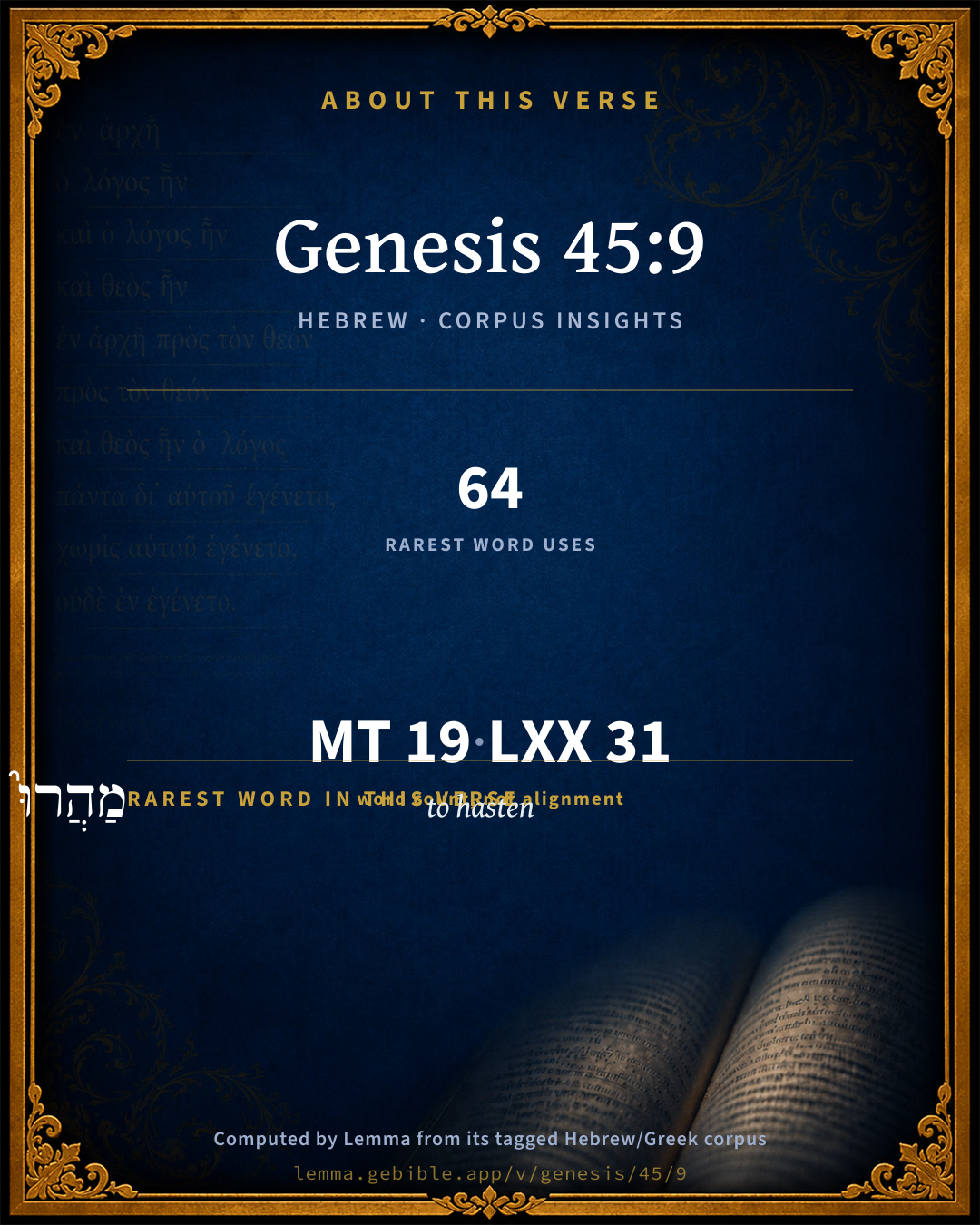
These counts appear in no published source. They are computed here, from the morphology-tagged text and Lemma’s own curated glosses. What Lemma adds →

19
words
16
distinct lemmas
Pentateuch
section

Grammatical profile

  • 7 verbs
  • 7 nouns
  • 3 prepositions
  • 1 adverb
  • 1 particle

Verb forms

  • מַהֲרוּ֮ Piel · Imperative
  • וַעֲל֣וּ Qal · Imperative
  • וַאֲמַרְתֶּ֣ם Qal · Sequential Perfect
  • אָמַר֙ Qal · Perfect
  • שָׂמַ֧נִי Qal · Perfect
  • רְדָ֥ה Qal · Imperative
  • תַּעֲמֹֽד Qal · Jussive

Repetition

Words recur within this verse — often emphatic in Hebrew:

  • וַאֲמַרְתֶּ֣ם to say H559 ×2
  • אֶל to H413 ×3

Hebrew & Septuagint length

In English translation the verse runs 31 words from the Hebrew and 37 from the Septuagint (LXX English) — closely comparable.

A rough comparison of the two English renderings, which tokenize alike — not a word-level alignment.

Word counts can differ between the Hebrew and the Greek without any difference in meaning — e.g. the Hebrew direct-object marker אֵת has no separate Greek word, and Greek often adds the article ὁ.

In the original languages it is 19 Hebrew tokens and 31 Greek tokens — but the two are counted differently (Hebrew bundles its prefixes and suffixes into one token; the Greek is in lemma form), so that isn’t a like-for-like length.

Cross-references

2

Topical passages linked to Genesis 45:9 in the Treasury of Scripture Knowledge — connected by theme and wording, ordered by reader-vote popularity; previews shown in the World English Bible.

  • Genesis 45:19–20 Now you are commanded: do this. Take wagons out of the land of Egypt for your little ones, and for your wives, and bring your father, and come.
  • Genesis 45:13 You shall tell my father of all my glory in Egypt, and of all that you have seen. You shall hurry and bring my father down here."

Cross-references courtesy of OpenBible.info (CC BY 4.0).

Hebrew and Greek witnesses Masoretic Hebrew ↔ Greek Septuagint

The same verse in the two great witnesses to the Old Testament, shown verse-for-verse.

These are two independent witnesses, not word-aligned to each other, and the Septuagint is shown in lemma (dictionary) form.

Hebrew Genesis 45:9 Masoretic · Westminster Leningrad Codex

מַהֲרוּ֮ וַעֲל֣וּ אֶל אָבִי֒ וַאֲמַרְתֶּ֣ם אֵלָ֗יו כֹּ֤ה אָמַר֙ בִּנְךָ֣ יוֹסֵ֔ף שָׂמַ֧נִי אֱלֹהִ֛ים לְאָד֖וֹן לְכָל מִצְרָ֑יִם רְדָ֥ה אֵלַ֖י אַֽל תַּעֲמֹֽד

Hurry, and go up to my father, and tell him, 'This is what your son Joseph says, "God has made me lord of all Egypt. Come down to me. Don't wait.

World English Bible · Public Domain

Greek LXX Genesis 45:9 Septuagint · lemma form

σπεύδω οὖν ἀναβαίνω πρός ὁ πατήρ ἐγώ καί εἶπον αὐτός ὅδε λέγω ὁ υἱός σύ ιωσηφ ποιέω ἐγώ ὁ θεός κύριος πᾶς γῆ αἴγυπτος καταβαίνω οὖν πρός ἐγώ καί μή μένω

Hasten, therefore, and go up to my father, and say to him, These things says your son Joseph; God has made me lord of all the land of Egypt; come down therefore to me, and wait not.

LXX2012 (modern English Septuagint) · Public Domain

Hebrew: Westminster Leningrad Codex (CC BY 4.0). Greek: Septuagint (public domain); English from LXX2012 (modern English Septuagint) (Public Domain). How the Septuagint differs from the Hebrew →

Targum (Aramaic paraphrase)

2

The Targum is the ancient Jewish Aramaic paraphrase of the Hebrew Scriptures — an interpretive translation, not the Hebrew text itself. Onkelos (literal) and Pseudo-Jonathan (expansive) render the Torah, and Jonathan the Prophets. Coverage is partial: where no permissively-licensed English translation exists for a verse, only the Aramaic is shown. This is verse-level text, not a word-by-word alignment to the Hebrew.

  1. Targum Onkelos Torah (Genesis–Deuteronomy)
    אוֹחוּ וּסְקוֹ לְוַת אַבָּא וְתֵימְרוּן לֵהּ כִּדְנַן אֲמַר בְּרָךְ יוֹסֵף שַׁוְּיַנִי יְיָ לְרִבּוֹן לְכָל מִצְרָיִם חוּת לְוָתִי לָא תִתְעַכָּב

    (no public-domain English translation for this verse)

    Targum Onkelos — Aramaic: “Onkelos Genesis” (public domain); “Onkelos Exodus” (public domain); “Onkelos Leviticus” (public domain); “Onkelos Numbers” (public domain); “Onkelos Deuteronomy” (public domain). English: “Sefaria Community Translation” (CC0 1.0 (public-domain dedication)); “J.W. Etheridge. The Targums of Onkelos and Jonathan Ben Uzziel on the Pentateuch. London: Longmans, Green, 1862” (public domain). Text via Sefaria.

  2. Targum Pseudo-Jonathan Torah (Genesis–Deuteronomy)
    אוֹחוּ וּסְקוּ לְוַת אַבָּא וְתֵימְרוּן לֵיהּ כִּדְנַן אָמַר בְּרָךְ יוֹסֵף שַׁוְויַינִי יְיָ לְרַב לְכָל מִצְרָאֵי חוֹת לְוָתִי לָא תִתְעַכָּב

    Make haste, and go up to my father, and say to him, Thus saith thy son Joseph, The Lord hath set me for a chief over all the Mizraee; come down to me, delay not,

    Targum Pseudo-Jonathan — Aramaic: “Targum Jonathan on Genesis” (public domain); “Targum Jonathan on Exodus” (public domain); “Targum Jonathan on Leviticus” (public domain); “Targum Jonathan on Numbers” (public domain); “Targum Jonathan on Deuteronomy” (public domain). English: “The Targum of Jonathan ben Uzziel, trans. J. W. Etheridge, London, 1862” (public domain). Text via Sefaria.

Commentary

Notes on Genesis 45:9 from classic Christian and Jewish commentators (each source and its license shown beneath its notes). The classic Christian expositions comment on the surrounding passage and are grouped to its opening verse, so a note may address several verses; the Jewish commentaries on the Tanakh (Rashi and others) are per-verse, so they appear only where the commentator wrote on this verse.

Lemma curates 59 commentaries, every one of them public domain or Creative Commons licensed, each selected and text-cleaned for this edition rather than reprinted as found. About our sources →

Trapp's Complete Commentary

John Trapp

Gen 45:9 Haste ye, and go up to my father, and say unto him, Thus saith thy son Joseph, God hath made me lord of all Egypt: come down unto me, tarry not:

Ver. 9. Come down unto me, tarry not.] Christ seems to send from heaven, and say unto us in like sort, God hath made me Lord of all; come up unto me, tarry not. Should the king call us to court, upon no other condition than to have and enjoy the pleasures and treasures there to be had, old Jacob never went so willingly into Egypt, as we should gladly accept and embrace such a motion.

John Trapp, A Commentary or Exposition upon All the Books of the Old and New Testament (1647–1656) — public domain. Text from a community e-Sword module.

The Biblical Illustrator

Joseph S. Exell

Gen_45:9-13

Thus saith thy son Joseph

Lessons

1.

Providence may order traitors to be messengers of better news than they intended.

2. Gracious children are speedy to take off grief from their parents hearts.

3. God orders those events of mercy to be declared unto His, which they sometimes would not believe.

4. Josephs spirit owneth his afflicted father in all his own glory.

5. Josephs heart ascribes all his glory unto God only.

6. Joseph contents not himself to be in plenty and glory, but to have his father with him (Gen_45:9).

7. Certain and fertile habitations are human motives to draw from barren places.

8. Nearness to dearest relations may persuade to change habitations (Gen_45:10).

9. Alimony is a duty of children to parents in straights.

10. Assurance of nourishment may well draw from places where bread is wanting.

11. Gods continuance of famine should move souls to follow His providence for food.

12. It is beseeming Gods servants to provide under Him against impoverishing of their families. So Joseph (Gen_45:11).

13. Eyewitnesses and they dear ones of Gods gracious events, should persuade good souls to believe them (verse 121.

14. Gracious souls may urge their dignity to help the distressed, but not in vain glory.

15. Grace makes nature speedy in the execution of its duty.

16. Gracious children desire earnestly their parents with them in their fulness (Gen_45:13). (G. Hughes, B. D.)

The Biblical Illustrator, edited by Joseph S. Exell (c. 1880s–1900s) — public domain. Text from a community e-Sword module.

Joseph Benson's Commentary

Gen 45:9. Haste you, and go to my father — He desires that his father might speedily be made glad with the tidings of his life and honour. He knew it would be a refreshing oil to his hoary head, and a sovereign cordial to his spirits. He desires them to give themselves, and take with them to their father, all possible satisfaction of these surprising tidings.

Joseph Benson's Commentary on the Old and New Testaments (1811–1818) — public domain. Text from a community e-Sword module.

Tyndale Open Study Notes

Tyndale Open Resources

45:9-13 Joseph instructed his brothers to inform Jacob. The whole family was to move to Egypt and live in Goshen, a fertile region in the Nile delta (see 47:1-12). If they did not come to Egypt, they would not survive the five years of famine ahead.

Tyndale Open Study Notes — © Tyndale Open Resources, licensed CC BY-SA 4.0. Text via the HelloAO Bible API.

John Calvin's Commentaries

9. Thus saith thy son Joseph. In giving this command, he shows that he spoke of his power in order to inspire his father with stronger confidence. We know how dilatory old men are; and, besides, it was difficult to tear holy Jacob away from the inheritance which was divinely promised to him. Therefore Joseph, having pointed out the necessity for the step, declares what a desirable relief the Lord had offered. It may, however, be asked, why the oracle did not occur to their minds, concerning which they had been instructed by their fathers, namely, that they should be strangers and servants in a strange land. (Genesis 15:13.) For it seems that Joseph here promises nothing but mere pleasures, as if no future adversity was to be apprehended. But though nothing is expressly declared on this point by Moses, yet I am induced, by a probable conjecture, to believe that Jacob was not forgetful of the oracle. For, unless he had been retained by some celestial chain, he never could have remained in Egypt after the expiration of the time of scarcity. For by remaining there voluntarily, he would have appeared to cast away the hope of the inheritance promised him by God. Seeing, then, that he does not provide for his return into the land of Canaan, but only commands his corpse to be carried thither; nor yet exhorts his sons to a speedy return, but suffers them to settle in Egypt; he does this, not from indolence, or because he is allured by the attractions of Egypt, or has become weary of the land of Canaan; but because he is preparing himself and his offspring to bear that tyranny, concerning which he had been forewarned by his father Isaac. Therefore he regards it as an advantage that, at his first coming, he is hospitably received; but, in the meantime, he revolves in his mind what had been spoken to Abraham.

John Calvin's Commentaries (1540-1563) — public domain. Text from the Calvin Translation Society English edition (1840s-50s) via the Christian Classics Ethereal Library (ccel.org). Calvin's coverage is partial (roughly two-thirds of the Bible); uncommented books and verses are honest gaps, never fabricated. The 19th-century editor's footnotes and remarks are omitted so the notes are faithfully Calvin's own voice.

John Gill's Exposition

Haste you, and go up to my father,.... In Canaan, which lay higher than Egypt; being desirous he should know as soon as possible that he was alive, and in what circumstances he was:

and say unto him, thus saith thy son Joseph; without any title, such as the father and counsellor of Pharaoh and governor of Egypt, only Joseph his son, which would be enough to revive the heart of Jacob:

God hath made me lord over all Egypt: his exaltation to this dignity he ascribes, not to Pharaoh, but to God; civil honour and promotion to worldly grandeur and dignity are from God, and not from man:

come down unto me, tarry not; the great business on his hands not permitting him to go to his father and fetch him to Egypt, he desires that he would come to him without delay, which would be greatly to the advantage of him and his family, and to their mutual comfort.

John Gill's Exposition of the Whole Bible (1746–1763) — public domain (CC PDM 1.0). Text via the HelloAO Bible API.

Whedon's Commentary on the Bible

Daniel D. Whedon

9. Haste ye… tarry not — The emotion of a consuming filial love is in these words. How long will seem the days until son and father meet again!

Daniel D. Whedon (gen. ed.), Commentary on the Old and New Testaments (1874–1909) — public domain. Text from a community e-Sword module.

unfoldingWord translationNotes

Door43 World Missions Community

go up to my father

It was common to use the phrase "go up" when speaking about going from Egypt to Canaan. AT: "go back to my father"

say to him, 'This is what your son Joseph says, "God has ... all that you have

This is a quotation with three layers. It can be simplified to two layers. AT: "tell him that this is what I said: 'God has ... all that you have" (See: Quotes Within Quotes and Direct and Indirect Quotations)

Come down to me

It was common to use the phrase "come down" when speaking about going from Canaan to Egypt. AT: "Come here to me"

come to poverty

This speaks about "poverty" as if it were a destination. AT: "waste away" or "starve" (See: Metaphor)

translationWords

Goshen

children

flocks

year

famine

household

unfoldingWord translationNotes — © Distant Shores Media and the Door43 World Missions Community, licensed CC BY-SA 4.0. Source: git.door43.org/Door43/en_tn.

Rashi

Rabbi Shlomo Yitzchaki (Rashi)

ועלו אל אבי AND GO UP TO MY FATHER — he said “go up” because the land of Israel is situated higher than all the neighbouring countries (Kiddushin 69a).

Rashi on the Tanakh — English translations: “The Judaica Press complete Tanach with Rashi, translated by A. J. Rosenberg” (CC BY 4.0); “Pentateuch with Rashi's commentary by M. Rosenbaum and A.M. Silbermann, 1929-1934” (public domain); “The Metsudah Tanach series, Lakewood, N.J” (CC BY 4.0); and “The Book of Joshua, Metsudah Publications, 1997” (CC BY 4.0). Text via Sefaria.

Lesson kit

Teaching starters — assembled from the data on this page, not authored interpretation. Every prompt links to the verse data it draws on. Edit before teaching.

Genesis, in the Pentateuch, opens this verse with 19 words (16 distinct Hebrew lemmas). Its most distinctive word is mâhar (“to hasten”). A historical commentator’s framing appears above. Read the whole chapter for the surrounding context.

Discussion questions

  1. The word mâhar carries the sense “to hasten.” How does it shape the verse?
  2. Genesis 45:19–20 shares this passage’s theme. How do the two illuminate each other?
  3. “to say” occurs 2× in this one verse. What is the effect of the repetition?
  4. The translations on this page render this verse differently — a whole-verse word diff, not a word-by-word alignment. What might account for the different wordings?
  5. The verb «מַהֲרוּ֮» is Piel Imperative. How does its form color the action?
  6. Reading how Trapp's Complete Commentary and The Biblical Illustrator read this verse, where do the two commentators agree and where do they part?

Things to notice

Reading settings

Reading text

Shown beneath each verse's original-language words.

Old Testament
Old Testament edition

Read the OT as the Masoretic Hebrew (MT) or the Greek Septuagint (LXX).

English shown for the Greek Septuagint (in the Hebrew ↔ Greek comparison).

Comparing translations? Open the Compare panel on any verse page to stack up to four side by side.