Ezekiel 37:8

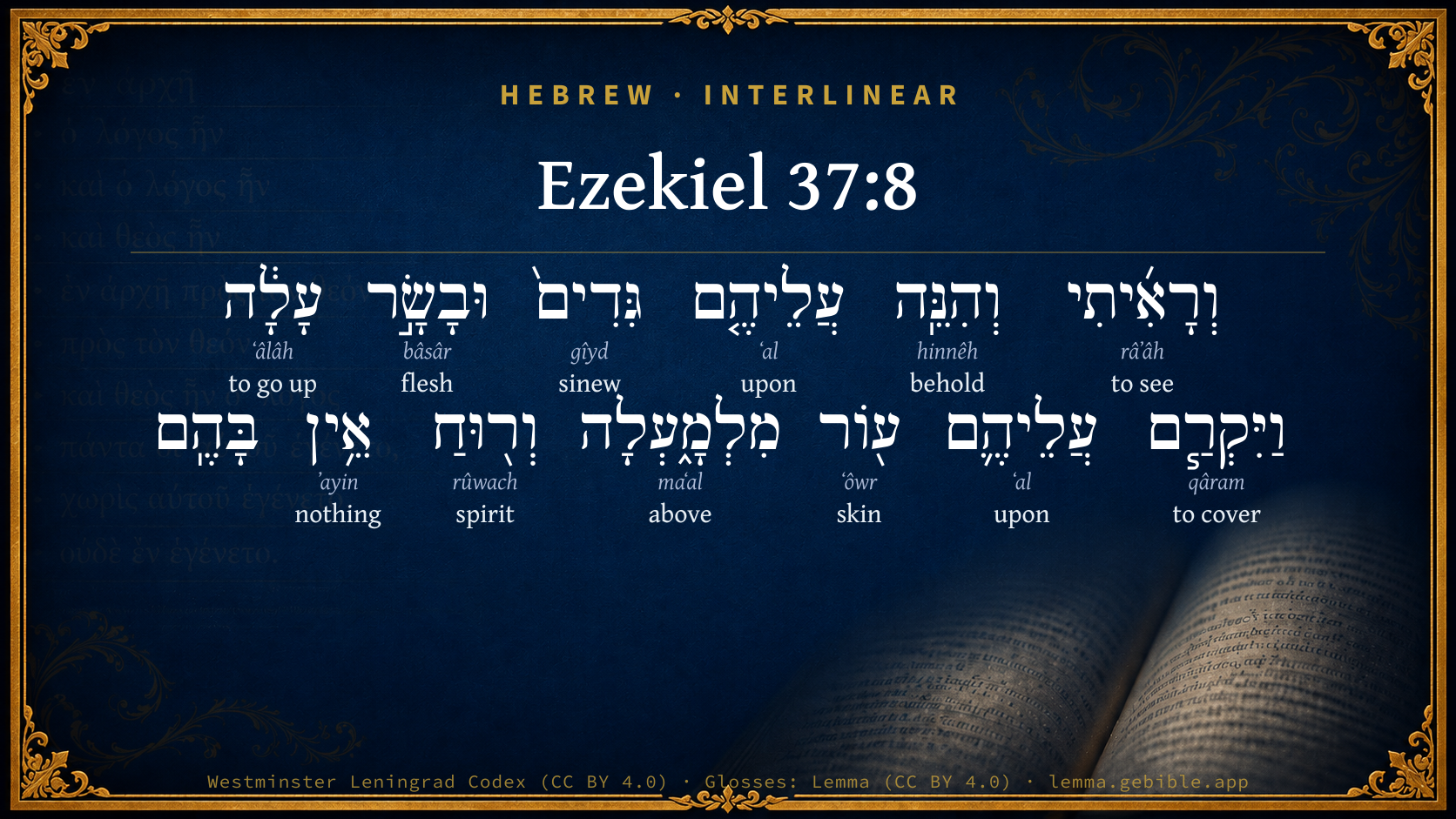
Hebrew (Westminster Leningrad Codex) Ezekiel 37:8 appears in the Hebrew Old Testament. The text above is from the Westminster Leningrad Codex. Each word links to its Strong’s number, a concise gloss, and parsing drawn from the Open Scriptures Hebrew Bible morphology. Click any word for its full Brown-Driver-Briggs (BDB) entry.
Download image
Cite this verse

Ezekiel 37:8 (World English Bible). Public Domain. Lemma interlinear Bible study tool, https://lemma.gebible.app/v/ezekiel/37/8.

Show BibTeX & RIS
BibTeX
RIS
English Translation
I saw, and, behold, there were sinews on them, and flesh came up, and skin covered them above; but there was no breath in them.
World English Bible · Public Domain
Download a study sheet

One document with this verse’s original text, its word-by-word gloss line, the meaning frame, cross-references with their text, attributed commentary, and full source and license credits — printable, and it pastes into notes with its structure intact.

This verse Autodidact and up

Study sheet (.html) Plain text (.txt)

A passage Seminary Student

Up to 50 verses in one chapter. A passage sheet keeps up to 6 commentary sources and 12 cross-references per verse, in the order this page ranks them, and says so on the sheet whenever that leaves anything out. Ask for a single verse and you get the Autodidact verse sheet above.

Everything on this page stays free to read, with no account — the sheet is a download of what is already on screen, not access to it.

Want to remove ads? Support Godless Engineer
Compare translations 3

The same verse in 3 English versions, stacked beneath the original-language interlinear above. Click any original word for its lexicon entry.

Each is an independent rendering of the whole verse — the interlinear is not word-aligned to these translations.

Highlighted words mark where these versions differ — a whole-verse word diff, not a word-by-word alignment.

  • World English Bible Public Domain
    I saw, and, behold, there were sinews on them, and flesh came up, and skin covered them above; but there was no breath in them.
  • King James Version Public Domain
    And when I beheld, lo, the sinews and the flesh came up upon them, and the skin covered them above: but there was no breath in them.
  • unfoldingWord Literal Text CC BY-SA 4.0
    I looked and, behold, sinews were now on them, and flesh grew up and skin covered them. But there was still no breath in them.

unfoldingWord Literal Text — © unfoldingWord, licensed CC BY-SA 4.0. Word-aligned USFM3 via Door43 (git.door43.org/unfoldingWord/en_ult).

Versions to compare (up to 4)

3 of 4 selected

Show all 18 translations

Every available English version of this verse, each an independent rendering of the whole verse.

  • World English Bible Public Domain
    I saw, and, behold, there were sinews on them, and flesh came up, and skin covered them above; but there was no breath in them.
  • Berean Standard Bible Public Domain
    As I looked on, tendons appeared on them, flesh grew, and skin covered them; but there was no breath in them.
  • Majority Standard Bible Public Domain
    As I looked on, tendons appeared on them, flesh grew, and skin covered them; but there was no breath in them.
  • King James Version Public Domain
    And when I beheld, lo, the sinews and the flesh came up upon them, and the skin covered them above: but there was no breath in them.
  • American Standard Version (1901) Public Domain
    And I beheld, and, lo, there were sinews upon them, and flesh came up, and skin covered them above; but there was no breath in them.
  • Revised Version (1885) Public Domain
    And I beheld, and lo, there were sinews upon them, and flesh came up, and skin covered them above: but there was no breath in them.
  • Geneva Bible (1599) Public Domain
    And when I beheld, loe, the sinewes, and the flesh grewe vpon them, and aboue, the skinne couered them, but there was no breath in them.
  • Douay-Rheims (1899) Public Domain
    And I saw, and behold the sinews, and the flesh came up upon them: and the skin was stretched out over them, but there was no spirit in them.
  • Young's Literal Translation Public Domain
    And I beheld, and lo, on them `are' sinews, and flesh hath come up, and cover them doth skin over above -- and spirit there is none in them.
  • Literal Standard Version CC BY-SA 4.0
    And I beheld, and behold, sinews [are] on them, and flesh has come up, and skin covers them over above—and there is no spirit in them.
  • Unlocked Literal Bible CC BY-SA 4.0
    I looked and, behold, sinews were now on them, and flesh grew up and skin covered them. But there was still no breath in them.
  • unfoldingWord Literal Text CC BY-SA 4.0
    I looked and, behold, sinews were now on them, and flesh grew up and skin covered them. But there was still no breath in them.
  • Darby Bible Public Domain
    And I looked, and behold, sinews and flesh came up upon them, and the skin covered them over; but there was no breath in them.
  • World Messianic Bible Public Domain
    I saw, and, behold, there were sinews on them, and flesh came up, and skin covered them above; but there was no breath in them.
  • Webster's Bible Public Domain
    And when I beheld, lo, the sinews and the flesh came up upon them, and the skin covered them above: but there was no breath in them.
  • Free Bible Version CC BY-SA 4.0
    As I watched, I saw tendons and flesh grow on them, and skin covered them; but the bodies didn't breathe.
  • Bible in Basic English Public Domain
    And looking I saw that there were muscles on them and flesh came up, and they were covered with skin: but there was no breath in them.
  • JPS Tanakh (1917) Public Domain
    And I beheld, and, lo, there were sinews upon them, and flesh came up, and skin covered them above; but there was no breath in them.

Literal Standard Version (2020), Covenant Press — licensed CC BY-SA 4.0. Text via the HelloAO Bible API (eBible.org). Unlocked Literal Bible (unfoldingWord) — licensed CC BY-SA 4.0. Text via the HelloAO Bible API (eBible.org). unfoldingWord Literal Text — © unfoldingWord, licensed CC BY-SA 4.0. Word-aligned USFM3 via Door43 (git.door43.org/unfoldingWord/en_ult). Free Bible Version, Dr. Jonathan Gallagher — licensed CC BY-SA 4.0. Text via the HelloAO Bible API (eBible.org).

Word by word

More ways to search: Search by grammar → Find every occurrence → Compare this word →

Practice this passage: Drill this verse → Learn its vocabulary →

וַיִּקְרַ֧ם
qâram
H7159
“and · to cover”
Conjunction + Verb, Qal, Sequential Imperfect, 3rd Person, Masculine, Singular
Part of Speech
Conjunction + Verb
Stem
Qal
Form
Sequential Imperfect
Person
3rd Person
Gender
Masculine
Number
Singular
Full BDB Definition

Origin: a primitive root

TWOT: 2071

to spread or lay something over, cover, spread over - (Qal) to be spread over
  1. וְרָאִ֜יתִי râʼâh H7200 “and · to see” Conjunction + Verb, Qal, Perfect, 1st Person, Common, Singular
  2. וְהִנֵּֽה hinnêh H2009 “and · behold” Conjunction + Particle, Demonstrative
  3. עֲלֵיהֶ֤ם ʻal H5921 “upon · them” Preposition + Suffix, Personal, 3rd Person, Masculine, Plural
  4. גִּדִים֙ gîyd H1517 “sinews” Noun, Common, Masculine, Plural, Absolute
  5. וּבָשָׂ֣ר bâsâr H1320 “and · flesh” Conjunction + Noun, Common, Masculine, Singular, Absolute
  6. עָלָ֔ה ʻâlâh H5927 “to go up” Verb, Qal, Perfect, 3rd Person, Masculine, Singular
  7. עֲלֵיהֶ֛ם ʻal H5921 “upon · them” Preposition + Suffix, Personal, 3rd Person, Masculine, Plural
  8. ע֖וֹר ʻôwr H5785 “skin” Noun, Common, Masculine, Singular, Absolute
  9. מִלְמָ֑עְלָה maʻal H4605 “from · to/for · above · toward” Preposition + Preposition + Adverb + Suffix, Demonstrative
  10. וְר֖וּחַ rûwach H7307 “and · spirit” Conjunction + Noun, Common, Both, Singular, Absolute
  11. אֵ֥ין ʼayin H369 “nothing” Particle, Negative

About this verse

These counts appear in no published source. They are computed here, from the morphology-tagged text and Lemma’s own curated glosses. What Lemma adds →

13
words
11
distinct lemmas
Prophets
section

Notable vocabulary

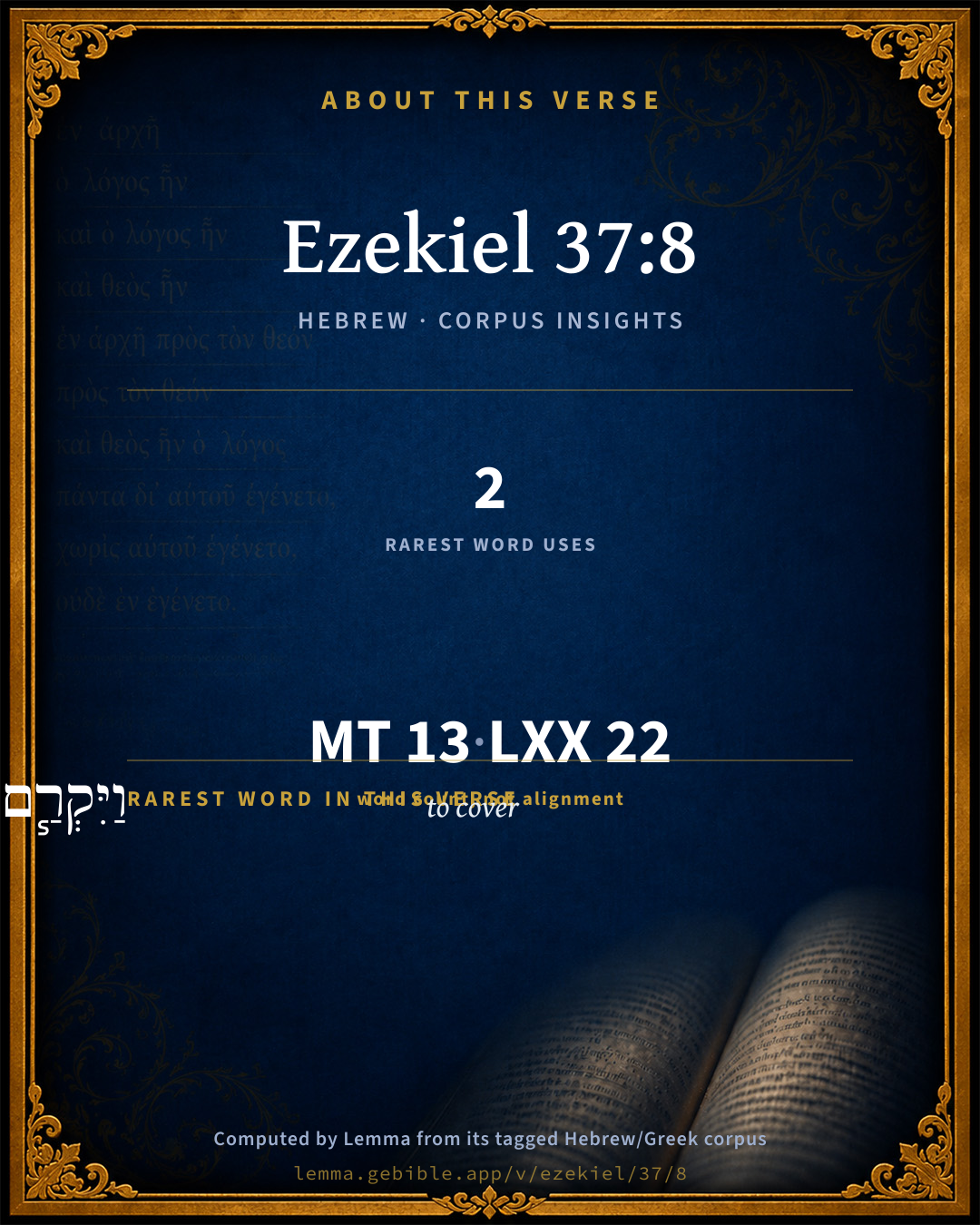
The rarest word here is וַיִּקְרַ֧ם to cover H7159 — appearing just 2 times in the whole Hebrew Bible.

Shared distinctive vocabulary

וַיִּקְרַ֧ם to cover H7159 occurs in 2 verses of the Hebrew Bible. Also found in:

Grammatical profile

  • 3 verbs
  • 4 nouns
  • 3 prepositions
  • 1 adverb
  • 2 particles

Verb forms

  • וְרָאִ֜יתִי Qal · Perfect
  • עָלָ֔ה Qal · Perfect
  • וַיִּקְרַ֧ם Qal · Sequential Imperfect

Repetition

A word recurs within this verse — often emphatic in Hebrew:

  • עֲלֵיהֶ֤ם upon H5921 ×2

Hebrew & Septuagint length

In English translation the verse runs 25 words from the Hebrew and 24 from the Septuagint (LXX English) — closely comparable.

A rough comparison of the two English renderings, which tokenize alike — not a word-level alignment.

Word counts can differ between the Hebrew and the Greek without any difference in meaning — e.g. the Hebrew direct-object marker אֵת has no separate Greek word, and Greek often adds the article ὁ.

In the original languages it is 13 Hebrew tokens and 22 Greek tokens — but the two are counted differently (Hebrew bundles its prefixes and suffixes into one token; the Greek is in lemma form), so that isn’t a like-for-like length.

Hebrew and Greek witnesses Masoretic Hebrew ↔ Greek Septuagint

The same verse in the two great witnesses to the Old Testament, shown verse-for-verse.

These are two independent witnesses, not word-aligned to each other, and the Septuagint is shown in lemma (dictionary) form.

Hebrew Ezekiel 37:8 Masoretic · Westminster Leningrad Codex

וְרָאִ֜יתִי וְהִנֵּֽה עֲלֵיהֶ֤ם גִּדִים֙ וּבָשָׂ֣ר עָלָ֔ה וַיִּקְרַ֧ם עֲלֵיהֶ֛ם ע֖וֹר מִלְמָ֑עְלָה וְר֖וּחַ אֵ֥ין בָּהֶֽם

I saw, and, behold, there were sinews on them, and flesh came up, and skin covered them above; but there was no breath in them.

World English Bible · Public Domain

Greek LXX Ezekiel 37:8 Septuagint · lemma form

καί ὁράω καί ἰδού ἐπί αὐτός νεῦρον καί σάρξ φύω καί ἀναβαίνω ἐπί αὐτός δέρμα ἐπάνω καί πνεῦμα οὐ εἰμί ἐν αὐτός

And I looked, and behold, sinews and flesh grew upon them, and skin came upon them above: but there was not breath in them.

LXX2012 (modern English Septuagint) · Public Domain

Hebrew: Westminster Leningrad Codex (CC BY 4.0). Greek: Septuagint (public domain); English from LXX2012 (modern English Septuagint) (Public Domain). How the Septuagint differs from the Hebrew →

Targum (Aramaic paraphrase)

1

The Targum is the ancient Jewish Aramaic paraphrase of the Hebrew Scriptures — an interpretive translation, not the Hebrew text itself. Onkelos (literal) and Pseudo-Jonathan (expansive) render the Torah, and Jonathan the Prophets. Coverage is partial: where no permissively-licensed English translation exists for a verse, only the Aramaic is shown. This is verse-level text, not a word-by-word alignment to the Hebrew.

  1. Targum Jonathan Prophets (Joshua–Malachi)
    וַחֲזֵית וְהָא עֲלֵיהוֹן גִידִין וּבִסְרָא סְלֵיק וּקְרֵם עֲלֵיהוֹן מַשְׁכָא מִלְעֵילָא וְרוּחָא לֵית בְּהוֹן:

    (no public-domain English translation for this verse)

    Targum Jonathan — Aramaic: “Mikraot Gedolot” (public domain). English: “Sefaria Community Translation” (CC0 1.0 (public-domain dedication)); “London "Chaldee Paraphrase," 1871” (public domain). Text via Sefaria.

Commentary

Notes on Ezekiel 37:8 from classic Christian and Jewish commentators (each source and its license shown beneath its notes). The classic Christian expositions comment on the surrounding passage and are grouped to its opening verse, so a note may address several verses; the Jewish commentaries on the Tanakh (Rashi and others) are per-verse, so they appear only where the commentator wrote on this verse.

Lemma curates 59 commentaries, every one of them public domain or Creative Commons licensed, each selected and text-cleaned for this edition rather than reprinted as found. About our sources →

Trapp's Complete Commentary

John Trapp

Eze 37:8 And when I beheld, lo, the sinews and the flesh came up upon them, and the skin covered them above: but [there was] no breath in them.

Ver. 8. Lo, the sinews and the flesh came up upon them.] The body is the soul’s sheath, {Dan 7:15} the soul’s suit. The upper garment is the skin, the inner the flesh; the inmost of all, bones and sinews.

John Trapp, A Commentary or Exposition upon All the Books of the Old and New Testament (1647–1656) — public domain. Text from a community e-Sword module.

The Biblical Illustrator

Joseph S. Exell

Eze_37:8

There was no breath in them.

No life apart from the Spirit of God

I. The servant of God, anxiously engaged in his work, often sees among the people to whom he ministers, a state of things which may be thus described: There was no breath in them. This may be said where there is--

1. Theology without religion. Theology is truth. Religion is life. And a framework of bones without living breath in it, aptly represents a well-arranged scheme of doctrine without an inspiring spirit to animate it. The doctrines may be as beautifully set as is the wondrous human frame--everything in its place; but if that be all, there is a grievous defect--there is no breath in them! Glorious as Gospel doctrine is when it is alive in living souls, there is nothing so hateful as dead doctrines held in dead souls.

2. Knowledge without service. There is a man who is ever making researches in one direction or other--in philosophy, literature, science, history, or art. Never a day passes but he makes some fresh acquirement. His memory is so retentive he lets nothing drop out, and can summon at will any thought or fact from the recesses of his brain when it is required. His mental digestion is marvellously strong; his reading well-nigh universal. The laws which minister to health, and the laws which lead on to wealth, he knows with a clearness and fulness beyond those of most men. But all that he knows is merely so much dead material; like so much magnificent furniture covered up in an unused drawing room: an index of wealth, but of no manner of use.

3. Faith without works. There is a man who has been brought up from childhood in the beliefs of the doctrines of the Gospel--and he does not doubt one of them--but with him, these beliefs are all dogmas dead as a corpse; they never stir. He is not moved by them to penitence, or to love. Here is a mass of useless capital--which, though more precious than gold, is lying idle as lumber.

4. Teaching that is without heart. Have not most of us had experience enough to understand what this is? Mr.

is a clear thinker, a close reasoner, and an eloquent speaker and preacher. You listen. The words pour out uninterruptedly, without difficulty, without a flaw; faultlessly accurate, and yet somehow, you know not how, they leave no impression behind. Rather give me a plain, humble discourse from a man who has a heart, than all the fine words and faultless harangues in the world, if there is no breath in them!

5. Organisation without animation. That is just what a breathless, but otherwise perfect skeleton would show. The ordinary machinery of Christian work moves on without discomfort. Orthodoxy unimpeachable. Propriety unspotted. But it is like being in an ice house to be there. Official mechanism smothers, suppresses, stifles all eagerness; that would be irregular, and nothing but a stereotyped conventionalism is permitted. Earnest souls speed elsewhere in despair. Bone fits to bone--but there is no breath in them!

6. Ceremonial worship without devotion. The water imparts spiritual life; the bread and wine nourish it. The priest absolves--the priest at the font--the priest at the marriage altar--the priest at the communion--the priest at the confessional--the priest in sickness--the priest at the article of death--the priest at the grave! Oh, the miserable sham! The mere skeleton work of a religion. No life--no breath in it!

7. Words without deeds. Fluency of tongue may be a blessing, but it is often a snare. And where God has imparted this gift, which, when put to high and holy uses, is of vast service, yet its use may bring its own temptation with it. The fairest talker may not be the man of holiest life. He may be an accomplished critic, having a keen eye for the defects of his fellow members, and perhaps a ready flow of wit, which he does not hesitate so to use as to sting and wound another. But all the while he forgets to turn the talk upon himself; he never thinks of criticising his own acts and words, nor of setting them in the light of the holy and searching law of God: nor does he care to inquire how he stands in the sight of Him with Whom he has to do! His religion is but superficial and empty. There is no breath in it.

8. Profession without possession, or church membership without real godliness. His religion, such as it is, is of a neutral tint. He does not offend by provocation: nor does he help anybody in religion, as if his heart and soul were inspired for Christ. No fervour--no glow. The bones, at the prophets voice, have come together, bone to his bone, and the skin covers them above, so that they do not drop to pieces again--but there is no breath in them!

II. What is to be said of such a state of things?

1. Such a state of things is extremely unsatisfactory. This indeed is saying little; for the fact is that in each case there is a dead failure. What purpose can a row of corpses answer, however perfect the skeletons? The world is none the poorer for the bones of the dead dropping to pieces in coffins underground; and if theology be dead, and beliefs be dead, and churches are dead, away with them! No loss if they go! The loss of lifelessness is one which both the world and the Church can well afford to bear; and, indeed, it is one of Gods mercies that dead things must go!

2. No breath in them. Looking at Ezekiels vision, we see that, in that case, bad as it was, it had been even worse. For these dead bodies were organised. We do not know of any revealed law of God by which breath could come into a promiscuous collection of bones! But let chaos cease, let order reign, let bone fit to bone, and skin cover them above, and then there is, at all events, something for the living breath to animate. So that--

3. The case is not a hopeless one. For if at the appointment of God, when s prophet spake to dead bones, there was a rustling, a shaking, so that bone came to his bone,--that looks as if God did not mean things to stop there. No breath in them. But God wills that there shall be.

4. Thus the case is one which indicates duty. Namely, the duty, the important duty of pleading with God. Come from the four winds, O breath. (C. Clemance, D. D.)

The Biblical Illustrator, edited by Joseph S. Exell (c. 1880s–1900s) — public domain. Text from a community e-Sword module.

Jamieson, Fausset & Brown

Robert Jamieson, A. R. Fausset & David Brown

So far, they were only cohering in order as unsightly skeletons. The next step, that of covering them successively with sinews, skin, and flesh, gives them beauty; but still "no breath" of life in them. This may imply that Israel hereafter, as at the restoration from Babylon was the case in part, shall return to Judea unconverted at first (Zac 13:8-9). Spiritually: a man may assume all the semblances of spiritual life, yet have none, and so be dead before God.

Jamieson, Fausset & Brown — Commentary Critical and Explanatory on the Whole Bible (1871) — public domain (CC PDM 1.0). Text via the HelloAO Bible API.

Ellicott's Commentary for English Readers

(8) No breath in them.—The restoration of the dry bones to life is described as taking place in two stages, with evident reference to the record of the creation of man in Gen_2:7. In the first, they are restored to perfect form, but yet without life; in the second, they receive breath and become “living creatures,” as in Gen_1:20-21; Gen_1:24; Gen_2:7, in all which the same expression is used.

A Bible Commentary for English Readers, edited by Charles John Ellicott (1878–1897) — public domain. Text from a community e-Sword module.

John Gill's Exposition

And when I beheld, lo, the sinews and the flesh came up upon them,.... And they began to look like men, in the shape of men, and were a body of them, as the Jews did when gathered together:

and the skin covered them above; and so looked comely and beautiful, as in the proper form of men; as did the Jews enriched and protected by Cyrus: and this may be an image of such persons so far wrought upon under the word as to look like Christians; to have the form of godliness, and appear outwardly righteous before men, submitting to ordinances, and performing the duties of religion; and yet no principle of spiritual life in them; but, like Adam's body, of the earth, earthly, and breathless, before the breath of life was breathed into it; so here, but there was no breath in them; no spirit in the Jews to return to their land, though they had liberty, till the Lord stirred up their spirits, Ezr 1:5, all this, in a spiritual sense, shows how far persons may go under temporary convictions by the word, and yet not be living Christians.

John Gill's Exposition of the Whole Bible (1746–1763) — public domain (CC PDM 1.0). Text via the HelloAO Bible API.

Matthew Poole's English Annotations

The noise he heard would certainly make any one look, and consider what it was.

I beheld; looked carefully, and heedfully observed.

Came up upon them; came gradually, spreading itself, as what grows wider and longer.

Above; uppermost the skin covered them. So here were men in skin, with flesh, sinews, bones; but, like Adam before inspired with the breath of life, the spirit of life was yet wanting.

Matthew Poole's English Annotations on the Holy Bible (1683–1685) — public domain. Text from a community e-Sword/MySword module.

John Wesley's Explanatory Notes

Came up - Gradually spreading itself.

John Wesley, Explanatory Notes Upon the Whole Bible (1754–1765) — public domain. Text via the GEBible commentary corpus.

Lesson kit

Teaching starters — assembled from the data on this page, not authored interpretation. Every prompt links to the verse data it draws on. Edit before teaching.

Ezekiel, in the Prophets, opens this verse with 13 words (11 distinct Hebrew lemmas). Its most distinctive word is qâram (“to cover”). A historical commentator’s framing appears above. Read the whole chapter for the surrounding context.

Discussion questions

  1. The word qâram carries the sense “to cover.” How does it shape the verse?
  2. How does Ezekiel 37:6, which shares the word «to cover», read alongside this verse?
  3. What does the repetition of “upon” (2× in this one verse) do in this verse?
  4. The translations on this page render this verse differently — a whole-verse word diff, not a word-by-word alignment. What might account for the different wordings?
  5. «וְרָאִ֜יתִי» is a Qal Perfect verb. How does that grammatical form shape the action described?
  6. Compare how Trapp's Complete Commentary and The Biblical Illustrator read this verse. Where do they agree or differ?

Things to notice

Reading settings

Reading text

Shown beneath each verse's original-language words.

Old Testament
Old Testament edition

Read the OT as the Masoretic Hebrew (MT) or the Greek Septuagint (LXX).

English shown for the Greek Septuagint (in the Hebrew ↔ Greek comparison).

Comparing translations? Open the Compare panel on any verse page to stack up to four side by side.