
Numbers 32:11

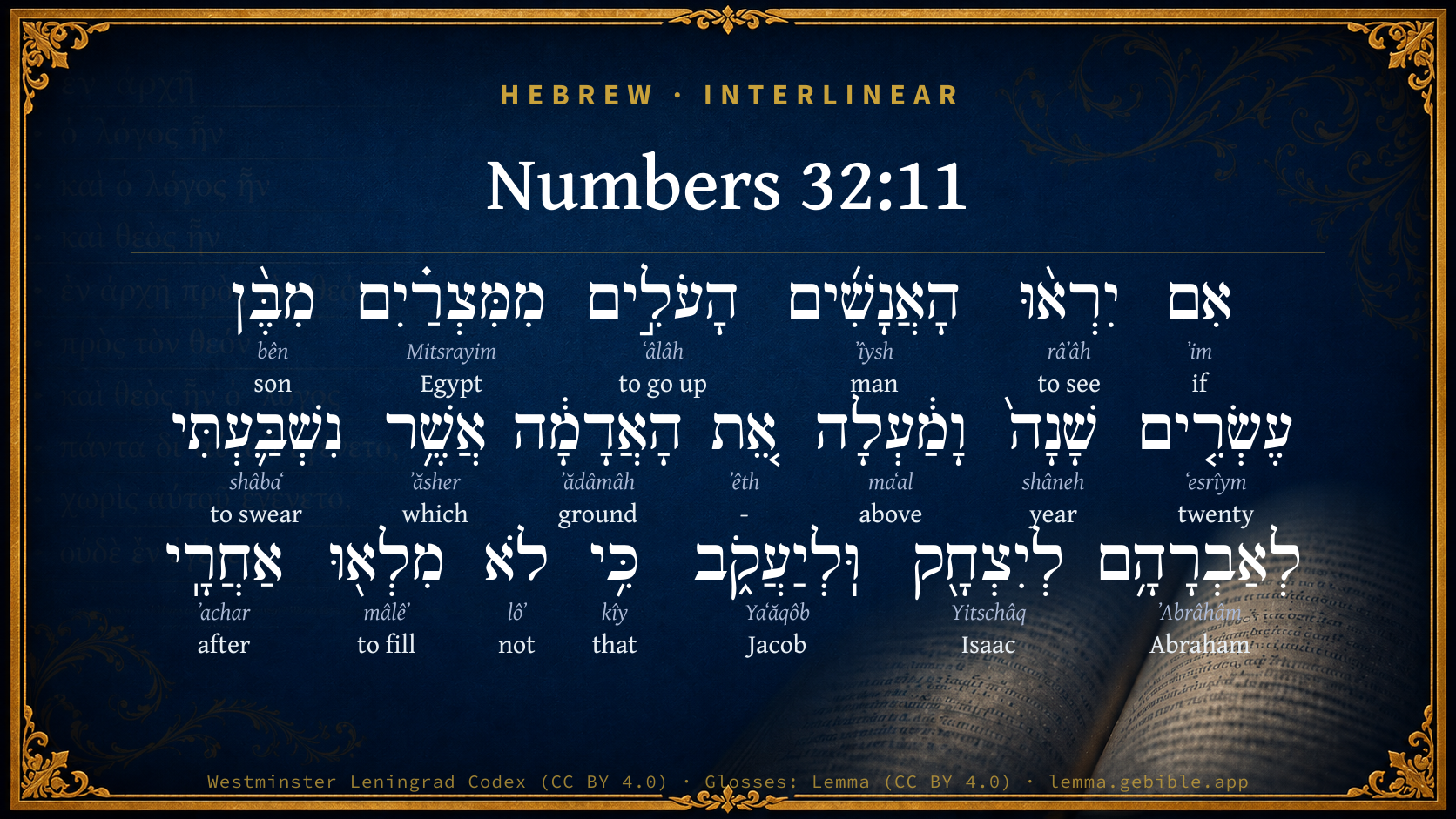
Hebrew (Westminster Leningrad Codex) Numbers 32:11 appears in the Hebrew Old Testament. The text above is from the Westminster Leningrad Codex. Each word links to its Strong’s number, a concise gloss, and parsing drawn from the Open Scriptures Hebrew Bible morphology. Click any word for its full Brown-Driver-Briggs (BDB) entry.
Download image
Cite this verse

Numbers 32:11 (World English Bible). Public Domain. Lemma interlinear Bible study tool, https://lemma.gebible.app/v/numbers/32/11.

Show BibTeX & RIS
BibTeX
RIS
English Translation
Surely none of the men who came up out of Egypt, from twenty years old and upward, shall see the land which I swore to Abraham, to Isaac, and to Jacob; because they have not wholly followed me:
World English Bible · Public Domain
Download a study sheet

One document with this verse’s original text, its word-by-word gloss line, the meaning frame, cross-references with their text, attributed commentary, and full source and license credits — printable, and it pastes into notes with its structure intact.

This verse Autodidact and up

Study sheet (.html) Plain text (.txt)

A passage Seminary Student

Up to 50 verses in one chapter. A passage sheet keeps up to 6 commentary sources and 12 cross-references per verse, in the order this page ranks them, and says so on the sheet whenever that leaves anything out. Ask for a single verse and you get the Autodidact verse sheet above.

Everything on this page stays free to read, with no account — the sheet is a download of what is already on screen, not access to it.

Want to remove ads? Support Godless Engineer
Compare translations 3

The same verse in 3 English versions, stacked beneath the original-language interlinear above. Click any original word for its lexicon entry.

Each is an independent rendering of the whole verse — the interlinear is not word-aligned to these translations.

Highlighted words mark where these versions differ — a whole-verse word diff, not a word-by-word alignment.

  • World English Bible Public Domain
    Surely none of the men who came up out of Egypt, from twenty years old and upward, shall see the land which I swore to Abraham, to Isaac, and to Jacob; because they have not wholly followed me:
  • King James Version Public Domain
    Surely none of the men that came up out of Egypt, from twenty years old and upward, shall see the land which I sware unto Abraham, unto Isaac, and unto Jacob; because they have not wholly followed me:
  • unfoldingWord Literal Text CC BY-SA 4.0
    ‘If the men who went up from Egypt, from a son of 20 years and upward, will see the ground which I swore to Abraham, to Isaac, and to Jacob! For they are not fully after me,

unfoldingWord Literal Text — © unfoldingWord, licensed CC BY-SA 4.0. Word-aligned USFM3 via Door43 (git.door43.org/unfoldingWord/en_ult).

Versions to compare (up to 4)

3 of 4 selected

Show all 18 translations

Every available English version of this verse, each an independent rendering of the whole verse.

  • World English Bible Public Domain
    Surely none of the men who came up out of Egypt, from twenty years old and upward, shall see the land which I swore to Abraham, to Isaac, and to Jacob; because they have not wholly followed me:
  • Berean Standard Bible Public Domain
    ‘Because they did not follow Me wholeheartedly, not one of the men twenty years of age or older who came out of Egypt will see the land that I swore to give Abraham, Isaac, and Jacob—
  • Majority Standard Bible Public Domain
    ‘Because they did not follow Me wholeheartedly, not one of the men twenty years of age or older who came out of Egypt will see the land that I swore to give Abraham, Isaac, and Jacob—
  • King James Version Public Domain
    Surely none of the men that came up out of Egypt, from twenty years old and upward, shall see the land which I sware unto Abraham, unto Isaac, and unto Jacob; because they have not wholly followed me:
  • American Standard Version (1901) Public Domain
    Surely none of the men that came up out of Egypt, from twenty years old and upward, shall see the land which I sware unto Abraham, unto Isaac, and unto Jacob; because they have not wholly followed me:
  • Revised Version (1885) Public Domain
    Surely none of the men that came up out of Egypt, from twenty years old and upward, shall see the land which I sware unto Abraham, unto Isaac, and unto Jacob; because they have not wholly followed me:
  • Geneva Bible (1599) Public Domain
    None of the men that came out of Egypt from twentie yeere olde and aboue, shall see the land for the which I sware vnto Abraham, to Izhak, and to Iaakob, because they haue not wholly followed me:
  • Douay-Rheims (1899) Public Domain
    If these men, that came up out of Egypt, from twenty years old and upward, shall see the land, which I promised with an oath to Abraham, Isaac, and Jacob: because they would not follow me,
  • Young's Literal Translation Public Domain
    They do not see -- the men who are coming up out of Egypt from a son of twenty years and upward -- the ground which I have sworn to Abraham, to Isaac, and to Jacob, for they have not been fully after Me;
  • Literal Standard Version CC BY-SA 4.0
    They do not see—the men who are coming up out of Egypt from a son of twenty years and upward—the ground which I have sworn to Abraham, to Isaac, and to Jacob, for they have not been fully after Me,
  • Unlocked Literal Bible CC BY-SA 4.0
    'Surely none of the men who came up out of Egypt, from twenty years old and up, will see the land about which I swore to Abraham, to Isaac, and to Jacob, because they have not completely followed me, except for
  • unfoldingWord Literal Text CC BY-SA 4.0
    ‘If the men who went up from Egypt, from a son of 20 years and upward, will see the ground which I swore to Abraham, to Isaac, and to Jacob! For they are not fully after me,
  • Darby Bible Public Domain
    If the men that came up out of Egypt, from twenty years old and upward, shall see the land that I swore to Abraham, to Isaac, and to Jacob! for they have not wholly followed me;
  • World Messianic Bible Public Domain
    ‘Surely none of the men who came up out of Egypt, from twenty years old and upward, shall see the land which I swore to Abraham, to Isaac, and to Jacob; because they have not wholly followed me,
  • Webster's Bible Public Domain
    Surely none of the men that came up from Egypt, from twenty years old and upward, shall see the land which I swore to Abraham, to Isaac, and to Jacob; because they have not wholly followed me:
  • Free Bible Version CC BY-SA 4.0
    ‘Not a single one of those I saved from Egypt who is twenty years old or older will ever see the land I promised with an oath to give to Abraham, Isaac, and Jacob, because they were not completely committed to me—
  • Bible in Basic English Public Domain
    Truly, not one of the men of twenty years old and over who came out of Egypt will see the land which I gave by oath to Abraham, Isaac, and Jacob; because they have not been true to me with all their heart;
  • JPS Tanakh (1917) Public Domain
    Surely none of the men that came up out of Egypt, from twenty years old and upward, shall see the land which I swore unto Abraham, unto Isaac, and unto Jacob; because they have not wholly followed Me;

Literal Standard Version (2020), Covenant Press — licensed CC BY-SA 4.0. Text via the HelloAO Bible API (eBible.org). Unlocked Literal Bible (unfoldingWord) — licensed CC BY-SA 4.0. Text via the HelloAO Bible API (eBible.org). unfoldingWord Literal Text — © unfoldingWord, licensed CC BY-SA 4.0. Word-aligned USFM3 via Door43 (git.door43.org/unfoldingWord/en_ult). Free Bible Version, Dr. Jonathan Gallagher — licensed CC BY-SA 4.0. Text via the HelloAO Bible API (eBible.org).

Word by word

More ways to search: Search by grammar → Find every occurrence → Compare this word →

Practice this passage: Drill this verse → Learn its vocabulary →

לְיִצְחָ֖ק
Yitschâq
H3327
“to/for · Isaac”
Preposition + Noun, Proper
Part of Speech
Preposition + Noun
Type
Proper
Full BDB Definition

Origin: from H6711

TWOT: 1905b

Isaac = "he laughs" - son of Abraham by Sarah his wife and father of Jacob and Esau
  1. אִם ʼim H518 “if” Conjunction
  2. יִרְא֨וּ râʼâh H7200 “to see” Verb, Qal, Imperfect, 3rd Person, Masculine, Plural
  3. הָאֲנָשִׁ֜ים ʼîysh H376 “the · men” Particle, Definite Article + Noun, Common, Masculine, Plural, Absolute
  4. הָעֹלִ֣ים ʻâlâh H5927 “the · going up” Particle, Definite Article + Verb, Qal, Participle Active, Masculine, Plural, Absolute
  5. מִמִּצְרַ֗יִם Mitsrayim H4714 “from · Egypt” Preposition + Noun, Proper
  6. מִבֶּ֨ן bên H1121 “from · son of” Preposition + Noun, Common, Masculine, Singular, Construct
  7. עֶשְׂרִ֤ים ʻesrîym H6242 “twenty” Adjective, Cardinal number, Both, Plural, Absolute
  8. שָׁנָה֙ shâneh H8141 “year” Noun, Common, Feminine, Singular, Absolute
  9. וָמַ֔עְלָה maʻal H4605 “and · above · toward” Conjunction + Adverb + Suffix, Demonstrative
  10. אֵ֚ת ʼêth H853 “-” Particle, Direct Object
  11. הָאֲדָמָ֔ה ʼădâmâh H127 “the · ground” Particle, Definite Article + Noun, Common, Feminine, Singular, Absolute
  12. אֲשֶׁ֥ר ʼăsher H834 “which” Particle, Relative
  13. נִשְׁבַּ֛עְתִּי shâbaʻ H7650 “to swear” Verb, Niphal, Perfect, 1st Person, Common, Singular
  14. לְאַבְרָהָ֥ם ʼAbrâhâm H85 “to/for · Abraham” Preposition + Noun, Proper
  15. וּֽלְיַעֲקֹ֑ב Yaʻăqôb H3290 “and · to/for · Jacob” Conjunction + Preposition + Noun, Proper
  16. כִּ֥י kîy H3588 “that” Conjunction
  17. לֹא lôʼ H3808 “not” Particle, Negative
  18. מִלְא֖וּ mâlêʼ H4390 “to fill” Verb, Piel, Perfect, 3rd Person, Common, Plural
  19. אַחֲרָֽי ʼachar H310 “after · me” Preposition + Suffix, Personal, 1st Person, Common, Singular

About this verse

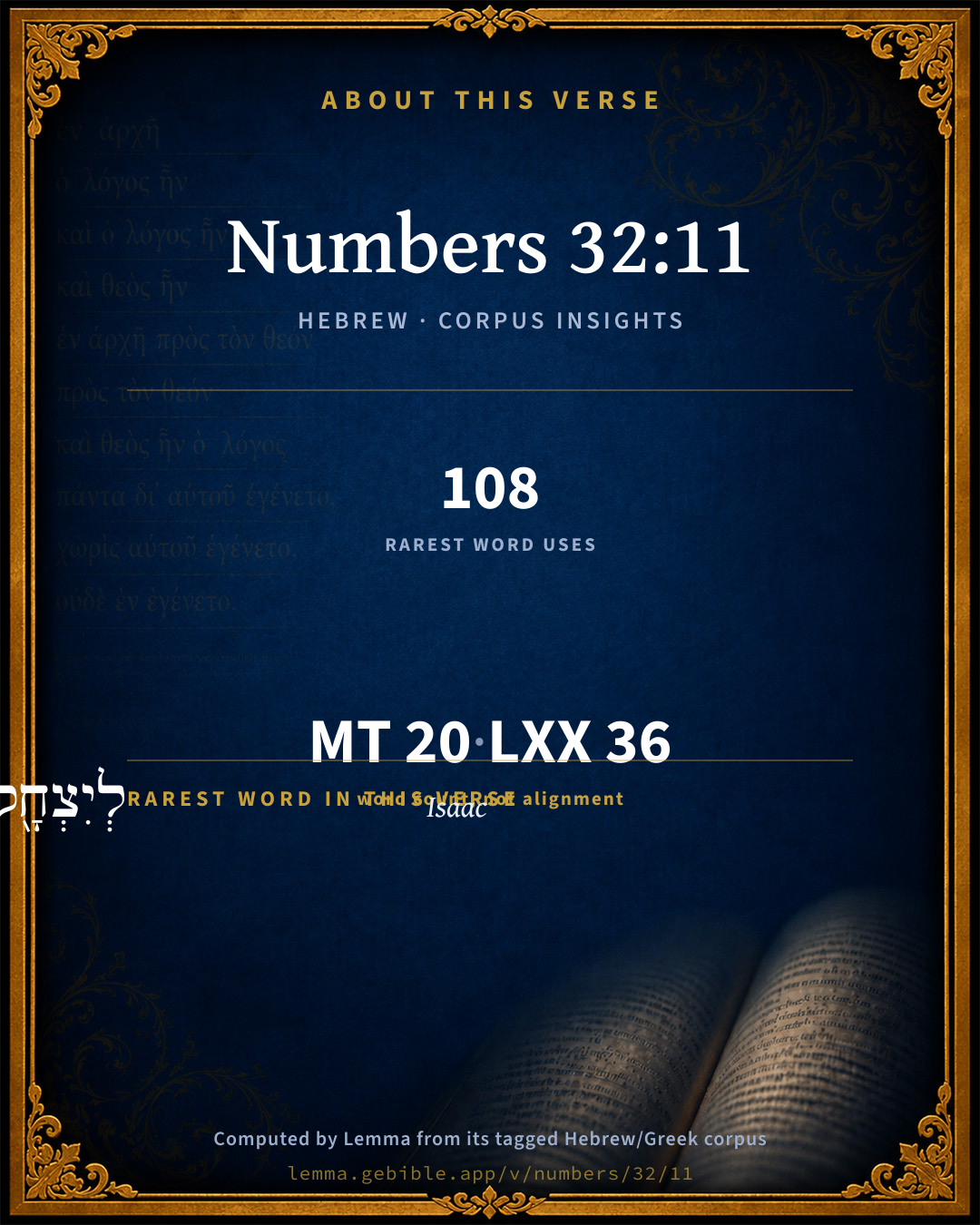
These counts appear in no published source. They are computed here, from the morphology-tagged text and Lemma’s own curated glosses. What Lemma adds →

20
words
20
distinct lemmas
Pentateuch
section

Grammatical profile

  • 4 verbs
  • 8 nouns
  • 1 adjective
  • 1 preposition
  • 2 conjunctions
  • 1 adverb
  • 3 particles

Verb forms

  • יִרְא֨וּ Qal · Imperfect
  • הָעֹלִ֣ים Qal · Participle Active
  • נִשְׁבַּ֛עְתִּי Niphal · Perfect
  • מִלְא֖וּ Piel · Perfect

Hebrew & Septuagint length

In English translation the verse runs 38 words from the Hebrew and 44 from the Septuagint (LXX English) — closely comparable.

A rough comparison of the two English renderings, which tokenize alike — not a word-level alignment.

Word counts can differ between the Hebrew and the Greek without any difference in meaning — e.g. the Hebrew direct-object marker אֵת has no separate Greek word, and Greek often adds the article ὁ.

In the original languages it is 20 Hebrew tokens and 36 Greek tokens — but the two are counted differently (Hebrew bundles its prefixes and suffixes into one token; the Greek is in lemma form), so that isn’t a like-for-like length.

Cross-references

7

Topical passages linked to Numbers 32:11 in the Treasury of Scripture Knowledge — connected by theme and wording, ordered by reader-vote popularity; previews shown in the World English Bible.

  • Numbers 14:28–30 Tell them, As I live, says Yahweh, surely as you have spoken in my ears, so will I do to you:
  • Numbers 14:24 but my servant Caleb, because he had another spirit with him, and has followed me fully, him will I bring into the land into which he went; and his seed shall possess it.
  • Numbers 26:2 Take the sum of all the congregation of the children of Israel, from twenty years old and upward, by their fathers' houses, all who are able to go forth to war in Israel.
  • Joshua 14:8–9 Nevertheless my brothers who went up with me made the heart of the people melt; but I wholly followed Yahweh my God.
  • Numbers 26:64–65 But among these there was not a man of them who were numbered by Moses and Aaron the priest, who numbered the children of Israel in the wilderness of Sinai.
  • Deuteronomy 1:35 Surely there shall not one of these men of this evil generation see the good land, which I swore to give to your fathers,
  • Deuteronomy 2:14–15 The days in which we came from Kadesh-barnea, until we were come over the brook Zered, were thirty-eight years; until all the generation of the men of war were consumed from the midst of the camp, as Yahweh swore to them.

Cross-references courtesy of OpenBible.info (CC BY 4.0).

Hebrew and Greek witnesses Masoretic Hebrew ↔ Greek Septuagint

The same verse in the two great witnesses to the Old Testament, shown verse-for-verse.

These are two independent witnesses, not word-aligned to each other, and the Septuagint is shown in lemma (dictionary) form.

Hebrew Numbers 32:11 Masoretic · Westminster Leningrad Codex

אִם יִרְא֨וּ הָאֲנָשִׁ֜ים הָעֹלִ֣ים מִמִּצְרַ֗יִם מִבֶּ֨ן עֶשְׂרִ֤ים שָׁנָה֙ וָמַ֔עְלָה אֵ֚ת הָאֲדָמָ֔ה אֲשֶׁ֥ר נִשְׁבַּ֛עְתִּי לְאַבְרָהָ֥ם לְיִצְחָ֖ק וּֽלְיַעֲקֹ֑ב כִּ֥י לֹא מִלְא֖וּ אַחֲרָֽי

Surely none of the men who came up out of Egypt, from twenty years old and upward, shall see the land which I swore to Abraham, to Isaac, and to Jacob; because they have not wholly followed me:

World English Bible · Public Domain

Greek LXX Numbers 32:11 Septuagint · lemma form

εἰ ὁράω ὁ ἄνθρωπος οὗτος ὁ ἀναβαίνω ἐκ αἴγυπτος ἀπό εἰκοσαετής καί ἐπάνω ὁ ἐπίσταμαι ὁ κακός καί ὁ ἀγαθός ὁ γῆ ὅς ὄμνυμι ὁ ἀβραάμ καί ισαακ καί ἰακώβ οὐ γάρ συν ἐπιἀκολουθέω ὀπίσω ἐγώ

Surely these men who came up out of Egypt from twenty years old and upward, who know good and evil, shall not see the land which I swore to give to Abraam and Isaac and Jacob, for they have not closely followed after me:

LXX2012 (modern English Septuagint) · Public Domain

Hebrew: Westminster Leningrad Codex (CC BY 4.0). Greek: Septuagint (public domain); English from LXX2012 (modern English Septuagint) (Public Domain). How the Septuagint differs from the Hebrew →

Targum (Aramaic paraphrase)

2

The Targum is the ancient Jewish Aramaic paraphrase of the Hebrew Scriptures — an interpretive translation, not the Hebrew text itself. Onkelos (literal) and Pseudo-Jonathan (expansive) render the Torah, and Jonathan the Prophets. Coverage is partial: where no permissively-licensed English translation exists for a verse, only the Aramaic is shown. This is verse-level text, not a word-by-word alignment to the Hebrew.

  1. Targum Onkelos Torah (Genesis–Deuteronomy)
    אִם יֶחֱזוּן גֻבְרַיָא דִסְלִיקוּ מִמִצְרַיִם מִבַּר עַשְׂרִין שְׁנִין וּלְעֵילָא יָת אַרְעָא דִי קַיֵימִית לְאַבְרָהָם לְיִצְחָק וּלְיַעֲקֹב אֲרֵי לָא אַשְׁלִימוּ בָּתַר דַחַלְתִּי

    (no public-domain English translation for this verse)

    Targum Onkelos — Aramaic: “Onkelos Genesis” (public domain); “Onkelos Exodus” (public domain); “Onkelos Leviticus” (public domain); “Onkelos Numbers” (public domain); “Onkelos Deuteronomy” (public domain). English: “Sefaria Community Translation” (CC0 1.0 (public-domain dedication)); “J.W. Etheridge. The Targums of Onkelos and Jonathan Ben Uzziel on the Pentateuch. London: Longmans, Green, 1862” (public domain). Text via Sefaria.

  2. Targum Pseudo-Jonathan Torah (Genesis–Deuteronomy)
    אִין יֶחֱמוּן גוּבְרַיָא דִסְלִיקוּ מִמִצְרַיִם מִבַּר עֶשְרִין שְׁנִין וּלְעֵילָא יַת אַרְעָא דְקַיֵימִית לְאַבְרָהָם לְיִצְחָק וּלְיַעֲקב אֲרוּם לָא שְׁלִימוּ בָּתַר דַחַלְתִּי

    If these men who came out of Mizraim from twenty years old and upward shall see the land which I covenanted to Abraham, Izhak, and Jakob, because they have not fully (walked) according to My fear;

    Targum Pseudo-Jonathan — Aramaic: “Targum Jonathan on Genesis” (public domain); “Targum Jonathan on Exodus” (public domain); “Targum Jonathan on Leviticus” (public domain); “Targum Jonathan on Numbers” (public domain); “Targum Jonathan on Deuteronomy” (public domain). English: “The Targum of Jonathan ben Uzziel, trans. J. W. Etheridge, London, 1862” (public domain). Text via Sefaria.

Commentary

Notes on Numbers 32:11 from classic Christian and Jewish commentators (each source and its license shown beneath its notes). The classic Christian expositions comment on the surrounding passage and are grouped to its opening verse, so a note may address several verses; the Jewish commentaries on the Tanakh (Rashi and others) are per-verse, so they appear only where the commentator wrote on this verse.

Lemma curates 59 commentaries, every one of them public domain or Creative Commons licensed, each selected and text-cleaned for this edition rather than reprinted as found. About our sources →

Trapp's Complete Commentary

John Trapp

Num 32:11 Surely none of the men that came up out of Egypt, from twenty years old and upward, shall see the land which I sware unto Abraham, unto Isaac, and unto Jacob; because they have not wholly followed me:

Ver. 11. They have not.] {See Trapp on "Num 14:24"}

John Trapp, A Commentary or Exposition upon All the Books of the Old and New Testament (1647–1656) — public domain. Text from a community e-Sword module.

Geneva Bible (1599)

Geneva Bible translators

Or, persevered and continued.

Hebrew, if any of the men.

Geneva Bible (1599) marginal notes — public domain. Text via Bolls.life.

John Gill's Exposition

Save Caleb the son of Jephunneh the Kenezite, and Joshua the son of Nun,.... See Num 14:30, whether Caleb or Jephunneh is called the Kenezite is not so easy to determine; the latter rather seems to be most correct, for that Caleb should be called so from Kenaz the father of Othniel, who is said to be Caleb's brother seems not to be agreeable; since it is not likely that they were his own brothers, or Caleb would not have given his daughter to him; besides Jephunneh and not Kenaz is always said to be the father of Caleb, unless his father can be thought to have two names; it is most likely that Jephunneh, and so Caleb, might be called the Kenezite, from an ancestor of theirs of that name: Jarchi says, Caleb was the son-in-law of Kenaz, and Caleb's mother bore unto him Othniel:

for they have wholly followed the Lord; here what was said of Caleb, Num 14:24 is said both of him and Joshua; See Gill on Num 14:24.

John Gill's Exposition of the Whole Bible (1746–1763) — public domain (CC PDM 1.0). Text via the HelloAO Bible API.

Haydock's Catholic Bible Commentary

If, &c. They shall not see Chanaan. (Menochius) --- In Scripture, odious things are not fully expressed, particularly in oaths, Psalm lxxxviii. 36., and cxxxi. 2. (Calmet) --- Hebrew, "surely none....shall see....because they have not perfectly followed me." (Grotius) (Haydock)

George Leo Haydock (1774–1849), Haydock's Catholic Family Bible and Commentary, 1859 edition — public domain. Excludes Psalms (Douay-Rheims chapter numbering differs from Protestant) and Deuterocanonical books (Catholic canon only).

Whedon's Commentary on the Bible

Daniel D. Whedon

11. From twenty years old — Num_14:26-35; Num_26:64-65, note.

Have not wholly followed me — Literally, fulfilled after me, perseveringly followed me with all the heart. A similar charge is brought against Solomon in 1Ki_11:6. See Num_14:24, note.

Daniel D. Whedon (gen. ed.), Commentary on the Old and New Testaments (1874–1909) — public domain. Text from a community e-Sword module.

The Pulpit Commentary

That came up out of Egypt, from twenty years old and upward. Here is another instance of the haste and inaccuracy with which Moses spoke. The Divine sentence of exclusion had been pronounced upon all who were numbered at Sinai as being then over twenty. (Num_14:29)

The Pulpit Commentary (1880–1919), ed. H.D.M. Spence-Jones & Joseph S. Exell — public domain. Text from a community e-Sword module.

Lesson kit

Teaching starters — assembled from the data on this page, not authored interpretation. Every prompt links to the verse data it draws on. Edit before teaching.

Numbers, in the Pentateuch, opens this verse with 20 words (20 distinct Hebrew lemmas). Its most distinctive word is Yitschâq (“Isaac”). A historical commentator’s framing appears above. Read the whole chapter for the surrounding context.

Discussion questions

  1. How does “Isaac” (Yitschâq) shape what this verse is saying?
  2. How does Numbers 14:28–30, which shares this passage’s theme, read alongside this verse?
  3. These translations render this verse differently; the difference is in the English rendering, not the original. What questions does that raise?
  4. «יִרְא֨וּ» is a Qal Imperfect verb. How does that grammatical form shape the action described?
  5. Compare how Trapp's Complete Commentary and Geneva Bible (1599) read this verse. Where do they agree or differ?

Things to notice

Reading settings

Reading text

Shown beneath each verse's original-language words.

Old Testament
Old Testament edition

Read the OT as the Masoretic Hebrew (MT) or the Greek Septuagint (LXX).

English shown for the Greek Septuagint (in the Hebrew ↔ Greek comparison).

Comparing translations? Open the Compare panel on any verse page to stack up to four side by side.