Joshua 4:19

Hebrew (Westminster Leningrad Codex) Joshua 4:19 appears in the Hebrew Old Testament. The text above is from the Westminster Leningrad Codex. Each word links to its Strong’s number, a concise gloss, and parsing drawn from the Open Scriptures Hebrew Bible morphology. Click any word for its full Brown-Driver-Briggs (BDB) entry.
Download image
Cite this verse

Joshua 4:19 (World English Bible). Public Domain. Lemma interlinear Bible study tool, https://lemma.gebible.app/v/joshua/4/19.

Show BibTeX & RIS
BibTeX
RIS
English Translation
The people came up out of the Jordan on the tenth day of the first month, and encamped in Gilgal, on the east border of Jericho.
World English Bible · Public Domain
Download a study sheet

One document with this verse’s original text, its word-by-word gloss line, the meaning frame, cross-references with their text, attributed commentary, and full source and license credits — printable, and it pastes into notes with its structure intact.

This verse Autodidact and up

Study sheet (.html) Plain text (.txt)

A passage Seminary Student

Up to 50 verses in one chapter. A passage sheet keeps up to 6 commentary sources and 12 cross-references per verse, in the order this page ranks them, and says so on the sheet whenever that leaves anything out. Ask for a single verse and you get the Autodidact verse sheet above.

Everything on this page stays free to read, with no account — the sheet is a download of what is already on screen, not access to it.

Want to remove ads? Support Godless Engineer
Compare translations 3

The same verse in 3 English versions, stacked beneath the original-language interlinear above. Click any original word for its lexicon entry.

Each is an independent rendering of the whole verse — the interlinear is not word-aligned to these translations.

Highlighted words mark where these versions differ — a whole-verse word diff, not a word-by-word alignment.

  • World English Bible Public Domain
    The people came up out of the Jordan on the tenth day of the first month, and encamped in Gilgal, on the east border of Jericho.
  • King James Version Public Domain
    And the people came up out of Jordan on the tenth day of the first month, and encamped in Gilgal, in the east border of Jericho.
  • unfoldingWord Literal Text CC BY-SA 4.0
    Now the people came up from the Jordan on the tenth of the first month. And they camped in Gilgal, on the east border of Jericho.

unfoldingWord Literal Text — © unfoldingWord, licensed CC BY-SA 4.0. Word-aligned USFM3 via Door43 (git.door43.org/unfoldingWord/en_ult).

Versions to compare (up to 4)

3 of 4 selected

Show all 18 translations

Every available English version of this verse, each an independent rendering of the whole verse.

  • World English Bible Public Domain
    The people came up out of the Jordan on the tenth day of the first month, and encamped in Gilgal, on the east border of Jericho.
  • Berean Standard Bible Public Domain
    On the tenth day of the first month the people went up from the Jordan and camped at Gilgal on the eastern border of Jericho.
  • Majority Standard Bible Public Domain
    On the tenth day of the first month the people went up from the Jordan and camped at Gilgal on the eastern border of Jericho.
  • King James Version Public Domain
    And the people came up out of Jordan on the tenth day of the first month, and encamped in Gilgal, in the east border of Jericho.
  • American Standard Version (1901) Public Domain
    And the people came up out of the Jordan on the tenth day of the first month, and encamped in Gilgal, on the east border of Jericho.
  • Revised Version (1885) Public Domain
    And the people came up out of Jordan on the tenth day of the first month, and encamped in Gilgal, on the east border of Jericho.
  • Geneva Bible (1599) Public Domain
    So the people came vp out of Iorden the tenth day of the first moneth, and pitched in Gilgal, in the Eastside of Iericho.
  • Douay-Rheims (1899) Public Domain
    And the people came up out of the Jordan, the tenth day of the first month, and camped in Galgal, over against the east side of the city of Jericho.
  • Young's Literal Translation Public Domain
    And the people have come up out of the Jordan on the tenth of the first month, and encamp in Gilgal, in the extremity east of Jericho;
  • Literal Standard Version CC BY-SA 4.0
    And the people have come up out of the Jordan on the tenth of the first month, and encamp in Gilgal, in the extremity east of Jericho;
  • Unlocked Literal Bible CC BY-SA 4.0
    The people came up out of the Jordan on the tenth day of the first month. They stayed in Gilgal, east of Jericho.
  • unfoldingWord Literal Text CC BY-SA 4.0
    Now the people came up from the Jordan on the tenth of the first month. And they camped in Gilgal, on the east border of Jericho.
  • Darby Bible Public Domain
    And the people came up out of the Jordan on the tenth of the first month, and encamped in Gilgal, on the eastern extremity of Jericho.
  • World Messianic Bible Public Domain
    The people came up out of the Jordan on the tenth day of the first month, and encamped in Gilgal, on the east border of Jericho.
  • Webster's Bible Public Domain
    And the people came up out of Jordan on the tenth day of the first month, and encamped in Gilgal, in the east border of Jericho.
  • Free Bible Version CC BY-SA 4.0
    The people went up from the Jordan and camped at Gilgal, to the east of Jericho, on the tenth day of the first month.
  • Bible in Basic English Public Domain
    So on the tenth day of the first month the people came up out of Jordan, and put up their tents in Gilgal, on the east side of Jericho.
  • JPS Tanakh (1917) Public Domain
    And the people came up out of the Jordan on the tenth day of the first month, and encamped in Gilgal, on the east border of Jericho.

Literal Standard Version (2020), Covenant Press — licensed CC BY-SA 4.0. Text via the HelloAO Bible API (eBible.org). Unlocked Literal Bible (unfoldingWord) — licensed CC BY-SA 4.0. Text via the HelloAO Bible API (eBible.org). unfoldingWord Literal Text — © unfoldingWord, licensed CC BY-SA 4.0. Word-aligned USFM3 via Door43 (git.door43.org/unfoldingWord/en_ult). Free Bible Version, Dr. Jonathan Gallagher — licensed CC BY-SA 4.0. Text via the HelloAO Bible API (eBible.org).

Word by word

More ways to search: Search by grammar → Find every occurrence → Compare this word →

Practice this passage: Drill this verse → Learn its vocabulary →

בֶּעָשׂ֖וֹר
ʻâsôwr
H6218
“in/at the · ten”
Preposition, Determined + Noun, Common, Masculine, Singular, Absolute
Part of Speech
Preposition + Noun
Type
Common
Gender
Masculine
Number
Singular
State
Absolute
Full BDB Definition

Origin: from H6235

TWOT: 1711d

ten, decade - ten, tenth - ten-stringed, harp
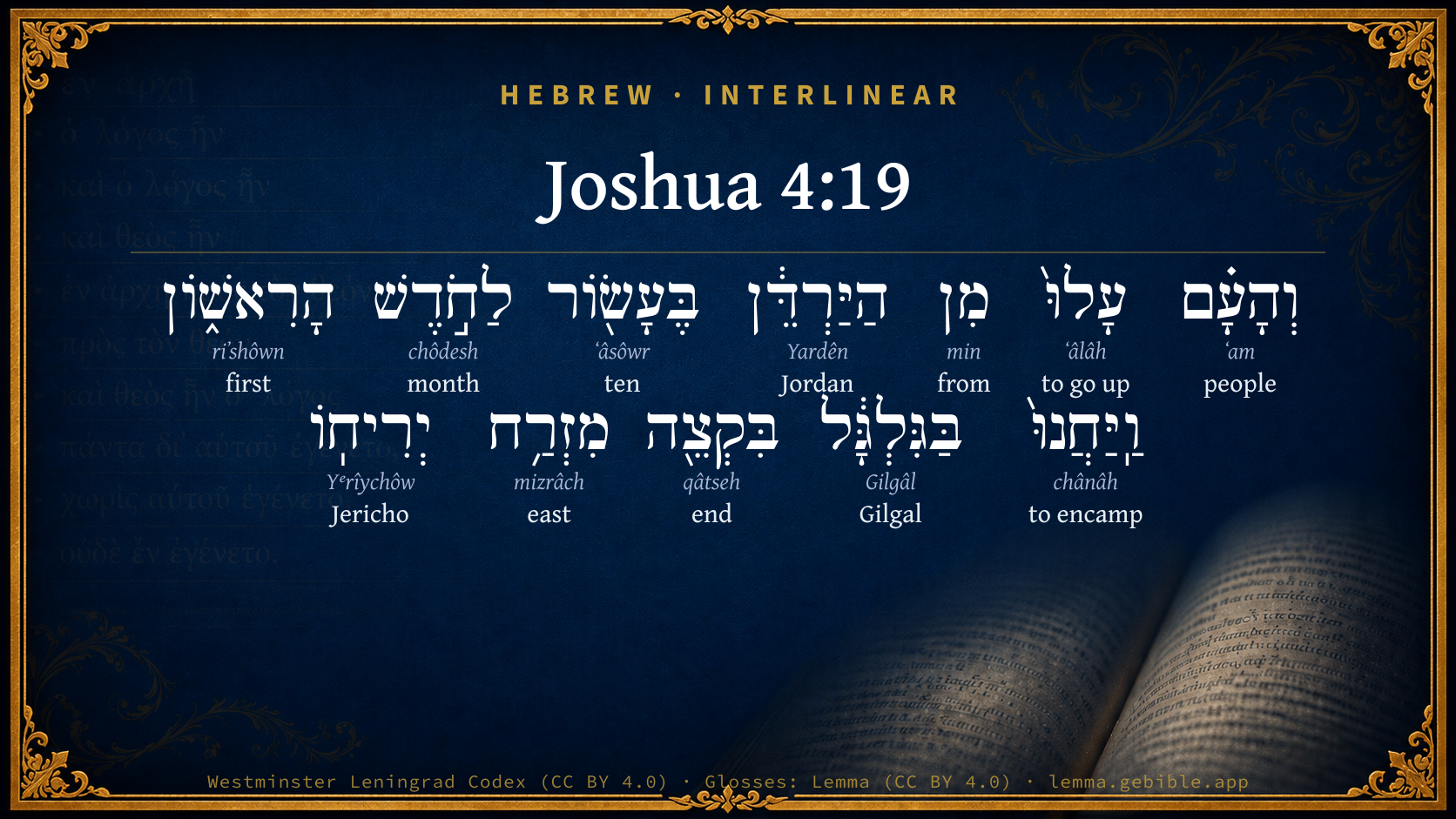
  1. וְהָעָ֗ם ʻam H5971 “and · the · people” Conjunction + Particle, Definite Article + Noun, Common, Masculine, Singular, Absolute
  2. עָלוּ֙ ʻâlâh H5927 “to go up” Verb, Qal, Perfect, 3rd Person, Common, Plural
  3. מִן min H4480 “from” Preposition
  4. הַיַּרְדֵּ֔ן Yardên H3383 “the · Jordan” Particle, Definite Article + Noun, Proper
  5. לַחֹ֣דֶשׁ chôdesh H2320 “to/for the · month” Preposition, Determined + Noun, Common, Masculine, Singular, Absolute
  6. הָרִאשׁ֑וֹן riʼshôwn H7223 “the · first” Particle, Definite Article + Adjective, Ordinal number, Masculine, Singular, Absolute
  7. וַֽיַּחֲנוּ֙ chânâh H2583 “and · to encamp” Conjunction + Verb, Qal, Sequential Imperfect, 3rd Person, Masculine, Plural
  8. בַּגִּלְגָּ֔ל Gilgâl H1537 “in/at the · Gilgal” Preposition, Determined + Noun, Proper
  9. בִּקְצֵ֖ה qâtseh H7097 “in/at · end of” Preposition + Noun, Common, Both, Singular, Construct
  10. מִזְרַ֥ח mizrâch H4217 “east of” Noun, Common, Masculine, Singular, Construct
  11. יְרִיחֽוֹ Yᵉrîychôw H3405 “Jericho” Noun, Proper

About this verse

These counts appear in no published source. They are computed here, from the morphology-tagged text and Lemma’s own curated glosses. What Lemma adds →

12
words
12
distinct lemmas
Historical
section

Notable vocabulary

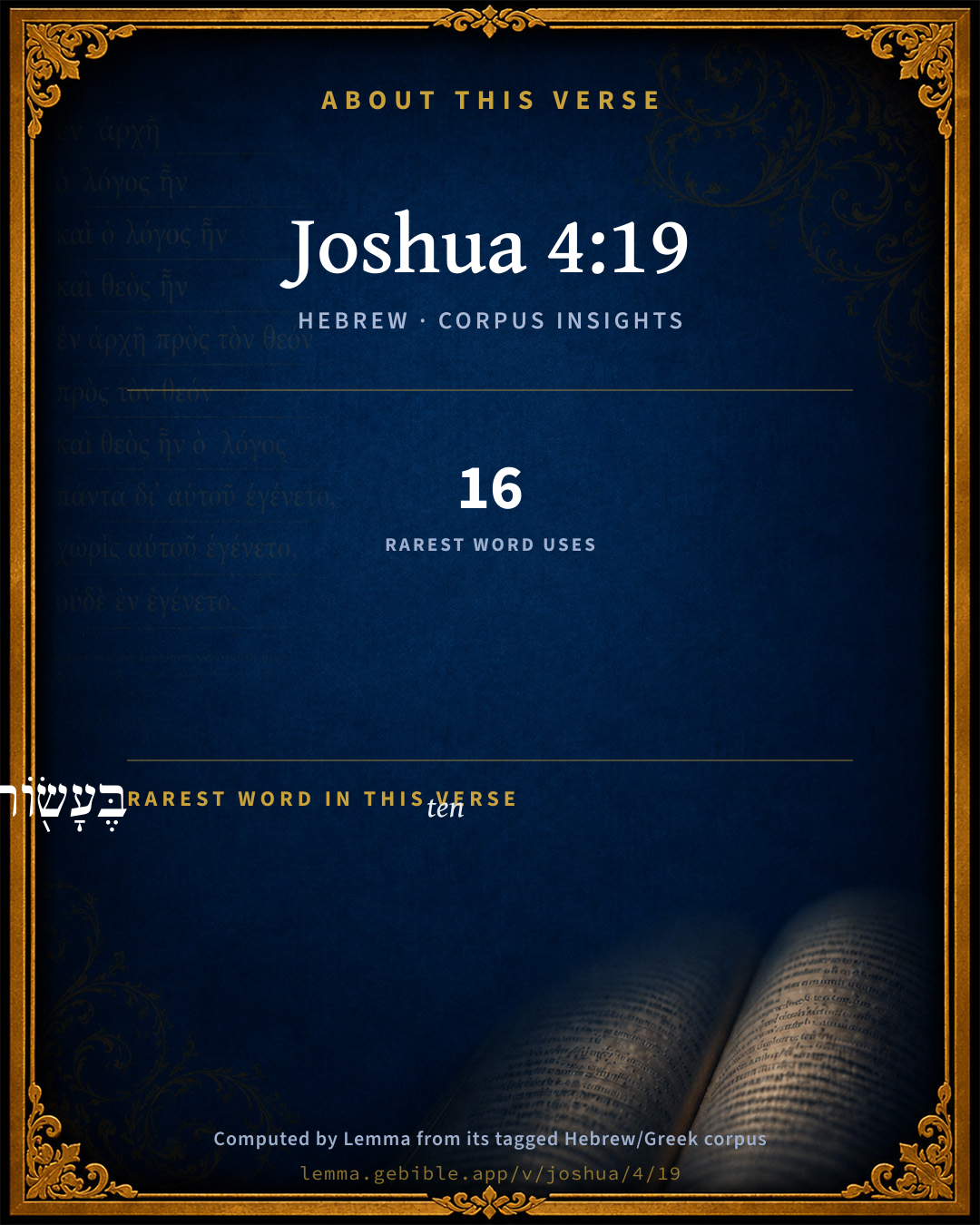
The rarest word here is בֶּעָשׂ֖וֹר ten H6218 — appearing just 16 times in the whole Hebrew Bible.

Shared distinctive vocabulary

בֶּעָשׂ֖וֹר ten H6218 occurs in 16 verses of the Hebrew Bible. Also found in:

Grammatical profile

  • 2 verbs
  • 8 nouns
  • 1 adjective
  • 1 preposition

Verb forms

  • עָלוּ֙ Qal · Perfect
  • וַֽיַּחֲנוּ֙ Qal · Sequential Imperfect

Hebrew & Septuagint length

In English translation the verse runs 26 words from the Hebrew and 30 from the Septuagint (LXX English) — closely comparable.

A rough comparison of the two English renderings, which tokenize alike — not a word-level alignment.

Word counts can differ between the Hebrew and the Greek without any difference in meaning — e.g. the Hebrew direct-object marker אֵת has no separate Greek word, and Greek often adds the article ὁ.

Cross-references

10

Topical passages linked to Joshua 4:19 in the Treasury of Scripture Knowledge — connected by theme and wording, ordered by reader-vote popularity; previews shown in the World English Bible.

  • Joshua 5:9 Yahweh said to Joshua, This day have I rolled away the reproach of Egypt from off you. Therefore the name of that place was called Gilgal, to this day.
  • Micah 6:5 My people, remember now what Balak king of Moab devised, And what Balaam the son of Beor answered him from Shittim to Gilgal, That you may know the righteous acts of Yahweh."
  • Exodus 12:2–3 "This month shall be to you the beginning of months. It shall be the first month of the year to you.
  • Joshua 10:6 The men of Gibeon sent to Joshua to the camp to Gilgal, saying, Don't slack your hand from your servants; come up to us quickly, and save us, and help us: for all the kings of the Amorites that dwell in the hill-country are gathered together against us.
  • Joshua 10:43 Joshua returned, and all Israel with him, to the camp to Gilgal.
  • Joshua 15:7 and the border went up to Debir from the valley of Achor, and so northward, looking toward Gilgal, that is over against the ascent of Adummim, which is on the south side of the river; and the border passed along to the waters of En Shemesh, and the goings out of it were at En Rogel;
  • 1 Samuel 11:14–15 Then said Samuel to the people, Come, and let us go to Gilgal, and renew the kingdom there.
  • 1 Samuel 15:33 Samuel said, As your sword has made women childless, so shall your mother be childless among women. Samuel hewed Agag in pieces before Yahweh in Gilgal.
  • Amos 4:4 "Go to Bethel, and sin; To Gilgal, and sin more. Bring your sacrifices every morning, Your tithes every three days,
  • Amos 5:5 But don't seek Bethel, Nor enter into Gilgal, And don't pass to Beersheba: For Gilgal shall surely go into captivity, And Bethel shall come to nothing.

Cross-references courtesy of OpenBible.info (CC BY 4.0).

Hebrew and Greek witnesses Masoretic Hebrew ↔ Greek Septuagint

The same verse in the two great witnesses to the Old Testament, shown verse-for-verse.

These are two independent witnesses, not word-aligned to each other, and the Septuagint is shown in lemma (dictionary) form.

Hebrew Joshua 4:19 Masoretic · Westminster Leningrad Codex

וְהָעָ֗ם עָלוּ֙ מִן הַיַּרְדֵּ֔ן בֶּעָשׂ֖וֹר לַחֹ֣דֶשׁ הָרִאשׁ֑וֹן וַֽיַּחֲנוּ֙ בַּגִּלְגָּ֔ל בִּקְצֵ֖ה מִזְרַ֥ח יְרִיחֽוֹ

The people came up out of the Jordan on the tenth day of the first month, and encamped in Gilgal, on the east border of Jericho.

World English Bible · Public Domain

Greek LXX Joshua 4:19 Septuagint · lemma form

καί ὁ λαός ἀναβαίνω ἐκ ὁ ἰορδάνης δέκατος ὁ μήν ὁ πρῶτος καί καταστρατοπεδεύω ὁ υἱός ἰσραήλ ἐν γάλγαλα κατά μέρος ὁ πρός ἥλιος ἀνατολή ἀπό ὁ ιεριχω

And the people went up out of Jordan on the tenth day of the first month; and the children of Israel encamped in Galgala in the region eastward from Jericho.

LXX2012 (modern English Septuagint) · Public Domain

Hebrew: Westminster Leningrad Codex (CC BY 4.0). Greek: Septuagint (public domain); English from LXX2012 (modern English Septuagint) (Public Domain). How the Septuagint differs from the Hebrew →

Targum (Aramaic paraphrase)

1

The Targum is the ancient Jewish Aramaic paraphrase of the Hebrew Scriptures — an interpretive translation, not the Hebrew text itself. Onkelos (literal) and Pseudo-Jonathan (expansive) render the Torah, and Jonathan the Prophets. Coverage is partial: where no permissively-licensed English translation exists for a verse, only the Aramaic is shown. This is verse-level text, not a word-by-word alignment to the Hebrew.

  1. Targum Jonathan Prophets (Joshua–Malachi)
    וְעַמָא סְלִיקוּ מִן יַרְדְנָא בְּעַשְׂרָא לְיַרְחָא קַדְמָאָה וּשְׁרוֹ בְגִלְגָלָא בִּסְיָפֵי מַדְנַח יְרִיחוֹ:

    (no public-domain English translation for this verse)

    Targum Jonathan — Aramaic: “Mikraot Gedolot” (public domain). English: “Sefaria Community Translation” (CC0 1.0 (public-domain dedication)); “London "Chaldee Paraphrase," 1871” (public domain). Text via Sefaria.

Commentary

Notes on Joshua 4:19 from classic Christian and Jewish commentators (each source and its license shown beneath its notes). The classic Christian expositions comment on the surrounding passage and are grouped to its opening verse, so a note may address several verses; the Jewish commentaries on the Tanakh (Rashi and others) are per-verse, so they appear only where the commentator wrote on this verse.

Lemma curates 59 commentaries, every one of them public domain or Creative Commons licensed, each selected and text-cleaned for this edition rather than reprinted as found. About our sources →

Ellicott's Commentary for English Readers

EVENTS AT GILGAL (Jos_4:19 to Jos_5:12, inclusive).

(19) On the tenth day of the first month.—Of the forty-first year after they left Egypt. Exactly forty years before, on the tenth day of the first month, (Exo_12:5), they had been commanded to take them “a lamb for an house,” that they might keep the Passover. The forty years of the Exodus were now complete, and on the self-same day they passed over the last barrier, and entered the Promised Land.

A Bible Commentary for English Readers, edited by Charles John Ellicott (1878–1897) — public domain. Text from a community e-Sword module.

Trapp's Complete Commentary

John Trapp

Jos 4:19 And the people came up out of Jordan on the tenth [day] of the first month, and encamped in Gilgal, in the east border of Jericho.

Ver. 19. On the tenth day of the first month.] {See Trapp on "Exo 12:3"}

John Trapp, A Commentary or Exposition upon All the Books of the Old and New Testament (1647–1656) — public domain. Text from a community e-Sword module.

Joseph Benson's Commentary

Jos 4:19. On the tenth day of the first month — Namely, of Nisan, which wanted but five days of forty years from the time of their coming out of Egypt, which was on the fifteenth day of this month. So punctual is God in the performing of his word, whether promised or threatened. And this day was very seasonable for the taking up of the lambs which were to be used four days after, according to the law, Exo 12:3; Exo 12:6. Gilgal — A place afterward so called, Jos 5:9.

Joseph Benson's Commentary on the Old and New Testaments (1811–1818) — public domain. Text from a community e-Sword module.

Keil & Delitzsch

C. F. Keil & F. Delitzsch

The crossing took place on the tenth day of the first month, that is to say, on the same day on which, forty years before, Israel had begun to prepare for going out of Egypt by setting apart the paschal lamb (Exo 12:3). After crossing the river, the people encamped at Gilgal, on the eastern border of the territory of Jericho. The place of encampment is called Gilgal proleptically in Jos 4:19 and Jos 4:20 (see at Jos 5:9).

Keil & Delitzsch — Biblical Commentary on the Old Testament (1861–1891) — public domain (CC PDM 1.0). Text via the HelloAO Bible API. (Old Testament only.)

Tyndale Open Study Notes

Tyndale Open Resources

4:19-20 The tenth day of the first month occurred a few days before Passover. • Gilgal became an important worship center for early Israel. Although its location is uncertain, it was somewhere just east or northeast of Jericho. Its name (which means “wheel of a cart,” cp. Isa 28:28) implies that Joshua set the twelve stones in a circle (cp. study note on Josh 5:9).

Tyndale Open Study Notes — © Tyndale Open Resources, licensed CC BY-SA 4.0. Text via the HelloAO Bible API.

Geneva Bible (1599)

Geneva Bible translators

Called Abib or Nisan, containing part of March and part of April.

Geneva Bible (1599) marginal notes — public domain. Text via Bolls.life.

Jamieson, Fausset & Brown

Robert Jamieson, A. R. Fausset & David Brown

the people came up out of Jordan on the tenth day of the first month--that is, the month Nisan, four days before the passover, and the very day when the paschal lamb required to be set apart, the providence of God having arranged that the entrance into the promised land should be at the feast.

and encamped in Gilgal--The name is here given by anticipation (see on Jos 5:9). It was a tract of land, according to JOSEPHUS, fifty stadia (six and one-half miles) from Jordan, and ten stadia (one and one-fourth miles) from Jericho, at the eastern outskirts of the palm forest, now supposed to be the spot occupied by the village Riha.

Jamieson, Fausset & Brown — Commentary Critical and Explanatory on the Whole Bible (1871) — public domain (CC PDM 1.0). Text via the HelloAO Bible API.

Adam Clarke's Commentary

Verse 19. On the tenth day of the first month] As the Israelites left Egypt on the fifteenth day of the first month, A.M. 2513, (see Ex 14:1-31), and they entered into Canaan the tenth of the first month, A.M. 2553, it is evident that forty years, wanting five days, had elapsed from the time of their exodus from Egypt to their entrance into the promised inheritance.

Encamped in Gilgal] That is, in the place that was afterwards called Gilgal, see Jos 5:9; for here the name is given it by anticipation. In Hebrew, gal signifies to roll; and the doubling of the root, galgal or gilgal, signifies rolling round and round, or rolling off or away, because, in circumcising the children that had been born in the wilderness, Joshua rolled away, rolled off completely, the reproach of the people. From this time Gilgal became a place of considerable eminence in the sacred history.

1. It was the place where the Israelitish camp rested the first night of their entering into that land which had been promised to their fathers from the days of Abraham.

2. It was the place in which Joshua circumcised all the people who had been born in the wilderness, during the forty years of their wandering, after they left Egypt.

3. It was the place in which Joshua had what we might term his fortified camp, and to which he and his army constantly returned after each of their expeditions against the inhabitants of the land.

4. It appears to have been the place where all the women, children, cattle, and goods, &c., were lodged, probably during the whole of the Canaanitish war.

5. It was the place where they celebrated the first passover they kept in the promised land.

6. It was the place where Saul, the first king of Israel, was proclaimed.

7. There the manna ceased to fall. And,

8. There the ark was fixed till, after the conquest of the country, it was removed to Shiloh.

Gilgal was about ten furlongs from Jericho, and fifty from Jordan: Jericho being on the west, and Jordan on the east, Gilgal being between both. See Josephus, De Bello, &c., lib. v., c. 4, and Calmet on this place. Calmet supposes there was neither city nor town here before the arrival of the Israelites.

Adam Clarke's Commentary on the Bible (1810–1826) — public domain. Text from a community e-Sword/MySword module.

John Calvin's Commentaries

19. And the people came up, etc Why the day on which they entered the land, and first encamped in it, is marked, we shall see in next chapter. But the name of Gilgal is given to the first station by anticipation, for this new name was afterwards given to it by Joshua on the renewal of circumcision; its etymology will be explained in its own place. Moreover, the thing here principally treated of is the monument of twelve stones; for though it was formerly mentioned, a kind of solemn dedication is now related, namely, that Joshua not only erected a mound, but called the attention of the people to its use in enabling fathers to keep the memory of the divine goodness alive among their children. From his introducing the children asking, What mean these stones? we infer that they were arranged so as to attract the notice of spectators. For had they been heaped together at random without any order, it would never have come into the mind of posterity to inquire concerning their meaning. There must therefore have been something so remarkable in their position as not to allow the sight to be overlooked.

Moreover, because the covenant by which God had adopted the race of Abraham was firm in an uninterrupted succession for a thousand generations, the benefit which God had bestowed on the deceased fathers is, on account of the unity of the body, transferred in common to their children who were born long after. And the continuation must have more strongly awakened their attention, inasmuch as posterity were in this way reminded that what had long ago been given to their ancestors belonged to them also. The answer of the parents would have been coldly listened to had the divine favor been confined to a single day. But when the sons’ sons hear that the waters of Jordan were dried up many ages before they were born, they acknowledge themselves to be the very people towards whom that wonderful act of divine favor had been manifested. The same account is to be given of the drying up of the Red Sea, though the event was not very ancient. It is certain that of those who had come out of Egypt, Caleb and Joshua were the only survivors, and yet he addresses the whole people as if they had been eye-witnesses of the miracle. God dried up the Red Sea before our face; in other words, it was done in virtue of the adoption which passed without interruption from the fathers to the children. Moreover, it was worth while to call the passage of the Red Sea to remembrance, not only that the similarity of the miracle might cause belief, but that on hearing the story of the Jordan, that former miracle might be at the same time renewed, although no visible symbol of it was present to the eye.

John Calvin's Commentaries (1540-1563) — public domain. Text from the Calvin Translation Society English edition (1840s-50s) via the Christian Classics Ethereal Library (ccel.org). Calvin's coverage is partial (roughly two-thirds of the Bible); uncommented books and verses are honest gaps, never fabricated. The 19th-century editor's footnotes and remarks are omitted so the notes are faithfully Calvin's own voice.

The Cambridge Bible for Schools and Colleges

gen. ed. J. J. S. Perowne

19–24. Erection of the Monument at Gilgal

19. the tenth day of the first month] Notice the exactness of the narrative. The first month is elsewhere called Abib, i.e. “the month of green ears” (Exo_13:4; Exo_23:15; Deu_16:1), and subsequently “Nisan” (Neh_2:1; Est_3:7).

encamped] The site was doubtless fortified by Joshua “as a frontier fortress, such as the Greeks under the name of epitichisma, and the Romans under the name of colonia, always planted as their advanced posts in a hostile country, such as at Kufa the Arab conquerors founded before the building of Bagdad, and at Fostal before the building of Cairo.” Stanley’s Lectures, p. 233.

in Gilgal] situated apparently on a hillock or rising ground in the Arboth-Jericho, or, as it is rendered in our Version, “the plains of Jericho,” the more level district of the “Ghôr” which lay between the town and the river. We find Gilgal mentioned again, (a) in the time of Saul (1Sa_7:16; 1Sa_10:8), and (b) some sixty years later in the history of David’s return to Jerusalem (2Sa_19:15). The name is here mentioned by anticipation, Jos_5:9.

The Cambridge Bible for Schools and Colleges (gen. ed. J. J. S. Perowne; Cambridge University Press, 1878–1918) — public domain. Text from a community e-Sword module.

John Gill's Exposition

And the people came up out of Jordan,.... The channel of it, to the shore:

on the tenth day of the first month; the month Nisan or Abib, which from the time of Israel's coming out of Egypt was appointed the first month of the year, Exo 12:2; on the fifteenth of which month they came out of Egypt, having kept the passover on the fourteenth at even; so that their coming out of Egypt, to their entrance into Canaan, was just forty years, wanting five days. This tenth day was the day in which the passover was taken from the flock, and kept till the fourteenth, on which day the children of Israel kept their first passover in Canaan, in the plains of Jericho, Jos 5:10,

and encamped in Gilgal, in the east border of Jericho; it has its name here by anticipation, for it was so named after this for a reason given, Jos 5:9; It was, according to Josephus (l), ten furlongs, or a mile and a quarter, from Jericho. Jerom says (m), there was shown in his time a desert place two miles from Jericho, had in wonderful esteem by men of that country, which he suggests was this place; as it was had in great veneration, both by the worshippers of the true God, and by idolaters, for many ages.

(l) Ut supra. (Antiqu. l. 5. c. 1. sect. 4.) (m) De loc. Heb. fol. 91. M.

John Gill's Exposition of the Whole Bible (1746–1763) — public domain (CC PDM 1.0). Text via the HelloAO Bible API.

Albert Barnes' Notes on the Bible

Gilgal, mentioned here by anticipation (compare Jos 5:9), the modern Jiljulieh (Conder), was on rising ground (compare Jos 5:3), and, according to Josephus, nearly five miles from the river, and consequently about two from the city itself. The site of the camp was no doubt fortified by Joshua, as it constituted for some time the abiding foothold in Canaan, from where he sallied forth to subdue the country. It was also the place of safety where the ark, and no doubt also the women, children, cattle, and other property of the people were left. Hence, the demolition of Jericho and Ai, strong fortresses in the neighborhood of Gilgal, was no doubt dictated by sound policy as well as by religious obligations.

Albert Barnes' Notes on the Bible (1834–1885) — public domain. Text from a community e-Sword/MySword module.

Haydock's Catholic Bible Commentary

Month of the ecclesiastical year. They had left Egypt on the 15th of Nisan, so that they had spent forty years, within five days, on their journey. (Calmet)

George Leo Haydock (1774–1849), Haydock's Catholic Family Bible and Commentary, 1859 edition — public domain. Excludes Psalms (Douay-Rheims chapter numbering differs from Protestant) and Deuterocanonical books (Catholic canon only).

Matthew Poole's English Annotations

The first month, to wit, of Nisan, which wanted but five days of forty years from the time of their coming out of Egypt, which was on the fifteenth day of this month; so punctual is God in the performing of his word, whether promised or threatened. And this day was very seasonable for the taking up of the lambs, which were to be used four days after, according to the law, Exo 12:3,6.

Gilgal; a place so called hereafter upon a following occasion, Jos 5:9. So here it is an anticipation.

Matthew Poole's English Annotations on the Holy Bible (1683–1685) — public domain. Text from a community e-Sword/MySword module.

Whedon's Commentary on the Bible

Daniel D. Whedon

19. The tenth day of the first month — In Jos_5:10, we learn that the passover, the anniversary of the Exodus, occurred on the fourteenth of the same month, so that there were forty years, wanting four days, between the departure from Egypt and the entrance into Canaan. They did not enter earlier because of their unbelief. Heb_3:19.

Gilgal — On the significance which the Israelites afterwards attached to this name, see note on Jos_5:9. According to Josephus, Gilgal was fifty stadia, about six miles, from the Jordan, and ten stadia, exceeding a mile, from Jericho. No trace of the name or site now remains. This Gilgal must be carefully distinguished from another Gilgal in Central Palestine, known by the modern name Jiljilia. See note on Jos_9:6. Gilgal is noted as the first encampment of Israel in Canaan. Here was the scene of the circumcision, here the first passover was celebrated in the land, and here the manna ceased to fall.

Daniel D. Whedon (gen. ed.), Commentary on the Old and New Testaments (1874–1909) — public domain. Text from a community e-Sword module.

The Pulpit Commentary

On the tenth day of the first month. This statement, compared with Jos_5:10, will bear close analysis, and refutes the clumsy compiler theory. There was just time between the tenth and fourteenth day of the month for the events described in the meantime. And the scrupulous obedience to the law, the provisions of which, we are expressly told, had been of necessity neglected hitherto, is a fact closely in keeping with the character of Joshua, and the whole spirit of the narrative. Gilgal. The Gilgal, according to the Masorites, no doubt from its being a circular encampment. Not as yet, however, called by this name. (see Jos_5:9) It was "about five miles" (50 stadia, according to Josephus), "from the river banks" (Stanley, "Sinai and Palestine," p. 307). We gather from Jos_5:3 that it was a rising ground, but it isimpossible to identify the spot, since there never existed any town or village there. A spot is shown by the inhabitants about two miles from Jericho, which is held by them in great reverence, but this is further from Jericho than Josephus imagines it to be, for he places it about a mile and a quarter from Jericho. Tristram ("Land of Israel," p. 216) identifies Riha (see note on Jos_2:1) with Gilgal, but Bartlett (p. 452) places it "a mile east of Riha," "some three miles or more from the fords." It is hardly probable, however, that the Israelites, in their then unprepared condition (see next chapter, and cf. Gen_34:25), encamped so near the city, even though they were conscious of Divine protection, as Josephus would have us suppose. It has been denied by some that the Gilgal mentioned in Jos_9:6 Jos_10:6 is the same as this one (see notes there, as well as the Masoretic translation above). The reverence for sacred places, such as Gilgal, degenerated in the course of time, according to a well known law of humanity, into superstition a superstition severely rebuked by the prophets. (Hos_4:15 Hos_9:15 Amo_4:4 Amo_5:5) We may compare the idolatrous worship of the brazen serpent. (2Ki_18:4) It is sometimes contended by Roman Catholic commentators that no approval of the conduct of Hezekiah is here expressed; but a comparison of this passage with those above cited will show in which direction the minds of inspired men tended. Other places seem to have been similarly regarded with superstitious reverence. Not only do we find Bethel mentioned among such places as we might well expect from Jeroboam"s idolatrous worship there, but Beersheba also seems to have become a seat of this misdirected devotion (see Amo_5:5 Amo_8:14)

HOMILIES BY J. WAITE Vers. 19-24. Memorials.

The passage of the Jordan has been called a "priestly miracle," a natural event "turned into a miracle" by the historian for the sake of exalting the priestly office. We fail, however, to see that any such special prominence has been given to the priestly clement. It is the ark that is the medium of the miracle working power, the priests are but its servants and attendants. The ark, as the symbol and throne of the Divine presence, is the centre around which all the supernatural glory of the incident gathers. Indeed, there is rather a notable subordination of the priestly element at this period of Hebrew history. Joshua did not belong to the priestly order any more than Moses did. There was no sacerdotal rule. The twelve men who gathered these memorial stones from the bed of the river were not priests, but men chosen by the tribes for that particular work. The priestly functions were not those most brought into prominence by these incidents. There is no sign of anything like undue homage being paid to the priesthood at that period, and even as regards the religion of the people it was, as Stanley says, "a part of the mechanism of that religion rather than its animating spirit." The raising of these stones, then, to commemorate the great event that had just taken place, was the act of the whole people through their chosen representatives. Two piles of stones were raised: the one by direct Divine command; at Gilgal, where the Israelites rested for the night after the passage, and where they observed their first passover in the land of Canaan; the other, apparently without Divine command, on the other side, at the spot where the feet of the priests first touched the brink of the flooded river. The words of Joshua present them in two lights before us:

(1) As a memorial for the men of that generation, and

(2) as a means of instruction for their children.

I A MEMORIAL FOR THAT GENERATION. The wisdom of God is seen in the command to raise such a memorial. It meets that weakness in human nature by which it comes to pass that the most sacred impressions are prone to die the lapse of time and the succeeding waves of circumstance obliterate them. Most Divine institutions have rested on this principle. God "set his bow in the cloud" a sign and pledge of His faithfulness. The Sabbath was intended to quicken in men the sense of their Divine relations and their longing for the "rest that remaineth." The passover and other feasts were to be "for memorials;" and when Christ said to His disciples, "Do this in remembrance of me," He asserted the same principle. The sign was to be a stimulus to spiritual apprehension and a help to faith. The history of the olden times is full of examples of the way in which men, as by a natural instinct, have sought to create for themselves some permanent record of the most momentous experiences of their life, by the names they gave to certain scenes, or by the erection of altars, etc.. (Abraham at Mount Moriah, "Jehovah Jireh," Gen_22:19; Jacob at Bethel, Gen_28:18; Moses at Rephidim, Exo_17:14; Samuel at Mizpeh, "Ebenezer," 1Sa_7:12) All memorials of this kind have their outlook towards the past and towards the future. They serve a double purpose; they keep alive precious memories and awaken buoyant hopes, they excite gratitude and strengthen faith. We do well to set up such way marks in the pilgrimage of our life. Their value lies not so much in the fact that they record the extraordinary that which happened once and is not likely to happen again but rather in the fact that they link the past with the future. They show us that through all change something abides. Our nature is the same in its needs, dangers, responsibilities; God is the same in His loving regard for us and His power to deliver. Every passing experience of His grace is a pledge that He will not fail us in emergencies yet to come. Anything is good that deepens this impression, provokes to thankfulness, and rebukes distrust. The darkest passages in our history thus "leave benedictions behind them, are transformed into occasions of triumphant joy: "Out of our stony griefs Bethels we raise.

II A MEANS OF INSTRUCTION FOR THEIR CHILDREN. "When your children shall ask their fathers," etc. A glimpse here of the simplicity and sanctity of domestic relations which was so important a feature of ancient Hebrew life. The authority of the father over his children almost absolute and unlimited. Something terrible in its despotism, if it had not been modified and softened by certain provisions defining parental duty. Instruction in the sacred traditions of the nation, its memories and hopes an obligation continually enforced. (see Exo_12:26, 27 12:14 Deu_6:7-20, et seq. )

1. The beauty and worth of a spirit of inquiry in children. It is natural for the child to ask questions. A boundless realm of mystery lies all around the awakening mind, and an irresistible instinct moves it to inquire, "Why these things? What mean ye by these services?" The contact of mind with mind is needful in order to development, and of whom should the children ask, but of "their fathers," for the solution of the problems that perplex them? The most notable chapter, the only recorded chapter, in the early development of Jesus is that scene in which we behold Him in the temple, "sitting in the midst of the doctors, both hearing them and asking them questions.

2. The generous, sympathetic response this spirit of inquiry should meet with. No tender sensibility of childhood is to be suppressed, least of all any that may lead to the discovery of truth. The inquisitiveness of the child is a precious faculty that demands to be rightly directed. The indifference of many parents to the stirrings of the spirit of inquiry in their children arises from selfish indolence, and is a cruel wrong. No doubt children will often ask questions which the wisest cannot answer, but at least let the difficulty be frankly confessed; let the ground and reason of it be defined in a way adapted to the young intelligence. The very disappointment then becomes a means of Divine instruction. The higher interests of our being the laws of God"s government, the revelations of His love, the workings of His Providence and Spirit let these especially be unfolded. What nobler office can any parent perform than to mediate between the mind of his child and the mystery of the Unseen to lift up the veil that hides God"s glory, to explain and justify His ways, to be the medium of His truth and Spirit to the young requiring soul?

3. The practical result at which all instruction should aim. "That ye might fear the Lord your God forever." The miracle, the memorial, the teaching, all find here their ultimate issue. All subordinate purposes must lead on to this the showing forth of God"s glory, and the submission of His intelligent creatures to Him in reverence and godly fear. "Let us hear the conclusion of the whole matter," etc.. W. (Ecc_12:13)

The Pulpit Commentary (1880–1919), ed. H.D.M. Spence-Jones & Joseph S. Exell — public domain. Text from a community e-Sword module.

John Wesley's Explanatory Notes

The first month - Namely, of Nisan, which wanted but five days of forty years from the time of their coming out of Egypt, which was on the fifteenth day of this month. So punctual is God in the performing of his word, whether promised or threatened. And this day was very seasonable for the taking up of the lambs which were to be used four days after, according to the law, Exod. xii, 3, 6. Gilgal - A place afterwards so called, chap. v, 9.

John Wesley, Explanatory Notes Upon the Whole Bible (1754–1765) — public domain. Text via the GEBible commentary corpus.

Scofield Reference Notes

C. I. Scofield

first month

i.e. April.

The Scofield Reference Bible (1917 edition), notes by C. I. Scofield — public domain. Text from a community e-Sword module.

unfoldingWord translationNotes

Door43 World Missions Community

came up out of the Jordan

This refers to when Israel crossed the Jordan River on dry ground.

on the tenth day of the first month

This is the first month of the Hebrew calendar. The tenth day is near the end of March on Western calendars. (See: Hebrew Months and Ordinal Numbers)

The twelve stones that they took out of the Jordan

Each tribe was to take one stone from the Jordan River so Joshua could build a memorial of the crossing event. (See: Assumed Knowledge and Implicit Information)

translationWords

Jordan River

day

Gilgal

Jericho

Joshua

people group

Israel

descend

ancestor

unfoldingWord translationNotes — © Distant Shores Media and the Door43 World Missions Community, licensed CC BY-SA 4.0. Source: git.door43.org/Door43/en_tn.

Lesson kit

Teaching starters — assembled from the data on this page, not authored interpretation. Every prompt links to the verse data it draws on. Edit before teaching.

Joshua, in the Historical, opens this verse with 12 words (12 distinct Hebrew lemmas). Its most distinctive word is ʻâsôwr (“ten”). A historical commentator’s framing appears above. Read the whole chapter for the surrounding context.

Discussion questions

  1. What does “ten” (ʻâsôwr) contribute to the verse as a whole?
  2. Genesis 24:55 shares the word «ten» with this verse. How do the two illuminate each other?
  3. These translations render this verse differently; the difference is in the English rendering, not the original. What questions does that raise?
  4. The verb «עָלוּ֙» is Qal Perfect. How does its form color the action?
  5. Reading how Ellicott's Commentary for English Readers and Trapp's Complete Commentary read this verse, where do the two commentators agree and where do they part?

Things to notice

Reading settings

Reading text

Shown beneath each verse's original-language words.

Old Testament
Old Testament edition

Read the OT as the Masoretic Hebrew (MT) or the Greek Septuagint (LXX).

English shown for the Greek Septuagint (in the Hebrew ↔ Greek comparison).

Comparing translations? Open the Compare panel on any verse page to stack up to four side by side.