
Deuteronomy 1:22

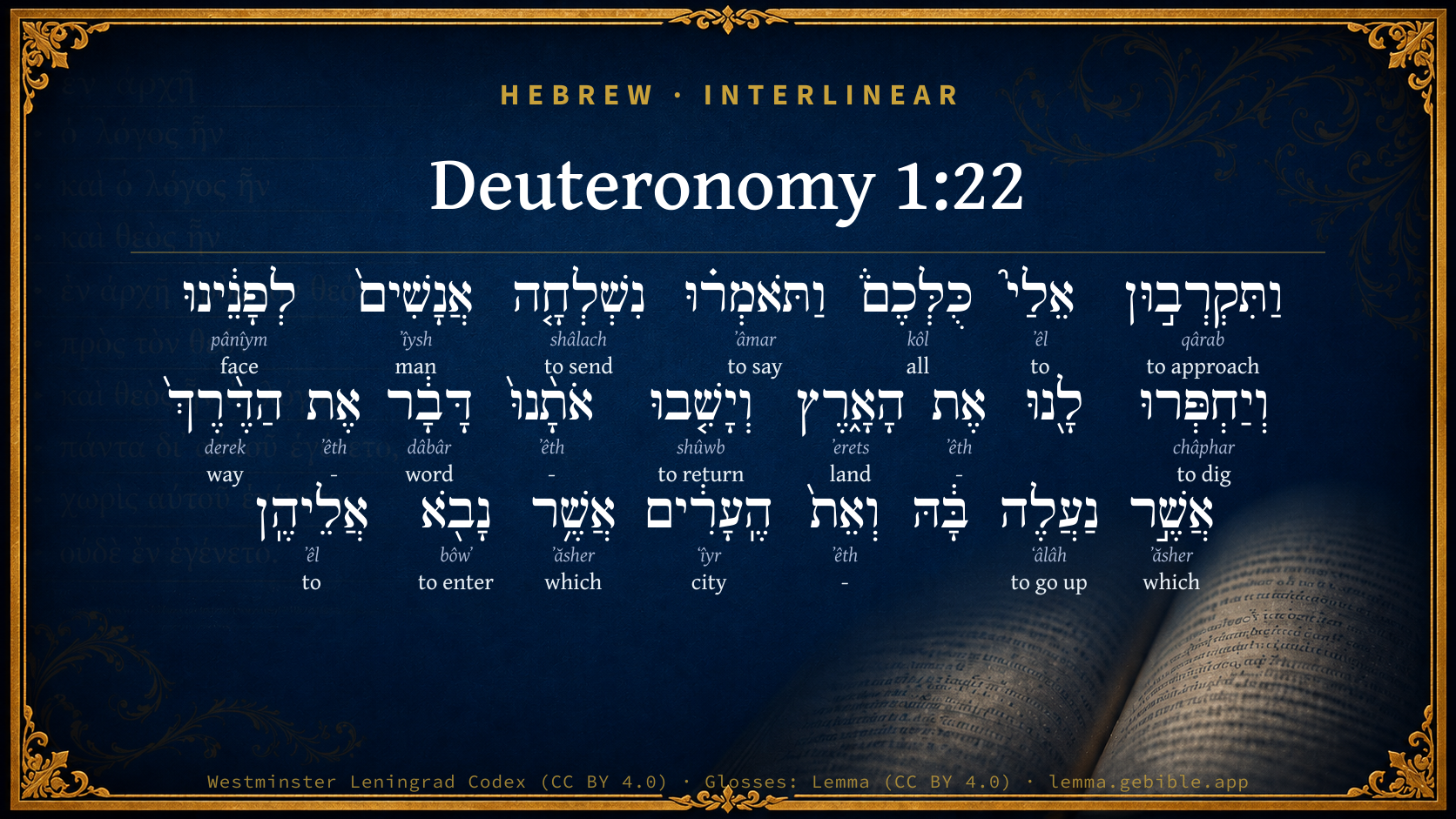
Hebrew (Westminster Leningrad Codex) Deuteronomy 1:22 appears in the Hebrew Old Testament. The text above is from the Westminster Leningrad Codex. Each word links to its Strong’s number, a concise gloss, and parsing drawn from the Open Scriptures Hebrew Bible morphology. Click any word for its full Brown-Driver-Briggs (BDB) entry.
Download image
Cite this verse

Deuteronomy 1:22 (World English Bible). Public Domain. Lemma interlinear Bible study tool, https://lemma.gebible.app/v/deuteronomy/1/22.

Show BibTeX & RIS
BibTeX
RIS
English Translation
You came near to me everyone of you, and said, Let us send men before us, that they may search the land for us, and bring us word again of the way by which we must go up, and the cities to which we shall come.
World English Bible · Public Domain
Download a study sheet

One document with this verse’s original text, its word-by-word gloss line, the meaning frame, cross-references with their text, attributed commentary, and full source and license credits — printable, and it pastes into notes with its structure intact.

This verse Autodidact and up

Study sheet (.html) Plain text (.txt)

A passage Seminary Student

Up to 50 verses in one chapter. A passage sheet keeps up to 6 commentary sources and 12 cross-references per verse, in the order this page ranks them, and says so on the sheet whenever that leaves anything out. Ask for a single verse and you get the Autodidact verse sheet above.

Everything on this page stays free to read, with no account — the sheet is a download of what is already on screen, not access to it.

Want to remove ads? Support Godless Engineer
Compare translations 3

The same verse in 3 English versions, stacked beneath the original-language interlinear above. Click any original word for its lexicon entry.

Each is an independent rendering of the whole verse — the interlinear is not word-aligned to these translations.

Highlighted words mark where these versions differ — a whole-verse word diff, not a word-by-word alignment.

  • World English Bible Public Domain
    You came near to me everyone of you, and said, Let us send men before us, that they may search the land for us, and bring us word again of the way by which we must go up, and the cities to which we shall come.
  • King James Version Public Domain
    And ye came near unto me every one of you, and said, We will send men before us, and they shall search us out the land, and bring us word again by what way we must go up, and into what cities we shall come.
  • unfoldingWord Literal Text CC BY-SA 4.0
    And you drew near to me, all of you, and you said, ‘Let us send men to our faces, and they shall spy out the land for us, and return to us a word the way which we will go up into and the cities which we will come to.’

unfoldingWord Literal Text — © unfoldingWord, licensed CC BY-SA 4.0. Word-aligned USFM3 via Door43 (git.door43.org/unfoldingWord/en_ult).

Versions to compare (up to 4)

3 of 4 selected

Show all 18 translations

Every available English version of this verse, each an independent rendering of the whole verse.

  • World English Bible Public Domain
    You came near to me everyone of you, and said, Let us send men before us, that they may search the land for us, and bring us word again of the way by which we must go up, and the cities to which we shall come.
  • Berean Standard Bible Public Domain
    Then all of you approached me and said, “Let us send men ahead of us to search out the land and bring us word of what route to follow and which cities to enter.”
  • Majority Standard Bible Public Domain
    Then all of you approached me and said, “Let us send men ahead of us to search out the land and bring us word of what route to follow and which cities to enter.”
  • King James Version Public Domain
    And ye came near unto me every one of you, and said, We will send men before us, and they shall search us out the land, and bring us word again by what way we must go up, and into what cities we shall come.
  • American Standard Version (1901) Public Domain
    And ye came near unto me every one of you, and said, Let us send men before us, that they may search the land for us, and bring us word again of the way by which we must go up, and the cities unto which we shall come.
  • Revised Version (1885) Public Domain
    And ye came near unto me every one of you, and said, Let us send men before us, that they may search the land for us, and bring us word again of the way by which we must go up, and the cities unto which we shall come.
  • Geneva Bible (1599) Public Domain
    Then ye came vnto me euery one, and said, We wil send men before vs, to search vs out the land and to bring vs word againe, what way we must go vp by, and vnto what cities we shall come.
  • Douay-Rheims (1899) Public Domain
    I said to you: You are come to the mountain of the Amorrhite, which the Lord our God will give to us.
  • Young's Literal Translation Public Domain
    `And ye come near unto me, all of you, and say, Let us send men before us, and they search for us the land, and they bring us back word `concerning' the way in which we go up into it, and the cities unto which we come in;
  • Literal Standard Version CC BY-SA 4.0
    And you come near to me, all of you, and say, Let us send men before us, and they search the land for us, and they bring us back word [concerning] the way in which we go up into it, and the cities to which we come in;
  • Unlocked Literal Bible CC BY-SA 4.0
    Every one of you came to me and said, 'Let us send men ahead of us, so that they may search out the land for us, and bring us word about the way by which we should attack, and about the cities to which we will come.'
  • unfoldingWord Literal Text CC BY-SA 4.0
    And you drew near to me, all of you, and you said, ‘Let us send men to our faces, and they shall spy out the land for us, and return to us a word the way which we will go up into and the cities which we will come to.’
  • Darby Bible Public Domain
    And ye came near to me all of you, and said, We will send men before us, who shall examine the land for us, and bring us word again of the way by which we must go up, and of the cities to which we shall come.
  • World Messianic Bible Public Domain
    You came near to me, everyone of you, and said, “Let’s send men before us, that they may search the land for us, and bring back to us word of the way by which we must go up, and the cities to which we shall come.”
  • Webster's Bible Public Domain
    And ye came near to me every one of you, and said, We will send men before us, and they shall explore the land for us, and bring us word again by what way we must go up, and into what cities we shall come.
  • Free Bible Version CC BY-SA 4.0
    Then you all came to me and suggested, “Let's send men on ahead to explore the land and report back to us about what route to take and which towns we'll come across.”
  • Bible in Basic English Public Domain
    And you came near to me, every one of you, and said, Let us send men before us to go through the land with care and give us an account of the way we are to go and the towns to which we will come.
  • JPS Tanakh (1917) Public Domain
    And ye came near unto me every one of you, and said: 'Let us send men before us, that they may search the land for us, and bring us back word of the way by which we must go up, and the cities unto which we shall come.'

Literal Standard Version (2020), Covenant Press — licensed CC BY-SA 4.0. Text via the HelloAO Bible API (eBible.org). Unlocked Literal Bible (unfoldingWord) — licensed CC BY-SA 4.0. Text via the HelloAO Bible API (eBible.org). unfoldingWord Literal Text — © unfoldingWord, licensed CC BY-SA 4.0. Word-aligned USFM3 via Door43 (git.door43.org/unfoldingWord/en_ult). Free Bible Version, Dr. Jonathan Gallagher — licensed CC BY-SA 4.0. Text via the HelloAO Bible API (eBible.org).

Word by word

More ways to search: Search by grammar → Find every occurrence → Compare this word →

Practice this passage: Drill this verse → Learn its vocabulary →

וְיַחְפְּרוּ
châphar
H2658
“and · to dig”
Conjunction + Verb, Qal, Imperfect, 3rd Person, Masculine, Plural
Part of Speech
Conjunction + Verb
Stem
Qal
Form
Imperfect
Person
3rd Person
Gender
Masculine
Number
Plural
Full BDB Definition

Origin: a primitive root

TWOT: 714

to dig, search for - (Qal) - to dig - to search, search out, explore
  1. וַתִּקְרְב֣וּן qârab H7126 “and · to approach” Conjunction + Verb, Qal, Sequential Imperfect, 2nd Person, Masculine, Plural + Suffix, n
  2. אֵלַי֮ ʼêl H413 “to · me” Preposition + Suffix, Personal, 1st Person, Common, Singular
  3. כֻּלְּכֶם֒ kôl H3605 “all · your” Noun, Common, Masculine, Singular, Construct + Suffix, Personal, 2nd Person, Masculine, Plural
  4. וַתֹּאמְר֗וּ ʼâmar H559 “and · to say” Conjunction + Verb, Qal, Sequential Imperfect, 2nd Person, Masculine, Plural
  5. נִשְׁלְחָ֤ה shâlach H7971 “to send” Verb, Qal, Cohortative, 1st Person, Common, Plural
  6. אֲנָשִׁים֙ ʼîysh H376 “men” Noun, Common, Masculine, Plural, Absolute
  7. לְפָנֵ֔ינוּ pânîym H6440 “to/for · face(s) · our” Preposition + Noun, Common, Both, Plural, Construct + Suffix, Personal, 1st Person, Common, Plural
  8. אֶת ʼêth H853 “-” Particle, Direct Object
  9. הָאָ֑רֶץ ʼerets H776 “the · land” Particle, Definite Article + Noun, Common, Both, Singular, Absolute
  10. וְיָשִׁ֤בוּ shûwb H7725 “and · to return” Conjunction + Verb, Hiphil, Imperfect, 3rd Person, Masculine, Plural
  11. אֹתָ֨נוּ֙ ʼêth H853 “- · us” Particle, Direct Object + Suffix, Personal, 1st Person, Common, Plural
  12. דָּבָ֔ר dâbâr H1697 “word” Noun, Common, Masculine, Singular, Absolute
  13. אֶת ʼêth H853 “-” Particle, Direct Object
  14. הַדֶּ֨רֶךְ֙ derek H1870 “the · way” Particle, Definite Article + Noun, Common, Both, Singular, Absolute
  15. אֲשֶׁ֣ר ʼăsher H834 “which” Particle, Relative
  16. נַעֲלֶה ʻâlâh H5927 “to go up” Verb, Qal, Imperfect, 1st Person, Common, Plural
  17. וְאֵת֙ ʼêth H853 “and · -” Conjunction + Particle, Direct Object
  18. הֶֽעָרִ֔ים ʻîyr H5892 “the · cities” Particle, Definite Article + Noun, Common, Feminine, Plural, Absolute
  19. אֲשֶׁ֥ר ʼăsher H834 “which” Particle, Relative
  20. נָבֹ֖א bôwʼ H935 “to enter” Verb, Qal, Imperfect, 1st Person, Common, Plural
  21. אֲלֵיהֶֽן ʼêl H413 “to · them” Preposition + Suffix, Personal, 3rd Person, Feminine, Plural

About this verse

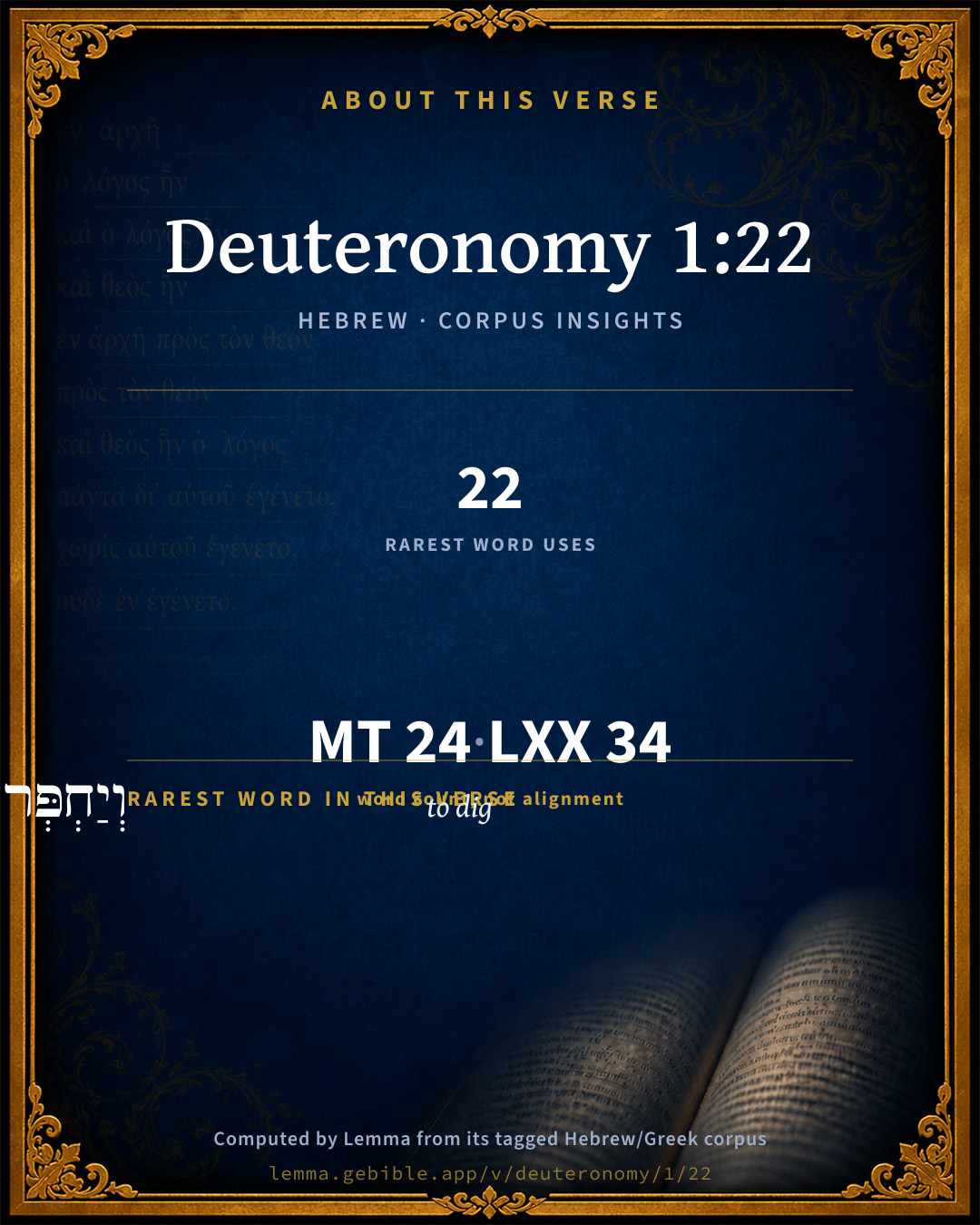
These counts appear in no published source. They are computed here, from the morphology-tagged text and Lemma’s own curated glosses. What Lemma adds →

24
words
17
distinct lemmas
Pentateuch
section

Notable vocabulary

The rarest word here is וְיַחְפְּרוּ to dig H2658 — appearing just 22 times in the whole Hebrew Bible.

Shared distinctive vocabulary

וְיַחְפְּרוּ to dig H2658 occurs in 21 verses of the Hebrew Bible. Also found in:

Grammatical profile

  • 7 verbs
  • 7 nouns
  • 4 prepositions
  • 6 particles

Verb forms

  • וַתִּקְרְב֣וּן Qal · Sequential Imperfect
  • וַתֹּאמְר֗וּ Qal · Sequential Imperfect
  • נִשְׁלְחָ֤ה Qal · Cohortative
  • וְיַחְפְּרוּ Qal · Imperfect
  • וְיָשִׁ֤בוּ Hiphil · Imperfect
  • נַעֲלֶה Qal · Imperfect
  • נָבֹ֖א Qal · Imperfect

Repetition

Words recur within this verse — often emphatic in Hebrew:

  • אֵלַי֮ to H413 ×2
  • אֲשֶׁ֣ר which H834 ×2

Hebrew & Septuagint length

In English translation the verse runs 46 words from the Hebrew and 51 from the Septuagint (LXX English) — closely comparable.

A rough comparison of the two English renderings, which tokenize alike — not a word-level alignment.

Word counts can differ between the Hebrew and the Greek without any difference in meaning — e.g. the Hebrew direct-object marker אֵת has no separate Greek word, and Greek often adds the article ὁ.

In the original languages it is 24 Hebrew tokens and 34 Greek tokens — but the two are counted differently (Hebrew bundles its prefixes and suffixes into one token; the Greek is in lemma form), so that isn’t a like-for-like length.

Cross-references

1

Topical passages linked to Deuteronomy 1:22 in the Treasury of Scripture Knowledge — connected by theme and wording, ordered by reader-vote popularity; previews shown in the World English Bible.

Cross-references courtesy of OpenBible.info (CC BY 4.0).

Hebrew and Greek witnesses Masoretic Hebrew ↔ Greek Septuagint

The same verse in the two great witnesses to the Old Testament, shown verse-for-verse.

These are two independent witnesses, not word-aligned to each other, and the Septuagint is shown in lemma (dictionary) form.

Hebrew Deuteronomy 1:22 Masoretic · Westminster Leningrad Codex

וַתִּקְרְב֣וּן אֵלַי֮ כֻּלְּכֶם֒ וַתֹּאמְר֗וּ נִשְׁלְחָ֤ה אֲנָשִׁים֙ לְפָנֵ֔ינוּ וְיַחְפְּרוּ לָ֖נוּ אֶת הָאָ֑רֶץ וְיָשִׁ֤בוּ אֹתָ֨נוּ֙ דָּבָ֔ר אֶת הַדֶּ֨רֶךְ֙ אֲשֶׁ֣ר נַעֲלֶה בָּ֔הּ וְאֵת֙ הֶֽעָרִ֔ים אֲשֶׁ֥ר נָבֹ֖א אֲלֵיהֶֽן

You came near to me everyone of you, and said, Let us send men before us, that they may search the land for us, and bring us word again of the way by which we must go up, and the cities to which we shall come.

World English Bible · Public Domain

Greek LXX Deuteronomy 1:22 Septuagint · lemma form

καί προςἔρχομαι ἐγώ πᾶς καί εἶπον ἀποστέλλω ἀνήρ πρότερος ἐγώ καί ἐπιὁδεύω ἐγώ ὁ γῆ καί ἀναἀγγέλλω ἐγώ ἀπόκρισις ὁ ὁδός διά ὅς ἀναβαίνω ἐν αὐτός καί ὁ πόλις εἰς ὅς εἰςπορεύομαι εἰς αὐτός

And you⌃ all came to me, and said, Let us send men before us, and let them go up to the land for us; and let them bring back to us a report of the way by which we shall go up, and of the cities into which we shall enter.

LXX2012 (modern English Septuagint) · Public Domain

Hebrew: Westminster Leningrad Codex (CC BY 4.0). Greek: Septuagint (public domain); English from LXX2012 (modern English Septuagint) (Public Domain). How the Septuagint differs from the Hebrew →

Targum (Aramaic paraphrase)

2

The Targum is the ancient Jewish Aramaic paraphrase of the Hebrew Scriptures — an interpretive translation, not the Hebrew text itself. Onkelos (literal) and Pseudo-Jonathan (expansive) render the Torah, and Jonathan the Prophets. Coverage is partial: where no permissively-licensed English translation exists for a verse, only the Aramaic is shown. This is verse-level text, not a word-by-word alignment to the Hebrew.

  1. Targum Onkelos Torah (Genesis–Deuteronomy)
    וּקְרֶבְתּוּן לְוָתִי כֻּלְכוֹן וַאֲמַרְתּוּן נִשְׁלַח גֻבְרִין קֳדָמָנָא וִיאַלְלוּן לָנָא יָת אַרְעָא וִיתִיבוּן יָתָנָא פִּתְגָמָא יָת אָרְחָא דִי נִסֵק בַּהּ וְיָת קִרְוַיָא דִי נֵעוֹל לְהֵן

    (no public-domain English translation for this verse)

    Targum Onkelos — Aramaic: “Onkelos Genesis” (public domain); “Onkelos Exodus” (public domain); “Onkelos Leviticus” (public domain); “Onkelos Numbers” (public domain); “Onkelos Deuteronomy” (public domain). English: “Sefaria Community Translation” (CC0 1.0 (public-domain dedication)); “J.W. Etheridge. The Targums of Onkelos and Jonathan Ben Uzziel on the Pentateuch. London: Longmans, Green, 1862” (public domain). Text via Sefaria.

  2. Targum Pseudo-Jonathan Torah (Genesis–Deuteronomy)
    וְקָרֵיבְתּוּן לְוָתִי בְּעַרְבּוּבְיָא כּוּלְכוֹן וַאֲמַרְתּוּן נְשַׁדֵּר גּוּבְרִין קֳדָמָנָא וְיִתְרָגְנוּן לָנָא יַת אַרְעָא וִיתֵיבוּן יָתָנָא פִּתְגָמָא יַת אוֹרְחָא דְנִיסַק בָּהּ וְיַת קִרְוַיָא דְנֵיעוּל לְוַתְהוֹן

    And all of you came to me in a body, and said, We will send men before us to examine the land for us, and bring us back word by what way we shall go up to it, and the cities we should enter.

    Targum Pseudo-Jonathan — Aramaic: “Targum Jonathan on Genesis” (public domain); “Targum Jonathan on Exodus” (public domain); “Targum Jonathan on Leviticus” (public domain); “Targum Jonathan on Numbers” (public domain); “Targum Jonathan on Deuteronomy” (public domain). English: “The Targum of Jonathan ben Uzziel, trans. J. W. Etheridge, London, 1862” (public domain). Text via Sefaria.

Commentary

Notes on Deuteronomy 1:22 from classic Christian and Jewish commentators (each source and its license shown beneath its notes). The classic Christian expositions comment on the surrounding passage and are grouped to its opening verse, so a note may address several verses; the Jewish commentaries on the Tanakh (Rashi and others) are per-verse, so they appear only where the commentator wrote on this verse.

Lemma curates 59 commentaries, every one of them public domain or Creative Commons licensed, each selected and text-cleaned for this edition rather than reprinted as found. About our sources →

Trapp's Complete Commentary

John Trapp

Deu 1:22 And ye came near unto me every one of you, and said, We will send men before us, and they shall search us out the land, and bring us word again by what way we must go up, and into what cities we shall come.

Ver. 22. We will send men before us.] Thus empty man will be wiser than God, though "man be born like a wild ass-colt." {Job 11:12} It was unbelief that prompted them to this practice: for "they could not enter because of unbelief." Carnal policy serves the worldling, as the ostrich’s wings, to make him outrun others upon earth, but helps him never a whit towards heaven.

John Trapp, A Commentary or Exposition upon All the Books of the Old and New Testament (1647–1656) — public domain. Text from a community e-Sword module.

Geneva Bible (1599)

Geneva Bible translators

Read Num. 13:13

Geneva Bible (1599) marginal notes — public domain. Text via Bolls.life.

Jamieson, Fausset & Brown

Robert Jamieson, A. R. Fausset & David Brown

ye came . . . and said, We will send men before us, and they shall search us out the land--The proposal to despatch spies emanated from the people through unbelief; but Moses, believing them sincere, gave his cordial assent to this measure, and God on being consulted permitted them to follow the suggestion (see on Num 13:1). The issue proved disastrous to them, only through their own sin and folly.

Jamieson, Fausset & Brown — Commentary Critical and Explanatory on the Whole Bible (1871) — public domain (CC PDM 1.0). Text via the HelloAO Bible API.

Adam Clarke's Commentary

Verse 22. We will send men before us] See on Nu 13:1-3.

Adam Clarke's Commentary on the Bible (1810–1826) — public domain. Text from a community e-Sword/MySword module.

Ellicott's Commentary for English Readers

(22) And ye came near . . . and said, We will send.—A new aspect is here given to the sending of the twelve spies. In Num_13:1 the incident is introduced thus: “And the Lord spake unto Moses, saying, Send thou men.” We learn here that the proposal in the first instance came from the people. Moses would naturally refer it to Jehovah; and, when approved, the scheme was carried out.

They shall search us out the land, and bring us word again by what way we must go up, and into what cities we shall come.—We read in Deu_1:33 that the Lord “went in the way before them to search out a place” for them to encamp in. But here the spies and Israel proposed to take the guidance of their march into their own hands. It is noticeable that in the campaigns of Joshua, not one step was taken without Divine direction. Thus the sending of the twelve spies, in the light in which the people intended it, was an act of unbelief. “In this thing (Deu_1:32) ye did not believe the Lord your God.” (See also Note on Jos_2:1.)

A Bible Commentary for English Readers, edited by Charles John Ellicott (1878–1897) — public domain. Text from a community e-Sword module.

The Cambridge Bible for Schools and Colleges

gen. ed. J. J. S. Perowne

22. And ye came near unto me … and said] The proposal to send spies is here attributed to the people, Moses consenting (see next verse). In P, Num_13:1 f., it is a divine command. There is no discrepancy of fact; but the difference of standpoint in describing the fact is instructive, and ought to be noticed along with other instances in D of the people’s initiative. JE has nothing on the origin of the mission of the spies; but the beginning of its narrative of the episode is broken (see above). This is one of four facts given in D of which no notice is found in JE; the other three are also given in P: (1) that the spies were twelve, Deu_1:23; Num_13:2; (2) that those who went down to Egypt with Jacob were seventy, Deu_10:22; Gen_46:27; Exo_1:5; (3) that the ark was of acacia wood, Deu_10:3; Exo_25:10. See Introd. § 3.

that they may search] Heb. ḥaphar, lit. to dig; to explore, only here and Jos_2:2 f.; JE has see and P uses the verb tûr, to go about, travel either for spying or for trading.

the land] JE, Num_13:18 ff.; land and people; P, Num_13:2 land of Canaan.

the way … and the cities] J, Num_13:19, what cities they dwell in, whether in camps or strongholds.

The Cambridge Bible for Schools and Colleges (gen. ed. J. J. S. Perowne; Cambridge University Press, 1878–1918) — public domain. Text from a community e-Sword module.

John Gill's Exposition

And ye came near unto me everyone of you,.... Not every individual of them, but the heads of their tribes, that represented them; this is not to be understood of the present generation personally, but of their fathers, who all died in the wilderness, save a very few of them; but they being the same people and nation, it is so expressed:

and said, we will send men before us; that is, they thought it was proper and prudent so to do, and came to Moses to consult him about it; for we are not to suppose that they had determined upon it, whether he approved of it or not:

and they shall search us out the land: that they might know what sort of land it was, whether good or bad, fruitful or not, and whether woody or not: see Num 13:19.

and bring us word again by what way we must go up; or, "concerning the way (m) in which we must go"; which is the best way of entering it, most easy and accessible, where the passes are most open and least dangerous:

and into what cities we shall come; which it would be the most proper to attack and subdue first.

(m) , "de via", Noldius, p. 117. No. 594. so the Arabic version, Junius & Tremellius, Piscator.

John Gill's Exposition of the Whole Bible (1746–1763) — public domain (CC PDM 1.0). Text via the HelloAO Bible API.

Albert Barnes' Notes on the Bible

The plan of sending the spies originated with the people; and, as in itself a reasonable one, it approved itself to Moses; it was submitted to God, sanctioned by Him, and carried out under special divine direction. The orator’s purpose in this chapter is to bring before the people emphatically their own responsibilites and behavior. It is therefore important to remind them, that the sending of the spies, which led immediately to their complaining and rebellion, was their own suggestion.

The following verses to the end of the chapter give a condensed account, the fuller one being in Num. 13–14, of the occurrences which led to the banishment of the people for 40 years into the wilderness.

Albert Barnes' Notes on the Bible (1834–1885) — public domain. Text from a community e-Sword/MySword module.

Whedon's Commentary on the Bible

Daniel D. Whedon

22. Send men before us — Let us send men, etc. Comparing this passage with Num_13:1-2, we infer that the proposal of sending men to explore the land originated with the people, and that Jehovah approved it when it was submitted to him by Moses.

Daniel D. Whedon (gen. ed.), Commentary on the Old and New Testaments (1874–1909) — public domain. Text from a community e-Sword module.

The Pulpit Commentary

Vers. 22-32. The mission of the spies.

We see from two instances in this chapter how God"s plans leave wide room for the independent action of the human mind. Moses got the suggestion of appointing judges from Jethro; the idea of sending spies to reconnoiter the Holy Land originated with the people. The source from which it came made the motive of it doubtful, but as in itself a measure of prudence, Moses was well pleased with it, and, with God"s permission, adopted it. We have here

I A POLICY OF CAUTION. Caution is in itself a virtue. It is never wise to rush into undertakings without well-planned measures. The more knowledge we have to guide us in entering upon difficult duty the better. The sending out of these spies was fitted to procure for the Israelites valuable information as to the nature of the land, the best mode of attack, the state of feeling among the inhabitants, etc. The Church would do well to improve upon the hint thus given, and have men out on the field, to keep a sharp watch on the fortifications and movements of the enemy, and bring back intelligence which may encourage, guide, or otherwise help those whose time and thought are devoted to the actual warfare.

II AN UNEXPECTED RESULT OF THAT POLICY. The spies, with two exceptions, brought back a most disheartening and ill-advised report. We see here the danger of a policy of caution, when that springs from over-fearfulness or an original indisposition to advance. When caution is divorced from courage, and gets the upper hand, its natural tendency is to neutralize enthusiasm, to concentrate attention on difficulties, to play into the hands of those who don"t want to do anything, and to furnish them with excuses and arguments for delay. It was so here. The real secret of the desire of the people to have spies sent out was their lurking disbelief and fear. The spies themselves shared in this fear. With the exception of Caleb and Joshua, they seem to have had an eye for little else than difficulties. They admitted the goodliness of the land, and brought with them a splendid sample of its fruit (ver. 25). But in every other respect their report was calculated to dispirit, It is a sad thing for the Church when those who ought to animate and encourage her begin themselves to show the craven spirit. Yet over-cautious people are apt, often unwittingly, to do the very work of these spies, by magnifying difficulties, looking only to discouragements, and standing in the way of plans and efforts which would do great good.

III A REBELLION OF THE PEOPLE. That rebellion was the result of downright unbelief (ver. 32), and illustrates its work (cf. Heb_3:19) We see in it how unbelief:

1. Looks only to the seen. They thought only of the size of the people and the strength of the cities (ver. 28). The help of their invisible King was to them as if it were not. They had not the slightest hold upon the reality of it.

2. Looks only the discouragements of duty. There was a bright side as well as a dark one to the report brought to them, but nothing would make them look at the bright one. The same two sides a bright and hopeful side, and a side of difficulty exist in every situation, and it is a test of character which we are most given to dwell upon.

3. Misreads the providence of God. What greater perversion of God"s kind dealings could human nature be guilty of than that in ver. 27?

4. Is blind to the lessons of the past. They had just been delivered from Egypt, had seen mighty miracles, had been brought across the Red Sea, had been strengthened to conquer the Amalekites, etc.; but all is already forgotten.

5. Issues in flat refusal to do Gods will. That is the upshot of unbelief, wherever it exists. The report of the spies, confirmed by the grapes of Eschol, suggests that there is very much in the world which makes it worth conquering for Christ (genius, art, beautiful natural characteristics, etc.). J.O.

The Pulpit Commentary (1880–1919), ed. H.D.M. Spence-Jones & Joseph S. Exell — public domain. Text from a community e-Sword module.

unfoldingWord translationNotes

Door43 World Missions Community

General Information:

Moses continues reminding the people of Israel what the previous generation of Israelites did.

twelve men

"12 men" (See: Numbers)

They turned and went

Turning is an idiom for beginning to obey a command. AT: "They left that place and went" (See: Idiom)

Valley of Eshkol

This is a valley in the Hebron region, which is south of Jerusalem. (See: How to Translate Names)

scouted it

"looked for places they could attack"

translationWords

send

word

tribe

unfoldingWord translationNotes — © Distant Shores Media and the Door43 World Missions Community, licensed CC BY-SA 4.0. Source: git.door43.org/Door43/en_tn.

Rashi

Rabbi Shlomo Yitzchaki (Rashi)

ותקרבון אלי כלכם AND YE APPROACHED ME ALL OF YOU — all of you: in a crowd. But further on (Deuteronomy 5:20, 21) it states, “Ye approached me, even all the heads of your tribes, and your elders, and ye said, Behold [the Eternal our God] hath shown us [His glory and His greatness]’’: That approach to me was a fitting one — young people showing respect to their elders, letting these precede them, and the elders showing respect to the heads of the tribes that these should precede them. Here, however, ye approached me, all of you, in a crowd, the young pushing aside their olders, the elders pushing aside the heads (Sifrei Devarim 20:1).

וישבו אתנו דבר AND THEY SHALL BRING US WORD — i.e. they shall report to us in what language they speak (Sifrei Devarim 20:3).

את הדרך אשר נעלה בה BY WHAT WAY WE MUST GO UP — you will rarely find a road in which there is not some zigzag course (Sifrei Devarim 20:4).

ואת הערים אשר נבא אליהן AND UNTO WHAT CITIES WE SHALL COME first to capture them (cf. Sifrei Devarim 20:5).

Rashi on the Tanakh — English translations: “The Judaica Press complete Tanach with Rashi, translated by A. J. Rosenberg” (CC BY 4.0); “Pentateuch with Rashi's commentary by M. Rosenbaum and A.M. Silbermann, 1929-1934” (public domain); “The Metsudah Tanach series, Lakewood, N.J” (CC BY 4.0); and “The Book of Joshua, Metsudah Publications, 1997” (CC BY 4.0). Text via Sefaria.

Ramban (Nachmanides)

Rabbi Moshe ben Nachman (Ramban / Nachmanides)

AND BRING US BACK WORD OF THE WAY BY WHICH WE MUST GO UP. “There is no road which does not have crooked segments. AND THE CITIES UNTO WHICH WE SHALL COME — first to capture.” This is Rashi’s language. And so it is also stated in the Sifre: 20. “There is no road which does not have crooked parts. There is no road which does not have traps. There is no road which does not have intersections. And the cities unto which we shall come — so that we may know by which road to come.” That is to say, from which direction we are to come into the Land so that we may capture those cities first. This is as I explained in the section Shelach Lecha that the Israelites requested spies only to show them the way.

Ramban (Nachmanides) on the Tanakh — English translation: “Commentary on the Torah by Ramban (Nachmanides). Translated and annotated by Charles B. Chavel. New York, Shilo Pub. House, 1971-1976” (CC BY 4.0). Text via Sefaria.

Lesson kit

Teaching starters — assembled from the data on this page, not authored interpretation. Every prompt links to the verse data it draws on. Edit before teaching.

Deuteronomy, in the Pentateuch, opens this verse with 24 words (17 distinct Hebrew lemmas). Its most distinctive word is châphar (“to dig”). A historical commentator’s framing appears above. Read the whole chapter for the surrounding context.

Discussion questions

  1. How does “to dig” (châphar) shape what this verse is saying?
  2. Genesis 21:30 shares the word «to dig» with this verse. How do the two illuminate each other?
  3. “to” occurs 2× in this one verse. What is the effect of the repetition?
  4. The translations on this page render this verse differently — a whole-verse word diff, not a word-by-word alignment. What might account for the different wordings?
  5. The verb «וַתִּקְרְב֣וּן» is Qal Sequential Imperfect. How does its form color the action?
  6. Reading how Trapp's Complete Commentary and Geneva Bible (1599) read this verse, where do the two commentators agree and where do they part?

Things to notice

Reading settings

Reading text

Shown beneath each verse's original-language words.

Old Testament
Old Testament edition

Read the OT as the Masoretic Hebrew (MT) or the Greek Septuagint (LXX).

English shown for the Greek Septuagint (in the Hebrew ↔ Greek comparison).

Comparing translations? Open the Compare panel on any verse page to stack up to four side by side.