Exodus 24:2

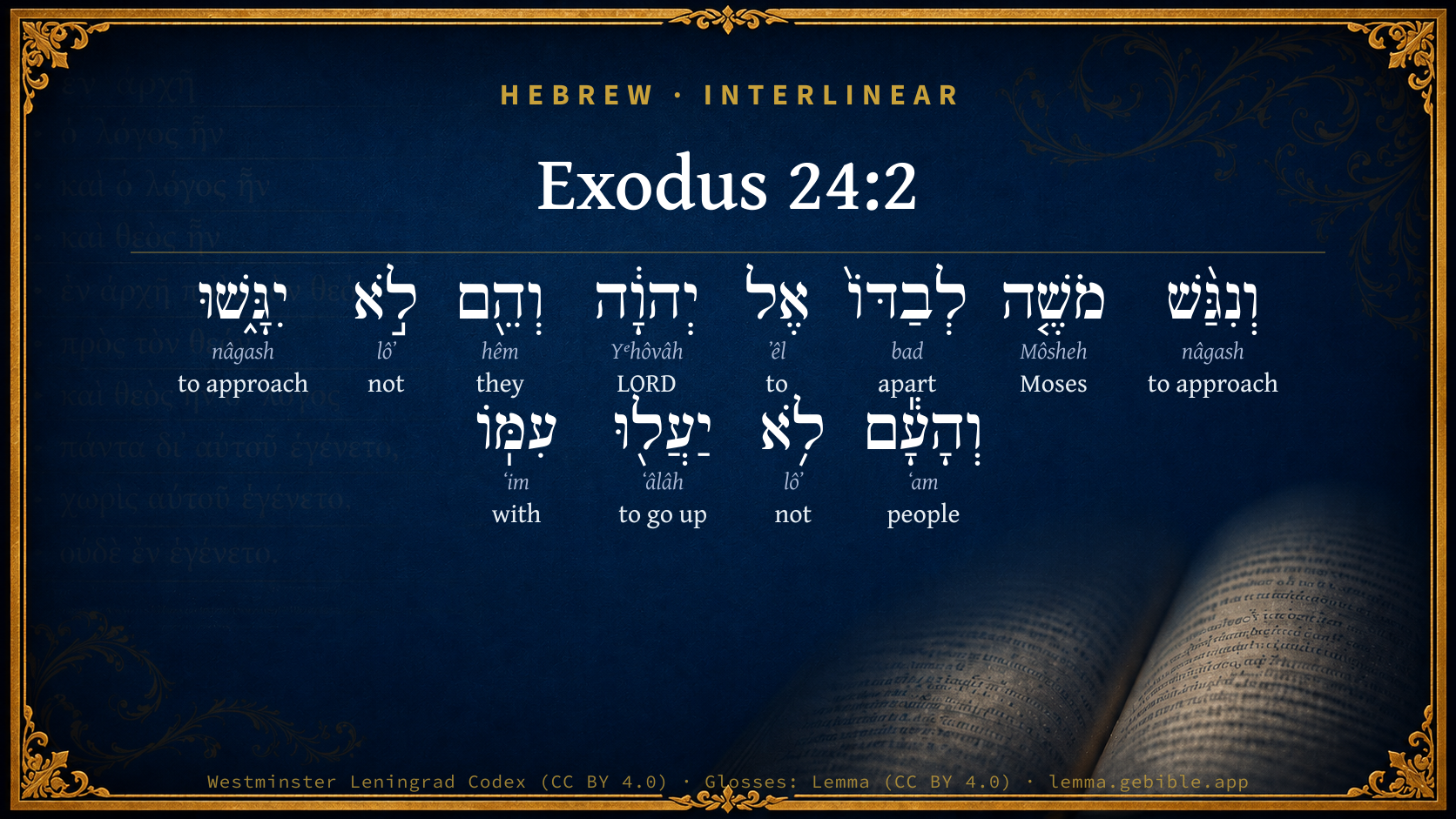
Hebrew (Westminster Leningrad Codex) Exodus 24:2 appears in the Hebrew Old Testament. The text above is from the Westminster Leningrad Codex. Each word links to its Strong’s number, a concise gloss, and parsing drawn from the Open Scriptures Hebrew Bible morphology. Click any word for its full Brown-Driver-Briggs (BDB) entry.
Download image
Cite this verse

Exodus 24:2 (World English Bible). Public Domain. Lemma interlinear Bible study tool, https://lemma.gebible.app/v/exodus/24/2.

Show BibTeX & RIS
BibTeX
RIS
English Translation
Moses alone shall come near to Yahweh, but they shall not come near, neither shall the people go up with him."
World English Bible · Public Domain
Download a study sheet

One document with this verse’s original text, its word-by-word gloss line, the meaning frame, cross-references with their text, attributed commentary, and full source and license credits — printable, and it pastes into notes with its structure intact.

This verse Autodidact and up

Study sheet (.html) Plain text (.txt)

A passage Seminary Student

Up to 50 verses in one chapter. A passage sheet keeps up to 6 commentary sources and 12 cross-references per verse, in the order this page ranks them, and says so on the sheet whenever that leaves anything out. Ask for a single verse and you get the Autodidact verse sheet above.

Everything on this page stays free to read, with no account — the sheet is a download of what is already on screen, not access to it.

Want to remove ads? Support Godless Engineer
Compare translations 3

The same verse in 3 English versions, stacked beneath the original-language interlinear above. Click any original word for its lexicon entry.

Each is an independent rendering of the whole verse — the interlinear is not word-aligned to these translations.

Highlighted words mark where these versions differ — a whole-verse word diff, not a word-by-word alignment.

  • World English Bible Public Domain
    Moses alone shall come near to Yahweh, but they shall not come near, neither shall the people go up with him."
  • King James Version Public Domain
    And Moses alone shall come near the LORD: but they shall not come nigh; neither shall the people go up with him.
  • unfoldingWord Literal Text CC BY-SA 4.0
    And Moses alone shall come near to Yahweh, and they shall not come near, and the people shall not come up with him.”

unfoldingWord Literal Text — © unfoldingWord, licensed CC BY-SA 4.0. Word-aligned USFM3 via Door43 (git.door43.org/unfoldingWord/en_ult).

Versions to compare (up to 4)

3 of 4 selected

Show all 18 translations

Every available English version of this verse, each an independent rendering of the whole verse.

  • World English Bible Public Domain
    Moses alone shall come near to Yahweh, but they shall not come near, neither shall the people go up with him."
  • Berean Standard Bible Public Domain
    Moses alone shall approach the LORD, but the others must not come near. And the people may not go up with him.”
  • Majority Standard Bible Public Domain
    Moses alone shall approach the LORD, but the others must not come near. And the people may not go up with him.”
  • King James Version Public Domain
    And Moses alone shall come near the LORD: but they shall not come nigh; neither shall the people go up with him.
  • American Standard Version (1901) Public Domain
    and Moses alone shall come near unto Jehovah; but they shall not come near; neither shall the people go up with him.
  • Revised Version (1885) Public Domain
    and Moses alone shall come near unto the LORD; but they shall not come near; neither shall the people go up with him.
  • Geneva Bible (1599) Public Domain
    And Moses himselfe alone shall come neere to the Lord, but they shall not come neere, neither shall the people goe vp with him.
  • Douay-Rheims (1899) Public Domain
    And Moses alone shall come up to the Lord, but they shall not come nigh; neither shall the people come up with him.
  • Young's Literal Translation Public Domain
    and Moses hath drawn nigh by himself unto Jehovah; and they draw not nigh, and the people go not up with him.
  • Literal Standard Version CC BY-SA 4.0
    and Moses has drawn near to YHWH by himself; and they do not draw near, and the people do not go up with him.
  • Unlocked Literal Bible CC BY-SA 4.0
    Moses alone may come near to me. The others must not come near, nor may the people come up with him.”
  • unfoldingWord Literal Text CC BY-SA 4.0
    And Moses alone shall come near to Yahweh, and they shall not come near, and the people shall not come up with him.”
  • Darby Bible Public Domain
    And let Moses alone come near Jehovah; but they shall not come near; neither shall the people go up with him.
  • World Messianic Bible Public Domain
    Moses alone shall come near to the LORD, but they shall not come near. The people shall not go up with him.”
  • Webster's Bible Public Domain
    And Moses alone shall come near the LORD: but they shall not come nigh; neither shall the people go up with him.
  • Free Bible Version CC BY-SA 4.0
    Only Moses may approach the Lord—the others must not come near. The people may not go up the mountain with him.”
  • Bible in Basic English Public Domain
    And Moses only may come near to the Lord; but the others are not to come near, and the people may not come up with them.
  • JPS Tanakh (1917) Public Domain
    and Moses alone shall come near unto the LORD; but they shall not come near; neither shall the people go up with him.'

Literal Standard Version (2020), Covenant Press — licensed CC BY-SA 4.0. Text via the HelloAO Bible API (eBible.org). Unlocked Literal Bible (unfoldingWord) — licensed CC BY-SA 4.0. Text via the HelloAO Bible API (eBible.org). unfoldingWord Literal Text — © unfoldingWord, licensed CC BY-SA 4.0. Word-aligned USFM3 via Door43 (git.door43.org/unfoldingWord/en_ult). Free Bible Version, Dr. Jonathan Gallagher — licensed CC BY-SA 4.0. Text via the HelloAO Bible API (eBible.org).

Word by word

More ways to search: Search by grammar → Find every occurrence → Compare this word →

Practice this passage: Drill this verse → Learn its vocabulary →

וְנִגַּ֨שׁ
nâgash
H5066
“and · to approach”
Conjunction + Verb, Niphal, Sequential Perfect, 3rd Person, Masculine, Singular
Part of Speech
Conjunction + Verb
Stem
Niphal
Form
Sequential Perfect
Person
3rd Person
Gender
Masculine
Number
Singular
Full BDB Definition

Origin: a primitive root

TWOT: 1297

to draw near, approach - (Qal) to draw or come near - of humans - of sexual intercourse - of inanimate subject - to approach one another - (Niphal) to draw near - (Hiphil) to cause to approach, bring near, bring - (Hophal) to be brought near - (Hithpael) to draw near
  1. מֹשֶׁ֤ה Môsheh H4872 “Moses” Noun, Proper
  2. לְבַדּוֹ֙ bad H905 “to/for · apart · his” Preposition + Noun, Common, Masculine, Singular, Construct + Suffix, Personal, 3rd Person, Masculine, Singular
  3. אֶל ʼêl H413 “to” Preposition
  4. יְהוָ֔ה Yᵉhôvâh H3068 “LORD” Noun, Proper
  5. וְהֵ֖ם hêm H1992 “and · they” Conjunction + Pronoun, Personal, 3rd Person, Masculine, Plural
  6. לֹ֣א lôʼ H3808 “not” Particle, Negative
  7. יִגָּ֑שׁוּ nâgash H5066 “to approach” Verb, Qal, Imperfect, 3rd Person, Masculine, Plural
  8. וְהָעָ֕ם ʻam H5971 “and · the · people” Conjunction + Particle, Definite Article + Noun, Common, Masculine, Singular, Absolute
  9. לֹ֥א lôʼ H3808 “not” Particle, Negative
  10. יַעֲל֖וּ ʻâlâh H5927 “to go up” Verb, Qal, Imperfect, 3rd Person, Masculine, Plural
  11. עִמּֽוֹ ʻim H5973 “with · him” Preposition + Suffix, Personal, 3rd Person, Masculine, Singular

About this verse

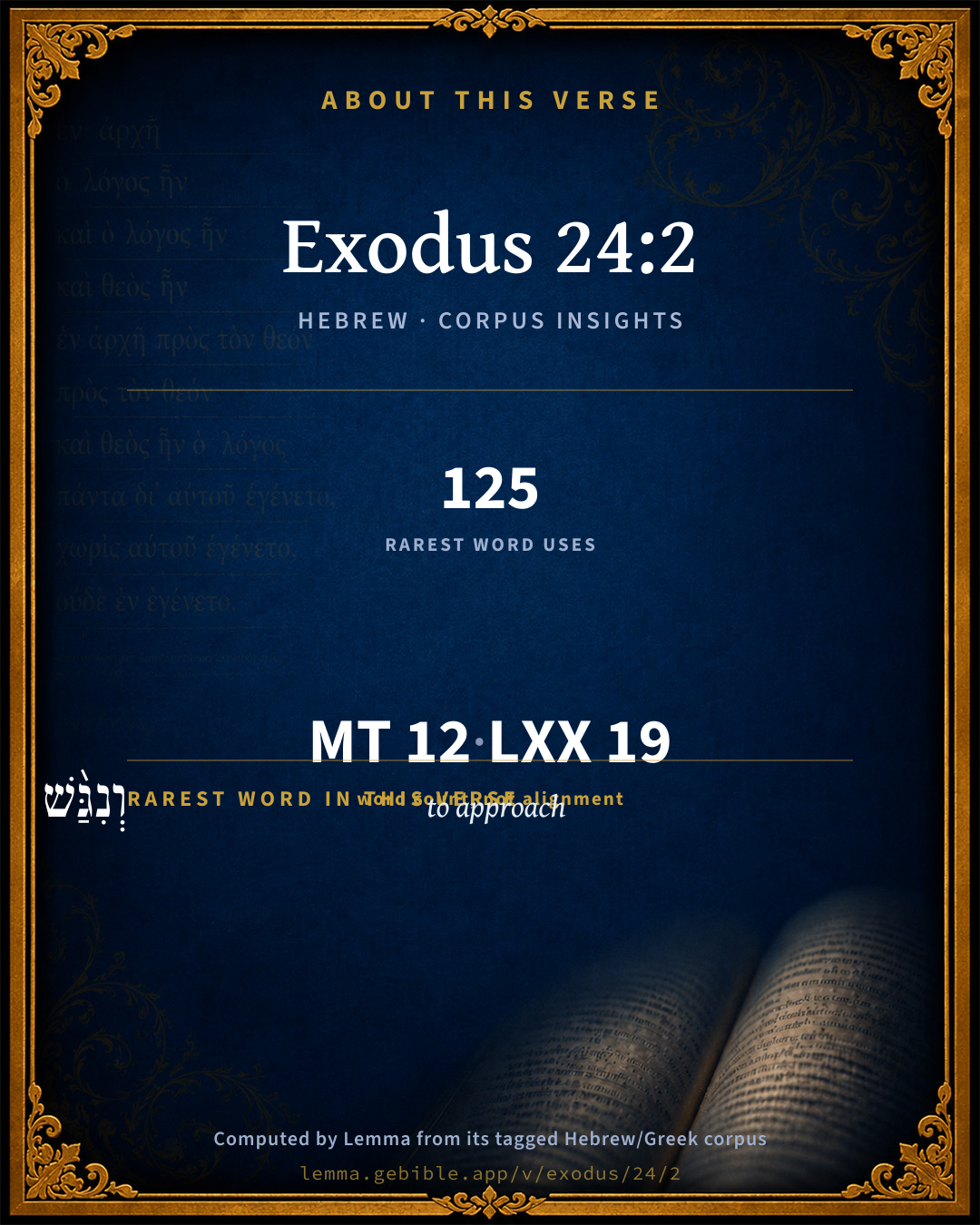
These counts appear in no published source. They are computed here, from the morphology-tagged text and Lemma’s own curated glosses. What Lemma adds →

12
words
10
distinct lemmas
Pentateuch
section

Grammatical profile

  • 3 verbs
  • 4 nouns
  • 1 pronoun
  • 2 prepositions
  • 2 particles

Verb forms

  • וְנִגַּ֨שׁ Niphal · Sequential Perfect
  • יִגָּ֑שׁוּ Qal · Imperfect
  • יַעֲל֖וּ Qal · Imperfect

Repetition

Words recur within this verse — often emphatic in Hebrew:

  • וְנִגַּ֨שׁ to approach H5066 ×2
  • לֹ֣א not H3808 ×2

Hebrew & Septuagint length

In English translation the verse runs 21 words from the Hebrew and 23 from the Septuagint (LXX English) — closely comparable.

A rough comparison of the two English renderings, which tokenize alike — not a word-level alignment.

Word counts can differ between the Hebrew and the Greek without any difference in meaning — e.g. the Hebrew direct-object marker אֵת has no separate Greek word, and Greek often adds the article ὁ.

In the original languages it is 12 Hebrew tokens and 19 Greek tokens — but the two are counted differently (Hebrew bundles its prefixes and suffixes into one token; the Greek is in lemma form), so that isn’t a like-for-like length.

Cross-references

9

Topical passages linked to Exodus 24:2 in the Treasury of Scripture Knowledge — connected by theme and wording, ordered by reader-vote popularity; previews shown in the World English Bible.

  • Exodus 24:13 Moses rose up with Joshua, his servant, and Moses went up onto God's Mountain.
  • Exodus 24:15 Moses went up on the mountain, and the cloud covered the mountain.
  • Exodus 24:18 Moses entered into the midst of the cloud, and went up on the mountain; and Moses was on the mountain forty days and forty nights.
  • Hebrews 10:21–22 and having a great priest over the house of God,
  • Numbers 16:5 and he spoke to Korah and to all his company, saying, In the morning Yahweh will show who are his, and who is holy, and will cause him to come near to him: even him whom he shall choose will he cause to come near to him.
  • Jeremiah 30:21 Their prince shall be of themselves, and their ruler shall proceed from the midst of them; and I will cause him to draw near, and he shall approach to me: for who is he who has had boldness to approach to me? says Yahweh.
  • Jeremiah 49:19 Behold, he shall come up like a lion from the pride of the Jordan against the strong habitation: for I will suddenly make them run away from it; and whoever is chosen, him will I appoint over it: for who is like me? and who will appoint me a time? and who is the shepherd who will stand before me?
  • Hebrews 9:24 For Christ hasn't entered into holy places made with hands, which are representations of the true, but into heaven itself, now to appear in the presence of God for us;
  • Exodus 20:21 The people stayed at a distance, and Moses drew near to the thick darkness where God was.

Cross-references courtesy of OpenBible.info (CC BY 4.0).

Hebrew and Greek witnesses Masoretic Hebrew ↔ Greek Septuagint

The same verse in the two great witnesses to the Old Testament, shown verse-for-verse.

These are two independent witnesses, not word-aligned to each other, and the Septuagint is shown in lemma (dictionary) form.

Hebrew Exodus 24:2 Masoretic · Westminster Leningrad Codex

וְנִגַּ֨שׁ מֹשֶׁ֤ה לְבַדּוֹ֙ אֶל יְהוָ֔ה וְהֵ֖ם לֹ֣א יִגָּ֑שׁוּ וְהָעָ֕ם לֹ֥א יַעֲל֖וּ עִמּֽוֹ

Moses alone shall come near to Yahweh, but they shall not come near, neither shall the people go up with him."

World English Bible · Public Domain

Greek LXX Exodus 24:2 Septuagint · lemma form

καί ἐγγίζω μωυσῆς μόνος πρός ὁ θεός αὐτός δέ οὐ ἐγγίζω ὁ δέ λαός οὐ συν ἀναβαίνω μετά αὐτός

And Moses alone shall draw near to God; and they shall not draw near, and the people shall not come up with them.

LXX2012 (modern English Septuagint) · Public Domain

Hebrew: Westminster Leningrad Codex (CC BY 4.0). Greek: Septuagint (public domain); English from LXX2012 (modern English Septuagint) (Public Domain). How the Septuagint differs from the Hebrew →

Targum (Aramaic paraphrase)

2

The Targum is the ancient Jewish Aramaic paraphrase of the Hebrew Scriptures — an interpretive translation, not the Hebrew text itself. Onkelos (literal) and Pseudo-Jonathan (expansive) render the Torah, and Jonathan the Prophets. Coverage is partial: where no permissively-licensed English translation exists for a verse, only the Aramaic is shown. This is verse-level text, not a word-by-word alignment to the Hebrew.

  1. Targum Onkelos Torah (Genesis–Deuteronomy)
    וְיִתְקְרֵב משֶׁה בִלְחוֹדוֹהִי לִקֳדָם יְיָ וְאִנוּן לָא יִתְקָרְבוּן וְעַמָא לָא יִסְקוּן עִמֵהּ:

    (no public-domain English translation for this verse)

    Targum Onkelos — Aramaic: “Onkelos Genesis” (public domain); “Onkelos Exodus” (public domain); “Onkelos Leviticus” (public domain); “Onkelos Numbers” (public domain); “Onkelos Deuteronomy” (public domain). English: “Sefaria Community Translation” (CC0 1.0 (public-domain dedication)); “J.W. Etheridge. The Targums of Onkelos and Jonathan Ben Uzziel on the Pentateuch. London: Longmans, Green, 1862” (public domain). Text via Sefaria.

  2. Targum Pseudo-Jonathan Torah (Genesis–Deuteronomy)
    וְיִתְקָרֵב משֶׁה בִּלְחוֹדוֹי קֳדָם יְיָ וְהִינוּן לָא יִתְקַרְבוּן וְעַמָּא לָא יִסְקוּן עִמֵּיהּ

    And Mosheh alone shall approach before the Lord; but they shall not draw nigh, nor may the people come up with him.

    Targum Pseudo-Jonathan — Aramaic: “Targum Jonathan on Genesis” (public domain); “Targum Jonathan on Exodus” (public domain); “Targum Jonathan on Leviticus” (public domain); “Targum Jonathan on Numbers” (public domain); “Targum Jonathan on Deuteronomy” (public domain). English: “The Targum of Jonathan ben Uzziel, trans. J. W. Etheridge, London, 1862” (public domain). Text via Sefaria.

Commentary

Notes on Exodus 24:2 from classic Christian and Jewish commentators (each source and its license shown beneath its notes). The classic Christian expositions comment on the surrounding passage and are grouped to its opening verse, so a note may address several verses; the Jewish commentaries on the Tanakh (Rashi and others) are per-verse, so they appear only where the commentator wrote on this verse.

Lemma curates 59 commentaries, every one of them public domain or Creative Commons licensed, each selected and text-cleaned for this edition rather than reprinted as found. About our sources →

Trapp's Complete Commentary

John Trapp

Exo 24:2 And Moses alone shall come near the LORD: but they shall not come nigh; neither shall the people go up with him.

Ver. 2. But they shall not come nigh.] But half-way only. {Exo 24:2} {See Trapp on "Exo 19:12"}

John Trapp, A Commentary or Exposition upon All the Books of the Old and New Testament (1647–1656) — public domain. Text from a community e-Sword module.

Joseph Benson's Commentary

Exo 24:2. And Moses alone shall come near — Being therein a type of Christ, who, as the high-priest, entered alone into the most holy place. In the following verse we have the solemn covenant made between God and Israel, and the exchanging of the ratifications: typifying the covenant of grace between God and believers through Christ.

Joseph Benson's Commentary on the Old and New Testaments (1811–1818) — public domain. Text from a community e-Sword module.

Adam Clarke's Commentary

Verse 2. Moses alone shall come near] The people stood at the foot of the mountain. Aaron and his two sons and the seventy elders went up, probably about half way, and Moses alone went to the summit.

Adam Clarke's Commentary on the Bible (1810–1826) — public domain. Text from a community e-Sword/MySword module.

The Cambridge Bible for Schools and Colleges

gen. ed. J. J. S. Perowne

2. they (emph.)] Aaron, his two sons, and the elders.

neither, &c.] Observe the gradation: the people generally are to remain at the foot of the mountain; Aaron, his two sons, and the elders come partly up the mountain; only Moses goes to the top (cf. Exo_19:21, Exo_20:21).

The Cambridge Bible for Schools and Colleges (gen. ed. J. J. S. Perowne; Cambridge University Press, 1878–1918) — public domain. Text from a community e-Sword module.

John Gill's Exposition

And Moses alone shall come near the Lord,.... Into the cloud where he was, and talk with him face to face, as a man talketh with his friend; which was great nearness indeed, and a peculiar favour and high honour was this:

but they shall not come nigh; Aaron, Nadab, and Abihu, and the seventy elders of Israel:

neither shall the people go up with him; not any of them, much less the whole body. It seems, by this account, that Moses had been down from the mount after he had received the laws recorded in the two preceding chapters; though as yet he had not related them to the people, but did before he went up again by the above order, as appears from what follows.

John Gill's Exposition of the Whole Bible (1746–1763) — public domain (CC PDM 1.0). Text via the HelloAO Bible API.

Matthew Poole's English Annotations

Moses alone, i.e. without the persons now mentioned, though not without Joshua his minister, as some conceive from Exo 24:13, though even there Moses seems to ascend into the mount without Joshua.

Neither shall the people go up with him to any part of the mount, as Aaron, and Nadab, &c. did, but they shall tarry at the bottom. See Exo 19:12.

Matthew Poole's English Annotations on the Holy Bible (1683–1685) — public domain. Text from a community e-Sword/MySword module.

Whedon's Commentary on the Bible

Daniel D. Whedon

2. Moses alone shall come near the Lord — Here was a symbolical outline of what was afterward formally fixed in the Levitical code. Moses represented the highpriest, who went alone into the most holy place, (Lev_16:17,) and these others the ordinary consecrated priests who might minister in the holy place, and at the altar, while the people were required to remain in the distance.

Daniel D. Whedon (gen. ed.), Commentary on the Old and New Testaments (1874–1909) — public domain. Text from a community e-Sword module.

John Wesley's Explanatory Notes

And Moses alone shall come near - Being therein a type of Christ, who as the high priest entered alone into the most holy place. In the following verses we have the solemn covenant made between God and Israel and the exchanging of the ratifications: typifying the covenant of grace between God and believers through Christ.

John Wesley, Explanatory Notes Upon the Whole Bible (1754–1765) — public domain. Text via the GEBible commentary corpus.

Rashi

Rabbi Shlomo Yitzchaki (Rashi)

ונגש משה לבדו AND MOSES ALONE SHALL STEP NEAR unto the thick darkness (cf. Exodus 20:18).

Rashi on the Tanakh — English translations: “The Judaica Press complete Tanach with Rashi, translated by A. J. Rosenberg” (CC BY 4.0); “Pentateuch with Rashi's commentary by M. Rosenbaum and A.M. Silbermann, 1929-1934” (public domain); “The Metsudah Tanach series, Lakewood, N.J” (CC BY 4.0); and “The Book of Joshua, Metsudah Publications, 1997” (CC BY 4.0). Text via Sefaria.

Ramban (Nachmanides)

Rabbi Moshe ben Nachman (Ramban / Nachmanides)

AND MOSES ALONE SHALL COME NEAR UNTO THE ETERNAL. In the opinion of Rabbi Abraham ibn Ezra this too is a case where a proper name is used instead of a pronoun, for after the expression, Come up unto the Eternal, it should have said, “and you alone shall come near,” but such is the Scriptural style, as I have mentioned. Similarly: And the Eternal caused to rain upon Sodom and upon Gomorrah brimstone and fire from the Eternal, which means “from Him;” And Moses said unto Hobab, the son of Reuel the Midianite, Moses’ father-in-law, which means “his father-in-law.” Also: And the Eternal sent Jerubaal, and Bedan, and Jephthah, and Samuel, and similarly: Then Solomon assembled the elders of Israel, and all the heads of the tribes… unto King Solomon. The correct interpretation here appears to me to be that this commandment was addressed also to Aaron, and he too heard the Voice of G-d saying to Moses, Come up unto the Eternal, thou, and Aaron, Nadab and Abihu, and seventy of the elders of Israel; and worship ye afar off. And if so, it was necessary that the name of the one who was to draw near [i.e., Moses] be expressly mentioned, for it was he alone who was to come near [and not Aaron]. And even if [we were to explain that when G-d said, Come up unto the Eternal etc.] He spoke to Moses directly [and Aaron did not hear it], it would still be necessary to explain that “you Moses alone shall come near unto the Eternal,” and the mere pronoun “thou” would not have sufficed. Therefore He said, And Moses alone shall come near; but they shall not come near. This is the reason for the word l’vado (alone), to exclude Aaron who had been included previously with Moses as far as the commandment [to “come up”].

Ramban (Nachmanides) on the Tanakh — English translation: “Commentary on the Torah by Ramban (Nachmanides). Translated and annotated by Charles B. Chavel. New York, Shilo Pub. House, 1971-1976” (CC BY 4.0). Text via Sefaria.

Lesson kit

Teaching starters — assembled from the data on this page, not authored interpretation. Every prompt links to the verse data it draws on. Edit before teaching.

Exodus, in the Pentateuch, opens this verse with 12 words (10 distinct Hebrew lemmas). Its most distinctive word is nâgash (“to approach”). A historical commentator’s framing appears above. Read the whole chapter for the surrounding context.

Discussion questions

  1. The word nâgash carries the sense “to approach.” How does it shape the verse?
  2. Exodus 24:13 shares this passage’s theme. How do the two illuminate each other?
  3. “to approach” occurs 2× in this one verse. What is the effect of the repetition?
  4. These translations render this verse differently. What is at stake in choosing one wording over another?
  5. The verb «וְנִגַּ֨שׁ» is Niphal Sequential Perfect. How does its form color the action?
  6. Reading how Trapp's Complete Commentary and Joseph Benson's Commentary read this verse, where do the two commentators agree and where do they part?

Things to notice

Reading settings

Reading text

Shown beneath each verse's original-language words.

Old Testament
Old Testament edition

Read the OT as the Masoretic Hebrew (MT) or the Greek Septuagint (LXX).

English shown for the Greek Septuagint (in the Hebrew ↔ Greek comparison).

Comparing translations? Open the Compare panel on any verse page to stack up to four side by side.