
Numbers 20:25

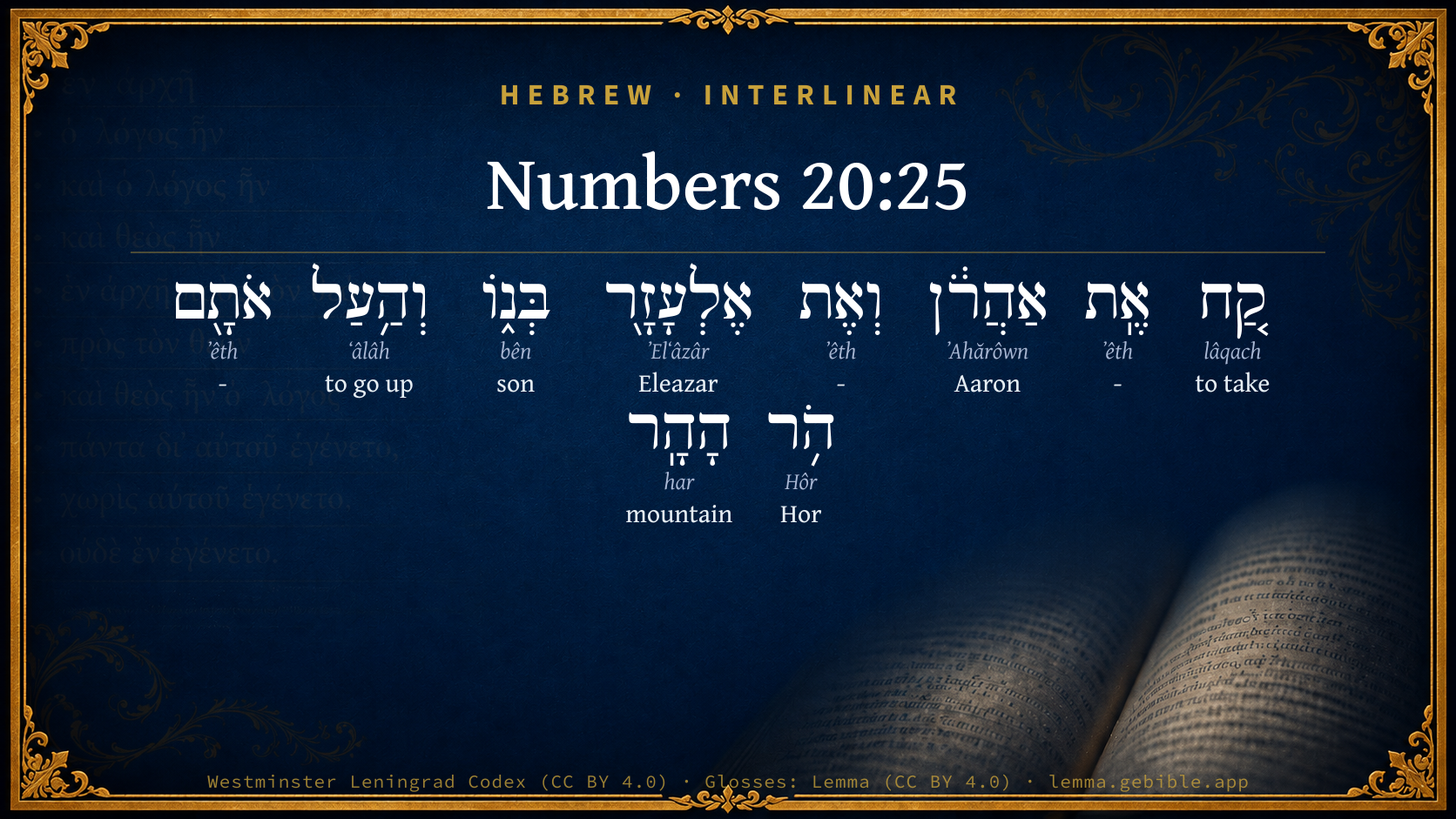
Hebrew (Westminster Leningrad Codex) Numbers 20:25 appears in the Hebrew Old Testament. The text above is from the Westminster Leningrad Codex. Each word links to its Strong’s number, a concise gloss, and parsing drawn from the Open Scriptures Hebrew Bible morphology. Click any word for its full Brown-Driver-Briggs (BDB) entry.
Download image
Cite this verse

Numbers 20:25 (World English Bible). Public Domain. Lemma interlinear Bible study tool, https://lemma.gebible.app/v/numbers/20/25.

Show BibTeX & RIS
BibTeX
RIS
English Translation
Take Aaron and Eleazar his son, and bring them up to Mount Hor;
World English Bible · Public Domain
Download a study sheet

One document with this verse’s original text, its word-by-word gloss line, the meaning frame, cross-references with their text, attributed commentary, and full source and license credits — printable, and it pastes into notes with its structure intact.

This verse Autodidact and up

Study sheet (.html) Plain text (.txt)

A passage Seminary Student

Up to 50 verses in one chapter. A passage sheet keeps up to 6 commentary sources and 12 cross-references per verse, in the order this page ranks them, and says so on the sheet whenever that leaves anything out. Ask for a single verse and you get the Autodidact verse sheet above.

Everything on this page stays free to read, with no account — the sheet is a download of what is already on screen, not access to it.

Want to remove ads? Support Godless Engineer
Compare translations 3

The same verse in 3 English versions, stacked beneath the original-language interlinear above. Click any original word for its lexicon entry.

Each is an independent rendering of the whole verse — the interlinear is not word-aligned to these translations.

Highlighted words mark where these versions differ — a whole-verse word diff, not a word-by-word alignment.

  • World English Bible Public Domain
    Take Aaron and Eleazar his son, and bring them up to Mount Hor;
  • King James Version Public Domain
    Take Aaron and Eleazar his son, and bring them up unto mount Hor:
  • unfoldingWord Literal Text CC BY-SA 4.0
    Take Aaron and Eleazar his son and bring them up Mount Hor.

unfoldingWord Literal Text — © unfoldingWord, licensed CC BY-SA 4.0. Word-aligned USFM3 via Door43 (git.door43.org/unfoldingWord/en_ult).

Versions to compare (up to 4)

3 of 4 selected

Show all 18 translations

Every available English version of this verse, each an independent rendering of the whole verse.

  • World English Bible Public Domain
    Take Aaron and Eleazar his son, and bring them up to Mount Hor;
  • Berean Standard Bible Public Domain
    Take Aaron and his son Eleazar and bring them up Mount Hor.
  • Majority Standard Bible Public Domain
    Take Aaron and his son Eleazar and bring them up Mount Hor.
  • King James Version Public Domain
    Take Aaron and Eleazar his son, and bring them up unto mount Hor:
  • American Standard Version (1901) Public Domain
    Take Aaron and Eleazar his son, and bring them up unto mount Hor;
  • Revised Version (1885) Public Domain
    Take Aaron and Eleazar his son, and bring them up unto mount Hor:
  • Geneva Bible (1599) Public Domain
    Take Aaron and Eleazar his sonne, and bring them vp into the mount Hor,
  • Douay-Rheims (1899) Public Domain
    Take Aaron and his son with him, and bring them up into mount Hor:
  • Young's Literal Translation Public Domain
    `Take Aaron and Eleazar his son, and cause them to go up mount Hor,
  • Literal Standard Version CC BY-SA 4.0
    Take Aaron and his son Eleazar, and cause them to go up Mount Hor,
  • Unlocked Literal Bible CC BY-SA 4.0
    Take Aaron and Eleazar his son, and bring them up to Mount Hor.
  • unfoldingWord Literal Text CC BY-SA 4.0
    Take Aaron and Eleazar his son and bring them up Mount Hor.
  • Darby Bible Public Domain
    Take Aaron and Eleazar his son, and bring them up unto mount Hor,
  • World Messianic Bible Public Domain
    Take Aaron and Eleazar his son, and bring them up to Mount Hor;
  • Webster's Bible Public Domain
    Take Aaron and Eleazar his son, and bring them up to mount Hor:
  • Free Bible Version CC BY-SA 4.0
    Have Aaron and his son Eleazar join you and climb up Mount Hor together.
  • Bible in Basic English Public Domain
    So take Aaron and Eleazar, his son, up into Mount Hor;
  • JPS Tanakh (1917) Public Domain
    Take Aaron and Eleazar his son, and bring them up unto mount Hor.

Literal Standard Version (2020), Covenant Press — licensed CC BY-SA 4.0. Text via the HelloAO Bible API (eBible.org). Unlocked Literal Bible (unfoldingWord) — licensed CC BY-SA 4.0. Text via the HelloAO Bible API (eBible.org). unfoldingWord Literal Text — © unfoldingWord, licensed CC BY-SA 4.0. Word-aligned USFM3 via Door43 (git.door43.org/unfoldingWord/en_ult). Free Bible Version, Dr. Jonathan Gallagher — licensed CC BY-SA 4.0. Text via the HelloAO Bible API (eBible.org).

Word by word

More ways to search: Search by grammar → Find every occurrence → Compare this word →

Practice this passage: Drill this verse → Learn its vocabulary →

הֹ֥ר
Hôr
H2023
“Hor”
Noun, Proper
Part of Speech
Noun
Type
Proper
Full BDB Definition

Origin: another form of H2022

TWOT: None

Hor = "mountain" - the mountain on which Aaron died; situated on the eastern side of the valley of Arabah, the highest of the whole range of sandstone mountains in Edom; on the eastern side is the ancient city of Petra - the mountain named as one of the marks of the northern boundary of the land which the children of Israel were about to conquer; located in Lebanon
  1. קַ֚ח lâqach H3947 “take” Verb, Qal, Imperative, 2nd Person, Masculine, Singular
  2. אֶֽת ʼêth H853 “-” Particle, Direct Object
  3. אַהֲרֹ֔ן ʼAhărôwn H175 “Aaron” Noun, Proper
  4. וְאֶת ʼêth H853 “and · -” Conjunction + Particle, Direct Object
  5. אֶלְעָזָ֖ר ʼElʻâzâr H499 “Eleazar” Noun, Proper
  6. בְּנ֑וֹ bên H1121 “son · his” Noun, Common, Masculine, Singular, Construct + Suffix, Personal, 3rd Person, Masculine, Singular
  7. וְהַ֥עַל ʻâlâh H5927 “and · go up” Conjunction + Verb, Hiphil, Imperative, 2nd Person, Masculine, Singular
  8. אֹתָ֖ם ʼêth H853 “- · them” Particle, Direct Object + Suffix, Personal, 3rd Person, Masculine, Plural
  9. הָהָֽר har H2022 “the · mountain” Particle, Definite Article + Noun, Common, Masculine, Singular, Absolute

About this verse

These counts appear in no published source. They are computed here, from the morphology-tagged text and Lemma’s own curated glosses. What Lemma adds →

10
words
8
distinct lemmas
Pentateuch
section

Notable vocabulary

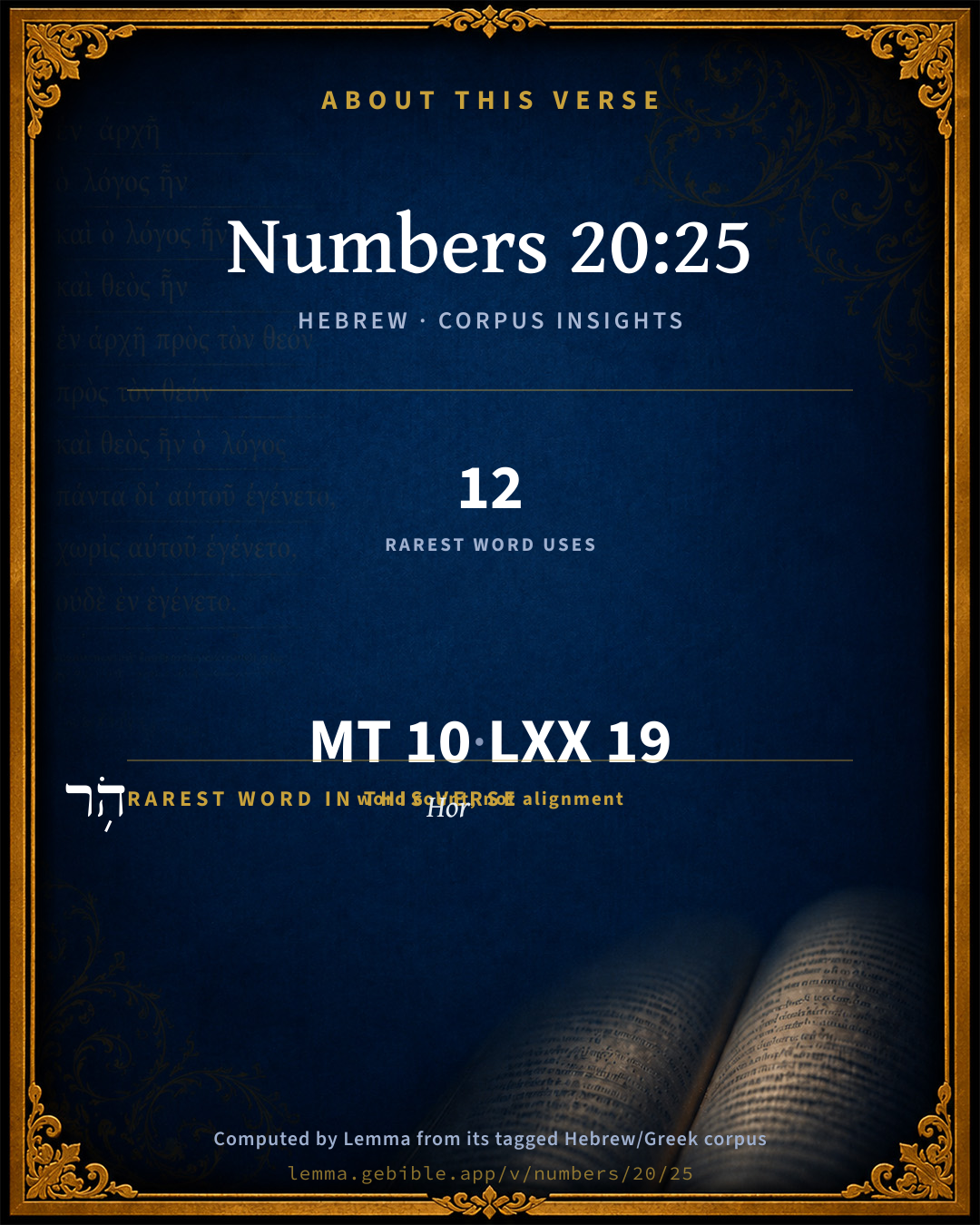
The rarest word here is הֹ֥ר Hor H2023 — appearing just 12 times in the whole Hebrew Bible.

Shared distinctive vocabulary

הֹ֥ר Hor H2023 occurs in 12 verses of the Hebrew Bible. Also found in:

Grammatical profile

  • 2 verbs
  • 5 nouns
  • 3 particles

Verb forms

  • קַ֚ח Qal · Imperative
  • וְהַ֥עַל Hiphil · Imperative

Hebrew & Septuagint length

In English translation the verse runs 13 words from the Hebrew and 18 from the Septuagint (LXX English) — closely comparable.

A rough comparison of the two English renderings, which tokenize alike — not a word-level alignment.

Word counts can differ between the Hebrew and the Greek without any difference in meaning — e.g. the Hebrew direct-object marker אֵת has no separate Greek word, and Greek often adds the article ὁ.

In the original languages it is 10 Hebrew tokens and 19 Greek tokens — but the two are counted differently (Hebrew bundles its prefixes and suffixes into one token; the Greek is in lemma form), so that isn’t a like-for-like length.

Cross-references

1

Topical passages linked to Numbers 20:25 in the Treasury of Scripture Knowledge — connected by theme and wording, ordered by reader-vote popularity; previews shown in the World English Bible.

  • Numbers 33:38–39 Aaron the priest went up into Mount Hor at the commandment of Yahweh, and died there, in the fortieth year after the children of Israel were come out of the land of Egypt, in the fifth month, on the first day of the month.

Cross-references courtesy of OpenBible.info (CC BY 4.0).

Hebrew and Greek witnesses Masoretic Hebrew ↔ Greek Septuagint

The same verse in the two great witnesses to the Old Testament, shown verse-for-verse.

These are two independent witnesses, not word-aligned to each other, and the Septuagint is shown in lemma (dictionary) form.

Hebrew Numbers 20:25 Masoretic · Westminster Leningrad Codex

קַ֚ח אֶֽת אַהֲרֹ֔ן וְאֶת אֶלְעָזָ֖ר בְּנ֑וֹ וְהַ֥עַל אֹתָ֖ם הֹ֥ר הָהָֽר

Take Aaron and Eleazar his son, and bring them up to Mount Hor;

World English Bible · Public Domain

Greek LXX Numbers 20:25 Septuagint · lemma form

λαμβάνω ὁ ἀαρών καί ελεαζαρ ὁ υἱός αὐτός καί ἀναβιβάζω αὐτός εἰς ωρ ὁ ὄρος ἔναντι πᾶς ὁ συναγωγή

Take Aaron, and Eleazar his son, and bring them up to the mount Or before all the congregation;

LXX2012 (modern English Septuagint) · Public Domain

Hebrew: Westminster Leningrad Codex (CC BY 4.0). Greek: Septuagint (public domain); English from LXX2012 (modern English Septuagint) (Public Domain). How the Septuagint differs from the Hebrew →

Targum (Aramaic paraphrase)

2

The Targum is the ancient Jewish Aramaic paraphrase of the Hebrew Scriptures — an interpretive translation, not the Hebrew text itself. Onkelos (literal) and Pseudo-Jonathan (expansive) render the Torah, and Jonathan the Prophets. Coverage is partial: where no permissively-licensed English translation exists for a verse, only the Aramaic is shown. This is verse-level text, not a word-by-word alignment to the Hebrew.

  1. Targum Onkelos Torah (Genesis–Deuteronomy)
    דְבַר יָת אַהֲרֹן וְיָת אֶלְעָזָר בְּרֵיהּ וְאַסֵיק יָתְהוֹן לְהֹר טּוּרָא

    (no public-domain English translation for this verse)

    Targum Onkelos — Aramaic: “Onkelos Genesis” (public domain); “Onkelos Exodus” (public domain); “Onkelos Leviticus” (public domain); “Onkelos Numbers” (public domain); “Onkelos Deuteronomy” (public domain). English: “Sefaria Community Translation” (CC0 1.0 (public-domain dedication)); “J.W. Etheridge. The Targums of Onkelos and Jonathan Ben Uzziel on the Pentateuch. London: Longmans, Green, 1862” (public domain). Text via Sefaria.

  2. Targum Pseudo-Jonathan Torah (Genesis–Deuteronomy)
    דְבַר יַת אַהֲרן וְיַת אֶלְעָזָר בְּרֵיהּ וְאַסֵיק יַתְהוֹן לְטַוְורוֹס אוּמָנוֹס

    Take Aharon and Elazar his son, and make them come up to Mount Umanom.

    Targum Pseudo-Jonathan — Aramaic: “Targum Jonathan on Genesis” (public domain); “Targum Jonathan on Exodus” (public domain); “Targum Jonathan on Leviticus” (public domain); “Targum Jonathan on Numbers” (public domain); “Targum Jonathan on Deuteronomy” (public domain). English: “The Targum of Jonathan ben Uzziel, trans. J. W. Etheridge, London, 1862” (public domain). Text via Sefaria.

Commentary

Notes on Numbers 20:25 from classic Christian and Jewish commentators (each source and its license shown beneath its notes). The classic Christian expositions comment on the surrounding passage and are grouped to its opening verse, so a note may address several verses; the Jewish commentaries on the Tanakh (Rashi and others) are per-verse, so they appear only where the commentator wrote on this verse.

Lemma curates 59 commentaries, every one of them public domain or Creative Commons licensed, each selected and text-cleaned for this edition rather than reprinted as found. About our sources →

The Biblical Illustrator

Joseph S. Exell

Num_20:25-29

Aaron died there in the top of the mount.

The death of Aaron

The first and most superficial aspect of death is that it is the close of an earthly career. What kind of career was it that was brought to a close when Aaron died? First of all, there could be no question as to its prominence. Aaron shares with Moses, though as a subordinate, the glory of having ruled and shaped the course and conduct of his countrymen at a time of unexampled difficulty, at a time pregnant with the highest consequences to the religious future of the world. But Aarons place in religious history is more distinctly measured if we consider the great office to which he was called. He was the first of a long line of men who were at the head of what was for ages the only true religion in the world. He was the first high priest of the chosen people. Office, however, and position is one thing; character is another; and, if it is here that we find a great difference between the brothers, we must first of all remind ourselves that Aaron is called in Scripture the saint of the Lord. He must have had a great background of those high qualities which go to make up the saintly character, if he also had defects which are recorded for our instruction. Aaron was morally a weak man. He had no such grasp of principle as would enable him to hold out against strong pressure. Nor is it inconsistent with this that Aaron could display obstinate self-assertion on inopportune occasions, as when he joined his sister Miriam in murmuring against Moses. This is exactly what weak people do; they give way when true loyalty to duty would teach them to resist, and then, haunted by the notion that they are weak, or at least that the world will think them so, they indulge in some form of spasmodic self-assertion which may remind us of the ungainly efforts that invalids will sometimes make to show that they are not quite so ill as their friends may think them. And now the end had come. Moses and Aaron both knew that Aaron would die. It may have been that some hitherto unsuspected disease had shown itself in the constitution of the old man; it may have been, as has been suggested, that a sand-storm in the Arabah had withered up his decaying vitality. That Aaron would die might have been known from observation, as God often speaks to us through the wonted changes of the world of nature. But Aaron and Moses also knew why Aaron was to die, and why on Mount Hor. If we knew enough, we should all of us know that there is a reason in the Divine mind for the hour at which, as for the means by which, every man and woman departs this life. We all are interested in ascertaining as exactly as we can the physical reason of the death of those relations whom God in His providence removes from our sight; but behind the physical reason there is a moral reason, if we could only know it; and we may say, with confidence, that, in the eyes of God, who is the perfect moral Being, the moral reason accounts for much more than the physical. Sometimes a life is prolonged to do one single piece of work which no other would do as well, and as soon as that work is done, that life is withdrawn. Sometimes a life is cut short because it has forfeited the particular privilege which an extension of some months or even weeks would bring to it, and this was the case of Aaron--And the Lord spake unto Moses and Aaron in Mount Hor, by the coast of the land of Edom, saying Aaron shall be gathered to his people, for he shall not enter into the land which I have given to the children of Israel because he rebelled against My word at the waters of Meribah. Aarons share in the sin of Meribah was due to the same want of firmness which, as we have seen, was a feature in his character. The sin of Meribah was, in the first instance, the sin of Moses, when the people murmured at the want of water, and Moses, worried no doubt by their perverseness, in the very act of relieving them betrayed, both by what he said and by what he did, a temper unworthy of his high office, so that he did not sanctify the Lord God in the eyes of the people. As a later Psalmist reflects--The people angered God at the waters of strife, so that He punished Moses for their sakes, because that they provoked his spirit so that he spake unadvisedly with his lips. As for Aaron, he not only did not check Moses, he acquiesced in what he must have known to be dishonourable to God; and this in a man with his spiritual responsibilities was a grave failure of duty. Much more, Moses bad forfeited that high privilege, but then the work which Moses had to do in the world was not yet done. But Aarons appointed work was done, and there was no reason for delaying his summons. And here we are led to reflect on a subject which too often escapes notice. Many men, probably the majority of those who do not incur eternal loss, yet do from some flaw in the character, from some warp or weakness in the will, fall, more or less, greatly short of what they might have been, of what natural powers and spiritual endowments and religious and other opportunities might have made them even in this world; and if here, then also hereafter, even if by Gods mercy in Christ we reach it, it may be to fill a lower rather than what might have been a higher place, but for some compliance with what conscience condemned, but for some act or some omission which has left upon the soul and the character that lasting impress which survives death. There is much to be noticed in the account of the close of Aarons life, but nothing is more worthy of our notice than his deliberate preparation for it. He did not let death come on him, he went to meet it. The last scene was as much a matter of duty, a matter of business, as his consecration to the high priesthood Ah I death, surely, is like a mountain-top for the survey which it gives to life, and the deserts through which we have wandered, and the barriers which have checked our progress, and the hopes, bright or dim, which have cheered us on, and the feebleness and the fear of man, and the self-seeking, and the petty vanity (if nothing worse) which have spoiled so much that God meant for Himself, standout in clear outlines above the haze of the distant past. Doubtless it was with Aaron as with any man who retains, along with a conscience that has not been seared, the free exercise of the minds powers in those last solemn moments which precede the greatest of all changes--doubtless, it was with him as with others upon whom their position and work in life have entailed great responsibility for the real and lasting happiness or misery of their fellow men. At such times the simply conventional no longer satisfies. At such times standards of conduct that are natural to human sanction are seen to be no longer applicable, the mental eye sees through and beyond the phrases which inclination or passion have hitherto interposed between it and the past. It sees the past more nearly, not as self-love has wished it to be, but as it was. At such times the higher a mans place in the government, or the social fabric of the state, or in the hierarchy of the Church, the more sincerely must he breathe the prayer, If Thou, Lord, shouldest be extreme to mark what is done amiss, O Lord, who may abide it? But time was passing. The last moments were now at hand; so Moses, acting, as we know, under Divine instructions, stripped Aaron of his garments, and put them upon Eleazar his son. There was, no doubt, a two-fold motive in this act of Moses. It showed, first of all, that the office of the high priesthood did not depend on the life of any single man, that God was watching over the religious interests of His people, that His gifts and calling were, as the apostle says, without repentance, without recall, and that He provides for the due transmission of those spiritual faculties which have been given that they may sustain the higher life of man from age to age. But it also reminded Aaron personally of the solemn truth of the utter solitariness of the soul in death. Not more than any other man can a high priest retain the outward position, the valued symbols, of his great office. He, too, shall carry nothing away with him when he dieth, neither shall his pomp follow him. Death strips us of everything save that which, so far as we know, is by Gods appointment strictly indestructible. Our undying personality and that type of character which acts and habits and the use or misuse of the supernatural grace of God have, for good or for evil, wrought into its very texture--this is indeed for ever ours. All else is, like the sacerdotal robes of Aaron, to be abandoned, at the place where, at the moment when, we lie down to die. It was all over. Aaron had closed his eyes, and Moses buried him where at this day a Moslem shrine, constructed out of the ruins of some earlier and finer edifice, still bears his name. It was all over, and like a procession returning from a funeral without the one object which had formed its chiefest interest, Moses and Eleazar, so we are told, came down from the mount. What were their thoughts about Aaron? Where was he now? Aaron, so runs the phrase of Moses, was gathered to his people. What does the phrase mean? It is used alike of Moses and Aaron. Does it describe only the interment of their bodies? But in either case their bodies rested at a distance from their people, in a foreign soil. Surely, it points to a world in which the bygone generations of men still live, a world of the existence of which Gods ancient people were well assured, though they knew much less of it than we. That world beyond the grave is no doubt presented with different degrees of clearness in the successive ages of Old Testament history. The age of the patriarchs is marked by strong and distinct faith in it. In the days and teaching of Moses it is more kept in the background, probably because the imagination of Israel was still haunted by the imagery of the underworld of the dead, as the Egyptians had conceived of it. In Job and some of the Psalms it is the subject sometimes of anxious discussion, sometimes of strong and undoubting faith. In the prophets it comes prominently forward as the promised Messiah, heralded not merely as an earthly ruler, but as a deliverer from the consequences of sin. In Ezekiel and Daniel we already meet with the resurrection of the body; in the writers after the captivity this doctrine goes hand in hand with a distinct faith in the immortality of the soul. We cannot doubt that, as Moses and Eleazar made their way down the western side of the mount on which Aaron was left, their thoughts were not only or chiefly centred on the tomb which enclosed his body; they followed him into the assembly of the spirits of the dead, they followed him with their sympathies, with their hopes, their prayers, even though around that world on which he had entered there still hung a veil for them which has been, through Christs mercy, removed for us. The Old Testament is sometimes a foreshadowing of the new, sometimes its foil. If Aaron was stripped of his sacerdotal robes on the eve of his death, Jesus our Lord was never more a priest than when He hung upon His Cross, and offered Himself as a full, perfect, and sufficient sacrifice, oblation and satisfaction for the sins of the whole world. If Aarons dust still lies somewhere among the rocks of Hor, awaiting the summons to judgment, Jesus is indeed risen from the dead, and become the first fruits of them that slept, nay, He has already, He has here, brought life and immortality to light through His gospel, He has taught us that there is a life which through His grace we may live, and the beauty of which our hearts cannot but own, while yet that life does but mock us if it ends at death, if it does not last, if it does not expand, hereafter. Be has shown us how this life may be, if at present it is not ours, and in possessing it we are already and most assuredly more than conquerors of death through Him that loved us. (Canon Liddon.)

The death of Aaron

I. The death of Aaron.

1. As a consequence of sin.

2. By the appointment of God.

3. The death of Aaron was his introduction to life and to congenial society.

II. The appointment of Aarons successor.

1. Kindness to Aaron. It assured him--

(1) That his office would be filled, his work carried on, &c.

(2) That his office would be filled by his own son ; that the high priesthood would continue in his own family.

2. A guarantee of the continuance of the Church of God.

III. The mourning because of Aarons death.

1. The worth of faithful ministers.

2. The appreciation of blessings when they are withdrawn from us, which were not valued when they were ours.

Lessons:

1. The universality of death.

2. The imperfection of the Aaronic priesthood.

3. The perfection of the priesthood of Christ (Heb_7:22-28; Heb_8:6; Heb_9:23-28; Heb_10:10-14). (W. Jones.)

Death of Aaron

I. The time. In the fortieth year of the wanderings.

1. A very important year in the history of Israel. Year of death also of Miriam and of Moses. Dates that mark formation of new or severance of old friendships, always important.

2. In about the 123-4 year of Aarons life. A long and eventful life. And yet, though his life was long--

(1) His death was hastened by sin. How often should we discover this to be the case if we knew all! Religion the best life-preserver.

(2) His death overtook him in the midst of work.

II. The warning. Many pass away without any warning. Duty of being always ready. In this case, a solemn intimation that the time appointed had come. It was kindly framed. Gathered unto his people. An old mans best friends--his people--are mostly in the better world. Aaron invited to join his people; the great ones amongst whom he ranked.

III. The place. A mountain. Reminds us that the good man in death is in death lifted up above the world ; and that, as Aaron at that time, he dies in view of the Church below and the Church above. Israel around, and the promised land before him.

IV. The circumstances. Toilsomely and calmly ascends the hill to be gathered to his fathers. The old man climbing the last of lifes hills. The last stage a rugged one.

V. The characteristics. A death--

1. Hastened by sin.

2. Closing all earthly offices and distinctions.

3. Heralded by solemn intimations.

4. Sweetened by presence of friends.

Learn--

1. A good man in dying is gathered to his people.

2. Seek to live on the borders of heaven that we may die in view of the promised land.

3. Endeavour to do what we have to do while it is called to-day. (J. C. Gray.)

The death of Aaron

I. We may learn a salutary lesson from the death of Aaron in its merely literal bearing. Aaron, the high priest, had to ascend Mount Hor clad in his priestly robes of office; but he must be stripped of them there, because he must die there. He could not carry his dignity or the emblems of it into the next world. He must lay them down at the graves brink. There is nothing which the world gives that men can carry with them when death lays hold of them. Even all which outwardly pertains to spiritual dignity, and which brings men into relation with things that are imperishable and eternal, must be left behind, and the individual man, as Gods accountable creature, must appear before his Maker in judgment. There is one thing imperishable and one dignity which even death cannot tarnish. The imperishable thing is the life which the Spirit of God imparts to the soul, and which connects the soul with God. The deathless dignity is that of being children of God.

II. Aaron must be stripped of his robes, and his son clad with them in his stead. This reminds us that while the priests under the law were not suffered to continue by reason of death, yet the office of the priesthood did not lapse. Aarons robes were not buried with him. His successor was provided. Yet the very thought that he needed a successor, that the office must be transmitted from one to another, leads us to think of the contrast which the apostle draws between the priests under the law and Him who abideth always. Jesus Christ is the same yesterday, to-day, and for ever. (A. B. Davidson.)

The good and faithful servant

I. The common destiny of man. Aaron, says God, shall be gathered to his people. Death is spoken of here, not as a strange event, not as something peculiar to Aaron, but as something that had happened to Aarons people, and would happen to all generations. Oh, the teeming myriads that preceded us, that carried on the works, the commerce, and the reforms of our world; all these, so far as the body is concerned--all dust!

II. The rigorousness of moral law. Here is a man who had struggled hard for many years in the wilderness, a man filled with high hopes, with glowing enthusiasm, a man who was approaching the goal, approaching the Canaan; and yet mark how, because of one sin, he dies, and never reaches that blessed spot. However distinguished a man may be for his excellences, however high he may be in the Church of God, his sin shall not go unpunished.

III. The termination of life in the midst of labour. We nearly all die with our work unfinished. The farmer dies when he has only half ploughed his field ; the merchant dies in the midst of some commercial enterprise to which he has committed himself; the statesman dies with some great political measure, perhaps, heavy on his hands; the minister dies with some schemes of thought in his brain unwrought out, some plans of usefulness undeveloped. That to me is a profound mystery. I should have thought that a man who had in his brain a great purpose to serve his race, to promote the truth, and to extend the kingdom of Christ, would have his life preserved, that he might realise his purpose. But it is not so. O God! we are not surprised when an old tree, though prolific in its day, dies, for it dies by the law of decay; nor are we astonished that an unfruitful tree should be cut down, for it is a cumberer of the ground; but we are astonished that a tree, with its branches full of sap, with its boughs laden with fruit, with thousands reposing under its shadow, should be struck with a thunderbolt from heaven. Thy path, O God, is in the great waters, and Thy footsteps are not known.

IV. Gods agency in mans dissolution. Why did Aaron die? He was not worn out with age. He was as vigorous, perhaps, at that moment, as anybody here. Not because there was disease rankling in his system, not because there was any external violence applied to him. Why, then, did he die? The Great One determines that he shall die, and he dies. And this, I take it, is always the philosophy of a mans death. We may ascribe it to that disease, to this accident, to this chance, to this occurrence ; but philosophy, the Bible, and reason all say, man dies because the Great One has determined that he should die. If you will ascertain the term of a creature s existence, you can only do it accurately by ascertaining the will of the great God concerning his existence. The constitution has nothing whatever to do with the question. If God determines it, the most robust dies in a moment,

V. The promptitude with which providence supplies the places of the dead. Aaron must die, but there is Eleazar standing by his side ready to step into his place. This is the order of Providence. A merchant dies, and another man stands by his side ready to carry on his business. A lawyer dies, and there is a man standing by his side ready in a moment to step into the place he occupied. A statesman dies, and Providence has a man exactly fitted for his position. Oh, how this encourages my faith in the progress of Divine truth in this world! I see missionaries die in the field, and ministers die in the Church; I see authors die who are moving the minds of men, and influencing them for their highest good; and sometimes I feel, now, surely there must be a pause. But no, there is another minister ready to take the departed ministers place. You labour, and other men enter into your labours; and when the mystery of godliness shall be finished, I believe the great series of workers will meet and mingle and rejoice together in the presence of the great common Father of us all. But whilst this encourages our faith, it is certainly humbling to our pride. The world can do without thee. Thou art but a blade in the field ; the landscape will bloom without thee. Thou art but a drop in the ocean; the mighty billows will not miss thee. Thou art not at all important.

VI. The trial of human friendships. Moses and Eleazar were very closely related to Aaron. Moses was more than a brother to Aaron. There was a spiritual kindredship between them. There were mental affinities and spiritual affections. Their hearts were welded together by tender feelings and associations, and yet part they must. Oh! I ask the question, leaving you to answer it. Can it be that the great God of love, who has made us to love, and who has disposed us to give our affections to certain men and persons, can it be that He intended that our love should lash within us such storms, and produce so many tears that we have to shed almost daily? The philosophy is here--these friendships are to be renewed. These losses and tears are only a passing storm, clearing the heavens. There is to be a renewal of real spiritual friendship. Eleazar, Moses, thou shalt meet that man whom thou art burying on Mount Hor again! The time is hastening on when a re-union shall take place, and separation never. After all, the separation which takes place in the death of true Christian friends is more in form than in reality--more an appearance than a fact. I have the idea that in truth we become more really friends by the death separation. Death cannot destroy our loving memories of them. Death does not kill--nay, it seems but to intensify our affections. Death seems to bring those who are gone more closely and more vitally into contact with our hearts. Death, I say, does not effect a real separation. Love photographs them in the soul.

VII. The painful recognition by society of its greatest losses. The people mourned for Aaron thirty days. Well might they mourn. If we cannot weep over great and true hearts, over what can we weep? Good men are as fountains welling up in the desert through which you are passing; they are lights in abounding darkness; they are salt that counteracts our tendency to corruption. Thank God for good men! But the Christian minister is the best of all men, and his loss is the greatest of all losses. I know of no man who is rendering such a service to society and to humanity as he! Such was Aaron. He was a minister of God. He had to go in between the corrupt Jews and the Infinite, and to entreat upon their behalf; and more than once did his prayers avert the threatened judgment. Aaron was more than that; he was a speaker, an orator. His words sometimes fell as a thunder-peal upon the proud heart of Egypts monarch; but they came down with rays of light, and as the gentle dew, upon the people of Israel. I can fancy Aaron talking to the people about God, about the coming Christianity, about the new dispensation, about the world to come. But he dies; and they mourn. I do not wonder at that. I should have been surprised if they had not wept when they know and felt, We shall see Aaron no more; he has ministered to us for many years, he has given consolation to our old men, a word of advice to the young men, and has talked to the children--and we shall see Aaron no more. (D. Thomas.)

The comforts of Aarons death

The comforts of Aarons death here are these: The Lord appoints it so, and His will, as it is ever good, so should it ever be our content. Secondly, his son succeedeth him in his place, a great comfort. Thirdly, he shall be freed from all his toil, from all his grief, from an unkind people. Now shall he rest and have peace, and all grief from his heart, all tears from his eyes wiped quite away. Blessed are the dead that die in the Lord, for they rest from their labours, and their works follow them. Let it be a comfort to all, and by name to Gods ministers, that faithfully and zealously have watched over their flock, and have reaped but wrong and oppression. God hath His sweet time to release us, and to gather us to our people as He here did Aaron. He will care for our children as here for Aarons, and put them in some place or other after us for their good in His great mercy, if we commend them to Him. Our labours shall not be lost with Him that rewardeth a cup of cold water. If we have sowed in tears we shall reap in joy. Earths woe shall be changed to heavens bliss, and happy shall we be. Go on in comfort, be faithful unto the end, the Lord shall give us a crown of life. (Bp. Babington.)

Divestiture and investiture--ministerial succession

1. In these calm, almost cold, words, is told all that man is to know of an event full of interest, mystery, and awe. In that year 1452 (as chronologers say) before the Christian era, a life is brought to its close, which, but for one other life beside it, would have been unique in wonder. That old man who has gone up into Mount Hor, under Divine direction, to die, is Gods high priest; the first of a long line, the only line that God ever consecrated to stand between Himself and His chosen people, in the things of religion and the soul, until He should at last come, who is the End of all Revelation and the Antitype of all Priesthood.

2. Aaron is shut out from Canaan for a fault, for a sin. Judged as man judges, it was a little sin. It was not the greatest of the sins even of this one life. But with God great and little have no place in the estimate of transgression.

3. The lesson of severity lies on the surface of the record.

4. There is here also the lesson of love. See how God chastens without disowning.

5. There is also the lesson of death. It is the fashion to say that the language of the Old Testament is cheerless about death. I cannot see it. These deaths for small sins seem to be eloquent as to the insignificance of death. They seem to say, The life that is seen is but a fragment of the whole life.

6. Nothing is more pathetic in Holy Scripture than that selflessness which God requires in His servants; that absorption of natural feeling in the One higher, which is the perfection of self-control and the self-forgetfulness. Aaron himself had been enabled to rise to it, when he saw his two sons cut off before him, forbidden to mourn, forbidden to bury them. And now it is his brothers turn to take his part in bearing the burden which Gods ministry lays upon them that are privileged to exercise it. Now he must strip his dying brother of the beautiful and costly vestments of his priesthood. He must array in them a new priest, who is to carry on Gods work before a younger generation. And when the sad and solemn office is ended, he must turn back, with that other, to the thoughts and acts of the living, till he also shall have finished his course, and be ready to rejoin his brother in the Paradise of the just made perfect.

7. There are some forms of ministration which suggest succession. Those garments which are emblematical of office--the judges ermine, worn only on the judgment-seat; the bishops lawn, put on with prayer and benediction, in the midst of the ceremony of his consecration--speak for themselves as to the disrobing. The wearer had a predecessor, shall have a successor in that ministry. He is but the life-holder: less than the life-holder, for decay of strength may further abridge the tenure of that charge, towards God and man, which the vestment of office typifies. There must be that stripping of which the text speaks; that putting off that another may put on. Let him live in the foreview of that day.

8. Behold in one view the littleness and the greatness of man. The littleness in space and time. One generation goeth, and another cometh. Earth is a speck, and time a moment. But, view life as a trust--view office, view work, view character, view being, as a priesthood--and all is ennobled, all consecrated. Say to yourself, I am Gods priest--I wear His ephod and His crown, and the inscription on that crown is, Holiness unto the Lord--then you are great; great above kings, who know not a hereafter; great above hierarchies which would shine in Gods stead; your light is Gods light, and the world shall be the brighter for it. (Dean Vaughan.)

The sin of Moses, and the death of Aaron

I. Faith in God is the regulating grace of the Christian character. So long as that is preserved, it will keep all other principles of our nature in restraint; but when that is lost, the brake is removed from the wheel, and everything goes wrong. The loss of faith leads to panic, and panic is utterly inconsistent with self-control. If we wish to overcome ourselves, then the victory is to be won through faith in God. Mere watchfulness will not suffice; but we must cultivate that confidence in God which believes that all things work together for good to them who love Him; which realises the universality of His providential administration as including the minutest as well as the vastest concerns of life ; and which has the unwavering assurance that we shall enter at last upon our heavenly inheritance.

II. How important it is to be always ready for death. The death of Aaron was not altogether without warning, but in some sense it may be regarded as sudden. There were no premonitions of it in his bodily frame, else he could not have ascended Mount Hor; and when Gods command came, it might take him, and probably did take him, by surprise. Yet he was not appalled, for he believed God, and that kept him in perfect peace. What, sir, said a domestic servant, who was sweeping her doorstep, to young Spencer, of Liverpool, as he was hastening by, is your opinion of sudden death? He paused a moment; then saying, Sudden death to the Christian is sudden glory, he hurried on; and in less than an hour afterward he was drowned while bathing in the Mersey.

III. The place and power of the individual in the onward progress of human society.

1. Ministers and people die, but the Church abides, and carries still forward its beneficent work.

2. We are the heirs of all the preceding generations; and if we act well our part, we shall leave something additional of our own behind us, which shall enrich those who shall come after us. The tabernacle service went on without Aaron, it is true; but if Aaron had not gone before him, Eleazar would not have entered upon such a sphere of usefulness as that which now opened before him. If there bad been no Bacon, there might have been no Newton; and if there had been no Newton, our modern philosophers would not have been what they are.

3. What, then, is the lesson of all this? It is that each of us shall strive to do his utmost in the work to which God has called him, so that we may leave a higher platform for those who shall come after us. (W. M. Taylor, D. D.)

Aarons death

Aaron went up to die. Some die in seclusion and unknown; yet it matters not where the saints depart, whether on a mount or in a vale, though, as a typical character, this circumstance seemed to indicate the way of the spirit, which riseth upwards, and the destiny of our whole humanity. To him dying was but ascending; and it will be so to all the Lords people. The great Representative and Forerunner of the Church died on one mount, and ascended from another. Had not some great truth thereby been to be expressed, Aaron had not attired himself for death as though to enter the holy of holies. It can signify but little what he puts on who is about to lie down in the shroud of dissolution. Naked came I out of my mothers womb, and naked shall I return, said Job. Oh! how do some long for evening, to undress! not that they would be unclothed, but clothed upon with their house which is from above. Yet the priest did not die, but the man. The transfer was made in life: the robes were taken from him while living, and not when dead. The Church was no moment without a priest and an offering. (W. Seaton.)

.

The Biblical Illustrator, edited by Joseph S. Exell (c. 1880s–1900s) — public domain. Text from a community e-Sword module.

John Gill's Exposition

And strip Aaron of his garments,.... His priestly garments, as the Targum of Jonathan, and so Jarchi:

and put them upon Eleazar his son; thereby declaring him to be high priest in his father's stead:

and Aaron shall be gathered unto his people, and shall die there; the phrase of gathering to his people is here explained of his dying.

John Gill's Exposition of the Whole Bible (1746–1763) — public domain (CC PDM 1.0). Text via the HelloAO Bible API.

The Pulpit Commentary

Bring them up unto Mount Hor. It can scarcely be doubted that the object of this command was to produce a deeper effect upon the people. The whole multitude would be able to see the high priest, whose form had been so familiar to them as long as they could remember anything, slowly ascending the bare sides of the mountain; and they knew that he went up to die. The whole multitude would be able to see another and a younger man descending by the same path in the same priestly robes, and they knew that Aaron was dead, and that Eleazar was high priest in his room. Death is often most striking when least expected, but there are occasions (and this was one) when it gains in effect by being invested in a certain simple ceremonial.

The Pulpit Commentary (1880–1919), ed. H.D.M. Spence-Jones & Joseph S. Exell — public domain. Text from a community e-Sword module.

unfoldingWord translationNotes

Door43 World Missions Community

Connecting Statement:

God continues speaking to Moses.

must die and be gathered to his people

These two phrases mean basically the same thing. They mean that it is time for Aaron to die and for his spirit to go to the place where his ancestors are. (See: Parallelism and Euphemism)

translationWords

Eleazar

priest

die

unfoldingWord translationNotes — © Distant Shores Media and the Door43 World Missions Community, licensed CC BY-SA 4.0. Source: git.door43.org/Door43/en_tn.

Rashi

Rabbi Shlomo Yitzchaki (Rashi)

קח את אהרן TAKE AARON by consoling words — say to him: Happy art thou that thou wilt see thy crown being given to thy son, something to which I am not privileged (Midrash Tanchuma, Chukat 17).

Rashi on the Tanakh — English translations: “The Judaica Press complete Tanach with Rashi, translated by A. J. Rosenberg” (CC BY 4.0); “Pentateuch with Rashi's commentary by M. Rosenbaum and A.M. Silbermann, 1929-1934” (public domain); “The Metsudah Tanach series, Lakewood, N.J” (CC BY 4.0); and “The Book of Joshua, Metsudah Publications, 1997” (CC BY 4.0). Text via Sefaria.

Lesson kit

Teaching starters — assembled from the data on this page, not authored interpretation. Every prompt links to the verse data it draws on. Edit before teaching.

Numbers, in the Pentateuch, opens this verse with 10 words (8 distinct Hebrew lemmas). Its most distinctive word is Hôr (“Hor”). A historical commentator’s framing appears above. Read the whole chapter for the surrounding context.

Discussion questions

  1. The word Hôr carries the sense “Hor.” How does it shape the verse?
  2. How does Numbers 20:22, which shares the word «Hor», read alongside this verse?
  3. «קַ֚ח» is a Qal Imperative verb. How does that grammatical form shape the action described?
  4. Compare how The Biblical Illustrator and John Gill's Exposition read this verse. Where do they agree or differ?

Things to notice

Reading settings

Reading text

Shown beneath each verse's original-language words.

Old Testament
Old Testament edition

Read the OT as the Masoretic Hebrew (MT) or the Greek Septuagint (LXX).

English shown for the Greek Septuagint (in the Hebrew ↔ Greek comparison).

Comparing translations? Open the Compare panel on any verse page to stack up to four side by side.