
Deuteronomy 25:7

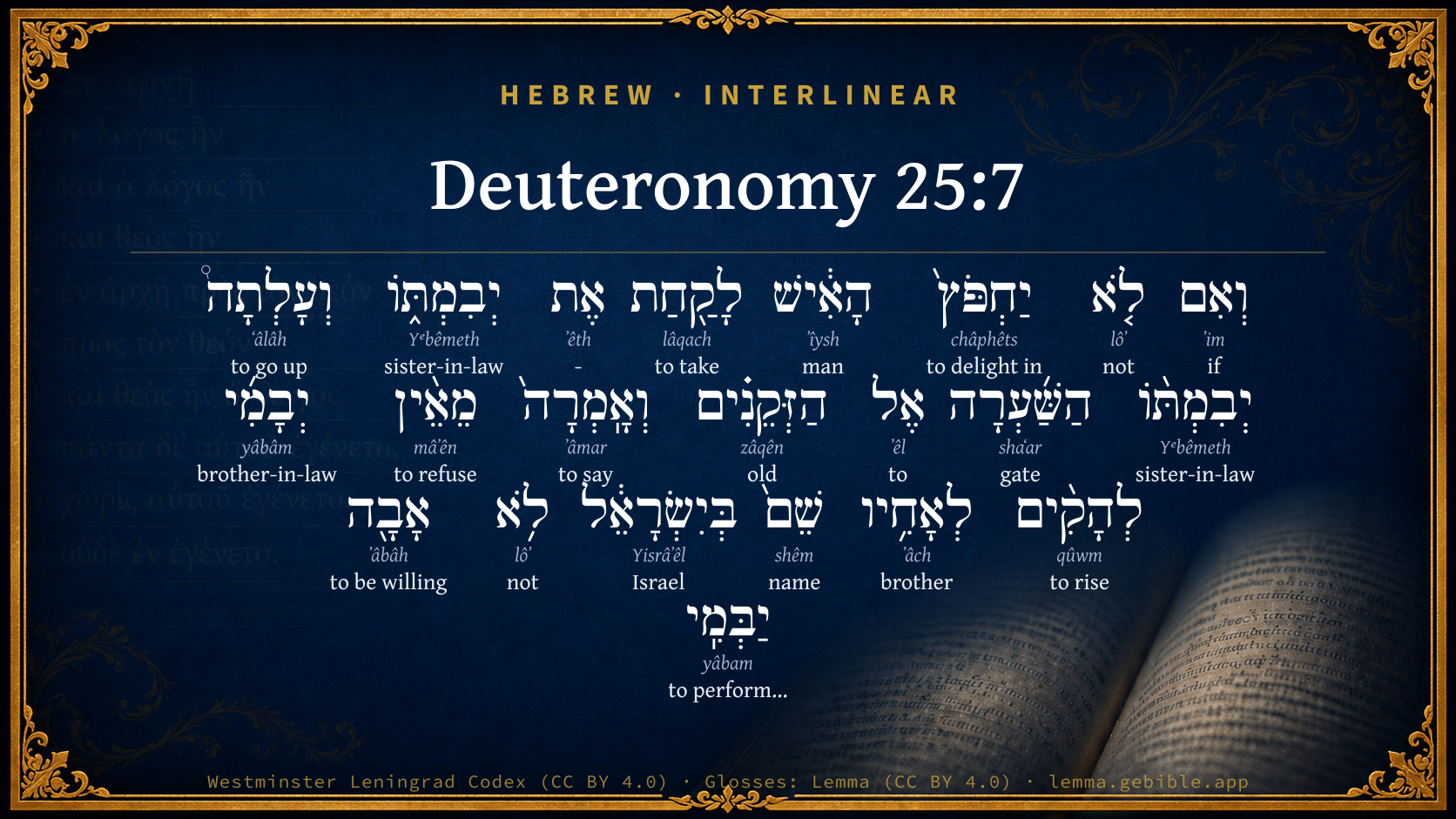
Hebrew (Westminster Leningrad Codex) Deuteronomy 25:7 appears in the Hebrew Old Testament. The text above is from the Westminster Leningrad Codex. Each word links to its Strong’s number, a concise gloss, and parsing drawn from the Open Scriptures Hebrew Bible morphology. Click any word for its full Brown-Driver-Briggs (BDB) entry.
Download image
Cite this verse

Deuteronomy 25:7 (World English Bible). Public Domain. Lemma interlinear Bible study tool, https://lemma.gebible.app/v/deuteronomy/25/7.

Show BibTeX & RIS
BibTeX
RIS
English Translation
If the man doesn't want to take his brother's wife, then his brother's wife shall go up to the gate to the elders, and say, My husband's brother refuses to raise up to his brother a name in Israel; he will not perform the duty of a husband's brother to me.
World English Bible · Public Domain
Highlights
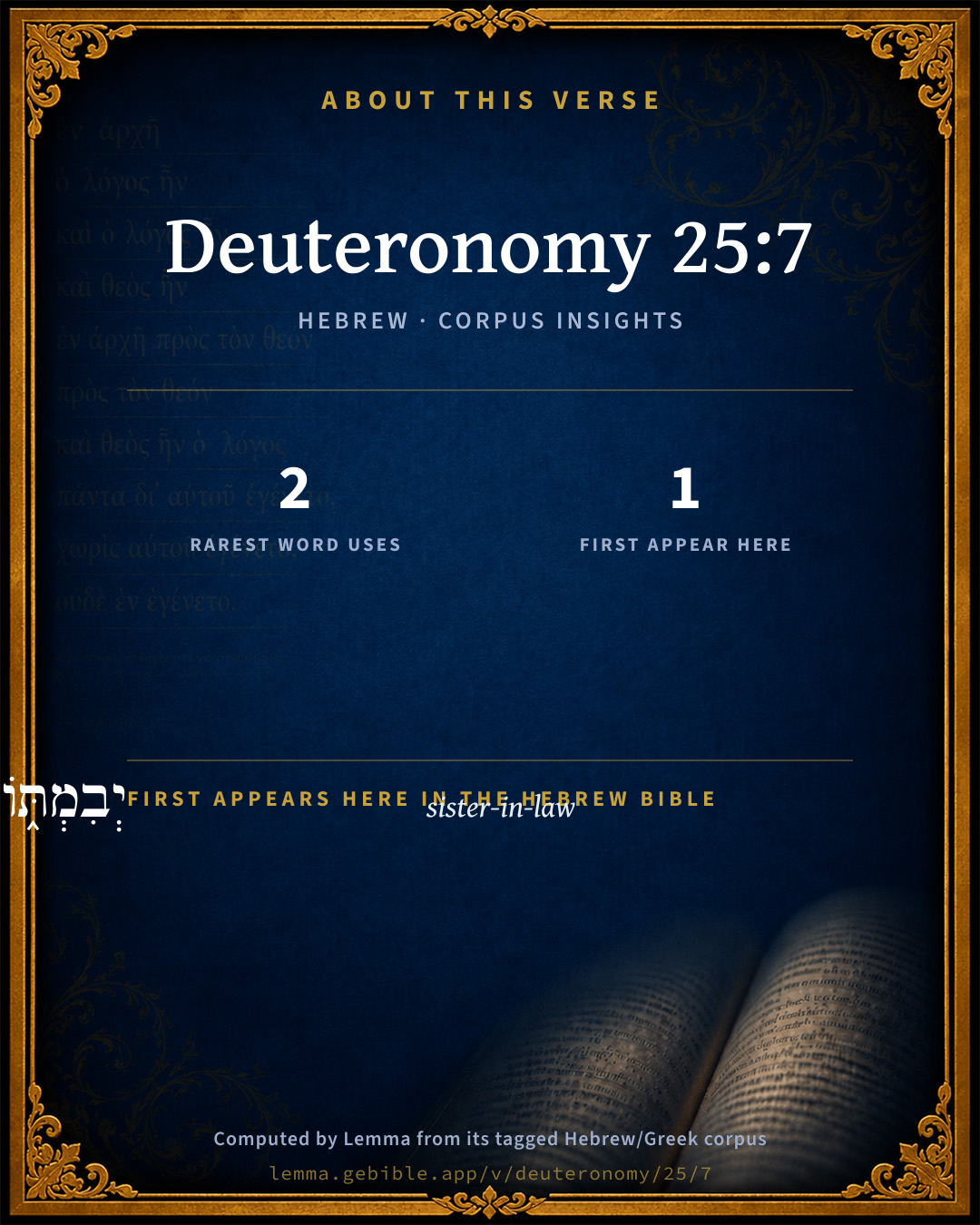
  • 1 first appearance in the Hebrew Bible
Full analysis ↓
Download a study sheet

One document with this verse’s original text, its word-by-word gloss line, the meaning frame, cross-references with their text, attributed commentary, and full source and license credits — printable, and it pastes into notes with its structure intact.

This verse Autodidact and up

Study sheet (.html) Plain text (.txt)

A passage Seminary Student

Up to 50 verses in one chapter. A passage sheet keeps up to 6 commentary sources and 12 cross-references per verse, in the order this page ranks them, and says so on the sheet whenever that leaves anything out. Ask for a single verse and you get the Autodidact verse sheet above.

Everything on this page stays free to read, with no account — the sheet is a download of what is already on screen, not access to it.

Want to remove ads? Support Godless Engineer
Compare translations 3

The same verse in 3 English versions, stacked beneath the original-language interlinear above. Click any original word for its lexicon entry.

Each is an independent rendering of the whole verse — the interlinear is not word-aligned to these translations.

Highlighted words mark where these versions differ — a whole-verse word diff, not a word-by-word alignment.

  • World English Bible Public Domain
    If the man doesn't want to take his brother's wife, then his brother's wife shall go up to the gate to the elders, and say, My husband's brother refuses to raise up to his brother a name in Israel; he will not perform the duty of a husband's brother to me.
  • King James Version Public Domain
    And if the man like not to take his brother's wife, then let his brother's wife go up to the gate unto the elders, and say, My husband's brother refuseth to raise up unto his brother a name in Israel, he will not perform the duty of my husband's brother.
  • unfoldingWord Literal Text CC BY-SA 4.0
    But if the man does not delight in taking his brother’s wife, then his brother’s wife shall go up to the gate to the elders and say, ‘My brother-in-law refuses to raise up for his brother a name in Israel; he is not willing my brother-in-law.’

unfoldingWord Literal Text — © unfoldingWord, licensed CC BY-SA 4.0. Word-aligned USFM3 via Door43 (git.door43.org/unfoldingWord/en_ult).

Versions to compare (up to 4)

3 of 4 selected

Show all 18 translations

Every available English version of this verse, each an independent rendering of the whole verse.

  • World English Bible Public Domain
    If the man doesn't want to take his brother's wife, then his brother's wife shall go up to the gate to the elders, and say, My husband's brother refuses to raise up to his brother a name in Israel; he will not perform the duty of a husband's brother to me.
  • Berean Standard Bible Public Domain
    But if the man does not want to marry his brother’s widow, she is to go to the elders at the city gate and say, “My husband’s brother refuses to preserve his brother’s name in Israel. He is not willing to perform the duty of a brother-in-law for me.”
  • Majority Standard Bible Public Domain
    But if the man does not want to marry his brother’s widow, she is to go to the elders at the city gate and say, “My husband’s brother refuses to preserve his brother’s name in Israel. He is not willing to perform the duty of a brother-in-law for me.”
  • King James Version Public Domain
    And if the man like not to take his brother's wife, then let his brother's wife go up to the gate unto the elders, and say, My husband's brother refuseth to raise up unto his brother a name in Israel, he will not perform the duty of my husband's brother.
  • American Standard Version (1901) Public Domain
    And if the man like not to take his brother's wife, then his brother's wife shall go up to the gate unto the elders, and say, My husband's brother refuseth to raise up unto his brother a name in Israel; he will not perform the duty of a husband's brother unto me.
  • Revised Version (1885) Public Domain
    And if the man like not to take his brother’s wife, then his brother’s wife shall go up to the gate unto the elders, and say, My husband’s brother refuseth to raise up unto his brother a name in Israel, he will not perform the duty of an husband’s brother unto me.
  • Geneva Bible (1599) Public Domain
    And if the man will not take his kinsewoman, then let his kinsewoman goe vp to the gate vnto the Elders, and say, My kinsman refuseth to rayse vp vnto his brother a name in Israel: hee will not doe the office of a kinsman vnto me.
  • Douay-Rheims (1899) Public Domain
    But if he will not take his brother's wife, who by law belongeth to him, the woman shall go to the gate of the city, and call upon the ancients, and say: My husband's brother refuseth to raise up his brother's name in Israel: and will not take me to wife.
  • Young's Literal Translation Public Domain
    `And if the man doth not delight to take his brother's wife, then hath his brother's wife gone up to the gate, unto the elders, and said, My husband's brother is refusing to raise up to his brother a name in Israel; he hath not been willing to perform the duty of my husband's brother;
  • Literal Standard Version CC BY-SA 4.0
    And if the man does not delight to take his brother’s wife, then his brother’s wife has gone up to the gate, to the elderly, and said, My husband’s brother is refusing to raise up a name for his brother in Israel; he has not been willing to perform the duty of my husband’s brother;
  • Unlocked Literal Bible CC BY-SA 4.0
    But if the man does not wish to take his brother's wife for himself, then his brother's wife must go up to the gate to the elders and say, 'My husband's brother refuses to raise up for his brother a name in Israel; he will not perform the duty of a husband's brother to me.'
  • unfoldingWord Literal Text CC BY-SA 4.0
    But if the man does not delight in taking his brother’s wife, then his brother’s wife shall go up to the gate to the elders and say, ‘My brother-in-law refuses to raise up for his brother a name in Israel; he is not willing my brother-in-law.’
  • Darby Bible Public Domain
    But if the man like not to take his brother's wife, his brother's wife shall go up to the gate unto the elders, and say, My husband's brother refuseth to raise up unto his brother a name in Israel: he will not perform for me the duty of a husband's brother.
  • World Messianic Bible Public Domain
    If the man doesn’t want to take his brother’s wife, then his brother’s wife shall go up to the gate to the elders, and say, “My husband’s brother refuses to raise up to his brother a name in Israel. He will not perform the duty of a husband’s brother to me.”
  • Webster's Bible Public Domain
    And if the man shall not like to take his brother's wife, then let his brother's wife go up to the gate to the elders, and say, My husband's brother refuseth to raise up to his brother a name in Israel, he will not perform the duty of my husband's brother.
  • Free Bible Version CC BY-SA 4.0
    However, if the man refuses to marry his brother's widow, she shall go to the elders at the town gate and tell them, “My husband's brother is refusing to keep his brother's name alive in Israel. He doesn't want to perform the requirements of a brother-in-law for me.”
  • Bible in Basic English Public Domain
    But if the man says he will not take his brother's wife, then let the wife go to the responsible men of the town, and say, My husband's brother will not keep his brother's name living in Israel; he will not do what it is right for a husband's brother to do.
  • JPS Tanakh (1917) Public Domain
    And if the man like not to take his brother's wife, then his brother's wife shall go up to the gate unto the elders, and say: 'My husband's brother refuseth to raise up unto his brother a name in Israel; he will not perform the duty of a husband's brother unto me.'

Literal Standard Version (2020), Covenant Press — licensed CC BY-SA 4.0. Text via the HelloAO Bible API (eBible.org). Unlocked Literal Bible (unfoldingWord) — licensed CC BY-SA 4.0. Text via the HelloAO Bible API (eBible.org). unfoldingWord Literal Text — © unfoldingWord, licensed CC BY-SA 4.0. Word-aligned USFM3 via Door43 (git.door43.org/unfoldingWord/en_ult). Free Bible Version, Dr. Jonathan Gallagher — licensed CC BY-SA 4.0. Text via the HelloAO Bible API (eBible.org).

Word by word

More ways to search: Search by grammar → Find every occurrence → Compare this word →

Practice this passage: Drill this verse → Learn its vocabulary →

יְבָמִ֜י
yâbâm
H2993
“brother-in-law · my”
Noun, Common, Masculine, Singular, Construct + Suffix, Personal, 1st Person, Common, Singular
Part of Speech
Noun
Type
Common
Gender
Masculine
Number
Singular
State
Construct
Full BDB Definition

Origin: from (the orig. of) H2992

TWOT: 836a

brother-in-law, husband's brother
  1. וְאִם ʼim H518 “and · if” Conjunction + Conjunction
  2. לֹ֤א lôʼ H3808 “not” Particle, Negative
  3. יַחְפֹּץ֙ châphêts H2654 “to delight in” Verb, Qal, Imperfect, 3rd Person, Masculine, Singular
  4. הָאִ֔ישׁ ʼîysh H376 “the · man” Particle, Definite Article + Noun, Common, Masculine, Singular, Absolute
  5. לָקַ֖חַת lâqach H3947 “to take” Preposition + Verb, Qal, Infinitive Construct
  6. אֶת ʼêth H853 “-” Particle, Direct Object
  7. יְבִמְתּ֑וֹ Yᵉbêmeth H2994 “sister-in-law · his” Noun, Common, Feminine, Singular, Construct + Suffix, Personal, 3rd Person, Masculine, Singular
  8. וְעָלְתָה֩ ʻâlâh H5927 “and · to go up” Conjunction + Verb, Qal, Sequential Perfect, 3rd Person, Feminine, Singular
  9. יְבִמְתּ֨וֹ Yᵉbêmeth H2994 “sister-in-law · his” Noun, Common, Feminine, Singular, Construct + Suffix, Personal, 3rd Person, Masculine, Singular
  10. הַשַּׁ֜עְרָה shaʻar H8179 “the · gate · toward” Particle, Definite Article + Noun, Common, Masculine, Singular, Absolute + Suffix, Demonstrative
  11. אֶל ʼêl H413 “to” Preposition
  12. הַזְּקֵנִ֗ים zâqên H2205 “the · old” Particle, Definite Article + Adjective, Adjective, Masculine, Plural, Absolute
  13. וְאָֽמְרָה֙ ʼâmar H559 “and · to say” Conjunction + Verb, Qal, Sequential Perfect, 3rd Person, Feminine, Singular
  14. מֵאֵ֨ין mâʼên H3985 “to refuse” Verb, Piel, Perfect, 3rd Person, Masculine, Singular
  15. לְהָקִ֨ים qûwm H6965 “to rise” Preposition + Verb, Hiphil, Infinitive Construct
  16. לְאָחִ֥יו ʼâch H251 “to/for · brother · his” Preposition + Noun, Common, Masculine, Singular, Construct + Suffix, Personal, 3rd Person, Masculine, Singular
  17. שֵׁם֙ shêm H8034 “name” Noun, Common, Masculine, Singular, Absolute
  18. בְּיִשְׂרָאֵ֔ל Yisrâʼêl H3478 “in/at · Israel” Preposition + Noun, Proper
  19. לֹ֥א lôʼ H3808 “not” Particle, Negative
  20. אָבָ֖ה ʼâbâh H14 “to be willing” Verb, Qal, Perfect, 3rd Person, Masculine, Singular
  21. יַבְּמִֽי yâbam H2992 “to perform levirate marriage · me” Verb, Piel, Infinitive Construct + Suffix, Personal, 1st Person, Common, Singular

About this verse

These counts appear in no published source. They are computed here, from the morphology-tagged text and Lemma’s own curated glosses. What Lemma adds →

22
words
20
distinct lemmas
Pentateuch
section

Notable vocabulary

The rarest word here is יְבָמִ֜י brother-in-law H2993 — appearing just 2 times in the whole Hebrew Bible.

First appearance in Scripture

This word makes its first canonical appearance in the Hebrew Bible here:

  • יְבִמְתּ֑וֹ sister-in-law H2994

Shared distinctive vocabulary

יְבָמִ֜י brother-in-law H2993 occurs in 2 verses of the Hebrew Bible. Also found in:

Grammatical profile

  • 8 verbs
  • 8 nouns
  • 1 adjective
  • 1 preposition
  • 1 conjunction
  • 3 particles

Verb forms

  • יַחְפֹּץ֙ Qal · Imperfect
  • לָקַ֖חַת Qal · Infinitive Construct
  • וְעָלְתָה֩ Qal · Sequential Perfect
  • וְאָֽמְרָה֙ Qal · Sequential Perfect
  • מֵאֵ֨ין Piel · Perfect
  • לְהָקִ֨ים Hiphil · Infinitive Construct
  • אָבָ֖ה Qal · Perfect
  • יַבְּמִֽי Piel · Infinitive Construct

Repetition

Words recur within this verse — often emphatic in Hebrew:

  • יְבִמְתּ֑וֹ sister-in-law H2994 ×2
  • לֹ֤א not H3808 ×2

Hebrew & Septuagint length

In English translation the verse runs 51 words from the Hebrew and 48 from the Septuagint (LXX English) — closely comparable.

A rough comparison of the two English renderings, which tokenize alike — not a word-level alignment.

Word counts can differ between the Hebrew and the Greek without any difference in meaning — e.g. the Hebrew direct-object marker אֵת has no separate Greek word, and Greek often adds the article ὁ.

Cross-references

2

Topical passages linked to Deuteronomy 25:7 in the Treasury of Scripture Knowledge — connected by theme and wording, ordered by reader-vote popularity; previews shown in the World English Bible.

  • Ruth 4:1–2 Now Boaz went up to the gate, and sat him down there: and, behold, the near kinsman of whom Boaz spoke came by; to whom he said, Ho, such a one! turn aside, sit down here. He turned aside, and sat down.
  • Ruth 4:5–6 Then said Boaz, What day you buy the field of the hand of Naomi, you must buy it also of Ruth the Moabitess, the wife of the dead, to raise up the name of the dead on his inheritance.

Cross-references courtesy of OpenBible.info (CC BY 4.0).

Hebrew and Greek witnesses Masoretic Hebrew ↔ Greek Septuagint

The same verse in the two great witnesses to the Old Testament, shown verse-for-verse.

These are two independent witnesses, not word-aligned to each other, and the Septuagint is shown in lemma (dictionary) form.

Hebrew Deuteronomy 25:7 Masoretic · Westminster Leningrad Codex

וְאִם לֹ֤א יַחְפֹּץ֙ הָאִ֔ישׁ לָקַ֖חַת אֶת יְבִמְתּ֑וֹ וְעָלְתָה֩ יְבִמְתּ֨וֹ הַשַּׁ֜עְרָה אֶל הַזְּקֵנִ֗ים וְאָֽמְרָה֙ מֵאֵ֨ין יְבָמִ֜י לְהָקִ֨ים לְאָחִ֥יו שֵׁם֙ בְּיִשְׂרָאֵ֔ל לֹ֥א אָבָ֖ה יַבְּמִֽי

If the man doesn't want to take his brother's wife, then his brother's wife shall go up to the gate to the elders, and say, My husband's brother refuses to raise up to his brother a name in Israel; he will not perform the duty of a husband's brother to me.

World English Bible · Public Domain

Greek LXX Deuteronomy 25:7 Septuagint · lemma form

ἐάν δέ μή βούλομαι ὁ ἄνθρωπος λαμβάνω ὁ γυνή ὁ ἀδελφός αὐτός καί ἀναβαίνω ὁ γυνή ἐπί ὁ πύλη ἐπί ὁ γερουσία καί εἶπον οὐ θέλω ὁ ἀδελφός ὁ ἀνήρ ἐγώ ἀναἵστημι ὁ ὄνομα ὁ ἀδελφός αὐτός ἐν ἰσραήλ οὐ θέλω ὁ ἀδελφός ὁ ἀνήρ ἐγώ

And if the man should not be willing to take his brother's wife, then shall the woman go up to the gate to the elders, and she shall say, My husband's brother will not raise up the name of his brother in Israel, my husband's brother has refused.

LXX2012 (modern English Septuagint) · Public Domain

Hebrew: Westminster Leningrad Codex (CC BY 4.0). Greek: Septuagint (public domain); English from LXX2012 (modern English Septuagint) (Public Domain). How the Septuagint differs from the Hebrew →

Targum (Aramaic paraphrase)

2

The Targum is the ancient Jewish Aramaic paraphrase of the Hebrew Scriptures — an interpretive translation, not the Hebrew text itself. Onkelos (literal) and Pseudo-Jonathan (expansive) render the Torah, and Jonathan the Prophets. Coverage is partial: where no permissively-licensed English translation exists for a verse, only the Aramaic is shown. This is verse-level text, not a word-by-word alignment to the Hebrew.

  1. Targum Onkelos Torah (Genesis–Deuteronomy)
    וְאִם לָא יִצְבֵי גַבְרָא לְמִסַב יָת יְבִמְתֵּהּ וְתִסַק יְבִמְתֵהּ לִתְרַע בֵּית דִינָא לָקֳדָם סָבַיָא וְתֵימַר לָא צָבֵי יְבָמִי לַאֲקָמָא לַאֲחוּהִי שְׁמָא בְּיִשְׂרָאֵל לָא אָבֵי לְיַבָּמוּתִי

    (no public-domain English translation for this verse)

    Targum Onkelos — Aramaic: “Onkelos Genesis” (public domain); “Onkelos Exodus” (public domain); “Onkelos Leviticus” (public domain); “Onkelos Numbers” (public domain); “Onkelos Deuteronomy” (public domain). English: “Sefaria Community Translation” (CC0 1.0 (public-domain dedication)); “J.W. Etheridge. The Targums of Onkelos and Jonathan Ben Uzziel on the Pentateuch. London: Longmans, Green, 1862” (public domain). Text via Sefaria.

  2. Targum Pseudo-Jonathan Torah (Genesis–Deuteronomy)
    וְאִם לָא יִצְבֵי גַבְרָא לְמֵיסַב יַת יְבִימְתֵּיהּ וְתִיסַק יְבִימְתֵּיהּ לִתְרַע בֵּי דִינָא קֳדָם חַמְשָׁא חַכִּימִין וִיהוֹן תְּלָתָא לְדַיְינִין וּתְרֵין לְסַהֲדִין וְתֵימַר בְּלִישַׁן בֵּית קוּדְשָׁא קֳדָמֵיהוֹן מְסָרֵב יְבָמִי לְמִקְמָא לְאָחוֹי שְׁמָא בְּיִשְרָאֵל לָא צָבֵי לְיַבָּמוּתִי

    But if the man be not willing, to take his sister-in-law, then shall his sister-in-law go up to the gate of the beth din before five of the sages, three of whom shall be judges and two of them witnesses, and let her say before them in the holy language: My husband’s brother refuseth to keep up the name of his brother in Israel, he not being willing to marry me.

    Targum Pseudo-Jonathan — Aramaic: “Targum Jonathan on Genesis” (public domain); “Targum Jonathan on Exodus” (public domain); “Targum Jonathan on Leviticus” (public domain); “Targum Jonathan on Numbers” (public domain); “Targum Jonathan on Deuteronomy” (public domain). English: “The Targum of Jonathan ben Uzziel, trans. J. W. Etheridge, London, 1862” (public domain). Text via Sefaria.

Commentary

Notes on Deuteronomy 25:7 from classic Christian and Jewish commentators (each source and its license shown beneath its notes). The classic Christian expositions comment on the surrounding passage and are grouped to its opening verse, so a note may address several verses; the Jewish commentaries on the Tanakh (Rashi and others) are per-verse, so they appear only where the commentator wrote on this verse.

Lemma curates 59 commentaries, every one of them public domain or Creative Commons licensed, each selected and text-cleaned for this edition rather than reprinted as found. About our sources →

The Cambridge Bible for Schools and Colleges

gen. ed. J. J. S. Perowne

7. shall go up to the gate] Rth_4:1, only here, in D; so also the terms like not and refuseth (see introd. note).

elders] Deu_21:19, Deu_22:15. See on Deu_16:18.

The Cambridge Bible for Schools and Colleges (gen. ed. J. J. S. Perowne; Cambridge University Press, 1878–1918) — public domain. Text from a community e-Sword module.

John Gill's Exposition

And the man like not to take his brother's wife,.... The provision here made by this law, when this was the case, is such as did not take place before it became a law; for then Onan would have taken the advantage of it, and refused marrying his brother's wife, which it is plain was not agreeable to him, Gen 38:9; as many do now on one account or another. Leo of Modena (l) says,"it was anciently accounted the more laudable thing to take her, than to release her; but now the corruption of the times, and the hardness of men's hearts, are such, as that they only look after worldly ends, either of riches, or of the beauty of the woman; so that there are very few that in this case will marry a brother's widow, especially among the Dutch and Italian Jews, but they always release her:"

then let his brother's wife go up to the gate; to the gate of the city, where the judges sit for public affairs; to the gate of the sanhedrim, or court of judicature, as the Targum of Jonathan; and this affair was cognizable by the bench of three judges, and might be dispatched by them; for so it is said (m),"the plucking off the shoe, and the refusal of marriage, are by three:''i.e. three judges, which was the lowest court of judicature with the Jews:

unto the elders, and say; which according to the above Targum were to be five wise men, of which three were to be judges, and two witnesses; and she was to say in the Hebrew language, in which, according to the Misnah (n), she was to pronounce what follows:

my husband's brother refuseth to raise up unto his brother a name in Israel, he will not perform the duty of my husband's brother; that is, in a few words, he will not marry her.

(l) Ut supra, sect. 3. (Leo Modena's History of Rites, &c. l. 1 sect. 3.) (m) Misn. Sanhedrin, c. 1. sect. 3. (n) Sotah, c. 7. sect. 2.

John Gill's Exposition of the Whole Bible (1746–1763) — public domain (CC PDM 1.0). Text via the HelloAO Bible API.

Matthew Poole's English Annotations

To raise up unto his brother a name; to revive his brother’s name and memory.

Matthew Poole's English Annotations on the Holy Bible (1683–1685) — public domain. Text from a community e-Sword/MySword module.

Whedon's Commentary on the Bible

Daniel D. Whedon

7. If the man like not — If the brother-in-law was unwilling to marry the widow of his deceased brother, then she was to bring the matter before the elders for their adjudication. For an illustration see the case of Boaz and Ruth, Ruth chapters 4 and 5.

Daniel D. Whedon (gen. ed.), Commentary on the Old and New Testaments (1874–1909) — public domain. Text from a community e-Sword module.

The Pulpit Commentary

Vers. 7-10. If the man refused to marry the widow of his deceased brother, he was free to do so; but the woman had her redress. She was to bring the matter before the eiders of the town, sitting as magistrates at the gate, and they were to summon the man and speak to him, and if he persisted in his refusal, the woman was to take his shoe from off his foot, and spit before his face, and say, So shall it be done unto that man that will not build up his brother"s house. The taking off of the shoe of the man by the woman was an act of indignity to him; it amounted to a declaration that he was not worthy to stand in his brother"s place, and was scornfully rejected by the woman herself. As the planting of the shod foot on a piece of property, or the casting of the shoe over a field, was emblematical of taking possession of it with satisfaction; (Psa_60:8 Psa_108:9) and as the voluntary handing of one"s shoe to another betokened the giving up to that other of some property or right; so, contrariwise, the forcible removal from one of his shoe and the casting of it aside indicated contemptuous rejection of the owner, and repudiation of all his rights and claims in the matter. To walk barefooted was regarded by the Jews as ignominious and miserable. (cf. Isa_20:2, Isa_20:4; 2Sa_15:30) The spitting before the face of the man (wynpB in front of him) is by the Jewish interpreters understood of spitting on the ground in his presence (Talmud, "Jebam.," 106; Madmen., "In Jibbum.," 4:6-8). This seems to be what the words express (cf. Deu_4:37 Deu_7:24 Deu_11:25; Jos_10:8; Eze_10:8, for the rendering of ynpb) and this, according to Oriental notions, would be insult enough (cf. Num_12:14; Isa_1:6; Niebuhr, "Description de l"Arabie," 1:49).

The Pulpit Commentary (1880–1919), ed. H.D.M. Spence-Jones & Joseph S. Exell — public domain. Text from a community e-Sword module.

unfoldingWord translationNotes

Door43 World Missions Community

General Information:

Moses continues speaking to the people of Israel.

must go up to the gate to the elders

The full meaning of this statement can be made explicit. AT: "must go up to the city gate where the elders judge cases" (See: Assumed Knowledge and Implicit Information)

refuses to raise up for his brother a name

Here "name" refers to the memory of someone through his descendants. AT: "refuses to give his brother a son" (See: Metonymy)

he will not perform the duty of a husband's brother to me

"he will not do what a husband's brother is supposed to do and marry me"

I do not wish to take her

"I do not wish to marry her"

translationWords

brother

gate

elder

name

Israel

call

unfoldingWord translationNotes — © Distant Shores Media and the Door43 World Missions Community, licensed CC BY-SA 4.0. Source: git.door43.org/Door43/en_tn.

Rashi

Rabbi Shlomo Yitzchaki (Rashi)

השערה — Translate this as the Targum does: to the gate of the court.

Rashi on the Tanakh — English translations: “The Judaica Press complete Tanach with Rashi, translated by A. J. Rosenberg” (CC BY 4.0); “Pentateuch with Rashi's commentary by M. Rosenbaum and A.M. Silbermann, 1929-1934” (public domain); “The Metsudah Tanach series, Lakewood, N.J” (CC BY 4.0); and “The Book of Joshua, Metsudah Publications, 1997” (CC BY 4.0). Text via Sefaria.

Lesson kit

Teaching starters — assembled from the data on this page, not authored interpretation. Every prompt links to the verse data it draws on. Edit before teaching.

Deuteronomy, in the Pentateuch, opens this verse with 22 words (20 distinct Hebrew lemmas). Its most distinctive word is yâbâm (“brother-in-law”). A historical commentator’s framing appears above. Read the whole chapter for the surrounding context.

Discussion questions

  1. The word yâbâm carries the sense “brother-in-law.” How does it shape the verse?
  2. This is the first place “sister-in-law” appears in Scripture (first appears here). What does its debut here establish?
  3. How does Deuteronomy 25:5, which shares the word «brother-in-law», read alongside this verse?
  4. What does the repetition of “sister-in-law” (2× in this one verse) do in this verse?
  5. These translations render this verse differently; the difference is in the English rendering, not the original. What questions does that raise?
  6. «יַחְפֹּץ֙» is a Qal Imperfect verb. How does that grammatical form shape the action described?
  7. Compare how The Cambridge Bible for Schools and Colleges and John Gill's Exposition read this verse. Where do they agree or differ?

Things to notice

  • 1 word makes its first canonical appearance in Scripture here.
  • These translations choose different wording for 20 words in this verse.
  • “sister-in-law” occurs 2× in this single verse.
  • 20 distinct Hebrew lemmas span 22 words in this verse.

Reading settings

Reading text

Shown beneath each verse's original-language words.

Old Testament
Old Testament edition

Read the OT as the Masoretic Hebrew (MT) or the Greek Septuagint (LXX).

English shown for the Greek Septuagint (in the Hebrew ↔ Greek comparison).

Comparing translations? Open the Compare panel on any verse page to stack up to four side by side.