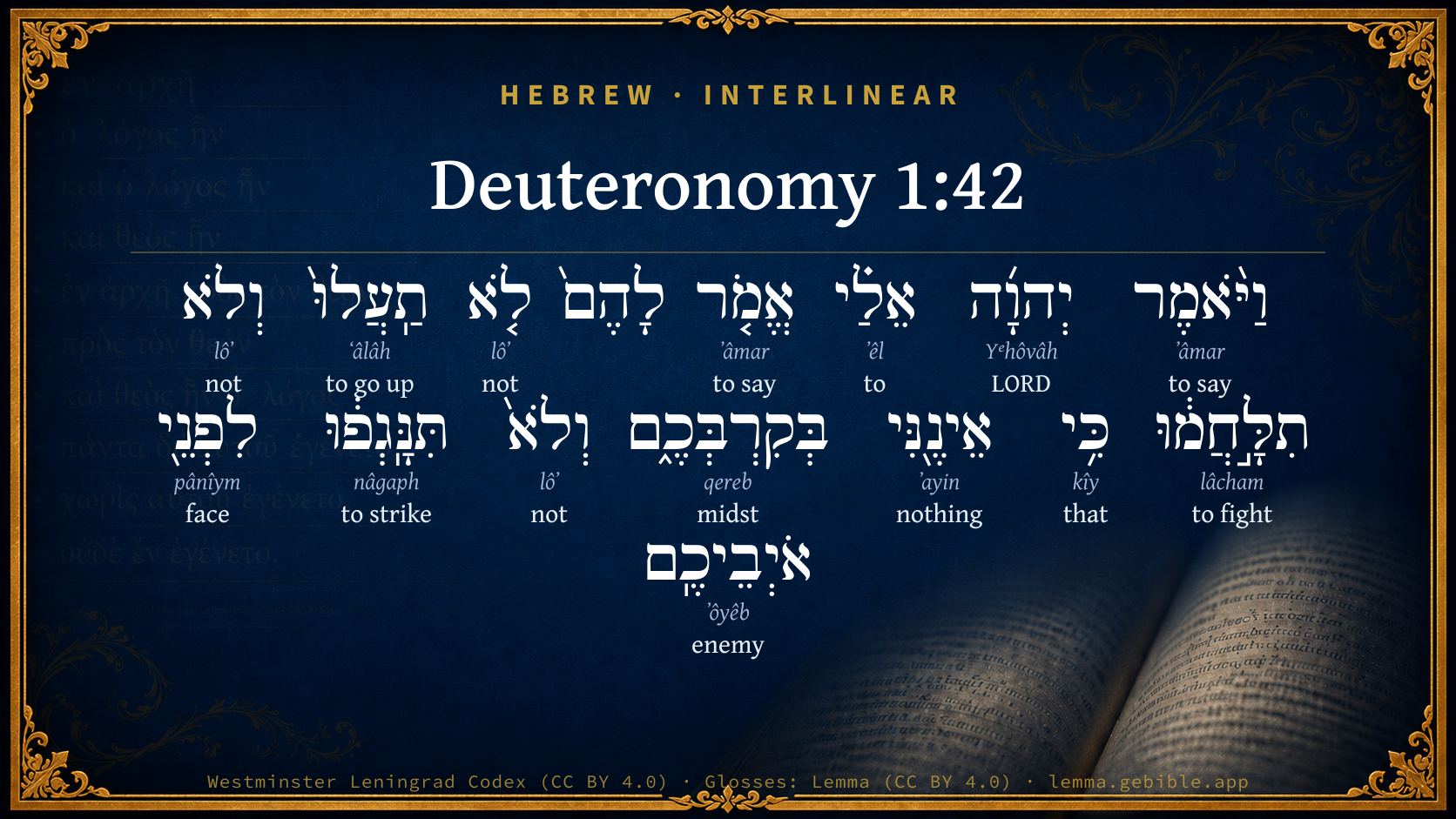
Deuteronomy 1:42

Hebrew (Westminster Leningrad Codex) Deuteronomy 1:42 appears in the Hebrew Old Testament. The text above is from the Westminster Leningrad Codex. Each word links to its Strong’s number, a concise gloss, and parsing drawn from the Open Scriptures Hebrew Bible morphology. Click any word for its full Brown-Driver-Briggs (BDB) entry.
Download image
Cite this verse

Deuteronomy 1:42 (World English Bible). Public Domain. Lemma interlinear Bible study tool, https://lemma.gebible.app/v/deuteronomy/1/42.

Show BibTeX & RIS
BibTeX
RIS
English Translation
Yahweh said to me, Tell them, Don't go up, neither fight; for I am not among you; lest you be struck before your enemies.
World English Bible · Public Domain
Download a study sheet

One document with this verse’s original text, its word-by-word gloss line, the meaning frame, cross-references with their text, attributed commentary, and full source and license credits — printable, and it pastes into notes with its structure intact.

This verse Autodidact and up

Study sheet (.html) Plain text (.txt)

A passage Seminary Student

Up to 50 verses in one chapter. A passage sheet keeps up to 6 commentary sources and 12 cross-references per verse, in the order this page ranks them, and says so on the sheet whenever that leaves anything out. Ask for a single verse and you get the Autodidact verse sheet above.

Everything on this page stays free to read, with no account — the sheet is a download of what is already on screen, not access to it.

Want to remove ads? Support Godless Engineer
Compare translations 3

The same verse in 3 English versions, stacked beneath the original-language interlinear above. Click any original word for its lexicon entry.

Each is an independent rendering of the whole verse — the interlinear is not word-aligned to these translations.

Highlighted words mark where these versions differ — a whole-verse word diff, not a word-by-word alignment.

  • World English Bible Public Domain
    Yahweh said to me, Tell them, Don't go up, neither fight; for I am not among you; lest you be struck before your enemies.
  • King James Version Public Domain
    And the LORD said unto me, Say unto them. Go not up, neither fight; for I am not among you; lest ye be smitten before your enemies.
  • unfoldingWord Literal Text CC BY-SA 4.0
    And Yahweh said to me, ‘Say to them, “Do not go up and do not fight, and you will not be defeated to the face of your enemies, because I will not be among you.”’

unfoldingWord Literal Text — © unfoldingWord, licensed CC BY-SA 4.0. Word-aligned USFM3 via Door43 (git.door43.org/unfoldingWord/en_ult).

Versions to compare (up to 4)

3 of 4 selected

Show all 18 translations

Every available English version of this verse, each an independent rendering of the whole verse.

  • World English Bible Public Domain
    Yahweh said to me, Tell them, Don't go up, neither fight; for I am not among you; lest you be struck before your enemies.
  • Berean Standard Bible Public Domain
    But the LORD said to me, “Tell them not to go up and fight, for I am not with you to keep you from defeat by your enemies.”
  • Majority Standard Bible Public Domain
    But the LORD said to me, “Tell them not to go up and fight, for I am not with you to keep you from defeat by your enemies.”
  • King James Version Public Domain
    And the LORD said unto me, Say unto them. Go not up, neither fight; for I am not among you; lest ye be smitten before your enemies.
  • American Standard Version (1901) Public Domain
    And Jehovah said unto me, Say unto them, Go not up, neither fight; for I am not among you; lest ye be smitten before your enemies.
  • Revised Version (1885) Public Domain
    And the LORD said unto me, Say unto them, Go not up, neither fight; for I am not among you; lest ye be smitten before your enemies.
  • Geneva Bible (1599) Public Domain
    But the Lord said vnto me, Say vnto them, Goe not vp, neither fight, (for I am not among you) least ye fall before your enemies.
  • Douay-Rheims (1899) Public Domain
    But return you and go into the wilderness by the way of the Red Sea.
  • Young's Literal Translation Public Domain
    and Jehovah saith unto me, Say to them, Ye do not go up, nor fight, for I am not in your midst, and ye are not smitten before your enemies.
  • Literal Standard Version CC BY-SA 4.0
    and YHWH says to me, Say to them, You do not go up, nor fight, for I am not in your midst, and you are not struck before your enemies.
  • Unlocked Literal Bible CC BY-SA 4.0
    Yahweh said to me, 'Say to them, “Do not attack and do not fight, for I will not be with you, and you will be defeated by your enemies.'
  • unfoldingWord Literal Text CC BY-SA 4.0
    And Yahweh said to me, ‘Say to them, “Do not go up and do not fight, and you will not be defeated to the face of your enemies, because I will not be among you.”’
  • Darby Bible Public Domain
    And Jehovah said to me, Say unto them, Go not up, neither fight; for I am not among you; lest ye be smitten before your enemies.
  • World Messianic Bible Public Domain
    The LORD said to me, “Tell them, ‘Don’t go up and don’t fight; for I am not among you, lest you be struck before your enemies.’”
  • Webster's Bible Public Domain
    And the LORD said to me, Say to them, Go not up, neither fight; for I am not among you; lest ye be smitten before your enemies.
  • Free Bible Version CC BY-SA 4.0
    But the Lord instructed me, “Order them not to go and fight because I won't be with you to prevent you from being defeated by your enemies.”
  • Bible in Basic English Public Domain
    And the Lord said to me, Say to them, Do not go up to the attack; for I am not among you, and you will be overcome by those who are against you.
  • JPS Tanakh (1917) Public Domain
    And the LORD said unto me: 'Say unto them: Go not up, neither fight; for I am not among you; lest ye be smitten before your enemies.'

Literal Standard Version (2020), Covenant Press — licensed CC BY-SA 4.0. Text via the HelloAO Bible API (eBible.org). Unlocked Literal Bible (unfoldingWord) — licensed CC BY-SA 4.0. Text via the HelloAO Bible API (eBible.org). unfoldingWord Literal Text — © unfoldingWord, licensed CC BY-SA 4.0. Word-aligned USFM3 via Door43 (git.door43.org/unfoldingWord/en_ult). Free Bible Version, Dr. Jonathan Gallagher — licensed CC BY-SA 4.0. Text via the HelloAO Bible API (eBible.org).

Word by word

More ways to search: Search by grammar → Find every occurrence → Compare this word →

Practice this passage: Drill this verse → Learn its vocabulary →

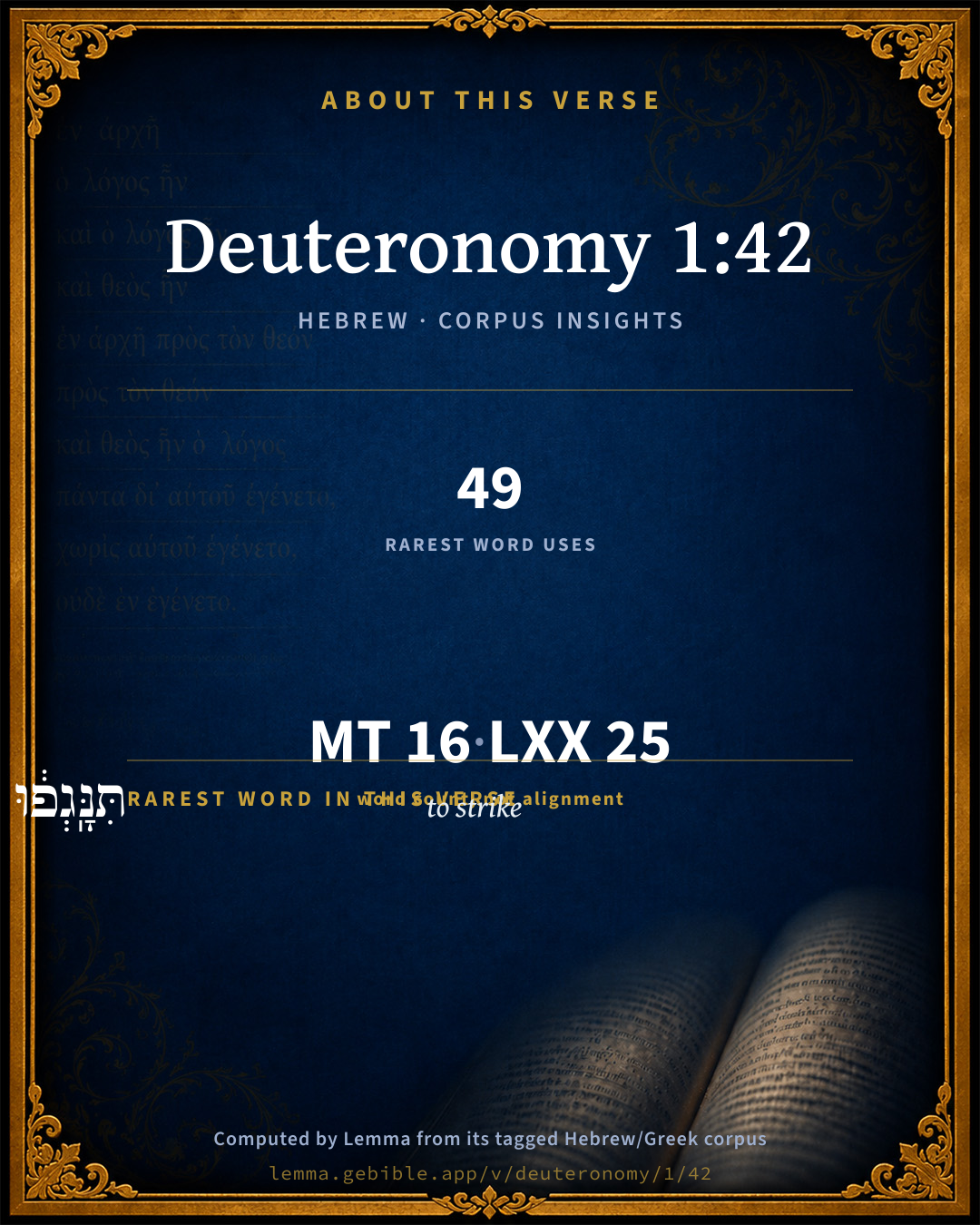
תִּנָּֽגְפ֔וּ
nâgaph
H5062
“to strike”
Verb, Niphal, Imperfect, 2nd Person, Masculine, Plural
Part of Speech
Verb
Stem
Niphal
Form
Imperfect
Person
2nd Person
Gender
Masculine
Number
Plural
Full BDB Definition

Origin: a primitive root

TWOT: 1294

to strike, smite - (Qal) to strike, smite - (Niphal) to be stricken, be smitten - (Hithpael) to stumble
  1. וַיֹּ֨אמֶר ʼâmar H559 “and · to say” Conjunction + Verb, Qal, Sequential Imperfect, 3rd Person, Masculine, Singular
  2. יְהוָ֜ה Yᵉhôvâh H3068 “LORD” Noun, Proper
  3. אֵלַ֗י ʼêl H413 “to · me” Preposition + Suffix, Personal, 1st Person, Common, Singular
  4. אֱמֹ֤ר ʼâmar H559 “say” Verb, Qal, Imperative, 2nd Person, Masculine, Singular
  5. לֹ֤א lôʼ H3808 “not” Particle, Negative
  6. תַֽעֲלוּ֙ ʻâlâh H5927 “to go up” Verb, Qal, Imperfect, 2nd Person, Masculine, Plural
  7. וְלֹא lôʼ H3808 “and · not” Conjunction + Particle, Negative
  8. תִלָּ֣חֲמ֔וּ lâcham H3898 “to fight” Verb, Niphal, Imperfect, 2nd Person, Masculine, Plural
  9. כִּ֥י kîy H3588 “that” Conjunction
  10. אֵינֶ֖נִּי ʼayin H369 “nothing · me” Particle, Negative + Suffix, Personal, 1st Person, Common, Singular
  11. בְּקִרְבְּכֶ֑ם qereb H7130 “in/at · midst · your” Preposition + Noun, Common, Masculine, Singular, Construct + Suffix, Personal, 2nd Person, Masculine, Plural
  12. וְלֹא֙ lôʼ H3808 “and · not” Conjunction + Particle, Negative
  13. לִפְנֵ֖י pânîym H6440 “to/for · face(s) of” Preposition + Noun, Common, Both, Plural, Construct
  14. אֹיְבֵיכֶֽם ʼôyêb H341 “enemy · you” Verb, Qal, Participle Active, Masculine, Plural, Construct + Suffix, Personal, 2nd Person, Masculine, Plural

About this verse

These counts appear in no published source. They are computed here, from the morphology-tagged text and Lemma’s own curated glosses. What Lemma adds →

16
words
12
distinct lemmas
Pentateuch
section

Shared distinctive vocabulary

תִּנָּֽגְפ֔וּ to strike H5062 occurs in 46 verses of the Hebrew Bible. Also found in:

Grammatical profile

  • 6 verbs
  • 3 nouns
  • 2 prepositions
  • 1 conjunction
  • 4 particles

Verb forms

  • וַיֹּ֨אמֶר Qal · Sequential Imperfect
  • אֱמֹ֤ר Qal · Imperative
  • תַֽעֲלוּ֙ Qal · Imperfect
  • תִלָּ֣חֲמ֔וּ Niphal · Imperfect
  • תִּנָּֽגְפ֔וּ Niphal · Imperfect
  • אֹיְבֵיכֶֽם Qal · Participle Active

Repetition

Words recur within this verse — often emphatic in Hebrew:

  • וַיֹּ֨אמֶר to say H559 ×2
  • לֹ֤א not H3808 ×3

Hebrew & Septuagint length

In English translation the verse runs 24 words from the Hebrew and 32 from the Septuagint (LXX English) — closely comparable.

A rough comparison of the two English renderings, which tokenize alike — not a word-level alignment.

Word counts can differ between the Hebrew and the Greek without any difference in meaning — e.g. the Hebrew direct-object marker אֵת has no separate Greek word, and Greek often adds the article ὁ.

In the original languages it is 16 Hebrew tokens and 25 Greek tokens — but the two are counted differently (Hebrew bundles its prefixes and suffixes into one token; the Greek is in lemma form), so that isn’t a like-for-like length.

Cross-references

8

Topical passages linked to Deuteronomy 1:42 in the Treasury of Scripture Knowledge — connected by theme and wording, ordered by reader-vote popularity; previews shown in the World English Bible.

  • Numbers 14:41–43 Moses said, Why now do you disobey the commandment of Yahweh, seeing it shall not prosper?
  • Joshua 7:8–13 Oh, Lord, what shall I say, after that Israel has turned their backs before their enemies!
  • Leviticus 26:17 I will set my face against you, and you will be struck before your enemies. Those who hate you will rule over you; and you will flee when no one pursues you.
  • 1 Samuel 4:2 The Philistines put themselves in array against Israel: and when they joined battle, Israel was struck before the Philistines; and they killed of the army in the field about four thousand men.
  • Isaiah 59:1–2 Behold, Yahweh's hand is not shortened, that it can't save; neither his ear heavy, that it can't hear:
  • Hosea 9:12 Though they bring up their children, Yet I will bereave them, so that not a man shall be left. Indeed, woe also to them when I depart from them!
  • 1 Samuel 4:10 The Philistines fought, and Israel was struck, and they fled every man to his tent: and there was a very great slaughter; for there fell of Israel thirty thousand footmen.
  • Isaiah 30:17 One thousand [shall flee] at the threat of one; at the threat of five shall you flee: until you be left as a beacon on the top of a mountain, and as an ensign on a hill.

Cross-references courtesy of OpenBible.info (CC BY 4.0).

Hebrew and Greek witnesses Masoretic Hebrew ↔ Greek Septuagint

The same verse in the two great witnesses to the Old Testament, shown verse-for-verse.

These are two independent witnesses, not word-aligned to each other, and the Septuagint is shown in lemma (dictionary) form.

Hebrew Deuteronomy 1:42 Masoretic · Westminster Leningrad Codex

וַיֹּ֨אמֶר יְהוָ֜ה אֵלַ֗י אֱמֹ֤ר לָהֶם֙ לֹ֤א תַֽעֲלוּ֙ וְלֹא תִלָּ֣חֲמ֔וּ כִּ֥י אֵינֶ֖נִּי בְּקִרְבְּכֶ֑ם וְלֹא֙ תִּנָּֽגְפ֔וּ לִפְנֵ֖י אֹיְבֵיכֶֽם

Yahweh said to me, Tell them, Don't go up, neither fight; for I am not among you; lest you be struck before your enemies.

World English Bible · Public Domain

Greek LXX Deuteronomy 1:42 Septuagint · lemma form

καί εἶπον κύριος πρός ἐγώ εἶπον αὐτός οὐ ἀναβαίνω οὐδέ μή πολεμέω οὐ γάρ εἰμί μετά σύ καί οὐ μή συντρίβω ἐνώπιον ὁ ἐχθρός σύ

And the Lord said to me, Tell them, You⌃ shall not go up, neither shall you⌃ fight, for I am not with you; thus shall you⌃ not be destroyed before your enemies.

LXX2012 (modern English Septuagint) · Public Domain

Hebrew: Westminster Leningrad Codex (CC BY 4.0). Greek: Septuagint (public domain); English from LXX2012 (modern English Septuagint) (Public Domain). How the Septuagint differs from the Hebrew →

Targum (Aramaic paraphrase)

2

The Targum is the ancient Jewish Aramaic paraphrase of the Hebrew Scriptures — an interpretive translation, not the Hebrew text itself. Onkelos (literal) and Pseudo-Jonathan (expansive) render the Torah, and Jonathan the Prophets. Coverage is partial: where no permissively-licensed English translation exists for a verse, only the Aramaic is shown. This is verse-level text, not a word-by-word alignment to the Hebrew.

  1. Targum Onkelos Torah (Genesis–Deuteronomy)
    וַאֲמַר יְיָ לִי אֱמַר לְהוֹן לָא תִסְקוּן וְלָא תְגִחוּן קְרָב אֲרֵי לֵית שְׁכִינְתִּי שָׁרְיָא בֵינֵיכוֹן וְלָא תִּתָּבְרוּן קֳדָם בַּעֲלֵי דְבָבֵיכוֹן

    (no public-domain English translation for this verse)

    Targum Onkelos — Aramaic: “Onkelos Genesis” (public domain); “Onkelos Exodus” (public domain); “Onkelos Leviticus” (public domain); “Onkelos Numbers” (public domain); “Onkelos Deuteronomy” (public domain). English: “Sefaria Community Translation” (CC0 1.0 (public-domain dedication)); “J.W. Etheridge. The Targums of Onkelos and Jonathan Ben Uzziel on the Pentateuch. London: Longmans, Green, 1862” (public domain). Text via Sefaria.

  2. Targum Pseudo-Jonathan Torah (Genesis–Deuteronomy)
    וַאֲמַר יְיָ לִי אֵימַר לְהוֹן לָא תִסְקוּן וְלָא תְסַדְּרוּן סִדְרֵי קְרָב אֲרוּם לֵית שְׁכִינְתִּי מְהַלְכָא בֵּינֵיכוֹן וְלָא תִיתְבְּרוּן קֳדָם בַּעֲלֵי דְבָבֵיכוֹן

    But the Lord said to me, Say to them, Go not up, nor prepare for battle, for My Shekinah goeth not among you; that you be not crushed before your enemies.

    Targum Pseudo-Jonathan — Aramaic: “Targum Jonathan on Genesis” (public domain); “Targum Jonathan on Exodus” (public domain); “Targum Jonathan on Leviticus” (public domain); “Targum Jonathan on Numbers” (public domain); “Targum Jonathan on Deuteronomy” (public domain). English: “The Targum of Jonathan ben Uzziel, trans. J. W. Etheridge, London, 1862” (public domain). Text via Sefaria.

Commentary

Notes on Deuteronomy 1:42 from classic Christian and Jewish commentators (each source and its license shown beneath its notes). The classic Christian expositions comment on the surrounding passage and are grouped to its opening verse, so a note may address several verses; the Jewish commentaries on the Tanakh (Rashi and others) are per-verse, so they appear only where the commentator wrote on this verse.

Lemma curates 59 commentaries, every one of them public domain or Creative Commons licensed, each selected and text-cleaned for this edition rather than reprinted as found. About our sources →

Geneva Bible (1599)

Geneva Bible translators

Signifying that man hath no strength, but when God is at hand to help him.

Geneva Bible (1599) marginal notes — public domain. Text via Bolls.life.

The Cambridge Bible for Schools and Colleges

gen. ed. J. J. S. Perowne

42. Say unto them, Go not up … for I am not among you] JE, Num_14:42. See previous note.

lest ye be smitten, etc.] JE, Num_14:42.

The Cambridge Bible for Schools and Colleges (gen. ed. J. J. S. Perowne; Cambridge University Press, 1878–1918) — public domain. Text from a community e-Sword module.

John Gill's Exposition

And the Lord said unto me,.... When the people had armed themselves, and were in motion, or ready to set forward to ascend the hill:

say unto them, go not up, neither fight; neither go up the hill, and if they did, contrary to this order, and should meet with enemies, not fight them, but retreat:

for I am not among you: the ark of the covenant, the symbol of his presence, was then among them, but it did not go with them, it continued in the camp, Num 14:44 nor did the Lord exert his power, or show himself present with them, or to be on their side, but left them to themselves, and to their enemies:

lest ye be smitten before your enemies; God not being with them to fight for them, protect and defend them, and give them victory.

John Gill's Exposition of the Whole Bible (1746–1763) — public domain (CC PDM 1.0). Text via the HelloAO Bible API.

Matthew Poole's English Annotations

I am not among you, with my powerful presence and assistance.

Matthew Poole's English Annotations on the Holy Bible (1683–1685) — public domain. Text from a community e-Sword/MySword module.

The Pulpit Commentary

Moses, by the command of God, warned the people that, if they presumed to go up, they should go without his protection, and so would certainly fall before their enemies.

The Pulpit Commentary (1880–1919), ed. H.D.M. Spence-Jones & Joseph S. Exell — public domain. Text from a community e-Sword module.

Rashi

Rabbi Shlomo Yitzchaki (Rashi)

לא תעלו “GO NOT UP” — There will be no “ascent” for you, but only a descent (defeat) (cf. Rashi on Numbers 16:12 and Numbers Rabbah 17:3).

Rashi on the Tanakh — English translations: “The Judaica Press complete Tanach with Rashi, translated by A. J. Rosenberg” (CC BY 4.0); “Pentateuch with Rashi's commentary by M. Rosenbaum and A.M. Silbermann, 1929-1934” (public domain); “The Metsudah Tanach series, Lakewood, N.J” (CC BY 4.0); and “The Book of Joshua, Metsudah Publications, 1997” (CC BY 4.0). Text via Sefaria.

Lesson kit

Teaching starters — assembled from the data on this page, not authored interpretation. Every prompt links to the verse data it draws on. Edit before teaching.

Deuteronomy, in the Pentateuch, opens this verse with 16 words (12 distinct Hebrew lemmas). Its most distinctive word is nâgaph (“to strike”). A historical commentator’s framing appears above. Read the whole chapter for the surrounding context.

Discussion questions

  1. How does “to strike” (nâgaph) shape what this verse is saying?
  2. Exodus 8:2 shares the word «to strike» with this verse. How do the two illuminate each other?
  3. “to say” occurs 2× in this one verse. What is the effect of the repetition?
  4. These translations render this verse differently. What is at stake in choosing one wording over another?
  5. The verb «וַיֹּ֨אמֶר» is Qal Sequential Imperfect. How does its form color the action?
  6. Reading how Geneva Bible (1599) and The Cambridge Bible for Schools and Colleges read this verse, where do the two commentators agree and where do they part?

Things to notice

Reading settings

Reading text

Shown beneath each verse's original-language words.

Old Testament
Old Testament edition

Read the OT as the Masoretic Hebrew (MT) or the Greek Septuagint (LXX).

English shown for the Greek Septuagint (in the Hebrew ↔ Greek comparison).

Comparing translations? Open the Compare panel on any verse page to stack up to four side by side.