1 Kings 2:34

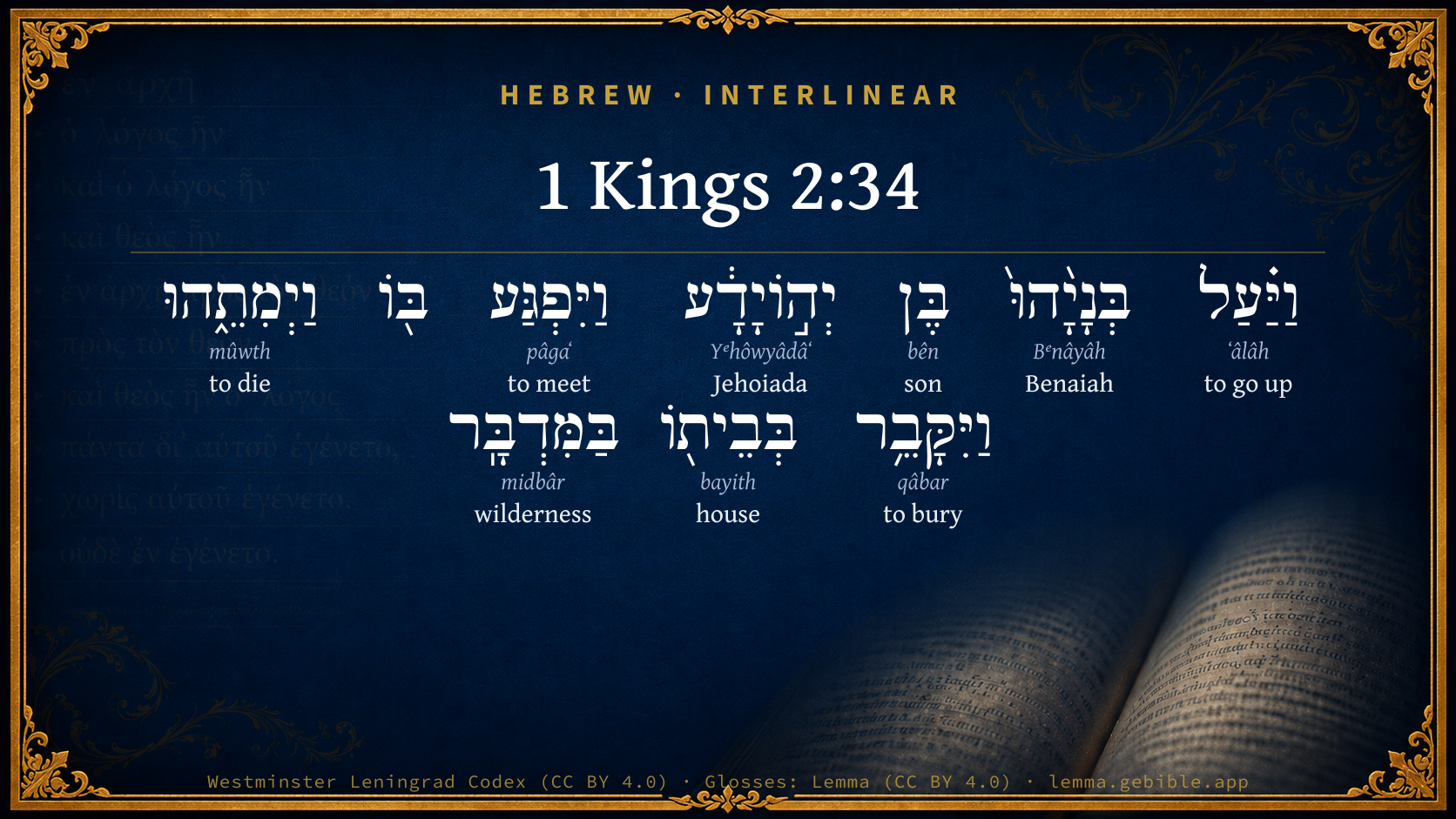
Hebrew (Westminster Leningrad Codex) 1 Kings 2:34 appears in the Hebrew Old Testament. The text above is from the Westminster Leningrad Codex. Each word links to its Strong’s number, a concise gloss, and parsing drawn from the Open Scriptures Hebrew Bible morphology. Click any word for its full Brown-Driver-Briggs (BDB) entry.
Download image
Cite this verse

1 Kings 2:34 (World English Bible). Public Domain. Lemma interlinear Bible study tool, https://lemma.gebible.app/v/1-kings/2/34.

Show BibTeX & RIS
BibTeX
RIS
English Translation
Then Benaiah the son of Jehoiada went up, and fell on him, and killed him; and he was buried in his own house in the wilderness.
World English Bible · Public Domain
Download a study sheet

One document with this verse’s original text, its word-by-word gloss line, the meaning frame, cross-references with their text, attributed commentary, and full source and license credits — printable, and it pastes into notes with its structure intact.

This verse Autodidact and up

Study sheet (.html) Plain text (.txt)

A passage Seminary Student

Up to 50 verses in one chapter. A passage sheet keeps up to 6 commentary sources and 12 cross-references per verse, in the order this page ranks them, and says so on the sheet whenever that leaves anything out. Ask for a single verse and you get the Autodidact verse sheet above.

Everything on this page stays free to read, with no account — the sheet is a download of what is already on screen, not access to it.

Want to remove ads? Support Godless Engineer
Compare translations 3

The same verse in 3 English versions, stacked beneath the original-language interlinear above. Click any original word for its lexicon entry.

Each is an independent rendering of the whole verse — the interlinear is not word-aligned to these translations.

Highlighted words mark where these versions differ — a whole-verse word diff, not a word-by-word alignment.

  • World English Bible Public Domain
    Then Benaiah the son of Jehoiada went up, and fell on him, and killed him; and he was buried in his own house in the wilderness.
  • King James Version Public Domain
    So Benaiah the son of Jehoiada went up, and fell upon him, and slew him: and he was buried in his own house in the wilderness.
  • unfoldingWord Literal Text CC BY-SA 4.0
    And Benaiah, the son of Jehoiada, went up and attacked him and killed him. And he was buried in his house in the wilderness.

unfoldingWord Literal Text — © unfoldingWord, licensed CC BY-SA 4.0. Word-aligned USFM3 via Door43 (git.door43.org/unfoldingWord/en_ult).

Versions to compare (up to 4)

3 of 4 selected

Show all 18 translations

Every available English version of this verse, each an independent rendering of the whole verse.

  • World English Bible Public Domain
    Then Benaiah the son of Jehoiada went up, and fell on him, and killed him; and he was buried in his own house in the wilderness.
  • Berean Standard Bible Public Domain
    So Benaiah son of Jehoiada went up, struck down Joab, and killed him. He was buried at his own home in the wilderness.
  • Majority Standard Bible Public Domain
    So Benaiah son of Jehoiada went up, struck down Joab, and killed him. He was buried at his own home in the wilderness.
  • King James Version Public Domain
    So Benaiah the son of Jehoiada went up, and fell upon him, and slew him: and he was buried in his own house in the wilderness.
  • American Standard Version (1901) Public Domain
    Then Benaiah the son of Jehoiada went up, and fell upon him, and slew him; and he was buried in his own house in the wilderness.
  • Revised Version (1885) Public Domain
    Then Benaiah the son of Jehoiada went up, and fell upon him, and slew him; and he was buried in his own house in the wilderness.
  • Geneva Bible (1599) Public Domain
    So Benaiah the sonne of Iehoiada went vp, and smote him, and slewe him, and he was buryed in his owne house in the wildernesse.
  • Douay-Rheims (1899) Public Domain
    So Banaias the son of Joiada went up, and setting upon him slew him, and he was buried in his house in the desert.
  • Young's Literal Translation Public Domain
    And Benaiah son of Jehoiada goeth up and falleth upon him, and putteth him to death, and he is buried in his own house in the wilderness,
  • Literal Standard Version CC BY-SA 4.0
    And Benaiah son of Jehoiada goes up and falls on him, and puts him to death, and he is buried in his own house in the wilderness,
  • Unlocked Literal Bible CC BY-SA 4.0
    Then Benaiah son of Jehoiada went up and attacked Joab and killed him. He was buried in his own house in the wilderness.
  • unfoldingWord Literal Text CC BY-SA 4.0
    And Benaiah, the son of Jehoiada, went up and attacked him and killed him. And he was buried in his house in the wilderness.
  • Darby Bible Public Domain
    And Benaiah the son of Jehoiada went up and fell upon him, and put him to death; and he was buried in his own house in the wilderness.
  • World Messianic Bible Public Domain
    Then Benaiah the son of Jehoiada went up and fell on him, and killed him; and he was buried in his own house in the wilderness.
  • Webster's Bible Public Domain
    So Benaiah the son of Jehoiada went, and fell upon him, and slew him: and he was buried in his own house in the wilderness.
  • Free Bible Version CC BY-SA 4.0
    So Benaiah son of Jehoiada returned and killed Joab. He was buried at his home in the wilderness.
  • Bible in Basic English Public Domain
    So Benaiah, the son of Jehoiada, went up, and falling on him, put him to death; and his body was put to rest in his house in the waste land.
  • JPS Tanakh (1917) Public Domain
    Then Benaiah the son of Jehoiada went up, and fell upon him, and slew him; and he was buried in his own house in the wilderness.

Literal Standard Version (2020), Covenant Press — licensed CC BY-SA 4.0. Text via the HelloAO Bible API (eBible.org). Unlocked Literal Bible (unfoldingWord) — licensed CC BY-SA 4.0. Text via the HelloAO Bible API (eBible.org). unfoldingWord Literal Text — © unfoldingWord, licensed CC BY-SA 4.0. Word-aligned USFM3 via Door43 (git.door43.org/unfoldingWord/en_ult). Free Bible Version, Dr. Jonathan Gallagher — licensed CC BY-SA 4.0. Text via the HelloAO Bible API (eBible.org).

Word by word

More ways to search: Search by grammar → Find every occurrence → Compare this word →

Practice this passage: Drill this verse → Learn its vocabulary →

בְּנָיָ֨הוּ֙
Bᵉnâyâh
H1141
“Benaiah”
Noun, Proper
Part of Speech
Noun
Type
Proper
Full BDB Definition

Origin: from H1129 and H3050

TWOT: None

Benaiah = "Jehovah has built" or " Yahweh has built up" - one of David's mighty warriors, son of Jehoiada the chief priest, a Levite, set by David over his bodyguard, later having remained faithful to Solomon during Adonijah's attempt on the crown, was raised into the place of Joab as commander-in-chief of the army - the Pirathonite, an Ephraimite, one of David's thirty mighty warriors, and the captain of the eleventh monthly course - a Simeonite, a prince of the families of Simeon - a Levite in the time of David who played with a psaltery on Alamoth - a priest in the time of David, appointed to blow the trumpet before the ark - a Levite of the sons of Asaph - a Levite in the time of Hezekiah - Four Israelites in the time of Ezra who had taken strange wives - the father of Pelatiah
  1. וַיַּ֗עַל ʻâlâh H5927 “and · to go up” Conjunction + Verb, Qal, Sequential Imperfect, 3rd Person, Masculine, Singular
  2. בֶּן bên H1121 “son of” Noun, Common, Masculine, Singular, Construct
  3. יְה֣וֹיָדָ֔ע Yᵉhôwyâdâʻ H3077 “Jehoiada” Noun, Proper
  4. וַיִּפְגַּע pâgaʻ H6293 “and · to meet” Conjunction + Verb, Qal, Sequential Imperfect, 3rd Person, Masculine, Singular
  5. וַיְמִתֵ֑הוּ mûwth H4191 “and · to die · him” Conjunction + Verb, Hiphil, Sequential Imperfect, 3rd Person, Masculine, Singular + Suffix, Personal, 3rd Person, Masculine, Singular
  6. וַיִּקָּבֵ֥ר qâbar H6912 “and · to bury” Conjunction + Verb, Niphal, Sequential Imperfect, 3rd Person, Masculine, Singular
  7. בְּבֵית֖וֹ bayith H1004 “in/at · house · his” Preposition + Noun, Common, Masculine, Singular, Construct + Suffix, Personal, 3rd Person, Masculine, Singular
  8. בַּמִּדְבָּֽר midbâr H4057 “in/at the · wilderness” Preposition, Determined + Noun, Common, Masculine, Singular, Absolute

About this verse

These counts appear in no published source. They are computed here, from the morphology-tagged text and Lemma’s own curated glosses. What Lemma adds →

10
words
9
distinct lemmas
Historical
section

Shared distinctive vocabulary

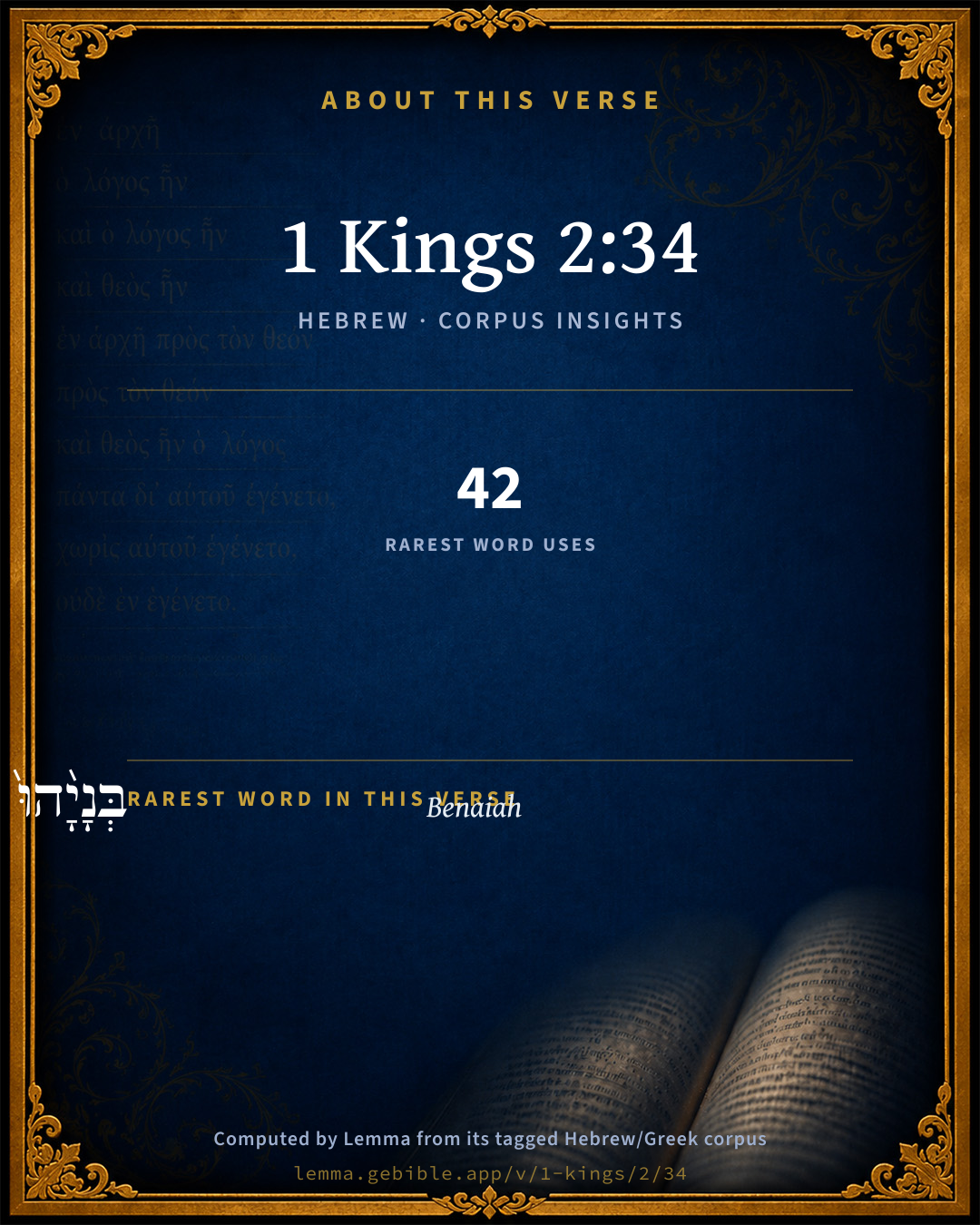
בְּנָיָ֨הוּ֙ Benaiah H1141 occurs in 41 verses of the Hebrew Bible. Also found in:

Grammatical profile

  • 4 verbs
  • 5 nouns
  • 1 preposition

Verb forms

  • וַיַּ֗עַל Qal · Sequential Imperfect
  • וַיִּפְגַּע Qal · Sequential Imperfect
  • וַיְמִתֵ֑הוּ Hiphil · Sequential Imperfect
  • וַיִּקָּבֵ֥ר Niphal · Sequential Imperfect

Hebrew & Septuagint length

In English translation the verse runs 26 words from the Hebrew and 22 from the Septuagint (LXX English) — closely comparable.

A rough comparison of the two English renderings, which tokenize alike — not a word-level alignment.

Word counts can differ between the Hebrew and the Greek without any difference in meaning — e.g. the Hebrew direct-object marker אֵת has no separate Greek word, and Greek often adds the article ὁ.

Cross-references

7

Topical passages linked to 1 Kings 2:34 in the Treasury of Scripture Knowledge — connected by theme and wording, ordered by reader-vote popularity; previews shown in the World English Bible.

  • Joshua 15:61 In the wilderness, Beth Arabah, Middin, and Secacah,
  • 1 Kings 2:25 King Solomon sent by Benaiah the son of Jehoiada; and he fell on him, so that he died.
  • Matthew 3:1 In those days, John the Baptizer came, preaching in the wilderness of Judea, saying,
  • 1 Kings 2:31 The king said to him, Do as he has said, and fall on him, and bury him; that you may take away the blood, which Joab shed without cause, from me and from my father's house.
  • 1 Kings 2:46 So the king commanded Benaiah the son of Jehoiada; and he went out, and fell on him, so that he died. The kingdom was established in the hand of Solomon.
  • 2 Kings 21:18 Manasseh slept with his fathers, and was buried in the garden of his own house, in the garden of Uzza: and Amon his son reigned in his place.
  • 2 Chronicles 33:20 So Manasseh slept with his fathers, and they buried him in his own house: and Amon his son reigned in his place.

Cross-references courtesy of OpenBible.info (CC BY 4.0).

Hebrew and Greek witnesses Masoretic Hebrew ↔ Greek Septuagint

The same verse in the two great witnesses to the Old Testament, shown verse-for-verse.

These are two independent witnesses, not word-aligned to each other, and the Septuagint is shown in lemma (dictionary) form.

Hebrew 1 Kings 2:34 Masoretic · Westminster Leningrad Codex

וַיַּ֗עַל בְּנָיָ֨הוּ֙ בֶּן יְה֣וֹיָדָ֔ע וַיִּפְגַּע בּ֖וֹ וַיְמִתֵ֑הוּ וַיִּקָּבֵ֥ר בְּבֵית֖וֹ בַּמִּדְבָּֽר

Then Benaiah the son of Jehoiada went up, and fell on him, and killed him; and he was buried in his own house in the wilderness.

World English Bible · Public Domain

Greek LXX 1 Kings 2:34 Septuagint · lemma form

καί ἀποἀντάω βαναιας υἱός ιωδαε ὁ ιωαβ καί θανατόω αὐτός καί θάπτω αὐτός ἐν ὁ οἶκος αὐτός ἐν ὁ ἔρημος

So Banaeas son of Jodae went up, and attacked him, and killed him, and buried him in his house in the wilderness.

LXX2012 (modern English Septuagint) · Public Domain

Hebrew: Westminster Leningrad Codex (CC BY 4.0). Greek: Septuagint (public domain); English from LXX2012 (modern English Septuagint) (Public Domain). How the Septuagint differs from the Hebrew →

Targum (Aramaic paraphrase)

1

The Targum is the ancient Jewish Aramaic paraphrase of the Hebrew Scriptures — an interpretive translation, not the Hebrew text itself. Onkelos (literal) and Pseudo-Jonathan (expansive) render the Torah, and Jonathan the Prophets. Coverage is partial: where no permissively-licensed English translation exists for a verse, only the Aramaic is shown. This is verse-level text, not a word-by-word alignment to the Hebrew.

  1. Targum Jonathan Prophets (Joshua–Malachi)
    וּסְלִיק בְּנָיָהוּ בַר יְהוֹיָדָע וְשַׁלִיט בֵּיהּ וְקַטְלֵיהּ וְאִתְקְבַר בְּבֵיתֵיהּ בְּמַדְבְּרָא:

    (no public-domain English translation for this verse)

    Targum Jonathan — Aramaic: “Mikraot Gedolot” (public domain). English: “Sefaria Community Translation” (CC0 1.0 (public-domain dedication)); “London "Chaldee Paraphrase," 1871” (public domain). Text via Sefaria.

Commentary

Notes on 1 Kings 2:34 from classic Christian and Jewish commentators (each source and its license shown beneath its notes). The classic Christian expositions comment on the surrounding passage and are grouped to its opening verse, so a note may address several verses; the Jewish commentaries on the Tanakh (Rashi and others) are per-verse, so they appear only where the commentator wrote on this verse.

Lemma curates 59 commentaries, every one of them public domain or Creative Commons licensed, each selected and text-cleaned for this edition rather than reprinted as found. About our sources →

Jamieson, Fausset & Brown

Robert Jamieson, A. R. Fausset & David Brown

SHIMEI PUT TO DEATH. (Kg1 2:34-46)

Benaiah . . . went up, and fell upon him--According to the terms of the statute (Exo 21:14), and the practice in similar cases (Kg2 11:15), the criminal was to be dragged from the altar and slain elsewhere. But the truth is, that the sanctity of the altar was violated as much by the violence used in forcing the criminal from the place as in shedding his blood there; the express command of God authorized the former and therefore by implication permitted the latter.

was buried in his own house--or family vault, at his property in the wilderness of Judah. His interment was included in the king's order, as enjoined in the divine law (Deu 21:23).

Jamieson, Fausset & Brown — Commentary Critical and Explanatory on the Whole Bible (1871) — public domain (CC PDM 1.0). Text via the HelloAO Bible API.

Trapp's Complete Commentary

John Trapp

1Ki 2:34 So Benaiah the son of Jehoiada went up, and fell upon him, and slew him: and he was buried in his own house in the wilderness.

Ver. 34. And he was buried in his own house in the wilderness,] i.e., In a forest, fit for pasturage, and but thinly inhabited. The Hebrews say that Joab’s house here mentioned was a hospital that he built in the way for the harbouring of poor passengers: and that for this good deed his soul was saved. But of this none can judge, saith Pet. Martyr, because the Scripture saith nothing of it. But this it saith, that when Joab was dead and buried, Hadad the Edomite hearing thereof, returned out of Egypt into his own country, and became an adversary to Solomon, when once he forgot his God. {1Ki 11:14; 1Ki 11:22}

John Trapp, A Commentary or Exposition upon All the Books of the Old and New Testament (1647–1656) — public domain. Text from a community e-Sword module.

Adam Clarke's Commentary

Verse 34. So Benaiah - went up - and slew him] It appears he slew him at the very altar. Joab must have been both old and infirm at this time, and now he bleeds for Abner, he bleeds for Amasa, and he bleeds for Uriah. The two former he murdered; of the blood of the latter he was not innocent; yet he had done the state much service, and they knew it. But he was a murderer, and vengeance would not suffer such to live.

Adam Clarke's Commentary on the Bible (1810–1826) — public domain. Text from a community e-Sword/MySword module.

The Cambridge Bible for Schools and Colleges

gen. ed. J. J. S. Perowne

34. went up] i.e. To the Tent of the Lord, which probably stood on a higher part of Mt. Zion than did Solomon’s own house.

buried in his own house] i.e. In the ground around his home. He appears to have had a home far out in the open country.

in the wilderness] Probably that district known as the wilderness of Judah. Wilderness, or desert, gives however an insufficient idea of the kind of country that is meant. It was land under no regular cultivation, but yet to which cattle might be driven for pasturage. So in the narrative of the feeding of the Five Thousand where St Matthew (1Ki_14:15) speaks of ‘a desert place,’ St John (1Ki_6:10) says ‘now there was much grass in the place.’

The Cambridge Bible for Schools and Colleges (gen. ed. J. J. S. Perowne; Cambridge University Press, 1878–1918) — public domain. Text from a community e-Sword module.

John Gill's Exposition

And the king put Benaiah the son of Jehoiada in his room over the host,.... Advanced him from being captain of his bodyguards to be general of the army:

and Zadok the priest did he put in the room of Abiathar; from a common priest he promoted him to the high priesthood; whereby that office was restored to its ancient line, the family or Eleazar, having been in the line of Ithamar for many years; and the prediction of the destruction of Eli's house, made eighty years ago, began to be fulfilled, Sa1 2:31.

John Gill's Exposition of the Whole Bible (1746–1763) — public domain (CC PDM 1.0). Text via the HelloAO Bible API.

Albert Barnes' Notes on the Bible

Retribution overtook Joab on the very scene (Gibeon) of the most treacherous of his murders. It was at the “great stone which is in Gibeon” that Joab killed Amasa 2Sa 20:8-10.

Albert Barnes' Notes on the Bible (1834–1885) — public domain. Text from a community e-Sword/MySword module.

Haydock's Catholic Bible Commentary

Slew him, holding the altar; though some think that he was removed by force, like Athalia, 4 Kings xi. 15. Both actions were contrary to the reverence due to so holy a place, and perhaps inexcusable; (Calmet) unless the law had ordered it otherwise, Exodus xxi. 14. (Haydock)

George Leo Haydock (1774–1849), Haydock's Catholic Family Bible and Commentary, 1859 edition — public domain. Excludes Psalms (Douay-Rheims chapter numbering differs from Protestant) and Deuterocanonical books (Catholic canon only).

Matthew Poole's English Annotations

Places which have but few houses and inhabitants are oft so called in Scripture, as Isa 42:11; Jer 25:24; Eze 34:25.

Matthew Poole's English Annotations on the Holy Bible (1683–1685) — public domain. Text from a community e-Sword/MySword module.

Whedon's Commentary on the Bible

Daniel D. Whedon

34. Buried in his own house in the wilderness — The old soldier was laid to rest among his native hills near Bethlehem: probably in his father’s sepulchre, where his brother Asahel had been buried. 2Sa_2:32. This was in the wilderness of Judah. See note on Jos_15:61. He had been a mighty and valiant warrior, and Solomon allowed him an honourable burial.

Daniel D. Whedon (gen. ed.), Commentary on the Old and New Testaments (1874–1909) — public domain. Text from a community e-Sword module.

The Pulpit Commentary

So Benaiah, the son of Jehoiada, went up not because the altar" stood higher up Mount Zion than Solomon"s house" (Keil), but because Gibeon, where the tabernacle and brazen altar then were, stood higher than Jerusalem. It is remarkable that retribution thus overtook Joab on the very scene of his last murder, for it was "at the great stone which is in Gibeon", (2Sa_20:8) that he slew Amasa. Cf., 2Ki_9:26: "I will requite thee in this plat, saith the Lord" and fell upon him, and slew him: and he was buried in his own house possibly in the courtyard: hardly in the garden. The same is recorded of Samuel. (1Sa_25:1) It was evidently an exceptional occurrence. Remembering the estimation in which the Jew held the corpse and the grave (Num_19:11, Num_19:16, Num_19:22; cf., Mat_23:27) it must have been a singular honour to make of the house a mausoleum. No doubt it was designed to be such in Joab"s case. Whatever his crimes, his services had deserved well of his country. Possibly his friends were led to pay him this special honour as a kind of counterpoise to the ignominy of his death in the wilderness i.e. , of Judah. Joab"s mother was of Bethlehem, which was on the border of the desert. The "wilderness of Tekoah", (2Ch_20:20) according to Jerome, was visible from Bethlehem, being but six Roman miles distant.

The Pulpit Commentary (1880–1919), ed. H.D.M. Spence-Jones & Joseph S. Exell — public domain. Text from a community e-Sword module.

John Wesley's Explanatory Notes

Wilderness - Places which have but few houses and inhabitants, are often so called in scripture. He was buried privately, like a criminal, not pompously, like a general.

John Wesley, Explanatory Notes Upon the Whole Bible (1754–1765) — public domain. Text via the GEBible commentary corpus.

unfoldingWord translationNotes

Door43 World Missions Community

General Information:

Benaiah kills Joab and becomes the commander of King Solomon's army.

He was buried in his own house

This can be translated in active form. AT: "They buried Joab in his own house"

in his own house

The house is a metonym for the land on which the house stood. The Israelites buried people out of doors in graves or tombs. AT: "where his family lived" (See: Metonymy)

translationWords

son

desert

Zadok

priest

Abiathar

unfoldingWord translationNotes — © Distant Shores Media and the Door43 World Missions Community, licensed CC BY-SA 4.0. Source: git.door43.org/Door43/en_tn.

Rashi

Rabbi Shlomo Yitzchaki (Rashi)

In his own house in the wilderness. For his home was unrestricted as a wilderness, to [help] the needy.

Rashi on the Tanakh — English translations: “The Judaica Press complete Tanach with Rashi, translated by A. J. Rosenberg” (CC BY 4.0); “Pentateuch with Rashi's commentary by M. Rosenbaum and A.M. Silbermann, 1929-1934” (public domain); “The Metsudah Tanach series, Lakewood, N.J” (CC BY 4.0); and “The Book of Joshua, Metsudah Publications, 1997” (CC BY 4.0). Text via Sefaria.

Lesson kit

Teaching starters — assembled from the data on this page, not authored interpretation. Every prompt links to the verse data it draws on. Edit before teaching.

1 Kings, in the Historical, opens this verse with 10 words (9 distinct Hebrew lemmas). Its most distinctive word is Bᵉnâyâh (“Benaiah”). A historical commentator’s framing appears above. Read the whole chapter for the surrounding context.

Discussion questions

  1. What does “Benaiah” (Bᵉnâyâh) contribute to the verse as a whole?
  2. 2 Samuel 8:18 shares the word «Benaiah» with this verse. How do the two illuminate each other?
  3. These translations render this verse differently; the difference is in the English rendering, not the original. What questions does that raise?
  4. The verb «וַיַּ֗עַל» is Qal Sequential Imperfect. How does its form color the action?
  5. Reading how Jamieson, Fausset & Brown and Trapp's Complete Commentary read this verse, where do the two commentators agree and where do they part?

Things to notice

Reading settings

Reading text

Shown beneath each verse's original-language words.

Old Testament
Old Testament edition

Read the OT as the Masoretic Hebrew (MT) or the Greek Septuagint (LXX).

English shown for the Greek Septuagint (in the Hebrew ↔ Greek comparison).

Comparing translations? Open the Compare panel on any verse page to stack up to four side by side.