
Exodus 40:29

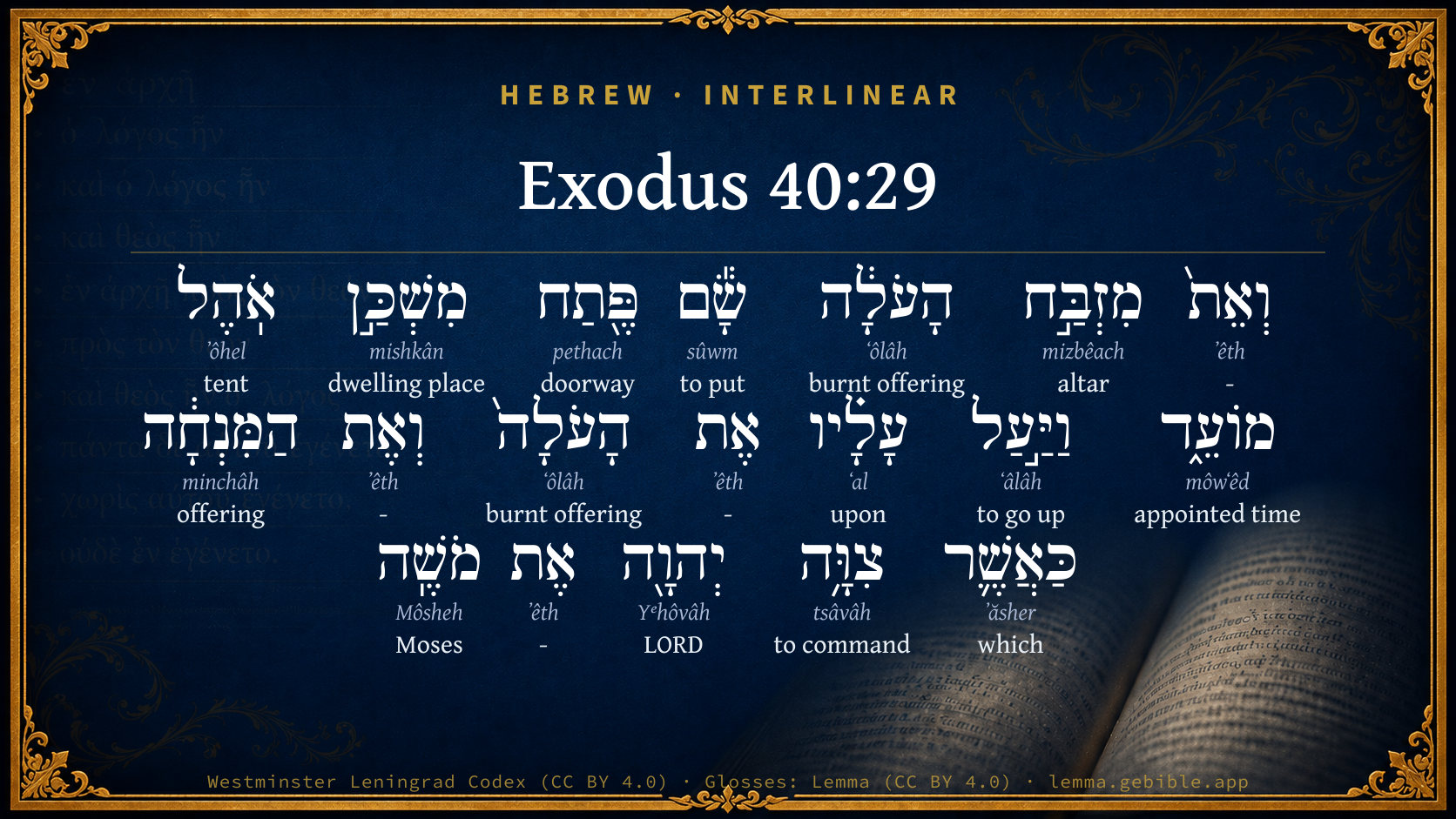
Hebrew (Westminster Leningrad Codex) Exodus 40:29 appears in the Hebrew Old Testament. The text above is from the Westminster Leningrad Codex. Each word links to its Strong’s number, a concise gloss, and parsing drawn from the Open Scriptures Hebrew Bible morphology. Click any word for its full Brown-Driver-Briggs (BDB) entry.
Download image
Cite this verse

Exodus 40:29 (World English Bible). Public Domain. Lemma interlinear Bible study tool, https://lemma.gebible.app/v/exodus/40/29.

Show BibTeX & RIS
BibTeX
RIS
English Translation
He set the altar of burnt offering at the door of the tent of the tent of meeting, and offered on it the burnt offering and the meal-offering, as Yahweh commanded Moses.
World English Bible · Public Domain
Download a study sheet

One document with this verse’s original text, its word-by-word gloss line, the meaning frame, cross-references with their text, attributed commentary, and full source and license credits — printable, and it pastes into notes with its structure intact.

This verse Autodidact and up

Study sheet (.html) Plain text (.txt)

A passage Seminary Student

Up to 50 verses in one chapter. A passage sheet keeps up to 6 commentary sources and 12 cross-references per verse, in the order this page ranks them, and says so on the sheet whenever that leaves anything out. Ask for a single verse and you get the Autodidact verse sheet above.

Everything on this page stays free to read, with no account — the sheet is a download of what is already on screen, not access to it.

Want to remove ads? Support Godless Engineer
Compare translations 3

The same verse in 3 English versions, stacked beneath the original-language interlinear above. Click any original word for its lexicon entry.

Each is an independent rendering of the whole verse — the interlinear is not word-aligned to these translations.

Highlighted words mark where these versions differ — a whole-verse word diff, not a word-by-word alignment.

  • World English Bible Public Domain
    He set the altar of burnt offering at the door of the tent of the tent of meeting, and offered on it the burnt offering and the meal-offering, as Yahweh commanded Moses.
  • King James Version Public Domain
    And he put the altar of burnt offering by the door of the tabernacle of the tent of the congregation, and offered upon it the burnt offering and the meat offering; as the LORD commanded Moses.
  • unfoldingWord Literal Text CC BY-SA 4.0
    And he put the altar of the burnt offering at the gate of the Dwelling, the tent of meeting, and offered up on it the burnt offering and the grain offering, just as Yahweh had commanded Moses.

unfoldingWord Literal Text — © unfoldingWord, licensed CC BY-SA 4.0. Word-aligned USFM3 via Door43 (git.door43.org/unfoldingWord/en_ult).

Versions to compare (up to 4)

3 of 4 selected

Show all 18 translations

Every available English version of this verse, each an independent rendering of the whole verse.

  • World English Bible Public Domain
    He set the altar of burnt offering at the door of the tent of the tent of meeting, and offered on it the burnt offering and the meal-offering, as Yahweh commanded Moses.
  • Berean Standard Bible Public Domain
    He placed the altar of burnt offering near the entrance to the tabernacle, the Tent of Meeting, and offered on it the burnt offering and the grain offering, just as the LORD had commanded him.
  • Majority Standard Bible Public Domain
    He placed the altar of burnt offering near the entrance to the tabernacle, the Tent of Meeting, and offered on it the burnt offering and the grain offering, just as the LORD had commanded him.
  • King James Version Public Domain
    And he put the altar of burnt offering by the door of the tabernacle of the tent of the congregation, and offered upon it the burnt offering and the meat offering; as the LORD commanded Moses.
  • American Standard Version (1901) Public Domain
    And he set the altar of burnt-offering at the door of the tabernacle of the tent of meeting, and offered upon it the burnt-offering and the meal-offering; as Jehovah commanded Moses.
  • Revised Version (1885) Public Domain
    And he set the altar of burnt offering at the door of the tabernacle of the tent of meeting, and offered upon it the burnt offering and the meal offering; as the LORD commanded Moses.
  • Geneva Bible (1599) Public Domain
    After, he set the burnt offring Altar without the doore of the Tabernacle, called the Tabernacle of the Congregation, and offered the burnt offering and the sacrifice thereon, as the Lord had commanded Moses.
  • Douay-Rheims (1899) Public Domain
    And Moses and Aaron, and his sons washed their hands and feet,
  • Young's Literal Translation Public Domain
    and the altar of the burnt-offering he hath set at the opening of the tabernacle of the tent of meeting, and causeth the burnt-offering to go up upon it, and the present, as Jehovah hath commanded Moses.
  • Literal Standard Version CC BY-SA 4.0
    and he has set the altar of the burnt-offering [at] the opening of the Dwelling Place of the Tent of Meeting, and causes the burnt-offering to go up on it, and the present, as YHWH has commanded Moses.
  • Unlocked Literal Bible CC BY-SA 4.0
    He put the altar for the burnt offering at the entrance to the tabernacle, the tent of meeting. He offered on it the burnt offering and the grain offering, as Yahweh had commanded him.
  • unfoldingWord Literal Text CC BY-SA 4.0
    And he put the altar of the burnt offering at the gate of the Dwelling, the tent of meeting, and offered up on it the burnt offering and the grain offering, just as Yahweh had commanded Moses.
  • Darby Bible Public Domain
    And he put the altar of burnt-offering at the entrance to the tabernacle of the tent of meeting, and offered on it the burnt-offering and the oblation; as Jehovah had commanded Moses.
  • World Messianic Bible Public Domain
    He set the altar of burnt offering at the door of the tabernacle of the Tent of Meeting, and offered on it the burnt offering and the meal offering, as the LORD commanded Moses.
  • Webster's Bible Public Domain
    And he put the altar of burnt-offering by the door of the tabernacle of the tent of the congregation, and offered upon it the burnt-offering, and the meat-offering; as the LORD commanded Moses.
  • Free Bible Version CC BY-SA 4.0
    He set up the altar of burnt offering near the entrance to the Tabernacle, the Tent of Meeting, and presented the burnt offering and the grain offering, as the Lord had ordered him to do.
  • Bible in Basic English Public Domain
    And at the door of the House of the Tent of meeting, he put the altar of burned offerings, offering on it the burned offering and the meal offering, as the Lord had given him orders.
  • JPS Tanakh (1917) Public Domain
    And the altar of burnt-offering he set at the door of the tabernacle of the tent of meeting, and offered upon it the burnt-offering and the meal-offering; as the LORD commanded Moses.

Literal Standard Version (2020), Covenant Press — licensed CC BY-SA 4.0. Text via the HelloAO Bible API (eBible.org). Unlocked Literal Bible (unfoldingWord) — licensed CC BY-SA 4.0. Text via the HelloAO Bible API (eBible.org). unfoldingWord Literal Text — © unfoldingWord, licensed CC BY-SA 4.0. Word-aligned USFM3 via Door43 (git.door43.org/unfoldingWord/en_ult). Free Bible Version, Dr. Jonathan Gallagher — licensed CC BY-SA 4.0. Text via the HelloAO Bible API (eBible.org).

Word by word

More ways to search: Search by grammar → Find every occurrence → Compare this word →

Practice this passage: Drill this verse → Learn its vocabulary →

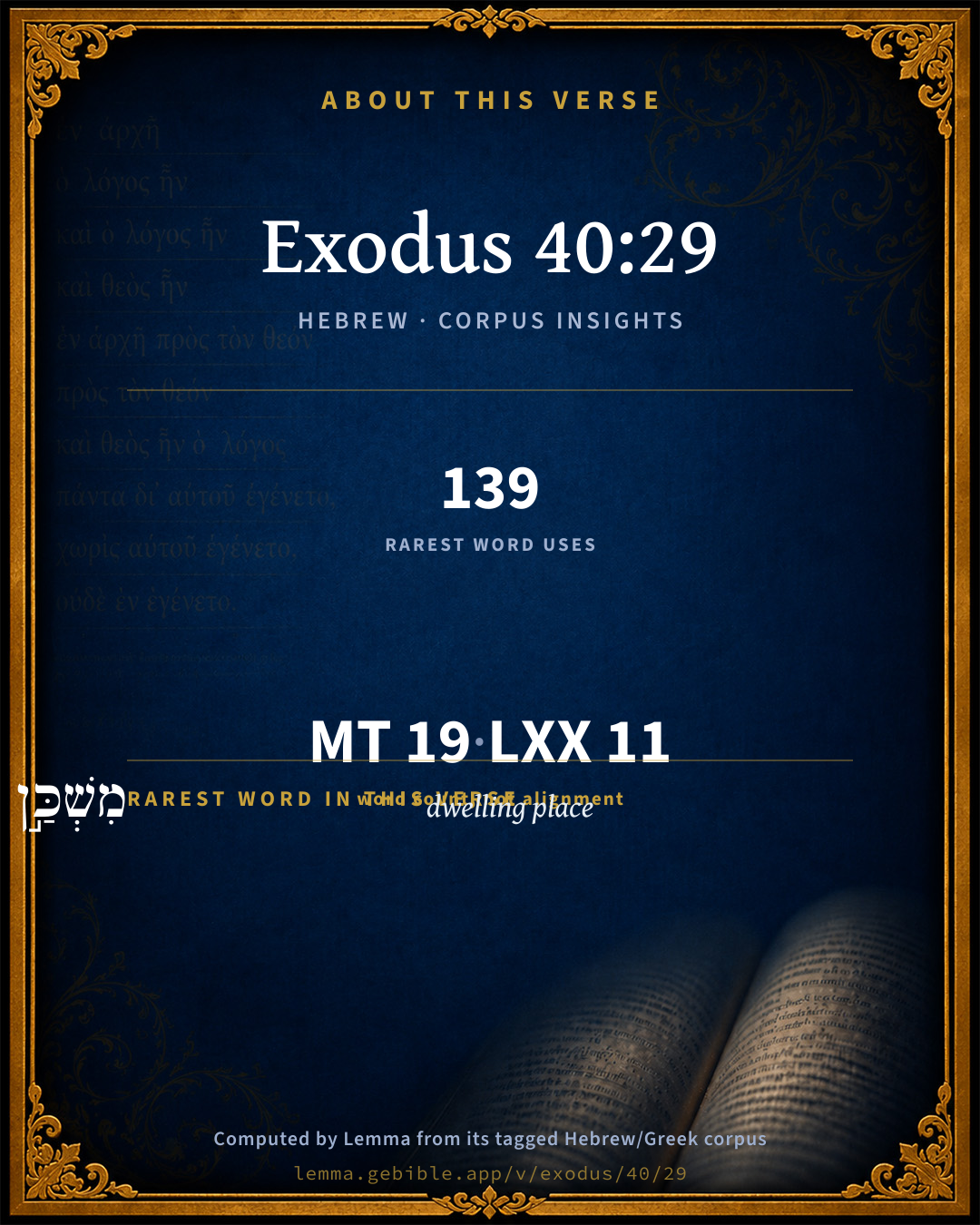
מִשְׁכַּ֣ן
mishkân
H4908
“dwelling place of”
Noun, Common, Masculine, Singular, Construct
Part of Speech
Noun
Type
Common
Gender
Masculine
Number
Singular
State
Construct
Full BDB Definition

Origin: from H7931

TWOT: 2387c

dwelling place, tabernacle - dwelling-place - dwellings
  1. וְאֵת֙ ʼêth H853 “and · -” Conjunction + Particle, Direct Object
  2. מִזְבַּ֣ח mizbêach H4196 “altar of” Noun, Common, Masculine, Singular, Construct
  3. הָעֹלָ֔ה ʻôlâh H5930 “the · burnt offering” Particle, Definite Article + Noun, Common, Feminine, Singular, Absolute
  4. שָׂ֕ם sûwm H7760 “to put” Verb, Qal, Perfect, 3rd Person, Masculine, Singular
  5. פֶּ֖תַח pethach H6607 “doorway of” Noun, Common, Masculine, Singular, Construct
  6. אֹֽהֶל ʼôhel H168 “tent of” Noun, Common, Masculine, Singular, Construct
  7. מוֹעֵ֑ד môwʻêd H4150 “appointed time” Noun, Common, Masculine, Singular, Absolute
  8. וַיַּ֣עַל ʻâlâh H5927 “and · to go up” Conjunction + Verb, Hiphil, Sequential Imperfect, 3rd Person, Masculine, Singular
  9. עָלָ֗יו ʻal H5921 “upon · him” Preposition + Suffix, Personal, 3rd Person, Masculine, Singular
  10. אֶת ʼêth H853 “-” Particle, Direct Object
  11. הָעֹלָה֙ ʻôlâh H5930 “the · burnt offering” Particle, Definite Article + Noun, Common, Feminine, Singular, Absolute
  12. וְאֶת ʼêth H853 “and · -” Conjunction + Particle, Direct Object
  13. הַמִּנְחָ֔ה minchâh H4503 “the · offering” Particle, Definite Article + Noun, Common, Feminine, Singular, Absolute
  14. כַּאֲשֶׁ֛ר ʼăsher H834 “like/as · which” Preposition + Particle, Relative
  15. צִוָּ֥ה tsâvâh H6680 “to command” Verb, Piel, Perfect, 3rd Person, Masculine, Singular
  16. יְהוָ֖ה Yᵉhôvâh H3068 “LORD” Noun, Proper
  17. אֶת ʼêth H853 “-” Particle, Direct Object
  18. מֹשֶֽׁה Môsheh H4872 “Moses” Noun, Proper

About this verse

These counts appear in no published source. They are computed here, from the morphology-tagged text and Lemma’s own curated glosses. What Lemma adds →

19
words
15
distinct lemmas
Pentateuch
section

Grammatical profile

  • 3 verbs
  • 10 nouns
  • 1 preposition
  • 5 particles

Verb forms

  • שָׂ֕ם Qal · Perfect
  • וַיַּ֣עַל Hiphil · Sequential Imperfect
  • צִוָּ֥ה Piel · Perfect

Repetition

A word recurs within this verse — often emphatic in Hebrew:

  • הָעֹלָ֔ה burnt offering H5930 ×2

Hebrew & Septuagint length

In English translation the verse runs 32 words from the Hebrew and 15 from the Septuagint (LXX English) — the Septuagint runs noticeably shorter here. See the side-by-side →

A rough comparison of the two English renderings, which tokenize alike — not a word-level alignment.

Word counts can differ between the Hebrew and the Greek without any difference in meaning — e.g. the Hebrew direct-object marker אֵת has no separate Greek word, and Greek often adds the article ὁ.

In the original languages it is 19 Hebrew tokens and 11 Greek tokens — but the two are counted differently (Hebrew bundles its prefixes and suffixes into one token; the Greek is in lemma form), so that isn’t a like-for-like length.

Cross-references

9

Topical passages linked to Exodus 40:29 in the Treasury of Scripture Knowledge — connected by theme and wording, ordered by reader-vote popularity; previews shown in the World English Bible.

  • Exodus 40:6 You shall set the altar of burnt offering before the door of the tent of the tent of meeting.
  • Exodus 27:1–8 "You shall make the altar of acacia wood, five cubits long, and five cubits broad; the altar shall be foursquare: and its height shall be three cubits.
  • Exodus 29:38–46 "Now this is that which you shall offer on the altar: two lambs a year old day by day continually.
  • Exodus 38:1–7 He made the altar of burnt offering of acacia wood. It was square. Its length was five cubits, its breadth was five cubits, and its height was three cubits.
  • Romans 3:24–26 being justified freely by his grace through the redemption that is in Christ Jesus;
  • Hebrews 9:12 nor yet through the blood of goats and calves, but through his own blood, entered in once for all into the Holy Place, having obtained eternal redemption.
  • Hebrews 13:5–6 Be free from the love of money, content with such things as you have, for he has said, "I will in no way leave you, neither will I in any way forsake you."
  • Hebrews 13:10 We have an altar from which those who serve the holy tabernacle have no right to eat.
  • Matthew 23:19 You blind fools! For which is greater, the gift, or the altar that sanctifies the gift?

Cross-references courtesy of OpenBible.info (CC BY 4.0).

Hebrew and Greek witnesses Masoretic Hebrew ↔ Greek Septuagint

The same verse in the two great witnesses to the Old Testament, shown verse-for-verse.

Here the Septuagint runs noticeably shorter than the Hebrew — LXX2012 (modern English Septuagint) 15 words vs World English Bible 32. A rough length comparison of the two English translations, not a word-level alignment — read both below.

These are two independent witnesses, not word-aligned to each other, and the Septuagint is shown in lemma (dictionary) form.

Hebrew Exodus 40:29 Masoretic · Westminster Leningrad Codex

וְאֵת֙ מִזְבַּ֣ח הָעֹלָ֔ה שָׂ֕ם פֶּ֖תַח מִשְׁכַּ֣ן אֹֽהֶל מוֹעֵ֑ד וַיַּ֣עַל עָלָ֗יו אֶת הָעֹלָה֙ וְאֶת הַמִּנְחָ֔ה כַּאֲשֶׁ֛ר צִוָּ֥ה יְהוָ֖ה אֶת מֹשֶֽׁה

He set the altar of burnt offering at the door of the tent of the tent of meeting, and offered on it the burnt offering and the meal-offering, as Yahweh commanded Moses.

World English Bible · Public Domain

Greek LXX Exodus 40:29 Septuagint · lemma form

καί ὁ θυσιαστήριον ὁ κάρπωμα τίθημι παρά ὁ θύρα ὁ σκηνή

And he put the altar of the burnt offerings by the doors of the tabernacle.

LXX2012 (modern English Septuagint) · Public Domain

Hebrew: Westminster Leningrad Codex (CC BY 4.0). Greek: Septuagint (public domain); English from LXX2012 (modern English Septuagint) (Public Domain). How the Septuagint differs from the Hebrew →

Targum (Aramaic paraphrase)

2

The Targum is the ancient Jewish Aramaic paraphrase of the Hebrew Scriptures — an interpretive translation, not the Hebrew text itself. Onkelos (literal) and Pseudo-Jonathan (expansive) render the Torah, and Jonathan the Prophets. Coverage is partial: where no permissively-licensed English translation exists for a verse, only the Aramaic is shown. This is verse-level text, not a word-by-word alignment to the Hebrew.

  1. Targum Onkelos Torah (Genesis–Deuteronomy)
    וְיָת מַדְבְּחָא דַעֲלָתָא שַׁוִי בִּתְרַע מַשְׁכְּנָא מַשְׁכַּן זִמְנָא וְאַסֵק עֲלוֹהִי יָת עֲלָתָא וְיָת מִנְחָתָּא כְּמָא דִי פַקִיד יְיָ יָת משֶׁה:

    (no public-domain English translation for this verse)

    Targum Onkelos — Aramaic: “Onkelos Genesis” (public domain); “Onkelos Exodus” (public domain); “Onkelos Leviticus” (public domain); “Onkelos Numbers” (public domain); “Onkelos Deuteronomy” (public domain). English: “Sefaria Community Translation” (CC0 1.0 (public-domain dedication)); “J.W. Etheridge. The Targums of Onkelos and Jonathan Ben Uzziel on the Pentateuch. London: Longmans, Green, 1862” (public domain). Text via Sefaria.

  2. Targum Pseudo-Jonathan Torah (Genesis–Deuteronomy)
    וְיַת מַדְבְּחָא דְעָלָתָא שַׁוִי בִּתְרַע מַשְׁכְּנָא וְאַסֵּיק עֲלוֹי יַת עֲלָתָא וְיַת מִנְחָתָא הֵיכְמָא דְפַקֵּיד יְיָ יַת משֶׁה

    And the altar of burnt offering he placed at the gate of the tabernacle, and offered thereon the burnt offering and the oblation, as the Lord commanded Mosheh.

    Targum Pseudo-Jonathan — Aramaic: “Targum Jonathan on Genesis” (public domain); “Targum Jonathan on Exodus” (public domain); “Targum Jonathan on Leviticus” (public domain); “Targum Jonathan on Numbers” (public domain); “Targum Jonathan on Deuteronomy” (public domain). English: “The Targum of Jonathan ben Uzziel, trans. J. W. Etheridge, London, 1862” (public domain). Text via Sefaria.

Commentary

Notes on Exodus 40:29 from classic Christian and Jewish commentators (each source and its license shown beneath its notes). The classic Christian expositions comment on the surrounding passage and are grouped to its opening verse, so a note may address several verses; the Jewish commentaries on the Tanakh (Rashi and others) are per-verse, so they appear only where the commentator wrote on this verse.

Lemma curates 59 commentaries, every one of them public domain or Creative Commons licensed, each selected and text-cleaned for this edition rather than reprinted as found. About our sources →

Ellicott's Commentary for English Readers

(29) He put the altar of burnt offering by the door of the tabernacle.—On the altar of burnt offering, see Exo_27:1-8; Exo_38:1-7. Some preposition has fallen out before the word “door.” Our translators suppose an omission of ’al, “at,” but it is more probable that liphney, which occurs in Exo_40:6, is the word omitted. The altar was not “at the door,” but “before” or “in front of the door.”

And offered upon it the burnt offering and the meat offering.—Offered upon it, i.e., the first evening sacrifice—a lamb for a burnt offering, together with the prescribed meat offering. (See Exo_29:40.)

A Bible Commentary for English Readers, edited by Charles John Ellicott (1878–1897) — public domain. Text from a community e-Sword module.

The Cambridge Bible for Schools and Colleges

gen. ed. J. J. S. Perowne

29. at the entrance of the Dwelling, &c.] See v. 6; and on Exo_39:32.

the burnt offering, &c.] See Exo_29:38-42.

The Cambridge Bible for Schools and Colleges (gen. ed. J. J. S. Perowne; Cambridge University Press, 1878–1918) — public domain. Text from a community e-Sword module.

John Gill's Exposition

And he reared up the court round about the tabernacle and the altar,.... Which consisted of hangings one hundred cubits long and fifty broad; see Exo 27:9, &c.

and set up the hanging of the court gate; which was at the east end of it; and the hanging was of twenty cubits, hung upon four pillars, Exo 27:16.

so Moses finished the work; of the tabernacle, in making it by workmen, and in rearing it up by the help of others; and as the former was the work of some months, so the latter, it is highly probable, was the work of some days, at least, in doing all that is said to be done in this chapter relative to it; for though it is said to be reared up on the first day of the first month, yet not then fully set up, or everything done requisite to the use and service of it; see Num 7:1.

John Gill's Exposition of the Whole Bible (1746–1763) — public domain (CC PDM 1.0). Text via the HelloAO Bible API.

Matthew Poole's English Annotations

The burnt-offering and the meat offering, for the consecration of the altar, this being the first sacrifice.

Matthew Poole's English Annotations on the Holy Bible (1683–1685) — public domain. Text from a community e-Sword/MySword module.

The Pulpit Commentary

He put the altar of burnt-offering by the door of the tabernacle. See the comment on ver. 6. And offered upon it the burnt offering and the meat-offeringi.e. , in his priestly character inaugurated the altar by offering upon it the first evening sacrifice. (see Exo_29:38-41)

The Pulpit Commentary (1880–1919), ed. H.D.M. Spence-Jones & Joseph S. Exell — public domain. Text from a community e-Sword module.

Rashi

Rabbi Shlomo Yitzchaki (Rashi)

ויעל עליו וגו׳ AND OFFERED UPON IT etc. Not only during the first seven days of the consecration of Aaron and his sons during which Moses set the dwelling up and then dismantled it, but also on the eighth day of the consecration which was the day of the final erection of the dwelling for its ordinary purposes did Moses officiate and offer the congregational sacrifices except those which had been commanded exclusively for that very day, as it is said, (Leviticus 9:7) “[And Moses said to Aaron], approach unto the altar and offer etc.

את העלה THE BURNT OFFERING — the daily burnt offering.

ואח המנחה AND THE MEAL OFFERING — The meal offering brought together with the libation which was made with the daily burnt offering, at it is said, (Exodus 29:40) “[And with the one lamb] (of the daily burnt offering) shall be brought a tenth deal of flour mingled with … oil; [and the fourth part of a hin of wine for a libation …]”.

Rashi on the Tanakh — English translations: “The Judaica Press complete Tanach with Rashi, translated by A. J. Rosenberg” (CC BY 4.0); “Pentateuch with Rashi's commentary by M. Rosenbaum and A.M. Silbermann, 1929-1934” (public domain); “The Metsudah Tanach series, Lakewood, N.J” (CC BY 4.0); and “The Book of Joshua, Metsudah Publications, 1997” (CC BY 4.0). Text via Sefaria.

Lesson kit

Teaching starters — assembled from the data on this page, not authored interpretation. Every prompt links to the verse data it draws on. Edit before teaching.

Exodus, in the Pentateuch, opens this verse with 19 words (15 distinct Hebrew lemmas). Its most distinctive word is mishkân (“dwelling place”). The Greek Septuagint runs shorter here. A historical commentator’s framing appears above. Read the whole chapter for the surrounding context.

Discussion questions

  1. What does “dwelling place” (mishkân) contribute to the verse as a whole?
  2. How does Exodus 40:6, which shares this passage’s theme, read alongside this verse?
  3. What does the repetition of “burnt offering” (2× in this one verse) do in this verse?
  4. The Septuagint runs shorter here than the Hebrew. What might account for the difference?
  5. These translations render this verse differently; the difference is in the English rendering, not the original. What questions does that raise?
  6. «שָׂ֕ם» is a Qal Perfect verb. How does that grammatical form shape the action described?
  7. Compare how Ellicott's Commentary for English Readers and The Cambridge Bible for Schools and Colleges read this verse. Where do they agree or differ?

Things to notice

Reading settings

Reading text

Shown beneath each verse's original-language words.

Old Testament
Old Testament edition

Read the OT as the Masoretic Hebrew (MT) or the Greek Septuagint (LXX).

English shown for the Greek Septuagint (in the Hebrew ↔ Greek comparison).

Comparing translations? Open the Compare panel on any verse page to stack up to four side by side.