
Numbers 21:17

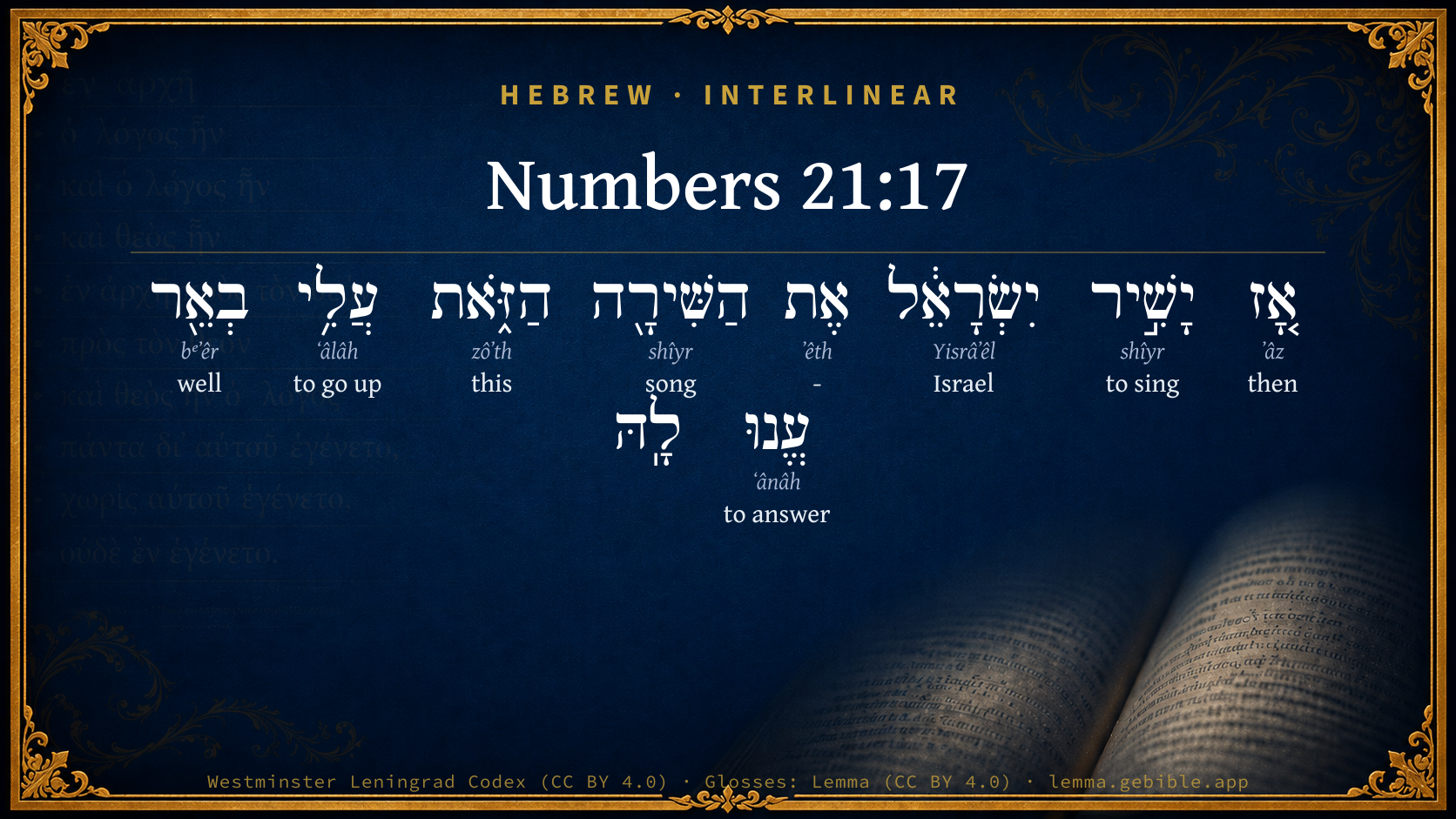
Hebrew (Westminster Leningrad Codex) Numbers 21:17 appears in the Hebrew Old Testament. The text above is from the Westminster Leningrad Codex. Each word links to its Strong’s number, a concise gloss, and parsing drawn from the Open Scriptures Hebrew Bible morphology. Click any word for its full Brown-Driver-Briggs (BDB) entry.
Download image
Cite this verse

Numbers 21:17 (World English Bible). Public Domain. Lemma interlinear Bible study tool, https://lemma.gebible.app/v/numbers/21/17.

Show BibTeX & RIS
BibTeX
RIS
English Translation
Then sang Israel this song: Spring up, well; sing you to it:
World English Bible · Public Domain
Download a study sheet

One document with this verse’s original text, its word-by-word gloss line, the meaning frame, cross-references with their text, attributed commentary, and full source and license credits — printable, and it pastes into notes with its structure intact.

This verse Autodidact and up

Study sheet (.html) Plain text (.txt)

A passage Seminary Student

Up to 50 verses in one chapter. A passage sheet keeps up to 6 commentary sources and 12 cross-references per verse, in the order this page ranks them, and says so on the sheet whenever that leaves anything out. Ask for a single verse and you get the Autodidact verse sheet above.

Everything on this page stays free to read, with no account — the sheet is a download of what is already on screen, not access to it.

Want to remove ads? Support Godless Engineer
Compare translations 3

The same verse in 3 English versions, stacked beneath the original-language interlinear above. Click any original word for its lexicon entry.

Each is an independent rendering of the whole verse — the interlinear is not word-aligned to these translations.

Highlighted words mark where these versions differ — a whole-verse word diff, not a word-by-word alignment.

  • World English Bible Public Domain
    Then sang Israel this song: Spring up, well; sing you to it:
  • King James Version Public Domain
    Then Israel sang this song, Spring up, O well; sing ye unto it:
  • unfoldingWord Literal Text CC BY-SA 4.0
    Then Israel sang this song: “Spring up, O well! Sing to it!

unfoldingWord Literal Text — © unfoldingWord, licensed CC BY-SA 4.0. Word-aligned USFM3 via Door43 (git.door43.org/unfoldingWord/en_ult).

Versions to compare (up to 4)

3 of 4 selected

Show all 18 translations

Every available English version of this verse, each an independent rendering of the whole verse.

  • World English Bible Public Domain
    Then sang Israel this song: Spring up, well; sing you to it:
  • Berean Standard Bible Public Domain
    Then Israel sang this song: “Spring up, O well, all of you sing to it!
  • Majority Standard Bible Public Domain
    Then Israel sang this song: “Spring up, O well, all of you sing to it!
  • King James Version Public Domain
    Then Israel sang this song, Spring up, O well; sing ye unto it:
  • American Standard Version (1901) Public Domain
    Then sang Israel this song: Spring up, O well; sing ye unto it:
  • Revised Version (1885) Public Domain
    Then sang Israel this song: Spring up, O well; sing ye unto it:
  • Geneva Bible (1599) Public Domain
    Then Israel sang this song, Rise vp well, sing ye vnto it.
  • Douay-Rheims (1899) Public Domain
    Then Israel sung this song: Let the well spring up. They sung thereto:
  • Young's Literal Translation Public Domain
    Then singeth Israel this song, concerning the well -- they have answered to it:
  • Literal Standard Version CC BY-SA 4.0
    Then Israel sings this song: “Spring up, O well, || Let all answer to it!
  • Unlocked Literal Bible CC BY-SA 4.0
    Then Israel sang this song: “Spring up, well! Sing about it,
  • unfoldingWord Literal Text CC BY-SA 4.0
    Then Israel sang this song: “Spring up, O well! Sing to it!
  • Darby Bible Public Domain
    Then Israel sang this song, Rise up, well! sing unto it:
  • World Messianic Bible Public Domain
    Then Israel sang this song: “Spring up, well! Sing to it,
  • Webster's Bible Public Domain
    Then Israel sung this song, Spring up, O well; sing ye to it:
  • Free Bible Version CC BY-SA 4.0
    Then the Israelites sang this song: “Pour out water, well! Everyone of you sing to it!
  • Bible in Basic English Public Domain
    Then Israel gave voice to this song: Come up, O water-spring, let us make a song to it:
  • JPS Tanakh (1917) Public Domain
    Then sang Israel this song: Spring up, O well — sing ye unto it —

Literal Standard Version (2020), Covenant Press — licensed CC BY-SA 4.0. Text via the HelloAO Bible API (eBible.org). Unlocked Literal Bible (unfoldingWord) — licensed CC BY-SA 4.0. Text via the HelloAO Bible API (eBible.org). unfoldingWord Literal Text — © unfoldingWord, licensed CC BY-SA 4.0. Word-aligned USFM3 via Door43 (git.door43.org/unfoldingWord/en_ult). Free Bible Version, Dr. Jonathan Gallagher — licensed CC BY-SA 4.0. Text via the HelloAO Bible API (eBible.org).

Word by word

More ways to search: Search by grammar → Find every occurrence → Compare this word →

Practice this passage: Drill this verse → Learn its vocabulary →

About this verse

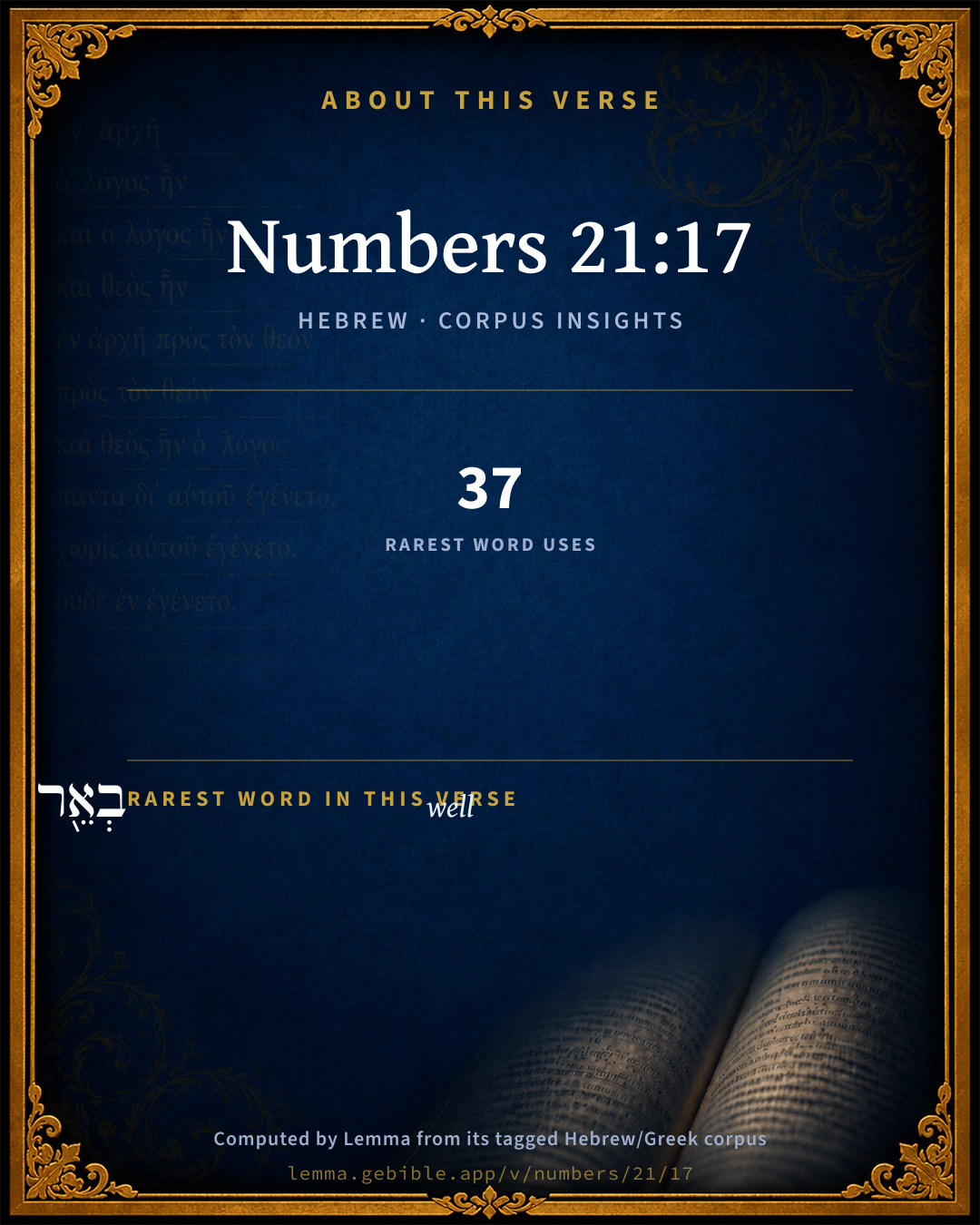
These counts appear in no published source. They are computed here, from the morphology-tagged text and Lemma’s own curated glosses. What Lemma adds →

10
words
9
distinct lemmas
Pentateuch
section

Shared distinctive vocabulary

בְאֵ֖ר well H875 occurs in 33 verses of the Hebrew Bible. Also found in:

Grammatical profile

  • 3 verbs
  • 3 nouns
  • 1 pronoun
  • 1 preposition
  • 1 adverb
  • 1 particle

Verb forms

  • יָשִׁ֣יר Qal · Imperfect
  • עֲלִ֥י Qal · Imperative
  • עֱנוּ Qal · Imperative

Hebrew & Septuagint length

In English translation the verse runs 12 words from the Hebrew and 14 from the Septuagint (LXX English) — closely comparable.

A rough comparison of the two English renderings, which tokenize alike — not a word-level alignment.

Word counts can differ between the Hebrew and the Greek without any difference in meaning — e.g. the Hebrew direct-object marker אֵת has no separate Greek word, and Greek often adds the article ὁ.

Cross-references

7

Topical passages linked to Numbers 21:17 in the Treasury of Scripture Knowledge — connected by theme and wording, ordered by reader-vote popularity; previews shown in the World English Bible.

  • Exodus 15:1–2 Then Moses and the children of Israel sang this song to Yahweh, and said, "I will sing to Yahweh, for he has triumphed gloriously: The horse and his rider he has thrown into the sea.
  • Judges 5:1 Then sang Deborah and Barak the son of Abinoam on that day, saying,
  • Psalms 105:2 Sing to him, sing praises to him! Tell of all his marvelous works.
  • Psalms 106:12 Then they believed his words. They sang his praise.
  • Isaiah 12:1–2 In that day you will say, "I will give thanks to you, Yahweh; for though you were angry with me, your anger has turned away and you comfort me.
  • Isaiah 12:5 Sing to Yahweh, for he has done excellent things! Let this be known in all the earth!
  • James 5:13 Is any among you suffering? Let him pray. Is any cheerful? Let him sing praises.

Cross-references courtesy of OpenBible.info (CC BY 4.0).

Hebrew and Greek witnesses Masoretic Hebrew ↔ Greek Septuagint

The same verse in the two great witnesses to the Old Testament, shown verse-for-verse.

These are two independent witnesses, not word-aligned to each other, and the Septuagint is shown in lemma (dictionary) form.

Hebrew Numbers 21:17 Masoretic · Westminster Leningrad Codex

אָ֚ז יָשִׁ֣יר יִשְׂרָאֵ֔ל אֶת הַשִּׁירָ֖ה הַזֹּ֑את עֲלִ֥י בְאֵ֖ר עֱנוּ לָֽהּ

Then sang Israel this song: Spring up, well; sing you to it:

World English Bible · Public Domain

Greek LXX Numbers 21:17 Septuagint · lemma form

τότε ᾄδω ἰσραήλ ὁ ἆ

Then Israel sang this song at the well, Begin to sing of the well;

LXX2012 (modern English Septuagint) · Public Domain

On this verse, Haydock's Catholic Bible Commentary discusses the Septuagint’s reading. Read the note in Commentary ↓

Hebrew: Westminster Leningrad Codex (CC BY 4.0). Greek: Septuagint (public domain); English from LXX2012 (modern English Septuagint) (Public Domain). How the Septuagint differs from the Hebrew →

Targum (Aramaic paraphrase)

2

The Targum is the ancient Jewish Aramaic paraphrase of the Hebrew Scriptures — an interpretive translation, not the Hebrew text itself. Onkelos (literal) and Pseudo-Jonathan (expansive) render the Torah, and Jonathan the Prophets. Coverage is partial: where no permissively-licensed English translation exists for a verse, only the Aramaic is shown. This is verse-level text, not a word-by-word alignment to the Hebrew.

  1. Targum Onkelos Torah (Genesis–Deuteronomy)
    בְּכֵן שַׁבַּח יִשְׂרָאֵל יָת תּוּשְׁבַּחְתָּא הָדָא סַקִי בֵירָא שַׁבָּחוּ לָהּ

    (no public-domain English translation for this verse)

    Targum Onkelos — Aramaic: “Onkelos Genesis” (public domain); “Onkelos Exodus” (public domain); “Onkelos Leviticus” (public domain); “Onkelos Numbers” (public domain); “Onkelos Deuteronomy” (public domain). English: “Sefaria Community Translation” (CC0 1.0 (public-domain dedication)); “J.W. Etheridge. The Targums of Onkelos and Jonathan Ben Uzziel on the Pentateuch. London: Longmans, Green, 1862” (public domain). Text via Sefaria.

  2. Targum Pseudo-Jonathan Torah (Genesis–Deuteronomy)
    הָא בְּכֵן שַׁבַּח יִשְרָאֵל יַת שְׁבַח שִׁירָתָא הֲדָא בִּזְמַן דְאִתְכַּסְיַית וְהַדְרַת בֵּירָא דְאִתְיְהִיבַת לְהוֹן בִּזְכוּתָא דְמִרְיָם סוּקִי בֵירָא סוּקִי בֵירָא הֲווֹן מְזַמְרִין לָהּ וְהִיא סַלְקָא

    Then, behold, Israel sang the thanksgiving of this song, at the time that the well which had been hidden was restored to them through the merit of Miriam: Spring up, O well, spring up, O well! sang they to it, and it sprang up:

    Targum Pseudo-Jonathan — Aramaic: “Targum Jonathan on Genesis” (public domain); “Targum Jonathan on Exodus” (public domain); “Targum Jonathan on Leviticus” (public domain); “Targum Jonathan on Numbers” (public domain); “Targum Jonathan on Deuteronomy” (public domain). English: “The Targum of Jonathan ben Uzziel, trans. J. W. Etheridge, London, 1862” (public domain). Text via Sefaria.

Commentary

Notes on Numbers 21:17 from classic Christian and Jewish commentators (each source and its license shown beneath its notes). The classic Christian expositions comment on the surrounding passage and are grouped to its opening verse, so a note may address several verses; the Jewish commentaries on the Tanakh (Rashi and others) are per-verse, so they appear only where the commentator wrote on this verse.

Lemma curates 59 commentaries, every one of them public domain or Creative Commons licensed, each selected and text-cleaned for this edition rather than reprinted as found. About our sources →

Trapp's Complete Commentary

John Trapp

Num 21:17 Then Israel sang this song, Spring up, O well; sing ye unto it:

Ver. 17. Then Israel sang this soug.] A sign of that Christian joy. {Isa 12:3-4}

John Trapp, A Commentary or Exposition upon All the Books of the Old and New Testament (1647–1656) — public domain. Text from a community e-Sword module.

Joseph Benson's Commentary

Num 21:17-18. Spring up — Hebrew, ascend; that is, let thy waters, which now lie hid below in the earth, ascend for our use. It is either a prediction that it should spring up, or a prayer that it might. With their staves — Probably as Moses smote the rock with his rod, so they struck the earth with their staves, as a sign that God would cause the water to flow out of the earth where they smote it, as he did before out of the rock. Or, perhaps, they made holes with their staves in the sandy ground, and God caused the water immediately to spring up.

Joseph Benson's Commentary on the Old and New Testaments (1811–1818) — public domain. Text from a community e-Sword module.

Scofield Reference Notes

C. I. Scofield

Then Israel

The spiritual order here is beautiful:

(1) atonement Num 21:8; Num 21:9; Joh 3:14; Joh 3:15

(2) water, symbol of the Spirit bestowed Num 21:16; Joh 7:37-39.

(3) joy Num 21:17; Num 21:18; Rom 14:17.

(4) power Num 21:21-24.

The Scofield Reference Bible (1917 edition), notes by C. I. Scofield — public domain. Text from a community e-Sword module.

Geneva Bible (1599)

Geneva Bible translators

Ye that receive the commodity thereof, give praise for it.

Or, spring.

Geneva Bible (1599) marginal notes — public domain. Text via Bolls.life.

Jamieson, Fausset & Brown

Robert Jamieson, A. R. Fausset & David Brown

Then Israel sang--This beautiful little song was in accordance with the wants and feelings of travelling caravans in the East, where water is an occasion both of prayer and thanksgiving. From the princes using their official rods only, and not spades, it seems probable that this well was concealed by the brushwood or the sand, as is the case with many wells in Idumea still. The discovery of it was seasonable, and owing to the special interposition of God.

Jamieson, Fausset & Brown — Commentary Critical and Explanatory on the Whole Bible (1871) — public domain (CC PDM 1.0). Text via the HelloAO Bible API.

Adam Clarke's Commentary

Verse 17. Spring up, O well, &c.] This is one of the most ancient war songs in the world, but is not easily understood, which is commonly the case with all very ancient compositions, especially the poetic. See Clarke on Ex 15:1, &c.

Adam Clarke's Commentary on the Bible (1810–1826) — public domain. Text from a community e-Sword/MySword module.

John Gill's Exposition

The princes digged the well,.... The princes and heads of the several tribes:

the nobles of the people digged it; the seventy elders, according to the Targum of Jonathan:

by the direction of the lawgiver; either the Lord himself, the lawgiver of his people, who pointed out the spot, and directed the princes where to dig, that is, be did this by Moses; and who, as Jarchi thinks, is the lawgiver, and not amiss: the Targums of Jonathan and Jerusalem render the word by Scribes, in the plural number, and interpret them of Moses and Aaron: and this the princes and nobles "dug with their staves"; either their walking sticks, or their rods, the ensigns of their authority; with these they smote the ground, or stuck them in a soft and sandy place, upon which the waters bubbled up and flowed out. Dr. Shaw (n) chooses to render the words, "with their united applause", or "clapping of hands", as the word in Chaldee signifies; or it may be expressed, as by Dr. Hunt, quoted by him, "by describing" or "marking out" the figure or fashion of the well "with staves". Mr. Ainsworth thinks that this well signified Christ, the fountain of gardens, and well of living waters; and the waters of it the Spirit and his graces, which are a well of living water springing up unto everlasting life; the means of which are the labours of the governors of the church, the ministers of Christ,by preaching the word, and opening the Scriptures; and such grace is worthy of a song, and to be had with joy out of the wells of salvation, Isa 12:3,

and from the wilderness they went to Mattanah; from the wilderness near Arnon, which came out of the coasts of the Amorites, Num 21:13 to a place which signifies a gift. The Targums of Jonathan and Jerusalem render it,"and from the wilderness it was given to them for a gift''that is, the well; and so the people of God, that are called out of the wilderness of this world, and come up from it, are called to partake of the gifts and blessings of grace, which are freely given unto them of God.

(n) Travels, p. 67. Ed. 2.

John Gill's Exposition of the Whole Bible (1746–1763) — public domain (CC PDM 1.0). Text via the HelloAO Bible API.

Albert Barnes' Notes on the Bible

This song, recognized by all authorities as dating from the earliest times, and suggested apparently by the fact that God in this place gave the people water not from the rock, but by commanding Moses to cause a well to be dug, bespeaks the glad zeal, the joyful faith, and the hearty cooperation among all ranks, which possessed the people. In after time it may well have been the water-drawing song of the maidens of Israel.

Num 21:18

By the direction of the lawgiver - Some render, with the lawgiver’s scepter; i. e. under the direction and with the authority of Moses; compare Gen 49:10, and note.

Albert Barnes' Notes on the Bible (1834–1885) — public domain. Text from a community e-Sword/MySword module.

Haydock's Catholic Bible Commentary

They sung. Hebrew, "sing ye unto it," in chorus, men and women. Septuagint, "commence a canticle unto it. This well the princes dug, the kings of nations hewed in the rock, in their kingdom, while they held dominion."

George Leo Haydock (1774–1849), Haydock's Catholic Family Bible and Commentary, 1859 edition — public domain. Excludes Psalms (Douay-Rheims chapter numbering differs from Protestant) and Deuterocanonical books (Catholic canon only).

Matthew Poole's English Annotations

Israel sang this song, to praise God for giving them such a seasonable blessing, before they asked it, or complained for the want of it.

Spring up; give forth thy waters that we may drink. Heb. Ascend, i.e. let thy waters, which now lie hid below in the earth, ascend for thy use. It is either a prediction that it should spring up, or a prayer that it might, or a command in the name of God directed to the well, by a usual prosopopaeia, as when God bids the heavens hear, and the earth give ear, Isa 1:2. Any of these ways it shows their faith. Sing ye unto it; or, sing ye of it; or, answer to it or concerning it; it being the manner of the Jewish singers that one should answer to another, of which see Exo 15:21; 1Sa 18:7.

Matthew Poole's English Annotations on the Holy Bible (1683–1685) — public domain. Text from a community e-Sword/MySword module.

Whedon's Commentary on the Bible

Daniel D. Whedon

17. Israel sang this song —

“Spring up, O well; sing ye unto it;

The well which the princes digged,

Which the nobles of the people delved

With the sceptre and with their staves.”

“The arrival in Moab marks, indeed, the first outburst of Hebrew poetry. Ordinary words would no longer suffice to give expression to the joy at entering on fertile regions, and leaving the desert behind them.” — Geikie. This song, first sung at the digging of the well, was afterward, no doubt, commonly used by those who came to draw water. The maidens of Israel chanted it one to another, verse by verse, as they toiled at the bucket, and thus beguiled their labour. But its peculiar charm lies in the characteristic touch which manifestly connects it with the life of the time to which the narrative assigns it. The leaders were not above doing some part of the work. “This little carol is fresh and lusty with long life; it sparkles like the water of the well whose springing up first occasioned it; it is the expression of lively confidence in the sympathy of their leaders, which might be relied on in all emergencies.” — Ewald.

Daniel D. Whedon (gen. ed.), Commentary on the Old and New Testaments (1874–1909) — public domain. Text from a community e-Sword module.

The Pulpit Commentary

Then Israel sang this song. This song of the well may be taken from the same collection of odes, but more probably is quoted from memory. It is remarkable for the spirit of joyousness which breathes in it, so different from the complaining, desponding tone of the past.

The Pulpit Commentary (1880–1919), ed. H.D.M. Spence-Jones & Joseph S. Exell — public domain. Text from a community e-Sword module.

John Wesley's Explanatory Notes

Spring up - Hebrew. ascend, that is, let thy waters, which now lie hid below in the earth, ascend for our use. It is either a prediction that it should spring up, or a prayer that it might.

John Wesley, Explanatory Notes Upon the Whole Bible (1754–1765) — public domain. Text via the GEBible commentary corpus.

unfoldingWord translationNotes

Door43 World Missions Community

Spring up, well

Here "well" represents the water in the well. The Israelites are speaking to the water as if it were a person who could hear them, and they are asking for it to fill the well. AT: "Water, fill up the well" (See: Metonymy and Personification)

the well that our leaders dug, the well the nobles of the people dug

These two phrases mean basically the same thing and emphasize the role of the leaders in digging the well. (See: Parallelism)

with the scepter and their staffs

A scepter was carried by those with authority, and the staff was carried by everyone. Neither of these are digging tools. These two items emphasize that they were not too proud to use any means available. AT: "using even their scepter and staffs" (See: Assumed Knowledge and Implicit Information)

translationWords

Israel

noble

scepter

staff

desert

unfoldingWord translationNotes — © Distant Shores Media and the Door43 World Missions Community, licensed CC BY-SA 4.0. Source: git.door43.org/Door43/en_tn.

Rashi

Rabbi Shlomo Yitzchaki (Rashi)

עלי באר COME UP, WELL from the valley and bring up what you have to bring up! — Whence do we know that it was the well that announced to them these miracles as it is stated above? Because it is said: ומשם בארה “and from there to the well”. For you cannot say that it means: “from that place was (they got) the well”, because was it indeed from there that they got it? Had it not been with them from the beginning of the forty years’ wanderings? But it means that from there it flowed down to the Israelites to proclaim the miracles! Then again, also, the paragraph beginning with the words: אז ישיר … השירה הזאת were spoken at the end of the forty years whilst the well was given them at the beginning of the forty, and what reason then can there be to write it as late as here. But the subject of the song has to be explained in connection with what precedes it (that it was a summons to the well to bring up the bodies of the slain) (Midrash Tanchuma, Chukat 20).

Rashi on the Tanakh — English translations: “The Judaica Press complete Tanach with Rashi, translated by A. J. Rosenberg” (CC BY 4.0); “Pentateuch with Rashi's commentary by M. Rosenbaum and A.M. Silbermann, 1929-1934” (public domain); “The Metsudah Tanach series, Lakewood, N.J” (CC BY 4.0); and “The Book of Joshua, Metsudah Publications, 1997” (CC BY 4.0). Text via Sefaria.

Lesson kit

Teaching starters — assembled from the data on this page, not authored interpretation. Every prompt links to the verse data it draws on. Edit before teaching.

Numbers, in the Pentateuch, opens this verse with 10 words (9 distinct Hebrew lemmas). Its most distinctive word is bᵉʼêr (“well”). A historical commentator’s framing appears above. Read the whole chapter for the surrounding context.

Discussion questions

  1. The word bᵉʼêr carries the sense “well.” How does it shape the verse?
  2. How does Genesis 14:10, which shares the word «well», read alongside this verse?
  3. These translations render this verse differently. What is at stake in choosing one wording over another?
  4. «יָשִׁ֣יר» is a Qal Imperfect verb. How does that grammatical form shape the action described?
  5. Compare how Trapp's Complete Commentary and Joseph Benson's Commentary read this verse. Where do they agree or differ?

Things to notice

Reading settings

Reading text

Shown beneath each verse's original-language words.

Old Testament
Old Testament edition

Read the OT as the Masoretic Hebrew (MT) or the Greek Septuagint (LXX).

English shown for the Greek Septuagint (in the Hebrew ↔ Greek comparison).

Comparing translations? Open the Compare panel on any verse page to stack up to four side by side.