
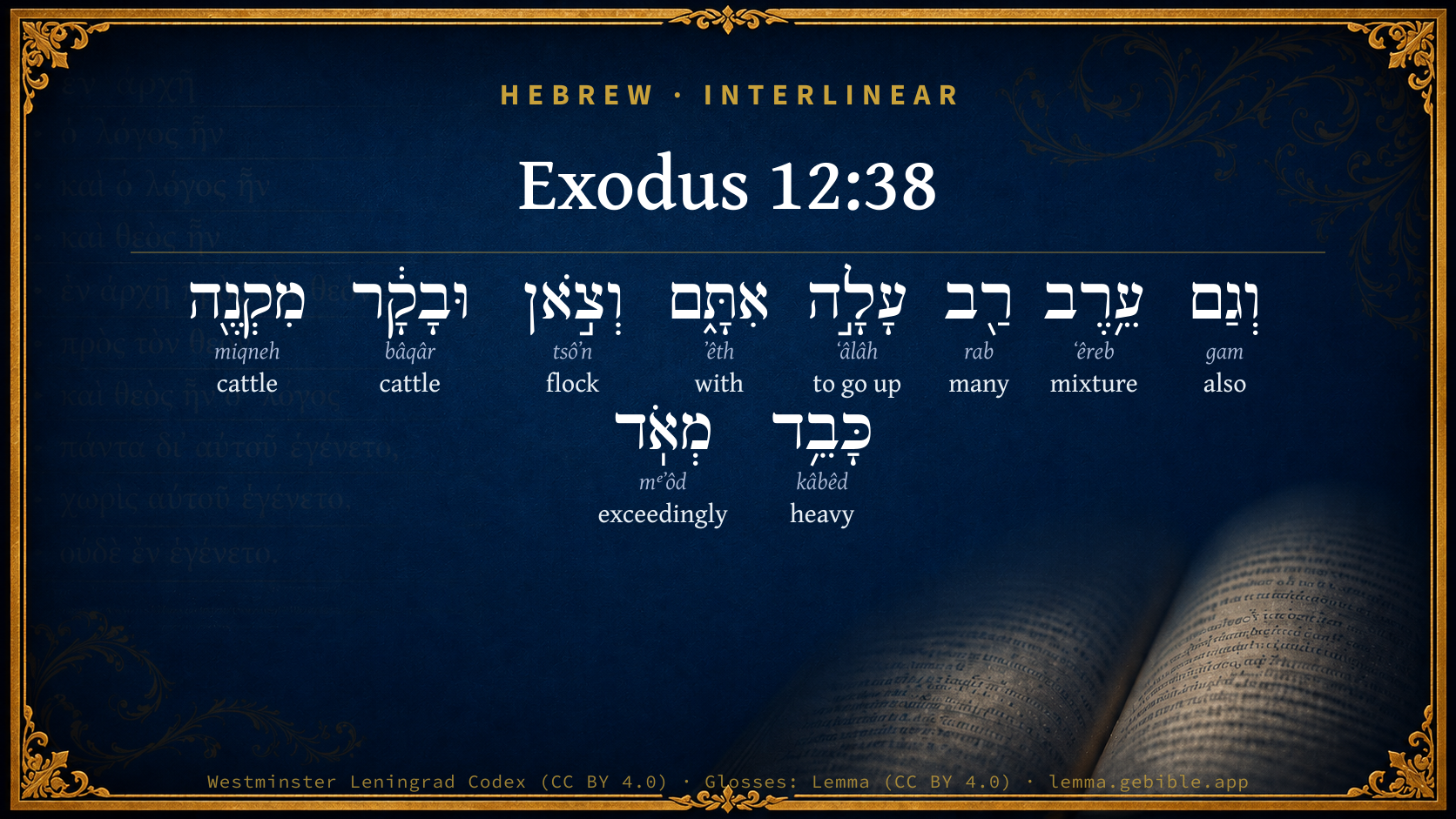
Exodus 12:38

Hebrew (Westminster Leningrad Codex) Exodus 12:38 appears in the Hebrew Old Testament. The text above is from the Westminster Leningrad Codex. Each word links to its Strong’s number, a concise gloss, and parsing drawn from the Open Scriptures Hebrew Bible morphology. Click any word for its full Brown-Driver-Briggs (BDB) entry.
Download image
Cite this verse

Exodus 12:38 (World English Bible). Public Domain. Lemma interlinear Bible study tool, https://lemma.gebible.app/v/exodus/12/38.

Show BibTeX & RIS
BibTeX
RIS
English Translation
A mixed multitude went up also with them, with flocks, herds, and even very much cattle.
World English Bible · Public Domain
Highlights
  • 1 first appearance in the Hebrew Bible
Full analysis ↓
Download a study sheet

One document with this verse’s original text, its word-by-word gloss line, the meaning frame, cross-references with their text, attributed commentary, and full source and license credits — printable, and it pastes into notes with its structure intact.

This verse Autodidact and up

Study sheet (.html) Plain text (.txt)

A passage Seminary Student

Up to 50 verses in one chapter. A passage sheet keeps up to 6 commentary sources and 12 cross-references per verse, in the order this page ranks them, and says so on the sheet whenever that leaves anything out. Ask for a single verse and you get the Autodidact verse sheet above.

Everything on this page stays free to read, with no account — the sheet is a download of what is already on screen, not access to it.

Want to remove ads? Support Godless Engineer
Compare translations 3

The same verse in 3 English versions, stacked beneath the original-language interlinear above. Click any original word for its lexicon entry.

Each is an independent rendering of the whole verse — the interlinear is not word-aligned to these translations.

Highlighted words mark where these versions differ — a whole-verse word diff, not a word-by-word alignment.

  • World English Bible Public Domain
    A mixed multitude went up also with them, with flocks, herds, and even very much cattle.
  • King James Version Public Domain
    And a mixed multitude went up also with them; and flocks, and herds, even very much cattle.
  • unfoldingWord Literal Text CC BY-SA 4.0
    And also a mixed multitude went up with them, and flock and herd—a very great number of livestock.

unfoldingWord Literal Text — © unfoldingWord, licensed CC BY-SA 4.0. Word-aligned USFM3 via Door43 (git.door43.org/unfoldingWord/en_ult).

Versions to compare (up to 4)

3 of 4 selected

Show all 18 translations

Every available English version of this verse, each an independent rendering of the whole verse.

  • World English Bible Public Domain
    A mixed multitude went up also with them, with flocks, herds, and even very much cattle.
  • Berean Standard Bible Public Domain
    And a mixed multitude also went up with them, along with great droves of livestock, both flocks and herds.
  • Majority Standard Bible Public Domain
    And a mixed multitude also went up with them, along with great droves of livestock, both flocks and herds.
  • King James Version Public Domain
    And a mixed multitude went up also with them; and flocks, and herds, even very much cattle.
  • American Standard Version (1901) Public Domain
    And a mixed multitude went up also with them; and flocks, and herds, even very much cattle.
  • Revised Version (1885) Public Domain
    And a mixed multitude went up also with them; and flocks, and herds, even very much cattle.
  • Geneva Bible (1599) Public Domain
    And a great multitude of sundrie sortes of people went out with them, and sheepe, and beeues, and cattel in great abundance.
  • Douay-Rheims (1899) Public Domain
    And a mixed multitude without number went up also with them, sheep and herds and beasts of divers kinds, exceeding many.
  • Young's Literal Translation Public Domain
    and a great rabble also hath gone up with them, and flock and herd -- very much cattle.
  • Literal Standard Version CC BY-SA 4.0
    and a great rabble has also gone up with them, and flock and herd—very much livestock.
  • Unlocked Literal Bible CC BY-SA 4.0
    A mixed multitude also went with them, together with flocks and herds, a very large number of livestock.
  • unfoldingWord Literal Text CC BY-SA 4.0
    And also a mixed multitude went up with them, and flock and herd—a very great number of livestock.
  • Darby Bible Public Domain
    And a mixed multitude went up also with them; and flocks and herds -- very much cattle.
  • World Messianic Bible Public Domain
    A mixed multitude went up also with them, with flocks, herds, and even very much livestock.
  • Webster's Bible Public Domain
    And a mixed multitude went up also with them; and flocks, and herds, even very many cattle.
  • Free Bible Version CC BY-SA 4.0
    In addition many foreigners joined them. They also took with them large herds and flocks of livestock.
  • Bible in Basic English Public Domain
    And a mixed band of people went with them; and flocks and herds in great numbers.
  • JPS Tanakh (1917) Public Domain
    And a mixed multitude went up also with them; and flocks, and herds, even very much cattle.

Literal Standard Version (2020), Covenant Press — licensed CC BY-SA 4.0. Text via the HelloAO Bible API (eBible.org). Unlocked Literal Bible (unfoldingWord) — licensed CC BY-SA 4.0. Text via the HelloAO Bible API (eBible.org). unfoldingWord Literal Text — © unfoldingWord, licensed CC BY-SA 4.0. Word-aligned USFM3 via Door43 (git.door43.org/unfoldingWord/en_ult). Free Bible Version, Dr. Jonathan Gallagher — licensed CC BY-SA 4.0. Text via the HelloAO Bible API (eBible.org).

Word by word

More ways to search: Search by grammar → Find every occurrence → Compare this word →

Practice this passage: Drill this verse → Learn its vocabulary →

About this verse

These counts appear in no published source. They are computed here, from the morphology-tagged text and Lemma’s own curated glosses. What Lemma adds →

10
words
10
distinct lemmas
Pentateuch
section

Notable vocabulary

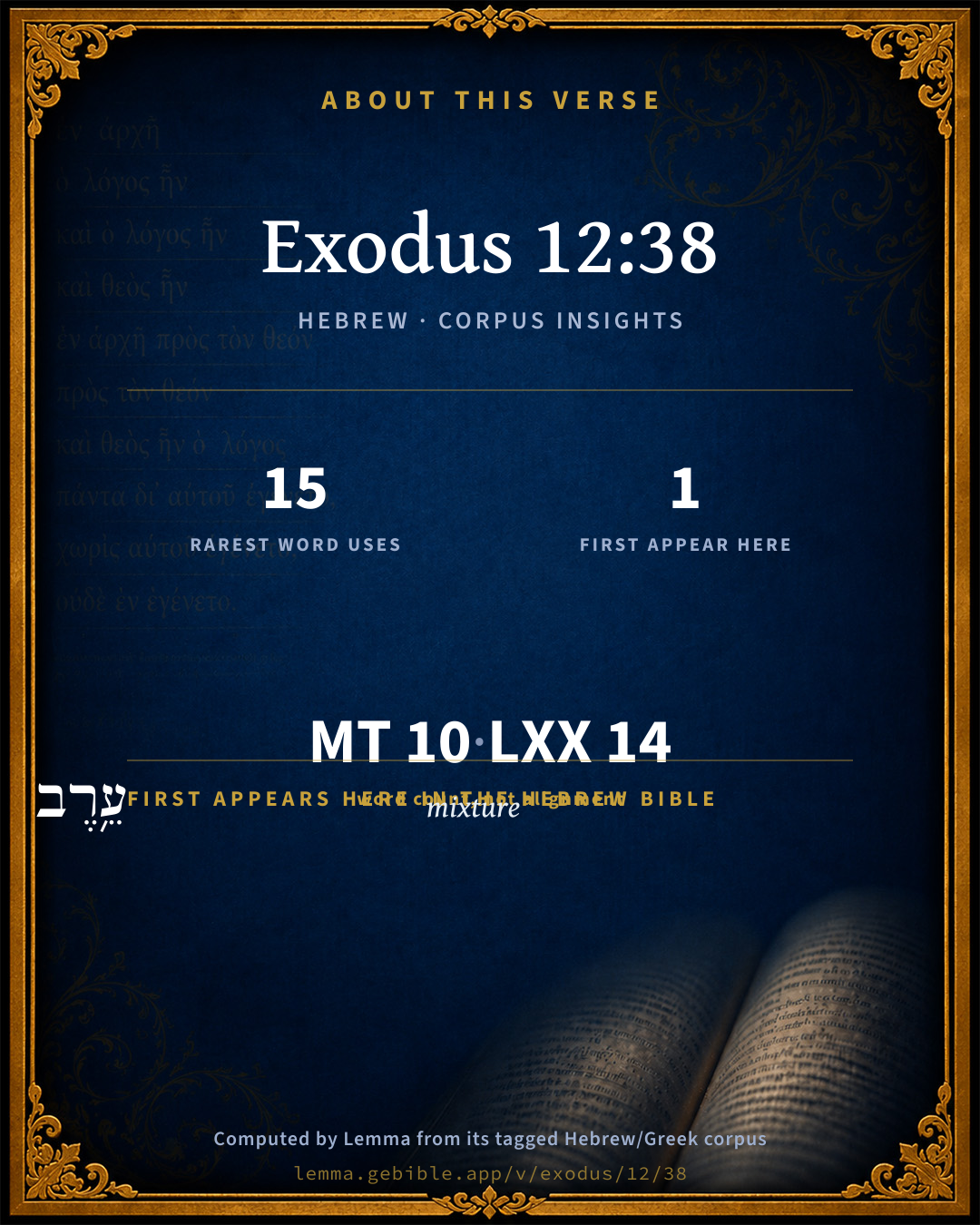
The rarest word here is עֵ֥רֶב mixture H6154 — appearing just 15 times in the whole Hebrew Bible.

First appearance in Scripture

This word makes its first canonical appearance in the Hebrew Bible here:

  • עֵ֥רֶב mixture H6154

Shared distinctive vocabulary

עֵ֥רֶב mixture H6154 occurs in 15 verses of the Hebrew Bible. Also found in:

Grammatical profile

  • 1 verb
  • 4 nouns
  • 2 adjectives
  • 1 preposition
  • 1 adverb
  • 1 particle

Verb forms

  • עָלָ֣ה Qal · Perfect

Hebrew & Septuagint length

In English translation the verse runs 16 words from the Hebrew and 17 from the Septuagint (LXX English) — closely comparable.

A rough comparison of the two English renderings, which tokenize alike — not a word-level alignment.

Word counts can differ between the Hebrew and the Greek without any difference in meaning — e.g. the Hebrew direct-object marker אֵת has no separate Greek word, and Greek often adds the article ὁ.

In the original languages it is 10 Hebrew tokens and 14 Greek tokens — but the two are counted differently (Hebrew bundles its prefixes and suffixes into one token; the Greek is in lemma form), so that isn’t a like-for-like length.

Cross-references

2

Topical passages linked to Exodus 12:38 in the Treasury of Scripture Knowledge — connected by theme and wording, ordered by reader-vote popularity; previews shown in the World English Bible.

  • Numbers 11:4 The mixed multitude that was among them lusted exceedingly: and the children of Israel also wept again, and said, Who shall give us flesh to eat?
  • Zechariah 8:23 Thus says Yahweh of Hosts: "In those days, ten men will take hold, out of all the languages of the nations, they will take hold of the skirt of him who is a Jew, saying, 'We will go with you, for we have heard that God is with you.'"

Cross-references courtesy of OpenBible.info (CC BY 4.0).

Hebrew and Greek witnesses Masoretic Hebrew ↔ Greek Septuagint

The same verse in the two great witnesses to the Old Testament, shown verse-for-verse.

These are two independent witnesses, not word-aligned to each other, and the Septuagint is shown in lemma (dictionary) form.

Hebrew Exodus 12:38 Masoretic · Westminster Leningrad Codex

וְגַם עֵ֥רֶב רַ֖ב עָלָ֣ה אִתָּ֑ם וְצֹ֣אן וּבָקָ֔ר מִקְנֶ֖ה כָּבֵ֥ד מְאֹֽד

A mixed multitude went up also with them, with flocks, herds, and even very much cattle.

World English Bible · Public Domain

Greek LXX Exodus 12:38 Septuagint · lemma form

καί ἐπίμικτος πολύς συν ἀναβαίνω αὐτός καί πρόβατον καί βοῦς καί κτῆνος πολύς σφόδρα

And a great mixed company went up with them, and sheep and oxen and very much cattle.

LXX2012 (modern English Septuagint) · Public Domain

On this verse, John Gill's Exposition discusses the Septuagint’s reading. Read the note in Commentary ↓

Hebrew: Westminster Leningrad Codex (CC BY 4.0). Greek: Septuagint (public domain); English from LXX2012 (modern English Septuagint) (Public Domain). How the Septuagint differs from the Hebrew →

Targum (Aramaic paraphrase)

2

The Targum is the ancient Jewish Aramaic paraphrase of the Hebrew Scriptures — an interpretive translation, not the Hebrew text itself. Onkelos (literal) and Pseudo-Jonathan (expansive) render the Torah, and Jonathan the Prophets. Coverage is partial: where no permissively-licensed English translation exists for a verse, only the Aramaic is shown. This is verse-level text, not a word-by-word alignment to the Hebrew.

  1. Targum Onkelos Torah (Genesis–Deuteronomy)
    וְאַף נוּכְרָאִין סַגִיאִין סְלִיקוּ עִמְהוֹן וְעָנָא וְתוֹרִין בְּעִירָא סַגִי לַחֲדָא:

    (no public-domain English translation for this verse)

    Targum Onkelos — Aramaic: “Onkelos Genesis” (public domain); “Onkelos Exodus” (public domain); “Onkelos Leviticus” (public domain); “Onkelos Numbers” (public domain); “Onkelos Deuteronomy” (public domain). English: “Sefaria Community Translation” (CC0 1.0 (public-domain dedication)); “J.W. Etheridge. The Targums of Onkelos and Jonathan Ben Uzziel on the Pentateuch. London: Longmans, Green, 1862” (public domain). Text via Sefaria.

  2. Targum Pseudo-Jonathan Torah (Genesis–Deuteronomy)
    וְאוּף נוּכְרָאִין סַגִּיאִין מִנְהוֹן מָאתָן וְאַרְבְּעִין רִבְוָון סַלִּיקוּ עִמְהוֹן וְעָאָן וְתוֹרֵי וְגֵיתֵי סַגִּי לַחֲדָא

    and a multitude of strangers, two hundred and forty myriads, went up with them, and sheep, and oxen, and cattle, very many.

    Targum Pseudo-Jonathan — Aramaic: “Targum Jonathan on Genesis” (public domain); “Targum Jonathan on Exodus” (public domain); “Targum Jonathan on Leviticus” (public domain); “Targum Jonathan on Numbers” (public domain); “Targum Jonathan on Deuteronomy” (public domain). English: “The Targum of Jonathan ben Uzziel, trans. J. W. Etheridge, London, 1862” (public domain). Text via Sefaria.

Commentary

Notes on Exodus 12:38 from classic Christian and Jewish commentators (each source and its license shown beneath its notes). The classic Christian expositions comment on the surrounding passage and are grouped to its opening verse, so a note may address several verses; the Jewish commentaries on the Tanakh (Rashi and others) are per-verse, so they appear only where the commentator wrote on this verse.

Lemma curates 59 commentaries, every one of them public domain or Creative Commons licensed, each selected and text-cleaned for this edition rather than reprinted as found. About our sources →

Trapp's Complete Commentary

John Trapp

Exo 12:38 And a mixed multitude went up also with them; and flocks, and herds, [even] very much cattle.

Ver. 38. And a mixed multitude.] Of strangers, that "took hold of the skirts of these Jews, and said, We will go with you," {Zec 8:23} but afterwards turned tippet, {Num 11:4} lusted greatly and greedily, and made Israel to sin. Coals touched will either burn or sully us.

John Trapp, A Commentary or Exposition upon All the Books of the Old and New Testament (1647–1656) — public domain. Text from a community e-Sword module.

Joseph Benson's Commentary

Exo 12:38-39. And a mixed multitude went up with them — Some perhaps willing to leave their country, because it was laid waste by the plagues. But probably the greatest part was but a rude, unthinking mob, that followed they knew not why. It is likely, when they understood that the children of Israel were to continue forty years in the wilderness, they quitted them, and returned to Egypt again. And flocks and herds, even very much cattle — This is taken notice of, because it was long ere Pharaoh would give them leave to remove their effects, which were chiefly cattle. Thrust out — By importunate entreaties.

Joseph Benson's Commentary on the Old and New Testaments (1811–1818) — public domain. Text from a community e-Sword module.

Tyndale Open Study Notes

Tyndale Open Resources

12:38 A rabble of non-Israelites: Some of these people later became disaffected and led the Israelites into complaining about their difficulties (see Num 11:4). We are never told their motivation for joining with the Israelites. Perhaps some had come to faith in the Lord as a result of the plagues. Others probably saw it as an opportunity for a better life elsewhere.

Tyndale Open Study Notes — © Tyndale Open Resources, licensed CC BY-SA 4.0. Text via the HelloAO Bible API.

Geneva Bible (1599)

Geneva Bible translators

Which were strangers, and not born of the Israelites.

Geneva Bible (1599) marginal notes — public domain. Text via Bolls.life.

Jamieson, Fausset & Brown

Robert Jamieson, A. R. Fausset & David Brown

a mixed multitude went with them--literally, "a great rabble" (see also Num 11:4; Deu 29:11); slaves, persons in the lowest grades of society, partly natives and partly foreigners, bound close to them as companions in misery, and gladly availing themselves of the opportunity to escape in the crowd. (Compare Zac 8:23).

Jamieson, Fausset & Brown — Commentary Critical and Explanatory on the Whole Bible (1871) — public domain (CC PDM 1.0). Text via the HelloAO Bible API.

Ellicott's Commentary for English Readers

(38) A mixed multitude went up also with them.—Nothing is told us of the component elements of this “mixed multitude.” We hear of them as “murmuring” in Num_11:4, so that they seem to have remained with Israel. Some may have been Egyptians, impressed by the recent miracles; some foreigners held to servitude, like the Israelites, and glad to escape from their masters. It is noticeable that the Egyptian writers, in their perverted accounts of the Exodus, made a multitude of foreigners (Hyksôs) take part with the Hebrews.

A Bible Commentary for English Readers, edited by Charles John Ellicott (1878–1897) — public domain. Text from a community e-Sword module.

The Cambridge Bible for Schools and Colleges

gen. ed. J. J. S. Perowne

38. a great mixed multitude] cf. Num_11:4 (the Heb. word different). Non-Israelites (cf. the same word in Neh_13:3) of various kinds are meant: e.g. Egyptians who had intermarried with Israelites (cf. Lev_24:10), other Semites who had found their way into Egypt, and prisoners taken in war who had been employed in the corvée (Exo_1:9).

flocks and herds] cf. v. 32, Exo_10:26.

The Cambridge Bible for Schools and Colleges (gen. ed. J. J. S. Perowne; Cambridge University Press, 1878–1918) — public domain. Text from a community e-Sword module.

John Gill's Exposition

Now the sojourning of the children of Israel, who dwelt in Egypt,.... The Septuagint version adds, "and in the land of Canaan"; and the Samaritan version is,"the sojourning of the children of Israel, and of their fathers, in the land of Canaan, and in the land of Egypt.''Agreeably to which are both the Talmuds: in one (o) of them the words are,"in Egypt and in all lands,''and in the other (p),"in Egypt, and in the rest of the lands;''and in the same way Aben Ezra interprets the words. And certain it is, that Israel did not dwell in Egypt four hundred and thirty years, and even not much more than two hundred years; but then they and their fathers, Abraham, Isaac, and Jacob, dwelt so long in Mesopotamia, in Canaan, and in Egypt, in foreign countries, in a land not theirs, as the phrase is, Gen 15:13 where the place of their sojourning, and the time of it, are given by way of prophecy. The Jews reckon from the vision of God to Abraham between the pieces to the birth of Isaac thirty years, so the Targum of Jonathan; but that cannot be, though from his coming out of his own native place, Ur of the Chaldeans, to the birth of Isaac, might be so many years, since he was seventy five years of age when he came out of Haran, Gen 12:4 and if he stayed at Haran five years, as probably he did, then there were just thirty from his coming out of Ur of the Chaldees to Isaac's birth, since he was born when he was one hundred years old; and from the birth of Isaac to the birth of Jacob was sixty years, Gen 25:26 and from thence to his going down to Egypt was one hundred and thirty, Gen 47:9 and from thence to the coming of Israel out of Egypt were two hundred and ten years, as is generally computed, which make the exact sum of four hundred and thirty years; of these See Gill on Act 7:6, Gal 3:17.

(o) T. Hieros. Magillah, fol. 71. 4. (p) T. Bab. Megillah, fol. 9. 1.

John Gill's Exposition of the Whole Bible (1746–1763) — public domain (CC PDM 1.0). Text via the HelloAO Bible API.

Albert Barnes' Notes on the Bible

A mixed multitude - Probably remains of the old Semitic population, whether first brought into the district by the Hyksos or not is uncertain. As natural objects of suspicion and dislike to the Egyptians who had lately become masters of the country, they would be anxious to escape, the more especially after the calamities which preceded the Exodus.

Very much cattle - This is an important fact, both as showing that the oppression of the Israelites had not extended to confiscation of their property, and as bearing upon the question of their maintenance in the Wilderness.

Albert Barnes' Notes on the Bible (1834–1885) — public domain. Text from a community e-Sword/MySword module.

Matthew Poole's English Annotations

A mixed multitude, consisting of Egyptians or other people, who went with them, either because they were their servants, or that by this means they might free themselves from the servitude which they endured under hard masters in Egypt; or because the glorious works which they had seen, had raised their esteem of God and of his people, and made them expect a share in the great felicities which they presumed would be conferred upon a people so highly honoured and beloved of such an almighty and all-sufficient God. And because their hearts were not sincere, nor their ends right, they soon repented of their choice, Num 11:4. Compare Zec 8:23.

Matthew Poole's English Annotations on the Holy Bible (1683–1685) — public domain. Text from a community e-Sword/MySword module.

Whedon's Commentary on the Bible

Daniel D. Whedon

38. A mixed multitude — Egyptians, who, in this time of popular excitement and commotion had become disaffected, unsettled, and a medley of adventurous spirits of various peoples, such as always follow an army or emigrating host. Egyptians and “strangers” are afterwards mentioned as living among the Israelites. From Num_11:4, we see that the distrust of God’s providence which led to the plague of Kibroth-hattaavah (Graves of lust) began among this heathen rabble, and from Deu_29:11, it would seem that these “strangers” became hewers of wood and drawers of water for Israel. The Israelites had always continued to be a pastoral people, so that their property consisted mainly of flocks and herds.

Daniel D. Whedon (gen. ed.), Commentary on the Old and New Testaments (1874–1909) — public domain. Text from a community e-Sword module.

The Pulpit Commentary

A mixed multitude went up also with them. Kalisch supposes that these strangers were native Egyptians, anxious to escape the tyranny of the kings. Canon Cook suggests that they were "remains of the old Semitic population" of the Eastern provinces. Perhaps it is more probable that they consisted of fugitives from other subject races (as the Shartana) oppressed by the Pharaohs. We have again mention of this "mixed multitude" in Num_11:4, where we find that they were the first to regret the "flesh and the fish, the cucumbers, the melons, the leeks, the onions, and the garlick" which they had eaten in Egypt freely (ib. 5). They thus set a bad example, which the Israelites followed. And flocks, and herds, even very much cattle. Compare Exo_10:26. It has been noticed that this is important, as lessening the difficulties connected with the sustentation of the Israelites in the wilderness. But it increases, on the other hand, the difficulties connected with the march, and with the possibility of finding pasture for such large flocks and herds in the Sinaitic peninsula.

The mixed multitude.

The mass of this mixed multitude which left Egypt with Moses, would consist of foreign settlers in the Delta, victims, like the Hebrews, of the tyranny of the Pharaohs, and, like them, glad to take this opportunity of making their escape. (cf. Exo_1:10) The enthusiasm of a great body of people is contagious. When the Israelites left Egypt, numbers would be moved to leave with them. Recent events, too, had doubtless produced a powerful impression on these mixed populations; and knowing that God was with Israel, they naturally expected great benefits from joining the departing nation. They had not calculated on the trials of the desert, and afterwards "fell a-lusting", (Num_11:4) provoking Israel to sin, and bringing wrath upon the comp.

I MULTITUDES JOIN THE RANKS OF THE CHURCH WHO HAVE LITTLE IN COMMON WITH HER SPIRIT AND AIMS. They are like the mixed crowd of hangers-on, which left Egypt with Israel. Their ideas, traditions, customs, maxims of life, habits of thought and feeling generally, are foreign to those of the true Israel of God. Yet they are moved to join the Church

1. From motives of self-interest.

2. Under transient convictions.

3. Caught by a wave of religious enthusiasm.

4. Under partial apprehensions of the importance of religion.

5. Because others are doing it.

They hang of necessity on the outskirts of the Church, taking little interest in her work, and acting as a drag upon her progress.

II THERE ARE MANY BY WHOM THE CHURCH WILL NOT BE BENEFITED, WHOSE ADHERENCE SHE IS YET NOT ENTITLED TO REFUSE. The "mixed multitude" were not forbidden to go with Israel. Because, perhaps, they could not altogether be prevented. It is kindlier, however, to believe that Israel allowed the mixed crowd to accompany it, in the hope of ultimately incorporating them with the people of Jehovah. The Church is certainly not at liberty to encourage nominal adherence. She must do her very utmost to dissuade men from mere empty profession. Neither to swell her numbers, nor to add to her wealth, nor to increase her respectability in the eyes of the world, nor under a mistaken idea of "comprehension," must she open her doors to those who are known to be ungodly, or who give no evidence of serious religious intentions. Yet neither must she draw her lines too stringently. She must not presume to judge the heart, or to deal with men otherwise than on the ground of their professed motives and beliefs. She must teach, exhort, warn, and rigorously exclude all whose lives are openly inconsistent with the Gospel; but she must at the same time exercise great charity, and rather include ten who may possibly prove unworthy, than mistakenly exclude one whom Christ would be willing to receive. The responsibility in the matter of religious profession must, in great measure, be allowed to rest with the individual who professes. The Church is to consider, not only what is best for her, but the duty she owes to the world, in laying hold of those who are yet very imperfect, and training them for Christ.

III NOMINAL ADHERENTS, HOWEVER, ARE NO SOURCE OF STRENGTH, BUT A GREAT WEAKNESS TO THE CHURCH. It may be the Church"s duty to bear with them, but she can never derive benefit from them. She may benefit them, and in that hope should treat them tenderly, but they will never benefit her. They will be a drag upon her activity. In proportion to their numbers they will exert a chilling and detrimental influence. They will stand in the way of good schemes. They will "fall a-lusting," and provoke discontent. The morale of a Church can scarcely avoid being lowered by them. What then? Put them out? Not so. We shall work in vain to separate tares and wheat, and we are forbidden to act on this principle. (Mat_13:24-31) But,

1. Let us do what we can to keep down their number. Many churches andchurch office-bearers are greatly to blame for the indiscriminate way in which they receive persons to communion. We are bound to abide by the principles above laid down; but consistently-with these principles it should be our care to keep down nominal adherence as far as that is possible. Many of the character of the "mixed multitude" will find their way into the Church without our seeking for them, or giving them any encouragement.

2. Let us do what we can to change their nominal adherence into realadherence. Seek their good. Be not overcome by their evil, but try to overcome it by superior goodness.

3. Beware of their influence, and seek to keep it in check. J.O.

The Pulpit Commentary (1880–1919), ed. H.D.M. Spence-Jones & Joseph S. Exell — public domain. Text from a community e-Sword module.

John Wesley's Explanatory Notes

And a mixed multitude went up with them - Some perhaps willing to leave their country, because it was laid waste by the plagues. But probably the greatest part was but a rude unthinking mob, that followed they knew not why: It is likely, when they understood that the children of Israel were to continue forty years in the wilderness, they quitted them, and returned to Egypt again. And flocks and herds, even very much cattle - This is taken notice of, because it was long ere Pharaoh would give them leave to remove their effects, which were chiefly cattle.

John Wesley, Explanatory Notes Upon the Whole Bible (1754–1765) — public domain. Text via the GEBible commentary corpus.

Scofield Reference Notes

C. I. Scofield

mixed

This mixed multitude, standing for unconverted church-members, was a source of weakness and division, then as now Num 11:4-6. (See Scofield "Num 11:4"). There had been a manifestation of divine power, and men were drawn to it without change of heart. CF. Luk 14:25-27.

The Scofield Reference Bible (1917 edition), notes by C. I. Scofield — public domain. Text from a community e-Sword module.

Rashi

Rabbi Shlomo Yitzchaki (Rashi)

ערב רב A MIXED MULTITUDE — a mingling of various nations who had become proselytes.

Rashi on the Tanakh — English translations: “The Judaica Press complete Tanach with Rashi, translated by A. J. Rosenberg” (CC BY 4.0); “Pentateuch with Rashi's commentary by M. Rosenbaum and A.M. Silbermann, 1929-1934” (public domain); “The Metsudah Tanach series, Lakewood, N.J” (CC BY 4.0); and “The Book of Joshua, Metsudah Publications, 1997” (CC BY 4.0). Text via Sefaria.

Lesson kit

Teaching starters — assembled from the data on this page, not authored interpretation. Every prompt links to the verse data it draws on. Edit before teaching.

Exodus, in the Pentateuch, opens this verse with 10 words (10 distinct Hebrew lemmas). Its most distinctive word is ʻêreb (“mixture”). A historical commentator’s framing appears above. Read the whole chapter for the surrounding context.

Discussion questions

  1. The word ʻêreb carries the sense “mixture.” How does it shape the verse?
  2. The word “mixture” first appears here in Scripture. What is being introduced at this debut?
  3. Leviticus 13:48 shares the word «mixture» with this verse. How do the two illuminate each other?
  4. The translations on this page render this verse differently — a whole-verse word diff, not a word-by-word alignment. What might account for the different wordings?
  5. The verb «עָלָ֣ה» is Qal Perfect. How does its form color the action?
  6. Reading how Trapp's Complete Commentary and Joseph Benson's Commentary read this verse, where do the two commentators agree and where do they part?

Things to notice

Reading settings

Reading text

Shown beneath each verse's original-language words.

Old Testament
Old Testament edition

Read the OT as the Masoretic Hebrew (MT) or the Greek Septuagint (LXX).

English shown for the Greek Septuagint (in the Hebrew ↔ Greek comparison).

Comparing translations? Open the Compare panel on any verse page to stack up to four side by side.