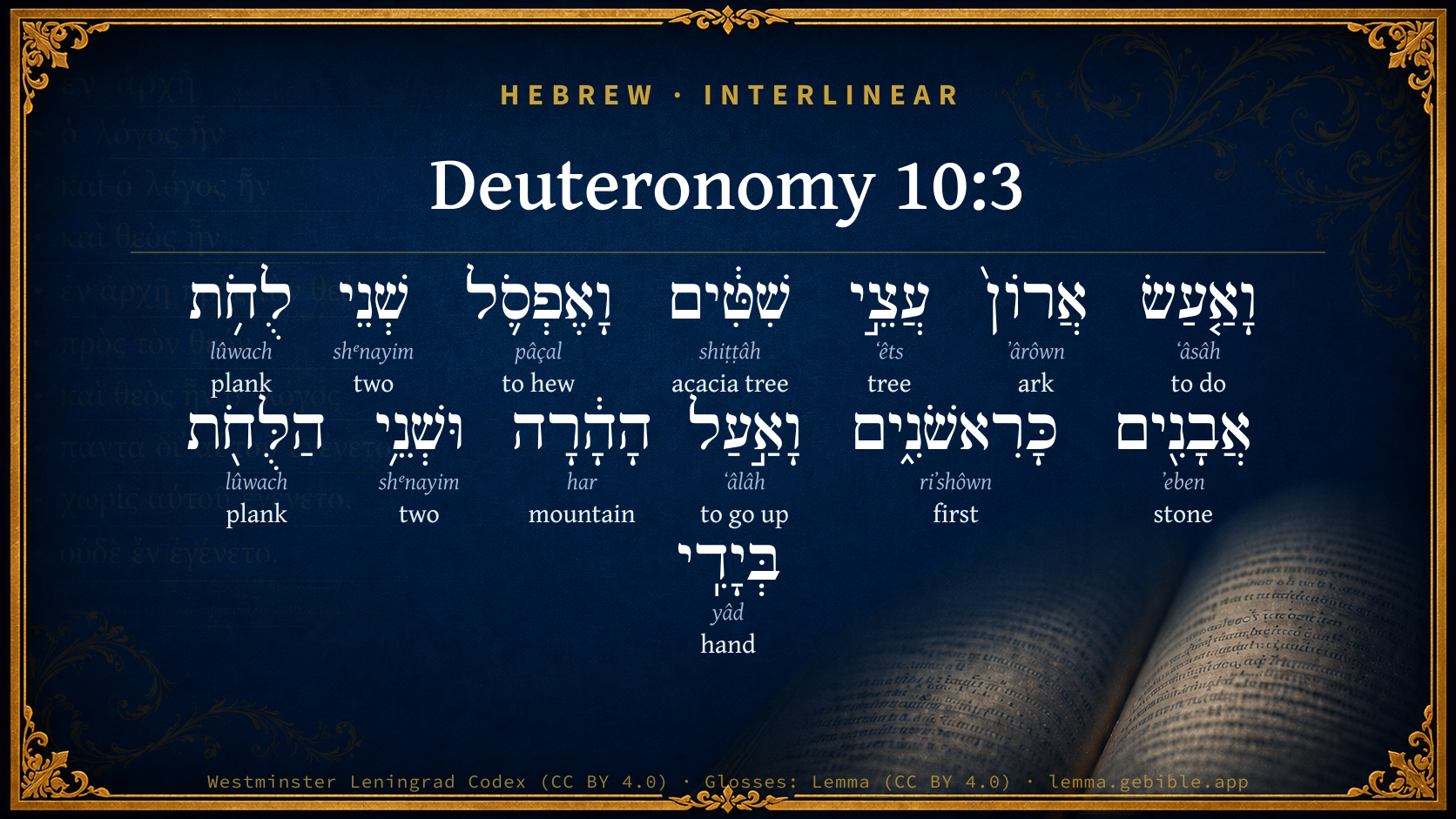
Deuteronomy 10:3

Hebrew (Westminster Leningrad Codex) Deuteronomy 10:3 appears in the Hebrew Old Testament. The text above is from the Westminster Leningrad Codex. Each word links to its Strong’s number, a concise gloss, and parsing drawn from the Open Scriptures Hebrew Bible morphology. Click any word for its full Brown-Driver-Briggs (BDB) entry.
Download image
Cite this verse

Deuteronomy 10:3 (World English Bible). Public Domain. Lemma interlinear Bible study tool, https://lemma.gebible.app/v/deuteronomy/10/3.

Show BibTeX & RIS
BibTeX
RIS
English Translation
So I made an ark of acacia wood, and hewed two tables of stone like the first, and went up onto the mountain, having the two tables in my hand.
World English Bible · Public Domain
Download a study sheet

One document with this verse’s original text, its word-by-word gloss line, the meaning frame, cross-references with their text, attributed commentary, and full source and license credits — printable, and it pastes into notes with its structure intact.

This verse Autodidact and up

Study sheet (.html) Plain text (.txt)

A passage Seminary Student

Up to 50 verses in one chapter. A passage sheet keeps up to 6 commentary sources and 12 cross-references per verse, in the order this page ranks them, and says so on the sheet whenever that leaves anything out. Ask for a single verse and you get the Autodidact verse sheet above.

Everything on this page stays free to read, with no account — the sheet is a download of what is already on screen, not access to it.

Want to remove ads? Support Godless Engineer
Compare translations 3

The same verse in 3 English versions, stacked beneath the original-language interlinear above. Click any original word for its lexicon entry.

Each is an independent rendering of the whole verse — the interlinear is not word-aligned to these translations.

Highlighted words mark where these versions differ — a whole-verse word diff, not a word-by-word alignment.

  • World English Bible Public Domain
    So I made an ark of acacia wood, and hewed two tables of stone like the first, and went up onto the mountain, having the two tables in my hand.
  • King James Version Public Domain
    And I made an ark of shittim wood, and hewed two tables of stone like unto the first, and went up into the mount, having the two tables in mine hand.
  • unfoldingWord Literal Text CC BY-SA 4.0
    And I made a box of acacia wood, and I carved two tablets of stone like the first, and I went up the mountain, and the two tablets in my hand.

unfoldingWord Literal Text — © unfoldingWord, licensed CC BY-SA 4.0. Word-aligned USFM3 via Door43 (git.door43.org/unfoldingWord/en_ult).

Versions to compare (up to 4)

3 of 4 selected

Show all 18 translations

Every available English version of this verse, each an independent rendering of the whole verse.

  • World English Bible Public Domain
    So I made an ark of acacia wood, and hewed two tables of stone like the first, and went up onto the mountain, having the two tables in my hand.
  • Berean Standard Bible Public Domain
    So I made an ark of acacia wood, chiseled out two stone tablets like the originals, and went up the mountain with the two tablets in my hands.
  • Majority Standard Bible Public Domain
    So I made an ark of acacia wood, chiseled out two stone tablets like the originals, and went up the mountain with the two tablets in my hands.
  • King James Version Public Domain
    And I made an ark of shittim wood, and hewed two tables of stone like unto the first, and went up into the mount, having the two tables in mine hand.
  • American Standard Version (1901) Public Domain
    So I made an ark of acacia wood, and hewed two tables of stone like unto the first, and went up into the mount, having the two tables in my hand.
  • Revised Version (1885) Public Domain
    So I made an ark of acacia wood, and hewed two tables of stone like unto the first, and went up into the mount, having the two tables in mine hand.
  • Geneva Bible (1599) Public Domain
    And I made an Arke of Shittim wood, and hewed two Tables of stone like vnto the first, and went vp into the Mountaine, and the two Tables in mine hand.
  • Douay-Rheims (1899) Public Domain
    And I made an ark of setim wood And when I had hewn two tables of stone like the former, I went up into the mount, having them in my hands.
  • Young's Literal Translation Public Domain
    and I make an ark of shittim wood, and grave two tables of stone like the first, and go up to the mount, and the two tables in my hand.
  • Literal Standard Version CC BY-SA 4.0
    And I make an ark of shittim wood, and hew two tablets of stone like the first, and go up to the mountain with the two tablets in my hand.
  • Unlocked Literal Bible CC BY-SA 4.0
    So I made an ark of acacia wood, and I carved two tablets of stone like the first, and I went up the mountain, having the two tablets in my hand.
  • unfoldingWord Literal Text CC BY-SA 4.0
    And I made a box of acacia wood, and I carved two tablets of stone like the first, and I went up the mountain, and the two tablets in my hand.
  • Darby Bible Public Domain
    And I made an ark of acacia-wood, and hewed two tables of stone like the first, and went up the mountain with the two tables in my hand.
  • World Messianic Bible Public Domain
    So I made an ark of acacia wood, and cut two stone tablets like the first, and went up onto the mountain, having the two tablets in my hand.
  • Webster's Bible Public Domain
    And I made an ark of shittim wood, and hewed two tables of stone like the first, and ascended the mount, having the two tables in my hand.
  • Free Bible Version CC BY-SA 4.0
    I made an Ark out of acacia wood, cut out two stone tablets like the first ones, and went up the mountain carrying them.
  • Bible in Basic English Public Domain
    So I made an ark of hard wood, and had two stones cut like the others, and went up the mountain with the stones in my hands.
  • JPS Tanakh (1917) Public Domain
    So I made an ark of acacia-wood, and hewed two tables of stone like unto the first, and went up into the mount, having the two tables in my hand.

Literal Standard Version (2020), Covenant Press — licensed CC BY-SA 4.0. Text via the HelloAO Bible API (eBible.org). Unlocked Literal Bible (unfoldingWord) — licensed CC BY-SA 4.0. Text via the HelloAO Bible API (eBible.org). unfoldingWord Literal Text — © unfoldingWord, licensed CC BY-SA 4.0. Word-aligned USFM3 via Door43 (git.door43.org/unfoldingWord/en_ult). Free Bible Version, Dr. Jonathan Gallagher — licensed CC BY-SA 4.0. Text via the HelloAO Bible API (eBible.org).

Word by word

More ways to search: Search by grammar → Find every occurrence → Compare this word →

Practice this passage: Drill this verse → Learn its vocabulary →

וָאֶפְסֹ֛ל
pâçal
H6458
“and · to hew”
Conjunction + Verb, Qal, Sequential Imperfect, 1st Person, Common, Singular
Part of Speech
Conjunction + Verb
Stem
Qal
Form
Sequential Imperfect
Person
1st Person
Gender
Common
Number
Singular
Full BDB Definition

Origin: a primitive root

TWOT: 1788

to cut, hew, hew into shape - (Qal) to hew, hew out, quarry
  1. וָאַ֤עַשׂ ʻâsâh H6213 “and · to do” Conjunction + Verb, Qal, Sequential Imperfect, 1st Person, Common, Singular
  2. אֲרוֹן֙ ʼârôwn H727 “ark of” Noun, Common, Both, Singular, Construct
  3. עֲצֵ֣י ʻêts H6086 “trees of” Noun, Common, Masculine, Plural, Construct
  4. שִׁטִּ֔ים shiṭṭâh H7848 “acacia trees” Noun, Common, Feminine, Plural, Absolute
  5. שְׁנֵי shᵉnayim H8147 “two” Adjective, Cardinal number, Masculine, Dual, Construct
  6. לֻחֹ֥ת lûwach H3871 “planks of” Noun, Common, Masculine, Plural, Construct
  7. אֲבָנִ֖ים ʼeben H68 “stones” Noun, Common, Feminine, Plural, Absolute
  8. כָּרִאשֹׁנִ֑ים riʼshôwn H7223 “like/as the · first” Preposition, Determined + Adjective, Adjective, Masculine, Plural, Absolute
  9. וָאַ֣עַל ʻâlâh H5927 “and · to go up” Conjunction + Verb, Qal, Sequential Imperfect, 1st Person, Common, Singular
  10. הָהָ֔רָה har H2022 “the · mountain · toward” Particle, Definite Article + Noun, Common, Masculine, Singular, Absolute + Suffix, Demonstrative
  11. וּשְׁנֵ֥י shᵉnayim H8147 “and · two” Conjunction + Adjective, Cardinal number, Masculine, Dual, Construct
  12. הַלֻּחֹ֖ת lûwach H3871 “the · planks” Particle, Definite Article + Noun, Common, Masculine, Plural, Absolute
  13. בְּיָדִֽי yâd H3027 “in/at · hand · my” Preposition + Noun, Common, Both, Singular, Construct + Suffix, Personal, 1st Person, Common, Singular

About this verse

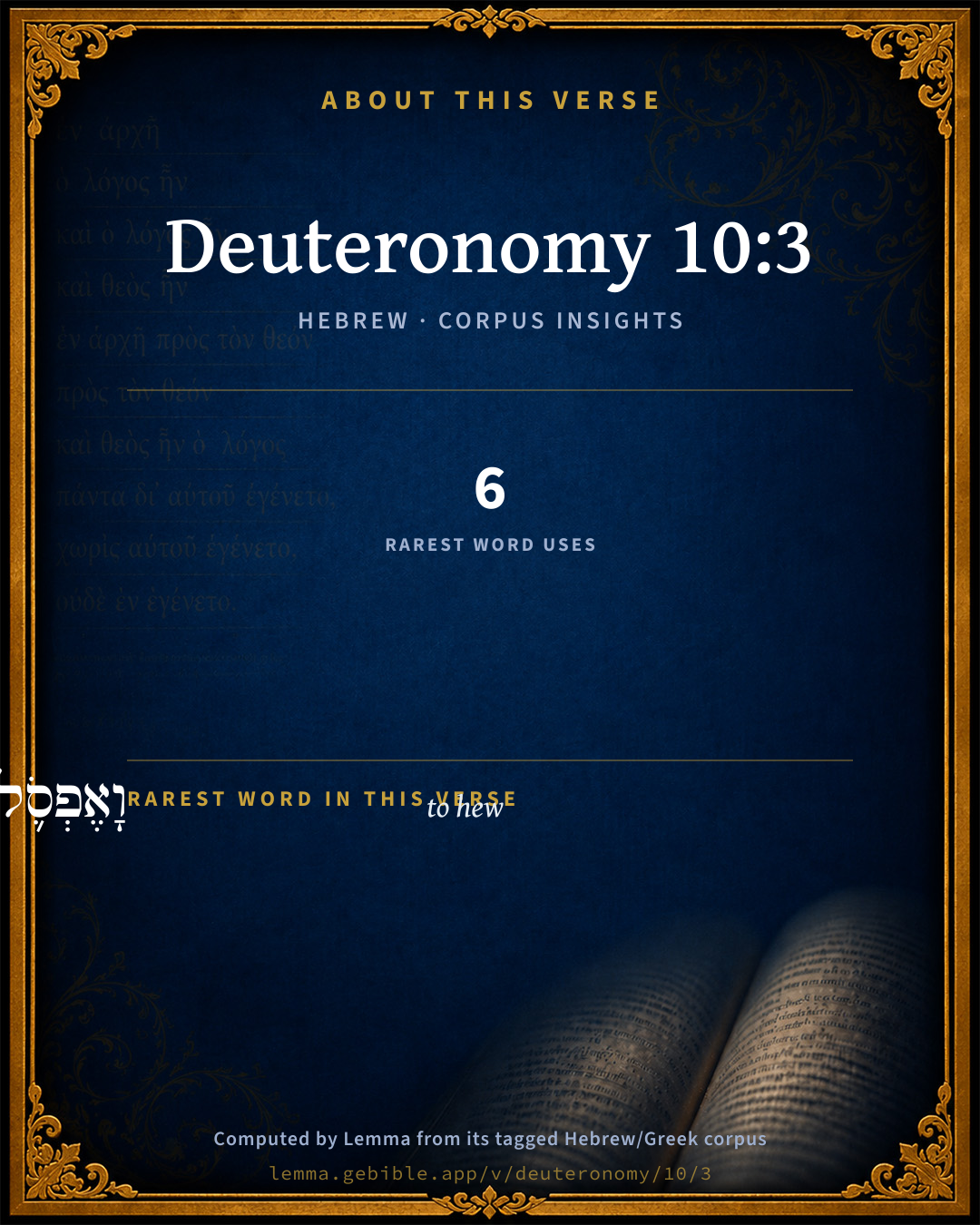
These counts appear in no published source. They are computed here, from the morphology-tagged text and Lemma’s own curated glosses. What Lemma adds →

14
words
12
distinct lemmas
Pentateuch
section

Notable vocabulary

The rarest word here is וָאֶפְסֹ֛ל to hew H6458 — appearing just 6 times in the whole Hebrew Bible.

Shared distinctive vocabulary

וָאֶפְסֹ֛ל to hew H6458 occurs in 6 verses of the Hebrew Bible. Also found in:

Grammatical profile

  • 3 verbs
  • 8 nouns
  • 3 adjectives

Verb forms

  • וָאַ֤עַשׂ Qal · Sequential Imperfect
  • וָאֶפְסֹ֛ל Qal · Sequential Imperfect
  • וָאַ֣עַל Qal · Sequential Imperfect

Repetition

Words recur within this verse — often emphatic in Hebrew:

  • שְׁנֵי two H8147 ×2
  • לֻחֹ֥ת plank H3871 ×2

Hebrew & Septuagint length

In English translation the verse runs 30 words from the Hebrew and 34 from the Septuagint (LXX English) — closely comparable.

A rough comparison of the two English renderings, which tokenize alike — not a word-level alignment.

Word counts can differ between the Hebrew and the Greek without any difference in meaning — e.g. the Hebrew direct-object marker אֵת has no separate Greek word, and Greek often adds the article ὁ.

Cross-references

5

Topical passages linked to Deuteronomy 10:3 in the Treasury of Scripture Knowledge — connected by theme and wording, ordered by reader-vote popularity; previews shown in the World English Bible.

  • Exodus 34:4 He chiseled two tablets of stone like the first; and Moses rose up early in the morning, and went up to Mount Sinai, as Yahweh had commanded him, and took in his hand two stone tablets.
  • Exodus 25:5 rams' skins dyed red, sea cow hides, acacia wood,
  • Exodus 25:10 "They shall make an ark of acacia wood. Its length shall be two and a half cubits, its breadth a cubit and a half, and a cubit and a half its height.
  • Exodus 37:1–9 Bezalel made the ark of acacia wood. Its length was two and a half cubits, and its breadth a cubit and a half, and a cubit and a half its height.
  • Deuteronomy 10:1 At that time Yahweh said to me, Hew you two tables of stone like the first, and come up to me onto the mountain, and make an ark of wood.

Cross-references courtesy of OpenBible.info (CC BY 4.0).

Hebrew and Greek witnesses Masoretic Hebrew ↔ Greek Septuagint

The same verse in the two great witnesses to the Old Testament, shown verse-for-verse.

These are two independent witnesses, not word-aligned to each other, and the Septuagint is shown in lemma (dictionary) form.

Hebrew Deuteronomy 10:3 Masoretic · Westminster Leningrad Codex

וָאַ֤עַשׂ אֲרוֹן֙ עֲצֵ֣י שִׁטִּ֔ים וָאֶפְסֹ֛ל שְׁנֵי לֻחֹ֥ת אֲבָנִ֖ים כָּרִאשֹׁנִ֑ים וָאַ֣עַל הָהָ֔רָה וּשְׁנֵ֥י הַלֻּחֹ֖ת בְּיָדִֽי

So I made an ark of acacia wood, and hewed two tables of stone like the first, and went up onto the mountain, having the two tables in my hand.

World English Bible · Public Domain

Greek LXX Deuteronomy 10:3 Septuagint · lemma form

καί ποιέω κιβωτός ἐκ ξύλον ἄσηπτος καί λαξεύω ὁ δύο πλάξ ὁ λίθινος ὡς ὁ πρῶτος καί ἀναβαίνω εἰς ὁ ὄρος καί ὁ δύο πλάξ ἐπί ὁ χείρ ἐγώ

So I made an ark of boards of incorruptible wood, and I hewed tables of stone like the first, and I went up to the mountain, and the two tables were in my hand.

LXX2012 (modern English Septuagint) · Public Domain

Hebrew: Westminster Leningrad Codex (CC BY 4.0). Greek: Septuagint (public domain); English from LXX2012 (modern English Septuagint) (Public Domain). How the Septuagint differs from the Hebrew →

Targum (Aramaic paraphrase)

2

The Targum is the ancient Jewish Aramaic paraphrase of the Hebrew Scriptures — an interpretive translation, not the Hebrew text itself. Onkelos (literal) and Pseudo-Jonathan (expansive) render the Torah, and Jonathan the Prophets. Coverage is partial: where no permissively-licensed English translation exists for a verse, only the Aramaic is shown. This is verse-level text, not a word-by-word alignment to the Hebrew.

  1. Targum Onkelos Torah (Genesis–Deuteronomy)
    וַעֲבָדִית אֲרוֹנָא דְאָעֵי שִׁטִּין וּפְסָלִית תְּרֵין לוּחֵי אַבְנַיָא כְּקַדְמָאֵי וּסְלֵקִית לְטוּרָא וּתְרֵין לוּחַיָא בִּידִי

    (no public-domain English translation for this verse)

    Targum Onkelos — Aramaic: “Onkelos Genesis” (public domain); “Onkelos Exodus” (public domain); “Onkelos Leviticus” (public domain); “Onkelos Numbers” (public domain); “Onkelos Deuteronomy” (public domain). English: “Sefaria Community Translation” (CC0 1.0 (public-domain dedication)); “J.W. Etheridge. The Targums of Onkelos and Jonathan Ben Uzziel on the Pentateuch. London: Longmans, Green, 1862” (public domain). Text via Sefaria.

  2. Targum Pseudo-Jonathan Torah (Genesis–Deuteronomy)
    וַעֲבָדִית אֲרוֹנָא דְקֵיסֵי שִׁטַיָא וּפְסָלִית תְּרֵין לוּחֵי מַרְמִירָא כְּצוּרַת קַמָּאֵי וּסְלָקִית לְטַוְורָא וּתְרֵין לוּחֵי בִּידִי

    And I made an ark of sitta wood, and hewed two marble tables according to the form of the first, and went up into the mountain, having the two tables in my hand.

    Targum Pseudo-Jonathan — Aramaic: “Targum Jonathan on Genesis” (public domain); “Targum Jonathan on Exodus” (public domain); “Targum Jonathan on Leviticus” (public domain); “Targum Jonathan on Numbers” (public domain); “Targum Jonathan on Deuteronomy” (public domain). English: “The Targum of Jonathan ben Uzziel, trans. J. W. Etheridge, London, 1862” (public domain). Text via Sefaria.

Commentary

Notes on Deuteronomy 10:3 from classic Christian and Jewish commentators (each source and its license shown beneath its notes). The classic Christian expositions comment on the surrounding passage and are grouped to its opening verse, so a note may address several verses; the Jewish commentaries on the Tanakh (Rashi and others) are per-verse, so they appear only where the commentator wrote on this verse.

Lemma curates 59 commentaries, every one of them public domain or Creative Commons licensed, each selected and text-cleaned for this edition rather than reprinted as found. About our sources →

Trapp's Complete Commentary

John Trapp

Deu 10:3 And I made an ark [of] shittim wood, and hewed two tables of stone like unto the first, and went up into the mount, having the two tables in mine hand.

Ver. 3. And I made an ark.] In its use far beyond that Persian casket embroidered with gold and pearl, which Alexander reserved for Homer’s Iliad.

John Trapp, A Commentary or Exposition upon All the Books of the Old and New Testament (1647–1656) — public domain. Text from a community e-Sword module.

Joseph Benson's Commentary

Deu 10:3. I made an ark — Some of the Jewish doctors conclude from this text that there were two arks, one made by Bezaleel, and this one by Moses, which they fancy was the ark that went before them in their marches and battles. But this notion is confuted by many other passages. All that Moses means by saying, I made an ark, is, that he ordered one to be made, just as the expression, Solomon built the temple, only means that he provided for the building of it, and caused it to be built.

Joseph Benson's Commentary on the Old and New Testaments (1811–1818) — public domain. Text from a community e-Sword module.

Tyndale Open Study Notes

Tyndale Open Resources

10:3 acacia wood: This durable desert tree is probably the species Acacia raddiana; it is the only variety that grows large enough in the Negev to produce timber for building.

Tyndale Open Study Notes — © Tyndale Open Resources, licensed CC BY-SA 4.0. Text via the HelloAO Bible API.

Geneva Bible (1599)

Geneva Bible translators

Which wood is of long continuance.

Geneva Bible (1599) marginal notes — public domain. Text via Bolls.life.

Jamieson, Fausset & Brown

Robert Jamieson, A. R. Fausset & David Brown

And I made an ark of shittim wood--It appears, however, from Exo 37:1, that the ark was not framed till his return from the mount, or most probably, he gave instructions to Bezaleel, the artist employed on the work, before he ascended the mount--that, on his descent, it might be finished, and ready to receive the precious deposit.

Jamieson, Fausset & Brown — Commentary Critical and Explanatory on the Whole Bible (1871) — public domain (CC PDM 1.0). Text via the HelloAO Bible API.

Adam Clarke's Commentary

Verse 3. Shittim wood] See Clarke on Ex 25:5, and succeeding verses, and on the parallel places in the margin.

Adam Clarke's Commentary on the Bible (1810–1826) — public domain. Text from a community e-Sword/MySword module.

The Cambridge Bible for Schools and Colleges

gen. ed. J. J. S. Perowne

3. So I made an ark of acacia wood] Not now in JE, see above. P, Exo_25:10; Exo_37:1, Beṣal’el made the ark of acacia wood.

acacia wood] planks of shiṭṭim, the plur. of the tree shiṭṭah = shinṭah, Ar. ‘sant,’ a name given to several species of the thorny acacia; in Egypt to ‘A. (mimosa) Nilotica’ (Lane, Ar. Eng. Lex.); and by the Arabs of the Desert of the wanderings of Israel to the ‘A. tortilis’ and ‘A. laeta’ (Hart, Fauna and Flora of Sinai, Petra and W. Araba, 52). More probably the former, an upright tree, 10 or 15 feet high, with a thick trunk and occasionally very numerous (e.g. a grove of acacias, chiefly ‘tortilis,’ ten miles long in the Arabah, id. 31, cp. 8, 12, 92, and found on W. el Ithm, by which Israel probably passed to the Edomite plateau); the ‘A. laeta’ is a tropical tree found only in the Ghor, and there seldom. Both Tristram (Nat. Hist. of the Bible, 298 f.) and Post (Flora, 298 f. and art. ‘Shittah’ in Hastings’ D.B.) identify the Shittah tree with the Seyyâl acacia, but this is never called ‘Sunṭ’ by the Beduin to-day, and indeed is distinguished by them from ‘Sunṭ’ (Hart, op. cit. 52). Doughty mentions an acacia, called by the modern inhabitants of the Arabian peninsula ‘ṭolh,’ the only acacia wood which is not brittle, and is used by the Solubba, or tribe of smiths and carpenters, for saddle-trees and frames and vessels for milk, and also on the Arabian coast for ship-building (Arabia Deserta, i. 280, ii. 91, 678).

and hewed two tables of stone like unto the first] So Exo_34:4 a, JE.

and went up into the mount, with the two tables in mine hand] So substantially Exo_34:4 b, J.

The Cambridge Bible for Schools and Colleges (gen. ed. J. J. S. Perowne; Cambridge University Press, 1878–1918) — public domain. Text from a community e-Sword module.

John Gill's Exposition

And I made an ark of shittim wood,.... That is, ordered it to be made, and it was made by Bezaleel, and that of shittim wood: so the ark that was put into the holy of holies was made of this wood; see See Gill on Exo 25:10; see Gill on Exo 37:1,

and hewed two tables of stone like unto the first; two marble ones, as the Targum of Jonathan; that is, he ordered them to be hewed, and took care that they should be exactly made as the former were, of which he had perfect knowledge, having received them of the Lord, and brought them with him down the mount:

and went up into the mount, having the two tables in my hand; in order to have the words of the law, the ten commands, written on them, these being only hewn stones, without anything on them: they were very probably marble, of which great quantities were near at hand.

John Gill's Exposition of the Whole Bible (1746–1763) — public domain (CC PDM 1.0). Text via the HelloAO Bible API.

Haydock's Catholic Bible Commentary

I made, or gave orders to have one ready against my return. (Calmet)

George Leo Haydock (1774–1849), Haydock's Catholic Family Bible and Commentary, 1859 edition — public domain. Excludes Psalms (Douay-Rheims chapter numbering differs from Protestant) and Deuterocanonical books (Catholic canon only).

Whedon's Commentary on the Bible

Daniel D. Whedon

3. I made an ark of shittim wood — Better, acacia. It is not improbable that Moses gave directions to Bezaleel, the artist, who with others wrought on the work of the sanctuary, before he went up to the mount. In Exodus 25, and also 35, we find a full description of the ark.

Daniel D. Whedon (gen. ed.), Commentary on the Old and New Testaments (1874–1909) — public domain. Text from a community e-Sword module.

Scofield Reference Notes

C. I. Scofield

shittim

i.e. acacia.

The Scofield Reference Bible (1917 edition), notes by C. I. Scofield — public domain. Text from a community e-Sword module.

unfoldingWord translationNotes

Door43 World Missions Community

General Information:

Moses continues to remind the people of Israel about what happened in the past.

the first

This refers to the first set of tablets that Moses had broken. AT: "the tablets I had before" (See: Ellipsis and Ordinal Numbers)

went up the mountain

"went up Mount Sinai"

out of the middle of the fire

It was as if Yahweh were a person standing in the middle of a fire and speaking with a loud voice. See how you translated this in Deuteronomy 9:10.

on the day of the assembly

The abstract noun "assembly" can be expressed as the verb "gather together." See how you translated this in Deuteronomy 9:10. AT: "on the day when you Israelites all came and met together in one place"

translationWords

acacia

Ten Commandments

Yahweh

fire

assembly

unfoldingWord translationNotes — © Distant Shores Media and the Door43 World Missions Community, licensed CC BY-SA 4.0. Source: git.door43.org/Door43/en_tn.

Lesson kit

Teaching starters — assembled from the data on this page, not authored interpretation. Every prompt links to the verse data it draws on. Edit before teaching.

Deuteronomy, in the Pentateuch, opens this verse with 14 words (12 distinct Hebrew lemmas). Its most distinctive word is pâçal (“to hew”). A historical commentator’s framing appears above. Read the whole chapter for the surrounding context.

Discussion questions

  1. The word pâçal carries the sense “to hew.” How does it shape the verse?
  2. How does Exodus 34:1, which shares the word «to hew», read alongside this verse?
  3. What does the repetition of “two” (2× in this one verse) do in this verse?
  4. These translations render this verse differently; the difference is in the English rendering, not the original. What questions does that raise?
  5. «וָאַ֤עַשׂ» is a Qal Sequential Imperfect verb. How does that grammatical form shape the action described?
  6. Compare how Trapp's Complete Commentary and Joseph Benson's Commentary read this verse. Where do they agree or differ?

Things to notice

Reading settings

Reading text

Shown beneath each verse's original-language words.

Old Testament
Old Testament edition

Read the OT as the Masoretic Hebrew (MT) or the Greek Septuagint (LXX).

English shown for the Greek Septuagint (in the Hebrew ↔ Greek comparison).

Comparing translations? Open the Compare panel on any verse page to stack up to four side by side.