Daniel 11:23

Hebrew (Westminster Leningrad Codex) Daniel 11:23 appears in the Hebrew Old Testament. The text above is from the Westminster Leningrad Codex. Each word links to its Strong’s number, a concise gloss, and parsing drawn from the Open Scriptures Hebrew Bible morphology. Click any word for its full Brown-Driver-Briggs (BDB) entry.
Download image
Cite this verse

Daniel 11:23 (World English Bible). Public Domain. Lemma interlinear Bible study tool, https://lemma.gebible.app/v/daniel/11/23.

Show BibTeX & RIS
BibTeX
RIS
English Translation
After the league made with him he shall work deceitfully; for he shall come up, and shall become strong, with a small people.
World English Bible · Public Domain
Download a study sheet

One document with this verse’s original text, its word-by-word gloss line, the meaning frame, cross-references with their text, attributed commentary, and full source and license credits — printable, and it pastes into notes with its structure intact.

This verse Autodidact and up

Study sheet (.html) Plain text (.txt)

A passage Seminary Student

Up to 50 verses in one chapter. A passage sheet keeps up to 6 commentary sources and 12 cross-references per verse, in the order this page ranks them, and says so on the sheet whenever that leaves anything out. Ask for a single verse and you get the Autodidact verse sheet above.

Everything on this page stays free to read, with no account — the sheet is a download of what is already on screen, not access to it.

Want to remove ads? Support Godless Engineer
Compare translations 3

The same verse in 3 English versions, stacked beneath the original-language interlinear above. Click any original word for its lexicon entry.

Each is an independent rendering of the whole verse — the interlinear is not word-aligned to these translations.

Highlighted words mark where these versions differ — a whole-verse word diff, not a word-by-word alignment.

  • World English Bible Public Domain
    After the league made with him he shall work deceitfully; for he shall come up, and shall become strong, with a small people.
  • King James Version Public Domain
    And after the league made with him he shall work deceitfully: for he shall come up, and shall become strong with a small people.
  • unfoldingWord Literal Text CC BY-SA 4.0
    After an alliance is made with him, he will act deceitfully, and he will go up and become strong with a small number of people.

unfoldingWord Literal Text — © unfoldingWord, licensed CC BY-SA 4.0. Word-aligned USFM3 via Door43 (git.door43.org/unfoldingWord/en_ult).

Versions to compare (up to 4)

3 of 4 selected

Show all 18 translations

Every available English version of this verse, each an independent rendering of the whole verse.

  • World English Bible Public Domain
    After the league made with him he shall work deceitfully; for he shall come up, and shall become strong, with a small people.
  • Berean Standard Bible Public Domain
    After an alliance is made with him, he will act deceitfully; for he will rise to power with only a few people.
  • Majority Standard Bible Public Domain
    After an alliance is made with him, he will act deceitfully; for he will rise to power with only a few people.
  • King James Version Public Domain
    And after the league made with him he shall work deceitfully: for he shall come up, and shall become strong with a small people.
  • American Standard Version (1901) Public Domain
    And after the league made with him he shall work deceitfully; for he shall come up, and shall become strong, with a small people.
  • Revised Version (1885) Public Domain
    And after the league made with him he shall work deceitfully: for he shall come up, and shall become strong, with a small people.
  • Geneva Bible (1599) Public Domain
    And after the league made with him, he shall worke deceitfully: for he shall come vp, and ouercome with a small people.
  • Douay-Rheims (1899) Public Domain
    And after friendships, he will deal deceitfully with him: and he shall go up, and shall overcome with a small people.
  • Young's Literal Translation Public Domain
    And after they join themselves unto him, he worketh deceit, and hath increased, and hath been strong by a few of the nation.
  • Literal Standard Version CC BY-SA 4.0
    And after they join themselves to him, he works deceit, and has increased, and has been strong by a few of the nation.
  • Unlocked Literal Bible CC BY-SA 4.0
    From the time an alliance is made with him, he will act deceitfully; with only a small number of people he will become strong.
  • unfoldingWord Literal Text CC BY-SA 4.0
    After an alliance is made with him, he will act deceitfully, and he will go up and become strong with a small number of people.
  • Darby Bible Public Domain
    And after the league made with him he shall work deceitfully, and he shall come up, and shall become strong with a small people.
  • World Messianic Bible Public Domain
    After the treaty made with him he will work deceitfully; for he will come up and will become strong with few people.
  • Webster's Bible Public Domain
    And after the league made with him he shall work deceitfully: for he shall come up, and shall become strong with a small people.
  • Free Bible Version CC BY-SA 4.0
    After making an alliance with him, he will act deceptively. He will come to power peacably, becoming strong though only having a few supporters.
  • Bible in Basic English Public Domain
    And from the time when they make an agreement with him, he will be working falsely: for he will take up arms suddenly with a small force,
  • JPS Tanakh (1917) Public Domain
    And after the league made with him he shall work deceitfully; and he shall come up and become strong, with a little nation.

Literal Standard Version (2020), Covenant Press — licensed CC BY-SA 4.0. Text via the HelloAO Bible API (eBible.org). Unlocked Literal Bible (unfoldingWord) — licensed CC BY-SA 4.0. Text via the HelloAO Bible API (eBible.org). unfoldingWord Literal Text — © unfoldingWord, licensed CC BY-SA 4.0. Word-aligned USFM3 via Door43 (git.door43.org/unfoldingWord/en_ult). Free Bible Version, Dr. Jonathan Gallagher — licensed CC BY-SA 4.0. Text via the HelloAO Bible API (eBible.org).

Word by word

More ways to search: Search by grammar → Find every occurrence → Compare this word →

Practice this passage: Drill this verse → Learn its vocabulary →

וְעָצַ֖ם
ʻâtsam
H6105
“and · to be mighty”
Conjunction + Verb, Qal, Sequential Perfect, 3rd Person, Masculine, Singular
Part of Speech
Conjunction + Verb
Stem
Qal
Form
Sequential Perfect
Person
3rd Person
Gender
Masculine
Number
Singular
Full BDB Definition

Origin: a primitive root

TWOT: 1673 , 1674

to be vast, be numerous, be mighty - (Qal) - to be mighty - to be numerous - (Hiphil) to make strong, make mighty - to shut (the eyes), close (the eyes) - (Qal) to shut (the eyes) - (Piel) to shut tightly (the eyes)
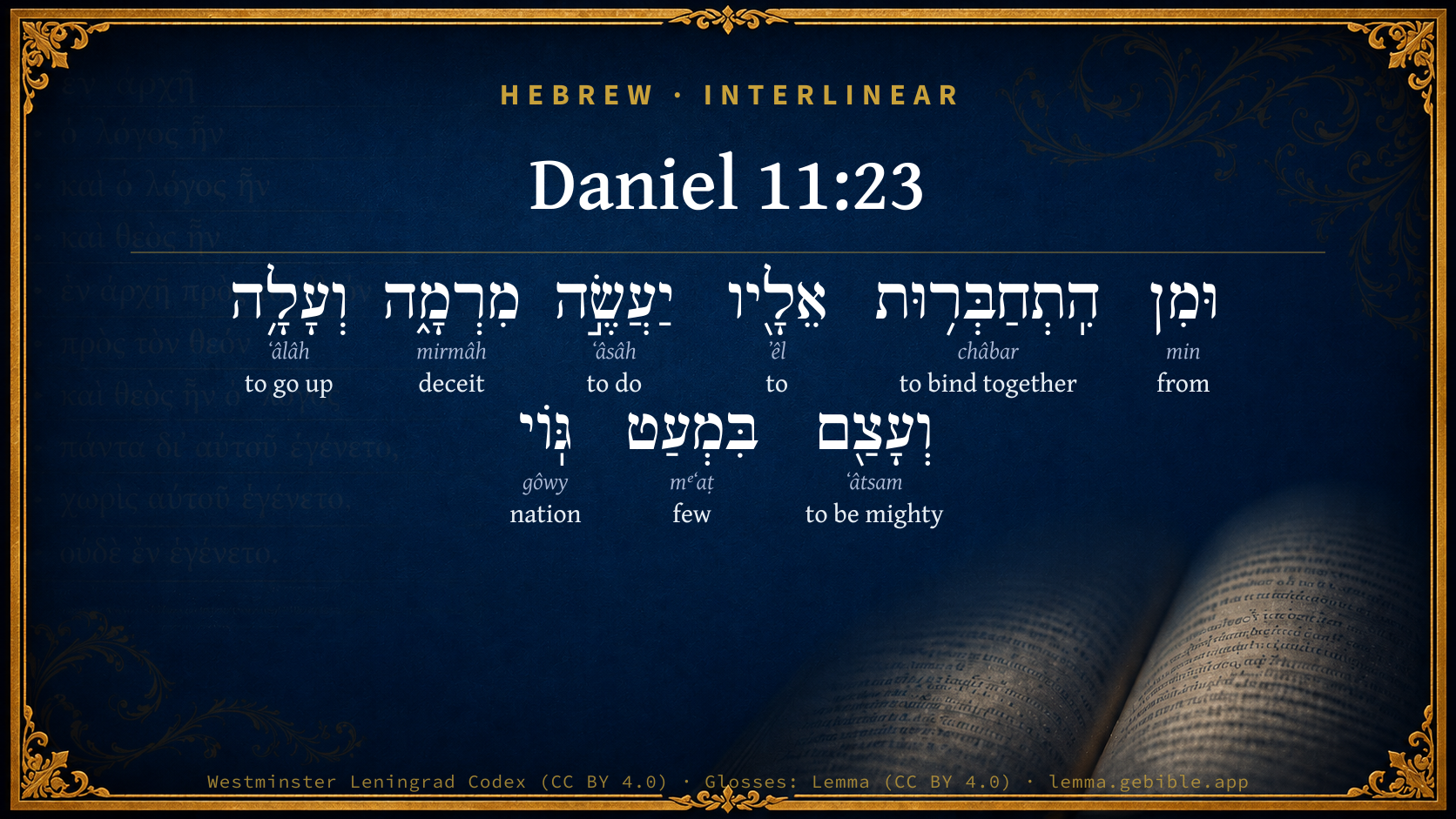
  1. וּמִן min H4480 “and · from” Conjunction + Preposition
  2. הִֽתְחַבְּר֥וּת châbar H2266 “to bind together” Verb, Hithpael, Infinitive Construct
  3. אֵלָ֖יו ʼêl H413 “to · him” Preposition + Suffix, Personal, 3rd Person, Masculine, Singular
  4. יַעֲשֶׂ֣ה ʻâsâh H6213 “to do” Verb, Qal, Imperfect, 3rd Person, Masculine, Singular
  5. מִרְמָ֑ה mirmâh H4820 “deceit” Noun, Common, Feminine, Singular, Absolute
  6. וְעָלָ֥ה ʻâlâh H5927 “and · to go up” Conjunction + Verb, Qal, Sequential Perfect, 3rd Person, Masculine, Singular
  7. בִּמְעַט mᵉʻaṭ H4592 “in/at · few of” Preposition + Noun, Common, Masculine, Singular, Construct
  8. גּֽוֹי gôwy H1471 “nation” Noun, Common, Masculine, Singular, Absolute

About this verse

These counts appear in no published source. They are computed here, from the morphology-tagged text and Lemma’s own curated glosses. What Lemma adds →

9
words
9
distinct lemmas
Prophets
section

Notable vocabulary

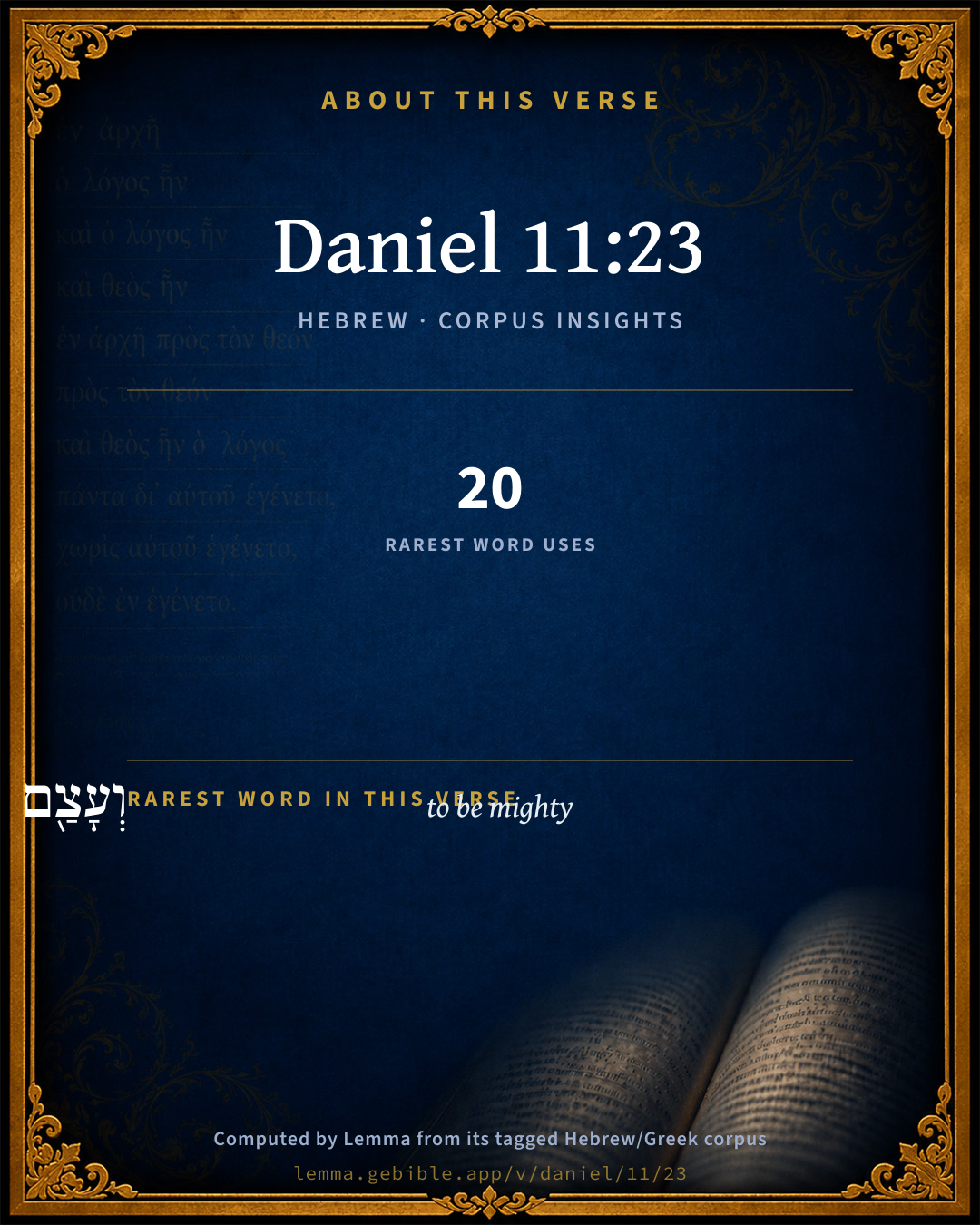
The rarest word here is וְעָצַ֖ם to be mighty H6105 — appearing just 20 times in the whole Hebrew Bible.

Shared distinctive vocabulary

וְעָצַ֖ם to be mighty H6105 occurs in 20 verses of the Hebrew Bible. Also found in:

Grammatical profile

  • 4 verbs
  • 3 nouns
  • 2 prepositions

Verb forms

  • הִֽתְחַבְּר֥וּת Hithpael · Infinitive Construct
  • יַעֲשֶׂ֣ה Qal · Imperfect
  • וְעָלָ֥ה Qal · Sequential Perfect
  • וְעָצַ֖ם Qal · Sequential Perfect

Hebrew & Septuagint length

In English translation the verse runs 23 words from the Hebrew and 24 from the Septuagint (LXX English) — closely comparable.

A rough comparison of the two English renderings, which tokenize alike — not a word-level alignment.

Word counts can differ between the Hebrew and the Greek without any difference in meaning — e.g. the Hebrew direct-object marker אֵת has no separate Greek word, and Greek often adds the article ὁ.

Cross-references

8

Topical passages linked to Daniel 11:23 in the Treasury of Scripture Knowledge — connected by theme and wording, ordered by reader-vote popularity; previews shown in the World English Bible.

  • Daniel 8:25 Through his policy he shall cause craft to prosper in his hand; and he shall magnify himself in his heart, and in [their] security shall he destroy many: he shall also stand up against the prince of princes; but he shall be broken without hand.
  • 2 Thessalonians 2:9 even he whose coming is according to the working of Satan with all power and signs and lying wonders,
  • Genesis 34:13 The sons of Jacob answered Shechem and Hamor his father with deceit, and spoke, because he had defiled Dinah their sister,
  • Psalms 52:2 Your tongue plots destruction, Like a sharp razor, working deceitfully.
  • Proverbs 11:18 Wicked people earn deceitful wages, But one who sows righteousness reaps a sure reward.
  • Ezekiel 17:13–19 and he took of the seed royal, and made a covenant with him; he also brought him under an oath, and took away the mighty of the land;
  • Romans 1:29 being filled with all unrighteousness, sexual immorality, wickedness, covetousness, maliciousness; full of envy, murder, strife, deceit, evil habits, secret slanderers,
  • 2 Corinthians 11:3 But I am afraid that somehow, as the serpent deceived Eve in his craftiness, so your minds might be corrupted from the simplicity that is in Christ.

Cross-references courtesy of OpenBible.info (CC BY 4.0).

Hebrew and Greek witnesses Masoretic Hebrew ↔ Greek Septuagint

The same verse in the two great witnesses to the Old Testament, shown verse-for-verse.

These are two independent witnesses, not word-aligned to each other, and the Septuagint is shown in lemma (dictionary) form.

Hebrew Daniel 11:23 Masoretic · Westminster Leningrad Codex

וּמִן הִֽתְחַבְּר֥וּת אֵלָ֖יו יַעֲשֶׂ֣ה מִרְמָ֑ה וְעָלָ֥ה וְעָצַ֖ם בִּמְעַט גּֽוֹי

After the league made with him he shall work deceitfully; for he shall come up, and shall become strong, with a small people.

World English Bible · Public Domain

Greek LXX Daniel 11:23 Septuagint · lemma form

καί μετά ὁ διαθήκη καί δῆμος συντάσσω μετά αὐτός ποιέω ψεῦδος καί ἐπί ἔθνος ἰσχυρός ἐν ὀλιγοστός ἔθνος

And because of the leagues made with him he shall work deceit: and he shall come up, and overpower them with a small nation.

LXX2012 (modern English Septuagint) · Public Domain

On this verse, The Pulpit Commentary discusses the Septuagint’s reading. Read the note in Commentary ↓

Hebrew: Westminster Leningrad Codex (CC BY 4.0). Greek: Septuagint (public domain); English from LXX2012 (modern English Septuagint) (Public Domain). How the Septuagint differs from the Hebrew →

Commentary

Notes on Daniel 11:23 from classic Christian and Jewish commentators (each source and its license shown beneath its notes). The classic Christian expositions comment on the surrounding passage and are grouped to its opening verse, so a note may address several verses; the Jewish commentaries on the Tanakh (Rashi and others) are per-verse, so they appear only where the commentator wrote on this verse.

Lemma curates 59 commentaries, every one of them public domain or Creative Commons licensed, each selected and text-cleaned for this edition rather than reprinted as found. About our sources →

Jamieson, Fausset & Brown

Robert Jamieson, A. R. Fausset & David Brown

TREGELLES notes three divisions in the history of the "vile person," which is continued to the end of the chapter: (1) His rise (Dan 11:21-22). (2) The time from his making the covenant to the taking away of the daily sacrifice and setting up of the abomination of desolation (Dan 11:23-31). (3) His career of blasphemy, to his destruction (Dan 11:32-45); the latter two periods answering to the "week" of years of his "covenant with many" (namely, in Israel) (Dan 9:27), and the last being the closing half week of the ninth chapter. But the context so accurately agrees with the relations of Antiochus to Ptolemy that the primary reference seems to be to the "league" between them. Antitypically, Antichrist's relations towards Israel are probably delineated. Compare Dan 8:11, Dan 8:25, with Dan 11:22 here, "prince of the covenant."

work deceitfully--Feigning friendship to young Ptolemy, as if he wished to order his kingdom for him, he took possession of Memphis and all Egypt ("the fattest places," Dan 11:34) as far as Alexandria.

with a small people--At first, to throw off suspicion, his forces were small.

Jamieson, Fausset & Brown — Commentary Critical and Explanatory on the Whole Bible (1871) — public domain (CC PDM 1.0). Text via the HelloAO Bible API.

Trapp's Complete Commentary

John Trapp

Dan 11:23 And after the league [made] with him he shall work deceitfully: for he shall come up, and shall become strong with a small people.

Ver. 23. He shall work deceitfully.] Outwitting the wisest among the Egyptians, who yet were held great politicians. See Isa 19:11; Isa 19:13.

And shall become strong with a small people.] He shall come in, as protector and co-adjutor to his nephew Philometor, with a small number, lest the Egyptians should be frightened; but being thus gotten in, he shall play his pranks to some purpose.

John Trapp, A Commentary or Exposition upon All the Books of the Old and New Testament (1647–1656) — public domain. Text from a community e-Sword module.

Tyndale Open Study Notes

Tyndale Open Resources

11:23 deceitful promises: Antiochus IV introduced Greek religion into Judea, helped by lawless followers who supported his policies (see 1 Maccabees 1:11-15).

Tyndale Open Study Notes — © Tyndale Open Resources, licensed CC BY-SA 4.0. Text via the HelloAO Bible API.

Geneva Bible (1599)

Geneva Bible translators

For after the battle Philometor and his uncle Antiochus made a league.

For he came upon him at unawares, and when he suspected his uncle Antiochus nothing.

Geneva Bible (1599) marginal notes — public domain. Text via Bolls.life.

Adam Clarke's Commentary

Verse 23. He shall come up] From Rome, where he had been a hostage for the payment of the tax laid on his father.

Shall become strong with a small people.] At first he had but few to espouse his cause when he arrived at Antioch, the people having been greatly divided by the many claimants of the crown; but being supported by Eumenes and Attalus, his few people increased, and he became strong.

Adam Clarke's Commentary on the Bible (1810–1826) — public domain. Text from a community e-Sword/MySword module.

John Calvin's Commentaries

The angel points out some interruption of the wars, because Antiochus would be content for a time with Syria, and would not make an attempt of Egypt. It was a great point to repel the attempts of all those who wished to recover the rights of his nephew. There is no doubt that the whole country was impoverished and exhausted with the continual expense of these wars; for whenever fresh commotion’s arose, it was necessary to draw new levies from these provinces, and This occasioned very great expense. It is not surprising, then, if Antiochus, who was of a cunning disposition, negotiated a temporary peace with his nephew Ptolemy Philometor the king of Egypt. His sister Cleopatra still survived, and this was an honorable excuse. The angel, then, states first, the proposal of a truce leading to settled peace between the two sovereigns. He adds, however, the perfidious conduct of Antiochus in his friendships. During, or after these agreements, he shall deal treacherously with him Although, therefore, he pretended to be the friend and ally of his nephew, yet he conducted himself deceitfully towards him. And he shall ascend, and shall prevail by a small band; meaning, he shall attack the boy suddenly. For when Ptolemy anticipated a lasting friendship with his uncle, Antiochus took the opportunity of fraudulently attacking some cities with a small force: He thus deceived his enemy, who thought all things would be tranquil with him; and so when Ptolemy had no fear of his uncle, he suddenly lost some of his cities. The angel means this; he shall rise by deceit, and shall prevail without large forces, because there shall be no suspicion of warfare. It is easy enough to oppress an enemy in a state of tranquillity, and in the absence of all fear. It is afterwards added, —

John Calvin's Commentaries (1540-1563) — public domain. Text from the Calvin Translation Society English edition (1840s-50s) via the Christian Classics Ethereal Library (ccel.org). Calvin's coverage is partial (roughly two-thirds of the Bible); uncommented books and verses are honest gaps, never fabricated. The 19th-century editor's footnotes and remarks are omitted so the notes are faithfully Calvin's own voice.

Ellicott's Commentary for English Readers

(23) He shall work.—Apparently this verse explains more fully the means by which the king succeeds in maintaining his influence. He has already destroyed those who are at peace with him. From the time that he first becomes their confederate, he works deceitfully, coming up with hostile intent, accompanied only by a few people, and in this way throwing off their guard those whom he would destroy.

A Bible Commentary for English Readers, edited by Charles John Ellicott (1878–1897) — public domain. Text from a community e-Sword module.

The Cambridge Bible for Schools and Colleges

gen. ed. J. J. S. Perowne

23. And from the time when he (or any) joins himself unto him—viz. in a league (2 Ch. 30:35, 37; cf. above, Dan_11:6)—he shall work deceit] he will immediately scheme to overreach his ally. The reference is again ambiguous. The allusion might be specially to Antiochus’ insincere friendship with Philometor, or to the manner in which he treated his allies in general.

and he shall come up] i.e., probably, rise to power (cf. Deu_28:43). The explanation ‘go up (the Nile to Memphis)’ (Jer. ascendit Memphim) is not natural. (The comma after up in A.V. should be transferred to follow strong.)

with a little (Dan_11:34) nation] alluding apparently (Bevan) to the partisans of Antiochus, ‘by whose help he was able to rise to power and overcome his rivals.’

The Cambridge Bible for Schools and Colleges (gen. ed. J. J. S. Perowne; Cambridge University Press, 1878–1918) — public domain. Text from a community e-Sword module.

John Gill's Exposition

And after the league made with him,.... The prince of the covenant; either Demetrius his nephew, or Ptolemy Philometor king of Egypt, with whom a league was made in the lifetime of Cleopatra, the sister of Antiochus, and mother of Ptolemy:

he shall work deceitfully; either with the princes and people of Syria, by good words and fair speeches, and by gifts and presents, to get the kingdom for himself, though he had covenanted with his nephew to hold it for him, and resign it to him at his return; and with the Romans, and among his friends in the senate, he artfully worked to detain him at Rome: or else with the king of Egypt, pretending great friendship to him, and to take the care and tuition of him during his minority; and at his coronation he sent one Apollonius to be present at it, and to congratulate him upon it; in the Apocrypha:

"Now when Apollonius the son of Menestheus was sent into Egypt for the coronation of king Ptolemeus Philometor, Antiochus, understanding him not to be well affected to his affairs, provided for his own safety: whereupon he came to Joppa, and from thence to Jerusalem:'' (2 Maccabees 4:21)

for he shall come up, and shall become strong with a small people; either he went into the heart of Syria with a small number of men at first, and gathered together a large army; or into Phoenicia with a handful of men, where he ingratiated himself into the affections of the people by words and gifts, and became strong; or he went up into Egypt accompanied only with a few, lest, the Egyptians should be suspicious of him; but these it is said were valiant men, whom he placed in the forts of Egypt, and so became master of it, which is an instance of his deceitful working; and Sutorius, an ancient historian, as quoted by Jerom, says that he subdued Egypt to himself with a very small number of people.

John Gill's Exposition of the Whole Bible (1746–1763) — public domain (CC PDM 1.0). Text via the HelloAO Bible API.

Albert Barnes' Notes on the Bible

And after the league made with him - A treaty of peace and concord. The great subject of contention between the kings of Syria and Egypt was the possession of Coelo-Syria and Palestine. This they often endeavored to settle by conquest as each of them claimed that in the original partition of the empire of Alexander this portion of the empire fell to himself; and often they endeavored to settle it by treaty. Consequently this region was constantly passing from one to the other, and was also the seat of frequent wars. The “league” here referred to seems to have been that respecting this country - file successive promises which had been made to the king of Egypt that Coelo-Syria and Palestine should be made over to him. These provinces had been secured to Ptolemy Lagus by the treaty made 301 b.c., and they had been again pledged by Antiochus the Great, in dowry, when his daughter Cleopatra should be made queen of Egypt. - Jahn, “Heb. Commonwealth,” p. 260. Antiochus Epiphanes, however, was by no means disposed to confirm this grant, and hence, the wars in which he was involved with the Egyptians.

He shall work deceitfully - In reference to the covenant or treaty above referred to. He shall endeavor to evade its claims; he shall refuse to comply with its conditions; he shall not deliver up the provinces according to the terms of the compact. The history accords exactly with this, for he did not intend to comply with the terms of the treaty, but sought every means to evade it, and finally waged a succession of bloody wars with Egypt. In reference to the terms of this treaty, and to secure their respective interests, both parties sent ambassadors to Rome to urge their claims before the Roman Senate. - Polybius, “Legat.” Sections 78, 82; Jerome, “Com. in loc.” As soon as Ptolemy Philometor had reached his fourteenth year, he was solemnly invested with the government; and ambassadors from all surrounding countries came to congatulate him on His accession to the throne. “On this occasion Antiochus sent to Egypt Apollonius, the son of Mnestheus, apparently to congratulate the king on his coronation, but with the real intention of sounding the purposes of the Egyptian court. When Apollonius, on has return, informed Antiochus that he was viewed as an enemy by the Egyptians, he immediately sailed to Joppa to survey his frontiers toward Egypt, and to put them in a state of defense.” - Jahn, “Heb. Commonwealth” p. 260; 2 Macc. 4:21.

The purpose of Antiochus was undoubtedly not to surrender Coelo-Syria and Palestine according to the treaties which had been made; and yet he designed to secure them if possible without an open rupture, and hence, his arts of diplomacy, or his efforts to evade compliance with the terms of the compact. Even when he had invaded Egypt, and had obtained possession of the king, Ptolemy Philometor, he still “pretended that he had come to Egypt solely for the good of king Ptolemy, to set the affairs of his kingdom in order for him; and Ptolemy found it expedient to act as though he really thought him his friend. But he must have seen,” says Jahn, “that Antiochus, with all his professions of friendship, was not unmindful of spoil, for he plundered Egypt in every quarter.” - “Heb. Commonwealth,” p. 263.

For he shall come up - Come upon Egypt. The result would be war. Rather than surrender the provinces according to the treaty, he would ultimately invade Egypt, and carry war into its borders.

And shall become strong with a small people - The meaning of this seems to be, that at first his own forces would be small; that he would go up in such a way as not to excite suspicion, but that, either by an increase of his forces there, by uniting himself to confederates, by alluring the people by the promise of rewards, or by gradually taking one town after another and adding them to his dominions, he would become strong. Jahn (Heb. Commonwealth, p. 263) says, “with a small body of troops he made himself master of Memphis, and of all Egypt as far as Alexandria, almost without striking a blow.” Compare Diod. Sic. xxvi. 75, 77; Jos. “Ant.” xii. 5, 2. The fact in the case was, that Antiochus pretended in his invasion of Egypt to be the friend of the Egyptian king, and that he came to aid him, and to settle him finaly on the throne. By degrees, however, he became possessed of one town after another, and subdued one place after another, until he finally became possessed of the king himself, and had him entirely in his powcr.

Albert Barnes' Notes on the Bible (1834–1885) — public domain. Text from a community e-Sword/MySword module.

Haydock's Catholic Bible Commentary

People. Ephiphanes pretended to be tutor of Philometor. But the nobles of Egypt distrusted him; whereupon he came to a battle, near Pelusium, and the young king surrendered himself. His uncle thus took possession of Egypt with surprising facility. Yet the people of Alexandria crowned Evergetes, which occasioned a civil war. (Calmet)

George Leo Haydock (1774–1849), Haydock's Catholic Family Bible and Commentary, 1859 edition — public domain. Excludes Psalms (Douay-Rheims chapter numbering differs from Protestant) and Deuterocanonical books (Catholic canon only).

Matthew Poole's English Annotations

For he made a league with Egypt, and came with a few in comparison, (but they were chosen men,) and he took the passes, and set garrisons, and put all in subjection to him.

Matthew Poole's English Annotations on the Holy Bible (1683–1685) — public domain. Text from a community e-Sword/MySword module.

Whedon's Commentary on the Bible

Daniel D. Whedon

23. Bevan translates, “And from the time when they shall ally themselves with him, he shall practice fraud and shall rise and become strong with (but) few men.” Those with whom this king made alliances (compare Dan_11:22) were usually outwitted. (Compare Dan_7:23.) At the beginning he had not very many trusty helpers, but his cunning diplomacy aided him in climbing up, step by step, until he became almost the greatest power in the civilized world.

Daniel D. Whedon (gen. ed.), Commentary on the Old and New Testaments (1874–1909) — public domain. Text from a community e-Sword module.

The Pulpit Commentary

And after the league made with him he shall work deceitfully: for he shall come up, and shall become strong with a small people. The rendering of the LXX is, "And with the covenant and a people set in array he shall fabricate a lie, even against a strong nation with (ejn) a small people." The rendering of Theodotion is somewhat difficult to comprehend, "By reason of leagues against him, he shall make a device, and shall ascend and master them with few people." The Peshitta is very like Theodotion, only the last clause of this verse is regarded as the first of the next. The Vulgate is closer to the Massoretic than are any of the other ancient versions, "And after friendships with him, he shall work fraud, and shall go up and conquer with a small number." The reference here is to the obscure events which attended the contest if there was a con-test that resulted in Epiphanes securing the throne. The alliance may refer to his league with Eumenes. Appian assigns as a reason for the help given to Epiphanes by Eumenes, that it was to gain his friendship. Only Appian mentions "Attains and Eumenes," as if they were separate sovereigns; but Attains was brother of Eumenes, and, at the time of the arrival of Epiphanes, his brother"s envoy at Rome. There may be some foundation of fact, and this would explain the statement in the text. The hopes of Eumenes, if he wished to strengthen himself by an alliance with Epiphanes, were probably soon frustrated, as Epiphanes involved himself in conflict with Egypt.

The Pulpit Commentary (1880–1919), ed. H.D.M. Spence-Jones & Joseph S. Exell — public domain. Text from a community e-Sword module.

John Wesley's Explanatory Notes

After the league - For he made a league with Egypt, and came with a few, (but chosen men) and took the passes, and put all in subjection to him.

John Wesley, Explanatory Notes Upon the Whole Bible (1754–1765) — public domain. Text via the GEBible commentary corpus.

unfoldingWord translationNotes

Door43 World Missions Community

General Information:

The angel continues speaking to Daniel.

From the time an alliance is made with him

This can also be stated in active form. AT: "When other rulers make a peace treaty with him" (See: Active or Passive)

will spread among his followers

"will distribute to his followers"

the booty, the plunder, and the wealth

"the valuable things that he and his army take from the people they defeat"

translationWords

deceive

province

stronghold

unfoldingWord translationNotes — © Distant Shores Media and the Door43 World Missions Community, licensed CC BY-SA 4.0. Source: git.door43.org/Door43/en_tn.

Rashi

Rabbi Shlomo Yitzchaki (Rashi)

And from the alliance with him he will work deceitfully And from the alliance that Rome will make with Israel, he will work deceitfully, for he will not reveal his evil plan.

and he will go up from his place.

and overpower in all places around the land of Judea: in Edom, in Ammon, and in Moab.

with few people He will not require a massive army, for the king of Judea will aid him, and so it is written in the book of Josiphon (ch. 23).

Rashi on the Tanakh — English translations: “The Judaica Press complete Tanach with Rashi, translated by A. J. Rosenberg” (CC BY 4.0); “Pentateuch with Rashi's commentary by M. Rosenbaum and A.M. Silbermann, 1929-1934” (public domain); “The Metsudah Tanach series, Lakewood, N.J” (CC BY 4.0); and “The Book of Joshua, Metsudah Publications, 1997” (CC BY 4.0). Text via Sefaria.

Lesson kit

Teaching starters — assembled from the data on this page, not authored interpretation. Every prompt links to the verse data it draws on. Edit before teaching.

Daniel, in the Prophets, opens this verse with 9 words (9 distinct Hebrew lemmas). Its most distinctive word is ʻâtsam (“to be mighty”). A historical commentator’s framing appears above. Read the whole chapter for the surrounding context.

Discussion questions

  1. What does “to be mighty” (ʻâtsam) contribute to the verse as a whole?
  2. Genesis 26:16 shares the word «to be mighty» with this verse. How do the two illuminate each other?
  3. These translations render this verse differently; the difference is in the English rendering, not the original. What questions does that raise?
  4. The verb «הִֽתְחַבְּר֥וּת» is Hithpael Infinitive Construct. How does its form color the action?
  5. Reading how Jamieson, Fausset & Brown and Trapp's Complete Commentary read this verse, where do the two commentators agree and where do they part?

Things to notice

Reading settings

Reading text

Shown beneath each verse's original-language words.

Old Testament
Old Testament edition

Read the OT as the Masoretic Hebrew (MT) or the Greek Septuagint (LXX).

English shown for the Greek Septuagint (in the Hebrew ↔ Greek comparison).

Comparing translations? Open the Compare panel on any verse page to stack up to four side by side.