Joel 2:7

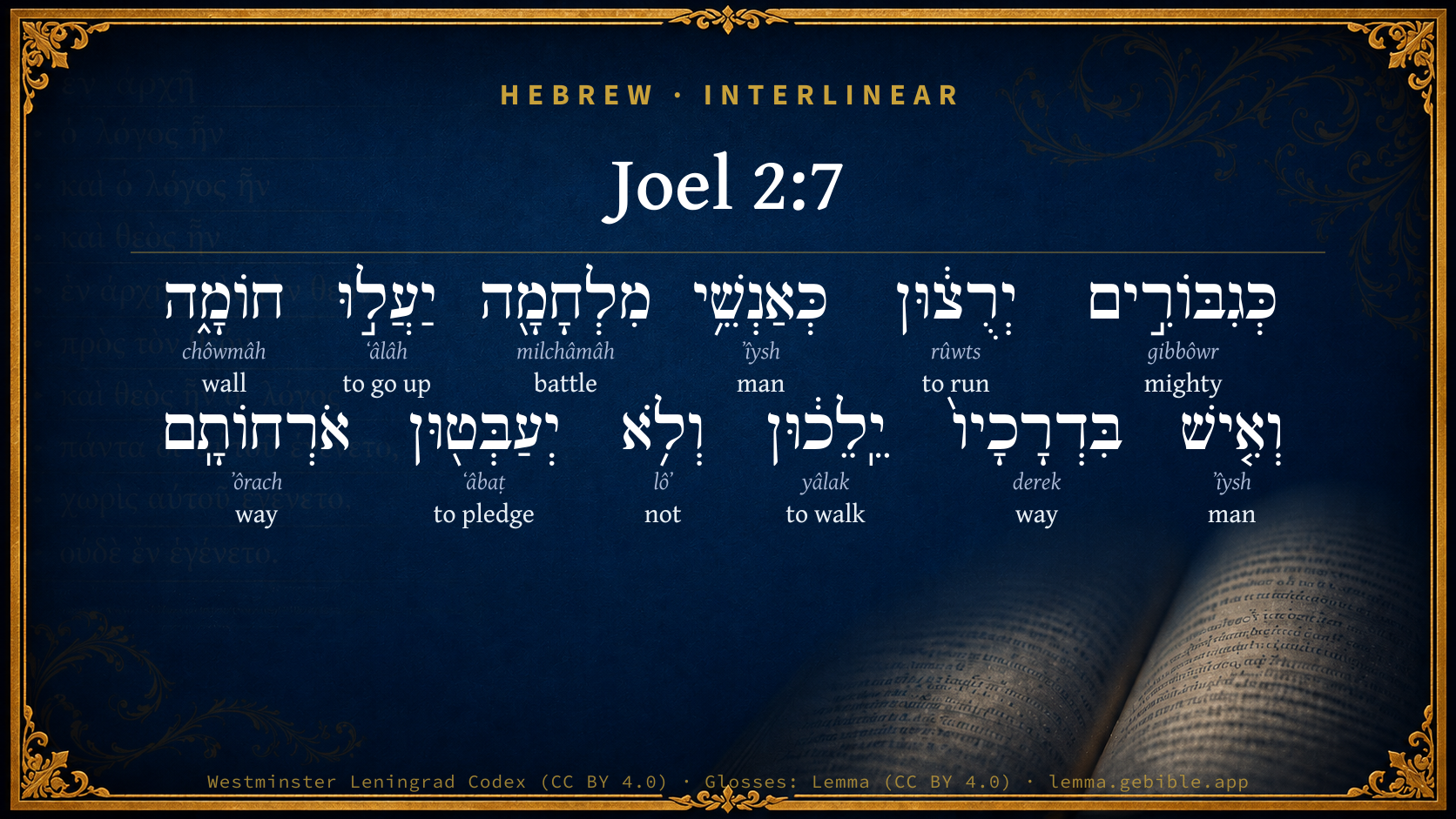
Hebrew (Westminster Leningrad Codex) Joel 2:7 appears in the Hebrew Old Testament. The text above is from the Westminster Leningrad Codex. Each word links to its Strong’s number, a concise gloss, and parsing drawn from the Open Scriptures Hebrew Bible morphology. Click any word for its full Brown-Driver-Briggs (BDB) entry.
Download image
Cite this verse

Joel 2:7 (World English Bible). Public Domain. Lemma interlinear Bible study tool, https://lemma.gebible.app/v/joel/2/7.

Show BibTeX & RIS
BibTeX
RIS
English Translation
They run like mighty men. They climb the wall like warriors. They each march in his line, and they don't swerve off course.
World English Bible · Public Domain
Download a study sheet

One document with this verse’s original text, its word-by-word gloss line, the meaning frame, cross-references with their text, attributed commentary, and full source and license credits — printable, and it pastes into notes with its structure intact.

This verse Autodidact and up

Study sheet (.html) Plain text (.txt)

A passage Seminary Student

Up to 50 verses in one chapter. A passage sheet keeps up to 6 commentary sources and 12 cross-references per verse, in the order this page ranks them, and says so on the sheet whenever that leaves anything out. Ask for a single verse and you get the Autodidact verse sheet above.

Everything on this page stays free to read, with no account — the sheet is a download of what is already on screen, not access to it.

Want to remove ads? Support Godless Engineer
Compare translations 3

The same verse in 3 English versions, stacked beneath the original-language interlinear above. Click any original word for its lexicon entry.

Each is an independent rendering of the whole verse — the interlinear is not word-aligned to these translations.

Highlighted words mark where these versions differ — a whole-verse word diff, not a word-by-word alignment.

  • World English Bible Public Domain
    They run like mighty men. They climb the wall like warriors. They each march in his line, and they don't swerve off course.
  • King James Version Public Domain
    They shall run like mighty men; they shall climb the wall like men of war; and they shall march every one on his ways, and they shall not break their ranks:
  • unfoldingWord Literal Text CC BY-SA 4.0
    They run like warriors; like men of war, they climb the wall. And they walk, a man in his ways, and they do not pledge their paths.

unfoldingWord Literal Text — © unfoldingWord, licensed CC BY-SA 4.0. Word-aligned USFM3 via Door43 (git.door43.org/unfoldingWord/en_ult).

Versions to compare (up to 4)

3 of 4 selected

Show all 18 translations

Every available English version of this verse, each an independent rendering of the whole verse.

  • World English Bible Public Domain
    They run like mighty men. They climb the wall like warriors. They each march in his line, and they don't swerve off course.
  • Berean Standard Bible Public Domain
    They charge like mighty men; they scale the walls like men of war. Each one marches in formation, not swerving from the course.
  • Majority Standard Bible Public Domain
    They charge like mighty men; they scale the walls like men of war. Each one marches in formation, not swerving from the course.
  • King James Version Public Domain
    They shall run like mighty men; they shall climb the wall like men of war; and they shall march every one on his ways, and they shall not break their ranks:
  • American Standard Version (1901) Public Domain
    They run like mighty men; they climb the wall like men of war; and they march every one on his ways, and they break not their ranks.
  • Revised Version (1885) Public Domain
    They run like mighty men; they climb the wall like men of war; and they march every one on his ways, and they break not their ranks.
  • Geneva Bible (1599) Public Domain
    They shall runne like strong men, and goe vp to the wall like men of warre, and euery man shall goe forward in his wayes, and they shall not stay in their paths.
  • Douay-Rheims (1899) Public Domain
    They shall run like valiant men: like men of war they shall scale the wall: the men shall march every one on his way, and they shall not turn aside from their ranks.
  • Young's Literal Translation Public Domain
    As mighty ones they run, As men of war they go up a wall, And each in his own ways they do go, And they embarrass not their paths.
  • Literal Standard Version CC BY-SA 4.0
    They run as mighty ones, || As men of war they go up a wall, || And they each go in his own ways, || And they do not change their paths.
  • Unlocked Literal Bible CC BY-SA 4.0
    They run like mighty warriors; they climb the walls like soldiers; they march, every one in step, and do not break their ranks.
  • unfoldingWord Literal Text CC BY-SA 4.0
    They run like warriors; like men of war, they climb the wall. And they walk, a man in his ways, and they do not pledge their paths.
  • Darby Bible Public Domain
    They run like mighty men; they climb the wall like men of war; and they march every one on his ways, and break not their ranks.
  • World Messianic Bible Public Domain
    They run like mighty men. They climb the wall like warriors. They each march in his line, and they don’t swerve off course.
  • Webster's Bible Public Domain
    They shall run like mighty men; they shall climb the wall like men of war; and they shall march every one on his ways, and they shall not break their ranks:
  • Free Bible Version CC BY-SA 4.0
    They attack like mighty warriors; they scale walls like soldiers. They all march as one, never breaking ranks.
  • Bible in Basic English Public Domain
    They are running like strong men, they go over the wall like men of war; every man goes straight on his way, their lines are not broken.
  • JPS Tanakh (1917) Public Domain
    They run like mighty men, they climb the wall like men of war; and they move on every one in his ways, and they entangle not their paths.

Literal Standard Version (2020), Covenant Press — licensed CC BY-SA 4.0. Text via the HelloAO Bible API (eBible.org). Unlocked Literal Bible (unfoldingWord) — licensed CC BY-SA 4.0. Text via the HelloAO Bible API (eBible.org). unfoldingWord Literal Text — © unfoldingWord, licensed CC BY-SA 4.0. Word-aligned USFM3 via Door43 (git.door43.org/unfoldingWord/en_ult). Free Bible Version, Dr. Jonathan Gallagher — licensed CC BY-SA 4.0. Text via the HelloAO Bible API (eBible.org).

Word by word

More ways to search: Search by grammar → Find every occurrence → Compare this word →

Practice this passage: Drill this verse → Learn its vocabulary →

יְעַבְּט֖וּן
ʻâbaṭ
H5670
“to pledge”
Verb, Piel, Imperfect, 3rd Person, Masculine, Plural + Suffix, n
Part of Speech
Verb
Stem
Piel
Form
Imperfect
Person
3rd Person
Gender
Masculine
Number
Plural
Full BDB Definition

Origin: a primitive root

TWOT: 1555

to take a pledge, give a pledge (for a debt) - (Qal) to take a pledge, give a pledge (for a debt) - (Piel) to interchange - (Hiphil) to cause to give a pledge
  1. כְּגִבּוֹרִ֣ים gibbôwr H1368 “like/as · mighty” Preposition + Adjective, Adjective, Masculine, Plural, Absolute
  2. יְרֻצ֔וּן rûwts H7323 “to run” Verb, Qal, Imperfect, 3rd Person, Masculine, Plural + Suffix, n
  3. כְּאַנְשֵׁ֥י ʼîysh H376 “like/as · men of” Preposition + Noun, Common, Masculine, Plural, Construct
  4. מִלְחָמָ֖ה milchâmâh H4421 “battle” Noun, Common, Feminine, Singular, Absolute
  5. יַעֲל֣וּ ʻâlâh H5927 “to go up” Verb, Qal, Imperfect, 3rd Person, Masculine, Plural
  6. חוֹמָ֑ה chôwmâh H2346 “wall” Noun, Common, Feminine, Singular, Absolute
  7. וְאִ֤ישׁ ʼîysh H376 “and · man” Conjunction + Noun, Common, Masculine, Singular, Absolute
  8. בִּדְרָכָיו֙ derek H1870 “in/at · ways · his” Preposition + Noun, Common, Both, Plural, Construct + Suffix, Personal, 3rd Person, Masculine, Singular
  9. יֵֽלֵכ֔וּן yâlak H3212 “to walk” Verb, Qal, Imperfect, 3rd Person, Masculine, Plural + Suffix, n
  10. וְלֹ֥א lôʼ H3808 “and · not” Conjunction + Particle, Negative
  11. אֹרְחוֹתָֽם ʼôrach H734 “ways · their” Noun, Common, Both, Plural, Construct + Suffix, Personal, 3rd Person, Masculine, Plural

About this verse

These counts appear in no published source. They are computed here, from the morphology-tagged text and Lemma’s own curated glosses. What Lemma adds →

12
words
11
distinct lemmas
Prophets
section

Notable vocabulary

The rarest word here is יְעַבְּט֖וּן to pledge H5670 — appearing just 6 times in the whole Hebrew Bible.

Shared distinctive vocabulary

יְעַבְּט֖וּן to pledge H5670 occurs in 4 verses of the Hebrew Bible. Also found in:

Grammatical profile

  • 4 verbs
  • 6 nouns
  • 1 adjective
  • 1 particle

Verb forms

  • יְרֻצ֔וּן Qal · Imperfect
  • יַעֲל֣וּ Qal · Imperfect
  • יֵֽלֵכ֔וּן Qal · Imperfect
  • יְעַבְּט֖וּן Piel · Imperfect

Repetition

A word recurs within this verse — often emphatic in Hebrew:

  • כְּאַנְשֵׁ֥י man H376 ×2

Hebrew & Septuagint length

In English translation the verse runs 23 words from the Hebrew and 33 from the Septuagint (LXX English) — the Septuagint runs noticeably longer here. See the side-by-side →

A rough comparison of the two English renderings, which tokenize alike — not a word-level alignment.

Word counts can differ between the Hebrew and the Greek without any difference in meaning — e.g. the Hebrew direct-object marker אֵת has no separate Greek word, and Greek often adds the article ὁ.

Cross-references

8

Topical passages linked to Joel 2:7 in the Treasury of Scripture Knowledge — connected by theme and wording, ordered by reader-vote popularity; previews shown in the World English Bible.

  • Proverbs 30:27 The locusts have no king, Yet they advance in ranks;
  • 2 Samuel 1:23 Saul and Jonathan were lovely and pleasant in their lives, In their death they were not divided: They were swifter than eagles, They were stronger than lions.
  • 2 Samuel 2:18–19 The three sons of Zeruiah were there, Joab, and Abishai, and Asahel: and Asahel was as light of foot as a wild gazelle.
  • 2 Samuel 5:8 David said on that day, Whoever strikes the Jebusites, let him get up to the watercourse, and [strike] the lame and the blind, who are hated of David's soul. Therefore they say, There are the blind and the lame; he can't come into the house.
  • Isaiah 5:26–29 He will lift up a banner to the nations from far, And he will whistle for them from the end of the earth. Behold, they will come speedily and swiftly.
  • Jeremiah 5:10 Go up on her walls, and destroy; but don't make a full end: take away her branches; for they are not Yahweh's.
  • Joel 2:9 They rush on the city. They run on the wall. They climb up into the houses. They enter in at the windows like thieves.
  • Psalms 19:5 Which is as a bridegroom coming out of his chamber, Like a strong man rejoicing to run his course.

Cross-references courtesy of OpenBible.info (CC BY 4.0).

Hebrew and Greek witnesses Masoretic Hebrew ↔ Greek Septuagint

The same verse in the two great witnesses to the Old Testament, shown verse-for-verse.

Here the Septuagint runs noticeably longer than the Hebrew — LXX2012 (modern English Septuagint) 33 words vs World English Bible 23. A rough length comparison of the two English translations, not a word-level alignment — read both below.

These are two independent witnesses, not word-aligned to each other, and the Septuagint is shown in lemma (dictionary) form.

Hebrew Joel 2:7 Masoretic · Westminster Leningrad Codex

כְּגִבּוֹרִ֣ים יְרֻצ֔וּן כְּאַנְשֵׁ֥י מִלְחָמָ֖ה יַעֲל֣וּ חוֹמָ֑ה וְאִ֤ישׁ בִּדְרָכָיו֙ יֵֽלֵכ֔וּן וְלֹ֥א יְעַבְּט֖וּן אֹרְחוֹתָֽם

They run like mighty men. They climb the wall like warriors. They each march in his line, and they don't swerve off course.

World English Bible · Public Domain

Greek LXX Joel 2:7 Septuagint · lemma form

ὡς μαχητής τρέχω καί ὡς ἀνήρ πολεμιστής ἀναβαίνω ἐπί ὁ τεῖχος καί ἕκαστος ἐν ὁ ὁδός αὐτός πορεύομαι καί οὐ μή ἐκκλίνω ὁ τρίβος αὐτός

As warriors shall they run, and as men of war shall they mount on the walls; and each shall move in his right path, and they shall not turn aside from their tracks:

LXX2012 (modern English Septuagint) · Public Domain

On this verse, John Gill's Exposition discusses the Septuagint’s reading. Read the note in Commentary ↓

Hebrew: Westminster Leningrad Codex (CC BY 4.0). Greek: Septuagint (public domain); English from LXX2012 (modern English Septuagint) (Public Domain). How the Septuagint differs from the Hebrew →

Targum (Aramaic paraphrase)

1

The Targum is the ancient Jewish Aramaic paraphrase of the Hebrew Scriptures — an interpretive translation, not the Hebrew text itself. Onkelos (literal) and Pseudo-Jonathan (expansive) render the Torah, and Jonathan the Prophets. Coverage is partial: where no permissively-licensed English translation exists for a verse, only the Aramaic is shown. This is verse-level text, not a word-by-word alignment to the Hebrew.

  1. Targum Jonathan Prophets (Joshua–Malachi)
    כְּגִבָּרַיָא רָהֲטִין כְּגַבְרֵי עָבְדֵי קְרָבָא סַלְקִין לְשׁוּרָא וּגְבַר בְּאוֹרְחֵיהּ אָזְלִין וְלָא מְעַכְּבִין אוֹרְחָתְהוֹן:

    (no public-domain English translation for this verse)

    Targum Jonathan — Aramaic: “Mikraot Gedolot” (public domain). English: “Sefaria Community Translation” (CC0 1.0 (public-domain dedication)); “London "Chaldee Paraphrase," 1871” (public domain). Text via Sefaria.

Commentary

Notes on Joel 2:7 from classic Christian and Jewish commentators (each source and its license shown beneath its notes). The classic Christian expositions comment on the surrounding passage and are grouped to its opening verse, so a note may address several verses; the Jewish commentaries on the Tanakh (Rashi and others) are per-verse, so they appear only where the commentator wrote on this verse.

Lemma curates 59 commentaries, every one of them public domain or Creative Commons licensed, each selected and text-cleaned for this edition rather than reprinted as found. About our sources →

Trapp's Complete Commentary

John Trapp

Joe 2:7 They shall run like mighty men; they shall climb the wall like men of war; and they shall march every one on his ways, and they shall not break their ranks:

Ver. 7. They shall run like mighty men] Horribiles, fortissimi ut gigantes. They shall strike terror into others, as in the former verse, but themselves, as giants and conquerors, shall overrun all with incredible swiftness and prowess. Strong soldiers have strong sinews, and thence their speedy marches and quick despatch. "Asahel was light of foot as a wild roe," 2Sa 2:18. Achilles is everywhere by Homer called swift-footed, ποδας ωκυς. Alexander the Great, being asked how he so quickly conquered so many countries, answered, Mηδεν αναβαλλομενος, by my nimbleness. Caesar in omnia princeps, Caesar in all things first, saith Lucan, he passed the Alps, and was at Rome with a trice, as they say. His word was, Veni, vidi, vici, I no sooner came, but I overcame. He is said to have taken a thousand towns, conquered three hundred nations, took prisoner one million of men, and to have slain as many. What a deal was done by Joshua in a short space at the conquest of Canaan? Charles V, Emperor of Germany, is reported to have won in the Indies, by his captains and commanders there, twenty-eight kingdoms in twenty-eight battles. Bajazet, the great Turk, for his swiftness and fierceness, was surnamed Gilderun, or lightning. To such worthy warriors, ready and speedy, prompt and present, are these locusts, God’s armed soldiers, here compared. "They shall run like mighty men, they shall climb the wall like men of war," that cannot be kept out, that will not be worsted.

They shall march every one (Heb., man) on his way] Though many, yet they shall not one hinder or hurt another, but hold a comely equipage, keep rank and file, observe the laws and rules of discipline, and so

“ Coniuneti pollent etiam vehementer inertes. ”

They go forth all of them by bands, or gathered together, saith Solomon, Pro 30:27. So do those locusts in the Revelation, the Popish clergy under their king, the destroyer, Rev 9:11. Locusts they are fitly called for their numerosity and voracity. The Jesuits alone have sometimes 200,000 scholars. And how they feed on the fat and drink the sweet where they swarm who knows not.

They shall not break their ranks] Or, writhe and pervert their paths, as Aben Ezra out of the Arabic idiom rendereth it. Jerome testifieth that he and others saw in Judea troops of locusts flying in so even an order, ut ne puncto quidem aut ungue transverso declinent ad alteram, that you could not say they brake rank at all; tanto ordine et dispositione iubentis Dei volitant, saith he, so strict and beautiful discipline there is in God’s whole army, to whom belong the shields of the earth, the militia of the whole world, Psa 47:9.

John Trapp, A Commentary or Exposition upon All the Books of the Old and New Testament (1647–1656) — public domain. Text from a community e-Sword module.

Joseph Benson's Commentary

Joe 2:7-8. They shall run like mighty men — They shall proceed everywhere like stout and mighty men, who are afraid of nothing. The description here given agrees perfectly to locusts, as Bochart has shown. “First, They shall run. Now their manner of fighting is thus described: They strike, or wound, not as they stand, but as they run. Secondly, They run as mighty men. What are more innumerable or strong than locusts, says St. Jerome, which no human pains can resist? Thirdly, They shall march every one in his way, and not break their ranks: and in the next verse, Neither shall one thrust or press his comrade. St. Jerome, in his notes on this place, observes, ‘This we lately saw in our part of the country; for when swarms of locusts came and filled the lower region of the air, they flew in such order, by the divine appointment, and kept their places as exactly, as when several tiles, or party-coloured stones, are skilfully placed in a pavement, so as not to be a hair’s breadth out of their several ranks.’“ The same is observed by other writers cited by Bochart: and what is further remarkable, before the body of them come to any place, they send scouts and messengers, as it were, to view the ground, and measure it out for their use; as the same last-mentioned writer remarks from Sigibertus, concerning the locusts which destroyed France in the year 874. When they fall upon the sword they shall not be wounded — By reason of their lightness and nimbleness, and the hardness and smoothness of the outward coat of their skin. It “refers,” says Newcome, “to the scales with which locusts are covered as with a coat of mail.” “Most animals retreat at the sight of a man, but it is the reverse with locusts, for they will studiously attack. Where they collect in numbers, the inhabitants retire into their dwellings as fast as possible, lest by appearing abroad they might provoke their anger. They show no fear, and, from their slender shape, frequently elude the blow aimed at them.”

Joseph Benson's Commentary on the Old and New Testaments (1811–1818) — public domain. Text from a community e-Sword module.

Keil & Delitzsch

C. F. Keil & F. Delitzsch

In Joe 2:7-10 the comparison of the army of locusts to a well-equipped army is carried out still further; and, in the first place, by a description of the irresistible force of its advance. Joe 2:7. "They run like heroes, like warriors they climb the wall; every one goes on its way, and they do not change their paths. Joe 2:8. And they do not press one another, they go every one in his path; and they fall headlong through weapons, and do not cut themselves in pieces. Joe 2:9. They run about in the city, they run upon the wall, they climb into the houses, they come through the windows like a thief." This description applies for the most part word for word to the advance of the locusts, as Jerome (in loc.) and Theodoret (on Joe 2:8) attest from their own observation.

(Note: Jerome says: "We saw (al. heard) this lately in the province (Palestine). For when the swarms of locusts come and fill the whole atmosphere between the earth and sky, they fly in such order, according to the appointment of the commanding God, that they preserve an exact shape, just like the squares drawn upon a tesselated pavement, not diverging on either side by, so to speak, so much as a finger's breadth. 'And,' as he (the prophet) interprets the metaphor, 'through the windows they will fall, and not be destroyed.' For there is no road impassable to locusts; they penetrate into fields, and crops, and trees, and cities, and houses, and even the recesses of the bed-chambers." And Theodoret observes on Joe 2:8: "For you may see the grasshopper like a hostile army ascending the walls, and advancing along the roads, and not suffering any difficulty to disperse them, but steadily moving forward, as if according to some concerted plan." And again, on Joe 2:9 : "And this we have frequently seen done, not merely by hostile armies, but also by locusts, which not only when flying, but by creeping along the walls, pass through the windows into the houses themselves.")

They run like heroes - namely, to the assault: רוּץ referring to an attack, as in Job 15:26 and Psa 18:30, "as their nimbleness has already been noticed in Joe 2:4" (Hitzig). Their climbing the walls also points to an assault. Their irresistible march to the object of their attack is the next point described. No one comes in another's way; they do not twist (עבט) their path, i.e., do not diverge either to the right hand or to the left, so as to hinder one another. Even the force of arms cannot stop their advance. שׁלח is not a missile, telum, missile (Ges. and others), but a weapon extended or held in front (Hitzig); and the word is not only applied to a sword (Ch2 23:10; Neh 4:11), but to weapons of defence (Ch2 32:5). בּצע, not "to wound themselves" (= פּצע), but "to cut in pieces," used here intransitively, to cut themselves in pieces. This does no doubt transcend the nature even of the locust; but it may be explained on the ground that they are represented as an invincible army of God.

(Note: The notion that these words refer to attempts to drive away the locusts by force of arms, in support of which Hitzig appeals to Liv. hist. xlii. 10, Plinii hist. n. xi. 29, and Hasselquist, Reise nach Pal. p. 225, is altogether inappropriate. All that Livy does is to speak of ingenti agmine hominum ad colligendas eas (locustas) coacto; and Pliny merely says, Necare et in Syria militari imperio coguntur. And although Hasselquist says, Both in Asia and Europe they sometimes take the field against the locusts with all the equipments of war," this statement is decidedly false so far as Europe is concerned. In Bessarabia (according to the accounts of eye-witnesses) they are merely in the habit of scaring away the swarms of locusts that come in clouds, by making a great noise with drums, kettles, hay-forks, and other noisy instruments, for the purpose of preventing them from settling on the ground, and so driving them further. Hass's account of a pasha of Tripoli having sent 4000 soldiers against the insects only a few years ago, is far too indefinite to prove that they were driven away by the force of arms.)

On the other hand, the words of Joe 2:9 apply, so far as the first half is concerned, both to the locusts and to an army (cf. Isa 33:4; Nah 2:5); whereas the second half applies only to the former, of which Theodoret relates in the passage quoted just now, that he has frequently seen this occur (compare also Exo 10:6).

Keil & Delitzsch — Biblical Commentary on the Old Testament (1861–1891) — public domain (CC PDM 1.0). Text via the HelloAO Bible API. (Old Testament only.)

Tyndale Open Study Notes

Tyndale Open Resources

2:7-9 The locusts would invade urban as well as agricultural areas, advancing like a disciplined, well-trained army to scale city walls and swarm over the city. Finding every means of entrance, they would even climb like thieves through the windows.

Tyndale Open Study Notes — © Tyndale Open Resources, licensed CC BY-SA 4.0. Text via the HelloAO Bible API.

Jamieson, Fausset & Brown

Robert Jamieson, A. R. Fausset & David Brown

Depicting the regular military order of their advance, "One locust not turning a nail's breadth out of his own place in the march" [JEROME]. Compare Pro 30:27, "The locusts have no king, yet go they forth all of them by bands."

Jamieson, Fausset & Brown — Commentary Critical and Explanatory on the Whole Bible (1871) — public domain (CC PDM 1.0). Text via the HelloAO Bible API.

Adam Clarke's Commentary

Verse 7. Like mighty men-like men of war (and as horsemen, Joe 2:4)] The prophet does not say they are such, but they resemble. They are locusts; but in their operations they are LIKE the above.

They shall not break their ranks] See the account on Joe 2:2, from Dr. Shaw.

Adam Clarke's Commentary on the Bible (1810–1826) — public domain. Text from a community e-Sword/MySword module.

Ellicott's Commentary for English Readers

(7-9) They shall run lite mighty men.—The onward irresistible march of the invaders is graphically described by the illustration of the advance of locusts. They appear on the mountains which environ the city, they mount the walls, they rush through the streets, they enter the houses, they are in possession of Jerusalem. Dr. Thomson (The Land and the Book, p. 416) describes the movements of a locust army in the following terms:—“Their number was astounding; the whole face of the mountain was black with them. On they came, like a living deluge. We dug trenches, and kindled fires, and beat and burned to death heaps upon heaps; but the effort was utterly useless. Wave after wave rolled up the mountain-side, and poured over rocks, walls, ditches, hedges—those behind covering up and bridging over the masses already killed.”

A Bible Commentary for English Readers, edited by Charles John Ellicott (1878–1897) — public domain. Text from a community e-Sword module.

The Cambridge Bible for Schools and Colleges

gen. ed. J. J. S. Perowne

7. They run like mighty men] i.e. like warriors, which is what the word (gibbôr) regularly denotes (2Sa_23:8; and comp. on Amo_2:14). To run means here to charge: cf. Psa_18:29; Job_15:26.

they climb the wall] viz. of the city which they essay to enter.

they move along every one in his ways, and they entangle not their paths] i.e. they all march straight forward into the city (Jos_6:5); none crosses the path of his neighbour, so as to impede his advance.

entangle] יעבטון can hardly be rendered otherwise than lend on pledge, figuratively for interchange, which however would be here a very forced metaphor. It is better to read either יעבתון, which occurs Mic_7:3, and which, though the root is not otherwise known, may perhaps mean twist together, intertwine (cf. עבות a rope,?something twisted), or, with Wellh., יְעַוְּתוּן (and in Mic. וַיְעַוְּתוּהָ), which certainly would mean make crooked or twist (Ecc_7:13).

The steadiness and regularity which mark the advance of a body of locusts, when moving along the ground, has been often noticed: see below, pp. 88–90. Comp. Pro_30:27 “The locusts have no king; yet go they forth all of them in bands” (lit. divided).

7–9. The attack, anticipated by the peoples with alarm (Joe_2:6) now follows: the onward movement of the locusts is compared to that of a well-appointed army: nothing impedes their advance; there is no disorder in their ranks; they climb the highest walls, and penetrate into the strongest cities.

The Cambridge Bible for Schools and Colleges (gen. ed. J. J. S. Perowne; Cambridge University Press, 1878–1918) — public domain. Text from a community e-Sword module.

John Gill's Exposition

They shall run like mighty men,.... Like men of war, in a hostile way, as soldiers run upon their enemy with undaunted courage and bravery. Bochart from Pisidas describes the locusts' manner of fighting, who says, they strike not standing, but running:

they shall climb the wall like men of war; scale the walls of cities as besiegers do; walls and bulwarks cannot keep them out; all places are accessible to them, walled cities, towns, yea, even houses, Exo 10:6;

and they shall march everyone on his ways; in his proper path, following one another, and keeping just distance:

and they shall not break their ranks; or "pervert their ways", as the word signifies in the Arabic language, as Aben Ezra, Kimchi, and Ben Melech, observe; that is, decline not from their paths, as the Septuagint version; proceed in an orderly way, keep rank and file; so they are said to go forth in bands, Pro 30:27; and to encamp, Nah 3:17. Jerom on the text relates what he saw with his own eyes:

"this we lately saw (says he) in this province (Palestine); for when swarms of locusts came, and filled the air between heaven and earth, they flew in such order, by the disposition and command of God, that they kept their place like chequered squares in a pavement fixed by the hands of artificers; so as not to decline a point, nor even I may say a nail's breadth;''

they keep as exact order as if military discipline was known and observed by them. Some render it, "they shall not ask their way" (n); being unconcerned about it, moving on in a direct line securely.

(n) "non interrogabunt isti ab illo de semitis suis", some in Vatablus, and others in Kimchi and Abendana.

John Gill's Exposition of the Whole Bible (1746–1763) — public domain (CC PDM 1.0). Text via the HelloAO Bible API.

Albert Barnes' Notes on the Bible

They shall run like mighty men - They are on God’s message, and they linger not, “but rejoice to run their course” Psa 19:5. “The height of walls cannot hinder the charge of the mighty; they enter not by the gates but over the walls” , as of a city taken by assault. People can mount a wall few at a time; the locusts scale much more steadily, more compactly, more determinately, and irresistibly. The picture unites the countless multitude, condensed march, and entire security of the locust with the might of warriors.

They shall march every one on his ways - There is something awful and majestic in the well-ordered flight of the winged locusts, or their march while yet unwinged. “This,” says Jerome, “we have seen lately in this province (Palestine). For when the hosts of locusts came, and filled the air between heaven and earth, they flew, by the disposal of God ordaining, in such order, as to hold each his place, like the minute pieces of mosaic, fixed in the pavement by the artist’s hands, so as not to incline to one another a hair’s breadth.” “You may see the locust,” says Theodoret, “like enemies, both mounting the walls, and marching on the roads, and not allowing itself to be dispersed by any violence, but making the assault by a sort of concert.” “It is said,” says Cyril, “that they go in rank, and fly as in array, and are not severed from each other, but attend one on the other, like sisters, nature infusing into them this mutual love.” : “They seemed to be impelled by one common instinct, and moved in one body, which had the appearance of being organized by a leader.” : “There is something frightful in the appearance of these locusts proceeding in divisions, some of which are a league in length and 200 paces in breadth.” : “They continued their journey, as if a signal had been actually given them to march.”

So, of the young brood it is related; : “In June, their young broods begin gradually to make their appearance; no sooner were any of them hatched than they immediately collected themselves together, each of them forming a compact body of several hundred yards square, which, marching afterward directly forward, climbed over trees, walls and houses, ate up every plant in their way, “and let nothing escape them.” : “They seemed to march in regular battalions, crawling over everything that lay in their passage, in one straight front.” So the judgments of God hold on their course, each going straight to that person for whom God in the awful wisdom of His justice ordains it. No one judgment or chastisement comes by chance. Each is directed and adapted, weighed and measured, by Infinite Wisdom, and reaches just that soul, for which God appointed it, and no other, and strikes upon it with just that force which God ordains it. As we look on, God’s judgments are like a heavy sleet of arrows; yet as each arrow, shot truly, found the mark at which it was aimed, so, and much more, does each lesser or greater judgment, sent by God, reach the heart for which He sends it and pierces it just as deeply as He wills.

Albert Barnes' Notes on the Bible (1834–1885) — public domain. Text from a community e-Sword/MySword module.

Haydock's Catholic Bible Commentary

Ranks. Locusts march like a regular army. (Theodoret) --- No fortification can keep them out. (Haydock)

George Leo Haydock (1774–1849), Haydock's Catholic Family Bible and Commentary, 1859 edition — public domain. Excludes Psalms (Douay-Rheims chapter numbering differs from Protestant) and Deuterocanonical books (Catholic canon only).

Matthew Poole's English Annotations

They, locusts, and they who by the locusts are signified, viz. Chaldeans, Assyrians, or Babylonians,

shall run, with speed, fierceness, and irresistible power, against their enemies.

Mighty men; valiant and strong men, or giants.

They shall climb the wall; no walls of any fortified towns shall be high enough to keep them out. Strange locusts, that assault cities! but armed and commissioned of God, they shall vigorously act their part, and do what he appointeth and commandeth them to do.

Like men of war; who fear no power that from within the cities might oppose them, they shall valiantly and skilfully manage the assault.

They shall march every one on his ways, and they shall not break their ranks: naturalists testify the truth of this in the stories of these insects, and their marshalling of themselves, of which also see Pro 30:27; Nah 3:17. This skill in ordering, and steadiness in keeping order, like exactly trained soldiers, foretells the terror and strength both of the armies signified by these locusts, and of the locusts themselves. As these then did, so the Assyrians, Chaldeans, or Babylonians should proceed in arms against this people.

Matthew Poole's English Annotations on the Holy Bible (1683–1685) — public domain. Text from a community e-Sword/MySword module.

Whedon's Commentary on the Bible

Daniel D. Whedon

7-10. The comparison with a well-equipped army is taken up again and carried further; the advance is irresistible; there is no confusion or disorder in their ranks; they climb the highest walls; they penetrate the inmost recesses of the houses.

They… run — To the assault; advance, charge (Psa_18:29; Job_15:26). There is no delay (Joe_2:4); if they have decided upon a point of attack they carry out their plan; nothing can impede their progress; walls they climb like men of war. They do not get into one another’s way, they advance straight ahead, without turning to the right or left. An admirable description of the advance of locusts (compare remark on Joe_2:4). Jerome says: “When the swarms of locusts come and fill the whole atmosphere between earth and sky, they fly, according to the appointment of the commanding God, in such order that they preserve an exact shape, just like the squares drawn upon a tessellated pavement, not diverging on either side by, so to speak, so much as a finger’s breadth.… There is no road impassable to locusts; they penetrate into fields, and crops, and trees, and cities, and houses, and even the recesses of the bedchambers.” So also Theodoret: “You may see the locusts like a hostile army ascending the walls, and advancing the roads, not suffering any difficulty to disperse them, but steadily moving forward as if according to some concerted plan.”

And when they fall upon the sword, they shall not be wounded — Better, R.V., “and they burst through the weapons, and break not off their course.” No resistance is effective; they throw themselves upon the weapons and pass on without being disturbed or confused. Some may be wounded and drop, but the great mass continues in regular order. This is a better interpretation than that implied in the translation, “They did not cut themselves to pieces” (Keil), or “without being wounded” (Von Orelli). The verse would seem to imply that the people were accustomed to meet the locusts with weapons to fight them off; and that is actually done, according to the statements of some travelers. “Both in Asia and Europe they sometimes take the field against the locusts with all the implements of war” (Hasselquist). “The guard of the Red Town attempted to stop their irruption into Transylvania by firing at them; and indeed when the balls and shot went through the swarm they gave way and divided; but having filled up their ranks in a moment they proceeded on their journey” (quoted by Pusey). Thomson also speaks of the impossibility of stopping their progress: “We dug trenches and kindled fires, and beat and burned to death heaps upon heaps, but the effort was utterly hopeless.” Livy and Pliny seem to have known of similar methods of fighting the locusts.

Sword — R.V., “weapons”; Hebrews shelah; not the ordinary word for weapon, but one used only in late writings; it seems to have been a weapon that was extended or held in front.

Held back by nothing, the host (9) forces its way into the city.

They shall run to and fro in the city — Hebrews shaqaq; literally, drive, impel to run, then, run hither and thither; here not, “they run to and fro in the city” after mastering it (A.V., Driver, Hitzig), but “they throw themselves upon the city” (Isa_33:4; Nah_2:4). Again they are successful; they run upon the wall, yea, they get into the houses themselves. On Joe_2:9 Theodoret makes this comment: “And this we have frequently seen done, not merely by hostile armies but also by locusts, which not only when flying but by creeping along the walls penetrate into dwellings by the light holes.” “During the great plague of locusts in 1865 many inhabitants of Nazareth were compelled to leave their homes” (Riehm).

Windows — Glass was and still is exceedingly scarce in the Orient, therefore expensive and used but rarely for windows; the latter consist ordinarily of lattice work, and serve also as chimneys out of which smoke may escape; so it was quite easy for locusts to creep through.

Like a thief — Would hardly be said of a hostile army, but is true of the locusts.

With Joe_2:10 a new start is made. The whole earth is terrified, for it becomes clear that the judgment is of unusual significance. The thought of the day of Jehovah becomes more prominent and influences the description to a large extent.

Before them — The singular, as in Joe_2:6, while the verbs in the preceding verses referring to the locusts are in the plural; yet the pronoun refers undoubtedly to the swarm of locusts which are looked upon as a unit. The preposition is not the same as in Joe_2:6; in the latter causality is implied, here the phenomena spoken of may be regarded not as caused by the locusts, but simply accompanying them; it leaves it undecided whether the locusts of 2-9 or Jehovah (Joe_2:11) is the cause.

The earth shall quake… the heavens shall tremble — “It is not that the strength of the locusts is so great that it can move the heavens and shake the earth, but that, to those who suffer from such calamities, through the greatness of their own terror the heavens appear to shake and the earth to reel” (Jerome).

Shall be dark — Heb, kadhar, “coal black”; not a particle of light is to be seen. The day of Jehovah is inaugurated by extraordinary phenomena in the sphere of nature (Joe_2:30-31; Joe_3:15; Isa_13:10; Isa_13:13; Amo_8:9). The locusts do darken the sky, but here the reference seems to be to something more — we are in the sphere of the apocalyptic — to the approach of Jehovah himself, before whom all nature stands in awe and terror. The thought of an actual earthquake, eclipse, or severe thunderstorm may have been in the mind of the prophet; but this is not certain, though the coming of Jehovah is often pictured in the imagery of a storm (Psa_18:7 ff.). The whole is a vivid picture of the terror that overcomes man and nature when it is discovered that Jehovah approaches for judgment. Jehovah is the leader of the hosts.

Utter his voice — Of command; Hebrews nathan qol; a very common Old Testament expression to designate thunder. Only so can he make himself understood, because the camp is very great — It stretches far into the distance, and the noise made by the locusts must be drowned; it is this vastness of the army also that makes it necessary to have a divine commander. The introduction of the next two clauses with “for” rather weakens the message of the prophet; they should be translated as exclamations (G.-K., 148d), emphasizing the vastness of Jehovah’s army: “Yea, strong is he that executeth his word” — the army of locusts (2-9, 25), which carries out his command; “yea, the day of Jehovah.” Here again the day cannot be identified with the calamity already experienced; it is still in the future, though near at hand. Already the wonderful phenomena that announce the day are seen in the sky (Joe_2:31; Mal_4:5).

Who can abide — Or, endure. No one can stand its terrors. The forerunner has exhausted all resources, all strength. Complete annihilation threatens, unless somehow the final blow can be turned aside.

Daniel D. Whedon (gen. ed.), Commentary on the Old and New Testaments (1874–1909) — public domain. Text from a community e-Sword module.

The Pulpit Commentary

Vers. 7-9. The prophet, having mentioned the consternation and terror occasioned by the approach of locusts, proceeds to compare them to an army well equipped and overcoming all impediments.

They shall run like mighty men. This either refers to their extreme nimbleness or rapidity of motion (compare the Homeric podav wkuv podarkhv , and the like), or describes their running to an assault with intrepid valour and unwearied vigour. They shall climb the wall like men of war. This marks the success of their assault; they scale the walls and make good their attack. And they shall march every one on his ways, and they shall not break their ranks. Their march is as irresistible as it is orderly. In their onward march each pursues his way, allowing no obstacle to arrest or retard his course; while in a collective body they proceed and maintain their serried ranks unbroken. The verb fb is probably cognate with tb, to twist, and thus to turn aside. Thus the LXX: "They shall not turn aside their tracks;" so also the Syriac and Jerome translate it; but the Chaldee compares it with fwb, a pledge, and, as the deposit is detained till the pledge is redeemed, takes in the meaning of delay. Rosenmuller explains it in the sense of change or exchange, from the Qal, signifying "to receive on loan," and the Hiph., "to give on loan." Otherwise it is to "interweave" (equivalent to tb), "change." The sense of the whole is their not diverging to either side, nor straggling out of rank.

The Pulpit Commentary (1880–1919), ed. H.D.M. Spence-Jones & Joseph S. Exell — public domain. Text from a community e-Sword module.

John Wesley's Explanatory Notes

Their ranks - This skill in ordering and the steadiness in keeping under, exactly like trained soldiers, foretells the terror and strength of both the armies signified by these locusts, and of the locusts themselves.

John Wesley, Explanatory Notes Upon the Whole Bible (1754–1765) — public domain. Text via the GEBible commentary corpus.

Rashi

Rabbi Shlomo Yitzchaki (Rashi)

and they do not make... crooked Heb. וְעַבְּטוּן. This has no comparison, but its interpretation according to its context is: they do not make crooked.

Rashi on the Tanakh — English translations: “The Judaica Press complete Tanach with Rashi, translated by A. J. Rosenberg” (CC BY 4.0); “Pentateuch with Rashi's commentary by M. Rosenbaum and A.M. Silbermann, 1929-1934” (public domain); “The Metsudah Tanach series, Lakewood, N.J” (CC BY 4.0); and “The Book of Joshua, Metsudah Publications, 1997” (CC BY 4.0). Text via Sefaria.

Lesson kit

Teaching starters — assembled from the data on this page, not authored interpretation. Every prompt links to the verse data it draws on. Edit before teaching.

Joel, in the Prophets, opens this verse with 12 words (11 distinct Hebrew lemmas). Its most distinctive word is ʻâbaṭ (“to pledge”). The Greek Septuagint runs longer here. A historical commentator’s framing appears above. Read the whole chapter for the surrounding context.

Discussion questions

  1. The word ʻâbaṭ carries the sense “to pledge.” How does it shape the verse?
  2. How does Deuteronomy 15:6, which shares the word «to pledge», read alongside this verse?
  3. What does the repetition of “man” (2× in this one verse) do in this verse?
  4. The Septuagint runs longer here than the Hebrew. What might account for the difference?
  5. These translations render this verse differently; the difference is in the English rendering, not the original. What questions does that raise?
  6. «יְרֻצ֔וּן» is a Qal Imperfect verb. How does that grammatical form shape the action described?
  7. Compare how Trapp's Complete Commentary and Joseph Benson's Commentary read this verse. Where do they agree or differ?

Things to notice

Reading settings

Reading text

Shown beneath each verse's original-language words.

Old Testament
Old Testament edition

Read the OT as the Masoretic Hebrew (MT) or the Greek Septuagint (LXX).

English shown for the Greek Septuagint (in the Hebrew ↔ Greek comparison).

Comparing translations? Open the Compare panel on any verse page to stack up to four side by side.