Deuteronomy 28:43

Hebrew (Westminster Leningrad Codex) Deuteronomy 28:43 appears in the Hebrew Old Testament. The text above is from the Westminster Leningrad Codex. Each word links to its Strong’s number, a concise gloss, and parsing drawn from the Open Scriptures Hebrew Bible morphology. Click any word for its full Brown-Driver-Briggs (BDB) entry.
Download image
Cite this verse

Deuteronomy 28:43 (World English Bible). Public Domain. Lemma interlinear Bible study tool, https://lemma.gebible.app/v/deuteronomy/28/43.

Show BibTeX & RIS
BibTeX
RIS
English Translation
The foreigner who is in the midst of you shall mount up above you higher and higher; and you shall come down lower and lower.
World English Bible · Public Domain
Download a study sheet

One document with this verse’s original text, its word-by-word gloss line, the meaning frame, cross-references with their text, attributed commentary, and full source and license credits — printable, and it pastes into notes with its structure intact.

This verse Autodidact and up

Study sheet (.html) Plain text (.txt)

A passage Seminary Student

Up to 50 verses in one chapter. A passage sheet keeps up to 6 commentary sources and 12 cross-references per verse, in the order this page ranks them, and says so on the sheet whenever that leaves anything out. Ask for a single verse and you get the Autodidact verse sheet above.

Everything on this page stays free to read, with no account — the sheet is a download of what is already on screen, not access to it.

Want to remove ads? Support Godless Engineer
Compare translations 3

The same verse in 3 English versions, stacked beneath the original-language interlinear above. Click any original word for its lexicon entry.

Each is an independent rendering of the whole verse — the interlinear is not word-aligned to these translations.

Highlighted words mark where these versions differ — a whole-verse word diff, not a word-by-word alignment.

  • World English Bible Public Domain
    The foreigner who is in the midst of you shall mount up above you higher and higher; and you shall come down lower and lower.
  • King James Version Public Domain
    The stranger that is within thee shall get up above thee very high; and thou shalt come down very low.
  • unfoldingWord Literal Text CC BY-SA 4.0
    The foreigner who among you will rise up above you higher higher, and you will descend lower lower.

unfoldingWord Literal Text — © unfoldingWord, licensed CC BY-SA 4.0. Word-aligned USFM3 via Door43 (git.door43.org/unfoldingWord/en_ult).

Versions to compare (up to 4)

3 of 4 selected

Show all 18 translations

Every available English version of this verse, each an independent rendering of the whole verse.

  • World English Bible Public Domain
    The foreigner who is in the midst of you shall mount up above you higher and higher; and you shall come down lower and lower.
  • Berean Standard Bible Public Domain
    The foreigner living among you will rise higher and higher above you, while you sink down lower and lower.
  • Majority Standard Bible Public Domain
    The foreigner living among you will rise higher and higher above you, while you sink down lower and lower.
  • King James Version Public Domain
    The stranger that is within thee shall get up above thee very high; and thou shalt come down very low.
  • American Standard Version (1901) Public Domain
    The sojourner that is in the midst of thee shall mount up above thee higher and higher; and thou shalt come down lower and lower.
  • Revised Version (1885) Public Domain
    The stranger that is in the midst of thee shall mount up above thee higher and higher; and thou shalt come down lower and lower.
  • Geneva Bible (1599) Public Domain
    The straunger that is among you, shall clime aboue thee vp on hie, and thou shalt come downe beneath alow.
  • Douay-Rheims (1899) Public Domain
    The stranger that liveth with thee in the land, shall rise up over thee, and shall be higher: and thou shalt go down, and be lower.
  • Young's Literal Translation Public Domain
    the sojourner who `is' in thy midst goeth up above thee very high, and thou goest down very low;
  • Literal Standard Version CC BY-SA 4.0
    the sojourner who [is] in your midst goes up very high above you, and you go down very low;
  • Unlocked Literal Bible CC BY-SA 4.0
    The foreigner who is among you will rise up above you higher and higher; you yourself will come down lower and lower.
  • unfoldingWord Literal Text CC BY-SA 4.0
    The foreigner who among you will rise up above you higher higher, and you will descend lower lower.
  • Darby Bible Public Domain
    The sojourner that is in thy midst shall rise above thee higher and higher, and thou shalt sink down lower and lower.
  • World Messianic Bible Public Domain
    The foreigner who is among you will mount up above you higher and higher, and you will come down lower and lower.
  • Webster's Bible Public Domain
    The stranger that is within thee shall rise above thee very high; and thou shalt come down very low.
  • Free Bible Version CC BY-SA 4.0
    Foreigners who live with you will rise higher and higher in status above you, while you sink lower and lower.
  • Bible in Basic English Public Domain
    The man from a strange land who is living among you will be lifted up higher and higher over you, while you go down lower and lower.
  • JPS Tanakh (1917) Public Domain
    The stranger that is in the midst of thee shall mount up above thee higher and higher; and thou shalt come down lower and lower.

Literal Standard Version (2020), Covenant Press — licensed CC BY-SA 4.0. Text via the HelloAO Bible API (eBible.org). Unlocked Literal Bible (unfoldingWord) — licensed CC BY-SA 4.0. Text via the HelloAO Bible API (eBible.org). unfoldingWord Literal Text — © unfoldingWord, licensed CC BY-SA 4.0. Word-aligned USFM3 via Door43 (git.door43.org/unfoldingWord/en_ult). Free Bible Version, Dr. Jonathan Gallagher — licensed CC BY-SA 4.0. Text via the HelloAO Bible API (eBible.org).

Word by word

More ways to search: Search by grammar → Find every occurrence → Compare this word →

Practice this passage: Drill this verse → Learn its vocabulary →

מַ֥טָּה
maṭṭâh
H4295
“downwards”
Adverb
Part of Speech
Adverb
Full BDB Definition

Origin: from H5786 with directive enclitic appended

TWOT: 1352a

downwards, below - downwards - under (of age) - beneath
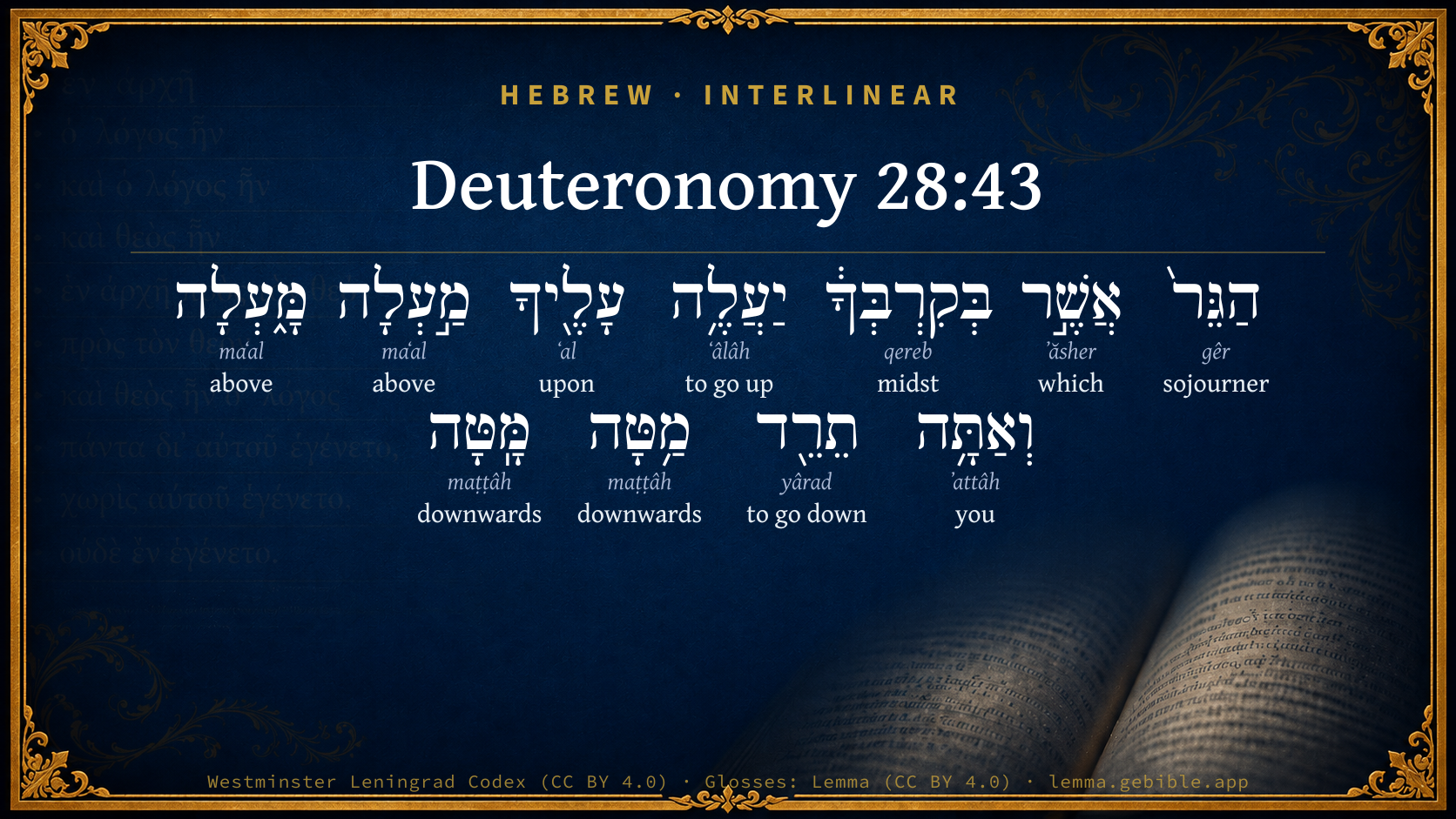
  1. הַגֵּר֙ gêr H1616 “the · sojourner” Particle, Definite Article + Noun, Common, Masculine, Singular, Absolute
  2. אֲשֶׁ֣ר ʼăsher H834 “which” Particle, Relative
  3. בְּקִרְבְּךָ֔ qereb H7130 “in/at · midst · your” Preposition + Noun, Common, Masculine, Singular, Construct + Suffix, Personal, 2nd Person, Masculine, Singular
  4. יַעֲלֶ֥ה ʻâlâh H5927 “to go up” Verb, Qal, Imperfect, 3rd Person, Masculine, Singular
  5. עָלֶ֖יךָ ʻal H5921 “upon · you” Preposition + Suffix, Personal, 2nd Person, Masculine, Singular
  6. מַ֣עְלָה maʻal H4605 “above · toward” Adverb + Suffix, Demonstrative
  7. מָּ֑עְלָה maʻal H4605 “above · toward” Adverb + Suffix, Demonstrative
  8. וְאַתָּ֥ה ʼattâh H859 “and · you” Conjunction + Pronoun, Personal, 2nd Person, Masculine, Singular
  9. תֵרֵ֖ד yârad H3381 “to go down” Verb, Qal, Imperfect, 2nd Person, Masculine, Singular
  10. מָּֽטָּה maṭṭâh H4295 “downwards” Adverb

About this verse

These counts appear in no published source. They are computed here, from the morphology-tagged text and Lemma’s own curated glosses. What Lemma adds →

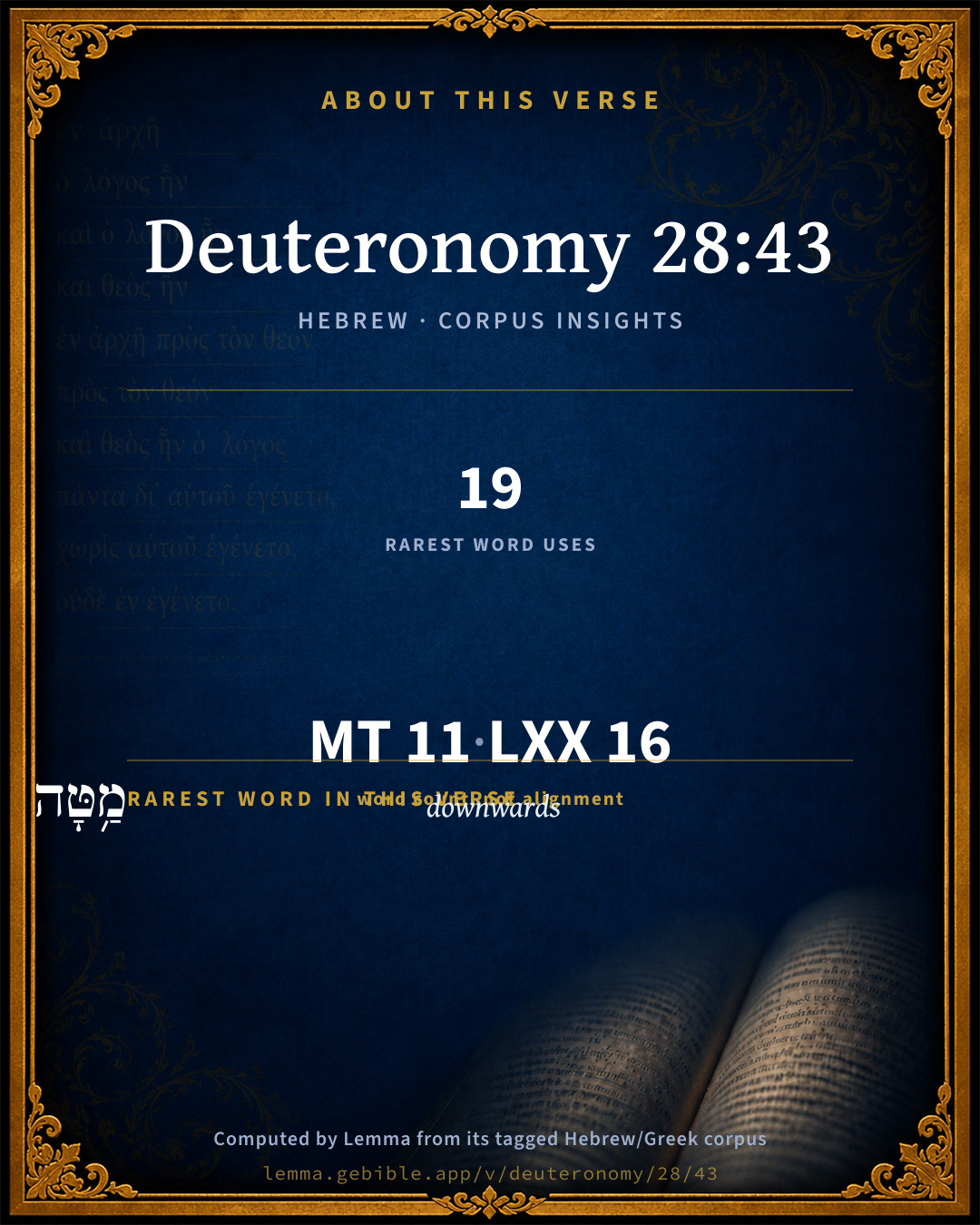
11
words
9
distinct lemmas
Pentateuch
section

Notable vocabulary

The rarest word here is מַ֥טָּה downwards H4295 — appearing just 19 times in the whole Hebrew Bible.

Shared distinctive vocabulary

מַ֥טָּה downwards H4295 occurs in 18 verses of the Hebrew Bible. Also found in:

Grammatical profile

  • 2 verbs
  • 2 nouns
  • 1 pronoun
  • 1 preposition
  • 4 adverbs
  • 1 particle

Verb forms

  • יַעֲלֶ֥ה Qal · Imperfect
  • תֵרֵ֖ד Qal · Imperfect

Repetition

Words recur within this verse — often emphatic in Hebrew:

  • מַ֣עְלָה above H4605 ×2
  • מַ֥טָּה downwards H4295 ×2

Hebrew & Septuagint length

In English translation the verse runs 25 words from the Hebrew and 18 from the Septuagint (LXX English) — closely comparable.

A rough comparison of the two English renderings, which tokenize alike — not a word-level alignment.

Word counts can differ between the Hebrew and the Greek without any difference in meaning — e.g. the Hebrew direct-object marker אֵת has no separate Greek word, and Greek often adds the article ὁ.

In the original languages it is 11 Hebrew tokens and 16 Greek tokens — but the two are counted differently (Hebrew bundles its prefixes and suffixes into one token; the Greek is in lemma form), so that isn’t a like-for-like length.

Cross-references

14

Topical passages linked to Deuteronomy 28:43 in the Treasury of Scripture Knowledge — connected by theme and wording, ordered by reader-vote popularity; previews shown in the World English Bible.

  • Deuteronomy 28:13 Yahweh will make you the head, and not the tail; and you shall be above only, and you shall not be beneath; if you shall listen to the commandments of Yahweh your God, which I command you this day, to observe and to do [them],
  • 1 Samuel 13:19–23 Now there was no smith found throughout all the land of Israel; for the Philistines said, Lest the Hebrews make them swords or spears:
  • Judges 2:3 Therefore I also said, I will not drive them out from before you; but they shall be [as thorns] in your sides, and their gods shall be a snare to you.
  • Judges 2:11–15 The children of Israel did that which was evil in the sight of Yahweh, and served the Baals;
  • Judges 4:2–3 Yahweh sold them into the hand of Jabin king of Canaan, who reigned in Hazor; the captain of whose host was Sisera, who lived in Harosheth of the Gentiles.
  • Judges 10:7–10 The anger of Yahweh was kindled against Israel, and he sold them into the hand of the Philistines, and into the hand of the children of Ammon.
  • Judges 14:4 But his father and his mother didn't know that it was of Yahweh; for he sought an occasion against the Philistines. Now at that time the Philistines had rule over Israel.
  • Judges 15:11–12 Then three thousand men of Judah went down to the cleft of the rock of Etam, and said to Samson, "Don't you know that the Philistines are rulers over us? What then is this that you have done to us?" He said to them, As they did to me, so have I done to them.
  • 2 Kings 17:20 Yahweh rejected all the seed of Israel, and afflicted them, and delivered them into the hand of spoilers, until he had cast them out of his sight.
  • 2 Kings 17:23 until Yahweh removed Israel out of his sight, as he spoke by all his servants the prophets. So Israel was carried away out of their own land to Assyria to this day.
  • 2 Kings 24:14–16 He carried away all Jerusalem, and all the princes, and all the mighty men of valor, even ten thousand captives, and all the craftsmen and the smiths; none remained, save the poorest sort of the people of the land.
  • John 18:31 Pilate therefore said to them, "Take him yourselves, and judge him according to your law." Therefore the Jews said to him, "It is not lawful for us to put anyone to death,"
  • John 19:15 They cried out, "Away with him! Away with him! Crucify him!" Pilate said to them, "Shall I crucify your King?" The chief priests answered, "We have no king but Caesar!"
  • 1 Samuel 13:3–7 Jonathan struck the garrison of the Philistines that was in Geba: and the Philistines heard of it. Saul blew the trumpet throughout all the land, saying, Let the Hebrews hear.

Cross-references courtesy of OpenBible.info (CC BY 4.0).

Hebrew and Greek witnesses Masoretic Hebrew ↔ Greek Septuagint

The same verse in the two great witnesses to the Old Testament, shown verse-for-verse.

These are two independent witnesses, not word-aligned to each other, and the Septuagint is shown in lemma (dictionary) form.

Hebrew Deuteronomy 28:43 Masoretic · Westminster Leningrad Codex

הַגֵּר֙ אֲשֶׁ֣ר בְּקִרְבְּךָ֔ יַעֲלֶ֥ה עָלֶ֖יךָ מַ֣עְלָה מָּ֑עְלָה וְאַתָּ֥ה תֵרֵ֖ד מַ֥טָּה מָּֽטָּה

The foreigner who is in the midst of you shall mount up above you higher and higher; and you shall come down lower and lower.

World English Bible · Public Domain

Greek LXX Deuteronomy 28:43 Septuagint · lemma form

ὁ προσήλυτος ὅς εἰμί ἐν σύ ἀναβαίνω ἐπί σύ ἄνω ἄνω σύ δέ καταβαίνω κάτω κάτω

The stranger that is within you shall get up very high, and you shall come down very low.

LXX2012 (modern English Septuagint) · Public Domain

Hebrew: Westminster Leningrad Codex (CC BY 4.0). Greek: Septuagint (public domain); English from LXX2012 (modern English Septuagint) (Public Domain). How the Septuagint differs from the Hebrew →

Targum (Aramaic paraphrase)

2

The Targum is the ancient Jewish Aramaic paraphrase of the Hebrew Scriptures — an interpretive translation, not the Hebrew text itself. Onkelos (literal) and Pseudo-Jonathan (expansive) render the Torah, and Jonathan the Prophets. Coverage is partial: where no permissively-licensed English translation exists for a verse, only the Aramaic is shown. This is verse-level text, not a word-by-word alignment to the Hebrew.

  1. Targum Onkelos Torah (Genesis–Deuteronomy)
    תּוֹתַב עָרֵל דִי בֵינָךְ יְהֵי סְלִיק עֵיל מִנָךְ לְעֵלָא לְעֵלָא וְאַתְּ תְּהֵי נָחֵת לְתַחְתָּא לְתַחְתָּא

    (no public-domain English translation for this verse)

    Targum Onkelos — Aramaic: “Onkelos Genesis” (public domain); “Onkelos Exodus” (public domain); “Onkelos Leviticus” (public domain); “Onkelos Numbers” (public domain); “Onkelos Deuteronomy” (public domain). English: “Sefaria Community Translation” (CC0 1.0 (public-domain dedication)); “J.W. Etheridge. The Targums of Onkelos and Jonathan Ben Uzziel on the Pentateuch. London: Longmans, Green, 1862” (public domain). Text via Sefaria.

  2. Targum Pseudo-Jonathan Torah (Genesis–Deuteronomy)
    עַרְלָאָה דְדַיַיר בֵּינֵיכוֹן יִסוֹק עֲלֵיכוֹן מְסוּקְיָין עַל מְסוּקְיָין וְאַתּוּן תְּחוּתוּן דְרַע מִנֵיהּ מְחוּתִין מִן מְחוּתִין

    The uncircumcised who dwelleth among you will rise above you with ascension upon ascension, but you will go downwards by descent after descent.

    Targum Pseudo-Jonathan — Aramaic: “Targum Jonathan on Genesis” (public domain); “Targum Jonathan on Exodus” (public domain); “Targum Jonathan on Leviticus” (public domain); “Targum Jonathan on Numbers” (public domain); “Targum Jonathan on Deuteronomy” (public domain). English: “The Targum of Jonathan ben Uzziel, trans. J. W. Etheridge, London, 1862” (public domain). Text via Sefaria.

Commentary

Notes on Deuteronomy 28:43 from classic Christian and Jewish commentators (each source and its license shown beneath its notes). The classic Christian expositions comment on the surrounding passage and are grouped to its opening verse, so a note may address several verses; the Jewish commentaries on the Tanakh (Rashi and others) are per-verse, so they appear only where the commentator wrote on this verse.

Lemma curates 59 commentaries, every one of them public domain or Creative Commons licensed, each selected and text-cleaned for this edition rather than reprinted as found. About our sources →

Trapp's Complete Commentary

John Trapp

Deu 28:43 The stranger that [is] within thee shall get up above thee very high; and thou shalt come down very low.

Ver. 43. The stranger.] The Lurdaines, as once here the Lord Danes.

John Trapp, A Commentary or Exposition upon All the Books of the Old and New Testament (1647–1656) — public domain. Text from a community e-Sword module.

Joseph Benson's Commentary

Deu 28:43. The stranger that is within thee — Within thy gates; who formerly honoured and served thee, and were, some of them, glad of the crumbs which fell from thy table. Shall get above thee very high — Shall rise to great wealth and prosperity upon thy ruin.

Joseph Benson's Commentary on the Old and New Testaments (1811–1818) — public domain. Text from a community e-Sword module.

Tyndale Open Study Notes

Tyndale Open Resources

28:43 foreigners (literally sojourners): In God’s day of judgment, those regarded as the weakest and most vulnerable elements of Israelite society (see 29:11) would dominate.

Tyndale Open Study Notes — © Tyndale Open Resources, licensed CC BY-SA 4.0. Text via the HelloAO Bible API.

The Cambridge Bible for Schools and Colleges

gen. ed. J. J. S. Perowne

43, 44. The antithesis to 12b, 13a (q.v.).

The Cambridge Bible for Schools and Colleges (gen. ed. J. J. S. Perowne; Cambridge University Press, 1878–1918) — public domain. Text from a community e-Sword module.

John Gill's Exposition

Because thou servedst not the Lord thy God,.... By attending his worship, and keeping his commandments:

with joyfulness and gladness of heart, for the abundance of all things; which they enjoyed in the land of Canaan, a land that abounded with all good things; which laid them under great obligations to serve the Lord: and yet, as they were wanting in a ready attendance on his worship, and in a cheerful obedience to his laws, so in their sacrifices, of praise and thanksgivings for their manifold mercies; and, because of all this, the curses written in this book came upon them.

John Gill's Exposition of the Whole Bible (1746–1763) — public domain (CC PDM 1.0). Text via the HelloAO Bible API.

Haydock's Catholic Bible Commentary

Lower. Hebrew repeats this word, to signify the utmost abjection. (Haydock) --- The Fathers gather hence the glorious superiority to which the Christian Church is raised. (Origen, Rom. ii.) (Theodoret, q. 34.)

George Leo Haydock (1774–1849), Haydock's Catholic Family Bible and Commentary, 1859 edition — public domain. Excludes Psalms (Douay-Rheims chapter numbering differs from Protestant) and Deuterocanonical books (Catholic canon only).

Matthew Poole's English Annotations

Within thee, i.e. within thy gates; who formerly honoured and served thee, and were some of them glad of the crumbs which fell from thy table.

Matthew Poole's English Annotations on the Holy Bible (1683–1685) — public domain. Text from a community e-Sword/MySword module.

Whedon's Commentary on the Bible

Daniel D. Whedon

43. The stranger… shall get up above thee — The nation would become feebler and feebler, utterly impoverished, while their enemies would rise higher and higher above them.

Daniel D. Whedon (gen. ed.), Commentary on the Old and New Testaments (1874–1909) — public domain. Text from a community e-Sword module.

The Pulpit Commentary

Vers. 43, 44. (Cf. vers. 12, 13.)

The Pulpit Commentary (1880–1919), ed. H.D.M. Spence-Jones & Joseph S. Exell — public domain. Text from a community e-Sword module.

John Wesley's Explanatory Notes

Within thee - Within thy gates; who formerly honoured and served thee, and were some of them glad of the crumbs which fell from thy table.

John Wesley, Explanatory Notes Upon the Whole Bible (1754–1765) — public domain. Text via the GEBible commentary corpus.

Lesson kit

Teaching starters — assembled from the data on this page, not authored interpretation. Every prompt links to the verse data it draws on. Edit before teaching.

Deuteronomy, in the Pentateuch, opens this verse with 11 words (9 distinct Hebrew lemmas). Its most distinctive word is maṭṭâh (“downwards”). A historical commentator’s framing appears above. Read the whole chapter for the surrounding context.

Discussion questions

  1. What does “downwards” (maṭṭâh) contribute to the verse as a whole?
  2. Exodus 26:24 shares the word «downwards» with this verse. How do the two illuminate each other?
  3. “above” occurs 2× in this one verse. What is the effect of the repetition?
  4. These translations render this verse differently; the difference is in the English rendering, not the original. What questions does that raise?
  5. The verb «יַעֲלֶ֥ה» is Qal Imperfect. How does its form color the action?
  6. Reading how Trapp's Complete Commentary and Joseph Benson's Commentary read this verse, where do the two commentators agree and where do they part?

Things to notice

Reading settings

Reading text

Shown beneath each verse's original-language words.

Old Testament
Old Testament edition

Read the OT as the Masoretic Hebrew (MT) or the Greek Septuagint (LXX).

English shown for the Greek Septuagint (in the Hebrew ↔ Greek comparison).

Comparing translations? Open the Compare panel on any verse page to stack up to four side by side.