Psalms 137:6

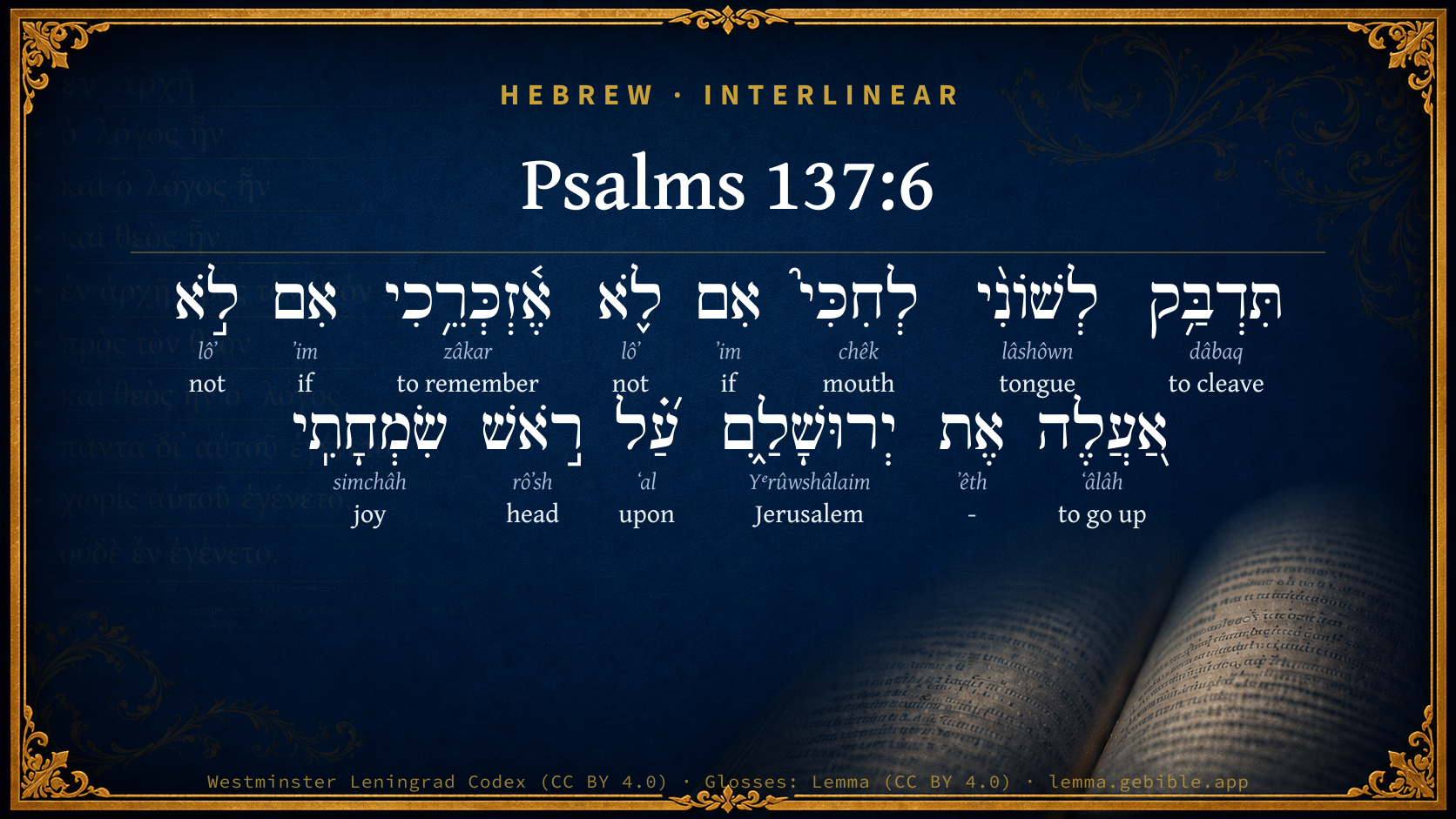
Hebrew (Westminster Leningrad Codex) Psalms 137:6 appears in the Hebrew Old Testament. The text above is from the Westminster Leningrad Codex. Each word links to its Strong’s number, a concise gloss, and parsing drawn from the Open Scriptures Hebrew Bible morphology. Click any word for its full Brown-Driver-Briggs (BDB) entry.
Download image
Cite this verse

Psalms 137:6 (World English Bible). Public Domain. Lemma interlinear Bible study tool, https://lemma.gebible.app/v/psalms/137/6.

Show BibTeX & RIS
BibTeX
RIS
English Translation
Let my tongue stick to the roof of my mouth if I don't remember you; If I don't prefer Jerusalem above my chief joy.
World English Bible · Public Domain
Download a study sheet

One document with this verse’s original text, its word-by-word gloss line, the meaning frame, cross-references with their text, attributed commentary, and full source and license credits — printable, and it pastes into notes with its structure intact.

This verse Autodidact and up

Study sheet (.html) Plain text (.txt)

A passage Seminary Student

Up to 50 verses in one chapter. A passage sheet keeps up to 6 commentary sources and 12 cross-references per verse, in the order this page ranks them, and says so on the sheet whenever that leaves anything out. Ask for a single verse and you get the Autodidact verse sheet above.

Everything on this page stays free to read, with no account — the sheet is a download of what is already on screen, not access to it.

Want to remove ads? Support Godless Engineer
Compare translations 3

The same verse in 3 English versions, stacked beneath the original-language interlinear above. Click any original word for its lexicon entry.

Each is an independent rendering of the whole verse — the interlinear is not word-aligned to these translations.

Highlighted words mark where these versions differ — a whole-verse word diff, not a word-by-word alignment.

  • World English Bible Public Domain
    Let my tongue stick to the roof of my mouth if I don't remember you; If I don't prefer Jerusalem above my chief joy.
  • King James Version Public Domain
    If I do not remember thee, let my tongue cleave to the roof of my mouth; if I prefer not Jerusalem above my chief joy.
  • unfoldingWord Literal Text CC BY-SA 4.0
    Let my tongue cling to my palate if I do not remember you, if I do not cause Jerusalem to go up above the head of my joy.

unfoldingWord Literal Text — © unfoldingWord, licensed CC BY-SA 4.0. Word-aligned USFM3 via Door43 (git.door43.org/unfoldingWord/en_ult).

Versions to compare (up to 4)

3 of 4 selected

Show all 18 translations

Every available English version of this verse, each an independent rendering of the whole verse.

  • World English Bible Public Domain
    Let my tongue stick to the roof of my mouth if I don't remember you; If I don't prefer Jerusalem above my chief joy.
  • Berean Standard Bible Public Domain
    May my tongue cling to the roof of my mouth if I do not remember you, if I do not exalt Jerusalem as my greatest joy!
  • Majority Standard Bible Public Domain
    May my tongue cling to the roof of my mouth if I do not remember you, if I do not exalt Jerusalem as my greatest joy!
  • King James Version Public Domain
    If I do not remember thee, let my tongue cleave to the roof of my mouth; if I prefer not Jerusalem above my chief joy.
  • American Standard Version (1901) Public Domain
    Let my tongue cleave to the roof of my mouth, If I remember thee not; If I prefer not Jerusalem Above my chief joy.
  • Revised Version (1885) Public Domain
    Let my tongue cleave to the roof of my mouth, if I remember thee not; if I prefer not Jerusalem above my chief joy.
  • Geneva Bible (1599) Public Domain
    If I do not remember thee, let my tongue cleaue to the roofe of my mouth: yea, if I preferre not Ierusalem to my chiefe ioy.
  • Douay-Rheims (1899) Public Domain
    Who established the earth above the waters: for his mercy endureth for ever.
  • Young's Literal Translation Public Domain
    My tongue doth cleave to my palate, If I do not remember thee, If I do not exalt Jerusalem above my chief joy.
  • Literal Standard Version CC BY-SA 4.0
    My tongue cleaves to my palate, || If I do not remember you, || If I do not exalt Jerusalem above my chief joy.
  • Unlocked Literal Bible CC BY-SA 4.0
    Let my tongue cling to the roof of my mouth if I think about you no more, if I do not prefer Jerusalem more than my greatest delights.
  • unfoldingWord Literal Text CC BY-SA 4.0
    Let my tongue cling to my palate if I do not remember you, if I do not cause Jerusalem to go up above the head of my joy.
  • Darby Bible Public Domain
    If I do not remember thee, let my tongue cleave to my palate: if I prefer not Jerusalem above my chief joy.
  • World Messianic Bible Public Domain
    Let my tongue stick to the roof of my mouth if I don’t remember you, if I don’t prefer Jerusalem above my chief joy.
  • Webster's Bible Public Domain
    If I do not remember thee, let my tongue cleave to the roof of my mouth; if I prefer not Jerusalem above my chief joy.
  • Free Bible Version CC BY-SA 4.0
    May my tongue stick to the roof of my mouth if I don't remember you—if I don't consider Jerusalem my greatest joy.
  • Bible in Basic English Public Domain
    If I let you go out of my thoughts, and if I do not put Jerusalem before my greatest joy, let my tongue be fixed to the roof of my mouth.
  • JPS Tanakh (1917) Public Domain
    Let my tongue cleave to the roof of my mouth, if I remember thee not; if I set not Jerusalem above my chiefest joy.

Literal Standard Version (2020), Covenant Press — licensed CC BY-SA 4.0. Text via the HelloAO Bible API (eBible.org). Unlocked Literal Bible (unfoldingWord) — licensed CC BY-SA 4.0. Text via the HelloAO Bible API (eBible.org). unfoldingWord Literal Text — © unfoldingWord, licensed CC BY-SA 4.0. Word-aligned USFM3 via Door43 (git.door43.org/unfoldingWord/en_ult). Free Bible Version, Dr. Jonathan Gallagher — licensed CC BY-SA 4.0. Text via the HelloAO Bible API (eBible.org).

Word by word

More ways to search: Search by grammar → Find every occurrence → Compare this word →

Practice this passage: Drill this verse → Learn its vocabulary →

לְחִכִּי֮
chêk
H2441
“to/for · mouth · my”
Preposition + Noun, Common, Masculine, Singular, Construct + Suffix, Personal, 1st Person, Common, Singular
Part of Speech
Preposition + Noun
Type
Common
Gender
Masculine
Number
Singular
State
Construct
Full BDB Definition

Origin: probably from H2596 in the sense of tasting

TWOT: 692a

mouth, palate, taste, gums
  1. תִּדְבַּ֥ק dâbaq H1692 “to cleave” Verb, Qal, Imperfect, 3rd Person, Feminine, Singular
  2. לְשׁוֹנִ֨י lâshôwn H3956 “tongue · our” Noun, Common, Both, Singular, Construct + Suffix, Personal, 1st Person, Common, Plural
  3. אִם ʼim H518 “if” Conjunction
  4. לֹ֪א lôʼ H3808 “not” Particle, Negative
  5. אֶ֫זְכְּרֵ֥כִי zâkar H2142 “to remember · you” Verb, Qal, Imperfect, 1st Person, Common, Singular + Suffix, Personal, 2nd Person, Feminine, Singular
  6. אִם ʼim H518 “if” Conjunction
  7. לֹ֣א lôʼ H3808 “not” Particle, Negative
  8. אַ֭עֲלֶה ʻâlâh H5927 “to go up” Verb, Hiphil, Imperfect, 1st Person, Common, Singular
  9. אֶת ʼêth H853 “-” Particle, Direct Object
  10. יְרוּשָׁלִַ֑ם Yᵉrûwshâlaim H3389 “Jerusalem” Noun, Proper
  11. עַ֝֗ל ʻal H5921 “upon” Preposition
  12. רֹ֣אשׁ rôʼsh H7218 “head of” Noun, Common, Masculine, Singular, Construct
  13. שִׂמְחָתִֽי simchâh H8057 “joy · my” Noun, Common, Feminine, Singular, Construct + Suffix, Personal, 1st Person, Common, Singular

About this verse

These counts appear in no published source. They are computed here, from the morphology-tagged text and Lemma’s own curated glosses. What Lemma adds →

14
words
12
distinct lemmas
Wisdom
section

Notable vocabulary

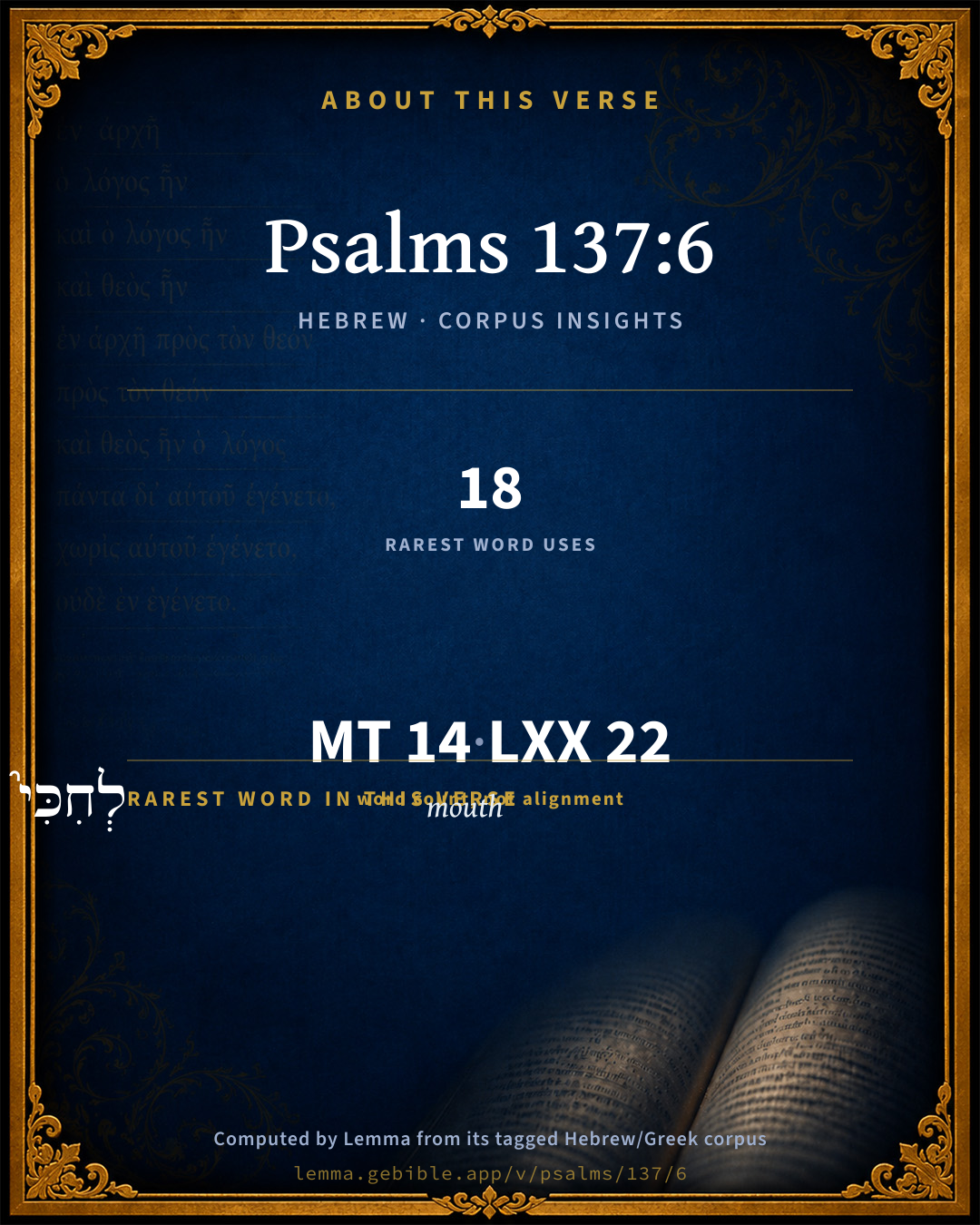
The rarest word here is לְחִכִּי֮ mouth H2441 — appearing just 18 times in the whole Hebrew Bible.

Shared distinctive vocabulary

לְחִכִּי֮ mouth H2441 occurs in 18 verses of the Hebrew Bible. Also found in:

Grammatical profile

  • 3 verbs
  • 5 nouns
  • 1 preposition
  • 2 conjunctions
  • 3 particles

Verb forms

  • תִּדְבַּ֥ק Qal · Imperfect
  • אֶ֫זְכְּרֵ֥כִי Qal · Imperfect
  • אַ֭עֲלֶה Hiphil · Imperfect

Repetition

Words recur within this verse — often emphatic in Hebrew:

Hebrew & Septuagint length

In English translation the verse runs 24 words from the Hebrew and 25 from the Septuagint (LXX English) — closely comparable.

A rough comparison of the two English renderings, which tokenize alike — not a word-level alignment.

Word counts can differ between the Hebrew and the Greek without any difference in meaning — e.g. the Hebrew direct-object marker אֵת has no separate Greek word, and Greek often adds the article ὁ.

In the original languages it is 14 Hebrew tokens and 22 Greek tokens — but the two are counted differently (Hebrew bundles its prefixes and suffixes into one token; the Greek is in lemma form), so that isn’t a like-for-like length.

Cross-references

10

Topical passages linked to Psalms 137:6 in the Treasury of Scripture Knowledge — connected by theme and wording, ordered by reader-vote popularity; previews shown in the World English Bible.

  • Ezekiel 3:26 and I will make your tongue cleave to the roof of your mouth, that you shall be mute, and shall not be to them a reprover; for they are a rebellious house.
  • Psalms 22:15 My strength is dried up like a potsherd. My tongue sticks to the roof of my mouth. You have brought me into the dust of death.
  • Job 29:10 The voice of the nobles was hushed, And their tongue stuck to the roof of their mouth.
  • Psalms 84:10 For a day in your courts is better than a thousand. I would rather be a doorkeeper in the house of my God, Than to dwell in the tents of wickedness.
  • Isaiah 41:17 The poor and needy seek water, and there is none, and their tongue fails for thirst; I, Yahweh, will answer them, I, the God of Israel, will not forsake them.
  • Lamentations 4:4 The tongue of the sucking child cleaves to the roof of his mouth for thirst: The young children ask bread, and no man breaks it to them.
  • 1 Thessalonians 3:7–9 for this cause, brothers, we were comforted over you in all our distress and affliction through your faith.
  • Matthew 6:33 But seek first God's Kingdom, and his righteousness; and all these things will be given to you as well.
  • Acts 20:24 But these things don't count; nor do I hold my life dear to myself, so that I may finish my race with joy, and the ministry which I received from the Lord Jesus, to fully testify to the Gospel of the grace of God.
  • Philippians 1:20 according to my earnest expectation and hope, that I will in no way be disappointed, but with all boldness, as always, now also Christ will be magnified in my body, whether by life, or by death.

Cross-references courtesy of OpenBible.info (CC BY 4.0).

Hebrew and Greek witnesses Masoretic Hebrew ↔ Greek Septuagint

The same verse in the two great witnesses to the Old Testament, shown verse-for-verse.

You’re reading Greek Psalm 136 (Hebrew Psalm 137). The Septuagint counts the superscription, so verse numbers can differ from the Hebrew — chapter-level alignment, not verse-by-verse. Numbering follows Rahlfs.

These are two independent witnesses, not word-aligned to each other, and the Septuagint is shown in lemma (dictionary) form.

Hebrew Psalms 137:6 Masoretic · Westminster Leningrad Codex

תִּדְבַּ֥ק לְשׁוֹנִ֨י לְחִכִּי֮ אִם לֹ֪א אֶ֫זְכְּרֵ֥כִי אִם לֹ֣א אַ֭עֲלֶה אֶת יְרוּשָׁלִַ֑ם עַ֝֗ל רֹ֣אשׁ שִׂמְחָתִֽי

Let my tongue stick to the roof of my mouth if I don't remember you; If I don't prefer Jerusalem above my chief joy.

World English Bible · Public Domain

Greek LXX Greek Psalm 136:6 Septuagint · lemma form

κολλάω ὁ γλῶσσα ἐγώ ὁ λάρυγξ ἐγώ ἐάν μή σύ μιμνήσκω ἐάν μή προ ἀνατάσσω ὁ ἰερουσαλήμ ἐν ἀρχή ὁ εὐφροσύνη ἐγώ

May my tongue cleave to my throat, if I do not remember you; if I do not prefer Jerusalem as the chief of my joy.

LXX2012 (modern English Septuagint) · Public Domain

Hebrew: Westminster Leningrad Codex (CC BY 4.0). Greek: Septuagint (public domain); English from LXX2012 (modern English Septuagint) (Public Domain). How the Septuagint differs from the Hebrew →

Commentary

Notes on Psalms 137:6 from classic Christian and Jewish commentators (each source and its license shown beneath its notes). The classic Christian expositions comment on the surrounding passage and are grouped to its opening verse, so a note may address several verses; the Jewish commentaries on the Tanakh (Rashi and others) are per-verse, so they appear only where the commentator wrote on this verse.

Lemma curates 59 commentaries, every one of them public domain or Creative Commons licensed, each selected and text-cleaned for this edition rather than reprinted as found. About our sources →

Trapp's Complete Commentary

John Trapp

Psa 137:6 If I do not remember thee, let my tongue cleave to the roof of my mouth; if I prefer not Jerusalem above my chief joy.

Ver. 6. If I do not remember thee] Hi gemitus Sanctorum sunt gemitus Spiritus sancti, these are the very sighs unutterable, that precede joys unspeakable and full of glory. Either our beds are soft or our hearts hard, that can rest when the Church is at unrest, that fed not our brethren’s hard cords through our soft beds.

If I prefer not Jerusalem above my chief joy] Heb. if I cause it not to ascend above the head of my joy. Christ in his ordinances must be our chiefest comfort, overtopping all other; and devouring all discontents whatsoever.

John Trapp, A Commentary or Exposition upon All the Books of the Old and New Testament (1647–1656) — public domain. Text from a community e-Sword module.

J. A. Alexander on Psalms

Joseph Addison Alexander

6. (Psa 137:6) Let my tongue cleave to my palate if I do not remember thee, if I do not raise Jerusalem above the head of my rejoicing. What he had first wished as to his power of instrumental performance, he now wishes with respect to his vocal organs. If I forget thee, let my hand for ever cease to strike the harp, and my tongue to utter sound! The most natural meaning of the last clause is the one paraphrastically given in the English version, if I prefer not Jerusalem above my chief joy.

Joseph Addison Alexander, The Psalms Translated and Explained (1850) — public domain. Text from a community e-Sword module.

Geneva Bible (1599)

Geneva Bible translators

The decay of God’s religion in their country was so grievous, that no joy could make them glad, except it were restored.

Geneva Bible (1599) marginal notes — public domain. Text via Bolls.life.

Adam Clarke's Commentary

Verse 6. Let my tongue cleave] Let me lose my voice, and all its powers of melody; my tongue, and all its faculty of speech; my ear, and its discernment of sounds; if I do not prefer my country, my people, and the ordinances of my God, beyond all these, and whatever may constitute the chiefest joy I can possess in aught else beside. This is truly patriotic, truly noble and dignified. Such sentiments can only be found in the hearts and mouths of those slaves whom the grace of God has made free.

Adam Clarke's Commentary on the Bible (1810–1826) — public domain. Text from a community e-Sword/MySword module.

The Cambridge Bible for Schools and Colleges

gen. ed. J. J. S. Perowne

6. Let my tongue cleave to the roof of my mouth,

If I remember thee not (R.V.).

Let all power of speech and song desert me. Cp. Job_29:10.

if I prefer not &c.] Lit. if I exalt not Jerusalem above my chiefest joy: i.e. if I do not regard J. as dearer to me than aught else.

The Cambridge Bible for Schools and Colleges (gen. ed. J. J. S. Perowne; Cambridge University Press, 1878–1918) — public domain. Text from a community e-Sword module.

John Gill's Exposition

If I do not remember thee,.... In prayer, in discourse, in conversation; this is the same as before, to forget, repeated for the confirmation of it;

let my tongue cleave to the roof of my mouth; as is the case of a person in a fever, or in a violent thirst, which is to be in great distress, Psa 18:6; the sense is, let me have no use of my tongue; let me be dumb and speechless, and never sing a song or speak a word more, should I be so forgetful of the deplorable state of Jerusalem as to sing songs at such a season, and in an enemy's country;

if I prefer not Jerusalem above my chief joy; meaning not God his exceeding joy, Psa 43:4; as his Creator, preserver, and benefactor, and much less as his covenant God and Father; as having loved him with an everlasting love; as the God of all grace unto him, and as his portion and exceeding great reward: nor Christ, the object of joy unspeakable and full of glory; joy in the greatness, glory, and fulness of his person; in the blessings and promises of his grace; in what he has done and suffered; as risen, ascended, exalted, and who will come a second time: nor the joy of the Holy Ghost in a way of believing, and in hope of the glory of God; but all worldly joy, or matter of it; and this not in things sinful, nor merely such as worldlings have in the increase of their substance; but a lawful joy, such as in the health, happiness, and prosperity of a man's family, wife, and children, and his own; which is the greatest outward joy a man can have; and yet the church of God and interest of Christ are preferred by a good man to these; see Sa1 4:19; which appears when all a man has that is matter of joy is sacrificed for the public good and interest of religion; when he can take no comfort in any outward enjoyment because of the sad case of Zion, Mal 2:3; when joy for its good is uppermost, and is first in his thoughts and words; when this is the "head" or "beginning" (g) of his joy, as it may be rendered. So Pindar (h) calls the chief, principal, and greatest part of joy, , the beginning of joy, the top and perfection of it.

(g) "caput laetitiae meae", Musculus, Junius & Tremellius, Piscator, Gejerus. (h) Pythia, Ode 1. v. 4.

John Gill's Exposition of the Whole Bible (1746–1763) — public domain (CC PDM 1.0). Text via the HelloAO Bible API.

Albert Barnes' Notes on the Bible

If I do not remember thee - Equivalent to, “If I forget thee.” If I ever fail to remember thee; if I shall ever act as if I had forgotten thee. Singing in a strange land, among those who had perpetrated such wrongs in thee - appearing to be happy, cheerful, joyous, happy, merry there - would be understood to imply that I had ceased to remember thee, and cared nothing for thee.

Let my tongue cleave to the roof of my mouth - Compare Eze 3:26. Let me be unable to speak; let my tongue be as it were attached to the upper part of the mouth, so that it could not be used. If I employ it in an unworthy purpose - in any way whereby it can be inferred that I have ceased to remember my native land, and the city of our solemnities, let my tongue be ever after useless. This language is often employed by Virgil: Vox faucibus haesit.

If I prefer not Jerusalem - literally, “If I do not cause to ascend.” That is, If I do not exalt Jerusalem in my estimation above everything that gives me pleasure; if I do not find my supreme happiness in that.

Above my chief joy - Margin, as in Hebrew, the head of my joy. The chief thing which gives me joy; as the head is the chief, or is supreme over the body. This is expressive of a great truth in regard to religion. Anything else - everything else - is to be sooner sacrificed than that. The happiness which is found in religion is superior to that found in every other source of enjoyment, and is preferred to every other. If either is to be sacrificed - the joy of religion, or the pleasure derived from society, from the frivolous world, from literature, from music, from dancing, from works of art - it will be the latter and not the former. There are other sources of joy which are not in any way inconsistent with religion: the joy of friendship; of domestic life; of honorable pursuits of the esteem of people. So of music, the arts, gardens, literature, science. But when one interferes with the other, or is inconsistent with the other, the joy of the world is to be sacrificed to the joy of religion. When the joy of religion is sacrificed for the joy of the world, it proves that there is no true piety in the soul. Religion, if it exists at all, will always be supreme.

Albert Barnes' Notes on the Bible (1834–1885) — public domain. Text from a community e-Sword/MySword module.

Matthew Poole's English Annotations

Remember thee with affection and sympathy, so as to damp my joys.

Cleave to the roof of my mouth; be made uncapable of singing, or speaking, or moving, as it is in some diseases. Compare Job 29:10; Psa 22:15. If I prefer not Jerusalem above my chief joy; if I do not value and desire Jerusalem’s prosperity more than all other delights, and consequently if Jerusalem’s misery doth not so deeply affect me as to hinder my delight in all other things.

Matthew Poole's English Annotations on the Holy Bible (1683–1685) — public domain. Text from a community e-Sword/MySword module.

The Treasury of David

Charles H. Spurgeon

Ver. 6. If I do not remember thee, let my tongue cleave to the roof of my mouth. Thus the singers imprecate eternal silence upon their mouths if they forget Jerusalem to gratify Babylon. The players on instruments and the sweet songsters are of one mind: the enemies of the Lord will get no mirthful tune or song from them. If I prefer not Jerusalem above my chief joy. The sacred city must ever be first in their thoughts, the queen of their souls; they had sooner be dumb than dishonour her sacred hymns, and give occasion to the oppressor to ridicule her worship. If such the attachment of a banished Jew to his native land, how much more should we love the church of God of which we are children and citizens. How jealous should we be of her honour, how zealous for her prosperity. Never let us find jests in the words of Scripture, or make amusement out of holy things, lest we be guilty of forgetting the Lord and his cause. It is to be feared that many tongues have lost all power to charm the regations of the saints because they have forgotten the gospel, and God has forgotten them.

Ver. 6. If I do not remember thee. Either our beds are soft, or our hearts hard, that can rest when the church is at unrest, that feel not our brethren's hard cords through our soft beds. John Trapp.

Ver. 6. If I prefer not Jerusalem above my chief joy. Literally, "if I advance not Jerusalem above the head of my joy." If I set not Jerusalem as a diadem on the head of my rejoicing, and crown all my happiness with it. Christopher Wordsworth.

Psalms 137:7*

Charles H. Spurgeon's The Treasury of David (1869–1885) — public domain. Psalms only. Text from a community e-Sword/MySword module.

The Pulpit Commentary

If I do not remember thee, let my tongue cleave to the roof of my mouth. Let me be deprived of the power of song. What was wished in the preceding verso with respect to the power of instrumental performance is here wished with respect to the vocal organs. If I prefer not Jerusalem above my chief joy. This seems to be the true sense, and is equivalent to "If I prefer not Jerusalem above aught else."

The Pulpit Commentary (1880–1919), ed. H.D.M. Spence-Jones & Joseph S. Exell — public domain. Text from a community e-Sword module.

John Wesley's Explanatory Notes

If - If I do not value Jerusalem's prosperity more than all other delights.

John Wesley, Explanatory Notes Upon the Whole Bible (1754–1765) — public domain. Text via the GEBible commentary corpus.

Rashi

Rabbi Shlomo Yitzchaki (Rashi)

If I do not bring up Jerusalem The remembrance of the mourning of its destruction I shall bring up to mention at the head of every joyous occasion of mine.

Rashi on the Tanakh — English translations: “The Judaica Press complete Tanach with Rashi, translated by A. J. Rosenberg” (CC BY 4.0); “Pentateuch with Rashi's commentary by M. Rosenbaum and A.M. Silbermann, 1929-1934” (public domain); “The Metsudah Tanach series, Lakewood, N.J” (CC BY 4.0); and “The Book of Joshua, Metsudah Publications, 1997” (CC BY 4.0). Text via Sefaria.

Lesson kit

Teaching starters — assembled from the data on this page, not authored interpretation. Every prompt links to the verse data it draws on. Edit before teaching.

Psalms, in the Wisdom, opens this verse with 14 words (12 distinct Hebrew lemmas). Its most distinctive word is chêk (“mouth”). A historical commentator’s framing appears above. Read the whole chapter for the surrounding context.

Discussion questions

  1. How does “mouth” (chêk) shape what this verse is saying?
  2. How does Job 6:30, which shares the word «mouth», read alongside this verse?
  3. What does the repetition of “if” (2× in this one verse) do in this verse?
  4. These translations render this verse differently; the difference is in the English rendering, not the original. What questions does that raise?
  5. «תִּדְבַּ֥ק» is a Qal Imperfect verb. How does that grammatical form shape the action described?
  6. Compare how Trapp's Complete Commentary and J. A. Alexander on Psalms read this verse. Where do they agree or differ?

Things to notice

Reading settings

Reading text

Shown beneath each verse's original-language words.

Old Testament
Old Testament edition

Read the OT as the Masoretic Hebrew (MT) or the Greek Septuagint (LXX).

English shown for the Greek Septuagint (in the Hebrew ↔ Greek comparison).

Comparing translations? Open the Compare panel on any verse page to stack up to four side by side.