
1 Samuel 6:7

Hebrew (Westminster Leningrad Codex) 1 Samuel 6:7 appears in the Hebrew Old Testament. The text above is from the Westminster Leningrad Codex. Each word links to its Strong’s number, a concise gloss, and parsing drawn from the Open Scriptures Hebrew Bible morphology. Click any word for its full Brown-Driver-Briggs (BDB) entry.
Download image
Cite this verse

1 Samuel 6:7 (World English Bible). Public Domain. Lemma interlinear Bible study tool, https://lemma.gebible.app/v/1-samuel/6/7.

Show BibTeX & RIS
BibTeX
RIS
English Translation
Now therefore take and prepare yourselves a new cart, and two milk cattle, on which there has come no yoke; and tie the cattle to the cart, and bring their calves home from them;
World English Bible · Public Domain
Download a study sheet

One document with this verse’s original text, its word-by-word gloss line, the meaning frame, cross-references with their text, attributed commentary, and full source and license credits — printable, and it pastes into notes with its structure intact.

This verse Autodidact and up

Study sheet (.html) Plain text (.txt)

A passage Seminary Student

Up to 50 verses in one chapter. A passage sheet keeps up to 6 commentary sources and 12 cross-references per verse, in the order this page ranks them, and says so on the sheet whenever that leaves anything out. Ask for a single verse and you get the Autodidact verse sheet above.

Everything on this page stays free to read, with no account — the sheet is a download of what is already on screen, not access to it.

Want to remove ads? Support Godless Engineer
Compare translations 3

The same verse in 3 English versions, stacked beneath the original-language interlinear above. Click any original word for its lexicon entry.

Each is an independent rendering of the whole verse — the interlinear is not word-aligned to these translations.

Highlighted words mark where these versions differ — a whole-verse word diff, not a word-by-word alignment.

  • World English Bible Public Domain
    Now therefore take and prepare yourselves a new cart, and two milk cattle, on which there has come no yoke; and tie the cattle to the cart, and bring their calves home from them;
  • King James Version Public Domain
    Now therefore make a new cart, and take two milch kine, on which there hath come no yoke, and tie the kine to the cart, and bring their calves home from them:
  • unfoldingWord Literal Text CC BY-SA 4.0
    And now, take and make a new cart, and two nursing cows upon which a yoke has not gone up. And you shall harness the cows to the cart, but you shall return their calves from behind them to the house.

unfoldingWord Literal Text — © unfoldingWord, licensed CC BY-SA 4.0. Word-aligned USFM3 via Door43 (git.door43.org/unfoldingWord/en_ult).

Versions to compare (up to 4)

3 of 4 selected

Show all 18 translations

Every available English version of this verse, each an independent rendering of the whole verse.

  • World English Bible Public Domain
    Now therefore take and prepare yourselves a new cart, and two milk cattle, on which there has come no yoke; and tie the cattle to the cart, and bring their calves home from them;
  • Berean Standard Bible Public Domain
    Now, therefore, prepare one new cart with two milk cows that have never been yoked. Hitch the cows to the cart, but take their calves away and pen them up.
  • Majority Standard Bible Public Domain
    Now, therefore, prepare one new cart with two milk cows that have never been yoked. Hitch the cows to the cart, but take their calves away and pen them up.
  • King James Version Public Domain
    Now therefore make a new cart, and take two milch kine, on which there hath come no yoke, and tie the kine to the cart, and bring their calves home from them:
  • American Standard Version (1901) Public Domain
    Now therefore take and prepare you a new cart, and two milch kine, on which there hath come no yoke; and tie the kine to the cart, and bring their calves home from them;
  • Revised Version (1885) Public Domain
    Now therefore take and prepare you a new cart, and two milch kine, on which there hath come no yoke, and tie the kine to the cart, and bring their calves home from them:
  • Geneva Bible (1599) Public Domain
    Now therefore make a new cart, and take two milch kine, on whome there hath come no yoke: and tye the kine to the cart, and bring the calues home from them.
  • Douay-Rheims (1899) Public Domain
    Now therefore take and make a new cart: and two kine that have calved, on which there hath come no yoke, tie to the cart, and shut up their calves at home.
  • Young's Literal Translation Public Domain
    `And now, take and make one new cart, and two suckling kine, on which a yoke hath not gone up, and ye have bound the kine in the cart, and caused their young ones to turn back from after them to the house,
  • Literal Standard Version CC BY-SA 4.0
    And now, take and make one new cart, and two suckling cows, on which a yoke has not gone up, and you have bound the cows in the cart, and caused their young ones to turn back from after them to the house,
  • Unlocked Literal Bible CC BY-SA 4.0
    Now then, prepare a new cart with two nursing cows that have never been yoked. Tie the cows to the cart, but take their calves home, away from them.
  • unfoldingWord Literal Text CC BY-SA 4.0
    And now, take and make a new cart, and two nursing cows upon which a yoke has not gone up. And you shall harness the cows to the cart, but you shall return their calves from behind them to the house.
  • Darby Bible Public Domain
    And now make a new cart, and take two milch kine, on which there has come no yoke, and tie the kine to the cart, and bring their calves home from them;
  • World Messianic Bible Public Domain
    “Now therefore take and prepare yourselves a new cart and two milk cows on which there has come no yoke; and tie the cows to the cart, and bring their calves home from them;
  • Webster's Bible Public Domain
    Now therefore make a new cart, and take two milch-cows on which there hath come no yoke, and tie the cows to the cart, and bring their calves home from them:
  • Free Bible Version CC BY-SA 4.0
    So get a new cart ready, pulled by two milk cows that have never been yoked. Tie the cows to the cart, but take their calves away and put them in a stall.
  • Bible in Basic English Public Domain
    So now, take and make ready a new cart, and two cows which have never come under the yoke, and have the cows yoked to the cart, and take their young ones away from them:
  • JPS Tanakh (1917) Public Domain
    Now therefore take and prepare you a new cart, and two milch kine, on which there hath come no yoke, and tie the kine to the cart, and bring their calves home from them.

Literal Standard Version (2020), Covenant Press — licensed CC BY-SA 4.0. Text via the HelloAO Bible API (eBible.org). Unlocked Literal Bible (unfoldingWord) — licensed CC BY-SA 4.0. Text via the HelloAO Bible API (eBible.org). unfoldingWord Literal Text — © unfoldingWord, licensed CC BY-SA 4.0. Word-aligned USFM3 via Door43 (git.door43.org/unfoldingWord/en_ult). Free Bible Version, Dr. Jonathan Gallagher — licensed CC BY-SA 4.0. Text via the HelloAO Bible API (eBible.org).

Word by word

More ways to search: Search by grammar → Find every occurrence → Compare this word →

Practice this passage: Drill this verse → Learn its vocabulary →

עָל֔וֹת
ʻûwl
H5763
“nursing”
Verb, Qal, Participle Active, Feminine, Plural, Absolute
Part of Speech
Verb
Stem
Qal
Form
Participle Active
Gender
Feminine
Number
Plural
State
Absolute
Full BDB Definition

Origin: a primitive root

TWOT: 1579

to give suck, suckle, nurse - (Qal) giving suck (participle)
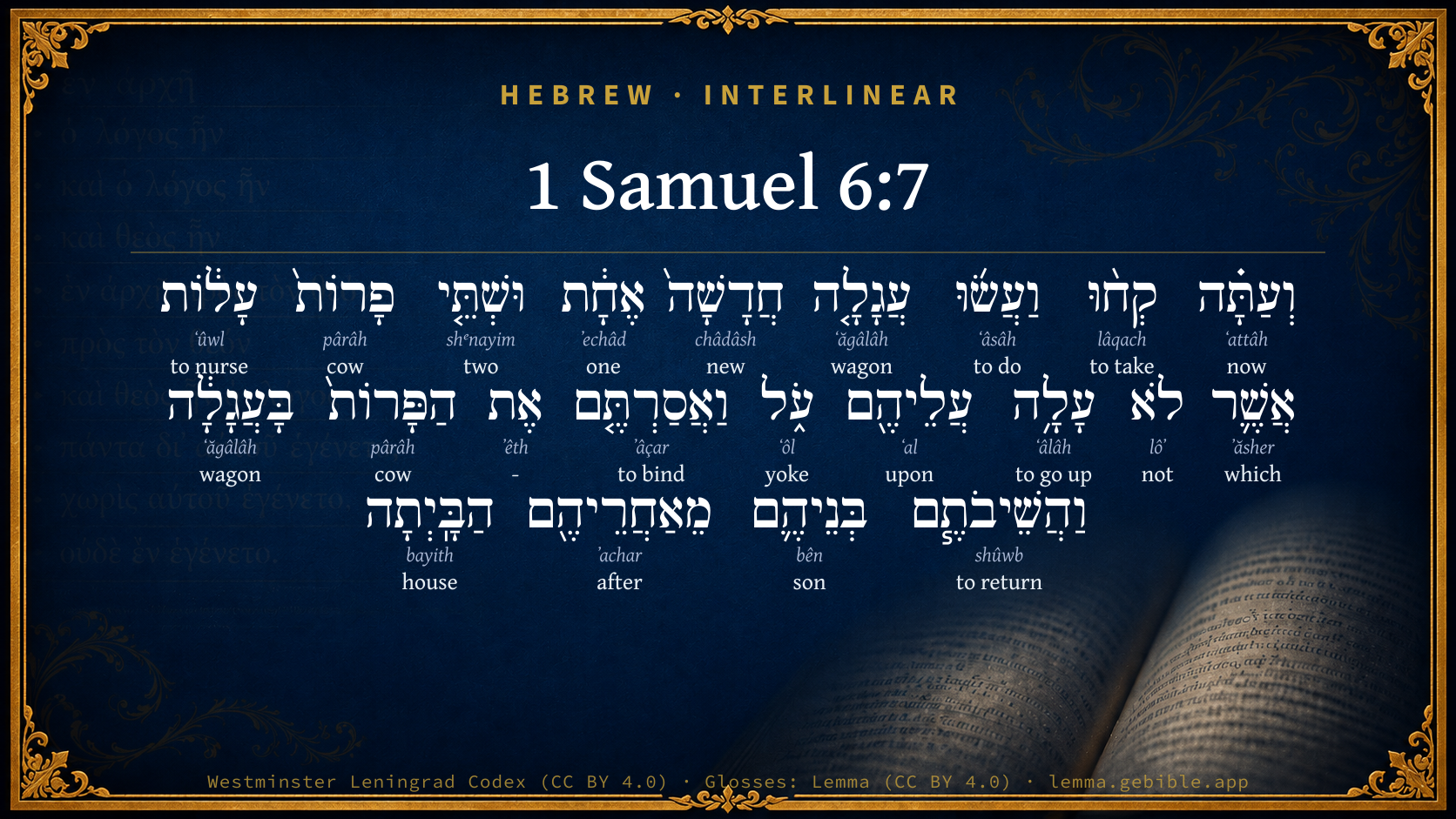
  1. וְעַתָּ֗ה ʻattâh H6258 “and · now” Conjunction + Adverb
  2. קְח֨וּ lâqach H3947 “take” Verb, Qal, Imperative, 2nd Person, Masculine, Plural
  3. וַעֲשׂ֜וּ ʻâsâh H6213 “and · do” Conjunction + Verb, Qal, Imperative, 2nd Person, Masculine, Plural
  4. עֲגָלָ֤ה ʻăgâlâh H5699 “wagon” Noun, Common, Feminine, Singular, Absolute
  5. חֲדָשָׁה֙ châdâsh H2319 “new” Adjective, Adjective, Feminine, Singular, Absolute
  6. אֶחָ֔ת ʼechâd H259 “one” Adjective, Cardinal number, Feminine, Singular, Absolute
  7. וּשְׁתֵּ֤י shᵉnayim H8147 “and · two” Conjunction + Adjective, Cardinal number, Feminine, Dual, Construct
  8. פָרוֹת֙ pârâh H6510 “cows” Noun, Common, Feminine, Plural, Absolute
  9. אֲשֶׁ֛ר ʼăsher H834 “which” Particle, Relative
  10. לֹא lôʼ H3808 “not” Particle, Negative
  11. עָלָ֥ה ʻâlâh H5927 “to go up” Verb, Qal, Perfect, 3rd Person, Masculine, Singular
  12. עֲלֵיהֶ֖ם ʻal H5921 “upon · them” Preposition + Suffix, Personal, 3rd Person, Masculine, Plural
  13. עֹ֑ל ʻôl H5923 “yoke” Noun, Common, Masculine, Singular, Absolute
  14. וַאֲסַרְתֶּ֤ם ʼâçar H631 “and · to bind” Conjunction + Verb, Qal, Sequential Perfect, 2nd Person, Masculine, Plural
  15. אֶת ʼêth H853 “-” Particle, Direct Object
  16. הַפָּרוֹת֙ pârâh H6510 “the · cows” Particle, Definite Article + Noun, Common, Feminine, Plural, Absolute
  17. בָּעֲגָלָ֔ה ʻăgâlâh H5699 “in/at the · wagon” Preposition, Determined + Noun, Common, Feminine, Singular, Absolute
  18. וַהֲשֵׁיבֹתֶ֧ם shûwb H7725 “and · to return” Conjunction + Verb, Hiphil, Sequential Perfect, 2nd Person, Masculine, Plural
  19. בְּנֵיהֶ֛ם bên H1121 “sons · their” Noun, Common, Masculine, Plural, Construct + Suffix, Personal, 3rd Person, Masculine, Plural
  20. מֵאַחֲרֵיהֶ֖ם ʼachar H310 “from · after · them” Preposition + Preposition + Suffix, Personal, 3rd Person, Masculine, Plural
  21. הַבָּֽיְתָה bayith H1004 “the · house · toward” Particle, Definite Article + Noun, Common, Masculine, Singular, Absolute + Suffix, Demonstrative

About this verse

These counts appear in no published source. They are computed here, from the morphology-tagged text and Lemma’s own curated glosses. What Lemma adds →

22
words
20
distinct lemmas
Historical
section

Notable vocabulary

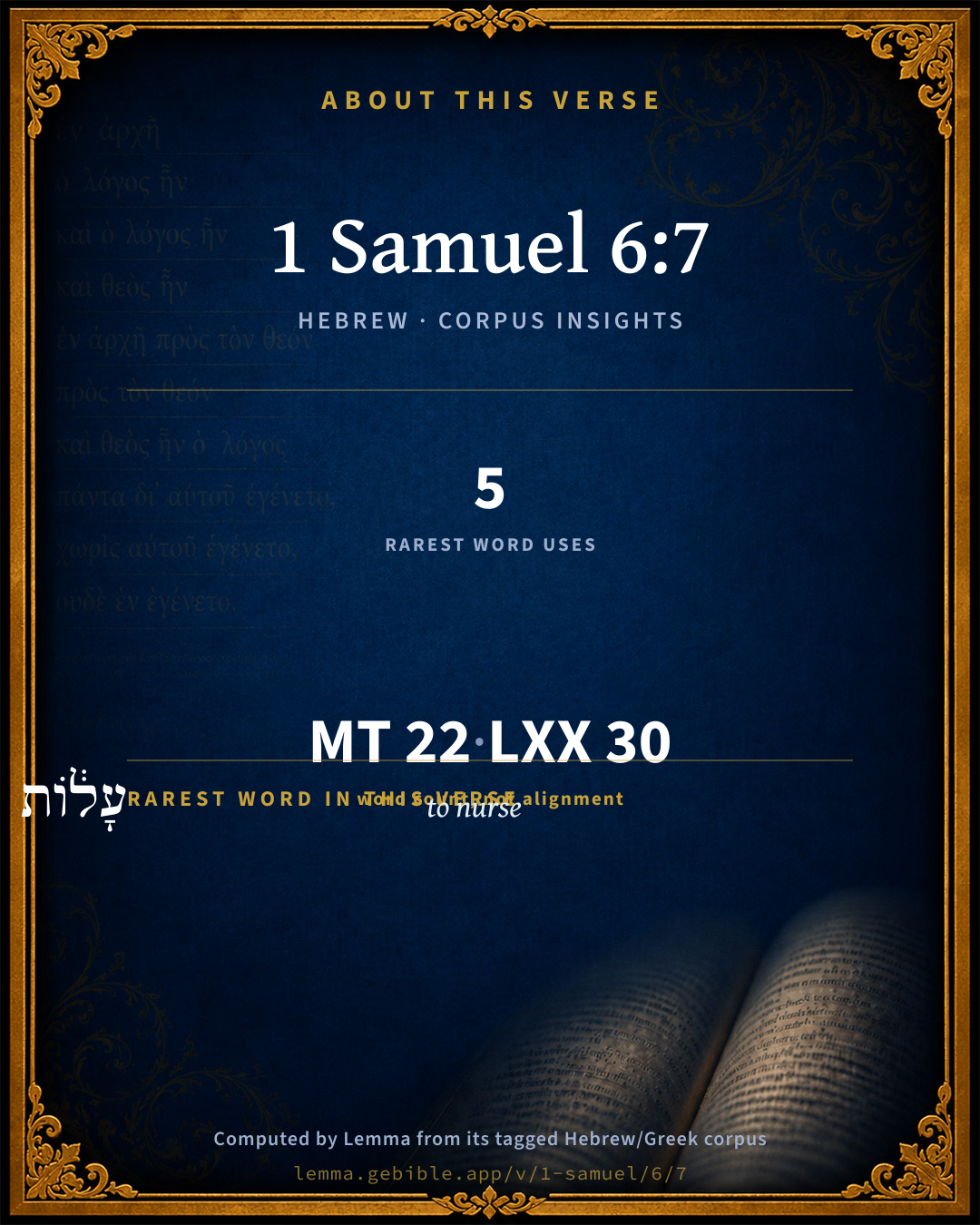
The rarest word here is עָל֔וֹת to nurse H5763 — appearing just 5 times in the whole Hebrew Bible.

Shared distinctive vocabulary

עָל֔וֹת to nurse H5763 occurs in 5 verses of the Hebrew Bible. Also found in:

Grammatical profile

  • 6 verbs
  • 7 nouns
  • 3 adjectives
  • 2 prepositions
  • 1 adverb
  • 3 particles

Verb forms

  • קְח֨וּ Qal · Imperative
  • וַעֲשׂ֜וּ Qal · Imperative
  • עָל֔וֹת Qal · Participle Active
  • עָלָ֥ה Qal · Perfect
  • וַאֲסַרְתֶּ֤ם Qal · Sequential Perfect
  • וַהֲשֵׁיבֹתֶ֧ם Hiphil · Sequential Perfect

Repetition

Words recur within this verse — often emphatic in Hebrew:

  • עֲגָלָ֤ה wagon H5699 ×2
  • פָרוֹת֙ cow H6510 ×2

Hebrew & Septuagint length

In English translation the verse runs 34 words from the Hebrew and 41 from the Septuagint (LXX English) — closely comparable.

A rough comparison of the two English renderings, which tokenize alike — not a word-level alignment.

Word counts can differ between the Hebrew and the Greek without any difference in meaning — e.g. the Hebrew direct-object marker אֵת has no separate Greek word, and Greek often adds the article ὁ.

In the original languages it is 22 Hebrew tokens and 30 Greek tokens — but the two are counted differently (Hebrew bundles its prefixes and suffixes into one token; the Greek is in lemma form), so that isn’t a like-for-like length.

Cross-references

3

Topical passages linked to 1 Samuel 6:7 in the Treasury of Scripture Knowledge — connected by theme and wording, ordered by reader-vote popularity; previews shown in the World English Bible.

  • Numbers 19:2 This is the statute of the law which Yahweh has commanded, saying, Speak to the children of Israel, that they bring you a red heifer without spot, in which is no blemish, [and] on which never came yoke.
  • 2 Samuel 6:3 They set the ark of God on a new cart, and brought it out of the house of Abinadab that was in the hill: and Uzzah and Ahio, the sons of Abinadab, drove the new cart.
  • 1 Chronicles 13:7 They carried the ark of God on a new cart, [and brought it] out of the house of Abinadab: and Uzza and Ahio drove the cart.

Cross-references courtesy of OpenBible.info (CC BY 4.0).

Hebrew and Greek witnesses Masoretic Hebrew ↔ Greek Septuagint

The same verse in the two great witnesses to the Old Testament, shown verse-for-verse.

These are two independent witnesses, not word-aligned to each other, and the Septuagint is shown in lemma (dictionary) form.

Hebrew 1 Samuel 6:7 Masoretic · Westminster Leningrad Codex

וְעַתָּ֗ה קְח֨וּ וַעֲשׂ֜וּ עֲגָלָ֤ה חֲדָשָׁה֙ אֶחָ֔ת וּשְׁתֵּ֤י פָרוֹת֙ עָל֔וֹת אֲשֶׁ֛ר לֹא עָלָ֥ה עֲלֵיהֶ֖ם עֹ֑ל וַאֲסַרְתֶּ֤ם אֶת הַפָּרוֹת֙ בָּעֲגָלָ֔ה וַהֲשֵׁיבֹתֶ֧ם בְּנֵיהֶ֛ם מֵאַחֲרֵיהֶ֖ם הַבָּֽיְתָה

Now therefore take and prepare yourselves a new cart, and two milk cattle, on which there has come no yoke; and tie the cattle to the cart, and bring their calves home from them;

World English Bible · Public Domain

Greek LXX 1 Samuel 6:7 Septuagint · lemma form

καί νῦν λαμβάνω καί ποιέω ἅμαξα καινός καί δύο βοῦς πρωτοτοκέω ἄνευ ὁ τέκνον καί ζευγνύω ὁ βοῦς ἐν ὁ ἅμαξα καί ἀποἄγω ὁ τέκνον ἀπό ὄπισθε αὐτός εἰς οἶκος

And now take wood and make a new wagon, and take two cows, that have calved for the first time, without their calves; and do you⌃ yoke the cows to the wagon, and lead away the calves from behind them home.

LXX2012 (modern English Septuagint) · Public Domain

Hebrew: Westminster Leningrad Codex (CC BY 4.0). Greek: Septuagint (public domain); English from LXX2012 (modern English Septuagint) (Public Domain). How the Septuagint differs from the Hebrew →

Targum (Aramaic paraphrase)

1

The Targum is the ancient Jewish Aramaic paraphrase of the Hebrew Scriptures — an interpretive translation, not the Hebrew text itself. Onkelos (literal) and Pseudo-Jonathan (expansive) render the Torah, and Jonathan the Prophets. Coverage is partial: where no permissively-licensed English translation exists for a verse, only the Aramaic is shown. This is verse-level text, not a word-by-word alignment to the Hebrew.

  1. Targum Jonathan Prophets (Joshua–Malachi)
    וּכְעַן סְבוּ וַעֲבִידוּ עֲגָלָתָא חַדְתָּא חֲדָא וְתַרְתֵּן תּוֹרָן מְיַנְקָן דִי לָא נְגַדָא בְּנִיר וְתֵיסְרוּן יַת תּוֹרָתָא בַּעֲגָלָתָא וּתְתִיבוּן בְּנֵיהֶן מִבַּתְרֵיהֶן לְגָיו:

    (no public-domain English translation for this verse)

    Targum Jonathan — Aramaic: “Mikraot Gedolot” (public domain). English: “Sefaria Community Translation” (CC0 1.0 (public-domain dedication)); “London "Chaldee Paraphrase," 1871” (public domain). Text via Sefaria.

Commentary

Notes on 1 Samuel 6:7 from classic Christian and Jewish commentators (each source and its license shown beneath its notes). The classic Christian expositions comment on the surrounding passage and are grouped to its opening verse, so a note may address several verses; the Jewish commentaries on the Tanakh (Rashi and others) are per-verse, so they appear only where the commentator wrote on this verse.

Lemma curates 59 commentaries, every one of them public domain or Creative Commons licensed, each selected and text-cleaned for this edition rather than reprinted as found. About our sources →

Trapp's Complete Commentary

John Trapp

1Sa 6:7 Now therefore make a new cart, and take two milch kine, on which there hath come no yoke, and tie the kine to the cart, and bring their calves home from them:

Ver. 7. Now therefore make a new cart.] For reverence to the ark, which the Philistines might cart: but if David, who should have known better, do so, as 2Sa 6:3, though it were a new cart, yet God made a breach upon him, because the ark was not carried as it ought, on the Levites’ shoulders.

On which there hath come no yoke.] Untamed and untrained, iuvencae petulcae, and therefore less likely to do that piece of service they were now to be put to. But God was the more seen in it, confuting his enemies by their own inventions.

And bring their calves home from them.] This made the miracle the greater, and the hand of God the more manifest, since they naturally longed after their calves, and would break through all, to come to them.

John Trapp, A Commentary or Exposition upon All the Books of the Old and New Testament (1647–1656) — public domain. Text from a community e-Sword module.

Joseph Benson's Commentary

1Sa 6:7. Make a new cart, &c. — It was in honour of the ark that they employed nothing about it that had ever served for any other use. And there was another reason for choosing such kine as are here mentioned; that it might be more manifest that they were led by the God of Israel, if they went directly into his country. For untamed heifers are apt to run back, or to wander, and keep no certain and constant paths, as oxen accustomed to the yoke do; and therefore were very unlikely to keep the direct road to the land of Israel. And the taking their calves from them would excite natural affection in them, and cause them rather to return home to their calves than to go into a strange country.

Joseph Benson's Commentary on the Old and New Testaments (1811–1818) — public domain. Text from a community e-Sword module.

Keil & Delitzsch

C. F. Keil & F. Delitzsch

Accordingly they arranged the sending back in such a manner as to manifest the reverence which ought to be shown to the God of Israel was a powerful deity (Sa1 6:7-9). The Philistines were to take a new cart and make it ready (עשׂה), and to yoke two milch cows to the cart upon which no yoke had ever come, and to take away their young ones (calves) from them into the house, i.e., into the stall, and then to put the ark upon the cart, along with the golden things to be presented as a trespass-offering, which were to be in a small chest by the side of the ark, and to send it (i.e., the ark) away, that it might go, viz., without the cows being either driven or guided. From the result of these arrangements, they were to learn whether the plague had been sent by the God of Israel, or had arisen accidentally. "If it (the ark) goeth up by the way to its border towards Bethshemesh, He (Jehovah) hath done us this great evil; but if not, we perceive that His hand hath not touched us. It came to us by chance," i.e., the evil came upon us merely by accident. In עליהם, בּניהם, and מאחריהם (Sa1 6:7), the masculine is used in the place of the more definite feminine, as being the more general form. This is frequently the case, and occurs again in Sa1 6:10 and Sa1 6:12. ארגּז, which only occurs again in Sa1 6:8, Sa1 6:11, and Sa1 6:15, signifies, according to the context and the ancient versions, a chest or little case. The suffix to אתו refers to the ark, which is also the subject to יעלה (Sa1 6:9). גּבוּלו, the territory of the ark, is the land of Israel, where it had its home. מקרה is used adverbially: by chance, or accidentally. The new cart and the young cows, which had never worn a yoke, corresponded to the holiness of the ark of God. To place it upon an old cart, which had already been used for all kinds of earthly purposes, would have been an offence against the holy thing; and it would have been just the same to yoke to the cart animals that had already been used for drawing, and had had their strength impaired by the yoke (see Deu 21:3). The reason for selecting cows, however, instead of male oxen, was no doubt to be found in the further object which they hoped to attain. It was certainly to be expected, that if suckling cows, whose calves had been kept back from them, followed their own instincts, without any drivers, they would not go away, but would come back to their young ones in the stall. And if the very opposite should take place, this would be a sure sign that they were driven and guided by a divine power, and in fact by the God whose ark they were to draw into His own land. From this they would be able to draw the conclusion, that the plagues which had fallen upon the Philistines were also sent by this God. There was no special sagacity in this advice of the priests; it was nothing more than a cleverly devised attempt to put the power of the God of the Israelites to the text, though they thereby unconsciously and against their will furnished the occasion for the living God to display His divine glory before those who did not know Him.

Keil & Delitzsch — Biblical Commentary on the Old Testament (1861–1891) — public domain (CC PDM 1.0). Text via the HelloAO Bible API. (Old Testament only.)

Tyndale Open Study Notes

Tyndale Open Resources

6:7 shut their calves away: If the cows went against their maternal nature and left their calves to take the Ark to Israel, it would prove that the plague was from Israel’s God (6:9).

Tyndale Open Study Notes — © Tyndale Open Resources, licensed CC BY-SA 4.0. Text via the HelloAO Bible API.

Jamieson, Fausset & Brown

Robert Jamieson, A. R. Fausset & David Brown

make a new cart--Their object in making a new one for the purpose seems to have been not only for cleanliness and neatness, but from an impression that there would have been an impropriety in using one that had been applied to meaner or more common services. It appears to have been a covered wagon (see on Sa2 6:3).

two milch kine--Such untrained heifers, wanton and vagrant, would pursue no certain and regular path, like those accustomed to the yoke, and therefore were most unlikely of their own spontaneous motion to prosecute the direct road to the land of Israel.

bring their calves home from them--The strong natural affection of the dams might be supposed to stimulate their return homewards, rather than direct their steps in a foreign country.

Jamieson, Fausset & Brown — Commentary Critical and Explanatory on the Whole Bible (1871) — public domain (CC PDM 1.0). Text via the HelloAO Bible API.

Adam Clarke's Commentary

Verse 7. Make a new cart] It was indecent and improper to employ in any part of the worship of God any thing that had before served for a common purpose. Every thing in the worship of God is said to be sanctified: now the general meaning of that word is, to separate a thing from all earthly and common uses, and devote it solely to the service of God.

When David removed the ark from the house of Abinadab, he put it on a new cart, 2Sa 6:3.

Bring their calves home from them] So it appears that their calves had been with them in the fields. This was a complete trial: unless they were supernaturally influenced, they would not leave their calves; unless supernaturally directed, they would not leave their home, and take a way unguided, which they had never gone before.

Adam Clarke's Commentary on the Bible (1810–1826) — public domain. Text from a community e-Sword/MySword module.

Ellicott's Commentary for English Readers

(7) Now therefore make a new cart.—The note here in the Speaker’s Commentary is interesting. “This was so ordered in reverence to the Ark, and was a right and true feeling. (See Num_19:2; 2Sa_6:3.) So our Lord rode on an ass ‘whereon never man sat’ (Mar_11:2), and His holy body was laid in Joseph’s ‘new tomb, wherein never man before was laid’ (Mat_27:60; Luk_23:53). For the supposed peculiar virtue of new things, see Jdg_16:7-11.”

A Bible Commentary for English Readers, edited by Charles John Ellicott (1878–1897) — public domain. Text from a community e-Sword module.

The Cambridge Bible for Schools and Colleges

gen. ed. J. J. S. Perowne

7. Now therefore make, &c.] Heb. “And now take and make a new cart” = set to work to make. Cp. 2Sa_18:18. The use of a new cart (cp. 2Sa_6:3) and unyoked kine (Num_19:2; Deu_21:3-4) was a natural mark of reverence.

The Cambridge Bible for Schools and Colleges (gen. ed. J. J. S. Perowne; Cambridge University Press, 1878–1918) — public domain. Text from a community e-Sword module.

John Gill's Exposition

Now therefore make a new cart,.... For there were no Levites, nor priests of the Lord to carry it upon their shoulders, as it was wont to be when carried, and therefore they ordered a cart to be made; and they might know the Levites were allowed wagons to carry some of their sacred things on, Num 7:1 and a new one for the honour of the ark, as David afterwards did, Sa2 6:3.

and take two milch kine, on which there hath come no yoke; which also might be designed for the honour of the ark; but there was a further view in it, at least in the providence of God; since two such creatures, who had young, would be apt, if left to themselves, as these were, to return home to them, and not to proceed on a journey; and being unaccustomed to a yoke, would draw one way, and another another, in different ways; and not go on in a direct road, as such that are used to the yoke do:

and tie the kine to the cart; in order to draw it:

and bring their calves home from them; that they might not cry after them, which would cause them to turn back.

John Gill's Exposition of the Whole Bible (1746–1763) — public domain (CC PDM 1.0). Text via the HelloAO Bible API.

Albert Barnes' Notes on the Bible

A new cart ... kine on which there hath come no yoke - This was so ordered in reverence to the ark, and was a right and true feeling. See Mar 11:2; Mat 27:60. For the supposed special virtue of new things, see Jdg 16:7, Jdg 16:11.

Albert Barnes' Notes on the Bible (1834–1885) — public domain. Text from a community e-Sword/MySword module.

Haydock's Catholic Bible Commentary

New cart. It would have been deemed irreverent to use one that had been employed for other profane purposes, 2 Kings vi. 3. --- Home. All these circumstances tended to prevent the ark from being conveyed home, (Calmet) unless Providence interfered.

George Leo Haydock (1774–1849), Haydock's Catholic Family Bible and Commentary, 1859 edition — public domain. Excludes Psalms (Douay-Rheims chapter numbering differs from Protestant) and Deuterocanonical books (Catholic canon only).

Matthew Poole's English Annotations

Make a new cart; as David did for the same use, 2Sa 6:3, in reverence to the ark.

On which there hath come no yoke; partly in respect to the ark, and partly for the better discovery, because such untamed heifers are wanton, and apt to wander, and keep no certain and constant paths, as oxen accustomed to the yoke do, and therefore were most unlikely to keep the direct road to Israel’s land.

Bring their calves home from them; which would stir up natural affection in their dams, and cause them rather to return home, than to go to a strange country.

Matthew Poole's English Annotations on the Holy Bible (1683–1685) — public domain. Text from a community e-Sword/MySword module.

Whedon's Commentary on the Bible

Daniel D. Whedon

7. A new cart — Compare 2Sa_6:3. An old vehicle, or one used for meaner purposes, would not accord with the sacredness of the ark.

Two milch kine, (cows,) on which… no yoke — And therefore not likely, in the natural course of things, to be at once docile and tractable.

Bring their calves home from them — Which would add still more to the difficulty of drawing them away from their own fields.

Daniel D. Whedon (gen. ed.), Commentary on the Old and New Testaments (1874–1909) — public domain. Text from a community e-Sword module.

The Pulpit Commentary

Make a new cart, and take, etc. The Hebrew is, "Now take and make you a new cart, and two milch kine." The transposition of the A.V throws undue stress upon the verb make, whereas the Hebrew simply means that both the cart was to be new, and the heifers untrained and unbroken to the yoke. Both these were marks of reverence. Nothing was to be employed in God"s service which had been previously used for baser purposes. (comp. Mar_11:2) No animal was deemed fit for sacrifice which had laboured in the field. The separation of the kine from their calves was for the purpose of demonstrating whether the plague after all was supernatural, and it is remarkable what great care the Philistine priests take against confounding the extraordinary with the Divine. If, however, the kine act in a manner contrary to nature, their last doubt will be removed.

The Pulpit Commentary (1880–1919), ed. H.D.M. Spence-Jones & Joseph S. Exell — public domain. Text from a community e-Sword module.

John Wesley's Explanatory Notes

Milch kine, &c. - In respect to the ark; and for the better discovery, because such untamed heifers are apt to wander, and keep no certain and constant paths, as oxen accustomed to the yoke do, and therefore were most unlikely to keep the direct road to Israel's land. From them - Which would stir up natural affection in their dams, and cause them rather to return home, than to go to a strange country.

John Wesley, Explanatory Notes Upon the Whole Bible (1754–1765) — public domain. Text via the GEBible commentary corpus.

unfoldingWord translationNotes

Door43 World Missions Community

two nursing cows

"two cows that have calves that are still drinking milk"

Then send it off and let it go its own way

Normally the two cows would head back home to their calves.

if it goes ... to Beth Shemesh, then it is Yahweh

It is unlikely that the cows would choose to wander to Beth Shemesh when their calves are back in the Philistine area.

translationWords

cow

yoke

ark of the covenant

Yahweh

Beth Shemesh

unfoldingWord translationNotes — © Distant Shores Media and the Door43 World Missions Community, licensed CC BY-SA 4.0. Source: git.door43.org/Door43/en_tn.

Rashi

Rabbi Shlomo Yitzchaki (Rashi)

Nursing cows. Nursing.

Which have not borne a yoke. All this is for the test. Since these cows are not capable of pulling [a load], and furthermore, they will yearn for their young. If the Ark will have the power to enable them to pull it by themselves, we shall know that He brought this upon us.

Rashi on the Tanakh — English translations: “The Judaica Press complete Tanach with Rashi, translated by A. J. Rosenberg” (CC BY 4.0); “Pentateuch with Rashi's commentary by M. Rosenbaum and A.M. Silbermann, 1929-1934” (public domain); “The Metsudah Tanach series, Lakewood, N.J” (CC BY 4.0); and “The Book of Joshua, Metsudah Publications, 1997” (CC BY 4.0). Text via Sefaria.

Lesson kit

Teaching starters — assembled from the data on this page, not authored interpretation. Every prompt links to the verse data it draws on. Edit before teaching.

1 Samuel, in the Historical, opens this verse with 22 words (20 distinct Hebrew lemmas). Its most distinctive word is ʻûwl (“to nurse”). A historical commentator’s framing appears above. Read the whole chapter for the surrounding context.

Discussion questions

  1. How does “to nurse” (ʻûwl) shape what this verse is saying?
  2. How does Genesis 33:13, which shares the word «to nurse», read alongside this verse?
  3. What does the repetition of “wagon” (2× in this one verse) do in this verse?
  4. The translations on this page render this verse differently — a whole-verse word diff, not a word-by-word alignment. What might account for the different wordings?
  5. «קְח֨וּ» is a Qal Imperative verb. How does that grammatical form shape the action described?
  6. Compare how Trapp's Complete Commentary and Joseph Benson's Commentary read this verse. Where do they agree or differ?

Things to notice

Reading settings

Reading text

Shown beneath each verse's original-language words.

Old Testament
Old Testament edition

Read the OT as the Masoretic Hebrew (MT) or the Greek Septuagint (LXX).

English shown for the Greek Septuagint (in the Hebrew ↔ Greek comparison).

Comparing translations? Open the Compare panel on any verse page to stack up to four side by side.