
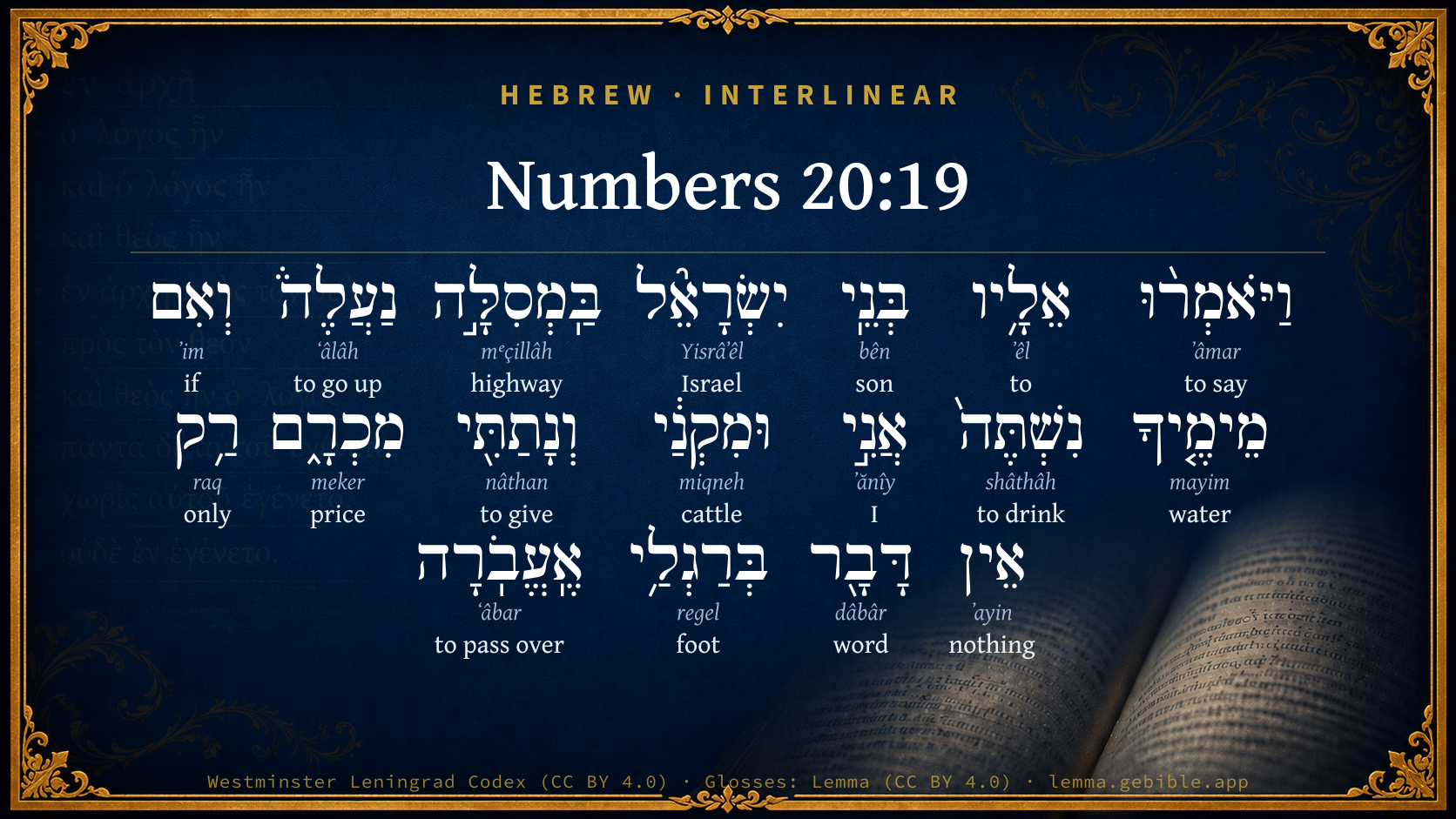
Numbers 20:19

Hebrew (Westminster Leningrad Codex) Numbers 20:19 appears in the Hebrew Old Testament. The text above is from the Westminster Leningrad Codex. Each word links to its Strong’s number, a concise gloss, and parsing drawn from the Open Scriptures Hebrew Bible morphology. Click any word for its full Brown-Driver-Briggs (BDB) entry.
Download image
Cite this verse

Numbers 20:19 (World English Bible). Public Domain. Lemma interlinear Bible study tool, https://lemma.gebible.app/v/numbers/20/19.

Show BibTeX & RIS
BibTeX
RIS
English Translation
The children of Israel said to him, We will go up by the highway; and if we drink of your water, I and my cattle, then will I give the price of it: let me only, without [doing] anything [else], pass through on my feet.
World English Bible · Public Domain
Highlights
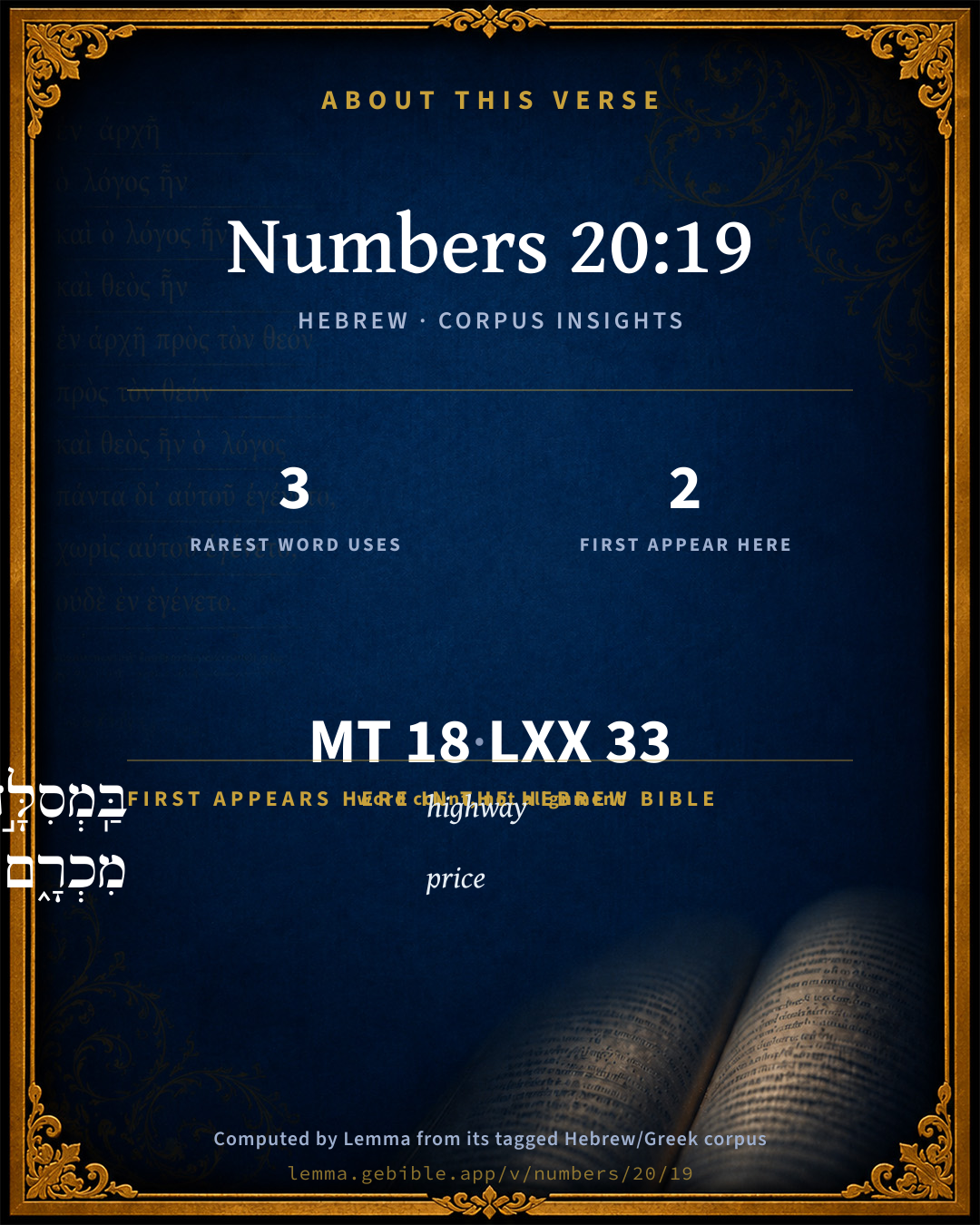
  • 2 first appearances in the Hebrew Bible
Full analysis ↓
Download a study sheet

One document with this verse’s original text, its word-by-word gloss line, the meaning frame, cross-references with their text, attributed commentary, and full source and license credits — printable, and it pastes into notes with its structure intact.

This verse Autodidact and up

Study sheet (.html) Plain text (.txt)

A passage Seminary Student

Up to 50 verses in one chapter. A passage sheet keeps up to 6 commentary sources and 12 cross-references per verse, in the order this page ranks them, and says so on the sheet whenever that leaves anything out. Ask for a single verse and you get the Autodidact verse sheet above.

Everything on this page stays free to read, with no account — the sheet is a download of what is already on screen, not access to it.

Want to remove ads? Support Godless Engineer
Compare translations 3

The same verse in 3 English versions, stacked beneath the original-language interlinear above. Click any original word for its lexicon entry.

Each is an independent rendering of the whole verse — the interlinear is not word-aligned to these translations.

Highlighted words mark where these versions differ — a whole-verse word diff, not a word-by-word alignment.

  • World English Bible Public Domain
    The children of Israel said to him, We will go up by the highway; and if we drink of your water, I and my cattle, then will I give the price of it: let me only, without [doing] anything [else], pass through on my feet.
  • King James Version Public Domain
    And the children of Israel said unto him, We will go by the high way: and if I and my cattle drink of thy water, then I will pay for it: I will only, without doing anything else, go through on my feet.
  • unfoldingWord Literal Text CC BY-SA 4.0
    And the sons of Israel said to him, “On the highway we will go up. And if we drink your water, I and my livestock, then I will give its price. Only, is no matter, let me pass over on my feet.”

unfoldingWord Literal Text — © unfoldingWord, licensed CC BY-SA 4.0. Word-aligned USFM3 via Door43 (git.door43.org/unfoldingWord/en_ult).

Versions to compare (up to 4)

3 of 4 selected

Show all 18 translations

Every available English version of this verse, each an independent rendering of the whole verse.

  • World English Bible Public Domain
    The children of Israel said to him, We will go up by the highway; and if we drink of your water, I and my cattle, then will I give the price of it: let me only, without [doing] anything [else], pass through on my feet.
  • Berean Standard Bible Public Domain
    “We will stay on the main road,” the Israelites replied, “and if we or our herds drink your water, we will pay for it. There will be no problem; only let us pass through on foot.”
  • Majority Standard Bible Public Domain
    “We will stay on the main road,” the Israelites replied, “and if we or our herds drink your water, we will pay for it. There will be no problem; only let us pass through on foot.”
  • King James Version Public Domain
    And the children of Israel said unto him, We will go by the high way: and if I and my cattle drink of thy water, then I will pay for it: I will only, without doing anything else, go through on my feet.
  • American Standard Version (1901) Public Domain
    And the children of Israel said unto him, We will go up by the highway; and if we drink of thy water, I and my cattle, then will I give the price thereof: let me only, without `doing' anything `else', pass through on my feet.
  • Revised Version (1885) Public Domain
    And the children of Israel said unto him, We will go up by the highway: and if we drink of thy water, I and my cattle, then will I give the price thereof: let me only, without doing any thing else, pass through on my feet.
  • Geneva Bible (1599) Public Domain
    Then the children of Israel said vnto him, We will goe vp by the hie way: and if I and my cattell drinke of thy water, I will then pay for it: I will onely (without any harme) goe through on my feete.
  • Douay-Rheims (1899) Public Domain
    And the children of Israel said: We will go by the beaten way: and if we and our cattle drink of thy waters, we will give thee what is just: there shall be no difficulty in the price, only let us pass speedily.
  • Young's Literal Translation Public Domain
    And the sons of Israel say unto him, `In the highway we go, and if of thy waters we drink -- I and my cattle -- then I have given their price; only (it is nothing) on my feet I pass over.'
  • Literal Standard Version CC BY-SA 4.0
    And the sons of Israel say to him, “We go in the highway, and if we drink of your waters—I and my livestock—then I have given their price; only, let me pass over on my feet, nothing [more].”
  • Unlocked Literal Bible CC BY-SA 4.0
    Then the people of Israel said to him, “We will go along the highway. If we or our livestock drink your water, we will pay for it. Just let us walk through on foot, without doing anything else.”
  • unfoldingWord Literal Text CC BY-SA 4.0
    And the sons of Israel said to him, “On the highway we will go up. And if we drink your water, I and my livestock, then I will give its price. Only, is no matter, let me pass over on my feet.”
  • Darby Bible Public Domain
    And the children of Israel said to him, We will go by the high way; and if we drink of thy water, I and my cattle, then I will pay for it: I will only, without anything else, go through on my feet.
  • World Messianic Bible Public Domain
    The children of Israel said to him, “We will go up by the highway; and if we drink your water, I and my livestock, then I will give its price. Only let me, without doing anything else, pass through on my feet.”
  • Webster's Bible Public Domain
    And the children of Israel said to him, We will go by the highway: and if I and my cattle drink of thy water, then I will pay for it: I will only, without doing any thing else, go through on my feet.
  • Free Bible Version CC BY-SA 4.0
    “We'll keep to the main road,” the Israelites persisted. “If we or our livestock drink your water, we'll pay you for it. That's all we want—just to pass through on foot.”
  • Bible in Basic English Public Domain
    And the children of Israel said to him, We will go up by the highway: and if we or our cattle take of your water, we will give you a price for it: only let us go through on our feet, nothing more.
  • JPS Tanakh (1917) Public Domain
    And the children of Israel said unto him: 'We will go up by the highway; and if we drink of thy water, I and my cattle, then will I give the price thereof; let me only pass through on my feet; there is no hurt.'

Literal Standard Version (2020), Covenant Press — licensed CC BY-SA 4.0. Text via the HelloAO Bible API (eBible.org). Unlocked Literal Bible (unfoldingWord) — licensed CC BY-SA 4.0. Text via the HelloAO Bible API (eBible.org). unfoldingWord Literal Text — © unfoldingWord, licensed CC BY-SA 4.0. Word-aligned USFM3 via Door43 (git.door43.org/unfoldingWord/en_ult). Free Bible Version, Dr. Jonathan Gallagher — licensed CC BY-SA 4.0. Text via the HelloAO Bible API (eBible.org).

Word by word

More ways to search: Search by grammar → Find every occurrence → Compare this word →

Practice this passage: Drill this verse → Learn its vocabulary →

מִכְרָ֑ם
meker
H4377
“price · their”
Noun, Common, Masculine, Singular, Construct + Suffix, Personal, 3rd Person, Masculine, Plural
Part of Speech
Noun
Type
Common
Gender
Masculine
Number
Singular
State
Construct
Full BDB Definition

Origin: from H4376

TWOT: 1194a

merchandise, value, price
  1. וַיֹּאמְר֨וּ ʼâmar H559 “and · to say” Conjunction + Verb, Qal, Sequential Imperfect, 3rd Person, Masculine, Plural
  2. אֵלָ֥יו ʼêl H413 “to · him” Preposition + Suffix, Personal, 3rd Person, Masculine, Singular
  3. בְּנֵֽי bên H1121 “sons of” Noun, Common, Masculine, Plural, Construct
  4. יִשְׂרָאֵ֘ל Yisrâʼêl H3478 “Israel” Noun, Proper
  5. בַּֽמְסִלָּ֣ה mᵉçillâh H4546 “in/at the · highway” Preposition, Determined + Noun, Common, Feminine, Singular, Absolute
  6. נַעֲלֶה֒ ʻâlâh H5927 “to go up” Verb, Qal, Imperfect, 1st Person, Common, Plural
  7. וְאִם ʼim H518 “and · if” Conjunction + Conjunction
  8. מֵימֶ֤יךָ mayim H4325 “water(s) · your” Noun, Common, Masculine, Plural, Construct + Suffix, Personal, 2nd Person, Masculine, Singular
  9. נִשְׁתֶּה֙ shâthâh H8354 “to drink” Verb, Qal, Imperfect, 1st Person, Common, Plural
  10. אֲנִ֣י ʼănîy H589 “I” Pronoun, Personal, 1st Person, Common, Singular
  11. וּמִקְנַ֔י miqneh H4735 “and · cattle · my” Conjunction + Noun, Common, Masculine, Plural, Construct + Suffix, Personal, 1st Person, Common, Singular
  12. וְנָתַתִּ֖י nâthan H5414 “and · to give” Conjunction + Verb, Qal, Sequential Perfect, 1st Person, Common, Singular
  13. רַ֥ק raq H7535 “only” Particle, Accusative
  14. אֵין ʼayin H369 “nothing” Particle, Negative
  15. דָּבָ֖ר dâbâr H1697 “word” Noun, Common, Masculine, Singular, Absolute
  16. בְּרַגְלַ֥י regel H7272 “in/at · feet · my” Preposition + Noun, Common, Feminine, Dual, Construct + Suffix, Personal, 1st Person, Common, Singular
  17. אֶֽעֱבֹֽרָה ʻâbar H5674 “to pass over” Verb, Qal, Cohortative, 1st Person, Common, Singular

About this verse

These counts appear in no published source. They are computed here, from the morphology-tagged text and Lemma’s own curated glosses. What Lemma adds →

18
words
18
distinct lemmas
Pentateuch
section

Notable vocabulary

The rarest word here is מִכְרָ֑ם price H4377 — appearing just 3 times in the whole Hebrew Bible.

First appearance in Scripture

These words make their first canonical appearance in the Hebrew Bible here:

  • בַּֽמְסִלָּ֣ה highway H4546
  • מִכְרָ֑ם price H4377

Shared distinctive vocabulary

מִכְרָ֑ם price H4377 occurs in 3 verses of the Hebrew Bible. Also found in:

Grammatical profile

  • 5 verbs
  • 8 nouns
  • 1 pronoun
  • 1 preposition
  • 1 conjunction
  • 2 particles

Verb forms

  • וַיֹּאמְר֨וּ Qal · Sequential Imperfect
  • נַעֲלֶה֒ Qal · Imperfect
  • נִשְׁתֶּה֙ Qal · Imperfect
  • וְנָתַתִּ֖י Qal · Sequential Perfect
  • אֶֽעֱבֹֽרָה Qal · Cohortative

Hebrew & Septuagint length

In English translation the verse runs 45 words from the Hebrew and 41 from the Septuagint (LXX English) — closely comparable.

A rough comparison of the two English renderings, which tokenize alike — not a word-level alignment.

Word counts can differ between the Hebrew and the Greek without any difference in meaning — e.g. the Hebrew direct-object marker אֵת has no separate Greek word, and Greek often adds the article ὁ.

In the original languages it is 18 Hebrew tokens and 33 Greek tokens — but the two are counted differently (Hebrew bundles its prefixes and suffixes into one token; the Greek is in lemma form), so that isn’t a like-for-like length.

Cross-references

3

Topical passages linked to Numbers 20:19 in the Treasury of Scripture Knowledge — connected by theme and wording, ordered by reader-vote popularity; previews shown in the World English Bible.

  • Deuteronomy 2:28 You shall sell me food for money, that I may eat; and give me water for money, that I may drink: only let me pass through on my feet,
  • Deuteronomy 2:6 You shall purchase food of them for money, that you may eat; and you shall also buy water of them for money, that you may drink.
  • Exodus 12:38 A mixed multitude went up also with them, with flocks, herds, and even very much cattle.

Cross-references courtesy of OpenBible.info (CC BY 4.0).

Hebrew and Greek witnesses Masoretic Hebrew ↔ Greek Septuagint

The same verse in the two great witnesses to the Old Testament, shown verse-for-verse.

These are two independent witnesses, not word-aligned to each other, and the Septuagint is shown in lemma (dictionary) form.

Hebrew Numbers 20:19 Masoretic · Westminster Leningrad Codex

וַיֹּאמְר֨וּ אֵלָ֥יו בְּנֵֽי יִשְׂרָאֵ֘ל בַּֽמְסִלָּ֣ה נַעֲלֶה֒ וְאִם מֵימֶ֤יךָ נִשְׁתֶּה֙ אֲנִ֣י וּמִקְנַ֔י וְנָתַתִּ֖י מִכְרָ֑ם רַ֥ק אֵין דָּבָ֖ר בְּרַגְלַ֥י אֶֽעֱבֹֽרָה

The children of Israel said to him, We will go up by the highway; and if we drink of your water, I and my cattle, then will I give the price of it: let me only, without [doing] anything [else], pass through on my feet.

World English Bible · Public Domain

Greek LXX Numbers 20:19 Septuagint · lemma form

καί λέγω αὐτός ὁ υἱός ἰσραήλ παρά ὁ ὄρος παραἔρχομαι ἐάν δέ ὁ ὕδωρ σύ πίνω ἐγώ τε καί ὁ κτῆνος δίδωμι τιμή σύ ἀλλά ὁ πρᾶγμα οὐδείς εἰμί παρά ὁ ὄρος παραἔρχομαι

And the children of Israel say to him, We will pass by the mountain; and if I and my cattle drink of your water, I will pay you: but it is no matter of importance, we will go by the mountain.

LXX2012 (modern English Septuagint) · Public Domain

On this verse, Haydock's Catholic Bible Commentary discusses the Septuagint’s reading. Read the note in Commentary ↓

Hebrew: Westminster Leningrad Codex (CC BY 4.0). Greek: Septuagint (public domain); English from LXX2012 (modern English Septuagint) (Public Domain). How the Septuagint differs from the Hebrew →

Targum (Aramaic paraphrase)

2

The Targum is the ancient Jewish Aramaic paraphrase of the Hebrew Scriptures — an interpretive translation, not the Hebrew text itself. Onkelos (literal) and Pseudo-Jonathan (expansive) render the Torah, and Jonathan the Prophets. Coverage is partial: where no permissively-licensed English translation exists for a verse, only the Aramaic is shown. This is verse-level text, not a word-by-word alignment to the Hebrew.

  1. Targum Onkelos Torah (Genesis–Deuteronomy)
    וַאֲמָרוּ לֵיהּ בְּנֵי יִשְׂרָאֵל בְּאֹרַח כְּבִישָׁא נִסַק וְאִם מֵימַךְ נִשְׁתֵּי אֲנָא וּבְעִירַי וְאֶתֵּן דְמֵיהוֹן לְחוֹד לֵית פִּתְגַם דְבִישׁ בְּרַגְלַי אֵעִיבַּר

    (no public-domain English translation for this verse)

    Targum Onkelos — Aramaic: “Onkelos Genesis” (public domain); “Onkelos Exodus” (public domain); “Onkelos Leviticus” (public domain); “Onkelos Numbers” (public domain); “Onkelos Deuteronomy” (public domain). English: “Sefaria Community Translation” (CC0 1.0 (public-domain dedication)); “J.W. Etheridge. The Targums of Onkelos and Jonathan Ben Uzziel on the Pentateuch. London: Longmans, Green, 1862” (public domain). Text via Sefaria.

  2. Targum Pseudo-Jonathan Torah (Genesis–Deuteronomy)
    וַאֲמָרוּ לֵיהּ בְּנֵי יִשְרָאֵל בְּאִסְטַרְטַיָא דְמַלְכָּא נֵיזֵיל אִין מַיִיךְ נִשְׁתֵּי אֲנָא וּבְעִירֵי וְאֵיתֵּן דְמֵי מֵימְהוֹן לְחוֹד לֵית פִּתְגַם דְבִישׁ בִּלְחוֹדִי אֲעִיבַר

    And Israel said to him, We would go by the king's highway; if we drink thy waters, I and my cattle, I will give thee the price of their value. I will only pass through, without doing wrong.

    Targum Pseudo-Jonathan — Aramaic: “Targum Jonathan on Genesis” (public domain); “Targum Jonathan on Exodus” (public domain); “Targum Jonathan on Leviticus” (public domain); “Targum Jonathan on Numbers” (public domain); “Targum Jonathan on Deuteronomy” (public domain). English: “The Targum of Jonathan ben Uzziel, trans. J. W. Etheridge, London, 1862” (public domain). Text via Sefaria.

Commentary

Notes on Numbers 20:19 from classic Christian and Jewish commentators (each source and its license shown beneath its notes). The classic Christian expositions comment on the surrounding passage and are grouped to its opening verse, so a note may address several verses; the Jewish commentaries on the Tanakh (Rashi and others) are per-verse, so they appear only where the commentator wrote on this verse.

Lemma curates 59 commentaries, every one of them public domain or Creative Commons licensed, each selected and text-cleaned for this edition rather than reprinted as found. About our sources →

Jamieson, Fausset & Brown

Robert Jamieson, A. R. Fausset & David Brown

if I and my cattle drink of thy water, then I will pay for it--From the scarcity of water in the warm climates of the East, the practice of levying a tax for the use of the wells is universal; and the jealousy of the natives, in guarding the collected treasures of rain, is often so great that water cannot be procured for money.

Jamieson, Fausset & Brown — Commentary Critical and Explanatory on the Whole Bible (1871) — public domain (CC PDM 1.0). Text via the HelloAO Bible API.

Ellicott's Commentary for English Readers

(19) I will only, without doing anything else . . . —Literally, Only—it is nothing—let me pass through on my feet.

A Bible Commentary for English Readers, edited by Charles John Ellicott (1878–1897) — public domain. Text from a community e-Sword module.

The Cambridge Bible for Schools and Colleges

gen. ed. J. J. S. Perowne

19. without doing anything else] lit. ‘it is not a matter’; i.e. it is not a matter that can cause you any injury or annoyance; it is a mere nothing that we ask.

The Cambridge Bible for Schools and Colleges (gen. ed. J. J. S. Perowne; Cambridge University Press, 1878–1918) — public domain. Text from a community e-Sword module.

John Gill's Exposition

And he said, thou shall not go through,.... Which is an absolute and peremptory denial:

and Edom came out against him with much people, and with a strong hand; the king raised the militia of his country, and came at the head of a powerful army to hinder their passing into it; being fearful and jealous, lest such a large body as they were should seize on his country, or spoil it, not relying on their promises; and this might arise also from the old grudge of Esau against Jacob, and which continued in his posterity, and might now be revived upon their going to Canaan to possess the earthly blessing conferred on Jacob and his seed: however, it seems, though the Edomites would not let Israel pass through their country, yet they furnished them with food and drink for their money, Deu 2:28.

John Gill's Exposition of the Whole Bible (1746–1763) — public domain (CC PDM 1.0). Text via the HelloAO Bible API.

Haydock's Catholic Bible Commentary

Price. Hebrew, "I will only do one thing, walk through." Septuagint, "the matter is of no consequence, we go by the mountain." Louis de Dieu translates, "It is not indeed a word, (or idle pretence) I will pass through on foot."

George Leo Haydock (1774–1849), Haydock's Catholic Family Bible and Commentary, 1859 edition — public domain. Excludes Psalms (Douay-Rheims chapter numbering differs from Protestant) and Deuterocanonical books (Catholic canon only).

Matthew Poole's English Annotations

Children of Israel said unto him, i.e. their messengers replied unto them what here follows.

I will pay for it; for water was a scarce commodity in those parts.

Matthew Poole's English Annotations on the Holy Bible (1683–1685) — public domain. Text from a community e-Sword/MySword module.

Whedon's Commentary on the Bible

Daniel D. Whedon

19. The high way — A causeway or raised way, as the single term signifies in the Hebrew. It is the same as the king’s way in Num_20:17, and was probably a road used for military purposes. See Mat_3:3, note. The Seventy render it, “We will pass along the mountains.”

Water… pay for — Says Dr. Thomson: “Water is often difficult to be had either for love or money. A friend of mine informed me, that passing through a part of the country east of the Jordan in the autumn, he could barely secure water absolutely necessary for his animals; and the article was so precious that all washing, even of his own face, was dispensed with for several days.”

Go through on my feet — The Vulgate, “Only let us go through swiftly.” They would make no encampment nor incur needless delay.

Daniel D. Whedon (gen. ed.), Commentary on the Old and New Testaments (1874–1909) — public domain. Text from a community e-Sword module.

The Pulpit Commentary

And the children of Israel said, i.e., probably, the messengers sent by Moses. By the highway. hLsimB. The Septuagint translates para to orov , but no doubt the word means a "high road" in the original sense of a raised causeway. (cf. Isa_57:14) Such a road is still called Derb es Sultan Emperor-road. I will only, without doing anything else, go through on my feet. Rather, "It is nothing;" (rbDAyae qr. Septuagint, alla to pragma ouden esti ) "I will go through on my feet." They meant, "We do not ask for anything of value, only leave to pass through."

The Pulpit Commentary (1880–1919), ed. H.D.M. Spence-Jones & Joseph S. Exell — public domain. Text from a community e-Sword module.

John Wesley's Explanatory Notes

Said - That is, their messengers replied what here follows.

John Wesley, Explanatory Notes Upon the Whole Bible (1754–1765) — public domain. Text via the GEBible commentary corpus.

Rashi

Rabbi Shlomo Yitzchaki (Rashi)

רק אין דבר lit., ONLY NO THING — i.e., nothing will do you any harm.

Rashi on the Tanakh — English translations: “The Judaica Press complete Tanach with Rashi, translated by A. J. Rosenberg” (CC BY 4.0); “Pentateuch with Rashi's commentary by M. Rosenbaum and A.M. Silbermann, 1929-1934” (public domain); “The Metsudah Tanach series, Lakewood, N.J” (CC BY 4.0); and “The Book of Joshua, Metsudah Publications, 1997” (CC BY 4.0). Text via Sefaria.

Ramban (Nachmanides)

Rabbi Moshe ben Nachman (Ramban / Nachmanides)

AND THE CHILDREN OF ISRAEL SAID UNTO HIM: ‘WE WILL GO UP BY THE HIGHWAY.’ At first they had said that they would come into the cities, but would take care not to enter fields and vineyards as armies [consisting of] many people are wont to do, in order to plunder the threshing-floors and to invade the vineyards. Instead, they [promised] to go along the king’s highway, which is a public thoroughfare, (the king’s highway) is explained as a definite official highway which followed the eastern bank of the Jordan. Ramban’s interpretation is thus unlike Ibn Ezra’s who explains it to mean the way which the king of Edom will specify for their passage. not a private road. Furthermore they said [at first] that they would not drink any of the water which they [the Edomites] have in their wells for their own needs. Afterwards the Israelites sent them a message [saying] that they would not [even] approach the cities at all, but they would go by the highway which leads up to the land of Canaan, which is a paved road traversed by all people, and if they or their animals drink [even] of the waters of the rivers on the way, whilst passing through the rivers, they would pay them for the benefit they derived from them. Therefore Moses said [here in Verse 19] there is no hurt, meaning that in [passing through their land] there would be no damage of any sort. Other scholars explain [that they meant to say] we shall not drink of the water of the wells unless we pay for it. But this is not correct, for [if so] why would he [Moses] propose to them again that which he [the king of Edom] had already refused at the beginning? [as explained in Verses 17-18]. The Midrashic interpretation 12. According to this explanation Moses was offering to buy from the Edomites their water, although the Israelites could have drunk freely from Miriam’s Well. is: “We shall not drink of the waters of [our own] well, but instead we will buy from you,” as Rashi wrote.Israel said to Edom, until we have passed thy border and they did not say to him [“and we will reach] the Land which the Eternal our G-d giveth us” [as they told Sihon king of Heshbon], in order that Edom should not be jealous of them [taking possession] of the Land, and [should not] claim that it would be theirs [the Edomites’], had not [Jacob] taken [Esau’s] birthright and blessing from him with guile. But to Sihon they did mention, until I shall pass over the Jordan into the Land which the Eternal our G-d giveth us, as Moses stated in the Book of Deuteronomy.

Ramban (Nachmanides) on the Tanakh — English translation: “Commentary on the Torah by Ramban (Nachmanides). Translated and annotated by Charles B. Chavel. New York, Shilo Pub. House, 1971-1976” (CC BY 4.0). Text via Sefaria.

Lesson kit

Teaching starters — assembled from the data on this page, not authored interpretation. Every prompt links to the verse data it draws on. Edit before teaching.

Numbers, in the Pentateuch, opens this verse with 18 words (18 distinct Hebrew lemmas). Its most distinctive word is meker (“price”). A historical commentator’s framing appears above. Read the whole chapter for the surrounding context.

Discussion questions

  1. The word meker carries the sense “price.” How does it shape the verse?
  2. 2 words here appear for the first time in Scripture. What is being introduced at this debut?
  3. Nehemiah 13:16 shares the word «price» with this verse. How do the two illuminate each other?
  4. These translations render this verse differently; the difference is in the English rendering, not the original. What questions does that raise?
  5. The verb «וַיֹּאמְר֨וּ» is Qal Sequential Imperfect. How does its form color the action?
  6. Reading how Jamieson, Fausset & Brown and Ellicott's Commentary for English Readers read this verse, where do the two commentators agree and where do they part?

Things to notice

Reading settings

Reading text

Shown beneath each verse's original-language words.

Old Testament
Old Testament edition

Read the OT as the Masoretic Hebrew (MT) or the Greek Septuagint (LXX).

English shown for the Greek Septuagint (in the Hebrew ↔ Greek comparison).

Comparing translations? Open the Compare panel on any verse page to stack up to four side by side.