Genesis 41:2

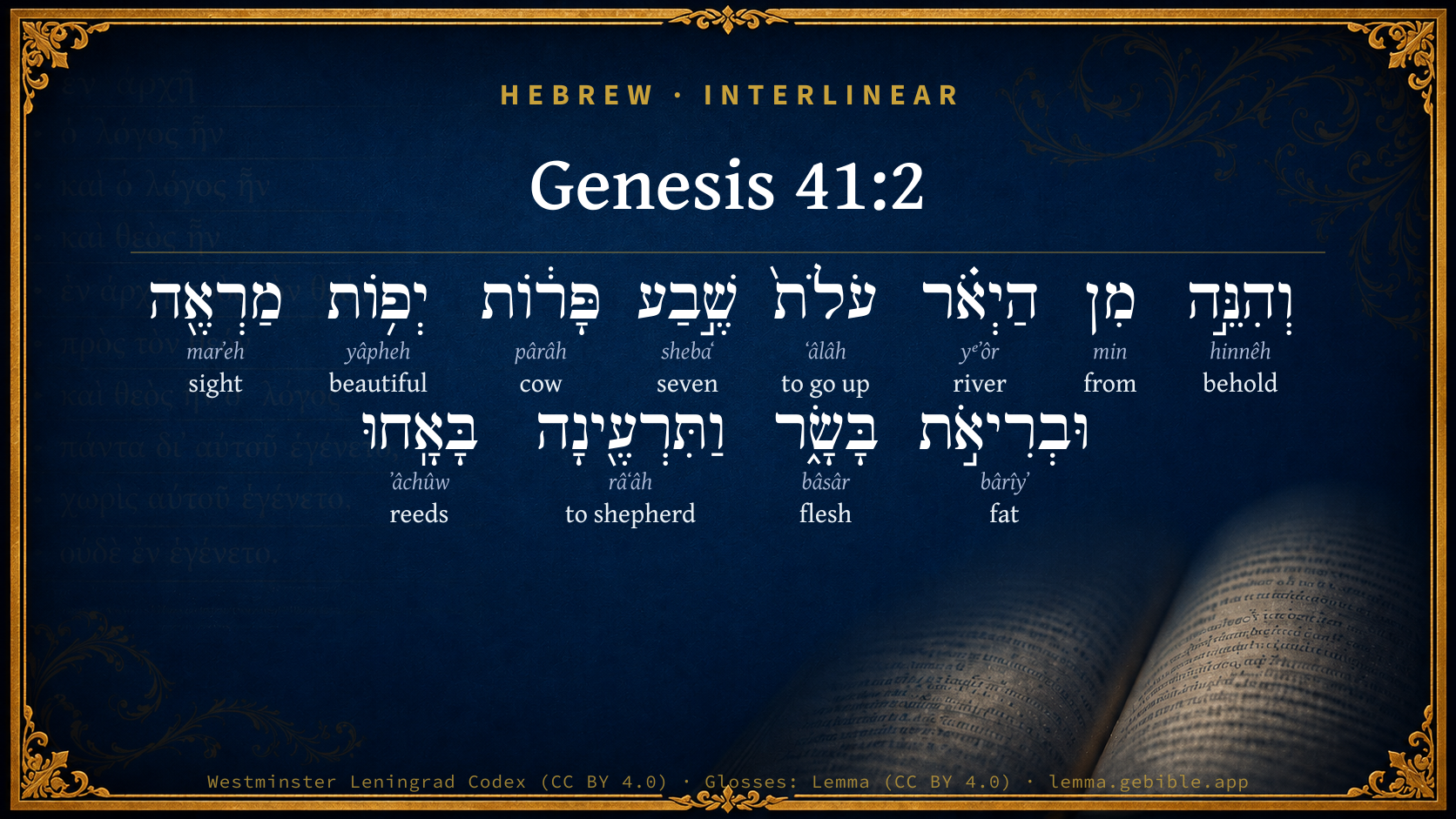
Hebrew (Westminster Leningrad Codex) Genesis 41:2 appears in the Hebrew Old Testament. The text above is from the Westminster Leningrad Codex. Each word links to its Strong’s number, a concise gloss, and parsing drawn from the Open Scriptures Hebrew Bible morphology. Click any word for its full Brown-Driver-Briggs (BDB) entry.
Download image
Cite this verse

Genesis 41:2 (World English Bible). Public Domain. Lemma interlinear Bible study tool, https://lemma.gebible.app/v/genesis/41/2.

Show BibTeX & RIS
BibTeX
RIS
English Translation
Behold, there came up out of the river seven cattle, well-favored and fat-fleshed, and they fed in the reed-grass.
World English Bible · Public Domain
Highlights Full analysis ↓
Download a study sheet

One document with this verse’s original text, its word-by-word gloss line, the meaning frame, cross-references with their text, attributed commentary, and full source and license credits — printable, and it pastes into notes with its structure intact.

This verse Autodidact and up

Study sheet (.html) Plain text (.txt)

A passage Seminary Student

Up to 50 verses in one chapter. A passage sheet keeps up to 6 commentary sources and 12 cross-references per verse, in the order this page ranks them, and says so on the sheet whenever that leaves anything out. Ask for a single verse and you get the Autodidact verse sheet above.

Everything on this page stays free to read, with no account — the sheet is a download of what is already on screen, not access to it.

Want to remove ads? Support Godless Engineer
Compare translations 3

The same verse in 3 English versions, stacked beneath the original-language interlinear above. Click any original word for its lexicon entry.

Each is an independent rendering of the whole verse — the interlinear is not word-aligned to these translations.

Highlighted words mark where these versions differ — a whole-verse word diff, not a word-by-word alignment.

  • World English Bible Public Domain
    Behold, there came up out of the river seven cattle, well-favored and fat-fleshed, and they fed in the reed-grass.
  • King James Version Public Domain
    And, behold, there came up out of the river seven well favored kine and fatfleshed; and they fed in a meadow.
  • unfoldingWord Literal Text CC BY-SA 4.0
    Then behold, from the river came up seven cows, fine-looking and fat-fleshed, and they grazed among the reeds.

unfoldingWord Literal Text — © unfoldingWord, licensed CC BY-SA 4.0. Word-aligned USFM3 via Door43 (git.door43.org/unfoldingWord/en_ult).

Versions to compare (up to 4)

3 of 4 selected

Show all 18 translations

Every available English version of this verse, each an independent rendering of the whole verse.

  • World English Bible Public Domain
    Behold, there came up out of the river seven cattle, well-favored and fat-fleshed, and they fed in the reed-grass.
  • Berean Standard Bible Public Domain
    when seven cows, sleek and well-fed, came up from the river and began to graze among the reeds.
  • Majority Standard Bible Public Domain
    when seven cows, sleek and well-fed, came up from the river and began to graze among the reeds.
  • King James Version Public Domain
    And, behold, there came up out of the river seven well favored kine and fatfleshed; and they fed in a meadow.
  • American Standard Version (1901) Public Domain
    And, behold, there came up out of the river seven kine, well-favored and fat-fleshed; and they fed in the reed-grass.
  • Revised Version (1885) Public Domain
    And, behold, there came up out of the river seven kine, well favoured and fatfleshed; and they fed in the reed-grass.
  • Geneva Bible (1599) Public Domain
    And loe, there came out of the riuer seuen goodly kine and fatfleshed, and they fedde in a medowe:
  • Douay-Rheims (1899) Public Domain
    Out of which came up seven kine, very beautiful and fat: and they fed in marshy places.
  • Young's Literal Translation Public Domain
    and lo, from the River coming up are seven kine, of fair appearance, and fat `in' flesh, and they feed among the reeds;
  • Literal Standard Version CC BY-SA 4.0
    and behold, from the River coming up are seven cows, of beautiful appearance, and fat [in] flesh, and they feed among the reeds;
  • Unlocked Literal Bible CC BY-SA 4.0
    Behold, seven cows came up out of the Nile, desirable and fat, and they grazed in the reeds.
  • unfoldingWord Literal Text CC BY-SA 4.0
    Then behold, from the river came up seven cows, fine-looking and fat-fleshed, and they grazed among the reeds.
  • Darby Bible Public Domain
    And behold, there came up out of the river seven kine, fine-looking and fat-fleshed, and they fed in the reed-grass.
  • World Messianic Bible Public Domain
    Behold, seven cattle came up out of the river. They were sleek and fat, and they fed in the marsh grass.
  • Webster's Bible Public Domain
    And behold, there came up out of the river seven well-favored cows and fat-fleshed; and they fed in a meadow.
  • Free Bible Version CC BY-SA 4.0
    He saw seven cows coming up from the river. They looked well-fed and healthy as they grazed among the reeds.
  • Bible in Basic English Public Domain
    And out of the Nile came seven cows, good-looking and fat, and their food was the river-grass.
  • JPS Tanakh (1917) Public Domain
    And, behold, there came up out of the river seven kine, well-favoured and fat-fleshed; and they fed in the reed-grass.

Literal Standard Version (2020), Covenant Press — licensed CC BY-SA 4.0. Text via the HelloAO Bible API (eBible.org). Unlocked Literal Bible (unfoldingWord) — licensed CC BY-SA 4.0. Text via the HelloAO Bible API (eBible.org). unfoldingWord Literal Text — © unfoldingWord, licensed CC BY-SA 4.0. Word-aligned USFM3 via Door43 (git.door43.org/unfoldingWord/en_ult). Free Bible Version, Dr. Jonathan Gallagher — licensed CC BY-SA 4.0. Text via the HelloAO Bible API (eBible.org).

Word by word

More ways to search: Search by grammar → Find every occurrence → Compare this word →

Practice this passage: Drill this verse → Learn its vocabulary →

בָּאָֽחוּ
ʼâchûw
H260
“in/at the · reeds”
Preposition, Determined + Noun, Common, Masculine, Singular, Absolute
Part of Speech
Preposition + Noun
Type
Common
Gender
Masculine
Number
Singular
State
Absolute
Full BDB Definition

Origin: of uncertain (perhaps Egyptian) derivation

TWOT: 63

reeds, marsh plants, rushes
  1. וְהִנֵּ֣ה hinnêh H2009 “and · behold” Conjunction + Particle, Demonstrative
  2. מִן min H4480 “from” Preposition
  3. הַיְאֹ֗ר yᵉʼôr H2975 “the · river” Particle, Definite Article + Noun, Proper
  4. עֹלֹת֙ ʻâlâh H5927 “going up” Verb, Qal, Participle Active, Feminine, Plural, Absolute
  5. שֶׁ֣בַע shebaʻ H7651 “seven” Adjective, Cardinal number, Feminine, Singular, Absolute
  6. פָּר֔וֹת pârâh H6510 “cows” Noun, Common, Feminine, Plural, Absolute
  7. יְפ֥וֹת yâpheh H3303 “beautiful of” Adjective, Adjective, Feminine, Plural, Construct
  8. מַרְאֶ֖ה marʼeh H4758 “sight” Noun, Common, Masculine, Singular, Absolute
  9. וּבְרִיאֹ֣ת bârîyʼ H1277 “and · fat of” Conjunction + Adjective, Adjective, Feminine, Plural, Construct
  10. בָּשָׂ֑ר bâsâr H1320 “flesh” Noun, Common, Masculine, Singular, Absolute
  11. וַתִּרְעֶ֖ינָה râʻâh H7462 “and · to shepherd” Conjunction + Verb, Qal, Sequential Imperfect, 3rd Person, Feminine, Plural

About this verse

These counts appear in no published source. They are computed here, from the morphology-tagged text and Lemma’s own curated glosses. What Lemma adds →

12
words
12
distinct lemmas
Pentateuch
section

Notable vocabulary

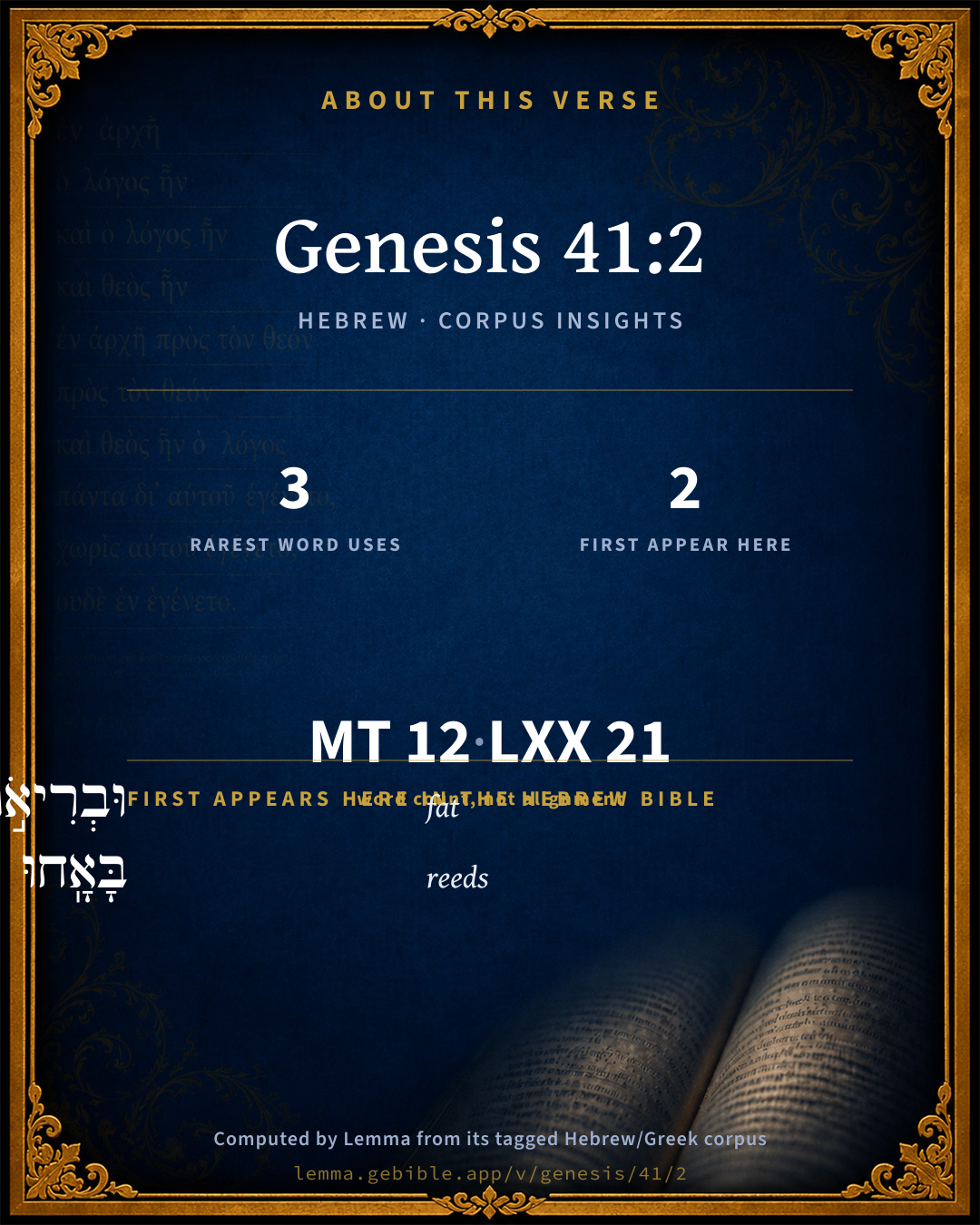
The rarest word here is בָּאָֽחוּ reeds H260 — appearing just 3 times in the whole Hebrew Bible.

First appearance in Scripture

These words make their first canonical appearance in the Hebrew Bible here:

  • וּבְרִיאֹ֣ת fat H1277
  • בָּאָֽחוּ reeds H260

Shared distinctive vocabulary

בָּאָֽחוּ reeds H260 occurs in 3 verses of the Hebrew Bible. Also found in:

Grammatical profile

  • 2 verbs
  • 5 nouns
  • 3 adjectives
  • 1 preposition
  • 1 particle

Verb forms

  • עֹלֹת֙ Qal · Participle Active
  • וַתִּרְעֶ֖ינָה Qal · Sequential Imperfect

Hebrew & Septuagint length

In English translation the verse runs 19 words from the Hebrew and 27 from the Septuagint (LXX English) — the Septuagint runs noticeably longer here. See the side-by-side →

A rough comparison of the two English renderings, which tokenize alike — not a word-level alignment.

Word counts can differ between the Hebrew and the Greek without any difference in meaning — e.g. the Hebrew direct-object marker אֵת has no separate Greek word, and Greek often adds the article ὁ.

In the original languages it is 12 Hebrew tokens and 21 Greek tokens — but the two are counted differently (Hebrew bundles its prefixes and suffixes into one token; the Greek is in lemma form), so that isn’t a like-for-like length.

Cross-references

1

Topical passages linked to Genesis 41:2 in the Treasury of Scripture Knowledge — connected by theme and wording, ordered by reader-vote popularity; previews shown in the World English Bible.

  • Isaiah 19:6 The rivers shall become foul; the streams of Egypt shall be diminished and dried up; the reeds and flags shall wither away.

Cross-references courtesy of OpenBible.info (CC BY 4.0).

Hebrew and Greek witnesses Masoretic Hebrew ↔ Greek Septuagint

The same verse in the two great witnesses to the Old Testament, shown verse-for-verse.

Here the Septuagint runs noticeably longer than the Hebrew — LXX2012 (modern English Septuagint) 27 words vs World English Bible 19. A rough length comparison of the two English translations, not a word-level alignment — read both below.

These are two independent witnesses, not word-aligned to each other, and the Septuagint is shown in lemma (dictionary) form.

Hebrew Genesis 41:2 Masoretic · Westminster Leningrad Codex

וְהִנֵּ֣ה מִן הַיְאֹ֗ר עֹלֹת֙ שֶׁ֣בַע פָּר֔וֹת יְפ֥וֹת מַרְאֶ֖ה וּבְרִיאֹ֣ת בָּשָׂ֑ר וַתִּרְעֶ֖ינָה בָּאָֽחוּ

Behold, there came up out of the river seven cattle, well-favored and fat-fleshed, and they fed in the reed-grass.

World English Bible · Public Domain

Greek LXX Genesis 41:2 Septuagint · lemma form

καί ἰδού ὥσπερ ἐκ ὁ ποταμός ἀναβαίνω ἑπτά βοῦς καλός ὁ εἶδος καί ἐκλεκτός ὁ σάρξ καί βόσκω ἐν ὁ ἄχι

And behold, there came up as it were out of the river seven cows, fair in appearance, and choice of flesh, and they fed on the sedge.

LXX2012 (modern English Septuagint) · Public Domain

On this verse, The Cambridge Bible for Schools and Colleges discusses the Septuagint’s reading. Read the note in Commentary ↓

Hebrew: Westminster Leningrad Codex (CC BY 4.0). Greek: Septuagint (public domain); English from LXX2012 (modern English Septuagint) (Public Domain). How the Septuagint differs from the Hebrew →

Targum (Aramaic paraphrase)

2

The Targum is the ancient Jewish Aramaic paraphrase of the Hebrew Scriptures — an interpretive translation, not the Hebrew text itself. Onkelos (literal) and Pseudo-Jonathan (expansive) render the Torah, and Jonathan the Prophets. Coverage is partial: where no permissively-licensed English translation exists for a verse, only the Aramaic is shown. This is verse-level text, not a word-by-word alignment to the Hebrew.

  1. Targum Onkelos Torah (Genesis–Deuteronomy)
    וְהָא מִן נַהֲרָא סָלְקָן שְׁבַע תּוֹרָן שַׁפִּירָן לְמֶחֱזֵי וּפַטִּימָן בְּשָׂר וְרָעְיָן בְּאַחְוָה

    (no public-domain English translation for this verse)

    Targum Onkelos — Aramaic: “Onkelos Genesis” (public domain); “Onkelos Exodus” (public domain); “Onkelos Leviticus” (public domain); “Onkelos Numbers” (public domain); “Onkelos Deuteronomy” (public domain). English: “Sefaria Community Translation” (CC0 1.0 (public-domain dedication)); “J.W. Etheridge. The Targums of Onkelos and Jonathan Ben Uzziel on the Pentateuch. London: Longmans, Green, 1862” (public domain). Text via Sefaria.

  2. Targum Pseudo-Jonathan Torah (Genesis–Deuteronomy)
    וְהָא מִן נַהֲרָא סַלְקַן שְׁבַע תּוֹרָתֵי שַׁפִּירָן לְמֵיחֲמֵי וּפַטִימָן בִּשְרָא וְרַעֲיָין בְּגוֹי גוּמַיָא

    and, behold, from the river came up seven oxen good-looking and fat-fleshed; and they grazed in the midst of the sedges.

    Targum Pseudo-Jonathan — Aramaic: “Targum Jonathan on Genesis” (public domain); “Targum Jonathan on Exodus” (public domain); “Targum Jonathan on Leviticus” (public domain); “Targum Jonathan on Numbers” (public domain); “Targum Jonathan on Deuteronomy” (public domain). English: “The Targum of Jonathan ben Uzziel, trans. J. W. Etheridge, London, 1862” (public domain). Text via Sefaria.

Commentary

Notes on Genesis 41:2 from classic Christian and Jewish commentators (each source and its license shown beneath its notes). The classic Christian expositions comment on the surrounding passage and are grouped to its opening verse, so a note may address several verses; the Jewish commentaries on the Tanakh (Rashi and others) are per-verse, so they appear only where the commentator wrote on this verse.

Lemma curates 59 commentaries, every one of them public domain or Creative Commons licensed, each selected and text-cleaned for this edition rather than reprinted as found. About our sources →

Trapp's Complete Commentary

John Trapp

Gen 41:2 And, behold, there came up out of the river seven well favoured kine and fatfleshed; and they fed in a meadow.

Ver. 2. There came up out of the river] Nile; which, by overflowing, fatteneth the plain of Egypt, filling it with fruits; and so fitly deciphering the seven years of plenty. {a} So far as this river watereth, there is a black mould so fruitful, that they do but throw in the seed, and have four rich harvests in less than four months, say travellers. {b}

{a} Mercer.

{b} Blunt’s Voyage, p. 37.

John Trapp, A Commentary or Exposition upon All the Books of the Old and New Testament (1647–1656) — public domain. Text from a community e-Sword module.

Joseph Benson's Commentary

Gen 41:2. There came out of the river — A just and proper emblem this, because both the fruitfulness and barrenness of the land of Egypt depended, under God, on the increase or diminution of the waters of that river. Well-favoured kine, and fat-fleshed — Signifying plenty of grass, whereby they had been thus fed, and promising milk and flesh-meat in abundance.

Joseph Benson's Commentary on the Old and New Testaments (1811–1818) — public domain. Text from a community e-Sword module.

Geneva Bible (1599)

Geneva Bible translators

Or, fair to behold.

Or, staggie place.

Geneva Bible (1599) marginal notes — public domain. Text via Bolls.life.

Adam Clarke's Commentary

Verse 2. There came up out of the river seven well-favoured kine] This must certainly refer to the hippopotamus or river horse, as the circumstances of coming up out of the river and feeding in the field characterize that animal alone. The hippopotamus is the well-known inhabitant of the Nile, and frequently by night comes out of the river to feed in the fields, or in the sedge by the river side.

Adam Clarke's Commentary on the Bible (1810–1826) — public domain. Text from a community e-Sword/MySword module.

Ellicott's Commentary for English Readers

(2) Kine.—The cow was regarded by the Egyptians as the symbol of the earth, and of agriculture; and naturally both the kine and the ears of wheat rose out of the river, because as no rain falls in Egypt, its fertility entirely depends upon the overflow of the Nile. The cows sacred to Isis were seven in number, and in a copy of the Ritual of the Dead, Mr. Malan (p. 192) found a picture of the seven sacred cows with the divine bull.

In a meadow.—Heb., in the marsh-grass. The word occurs only in this chapter and in Job_8:11, where it is translated flag. It is the name of the rank herbage which grows luxuriantly along the banks of the Nile; or, as some think, of one special kind of marsh-grass, called by botanists cyperus esculentus.

A Bible Commentary for English Readers, edited by Charles John Ellicott (1878–1897) — public domain. Text from a community e-Sword module.

The Cambridge Bible for Schools and Colleges

gen. ed. J. J. S. Perowne

2. out of the river] The Nile is the source of the fertility and wealth of Egypt. The cows issuing from the Nile would be a symbol of fertility. The Egyptian goddess Hathor is represented with the head of a cow.

seven kine] The number “seven” is commonly employed for the purposes of symbolism. The god Osiris is represented in Egyptian drawings as an ox accompanied by seven cows.

reed-grass] The Heb. word aḥu transliterates the Egyptian aḥu, or iḥi. It is found also in Gen_41:18; Job_8:11; Hos_13:15. LXX ἄχει, which occurs also in Isa_19:7; Sir_40:16. Jerome, commenting on Isa_19:7, explains ἄχει as quicquid in palude virens nascitur. The word, derived from a root meaning “green,” is applied to the Nile reed-grass whose vivid green, under that bright sky, strikes every traveller in Egypt1[58]

[58] “Pro junco papyrum transtulerunt LXX, de quo charta fit, addentes de suo Achi, viride, quod in Hebraeo non habetur. Cumque ab eruditis quaererem, quid hic sermo significaret, audivi ab Aegyptiis hoc nomine lingua eorum quicquid in palude virens nascitur appellari” (Comm. in Esai, § 291).

The Cambridge Bible for Schools and Colleges (gen. ed. J. J. S. Perowne; Cambridge University Press, 1878–1918) — public domain. Text from a community e-Sword module.

John Gill's Exposition

And, behold, there came up out of the river seven well favoured kine, and fatfleshed,.... Seven cows or heifers, sleek, fat, and plump, goodly to look at; these seemed in the dream, as if they came out of the river, because they were fed with the fruits of the earth, which the overflowing of the river Nile, and its canals, produced:

and they fed in a meadow; adjoining to the river, where there was good pasture for them, and gives a reason of their being in so good a condition.

John Gill's Exposition of the Whole Bible (1746–1763) — public domain (CC PDM 1.0). Text via the HelloAO Bible API.

Haydock's Catholic Bible Commentary

Marshy. Hebrew Achu; a word which the Septuagint and Siracides (Ecclesiasticus xl. 16, ) retain. (Du Hamel)

George Leo Haydock (1774–1849), Haydock's Catholic Family Bible and Commentary, 1859 edition — public domain. Excludes Psalms (Douay-Rheims chapter numbering differs from Protestant) and Deuterocanonical books (Catholic canon only).

Matthew Poole's English Annotations

This suits well with the nature of the thing, for both the fruitfulness and the barrenness of Egypt depended, under God, upon the increase or diminution of the waters of that river.

Kine, when they appeared in dreams, did portend, in the opinion of the learned Egyptians, the years or times to come, and them either good or bad, according to their quality.

Matthew Poole's English Annotations on the Holy Bible (1683–1685) — public domain. Text from a community e-Sword/MySword module.

Whedon's Commentary on the Bible

Daniel D. Whedon

2. Seven well favoured kine — Hebrews, seven heifers beautiful in appearance. “The Egyptians esteemed the cow above all other animals. It was sacred to Isis, (Herod. 2:41,) or rather to Athor, the Venus Genetrix of Egypt, and was looked on as a symbol of the earth and its cultivation and food. Hence it was very natural that in Pharaoh’s dream the fruitful and unfruitful years should be typified by well favoured and ill favoured kine.” — Speaker’s Com.

In a meadow — Rather, in the marsh grass, (אחו.)

The word is of Egyptian origin, and signifies, according to Gesenius, “marsh-grass, reeds, bulrushes, sedge, every thing which grows in wet grounds. The word was adopted not only into the Hebrew, but also into the Greek idiom of Alexandria.” The Sept. does not translate the word, but reads, εν τω αχει.

Daniel D. Whedon (gen. ed.), Commentary on the Old and New Testaments (1874–1909) — public domain. Text from a community e-Sword module.

Rashi

Rabbi Shlomo Yitzchaki (Rashi)

יפות מראה BEAUTIFUL TO THE SIGHT — This was an indication of a period of plenty, when people show themselves well-disposed one to another, for no-one then envies another person’s prosperity (cf. Genesis Rabbah 89:4).

באחו IN THE REED-GRASS — in the marshy land. old French marais; English, marsh. Similar is (Job 8:11) “Can reed-grass (אחו) grow?”

Rashi on the Tanakh — English translations: “The Judaica Press complete Tanach with Rashi, translated by A. J. Rosenberg” (CC BY 4.0); “Pentateuch with Rashi's commentary by M. Rosenbaum and A.M. Silbermann, 1929-1934” (public domain); “The Metsudah Tanach series, Lakewood, N.J” (CC BY 4.0); and “The Book of Joshua, Metsudah Publications, 1997” (CC BY 4.0). Text via Sefaria.

Ramban (Nachmanides)

Rabbi Moshe ben Nachman (Ramban / Nachmanides)

AND BEHOLD, THERE CAME UP OUT OF THE RIVER. Since the land of Egypt is irrigated by the river, and it is from the river that abundance or famine befalls them, the king saw the cows coming up out of the river. The cows symbolize plowing, and the ears of corn symbolize the harvest, just as Joseph said, in which there shall be neither plowing nor harvest. He saw that the river rose only slightly and there would thus be no plowing, and the little which will be planted in moist places, a wind blowing from the east, a wind from the Eternal would burn them, even as he saw the ears of corn parched with the east wind. It would appear to be implied in the verses that the abundance was only in the land of Egypt, even as it said, Seven years of great plenty throughout all the land of Egypt; likewise the verse, And he stored up all the food of the seven years which was in the land of Egypt. But the famine, on the other hand, was in all the lands. And so did Joseph interpret it when he said, And there shall arise after them seven years of famine, and did not mention the land of Egypt. It was for this reason that in the other countries they were unable to store up food even if they had heard about it, as they undoubtedly did, for the matter was well known throughout their lands. Perhaps this was alluded to in the dream since with respect to the fat cows, it mentions, And they fed in the reed-grass, for it was there in Egypt that they fed and stood, but the lean ones, after they consumed the fat ones, walked to and fro through the earth, and Pharaoh did not know where they had gone.

BA’ACHU. Meaning “in the marshy land,” as in the verse, Can ‘achu’ grow? This is the language of Rashi.This is not correct, as achu is the name of the grass which grows, [and not the land upon which it grows, as Rashi explained it], just as in the verse, Can the rush shoot up without mire, can the ‘achu’ (reed-grass) grow without water? It withereth before any other herb., Verses 11-12. Thus it is obvious that the word achu is not the marsh land. Perhaps Rashi’s intent is that the grass which grows in the marsh-lands is called by the name of the land upon which it grows.The correct interpretation is that achu is the generic name for all vegetation and grass which grow on the banks of the rivers and the marsh-lands. In that case, the letter beth in ba’achu would be as the beth in the verse, Come, eat ‘b’lachmi’ (of my bread), and drink of the wine which I have mingled, is the name of the grass, as he said in attempting to vindicate Rashi’s explanation, the verse before us should have said achu, rather than ba’achu. But if achu is a generic name, the term ba’achu is correct, and the verse would mean that they fed in the green foliage or vegetation which was upon the bank of the river. for they were feeding on the bank of the river, just as it is said, near the cows upon the bank of the river. Now perhaps the word achu is a derivative of achvah (brotherhood), since many varieties of grass grow together.

Ramban (Nachmanides) on the Tanakh — English translation: “Commentary on the Torah by Ramban (Nachmanides). Translated and annotated by Charles B. Chavel. New York, Shilo Pub. House, 1971-1976” (CC BY 4.0). Text via Sefaria.

Radak

Rabbi David Kimhi (Radak)

והנה מן היאור עולות שבע פרות, this was part of the interpretation, as in Egypt the river Nile rises annually above its embankment irrigating the farmland surrounding it. The cows both pull the ploughs and thresh the grain after it has been harvested. [thus far the dream reflected a well known reality in Egypt and it is difficult to see how the Egyptian wise men could have missed something so simple unless their eyes had been blinded by G’d. Ed.]

ותרעינה באחו, as they found plenty of grass near at hand.

Radak on the Tanakh — English translations: “Sefaria Community Translation” (CC0 1.0 (public-domain dedication)); “Eliyahu Munk, HaChut Hameshulash” (CC BY 4.0); “Rabbi Mike Feuer, Jerusalem Anthology” (CC BY 4.0); and “R. David Kimhi on the first book of Psalms, Translated by R.G. Finch, London, 1919” (public domain). Text via Sefaria.

Lesson kit

Teaching starters — assembled from the data on this page, not authored interpretation. Every prompt links to the verse data it draws on. Edit before teaching.

Genesis, in the Pentateuch, opens this verse with 12 words (12 distinct Hebrew lemmas). Its most distinctive word is ʼâchûw (“reeds”). The Greek Septuagint runs longer here. A historical commentator’s framing appears above. Read the whole chapter for the surrounding context.

Discussion questions

  1. The word ʼâchûw carries the sense “reeds.” How does it shape the verse?
  2. 2 words make their first appearance in Scripture here. What does this debut establish?
  3. How does Genesis 41:18, which shares the word «reeds», read alongside this verse?
  4. The Septuagint runs longer here than the Hebrew. What might account for the difference?
  5. The translations on this page render this verse differently — a whole-verse word diff, not a word-by-word alignment. What might account for the different wordings?
  6. «עֹלֹת֙» is a Qal Participle Active verb. How does that grammatical form shape the action described?
  7. Compare how Trapp's Complete Commentary and Joseph Benson's Commentary read this verse. Where do they agree or differ?

Things to notice

Reading settings

Reading text

Shown beneath each verse's original-language words.

Old Testament
Old Testament edition

Read the OT as the Masoretic Hebrew (MT) or the Greek Septuagint (LXX).

English shown for the Greek Septuagint (in the Hebrew ↔ Greek comparison).

Comparing translations? Open the Compare panel on any verse page to stack up to four side by side.