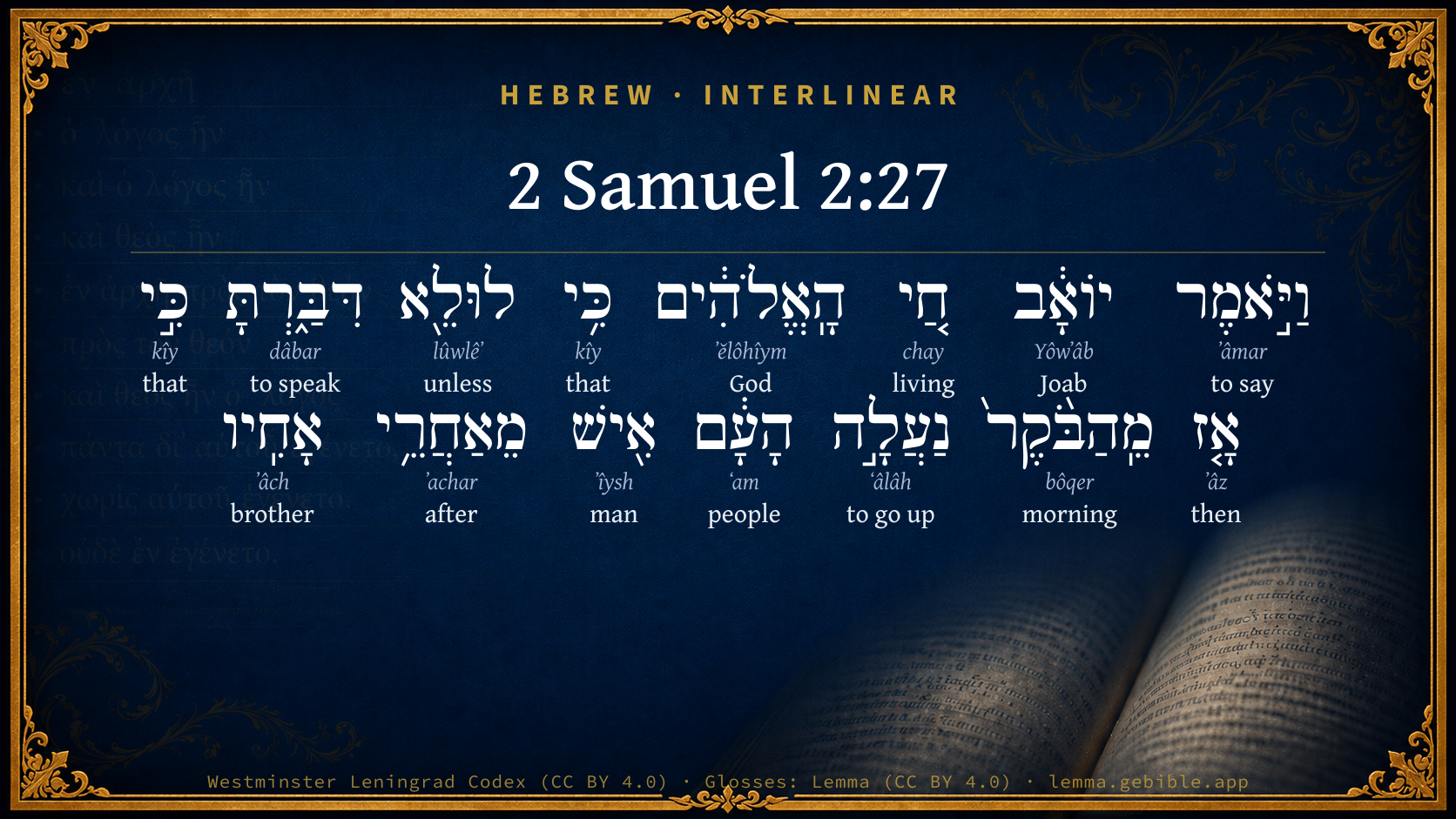
2 Samuel 2:27

Hebrew (Westminster Leningrad Codex) 2 Samuel 2:27 appears in the Hebrew Old Testament. The text above is from the Westminster Leningrad Codex. Each word links to its Strong’s number, a concise gloss, and parsing drawn from the Open Scriptures Hebrew Bible morphology. Click any word for its full Brown-Driver-Briggs (BDB) entry.
Download image
Cite this verse

2 Samuel 2:27 (World English Bible). Public Domain. Lemma interlinear Bible study tool, https://lemma.gebible.app/v/2-samuel/2/27.

Show BibTeX & RIS
BibTeX
RIS
English Translation
Joab said, As God lives, if you had not spoken, surely then in the morning the people had gone away, nor followed everyone his brother.
World English Bible · Public Domain
Download a study sheet

One document with this verse’s original text, its word-by-word gloss line, the meaning frame, cross-references with their text, attributed commentary, and full source and license credits — printable, and it pastes into notes with its structure intact.

This verse Autodidact and up

Study sheet (.html) Plain text (.txt)

A passage Seminary Student

Up to 50 verses in one chapter. A passage sheet keeps up to 6 commentary sources and 12 cross-references per verse, in the order this page ranks them, and says so on the sheet whenever that leaves anything out. Ask for a single verse and you get the Autodidact verse sheet above.

Everything on this page stays free to read, with no account — the sheet is a download of what is already on screen, not access to it.

Want to remove ads? Support Godless Engineer
Compare translations 3

The same verse in 3 English versions, stacked beneath the original-language interlinear above. Click any original word for its lexicon entry.

Each is an independent rendering of the whole verse — the interlinear is not word-aligned to these translations.

Highlighted words mark where these versions differ — a whole-verse word diff, not a word-by-word alignment.

  • World English Bible Public Domain
    Joab said, As God lives, if you had not spoken, surely then in the morning the people had gone away, nor followed everyone his brother.
  • King James Version Public Domain
    And Joab said, As God liveth, unless thou hadst spoken, surely then in the morning the people had gone up every one from following his brother.
  • unfoldingWord Literal Text CC BY-SA 4.0
    And Joab said, “The life of God, that if you had not spoken, that then from the morning the people would have taken itself up, a man from after his brother.”

unfoldingWord Literal Text — © unfoldingWord, licensed CC BY-SA 4.0. Word-aligned USFM3 via Door43 (git.door43.org/unfoldingWord/en_ult).

Versions to compare (up to 4)

3 of 4 selected

Show all 18 translations

Every available English version of this verse, each an independent rendering of the whole verse.

  • World English Bible Public Domain
    Joab said, As God lives, if you had not spoken, surely then in the morning the people had gone away, nor followed everyone his brother.
  • Berean Standard Bible Public Domain
    “As surely as God lives,” Joab replied, “if you had not spoken up, the troops would have continued pursuing their brothers until morning.”
  • Majority Standard Bible Public Domain
    “As surely as God lives,” Joab replied, “if you had not spoken up, the troops would have continued pursuing their brothers until morning.”
  • King James Version Public Domain
    And Joab said, As God liveth, unless thou hadst spoken, surely then in the morning the people had gone up every one from following his brother.
  • American Standard Version (1901) Public Domain
    And Joab said, As God liveth, if thou hadst not spoken, surely then in the morning the people had gone away, nor followed every one his brother.
  • Revised Version (1885) Public Domain
    And Joab said, As God liveth, if thou hadst not spoken, surely then in the morning the people had gone away, nor followed every one his brother.
  • Geneva Bible (1599) Public Domain
    And Ioab sayde, As God liueth, if thou haddest not spoken, surely euen in the morning the people had departed euery one backe from his brother.
  • Douay-Rheims (1899) Public Domain
    And Joab said: As the Lord liveth, if thou hadst spoke sooner, even in the morning the people should have retired from pursuing after their brethren.
  • Young's Literal Translation Public Domain
    And Joab saith, `God liveth! for unless thou hadst spoken, surely then from the morning had the people gone up each from after his brother.'
  • Literal Standard Version CC BY-SA 4.0
    And Joab says, “God lives! For unless you had spoken, surely then from the morning each of the people had gone up from after his brother.”
  • Unlocked Literal Bible CC BY-SA 4.0
    Joab replied, “Just as God lives, if you had not said that, my soldiers would have pursued their brothers until the morning!”
  • unfoldingWord Literal Text CC BY-SA 4.0
    And Joab said, “The life of God, that if you had not spoken, that then from the morning the people would have taken itself up, a man from after his brother.”
  • Darby Bible Public Domain
    And Joab said, [As] God liveth, unless thou hadst spoken, surely then in the morning the people had gone up every one from following his brother.
  • World Messianic Bible Public Domain
    Joab said, “As God lives, if you had not spoken, surely then in the morning the people would have gone away, and not each followed his brother.”
  • Webster's Bible Public Domain
    And Joab said, As God liveth, unless thou hadst spoken, surely then in the morning the people had gone up every one from following his brother.
  • Free Bible Version CC BY-SA 4.0
    “As God lives,” Joab replied, “if you had not said anything, my men would have continued chasing their brothers until the morning.”
  • Bible in Basic English Public Domain
    And Joab said, By the living God, if you had not given the word, the people would have gone on attacking their countrymen till the morning.
  • JPS Tanakh (1917) Public Domain
    And Joab said: 'As God liveth, if thou hadst not spoken, surely then only after the morning the people had gone away, every one from following his brother.'

Literal Standard Version (2020), Covenant Press — licensed CC BY-SA 4.0. Text via the HelloAO Bible API (eBible.org). Unlocked Literal Bible (unfoldingWord) — licensed CC BY-SA 4.0. Text via the HelloAO Bible API (eBible.org). unfoldingWord Literal Text — © unfoldingWord, licensed CC BY-SA 4.0. Word-aligned USFM3 via Door43 (git.door43.org/unfoldingWord/en_ult). Free Bible Version, Dr. Jonathan Gallagher — licensed CC BY-SA 4.0. Text via the HelloAO Bible API (eBible.org).

Word by word

More ways to search: Search by grammar → Find every occurrence → Compare this word →

Practice this passage: Drill this verse → Learn its vocabulary →

לוּלֵ֖א
lûwlêʼ
H3884
“unless”
Conjunction
Part of Speech
Conjunction
Full BDB Definition

Origin: from H3863 and H3808

TWOT: 1085a

unless, if not, except
  1. וַיֹּ֣אמֶר ʼâmar H559 “and · to say” Conjunction + Verb, Qal, Sequential Imperfect, 3rd Person, Masculine, Singular
  2. יוֹאָ֔ב Yôwʼâb H3097 “Joab” Noun, Proper
  3. חַ֚י chay H2416 “living” Adjective, Adjective, Masculine, Singular, Absolute
  4. הָֽאֱלֹהִ֔ים ʼĕlôhîym H430 “the · God(s)” Particle, Definite Article + Noun, Common, Masculine, Plural, Absolute
  5. כִּ֥י kîy H3588 “that” Conjunction
  6. דִּבַּ֑רְתָּ dâbar H1696 “to speak” Verb, Piel, Perfect, 2nd Person, Masculine, Singular
  7. כִּ֣י kîy H3588 “that” Conjunction
  8. אָ֤ז ʼâz H227 “then” Adverb
  9. מֵֽהַבֹּ֨קֶר֙ bôqer H1242 “from · the · morning” Preposition + Particle, Definite Article + Noun, Common, Masculine, Singular, Absolute
  10. נַעֲלָ֣ה ʻâlâh H5927 “to go up” Verb, Niphal, Perfect, 3rd Person, Masculine, Singular
  11. הָעָ֔ם ʻam H5971 “the · people” Particle, Definite Article + Noun, Common, Masculine, Singular, Absolute
  12. אִ֖ישׁ ʼîysh H376 “man” Noun, Common, Masculine, Singular, Absolute
  13. מֵאַחֲרֵ֥י ʼachar H310 “from · after” Preposition + Preposition
  14. אָחִֽיו ʼâch H251 “brother · his” Noun, Common, Masculine, Singular, Construct + Suffix, Personal, 3rd Person, Masculine, Singular

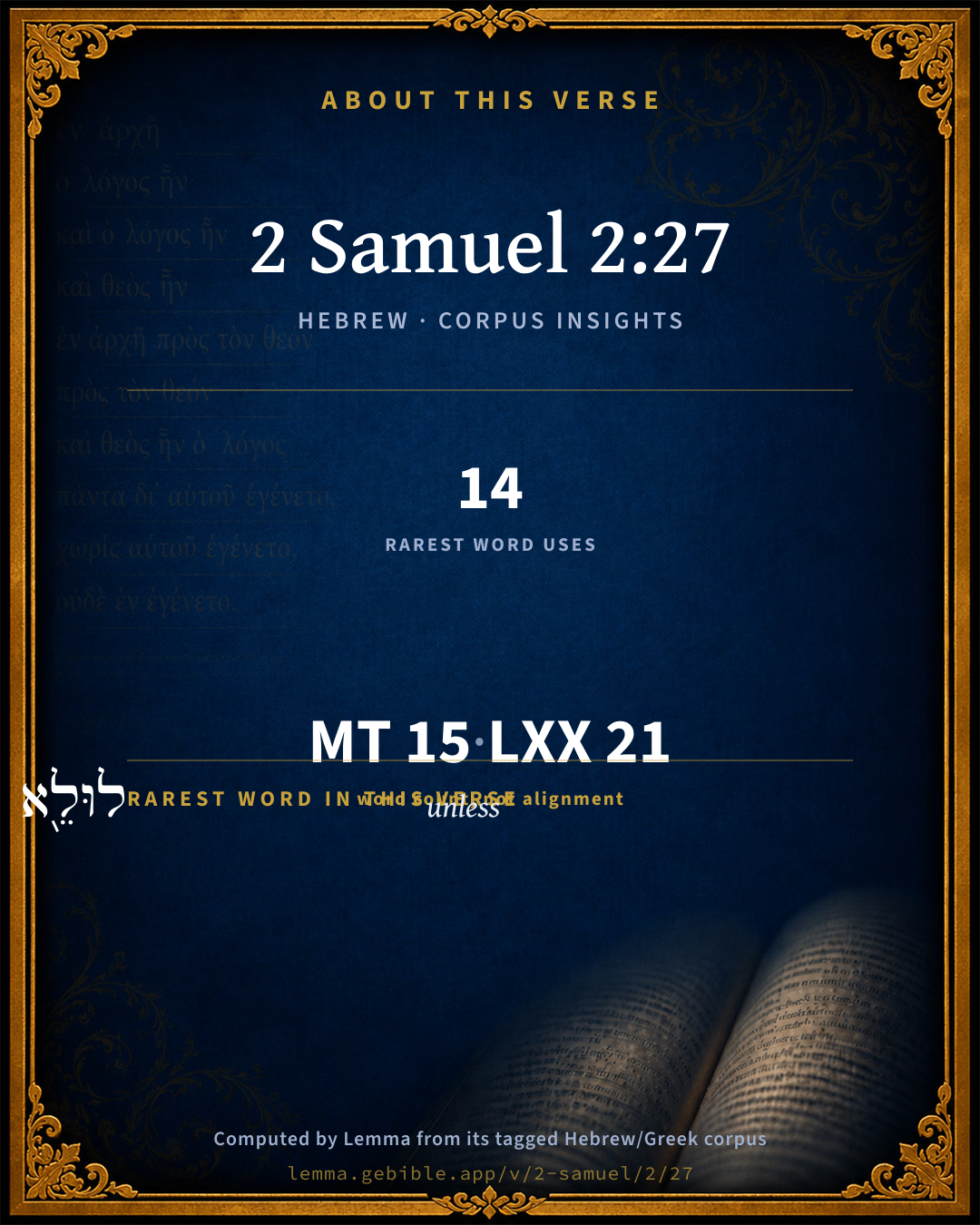
About this verse

These counts appear in no published source. They are computed here, from the morphology-tagged text and Lemma’s own curated glosses. What Lemma adds →

15
words
14
distinct lemmas
Historical
section

Notable vocabulary

The rarest word here is לוּלֵ֖א unless H3884 — appearing just 14 times in the whole Hebrew Bible.

Shared distinctive vocabulary

לוּלֵ֖א unless H3884 occurs in 14 verses of the Hebrew Bible. Also found in:

Grammatical profile

  • 3 verbs
  • 6 nouns
  • 1 adjective
  • 1 preposition
  • 3 conjunctions
  • 1 adverb

Verb forms

  • וַיֹּ֣אמֶר Qal · Sequential Imperfect
  • דִּבַּ֑רְתָּ Piel · Perfect
  • נַעֲלָ֣ה Niphal · Perfect

Repetition

A word recurs within this verse — often emphatic in Hebrew:

  • כִּ֥י that H3588 ×2

Hebrew & Septuagint length

In English translation the verse runs 25 words from the Hebrew and 27 from the Septuagint (LXX English) — closely comparable.

A rough comparison of the two English renderings, which tokenize alike — not a word-level alignment.

Word counts can differ between the Hebrew and the Greek without any difference in meaning — e.g. the Hebrew direct-object marker אֵת has no separate Greek word, and Greek often adds the article ὁ.

In the original languages it is 15 Hebrew tokens and 21 Greek tokens — but the two are counted differently (Hebrew bundles its prefixes and suffixes into one token; the Greek is in lemma form), so that isn’t a like-for-like length.

Cross-references

9

Topical passages linked to 2 Samuel 2:27 in the Treasury of Scripture Knowledge — connected by theme and wording, ordered by reader-vote popularity; previews shown in the World English Bible.

  • 1 Samuel 25:26 Now therefore, my lord, as Yahweh lives, and as your soul lives, seeing Yahweh has withheld you from blood guiltiness, and from avenging yourself with your own hand, now therefore let your enemies, and those who seek evil to my lord, be as Nabal.
  • 2 Samuel 2:14 Abner said to Joab, Please let the young men arise and play before us. Joab said, Let them arise.
  • Proverbs 17:14 The beginning of strife is like breaching a dam, Therefore stop contention before quarreling breaks out.
  • Job 27:2 "As God lives, who has taken away my right, The Almighty, who has made my soul bitter.
  • Proverbs 15:1 A gentle answer turns away wrath, But a harsh word stirs up anger.
  • Proverbs 20:18 Plans are established by advice; By wise guidance you wage war!
  • Proverbs 25:8 Don't be hasty in bringing charges to court. What will you do in the end when your neighbor shames you?
  • Isaiah 47:7 You said, I shall be mistress forever; so that you did not lay these things to your heart, neither did remember the latter end of it.
  • Luke 14:31–32 Or what king, as he goes to encounter another king in war, will not sit down first and consider whether he is able with ten thousand to meet him who comes against him with twenty thousand?

Cross-references courtesy of OpenBible.info (CC BY 4.0).

Hebrew and Greek witnesses Masoretic Hebrew ↔ Greek Septuagint

The same verse in the two great witnesses to the Old Testament, shown verse-for-verse.

These are two independent witnesses, not word-aligned to each other, and the Septuagint is shown in lemma (dictionary) form.

Hebrew 2 Samuel 2:27 Masoretic · Westminster Leningrad Codex

וַיֹּ֣אמֶר יוֹאָ֔ב חַ֚י הָֽאֱלֹהִ֔ים כִּ֥י לוּלֵ֖א דִּבַּ֑רְתָּ כִּ֣י אָ֤ז מֵֽהַבֹּ֨קֶר֙ נַעֲלָ֣ה הָעָ֔ם אִ֖ישׁ מֵאַחֲרֵ֥י אָחִֽיו

Joab said, As God lives, if you had not spoken, surely then in the morning the people had gone away, nor followed everyone his brother.

World English Bible · Public Domain

Greek LXX 2 Samuel 2:27 Septuagint · lemma form

καί εἶπον ιωαβ ζάω κύριος ὅτι εἰ μή λαλέω διότι τότε ἐκ πρωίθεν ἀναβαίνω ὁ λαός ἕκαστος κατόπισθεν ὁ ἀδελφός αὐτός

And Joab said, As the Lord lives, if you had not spoken, even from the morning the people had gone up every one from following his brother.

LXX2012 (modern English Septuagint) · Public Domain

Hebrew: Westminster Leningrad Codex (CC BY 4.0). Greek: Septuagint (public domain); English from LXX2012 (modern English Septuagint) (Public Domain). How the Septuagint differs from the Hebrew →

Targum (Aramaic paraphrase)

1

The Targum is the ancient Jewish Aramaic paraphrase of the Hebrew Scriptures — an interpretive translation, not the Hebrew text itself. Onkelos (literal) and Pseudo-Jonathan (expansive) render the Torah, and Jonathan the Prophets. Coverage is partial: where no permissively-licensed English translation exists for a verse, only the Aramaic is shown. This is verse-level text, not a word-by-word alignment to the Hebrew.

  1. Targum Jonathan Prophets (Joshua–Malachi)
    וַאֲמַר יוֹאָב קַיָם הוּא יְיָ אֲרֵי אִלוּלָפוֹן מַלֵילְתָּא אֲרֵי בְּכֵין פּוֹן מֵעִידַן צַפְרָא אִסְתַּלֵק עַמָא גְבַר מִבָתַר אֲחוּהִי:

    (no public-domain English translation for this verse)

    Targum Jonathan — Aramaic: “Mikraot Gedolot” (public domain). English: “Sefaria Community Translation” (CC0 1.0 (public-domain dedication)); “London "Chaldee Paraphrase," 1871” (public domain). Text via Sefaria.

Commentary

Notes on 2 Samuel 2:27 from classic Christian and Jewish commentators (each source and its license shown beneath its notes). The classic Christian expositions comment on the surrounding passage and are grouped to its opening verse, so a note may address several verses; the Jewish commentaries on the Tanakh (Rashi and others) are per-verse, so they appear only where the commentator wrote on this verse.

Lemma curates 59 commentaries, every one of them public domain or Creative Commons licensed, each selected and text-cleaned for this edition rather than reprinted as found. About our sources →

Trapp's Complete Commentary

John Trapp

2Sa 2:27 And Joab said, [As] God liveth, unless thou hadst spoken, surely then in the morning the people had gone up every one from following his brother.

Ver. 27. Unless thou hadst spoken,] q.d., Thou mayest thank thyself for the hurt that is done: for thou first madest the challenge. Aequum est ut faber quas fecit compedes ipse gestet.

John Trapp, A Commentary or Exposition upon All the Books of the Old and New Testament (1647–1656) — public domain. Text from a community e-Sword module.

Joseph Benson's Commentary

2Sa 2:27. Unless thou hadst spoken, &c. — Made the motion that they should fight, giving a rash challenge; surely in the morning the people had gone up — The armies had parted in peace, without any act of hostility: it was thou, not I, that gave the first occasion of this fight. This plainly shows that Joab’s instructions were not to begin hostilities, and that Abner was the sole cause of the war. Had it not been for him, all things might have been settled by an amicable agreement that very morning. Some, however, understand Joab’s words differently: they consider him as swearing solemnly, that inasmuch as Abner had given the challenge, and proposed fighting, if he had not also begun the parley for cessation, he and his men would have pursued him and Ish-bosheth’s vanquished army the whole night.

Joseph Benson's Commentary on the Old and New Testaments (1811–1818) — public domain. Text from a community e-Sword module.

Geneva Bible (1599)

Geneva Bible translators

If thou hadst not provoked them to battle, as verse 14.

Geneva Bible (1599) marginal notes — public domain. Text via Bolls.life.

Adam Clarke's Commentary

Verse 27. And Joab said] The meaning of this verse appears to be this: If Abner had not provoked the battle, (see 2Sa 2:14), Joab would not have attacked the Israelites that day; as his orders were probably to act on the defensive. Therefore the blame fell upon Israel.

Adam Clarke's Commentary on the Bible (1810–1826) — public domain. Text from a community e-Sword/MySword module.

Ellicott's Commentary for English Readers

(27) Unless thou hadst spoken.—Joab’s reply to Abner admits of either of two interpretations: (1) Joab seeks to throw the whole blame of the conflict upon Abner, by saying that if he had not proposed the combat between the champions (2Sa_2:14) there would have been no battle, but “the people” of both sides would have separated peaceably at Gibeon; or (2), as the phrase is more generally and more probably under. stood, that Joab had intended to keep up the pursuit only until the following morning, but as Abner already sued for mercy, he was content, and would stop now.

A Bible Commentary for English Readers, edited by Charles John Ellicott (1878–1897) — public domain. Text from a community e-Sword module.

The Cambridge Bible for Schools and Colleges

gen. ed. J. J. S. Perowne

27. unless thou hadst spoken] Abner found fault with Joab for continuing the pursuit. Joab retorts that Abner himself was to blame for the commencement of the battle. Unless thou hadst spoken (2Sa_2:14), and challenged us to fight, the armies might have separated this morning without coming to blows. Joab believed that the civil war might have been avoided by timely negotiation. This explanation is the simplest, and fits the context best. Another way of taking it is, Unless thou hadst spoken, and asked for a cessation of hostilities, then to-morrow morning, but not before, the people, &c.; i.e. Joab boasts that his compliance with Abner’s request was no sign of weakness on his part, for he might have continued the pursuit until morning. But this meaning is less obvious, and less suitable as an answer to Abner.

The Cambridge Bible for Schools and Colleges (gen. ed. J. J. S. Perowne; Cambridge University Press, 1878–1918) — public domain. Text from a community e-Sword module.

John Gill's Exposition

And Joab said, as God liveth,.... Which was the form of an oath, swearing by the living God:

unless thou hadst spoken; that is, these words in Sa2 2:14; "let the young men arise and play", that he had not given the challenge to fight:

surely then in the morning the people had gone up everyone from following his brother; they would have gone away and never fought at all; they were not desirous of shedding their blood, and following after them to slay them: thus he lays the blame upon Abner, and makes him to be the cause and beginner of the war. Some render the particle by "if", and give the sense, that if he had spoken what he last did sooner, the people would long before this time have desisted from pursuing them; for it was not from a thirst after their blood, and a desire to luke vengeance on them, that they pursued them, but to bring them to submission, and lay down their arms; for they could not in honour retreat until they desired it; but the former sense seems best, and is the general sense of the Jewish commentators.

John Gill's Exposition of the Whole Bible (1746–1763) — public domain (CC PDM 1.0). Text via the HelloAO Bible API.

Albert Barnes' Notes on the Bible

Joab’s speech means either “unless thou hadst spoken (challenged us to fight, 2Sa 2:14), the people would have returned from the pursuit of their brethren (many hours ago, even) this morning;” or, “If thou hadst not spoken (asked for peace, 2Sa 2:26), surely the people would have returned, etc., in the morning, i. e. would not have ceased the pursuit until the morning.” The latter interpretation is the more accordant with Joab’s boastful character.

Albert Barnes' Notes on the Bible (1834–1885) — public domain. Text from a community e-Sword/MySword module.

Haydock's Catholic Bible Commentary

CHAPTER II.

Sooner. Hebrew, "If thou hadst not spoken," (Du Hamel) by challenging, ver. 14. (Josephus, &c.) (Calmet)

George Leo Haydock (1774–1849), Haydock's Catholic Family Bible and Commentary, 1859 edition — public domain. Excludes Psalms (Douay-Rheims chapter numbering differs from Protestant) and Deuterocanonical books (Catholic canon only).

Matthew Poole's English Annotations

Unless thou hadst spoken; unless thou hadst made the motion that they might fight, 2Sa 2:14. It was thou, not I, that gave the first occasion of this fight. Withal, he intimates that Abner was the sole cause of this war; and that if he had not given commission and command, the war had never been undertaken, but all things had been ended by an amicable agreement; which might have been made that very morning, if he had so pleased.

Matthew Poole's English Annotations on the Holy Bible (1683–1685) — public domain. Text from a community e-Sword/MySword module.

Whedon's Commentary on the Bible

Daniel D. Whedon

27. Unless thou hadst spoken — As thou didst this morning, saying, “Let the young men arise and play.” 2Sa_2:14. That challenge provoked the war. Had it not been uttered the two armies would have separated without fight or bloodshed.

Daniel D. Whedon (gen. ed.), Commentary on the Old and New Testaments (1874–1909) — public domain. Text from a community e-Sword module.

The Pulpit Commentary

Unless thou hadst spoken, surely then in the morning the people had gone up; or as the Revised Version renders, had gone away, nor followed every man his brother. The Revised Version makes the sense more plain. Joab throws the whole blame, and rightly so, on Abner. David would under no circumstances have attacked Ishbosheth, and Joab with his men had marched to the tank of Gibeon simply to repel an invading force. When there, Joab, doubtless by David"s orders, had remained strictly on the defensive, and so unwilling were both armies to fight, that Abner had to resort to a most cruel scene of butchery in order to inflame their passions and force them to begin a conflict of brother against brother. But for Abner"s challenge, both armies would have separated as friends. And Joab still acts upon the same principle of forbearance, and gives the signal for stopping the pursuit. He was not a man of a tender heart, but he was wise and sensible, and fully aware that the slaughter of Abner and his men, even if he could have destroyed them all, would only have rankled in the minds of all Israel, and set them against David and his rule.

The Pulpit Commentary (1880–1919), ed. H.D.M. Spence-Jones & Joseph S. Exell — public domain. Text from a community e-Sword module.

John Wesley's Explanatory Notes

Unless, &c. - Unless thou hadst made the motion that they should fight, ver. 14. It was thou, not I, that gave the first occasion of this fight. Abner was the sole cause of this war; otherwise all things had been ended by an amicable agreement: which might have been made that very morning, if he had so pleased.

John Wesley, Explanatory Notes Upon the Whole Bible (1754–1765) — public domain. Text via the GEBible commentary corpus.

Keil & Delitzsch

C. F. Keil & F. Delitzsch

Joab replied, "If thou hadst not spoken (i.e., challenged to single combat, Sa2 2:14), the people would have gone away in the morning, every one from his brother," i.e., there would have been no such fratricidal conflict at all. The first כּי introduces the substance of the oath, as in Sa1 25:34; the second gives greater force to it (vid., Ewald, 330, b.). Thus Joab threw all the blame of the fight upon Abner, because he had been the instigator of the single combat; and as that was not decisive, and was so bloody in its character, the two armies had felt obliged to fight it out. But he then commanded the trumpet to be blown for a halt, and the pursuit to be closed.

Keil & Delitzsch — Biblical Commentary on the Old Testament (1861–1891) — public domain (CC PDM 1.0). Text via the HelloAO Bible API. (Old Testament only.)

Rashi

Rabbi Shlomo Yitzchaki (Rashi)

If you had not spoken. If only you had spoken this [way earlier] [The לא] is as [if it were written] לו, meaning it. Another [way] to interpret it is as it's plain meaning: if you had not spoken i.e. that which you said "Let the young soldiers get up and playfight."

Rashi on the Tanakh — English translations: “The Judaica Press complete Tanach with Rashi, translated by A. J. Rosenberg” (CC BY 4.0); “Pentateuch with Rashi's commentary by M. Rosenbaum and A.M. Silbermann, 1929-1934” (public domain); “The Metsudah Tanach series, Lakewood, N.J” (CC BY 4.0); and “The Book of Joshua, Metsudah Publications, 1997” (CC BY 4.0). Text via Sefaria.

Lesson kit

Teaching starters — assembled from the data on this page, not authored interpretation. Every prompt links to the verse data it draws on. Edit before teaching.

2 Samuel, in the Historical, opens this verse with 15 words (14 distinct Hebrew lemmas). Its most distinctive word is lûwlêʼ (“unless”). A historical commentator’s framing appears above. Read the whole chapter for the surrounding context.

Discussion questions

  1. How does “unless” (lûwlêʼ) shape what this verse is saying?
  2. Genesis 31:42 shares the word «unless» with this verse. How do the two illuminate each other?
  3. “that” occurs 2× in this one verse. What is the effect of the repetition?
  4. The translations on this page render this verse differently — a whole-verse word diff, not a word-by-word alignment. What might account for the different wordings?
  5. The verb «וַיֹּ֣אמֶר» is Qal Sequential Imperfect. How does its form color the action?
  6. Reading how Trapp's Complete Commentary and Joseph Benson's Commentary read this verse, where do the two commentators agree and where do they part?

Things to notice

Reading settings

Reading text

Shown beneath each verse's original-language words.

Old Testament
Old Testament edition

Read the OT as the Masoretic Hebrew (MT) or the Greek Septuagint (LXX).

English shown for the Greek Septuagint (in the Hebrew ↔ Greek comparison).

Comparing translations? Open the Compare panel on any verse page to stack up to four side by side.