
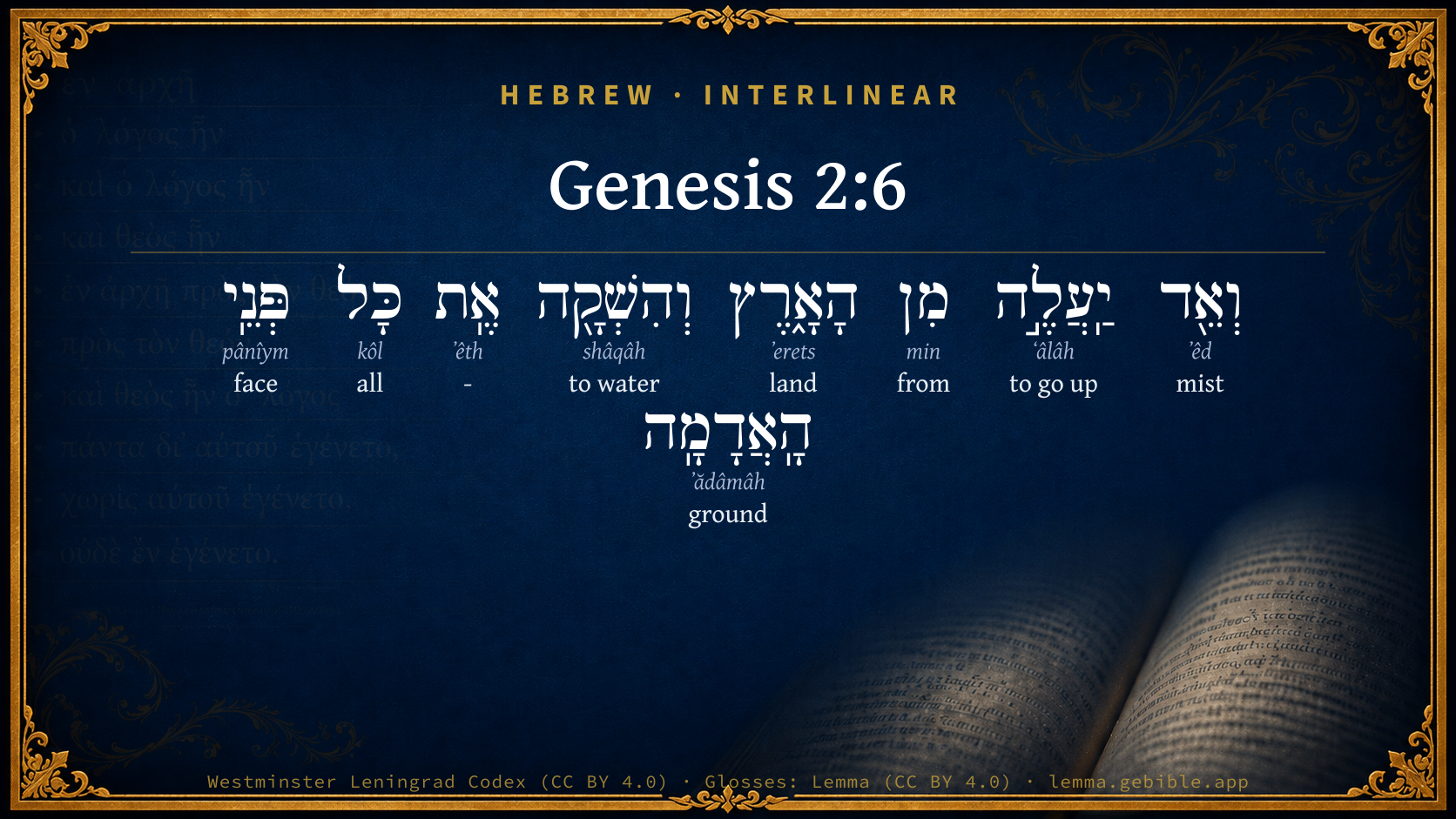
Genesis 2:6

Hebrew (Westminster Leningrad Codex) Genesis 2:6 appears in the Hebrew Old Testament. The text above is from the Westminster Leningrad Codex. Each word links to its Strong’s number, a concise gloss, and parsing drawn from the Open Scriptures Hebrew Bible morphology. Click any word for its full Brown-Driver-Briggs (BDB) entry.
Download image
Cite this verse

Genesis 2:6 (World English Bible). Public Domain. Lemma interlinear Bible study tool, https://lemma.gebible.app/v/genesis/2/6.

Show BibTeX & RIS
BibTeX
RIS
English Translation
but a mist went up from the earth, and watered the whole surface of the ground.
World English Bible · Public Domain
Highlights
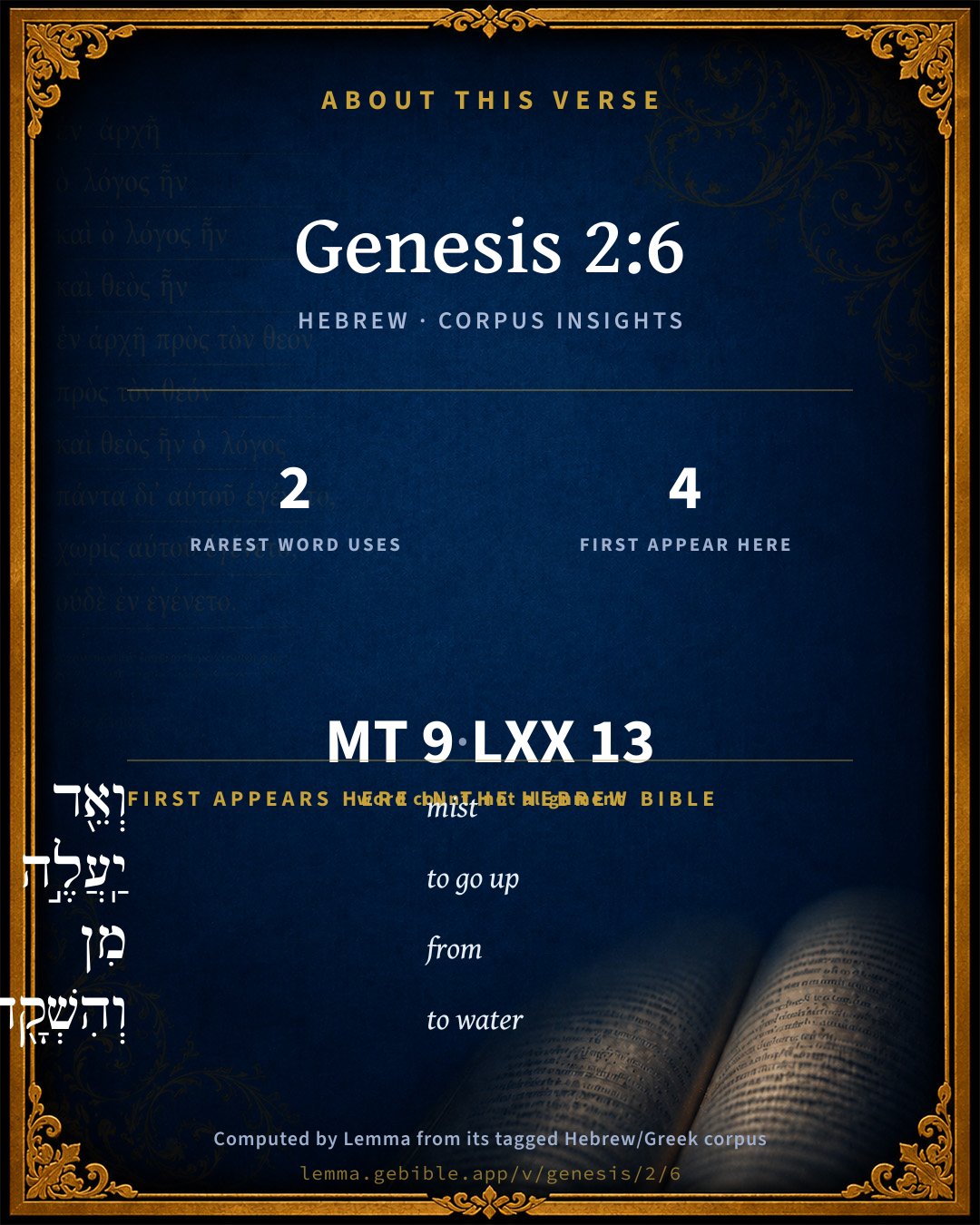
  • 4 first appearances in the Hebrew Bible
Full analysis ↓
Download a study sheet

One document with this verse’s original text, its word-by-word gloss line, the meaning frame, cross-references with their text, attributed commentary, and full source and license credits — printable, and it pastes into notes with its structure intact.

This verse Autodidact and up

Study sheet (.html) Plain text (.txt)

A passage Seminary Student

Up to 50 verses in one chapter. A passage sheet keeps up to 6 commentary sources and 12 cross-references per verse, in the order this page ranks them, and says so on the sheet whenever that leaves anything out. Ask for a single verse and you get the Autodidact verse sheet above.

Everything on this page stays free to read, with no account — the sheet is a download of what is already on screen, not access to it.

Want to remove ads? Support Godless Engineer
Compare translations 3

The same verse in 3 English versions, stacked beneath the original-language interlinear above. Click any original word for its lexicon entry.

Each is an independent rendering of the whole verse — the interlinear is not word-aligned to these translations.

Highlighted words mark where these versions differ — a whole-verse word diff, not a word-by-word alignment.

  • World English Bible Public Domain
    but a mist went up from the earth, and watered the whole surface of the ground.
  • King James Version Public Domain
    But there went up a mist from the earth, and watered the whole face of the ground.
  • unfoldingWord Literal Text CC BY-SA 4.0
    But mist came up from the earth and watered all of the surface of the ground.

unfoldingWord Literal Text — © unfoldingWord, licensed CC BY-SA 4.0. Word-aligned USFM3 via Door43 (git.door43.org/unfoldingWord/en_ult).

Versions to compare (up to 4)

3 of 4 selected

Show all 18 translations

Every available English version of this verse, each an independent rendering of the whole verse.

  • World English Bible Public Domain
    but a mist went up from the earth, and watered the whole surface of the ground.
  • Berean Standard Bible Public Domain
    But springs welled up from the earth and watered the whole surface of the ground.
  • Majority Standard Bible Public Domain
    But springs welled up from the earth and watered the whole surface of the ground.
  • King James Version Public Domain
    But there went up a mist from the earth, and watered the whole face of the ground.
  • American Standard Version (1901) Public Domain
    but there went up a mist from the earth, and watered the whole face of the ground.
  • Revised Version (1885) Public Domain
    but there went up a mist from the earth, and watered the whole face of the ground.
  • Geneva Bible (1599) Public Domain
    But a myst went vp from the earth, and watered all the earth.
  • Douay-Rheims (1899) Public Domain
    But a spring rose out the earth, watering all the surface of the earth.
  • Young's Literal Translation Public Domain
    and a mist goeth up from the earth, and hath watered the whole face of the ground.
  • Literal Standard Version CC BY-SA 4.0
    and a mist goes up from the earth, and has watered the whole face of the ground.
  • Unlocked Literal Bible CC BY-SA 4.0
    But a mist went up from the earth and watered the whole surface of the ground.
  • unfoldingWord Literal Text CC BY-SA 4.0
    But mist came up from the earth and watered all of the surface of the ground.
  • Darby Bible Public Domain
    But a mist went up from the earth, and moistened the whole surface of the ground.
  • World Messianic Bible Public Domain
    but a mist went up from the earth, and watered the whole surface of the ground.
  • Webster's Bible Public Domain
    But there went up a mist from the earth, and watered the whole face of the ground.
  • Free Bible Version CC BY-SA 4.0
    Dew came up from the earth and made the whole surface of the ground wet.
  • Bible in Basic English Public Domain
    But a mist went up from the earth, watering all the face of the land.
  • JPS Tanakh (1917) Public Domain
    but there went up a mist from the earth, and watered the whole face of the ground.

Literal Standard Version (2020), Covenant Press — licensed CC BY-SA 4.0. Text via the HelloAO Bible API (eBible.org). Unlocked Literal Bible (unfoldingWord) — licensed CC BY-SA 4.0. Text via the HelloAO Bible API (eBible.org). unfoldingWord Literal Text — © unfoldingWord, licensed CC BY-SA 4.0. Word-aligned USFM3 via Door43 (git.door43.org/unfoldingWord/en_ult). Free Bible Version, Dr. Jonathan Gallagher — licensed CC BY-SA 4.0. Text via the HelloAO Bible API (eBible.org).

Word by word

More ways to search: Search by grammar → Find every occurrence → Compare this word →

Practice this passage: Drill this verse → Learn its vocabulary →

About this verse

These counts appear in no published source. They are computed here, from the morphology-tagged text and Lemma’s own curated glosses. What Lemma adds →

9
words
9
distinct lemmas
Pentateuch
section

Notable vocabulary

The rarest word here is וְאֵ֖ד mist H108 — appearing just 2 times in the whole Hebrew Bible.

First appearance in Scripture

These words make their first canonical appearance in the Hebrew Bible here:

  • וְאֵ֖ד mist H108
  • יַֽעֲלֶ֣ה to go up H5927
  • מִן from H4480
  • וְהִשְׁקָ֖ה to water H8248

Shared distinctive vocabulary

וְאֵ֖ד mist H108 occurs in 2 verses of the Hebrew Bible. Also found in:

Grammatical profile

  • 2 verbs
  • 5 nouns
  • 1 preposition
  • 1 particle

Verb forms

  • יַֽעֲלֶ֣ה Qal · Imperfect
  • וְהִשְׁקָ֖ה Hiphil · Sequential Perfect

Hebrew & Septuagint length

In English translation the verse runs 16 words from the Hebrew and 17 from the Septuagint (LXX English) — closely comparable.

A rough comparison of the two English renderings, which tokenize alike — not a word-level alignment.

Word counts can differ between the Hebrew and the Greek without any difference in meaning — e.g. the Hebrew direct-object marker אֵת has no separate Greek word, and Greek often adds the article ὁ.

In the original languages it is 9 Hebrew tokens and 13 Greek tokens — but the two are counted differently (Hebrew bundles its prefixes and suffixes into one token; the Greek is in lemma form), so that isn’t a like-for-like length.

Hebrew and Greek witnesses Masoretic Hebrew ↔ Greek Septuagint

The same verse in the two great witnesses to the Old Testament, shown verse-for-verse.

These are two independent witnesses, not word-aligned to each other, and the Septuagint is shown in lemma (dictionary) form.

Hebrew Genesis 2:6 Masoretic · Westminster Leningrad Codex

וְאֵ֖ד יַֽעֲלֶ֣ה מִן הָאָ֑רֶץ וְהִשְׁקָ֖ה אֶֽת כָּל פְּנֵֽי הָֽאֲדָמָֽה

but a mist went up from the earth, and watered the whole surface of the ground.

World English Bible · Public Domain

Greek LXX Genesis 2:6 Septuagint · lemma form

πηγή δέ ἀναβαίνω ἐκ ὁ γῆ καί ποτίζω πᾶς ὁ πρόσωπον ὁ γῆ

But there rose a fountain out of the earth, and watered the whole face of the earth.

LXX2012 (modern English Septuagint) · Public Domain

On this verse, The Cambridge Bible for Schools and Colleges discusses the Septuagint’s reading. Read the note in Commentary ↓

Hebrew: Westminster Leningrad Codex (CC BY 4.0). Greek: Septuagint (public domain); English from LXX2012 (modern English Septuagint) (Public Domain). How the Septuagint differs from the Hebrew →

Targum (Aramaic paraphrase)

2

The Targum is the ancient Jewish Aramaic paraphrase of the Hebrew Scriptures — an interpretive translation, not the Hebrew text itself. Onkelos (literal) and Pseudo-Jonathan (expansive) render the Torah, and Jonathan the Prophets. Coverage is partial: where no permissively-licensed English translation exists for a verse, only the Aramaic is shown. This is verse-level text, not a word-by-word alignment to the Hebrew.

  1. Targum Onkelos Torah (Genesis–Deuteronomy)
    וַעֲנָנָא הֲוָה סָלֵיק מִן אַרְעָא וְאַשְׁקֵי יָת כָּל אַפֵּי אַדְמְתָא

    (no public-domain English translation for this verse)

    Targum Onkelos — Aramaic: “Onkelos Genesis” (public domain); “Onkelos Exodus” (public domain); “Onkelos Leviticus” (public domain); “Onkelos Numbers” (public domain); “Onkelos Deuteronomy” (public domain). English: “Sefaria Community Translation” (CC0 1.0 (public-domain dedication)); “J.W. Etheridge. The Targums of Onkelos and Jonathan Ben Uzziel on the Pentateuch. London: Longmans, Green, 1862” (public domain). Text via Sefaria.

  2. Targum Pseudo-Jonathan Torah (Genesis–Deuteronomy)
    וַעֲנַן יְקָרָא הֲוָה נָחִית מִתְּחוֹת כּוּרְסֵי יְקָרָא וּמְלֵי מַיָא מִן אוֹקְיָינוֹס וְהָדָר סַלִיק מִן אַרְעָא וּמָחִית מִטְרָא וּמַשְׁקֵי יַת כָּל אַפֵּי אַדְמָתָא

    But a cloud of glory descended from the throne of glory, and was filled with waters from the ocean, and afterward went up from the earth, and gave rain to come down and water all the face of the ground.

    Targum Pseudo-Jonathan — Aramaic: “Targum Jonathan on Genesis” (public domain); “Targum Jonathan on Exodus” (public domain); “Targum Jonathan on Leviticus” (public domain); “Targum Jonathan on Numbers” (public domain); “Targum Jonathan on Deuteronomy” (public domain). English: “The Targum of Jonathan ben Uzziel, trans. J. W. Etheridge, London, 1862” (public domain). Text via Sefaria.

Commentary

Notes on Genesis 2:6 from classic Christian and Jewish commentators (each source and its license shown beneath its notes). The classic Christian expositions comment on the surrounding passage and are grouped to its opening verse, so a note may address several verses; the Jewish commentaries on the Tanakh (Rashi and others) are per-verse, so they appear only where the commentator wrote on this verse.

Lemma curates 59 commentaries, every one of them public domain or Creative Commons licensed, each selected and text-cleaned for this edition rather than reprinted as found. About our sources →

Adam Clarke's Commentary

Verse 6. There went up a mist] This passage appears to have greatly embarrassed many commentators. The plain meaning seems to be this, that the aqueous vapours, ascending from the earth, and becoming condensed in the colder regions of the atmosphere, fell back upon the earth in the form of dews, and by this means an equal portion of moisture was distributed to the roots of plants, &c. As Moses had said, Ge 2:5, that the Lord had not caused it to rain upon the earth, he probably designed to teach us, in Ge 2:6, how rain is produced, viz., by the condensation of the aqueous vapours, which are generally through the heat of the sun and other causes raised to a considerable height in the atmosphere, where, meeting with cold air, the watery particles which were before so small and light that they could float in the air, becoming condensed, i.e., many drops being driven into one, become too heavy to be any longer suspended, and then, through their own gravity, fall down in the form which we term rain.

Adam Clarke's Commentary on the Bible (1810–1826) — public domain. Text from a community e-Sword/MySword module.

Trapp's Complete Commentary

John Trapp

Gen 2:6 But there went up a mist from the earth, and watered the whole face of the ground.

Ver. 6. But there went up a mist.] The matter of rain: and hereby God tempered the mortar whereof he would make man, as he did the clay with spittle, wherewith he cured the blind. {Joh 9:6}

John Trapp, A Commentary or Exposition upon All the Books of the Old and New Testament (1647–1656) — public domain. Text from a community e-Sword module.

Joseph Benson's Commentary

Gen 2:6. There went up — At certain times, it seems, as God appointed; a mist or vapour from the earth — Issuing from the abyss, or great deep of water in its bowels; (see Gen 7:14;) and watered the whole face of the ground — Not with rain, but with dew. By this the earth was softened and fitted to nourish the plants of all kinds already created, and the seeds and roots of these that they might produce new plants.

Joseph Benson's Commentary on the Old and New Testaments (1811–1818) — public domain. Text from a community e-Sword module.

Tyndale Open Study Notes

Tyndale Open Resources

2:6 springs: The word refers to subterranean springs that rose to the surface of the ground.

Tyndale Open Study Notes — © Tyndale Open Resources, licensed CC BY-SA 4.0. Text via the HelloAO Bible API.

Ellicott's Commentary for English Readers

(6) A mist.—This mist, as we learn from Job_36:27, where the same word is translated vapour, is the measure and material of the rain, and thus there was already preparation for the Divine method of watering the earth, and making it capable of producing food for man. But, as we gather from Genesis 1, vast periods of indefinite length intervened between the first rain and the creation of man; and in each of them numerous series of animals were introduced, adapted each to the geologic condition of its time. All this now is rapidly passed over, and three points only lightly touched: namely, first, the earth saturated with vapour, and unfit for man; secondly, the vapour condensing into rain, and the earth growing fit for man; thirdly, man.

A Bible Commentary for English Readers, edited by Charles John Ellicott (1878–1897) — public domain. Text from a community e-Sword module.

The Cambridge Bible for Schools and Colleges

gen. ed. J. J. S. Perowne

6. there went up] or “there used to go up,” i.e. periodically. The frequentative idea of the verb is given in the LXX ἀνέβαινεν, Lat. ascendebat.

a mist] Heb. ’êd, a word found elsewhere in the O.T. only in Job_36:27, where it is rendered “vapour.” Here the meaning is not certain: the versions (LXX πηγή: Lat. fons: Targum “cloud”) reflect the doubt. The English versions follow the Targum. Recently, Assyriologists have compared the Babylonian êdû, meaning a “flood” or “overflowing.” It is possible that the rendering “spring” or “stream” maybe more accurate than “mist”; that in Job_36:27 ’êd may denote the “source” of the waters above the heavens; and that here it may refer to the hidden source of the rivers of the world. No account is given of the origin of rain.

watered] Literally, “gave to drink”; an expression better suited to a “stream” than to a “mist”: cf. Gen_2:10, where it is used of a river. “The ground,” the face of which was watered by it, was “the cultivable soil” (adâmah).

The Cambridge Bible for Schools and Colleges (gen. ed. J. J. S. Perowne; Cambridge University Press, 1878–1918) — public domain. Text from a community e-Sword module.

John Gill's Exposition

But there went up a mist from the earth,.... After the waters had been drained off from it, and it was warmed by the body of light and heat created on the first day, which caused a vapour, which went up as a mist, and descended:

and watered the whole face of the ground; or earth, and so supplied the place of rain, until that was given: though rather the words may be rendered disjunctively, "or there went up" (g); that is, before a mist went up, when as yet there was none; not so much as a mist to water the earth, and plants and herbs were made to grow; and so Saadiah reads them negatively, "nor did a mist go up"; there were no vapours exhaled to form clouds, and produce rain, and yet the whole earth on the third day was covered with plants and herbs; and this is approved of by Kimchi and Ben Melech.

(g) "aut vapor ascendens", Junius & Tremellius.

John Gill's Exposition of the Whole Bible (1746–1763) — public domain (CC PDM 1.0). Text via the HelloAO Bible API.

Matthew Poole's English Annotations

There went up, from time to time, by God’s appointment, a vapour, or cloud, which going up into the air, was turned into rain, and fell down again to the earth from whence it arose; whereby the earth was softened, and disposed both to the nourishment of those plants or trees that were created, and to the production of new plants in a natural and ordinary way. But these words may be otherwise understood, the copulative and, here rendered but, being put for the disjunctive

or, as it is Exo 21:15,17; Job 6:22; 8:3, and in other places. Or, the negative particle not may be understood out of the foregoing clause, as it is usual in the Hebrew language, as Psa 1:5; 9:17; 44:19; 50:8; Isa 28:27-28. And so these words may be joined with the foregoing, and both translated in this manner,

There was no rain, nor a man to till the ground, or (or nor, for both come to one thing) so much as

a mist which went up from the earth, and watered (as afterwards was usual and natural) the whole face of the ground.

Matthew Poole's English Annotations on the Holy Bible (1683–1685) — public domain. Text from a community e-Sword/MySword module.

Whedon's Commentary on the Bible

Daniel D. Whedon

6. A mist — אד, a mist, a vapour. This first watering of the whole face of the ground was accomplished by an ascending vapour. Here is no mention of rain falling; but rather of mist going up. Perhaps, however, the one thought is designed to imply the other. The sacred writer thus also intimates how the vast reservoir of “waters above the firmament” (Gen_1:7) were thenceforth to be supplied.

Daniel D. Whedon (gen. ed.), Commentary on the Old and New Testaments (1874–1909) — public domain. Text from a community e-Sword module.

The Pulpit Commentary

But there went up a mist from the earth, and watered the whole face of the ground. The dry land having been separated from the waters, and the atmospheric ocean uplifted above them both, vaporous exhalations began to ascend to the aerial regions, and to return again in the shape of rain upon the ground. Jehovah thus caused it to rain upon the ground, and so prepared it for the vegetation which, in obedience to the Almighty fiat, sprung up at the close of the third day, although the writer does not mention its appearance, but leaves it to be inferred from the preceding section. That soon after its emergence from the waters the land should be "dry, sterile, and sandy" will not be thought remarkable if we remember the highly igneous condition of our planet at the time when the dry land was upheaved and the waters gathered into the subsiding valleys. Nothing would more naturally follow that event than the steaming up of vapors to float in the aerial sea. In fact, the rapidity with which evaporation would be carried on would very speedily leave the newly-formed land hard and dry, baked and caked into a crust, till the atmosphere, becoming overcharged with aqueous vapor, returned it in the shape of rain. To talk of insuperable difficulty and manifest dissonance where everything is clear, natural, and harmonious is to speak at random, and betrays an anxiety to create contradictions rather than to solve them.

The Pulpit Commentary (1880–1919), ed. H.D.M. Spence-Jones & Joseph S. Exell — public domain. Text from a community e-Sword module.

Rashi

Rabbi Shlomo Yitzchaki (Rashi)

ואד יעלה AND A MIST WENT UP — This has reference to the creation of Adam: viz., He caused the deep to rise and filled the clouds with water to moisten the dust, and man was created. It is like a kneader of bread who first pours in water and afterwards kneads the dough — similarly here: He first watered the ground and afterwards He formed man (Genesis Rabbah 14:1).

Rashi on the Tanakh — English translations: “The Judaica Press complete Tanach with Rashi, translated by A. J. Rosenberg” (CC BY 4.0); “Pentateuch with Rashi's commentary by M. Rosenbaum and A.M. Silbermann, 1929-1934” (public domain); “The Metsudah Tanach series, Lakewood, N.J” (CC BY 4.0); and “The Book of Joshua, Metsudah Publications, 1997” (CC BY 4.0). Text via Sefaria.

Lesson kit

Teaching starters — assembled from the data on this page, not authored interpretation. Every prompt links to the verse data it draws on. Edit before teaching.

Genesis, in the Pentateuch, opens this verse with 9 words (9 distinct Hebrew lemmas). Its most distinctive word is ʼêd (“mist”). A historical commentator’s framing appears above. Read the whole chapter for the surrounding context.

Discussion questions

  1. What does “mist” (ʼêd) contribute to the verse as a whole?
  2. 4 words here appear for the first time in Scripture. What is being introduced at this debut?
  3. Job 36:27 shares the word «mist» with this verse. How do the two illuminate each other?
  4. These translations render this verse differently; the difference is in the English rendering, not the original. What questions does that raise?
  5. The verb «יַֽעֲלֶ֣ה» is Qal Imperfect. How does its form color the action?
  6. Reading how Adam Clarke's Commentary and Trapp's Complete Commentary read this verse, where do the two commentators agree and where do they part?

Things to notice

Reading settings

Reading text

Shown beneath each verse's original-language words.

Old Testament
Old Testament edition

Read the OT as the Masoretic Hebrew (MT) or the Greek Septuagint (LXX).

English shown for the Greek Septuagint (in the Hebrew ↔ Greek comparison).

Comparing translations? Open the Compare panel on any verse page to stack up to four side by side.