
Deuteronomy 12:14

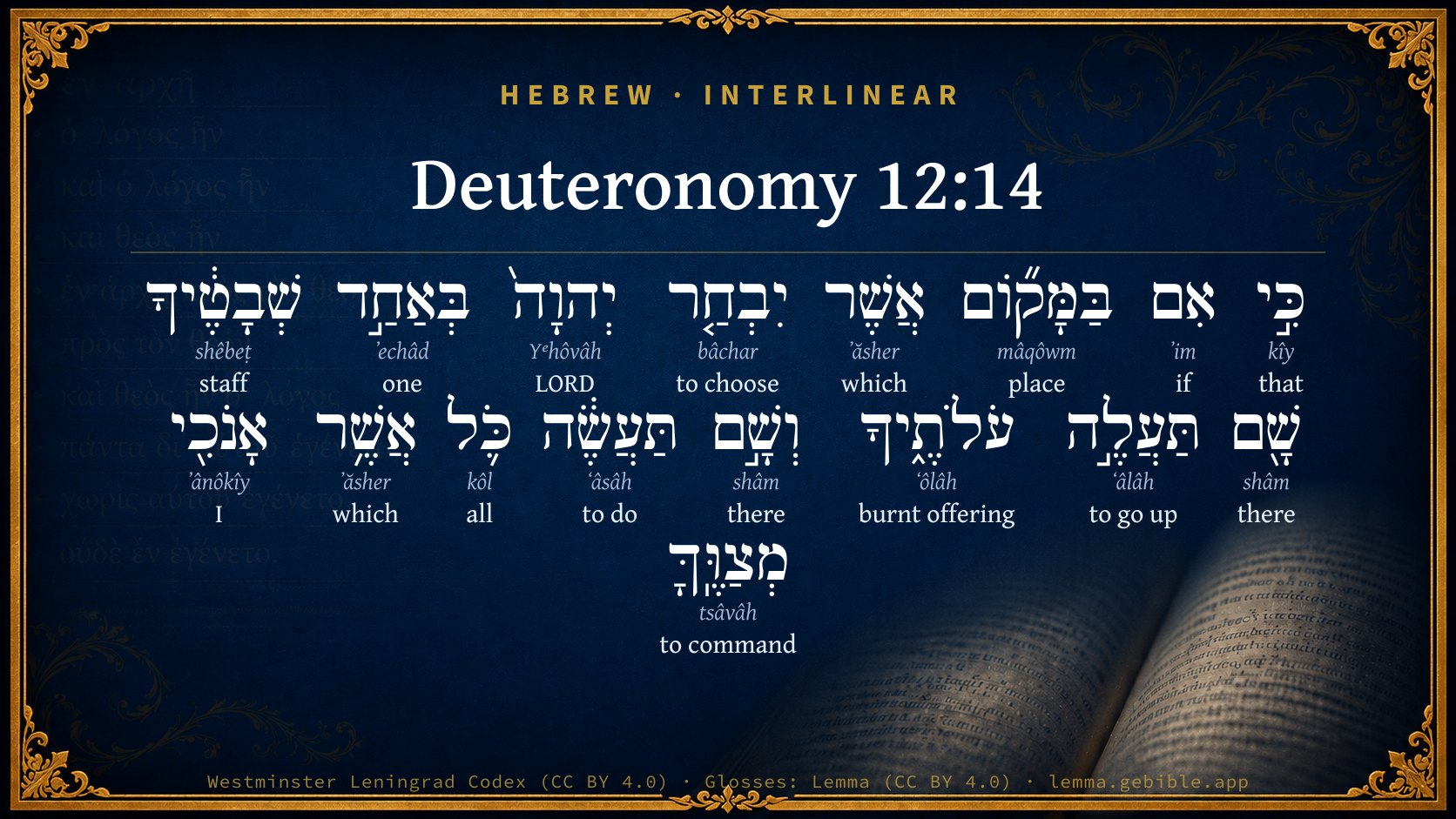
Hebrew (Westminster Leningrad Codex) Deuteronomy 12:14 appears in the Hebrew Old Testament. The text above is from the Westminster Leningrad Codex. Each word links to its Strong’s number, a concise gloss, and parsing drawn from the Open Scriptures Hebrew Bible morphology. Click any word for its full Brown-Driver-Briggs (BDB) entry.
Download image
Cite this verse

Deuteronomy 12:14 (World English Bible). Public Domain. Lemma interlinear Bible study tool, https://lemma.gebible.app/v/deuteronomy/12/14.

Show BibTeX & RIS
BibTeX
RIS
English Translation
but in the place which Yahweh shall choose in one of your tribes, there you shall offer your burnt offerings, and there you shall do all that I command you.
World English Bible · Public Domain
Download a study sheet

One document with this verse’s original text, its word-by-word gloss line, the meaning frame, cross-references with their text, attributed commentary, and full source and license credits — printable, and it pastes into notes with its structure intact.

This verse Autodidact and up

Study sheet (.html) Plain text (.txt)

A passage Seminary Student

Up to 50 verses in one chapter. A passage sheet keeps up to 6 commentary sources and 12 cross-references per verse, in the order this page ranks them, and says so on the sheet whenever that leaves anything out. Ask for a single verse and you get the Autodidact verse sheet above.

Everything on this page stays free to read, with no account — the sheet is a download of what is already on screen, not access to it.

Want to remove ads? Support Godless Engineer
Compare translations 3

The same verse in 3 English versions, stacked beneath the original-language interlinear above. Click any original word for its lexicon entry.

Each is an independent rendering of the whole verse — the interlinear is not word-aligned to these translations.

Highlighted words mark where these versions differ — a whole-verse word diff, not a word-by-word alignment.

  • World English Bible Public Domain
    but in the place which Yahweh shall choose in one of your tribes, there you shall offer your burnt offerings, and there you shall do all that I command you.
  • King James Version Public Domain
    But in the place which the LORD shall choose in one of thy tribes, there thou shalt offer thy burnt offerings, and there thou shalt do all that I command thee.
  • unfoldingWord Literal Text CC BY-SA 4.0
    except at the place that Yahweh will choose in one of your tribes, there you will offer your burnt offerings, and there you will do everything that I command you.

unfoldingWord Literal Text — © unfoldingWord, licensed CC BY-SA 4.0. Word-aligned USFM3 via Door43 (git.door43.org/unfoldingWord/en_ult).

Versions to compare (up to 4)

3 of 4 selected

Show all 18 translations

Every available English version of this verse, each an independent rendering of the whole verse.

  • World English Bible Public Domain
    but in the place which Yahweh shall choose in one of your tribes, there you shall offer your burnt offerings, and there you shall do all that I command you.
  • Berean Standard Bible Public Domain
    you must offer them only in the place the LORD will choose in one of your tribal territories, and there you shall do all that I command you.
  • Majority Standard Bible Public Domain
    you must offer them only in the place the LORD will choose in one of your tribal territories, and there you shall do all that I command you.
  • King James Version Public Domain
    But in the place which the LORD shall choose in one of thy tribes, there thou shalt offer thy burnt offerings, and there thou shalt do all that I command thee.
  • American Standard Version (1901) Public Domain
    but in the place which Jehovah shall choose in one of thy tribes, there thou shalt offer thy burnt-offerings, and there thou shalt do all that I command thee.
  • Revised Version (1885) Public Domain
    but in the place which the LORD shall choose in one of thy tribes, there thou shalt offer thy burnt offerings, and there thou shalt do all that I command thee.
  • Geneva Bible (1599) Public Domain
    But in ye place which the Lord shall chose in one of thy tribes, there thou shalt offer thy burnt offrings, and there thou shalt doe all that I commaund thee.
  • Douay-Rheims (1899) Public Domain
    But in the place which the Lord shall choose in one of thy tribes shalt thou offer sacrifices. and shalt do all that I command thee.
  • Young's Literal Translation Public Domain
    except in the place which Jehovah doth choose in one of thy tribes, there thou dost cause thy burnt-offerings to ascend, and there thou dost do all that which I am commanding thee.
  • Literal Standard Version CC BY-SA 4.0
    rather—that in the place which YHWH chooses in one of your tribes, there you cause your burnt-offerings to ascend, and there you do all that which I am commanding you.
  • Unlocked Literal Bible CC BY-SA 4.0
    but it is at the place that Yahweh will choose among one of your tribes that you will offer your burnt offerings, and there you will do everything that I command you.
  • unfoldingWord Literal Text CC BY-SA 4.0
    except at the place that Yahweh will choose in one of your tribes, there you will offer your burnt offerings, and there you will do everything that I command you.
  • Darby Bible Public Domain
    but in the place which Jehovah will choose in one of thy tribes, there thou shalt offer thy burnt-offerings, and there thou shalt do all that I command thee.
  • World Messianic Bible Public Domain
    but in the place which the LORD chooses in one of your tribes, there you shall offer your burnt offerings, and there you shall do all that I command you.
  • Webster's Bible Public Domain
    But in the place which the LORD shall choose in one of thy tribes, there thou shalt offer thy burnt-offerings, and there thou shalt do all that I command thee.
  • Free Bible Version CC BY-SA 4.0
    You are to offer them only in the place the Lord will choose in the territory of one of your tribes. That's where you are to do everything that I order you to do.
  • Bible in Basic English Public Domain
    But in the place marked out by the Lord in one of your tribes, there let your burned offerings be offered, and there do what I have given you orders to do.
  • JPS Tanakh (1917) Public Domain
    but in the place which the LORD shall choose in one of thy tribes, there thou shalt offer thy burnt-offerings, and there thou shalt do all that I command thee.

Literal Standard Version (2020), Covenant Press — licensed CC BY-SA 4.0. Text via the HelloAO Bible API (eBible.org). Unlocked Literal Bible (unfoldingWord) — licensed CC BY-SA 4.0. Text via the HelloAO Bible API (eBible.org). unfoldingWord Literal Text — © unfoldingWord, licensed CC BY-SA 4.0. Word-aligned USFM3 via Door43 (git.door43.org/unfoldingWord/en_ult). Free Bible Version, Dr. Jonathan Gallagher — licensed CC BY-SA 4.0. Text via the HelloAO Bible API (eBible.org).

Word by word

More ways to search: Search by grammar → Find every occurrence → Compare this word →

Practice this passage: Drill this verse → Learn its vocabulary →

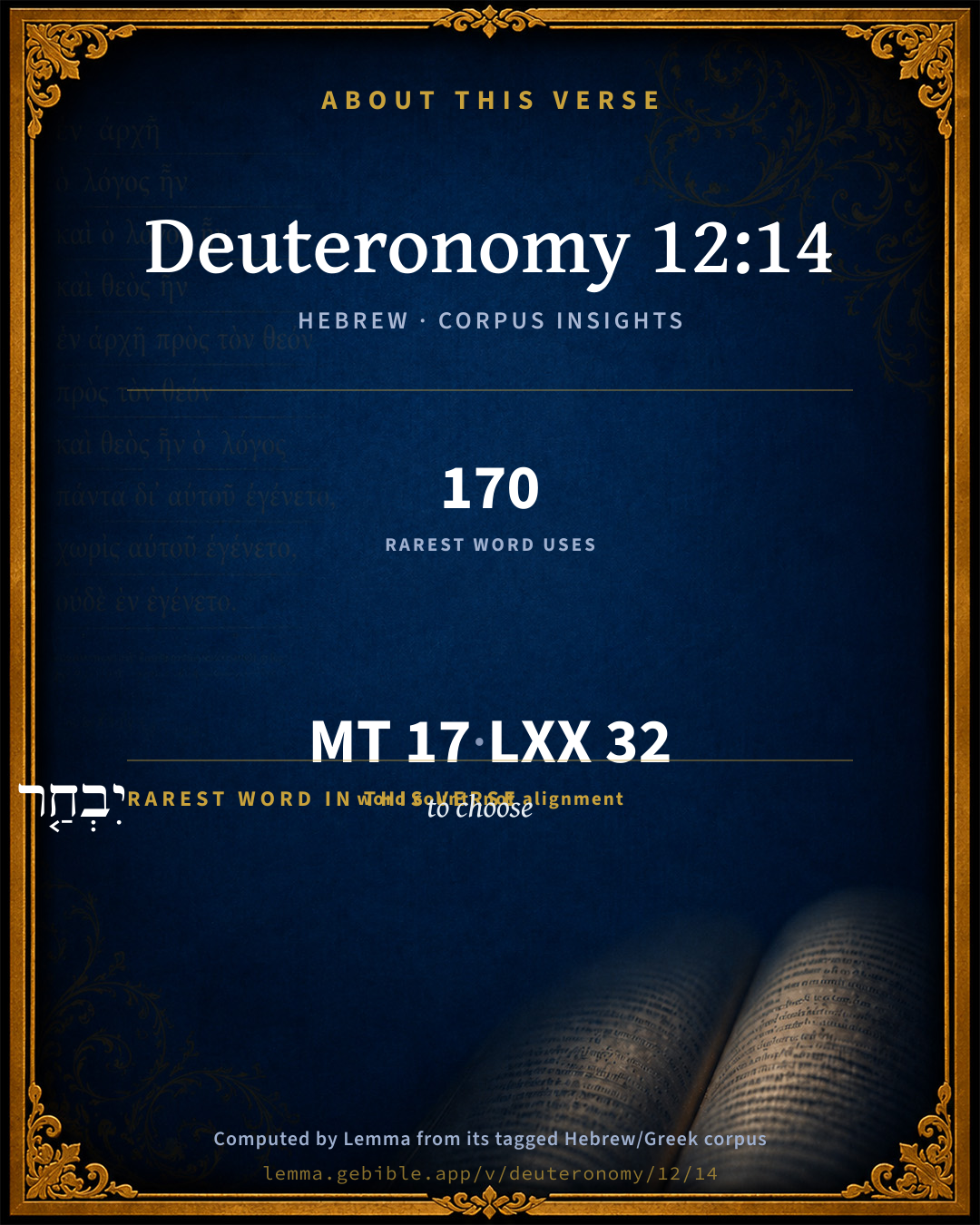
יִבְחַ֤ר
bâchar
H977
“to choose”
Verb, Qal, Imperfect, 3rd Person, Masculine, Singular
Part of Speech
Verb
Stem
Qal
Form
Imperfect
Person
3rd Person
Gender
Masculine
Number
Singular
Full BDB Definition

Origin: a primitive root

TWOT: 231

to choose, elect, decide for - (Qal) to choose - (Niphal) to be chosen - (Pual) to be chosen, selected
  1. כִּ֣י kîy H3588 “that” Conjunction
  2. אִם ʼim H518 “if” Conjunction
  3. בַּמָּק֞וֹם mâqôwm H4725 “in/at the · place” Preposition, Determined + Noun, Common, Masculine, Singular, Absolute
  4. אֲשֶׁר ʼăsher H834 “which” Particle, Relative
  5. יְהוָה֙ Yᵉhôvâh H3068 “LORD” Noun, Proper
  6. בְּאַחַ֣ד ʼechâd H259 “in/at · one” Preposition + Adjective, Cardinal number, Masculine, Singular, Construct
  7. שְׁבָטֶ֔יךָ shêbeṭ H7626 “staffs · your” Noun, Common, Masculine, Plural, Construct + Suffix, Personal, 2nd Person, Masculine, Singular
  8. שָׁ֖ם shâm H8033 “there” Adverb
  9. תַּעֲלֶ֣ה ʻâlâh H5927 “to go up” Verb, Hiphil, Imperfect, 2nd Person, Masculine, Singular
  10. עֹלֹתֶ֑יךָ ʻôlâh H5930 “burnt offerings · your” Noun, Common, Feminine, Plural, Construct + Suffix, Personal, 2nd Person, Masculine, Singular
  11. וְשָׁ֣ם shâm H8033 “and · there” Conjunction + Adverb
  12. תַּעֲשֶׂ֔ה ʻâsâh H6213 “to do” Verb, Qal, Imperfect, 2nd Person, Masculine, Singular
  13. כֹּ֛ל kôl H3605 “all” Noun, Common, Masculine, Singular, Absolute
  14. אֲשֶׁ֥ר ʼăsher H834 “which” Particle, Relative
  15. אָנֹכִ֖י ʼânôkîy H595 “I” Pronoun, Personal, 1st Person, Common, Singular
  16. מְצַוֶּֽךָּ tsâvâh H6680 “commanding · you” Verb, Piel, Participle Active, Masculine, Singular, Construct + Suffix, Personal, 2nd Person, Masculine, Singular

About this verse

These counts appear in no published source. They are computed here, from the morphology-tagged text and Lemma’s own curated glosses. What Lemma adds →

17
words
15
distinct lemmas
Pentateuch
section

Grammatical profile

  • 4 verbs
  • 5 nouns
  • 1 adjective
  • 1 pronoun
  • 2 conjunctions
  • 2 adverbs
  • 2 particles

Verb forms

  • יִבְחַ֤ר Qal · Imperfect
  • תַּעֲלֶ֣ה Hiphil · Imperfect
  • תַּעֲשֶׂ֔ה Qal · Imperfect
  • מְצַוֶּֽךָּ Piel · Participle Active

Repetition

Words recur within this verse — often emphatic in Hebrew:

  • שָׁ֖ם there H8033 ×2
  • אֲשֶׁר which H834 ×2

Hebrew & Septuagint length

In English translation the verse runs 30 words from the Hebrew and 37 from the Septuagint (LXX English) — closely comparable.

A rough comparison of the two English renderings, which tokenize alike — not a word-level alignment.

Word counts can differ between the Hebrew and the Greek without any difference in meaning — e.g. the Hebrew direct-object marker אֵת has no separate Greek word, and Greek often adds the article ὁ.

In the original languages it is 17 Hebrew tokens and 32 Greek tokens — but the two are counted differently (Hebrew bundles its prefixes and suffixes into one token; the Greek is in lemma form), so that isn’t a like-for-like length.

Cross-references

7

Topical passages linked to Deuteronomy 12:14 in the Treasury of Scripture Knowledge — connected by theme and wording, ordered by reader-vote popularity; previews shown in the World English Bible.

  • Deuteronomy 12:5 But to the place which Yahweh your God shall choose out of all your tribes, to put his name there, even to his habitation shall you seek, and there you shall come;
  • Deuteronomy 12:11 then it shall happen that to the place which Yahweh your God shall choose, to cause his name to dwell there, there shall you bring all that I command you: your burnt offerings, and your sacrifices, your tithes, and the heave-offering of your hand, and all your choice vows which you vow to Yahweh.
  • 2 Corinthians 5:19 namely, that God was in Christ reconciling the world to himself, not reckoning to them their trespasses, and having committed to us the word of reconciliation.
  • Psalms 5:7 But as for me, in the abundance of your loving kindness I will come into your house: I will bow toward your holy temple in reverence of you.
  • Psalms 9:11 Sing praises to Yahweh, who dwells in Zion, And declare among the people what he has done.
  • Hebrews 10:19–22 Having therefore, brothers, boldness to enter into the holy place by the blood of Jesus,
  • Hebrews 13:15 Through him, then, let us offer up a sacrifice of praise to God continually, that is, the fruit of lips which make confession to his name.

Cross-references courtesy of OpenBible.info (CC BY 4.0).

Hebrew and Greek witnesses Masoretic Hebrew ↔ Greek Septuagint

The same verse in the two great witnesses to the Old Testament, shown verse-for-verse.

These are two independent witnesses, not word-aligned to each other, and the Septuagint is shown in lemma (dictionary) form.

Hebrew Deuteronomy 12:14 Masoretic · Westminster Leningrad Codex

כִּ֣י אִם בַּמָּק֞וֹם אֲשֶׁר יִבְחַ֤ר יְהוָה֙ בְּאַחַ֣ד שְׁבָטֶ֔יךָ שָׁ֖ם תַּעֲלֶ֣ה עֹלֹתֶ֑יךָ וְשָׁ֣ם תַּעֲשֶׂ֔ה כֹּ֛ל אֲשֶׁ֥ר אָנֹכִ֖י מְצַוֶּֽךָּ

but in the place which Yahweh shall choose in one of your tribes, there you shall offer your burnt offerings, and there you shall do all that I command you.

World English Bible · Public Domain

Greek LXX Deuteronomy 12:14 Septuagint · lemma form

ἀλλά ἤ εἰς ὁ τόπος ὅς ἄν ἐκλέγω κύριος ὁ θεός σύ αὐτός ἐν εἷς ὁ φυλή σύ ἐκεῖ ἀναφέρω ὁ ὁλοκαύτωμα σύ καί ἐκεῖ ποιέω πᾶς ὅσος ἐγώ ἐντέλλομαι σύ σήμερον

save in the place which the Lord your God shall choose, in one of your tribes, there shall you⌃ offer your whole burnt offerings, and there shall you do all things whatever I charge you this day.

LXX2012 (modern English Septuagint) · Public Domain

Hebrew: Westminster Leningrad Codex (CC BY 4.0). Greek: Septuagint (public domain); English from LXX2012 (modern English Septuagint) (Public Domain). How the Septuagint differs from the Hebrew →

Targum (Aramaic paraphrase)

2

The Targum is the ancient Jewish Aramaic paraphrase of the Hebrew Scriptures — an interpretive translation, not the Hebrew text itself. Onkelos (literal) and Pseudo-Jonathan (expansive) render the Torah, and Jonathan the Prophets. Coverage is partial: where no permissively-licensed English translation exists for a verse, only the Aramaic is shown. This is verse-level text, not a word-by-word alignment to the Hebrew.

  1. Targum Onkelos Torah (Genesis–Deuteronomy)
    אֶלָהֵן בְּאַתְרָא דִי יִתִּרְעֵי יְיָ בְּחַד מִן שִׁבְטָיךְ תַּמָן תַּסֵק עֲלָוָתָךְ וְתַמָן תַּעְבֵּד כֹּל דִי אֲנָא מְפַקְדָךְ

    (no public-domain English translation for this verse)

    Targum Onkelos — Aramaic: “Onkelos Genesis” (public domain); “Onkelos Exodus” (public domain); “Onkelos Leviticus” (public domain); “Onkelos Numbers” (public domain); “Onkelos Deuteronomy” (public domain). English: “Sefaria Community Translation” (CC0 1.0 (public-domain dedication)); “J.W. Etheridge. The Targums of Onkelos and Jonathan Ben Uzziel on the Pentateuch. London: Longmans, Green, 1862” (public domain). Text via Sefaria.

  2. Targum Pseudo-Jonathan Torah (Genesis–Deuteronomy)
    אֱלָהֵן לְאַתְרָא דְיִתְרְעֵי יְיָ בְּאַחֲסָנַת חַד מִן שִׁבְטֵיכוֹן תַּמָּן תִּסְקוּן עֲלָוַותְכוֹן וְתַמָּן תַּעַבְדוּן יַת כָּל מַה דַאֲנָא מְפַקֵּיד לְכוֹן

    but in the Place which the Lord will choose in the inheritance of one of your tribes, there shall you offer your sacrifices and do whatever I command you.

    Targum Pseudo-Jonathan — Aramaic: “Targum Jonathan on Genesis” (public domain); “Targum Jonathan on Exodus” (public domain); “Targum Jonathan on Leviticus” (public domain); “Targum Jonathan on Numbers” (public domain); “Targum Jonathan on Deuteronomy” (public domain). English: “The Targum of Jonathan ben Uzziel, trans. J. W. Etheridge, London, 1862” (public domain). Text via Sefaria.

Commentary

Notes on Deuteronomy 12:14 from classic Christian and Jewish commentators (each source and its license shown beneath its notes). The classic Christian expositions comment on the surrounding passage and are grouped to its opening verse, so a note may address several verses; the Jewish commentaries on the Tanakh (Rashi and others) are per-verse, so they appear only where the commentator wrote on this verse.

Lemma curates 59 commentaries, every one of them public domain or Creative Commons licensed, each selected and text-cleaned for this edition rather than reprinted as found. About our sources →

Trapp's Complete Commentary

John Trapp

Deu 12:14 But in the place which the LORD shall choose in one of thy tribes, there thou shalt offer thy burnt offerings, and there thou shalt do all that I command thee.

Ver. 14. But in the place.] This taught them unity and uniformity in divine worship; as also that there was but one only way to obtain pardon of their sin, and acceptance of their services, viz., by Jesus Christ, of whom their tabernacle and temple was a type.

John Trapp, A Commentary or Exposition upon All the Books of the Old and New Testament (1647–1656) — public domain. Text from a community e-Sword module.

Geneva Bible (1599)

Geneva Bible translators

As was declared ever by the placing of the Ark, as in Shiloh 243 years, or as some write more than 300 years, and in other places till the temple was built.

Geneva Bible (1599) marginal notes — public domain. Text via Bolls.life.

Adam Clarke's Commentary

Verse 14. The place which the Lord shall choose] To prevent idolatry and bring about a perfect uniformity in the Divine worship, which at that time was essentially necessary; because every rite and ceremony had a determinate meaning, and pointed out the good things which were to come, therefore one place must be established where those rites and ceremonies should be carefully and punctually observed. Had it not been so, every man would have formed his worship according to his own mind, and the whole beauty and importance of the grand representative system would have been destroyed, and the Messiah and the glories of his kingdom could not have been seen through the medium of the Jewish ritual. For uniformity in every part of the Divine worship the same necessity does not now exist; because that which was typified is come, and the shadows have all fled away. Yet, when it can be obtained, how desirable is it that all sincere Christians should with one mouth, as well as with one heart, glorify their common Lord and Saviour!

Adam Clarke's Commentary on the Bible (1810–1826) — public domain. Text from a community e-Sword/MySword module.

John Gill's Exposition

But in the place which the Lord shall choose in one of thy tribes,.... Which tribe is not named, nor what place in that tribe; See Gill on Deu 12:5,

there thou shalt offer thy burnt offerings; on the altar of burnt offering there placed:

and there shalt thou do all that I command thee; respecting sanctuary service, and particularly those things observed in Deu 12:6.

John Gill's Exposition of the Whole Bible (1746–1763) — public domain (CC PDM 1.0). Text via the HelloAO Bible API.

Rashi

Rabbi Shlomo Yitzchaki (Rashi)

באחד שבטיך [BUT IN THE PLACE WHICH THE LORD SHALL CHOOSE] IN ONE OF THY TRIBES — namely in the allotment of Benjamin (in whose territory the Temple stood). But above (v. 5) it states, “the place which the Lord … shall choose from all your tribes”? How can this be reconciled with that? In the following manner: when David bought the threshing-floor from Araunah the Jebusite (II Samuel 24:24) to build the Temple thereon, he collected money from all the tribes; however, the threshing-floor itself was situated in the territory of Benjamin (Sifrei Devarim 62:3).

Rashi on the Tanakh — English translations: “The Judaica Press complete Tanach with Rashi, translated by A. J. Rosenberg” (CC BY 4.0); “Pentateuch with Rashi's commentary by M. Rosenbaum and A.M. Silbermann, 1929-1934” (public domain); “The Metsudah Tanach series, Lakewood, N.J” (CC BY 4.0); and “The Book of Joshua, Metsudah Publications, 1997” (CC BY 4.0). Text via Sefaria.

Lesson kit

Teaching starters — assembled from the data on this page, not authored interpretation. Every prompt links to the verse data it draws on. Edit before teaching.

Deuteronomy, in the Pentateuch, opens this verse with 17 words (15 distinct Hebrew lemmas). Its most distinctive word is bâchar (“to choose”). A historical commentator’s framing appears above. Read the whole chapter for the surrounding context.

Discussion questions

  1. What does “to choose” (bâchar) contribute to the verse as a whole?
  2. How does Deuteronomy 12:5, which shares this passage’s theme, read alongside this verse?
  3. What does the repetition of “there” (2× in this one verse) do in this verse?
  4. These translations render this verse differently. What is at stake in choosing one wording over another?
  5. «יִבְחַ֤ר» is a Qal Imperfect verb. How does that grammatical form shape the action described?
  6. Compare how Trapp's Complete Commentary and Geneva Bible (1599) read this verse. Where do they agree or differ?

Things to notice

Reading settings

Reading text

Shown beneath each verse's original-language words.

Old Testament
Old Testament edition

Read the OT as the Masoretic Hebrew (MT) or the Greek Septuagint (LXX).

English shown for the Greek Septuagint (in the Hebrew ↔ Greek comparison).

Comparing translations? Open the Compare panel on any verse page to stack up to four side by side.