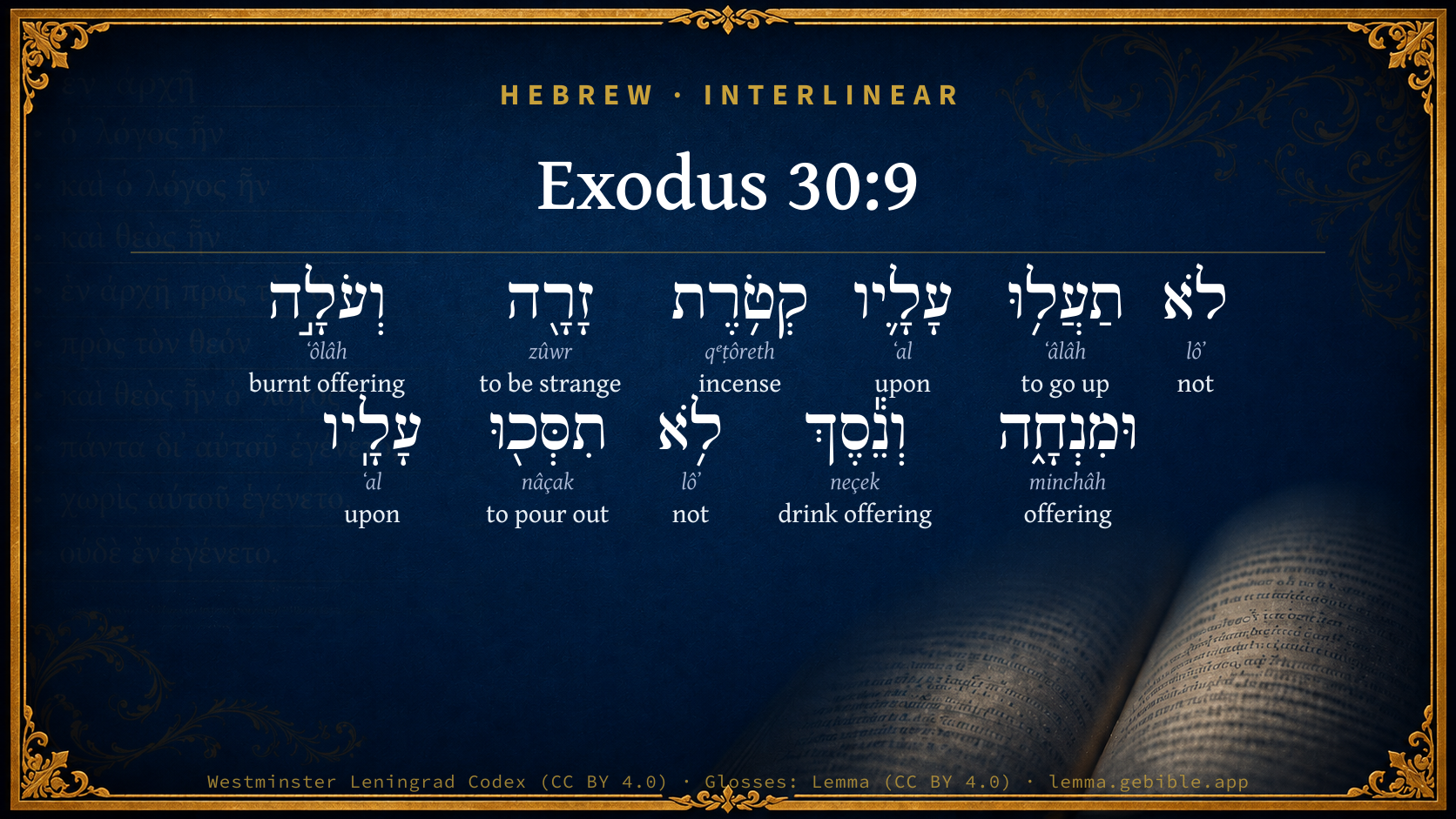
Exodus 30:9

Hebrew (Westminster Leningrad Codex) Exodus 30:9 appears in the Hebrew Old Testament. The text above is from the Westminster Leningrad Codex. Each word links to its Strong’s number, a concise gloss, and parsing drawn from the Open Scriptures Hebrew Bible morphology. Click any word for its full Brown-Driver-Briggs (BDB) entry.
Download image
Cite this verse

Exodus 30:9 (World English Bible). Public Domain. Lemma interlinear Bible study tool, https://lemma.gebible.app/v/exodus/30/9.

Show BibTeX & RIS
BibTeX
RIS
English Translation
You shall offer no strange incense on it, nor burnt offering, nor meal-offering; and you shall pour no drink-offering on it.
World English Bible · Public Domain
Download a study sheet

One document with this verse’s original text, its word-by-word gloss line, the meaning frame, cross-references with their text, attributed commentary, and full source and license credits — printable, and it pastes into notes with its structure intact.

This verse Autodidact and up

Study sheet (.html) Plain text (.txt)

A passage Seminary Student

Up to 50 verses in one chapter. A passage sheet keeps up to 6 commentary sources and 12 cross-references per verse, in the order this page ranks them, and says so on the sheet whenever that leaves anything out. Ask for a single verse and you get the Autodidact verse sheet above.

Everything on this page stays free to read, with no account — the sheet is a download of what is already on screen, not access to it.

Want to remove ads? Support Godless Engineer
Compare translations 3

The same verse in 3 English versions, stacked beneath the original-language interlinear above. Click any original word for its lexicon entry.

Each is an independent rendering of the whole verse — the interlinear is not word-aligned to these translations.

Highlighted words mark where these versions differ — a whole-verse word diff, not a word-by-word alignment.

  • World English Bible Public Domain
    You shall offer no strange incense on it, nor burnt offering, nor meal-offering; and you shall pour no drink-offering on it.
  • King James Version Public Domain
    Ye shall offer no strange incense thereon, nor burnt sacrifice, nor meat offering; neither shall ye pour drink offering thereon.
  • unfoldingWord Literal Text CC BY-SA 4.0
    You shall not offer up strange incense or a burnt offering or a grain offering on it. And you shall not pour a drink offering on it.

unfoldingWord Literal Text — © unfoldingWord, licensed CC BY-SA 4.0. Word-aligned USFM3 via Door43 (git.door43.org/unfoldingWord/en_ult).

Versions to compare (up to 4)

3 of 4 selected

Show all 18 translations

Every available English version of this verse, each an independent rendering of the whole verse.

  • World English Bible Public Domain
    You shall offer no strange incense on it, nor burnt offering, nor meal-offering; and you shall pour no drink-offering on it.
  • Berean Standard Bible Public Domain
    On this altar you must not offer unauthorized incense or a burnt offering or grain offering; nor are you to pour a drink offering on it.
  • Majority Standard Bible Public Domain
    On this altar you must not offer unauthorized incense or a burnt offering or grain offering; nor are you to pour a drink offering on it.
  • King James Version Public Domain
    Ye shall offer no strange incense thereon, nor burnt sacrifice, nor meat offering; neither shall ye pour drink offering thereon.
  • American Standard Version (1901) Public Domain
    Ye shall offer no strange incense thereon, nor burnt-offering, nor meal-offering; and ye shall pour no drink-offering thereon.
  • Revised Version (1885) Public Domain
    Ye shall offer no strange incense thereon, nor burnt offering, nor meal offering; and ye shall pour no drink offering thereon.
  • Geneva Bible (1599) Public Domain
    Ye shall offer no strange incense thereon, nor burnt sacrifice, nor offring, neither powre any drinke offring thereon.
  • Douay-Rheims (1899) Public Domain
    You shall not offer upon it incense of another composition nor oblation, and victim, neither shall you offer libations.
  • Young's Literal Translation Public Domain
    `Ye do not cause strange perfume to go up upon it, and burnt-offering, and present, and libation ye do not pour out on it;
  • Literal Standard Version CC BY-SA 4.0
    You do not cause strange incense to go up on it—and burnt-offering and present; and you do not pour out a drink-offering on it;
  • Unlocked Literal Bible CC BY-SA 4.0
    But you must offer no other incense on the incense altar, nor any burnt offering or grain offering. You must pour no drink offering on it.
  • unfoldingWord Literal Text CC BY-SA 4.0
    You shall not offer up strange incense or a burnt offering or a grain offering on it. And you shall not pour a drink offering on it.
  • Darby Bible Public Domain
    Ye shall offer up no strange incense thereon, nor burnt-offering, nor oblation; neither shall ye pour drink-offering thereon.
  • World Messianic Bible Public Domain
    You shall offer no strange incense on it, nor burnt offering, nor meal offering; and you shall pour no drink offering on it.
  • Webster's Bible Public Domain
    Ye shall offer no strange incense upon it, nor burnt-sacrifice, nor meat-offering; neither shall ye pour drink-offering upon it.
  • Free Bible Version CC BY-SA 4.0
    Don't offer on this altar any unapproved incense or any burnt offering or grain offering, and do not pour out a drink offering upon it.
  • Bible in Basic English Public Domain
    No strange perfume, no burned offering or meal offering, and no drink offering is to be offered on it.
  • JPS Tanakh (1917) Public Domain
    Ye shall offer no strange incense thereon, nor burnt-offering, nor meal-offering; and ye shall pour no drink-offering thereon.

Literal Standard Version (2020), Covenant Press — licensed CC BY-SA 4.0. Text via the HelloAO Bible API (eBible.org). Unlocked Literal Bible (unfoldingWord) — licensed CC BY-SA 4.0. Text via the HelloAO Bible API (eBible.org). unfoldingWord Literal Text — © unfoldingWord, licensed CC BY-SA 4.0. Word-aligned USFM3 via Door43 (git.door43.org/unfoldingWord/en_ult). Free Bible Version, Dr. Jonathan Gallagher — licensed CC BY-SA 4.0. Text via the HelloAO Bible API (eBible.org).

Word by word

More ways to search: Search by grammar → Find every occurrence → Compare this word →

Practice this passage: Drill this verse → Learn its vocabulary →

תִסְּכ֖וּ
nâçak
H5258
“to pour out”
Verb, Qal, Imperfect, 2nd Person, Masculine, Plural
Part of Speech
Verb
Stem
Qal
Form
Imperfect
Person
2nd Person
Gender
Masculine
Number
Plural
Full BDB Definition

Origin: a primitive root

TWOT: 1375 , 1377

to pour out, pour, offer, cast - (Qal) - to pour out - to cast metal images - to anoint (a king) - (Niphal) to be anointed - (Piel) to pour out (as a libation) - (Hiphil) to pour out libations - (Hophal) to be poured out - to set, install - (Qal) to install - (Niphal) to be installed
  1. לֹא lôʼ H3808 “not” Particle, Negative
  2. תַעֲל֥וּ ʻâlâh H5927 “to go up” Verb, Hiphil, Imperfect, 2nd Person, Masculine, Plural
  3. עָלָ֛יו ʻal H5921 “upon · him” Preposition + Suffix, Personal, 3rd Person, Masculine, Singular
  4. קְטֹ֥רֶת qᵉṭôreth H7004 “incense” Noun, Common, Feminine, Singular, Absolute
  5. זָרָ֖ה zûwr H2114 “strange” Adjective, Adjective, Feminine, Singular, Absolute
  6. וְעֹלָ֣ה ʻôlâh H5930 “and · burnt offering” Conjunction + Noun, Common, Feminine, Singular, Absolute
  7. וּמִנְחָ֑ה minchâh H4503 “and · offering” Conjunction + Noun, Common, Feminine, Singular, Absolute
  8. וְנֵ֕סֶךְ neçek H5262 “and · drink offering” Conjunction + Noun, Common, Masculine, Singular, Absolute
  9. לֹ֥א lôʼ H3808 “not” Particle, Negative
  10. עָלָֽיו ʻal H5921 “upon · him” Preposition + Suffix, Personal, 3rd Person, Masculine, Singular

About this verse

These counts appear in no published source. They are computed here, from the morphology-tagged text and Lemma’s own curated glosses. What Lemma adds →

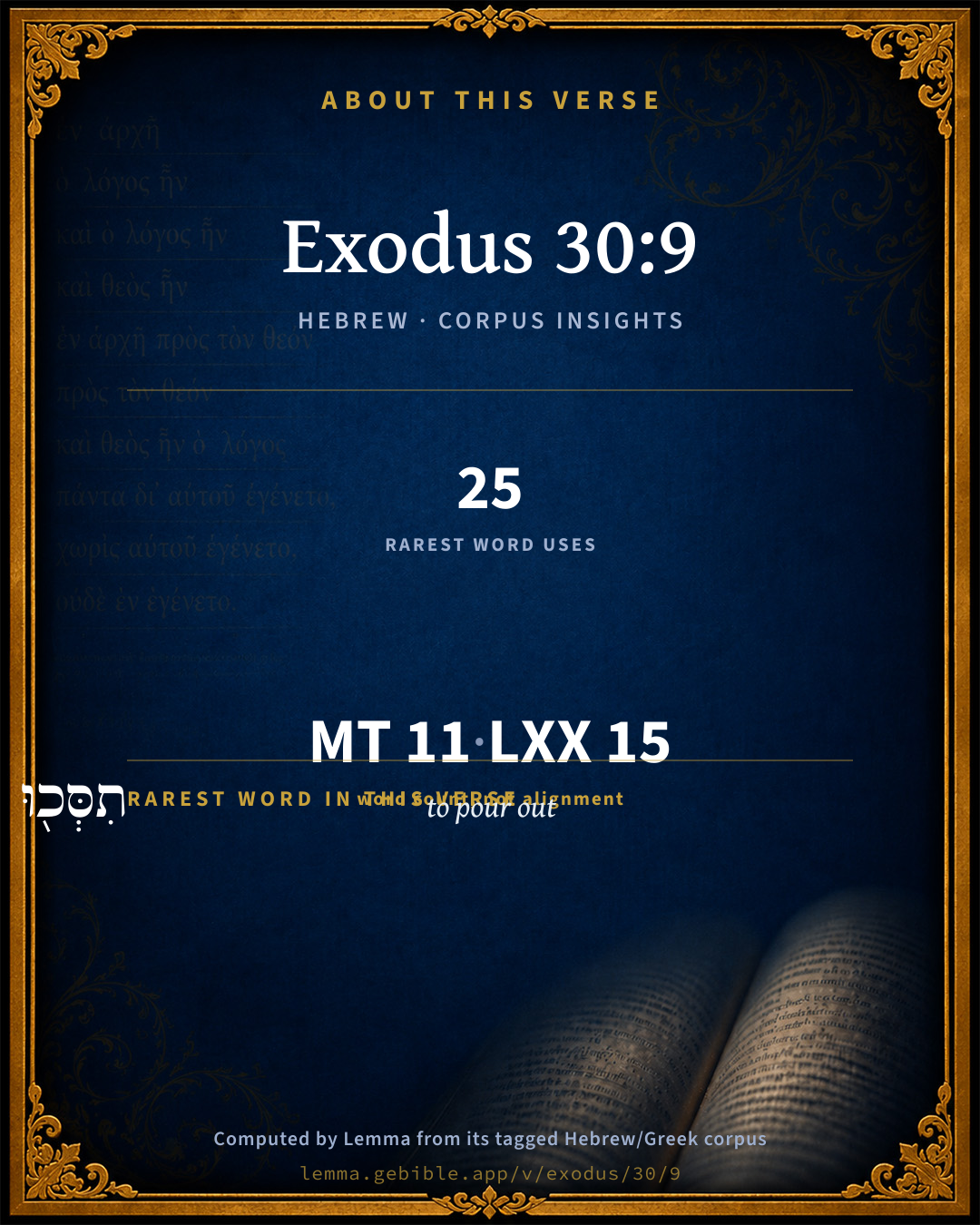
11
words
9
distinct lemmas
Pentateuch
section

Notable vocabulary

The rarest word here is תִסְּכ֖וּ to pour out H5258 — appearing just 25 times in the whole Hebrew Bible.

Shared distinctive vocabulary

תִסְּכ֖וּ to pour out H5258 occurs in 24 verses of the Hebrew Bible. Also found in:

Grammatical profile

  • 2 verbs
  • 4 nouns
  • 1 adjective
  • 2 prepositions
  • 2 particles

Verb forms

  • תַעֲל֥וּ Hiphil · Imperfect
  • תִסְּכ֖וּ Qal · Imperfect

Repetition

Words recur within this verse — often emphatic in Hebrew:

  • עָלָ֛יו upon H5921 ×2
  • לֹא not H3808 ×2

Hebrew & Septuagint length

In English translation the verse runs 21 words from the Hebrew and 27 from the Septuagint (LXX English) — closely comparable.

A rough comparison of the two English renderings, which tokenize alike — not a word-level alignment.

Word counts can differ between the Hebrew and the Greek without any difference in meaning — e.g. the Hebrew direct-object marker אֵת has no separate Greek word, and Greek often adds the article ὁ.

In the original languages it is 11 Hebrew tokens and 15 Greek tokens — but the two are counted differently (Hebrew bundles its prefixes and suffixes into one token; the Greek is in lemma form), so that isn’t a like-for-like length.

Cross-references

1

Topical passages linked to Exodus 30:9 in the Treasury of Scripture Knowledge — connected by theme and wording, ordered by reader-vote popularity; previews shown in the World English Bible.

  • Leviticus 10:1 Nadab and Abihu, the sons of Aaron, each took his censer, and put fire in it, and laid incense on it, and offered strange fire before Yahweh, which he had not commanded them.

Cross-references courtesy of OpenBible.info (CC BY 4.0).

Hebrew and Greek witnesses Masoretic Hebrew ↔ Greek Septuagint

The same verse in the two great witnesses to the Old Testament, shown verse-for-verse.

These are two independent witnesses, not word-aligned to each other, and the Septuagint is shown in lemma (dictionary) form.

Hebrew Exodus 30:9 Masoretic · Westminster Leningrad Codex

לֹא תַעֲל֥וּ עָלָ֛יו קְטֹ֥רֶת זָרָ֖ה וְעֹלָ֣ה וּמִנְחָ֑ה וְנֵ֕סֶךְ לֹ֥א תִסְּכ֖וּ עָלָֽיו

You shall offer no strange incense on it, nor burnt offering, nor meal-offering; and you shall pour no drink-offering on it.

World English Bible · Public Domain

Greek LXX Exodus 30:9 Septuagint · lemma form

καί οὐ ἀναφέρω ἐπί αὐτός θυμίαμα ἕτερος κάρπωμα θυσία καί σπονδή οὐ σπένδω ἐπί αὐτός

And you shall not offer strange incense upon it, nor and offering made by fire, nor a sacrifice; and you shall not pour a drink-offering upon it.

LXX2012 (modern English Septuagint) · Public Domain

Hebrew: Westminster Leningrad Codex (CC BY 4.0). Greek: Septuagint (public domain); English from LXX2012 (modern English Septuagint) (Public Domain). How the Septuagint differs from the Hebrew →

Targum (Aramaic paraphrase)

2

The Targum is the ancient Jewish Aramaic paraphrase of the Hebrew Scriptures — an interpretive translation, not the Hebrew text itself. Onkelos (literal) and Pseudo-Jonathan (expansive) render the Torah, and Jonathan the Prophets. Coverage is partial: where no permissively-licensed English translation exists for a verse, only the Aramaic is shown. This is verse-level text, not a word-by-word alignment to the Hebrew.

  1. Targum Onkelos Torah (Genesis–Deuteronomy)
    לָא תַסְקוּן עֲלוֹהִי קְטוֹרֶת בּוּסְמִין נוּכְרָאִין וַעֲלָתָא וּמִנְחָתָא וְנִסְכָּא לָא תְנַסְכוּן עֲלוֹהִי:

    (no public-domain English translation for this verse)

    Targum Onkelos — Aramaic: “Onkelos Genesis” (public domain); “Onkelos Exodus” (public domain); “Onkelos Leviticus” (public domain); “Onkelos Numbers” (public domain); “Onkelos Deuteronomy” (public domain). English: “Sefaria Community Translation” (CC0 1.0 (public-domain dedication)); “J.W. Etheridge. The Targums of Onkelos and Jonathan Ben Uzziel on the Pentateuch. London: Longmans, Green, 1862” (public domain). Text via Sefaria.

  2. Targum Pseudo-Jonathan Torah (Genesis–Deuteronomy)
    לָא תִסְקוּן עֲלוֹי קְטוֹרֶת בּוּסְמִין דְּעַמְמִין נוּכְרָאִין וְעָלָתָא וּמִנְחָתָא וְנִיסוּכִין לָא תְנַסְכוּן עֲלוֹי

    Thou shalt not offer thereon the sweet incense of strange peoples, nor offer upon it burnt offerings, or minchas, nor pour libations.

    Targum Pseudo-Jonathan — Aramaic: “Targum Jonathan on Genesis” (public domain); “Targum Jonathan on Exodus” (public domain); “Targum Jonathan on Leviticus” (public domain); “Targum Jonathan on Numbers” (public domain); “Targum Jonathan on Deuteronomy” (public domain). English: “The Targum of Jonathan ben Uzziel, trans. J. W. Etheridge, London, 1862” (public domain). Text via Sefaria.

Commentary

Notes on Exodus 30:9 from classic Christian and Jewish commentators (each source and its license shown beneath its notes). The classic Christian expositions comment on the surrounding passage and are grouped to its opening verse, so a note may address several verses; the Jewish commentaries on the Tanakh (Rashi and others) are per-verse, so they appear only where the commentator wrote on this verse.

Lemma curates 59 commentaries, every one of them public domain or Creative Commons licensed, each selected and text-cleaned for this edition rather than reprinted as found. About our sources →

Trapp's Complete Commentary

John Trapp

Exo 30:9 Ye shall offer no strange incense thereon, nor burnt sacrifice, nor meat offering; neither shall ye pour drink offering thereon.

Ver. 9. No strange incense.] So may we not pray, but according to God’s revealed will. {1Jn 5:14}

John Trapp, A Commentary or Exposition upon All the Books of the Old and New Testament (1647–1656) — public domain. Text from a community e-Sword module.

Geneva Bible (1599)

Geneva Bible translators

Otherwise made them this, which is described.

But it must only serve to burn perfume.

Geneva Bible (1599) marginal notes — public domain. Text via Bolls.life.

Jamieson, Fausset & Brown

Robert Jamieson, A. R. Fausset & David Brown

Ye shall offer no strange incense--that is, of a different composition from that of which the ingredients are described so minutely.

Jamieson, Fausset & Brown — Commentary Critical and Explanatory on the Whole Bible (1871) — public domain (CC PDM 1.0). Text via the HelloAO Bible API.

Adam Clarke's Commentary

Verse 9. No strange incense] None made in any other way.

Nor burnt-sacrifice] It should be an altar for incense, and for no other use.

Adam Clarke's Commentary on the Bible (1810–1826) — public domain. Text from a community e-Sword/MySword module.

Ellicott's Commentary for English Readers

(9) Ye shall offer no strange incense.—By “strange incense” is meant any that was composed differently from that of which the composition is laid down in Exo_30:34-35.

Nor burnt sacrifice, nor meat offering; neither . . . drink offering.—All these were to be offered on the brazen altar, not on the altar of incense, which was in no way suited for them.

A Bible Commentary for English Readers, edited by Charles John Ellicott (1878–1897) — public domain. Text from a community e-Sword module.

The Cambridge Bible for Schools and Colleges

gen. ed. J. J. S. Perowne

9. The altar is to be reserved exclusively for incense, and for incense moreover made from the authorized prescription (v. 34 ff.).

strange] i.e. strange to the law, unauthorized; cf. ‘strange fire,’ Lev_10:1, Num_3:4; Num_26:61. Comp. on Exo_29:33; and see DB. iv. 623.

The Cambridge Bible for Schools and Colleges (gen. ed. J. J. S. Perowne; Cambridge University Press, 1878–1918) — public domain. Text from a community e-Sword module.

John Gill's Exposition

Ye shall offer no strange incense thereon,.... Which had not the same, but was made of other materials, or had more or fewer; whatever was not exactly the same was not to be offered; and so to make use of other mediators than Christ, whether angels or men, or to put up prayer to God for the sake of our own righteousness, pleading the merits of our works, and not the blood, righteousness, and sacrifice of Christ, is to offer strange incense, unacceptable to God, and which will be of no avail to men:

nor burnt sacrifice, nor meat offering; these were to be offered and burnt upon the altar of burnt offering:

neither shall ye pour drink offering thereon; as upon the other altar; everything in God's worship and service was to be done in the proper place and order; these offerings and sacrifices, though they were by divine appointment, yet must be offered on that altar which was peculiar for them.

John Gill's Exposition of the Whole Bible (1746–1763) — public domain (CC PDM 1.0). Text via the HelloAO Bible API.

Haydock's Catholic Bible Commentary

Composition, than what is prescribed, ver. 34. (Menochius)

George Leo Haydock (1774–1849), Haydock's Catholic Family Bible and Commentary, 1859 edition — public domain. Excludes Psalms (Douay-Rheims chapter numbering differs from Protestant) and Deuterocanonical books (Catholic canon only).

Matthew Poole's English Annotations

No strange incense, i.e. of any other sort than what I shall here appoint, Exo 30:34, &c.

Matthew Poole's English Annotations on the Holy Bible (1683–1685) — public domain. Text from a community e-Sword/MySword module.

Whedon's Commentary on the Bible

Daniel D. Whedon

9. Strange incense — Offered with fire other than that which God ordained, on account of which impiety the two elder sons of Aaron were destroyed. Lev_10:1. This altar of incense being set apart for a special use, no burnt sacrifice, nor meat offering, nor drink offering, was to be offered thereon. The offerings made on the great altar, in the court without, effected reconciliation with Jehovah; the incense offering represented a closer approach to the divine glory, based upon previous reconciliation; and hence a bringing of the same offerings within, before the vail, as those offered without, would have been a confusion of distinct symbolical services.

Daniel D. Whedon (gen. ed.), Commentary on the Old and New Testaments (1874–1909) — public domain. Text from a community e-Sword module.

The Pulpit Commentary

By strange incense is meant any which was not prepared according to the directions given in vers. 34-38. None such was ever to be offered. Nor was the altar to be used for burnt-offering, meat-offering, or drink-offering . For burnt-offering it was manifestly unfit; but the prohibition of the others seems to show a determination to keep its use markedly distinct from that of the brazen altar in the court, which was to receive all that was offered either for expiation, or for self-dedication, or in gratitude. On the sole exception made to this general law, see the comment on the next verse.

The Pulpit Commentary (1880–1919), ed. H.D.M. Spence-Jones & Joseph S. Exell — public domain. Text from a community e-Sword module.

Scofield Reference Notes

C. I. Scofield

strange

(Cf.) Lev 10:1-3, two prohibitions are given concerning worship:

(1) No "strange" incense is to be offered. This speaks of simulated or purely formal worship.

(2) No "strange" fire was permitted. This refers to the excitation of "religious" feelings by merely sensuous means, and to the substitution for devotion to Christ of any other devotion, as to religious causes, or sects. (Cf) 1Co 1:11-13; Col 2:8; Col 2:16-19. (See Scofield "Exo 30:38").

The Scofield Reference Bible (1917 edition), notes by C. I. Scofield — public domain. Text from a community e-Sword module.

Rashi

Rabbi Shlomo Yitzchaki (Rashi)

לא תעלו עליו YE SHALL NOT OFFER ON IT — on it, i. e. on this altar, but you may offer on the copper altar (cf. Menachot 50b),

קטרת זרה STRANGE INCENSE — any incense brought as a freewill offering; all of them (all offerings of incense) are “strange” to it (to the altar) except this prescribed here.

ועלה ומנחה means, nor burnt offering nor meal-offering. The עולה is an offering of an animal or bird; מנחה is one of bread.

Rashi on the Tanakh — English translations: “The Judaica Press complete Tanach with Rashi, translated by A. J. Rosenberg” (CC BY 4.0); “Pentateuch with Rashi's commentary by M. Rosenbaum and A.M. Silbermann, 1929-1934” (public domain); “The Metsudah Tanach series, Lakewood, N.J” (CC BY 4.0); and “The Book of Joshua, Metsudah Publications, 1997” (CC BY 4.0). Text via Sefaria.

Ramban (Nachmanides)

Rabbi Moshe ben Nachman (Ramban / Nachmanides)

YE SHALL NOT BRING UP ‘KTORETH ZARAH’ (STRANGE INCENSE) THEREON — “any incense brought as a freewill offering; for all [offerings of incense] are ‘strange’ to [this altar] except this one [prescribed here].” This is Rashi’s language. But Onkelos rendered ktoreth zarah: ktoreth busmin nuchra’in (“the burning of aromatics which are of strange components,”) and he did not translate it nuchritha “strange incense” [as Rashi interpreted it]. By this translation Onkelos wanted to explain that the sense of the verse is that he should not offer an incense of any other components except those prescribed as He commanded. Similarly, if one were to add to the prescribed composition any other components one would transgress this negative commandment.Ki Thisa

Ramban (Nachmanides) on the Tanakh — English translation: “Commentary on the Torah by Ramban (Nachmanides). Translated and annotated by Charles B. Chavel. New York, Shilo Pub. House, 1971-1976” (CC BY 4.0). Text via Sefaria.

Lesson kit

Teaching starters — assembled from the data on this page, not authored interpretation. Every prompt links to the verse data it draws on. Edit before teaching.

Exodus, in the Pentateuch, opens this verse with 11 words (9 distinct Hebrew lemmas). Its most distinctive word is nâçak (“to pour out”). A historical commentator’s framing appears above. Read the whole chapter for the surrounding context.

Discussion questions

  1. The word nâçak carries the sense “to pour out.” How does it shape the verse?
  2. Genesis 35:14 shares the word «to pour out» with this verse. How do the two illuminate each other?
  3. “upon” occurs 2× in this one verse. What is the effect of the repetition?
  4. These translations render this verse differently. What is at stake in choosing one wording over another?
  5. The verb «תַעֲל֥וּ» is Hiphil Imperfect. How does its form color the action?
  6. Reading how Trapp's Complete Commentary and Geneva Bible (1599) read this verse, where do the two commentators agree and where do they part?

Things to notice

Reading settings

Reading text

Shown beneath each verse's original-language words.

Old Testament
Old Testament edition

Read the OT as the Masoretic Hebrew (MT) or the Greek Septuagint (LXX).

English shown for the Greek Septuagint (in the Hebrew ↔ Greek comparison).

Comparing translations? Open the Compare panel on any verse page to stack up to four side by side.