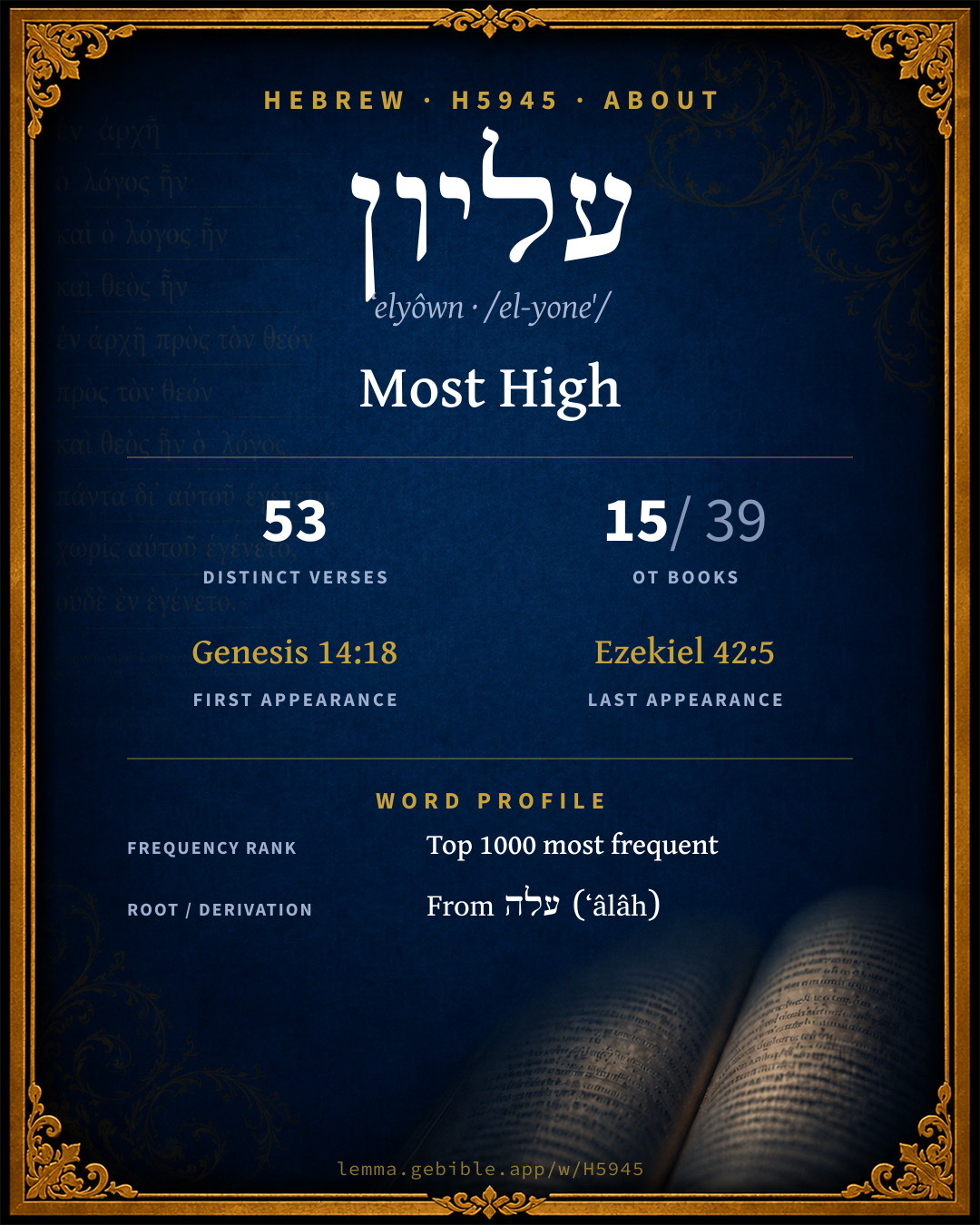
עֶלְיוֹן
Most High
‘Most High’ is one of 2 main senses fuller range ↓
Full lexicon entry — Brown-Driver-Briggs (BDB)
From Brown-Driver-Briggs (BDB)
Where this word appears
Grammar key — what these labels mean
Part of speech
- Adjective
- A word that describes or qualifies a noun.
State
- Absolute
- The independent form of a noun, not bound to a following word.
Gender
- Masculine
- Grammatically masculine.
- Feminine
- Grammatically feminine.
Number
- Singular
- One.
- Plural
- More than one (in Hebrew, generally three or more).
Grammatical forms
- Adjective, Adjective, Masculine, Singular, Absolute 48 times (91%)
- Adjective, Adjective, Feminine, Singular, Absolute 4 times (8%)
- Adjective, Adjective, Feminine, Plural, Absolute 1 time (2%)
Parsed forms decoded from the imported morphology (morphhb / Westminster Leningrad Codex — WLC text public domain, morphhb tagging CC BY 4.0), counted across 53 parsed occurrences — not distinct verses.
Every verse where H5945 appears — 53 distinct verses across 15 books. Click any verse to open its interlinear word-by-word view. Verse text shown in the World English Bible for context — . Each verse’s Hebrew form is shown with its reference; the English is not keyword-highlighted, since the data carries no word-level English alignment. Use “Compare translations” on any verse to read it across multiple English versions. This concordance covers the Hebrew Bible; Septuagint (Greek Old Testament) occurrences are not indexed here.
Genesis 5 verses
- Genesis 14:18 עֶלְיֽוֹן adj Adjective ms Melchizedek king of Salem brought forth bread and wine: and he was priest of God Most High.
- Genesis 14:19 עֶלְי֔וֹן adj Adjective ms He blessed him, and said, "Blessed be Abram of God Most High, possessor of heaven and earth:
- Genesis 14:20 עֶלְי֔וֹן adj Adjective ms and blessed be God Most High, who has delivered your enemies into your hand." Abram gave him a tenth of all.
- Genesis 14:22 עֶלְי֔וֹן adj Adjective ms Abram said to the king of Sodom, "I have lifted up my hand to Yahweh, God Most High, possessor of heaven and earth,
- Genesis 40:17 הָֽ/עֶלְי֔וֹן ptcl def.art + Adjective Adjective ms In the uppermost basket there was all kinds of baked food for Pharaoh, and the birds ate them out of the basket on my head."
Numbers 1 verse
Deuteronomy 3 verses
- Deuteronomy 26:19 עֶלְי֗וֹן adj Adjective ms and to make you high above all nations that he has made, in praise, and in name, and in honor; and that you may be a holy people to Yahweh your God, as he has spoken.
- Deuteronomy 28:1 עֶלְי֔וֹן adj Adjective ms It shall happen, if you shall listen diligently to the voice of Yahweh your God, to observe to do all his commandments which I command you this day, who Yahweh your God will set you on high above all the nations of the earth:
- Deuteronomy 32:8 עֶלְיוֹן֙ adj Adjective ms When the Most High gave to the nations their inheritance, When he separated the children of men, He set the bounds of the peoples According to the number of the children of Israel.
Joshua 1 verse
2 Samuel 1 verse
1 Kings 1 verse
2 Kings 2 verses
- 2 Kings 15:35 הָ/עֶלְיֽוֹן ptcl def.art + Adjective Adjective ms However the high places were not taken away: the people still sacrificed and burned incense in the high places. He built the upper gate of the house of Yahweh.
- 2 Kings 18:17 הָֽ/עֶלְיוֹנָ֔ה ptcl def.art + Adjective Adjective fs The king of Assyria sent Tartan and Rabsaris and Rabshakeh from Lachish to king Hezekiah with a great army to Jerusalem. They went up and came to Jerusalem. When they were come up, they came and stood by the conduit of the upper pool, which is in the highway of the fuller's field.
1 Chronicles 1 verse
2 Chronicles 5 verses
- 2 Chronicles 7:21 עֶלְי֔וֹן adj Adjective ms This house, which is so high, everyone who passes by it shall be astonished, and shall say, Why has Yahweh done thus to this land, and to this house?
- 2 Chronicles 8:5 הָֽ/עֶלְי֔וֹן ptcl def.art + Adjective Adjective ms Also he built Beth Horon the upper, and Beth Horon the lower, fortified cities, with walls, gates, and bars;
- 2 Chronicles 23:20 הָֽ/עֶלְי֖וֹן ptcl def.art + Adjective Adjective ms He took the captains of hundreds, and the nobles, and the governors of the people, and all the people of the land, and brought down the king from the house of Yahweh: and they came through the upper gate to the king's house, and set the king on the throne of the kingdom.
- 2 Chronicles 27:3 הָ/עֶלְי֑וֹן ptcl def.art + Adjective Adjective ms He built the upper gate of the house of Yahweh, and on the wall of Ophel he built much.
- 2 Chronicles 32:30 הָֽ/עֶלְי֔וֹן ptcl def.art + Adjective Adjective ms This same Hezekiah also stopped the upper spring of the waters of Gihon, and brought them straight down on the west side of the city of David. Hezekiah prospered in all his works.
Nehemiah 1 verse
Psalms 22 verses
- Psalms 7:17 עֶלְיֽוֹן adj Adjective ms I will give thanks to Yahweh according to his righteousness, And will sing praise to the name of Yahweh Most High.
- Psalms 9:2 עֶלְיֽוֹן adj Adjective ms I will be glad and rejoice in you. I will sing praise to your name, O Most High.
- Psalms 18:13 וְ֭/עֶלְיוֹן conj + Adjective Adjective ms Yahweh also thundered in the sky, The Most High uttered his voice: Hailstones and coals of fire.
- Psalms 21:7 עֶ֝לְי֗וֹן adj Adjective ms For the king trusts in Yahweh. Through the loving kindness of the Most High, he shall not be moved.
- Psalms 46:4 עֶלְיֽוֹן adj Adjective ms There is a river, the streams of which make the city of God glad, The holy place of the tents of the Most High.
- Psalms 47:2 עֶלְי֣וֹן adj Adjective ms For Yahweh Most High is awesome. He is a great King over all the earth.
- Psalms 50:14 לְ/עֶלְי֣וֹן prep + Adjective Adjective ms Offer to God the sacrifice of thanksgiving. Pay your vows to the Most High.
- Psalms 57:2 עֶלְי֑וֹן adj Adjective ms I cry out to God Most High, To God who accomplishes my requests for me.
- Psalms 73:11 בְ/עֶלְיֽוֹן prep + Adjective Adjective ms They say, "How does God know? Is there knowledge in the Most High?"
- Psalms 77:10 עֶלְיֽוֹן adj Adjective ms Then I thought, "I will appeal to this: The years of the right hand of the Most High."
- Psalms 78:17 עֶ֝לְי֗וֹן adj Adjective ms Yet they still went on to sin against him, To rebel against the Most High in the desert.
- Psalms 78:35 עֶ֝לְיוֹן adj Adjective ms They remembered that God was their rock, The Most High God their redeemer.
- Psalms 78:56 עֶלְי֑וֹן adj Adjective ms Yet they tempted and rebelled against the Most High God, And didn't keep his testimonies;
- Psalms 82:6 עֶלְי֣וֹן adj Adjective ms I said, "You are gods, All of you are sons of the Most High.
- Psalms 83:18 עֶ֝לְי֗וֹן adj Adjective ms That they may know that you alone, whose name is Yahweh, Are the Most High over all the earth.
- Psalms 87:5 עֶלְיֽוֹן adj Adjective ms Yes, of Zion it will be said, "This one and that one was born in her;" The Most High himself will establish her.
- Psalms 89:27 עֶ֝לְי֗וֹן adj Adjective ms I will also appoint him my firstborn, The highest of the kings of the earth.
- Psalms 91:1 עֶלְי֑וֹן adj Adjective ms He who dwells in the secret place of the Most High Will rest in the shadow of the Almighty.
- Psalms 91:9 עֶ֝לְי֗וֹן adj Adjective ms Because you have made Yahweh your refuge, And the Most High your dwelling place,
- Psalms 92:1 עֶלְיֽוֹן adj Adjective ms It is a good thing to give thanks to Yahweh, To sing praises to your name, Most High;
- Psalms 97:9 עֶלְי֥וֹן adj Adjective ms For you, Yahweh, are most high above all the earth. You are exalted far above all gods.
- Psalms 107:11 עֶלְי֣וֹן adj Adjective ms Because they rebelled against the words of God, And condemned the counsel of the Most High.
Isaiah 3 verses
- Isaiah 7:3 הָ/עֶלְיוֹנָ֔ה ptcl def.art + Adjective Adjective fs Then Yahweh said to Isaiah, "Go out now to meet Ahaz, you, and Shearjashub your son, at the end of the conduit of the upper pool, on the highway of the fuller's field.
- Isaiah 14:14 לְ/עֶלְיֽוֹן prep + Adjective Adjective ms I will ascend above the heights of the clouds; I will make myself like the Most High.
- Isaiah 36:2 הָ/עֶלְיוֹנָ֔ה ptcl def.art + Adjective Adjective fs The king of Assyria sent Rabshakeh from Lachish to Jerusalem to king Hezekiah with a great army. He stood by the conduit of the upper pool in the highway of the fuller's field.
Jeremiah 2 verses
- Jeremiah 20:2 הָֽ/עֶלְי֔וֹן ptcl def.art + Adjective Adjective ms Then Pashhur struck Jeremiah the prophet, and put him in the stocks that were in the upper gate of Benjamin, which was in the house of Yahweh.
- Jeremiah 36:10 הָ/עֶלְי֗וֹן ptcl def.art + Adjective Adjective ms Then read Baruch in the book the words of Jeremiah in the house of Yahweh, in the chamber of Gemariah the son of Shaphan, the scribe, in the upper court, at the entry of the new gate of Yahweh's house, in the ears of all the people.
Lamentations 2 verses
Ezekiel 3 verses
- Ezekiel 9:2 הָ/עֶלְי֜וֹן ptcl def.art + Adjective Adjective ms Behold, six men came from the way of the upper gate, which lies toward the north, every man with his slaughter weapon in his hand; and one man in the midst of them clothed in linen, with a writer's inkhorn by his side. They went in, and stood beside the brazen altar.
- Ezekiel 41:7 הָ/עֶלְיוֹנָ֖ה ptcl def.art + Adjective Adjective fs The side-chambers were broader as they encompassed [the house] higher and higher; for the encompassing of the house went higher and higher round about the house: therefore the breadth of the house [continued] upward; and so one went up [from] the lowest [chamber] to the highest by the middle [chamber].
- Ezekiel 42:5 הָ/עֶלְיוֹנֹ֖ת ptcl def.art + Adjective Adjective fp Now the upper chambers were shorter; for the galleries took away from these, more than from the lower and the middle, in the building.
About this entry
At a glance — auto-summarized from this page’s data, not written by a person. Every figure links to its source below. This summary describes the numbers; it doesn’t interpret them.
“Most High” is the headline sense of the Hebrew name עליון (ʻelyôwn). Its earliest occurrence is Genesis 14:18. It turns up in 53 verses across 15 books, a moderately common footprint. It concentrates in Psalms, which alone accounts for 42% of its uses. See 53-verse concordance and the renderings breakdown below.
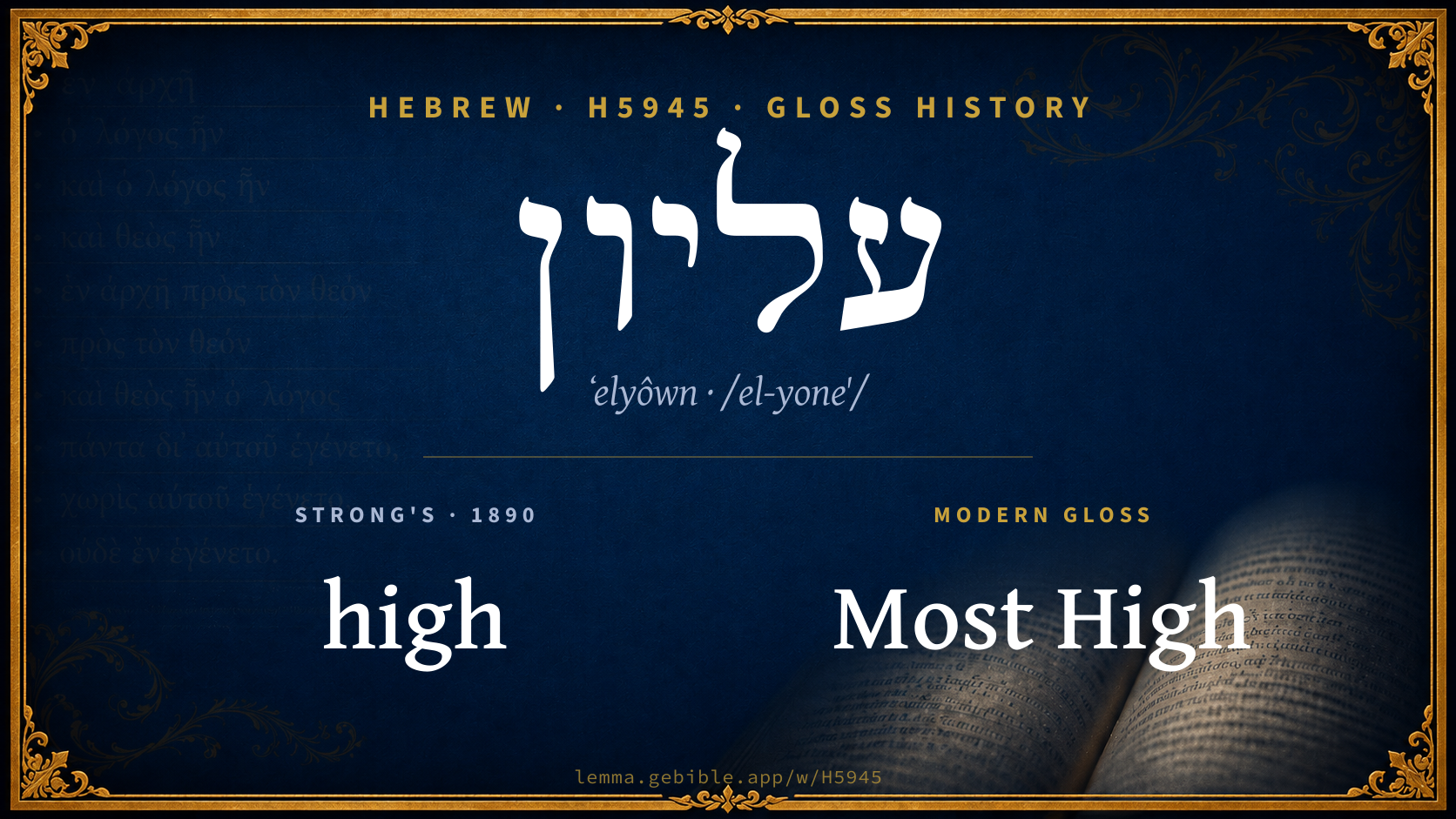
Gloss history
Strong's 1890 vs modern scholarship
About this word
Strong's H5945 catalogs a Hebrew word from the Hebrew Old Testament.
These counts are not copied from any lexicon or concordance. They are computed here, from the morphology-tagged Hebrew Old Testament. What Lemma adds →
- 53
- distinct verses
- The word appears in 53 distinct verses.
- 15 / 39
- OT books
- The word appears in 15 of 39 Old Testament books.
- #709
- by frequency
- Top 1000 most frequent Hebrew words (rank 709 of 8,640 Hebrew words by occurrence).
View all 53 occurrences in the concordance →
Most concentrated in
- Psalms 22 verses 42%
- Genesis 5 verses 9%
- 2 Chronicles 5 verses 9%
By section of the Old Testament
By traditional corpus
Conventional, traditional groupings — biblical authorship is debated, so this is a traditional corpus grouping, not an authorship claim. Each share is this word’s portion of its verses in that division of the Hebrew canon. Each figure is a share of the word’s 53 distinct verses.
- Writings (Ketuvim) 31 verses · 58%
- Prophets (Nevi'im) 13 verses · 25%
- Torah (Pentateuch) 9 verses · 17%
How translations render this word
Counts come from each version’s own published word-to-Strong’s tagging or interlinear alignment — an approximate guide to how each version renders this word, not a word-level alignment the data otherwise carries. Because each total is that version’s own tagged count, the per-version totals vary from one another and need not match the appearance or distinct-verse counts above. These counts may also differ from a printed concordance because Lemma counts each distinctly tagged rendering and does not collapse phrase taggings into a single head-word total. This is a fixed set of word-tagged versions (KJV, ASV, BSB, ULT) and does not change with the reading translation you choose elsewhere. Each version’s license is shown beside its name below (and on Sources).
BDB lists this Strong’s number as 2 distinct words (homographs). Each count above pools all of them and is not split by sense — see the Senses section below. A low-frequency rendering may belong to a different one of those words, not the primary meaning.
- King James Version†: Most high 23×, Upper 7×, High 4×
- American Standard Version†: Most high 23×, Upper 13×, Is so high 2×
- Berean Standard Bible†: Most high 27×, Upper 13×, Are most high 2×
- unfoldingWord Literal Text†: Most high 29×, Upper 14×, Exalted 2×
King James Version Public Domain
Renders H5945 across 53† tagged occurrences — most commonly:
Plus 11 renderings that appear only once — usually multi-word phrases or single function words the recovered tagging swept in, not distinct renderings.
American Standard Version Public Domain
Renders H5945 across 52† tagged occurrences — most commonly:
Plus 14 renderings that appear only once — usually multi-word phrases or single function words the recovered tagging swept in, not distinct renderings.
Berean Standard Bible Public Domain
Renders H5945 across 52† tagged occurrences — most commonly:
Plus 6 renderings that appear only once — usually multi-word phrases or single function words the recovered tagging swept in, not distinct renderings. Not rendered by a distinct English word in 1 further occurrence.
unfoldingWord Literal Text CC BY-SA 4.0
Renders H5945 across 52† tagged occurrences — most commonly:
Plus 5 renderings that appear only once — usually multi-word phrases or single function words the recovered tagging swept in, not distinct renderings.
Senses in the full BDB
What do BDB’s symbols mean?
BDB uses these scholarly abbreviations:
| Symbol | Meaning |
|---|---|
| 𝔊 | the Septuagint (the ancient Greek translation, LXX) |
| 𝔙 | the Vulgate (the Latin translation) |
| 𝔖 | the Syriac version (the Peshitta) |
| 𝔗 | the Targum (the Aramaic translation) |
| ψ | the Psalms |
| √ | root (the underlying root or stem) |
| ‖ | parallel passage (a synonymous or contrasted parallel) |
| † | the dagger: every passage where the word occurs is cited |
The 5 senses and sub-senses the full Brown-Driver-Briggs lexicon distinguishes for this word, in lexicon order (not ranked by frequency), with BDB’s own verbatim wording and sub-sense lettering. Shown in Hebrew script with BDB’s own scholarly abbreviations. The condensed entry is in the Lexicon Entry tab. See also the Forms in the corpus table below.
עליון I
- 1. high;—ms. ע׳ Dt 26:19; 28:1; 1 K 9:8 (? reading הַבַּיִת הַזֶּה הָע׳ as 𝔊L Benz) = 2 Ch 7:21, of י׳ ψ 97:9. e.g. Deuteronomy 26:19
- 2. upper Bethhoron, ע׳ Jos 16:5 העליון 1 Ch 7:24; 2 Ch 8:5, the upper (opp. lower), of house Ne 3:25; cf. 2 K 15:35; 2 Ch 23:20 + 5 times, + Gn 40:17 (uppermost basket); fs. הָעֶלְיוֹנָה the upper pool 2 K 18:17 = Is 36:2; Is 7:3; the highest side-chamber (צֵלָע) Ez 41:7; fpl. הָעֶלְיוֹנֹת 42:5 the upper chambers (לְשָׁכוֹת). e.g. Joshua 16:5
- 3. of Davidic king exalted above monarchs ψ 89:28 (cf. Dt 28:1, supr.). e.g. Psalms 89:28
עליון II Highest, Most High (prob. = foreg.)
- 1. name of God Nu 24:16; Dt 32:8 ψ 18:14 = 2 S 22:14 ψ 9:3; 21:8; 46:5; 50:14; 73:11; 77:11; 78:17; 83:19; 87:5; 91:1, 9; 92:2; 107:11; Is 14:14; La 3:35, 38; with other divine names: אל עליון Gn 14:18, 19, 20, 22 (v. Di) ψ 78:35; יהוה עליון ψ 7:18; 47:3; אלהים עליון ψ 57:3; 78:56. e.g. Numbers 24:16
- 2. of rulers, either monarchs or angel-princes, בְּנֵי עֶלְיוֹן = אלהים ψ 82:6. e.g. Psalms 82:6
Senses from the full Brown-Driver-Briggs lexicon (Brown, Driver, Briggs; Oxford 1906 — public domain), digitized via Sefaria, supplemented by the OpenScriptures HebrewLexicon (CC BY 4.0). Full attribution on Sources.
Word origin
n.m. Highest, Most High (prob. = foreg.);—
— Brown-Driver-Briggs (Oxford 1906, public domain), digitized via Sefaria, supplemented by the OpenScriptures HebrewLexicon (CC BY 4.0). See Sources.
Derived from עלה (ʻâlâh) (H5927) — to go up.
Jastrow Dictionary
A second Hebrew/Aramaic lexicon for comparison, covering Aramaic and post-biblical (Talmudic, Targumic, Midrashic) usage that the biblical-Hebrew BDB does not. Matched by lemma rather than by Strong’s number, so a lemma may carry more than one Jastrow headword (shown separately below), and the entries cover usage well beyond the Bible.
עֶלְיוֹן
- uppermost, highest; most high. B. Mets. X, 2 הע׳ the owner of the upper story, v. מַעֲזִיבָה. Y. Bicc. II, 64ᵈ bot. (ref. to הקדש, Deut. XXVI, 13) הקודש הע׳ במשמע if refers to the sacred matter mentioned above (first-fruits, ib. 2, sq.). Maasr. V, 8 זרע לוף הע׳ the seed- capsules on the tops of lof (v. לוֹף), expl. Y. ib. 52ᵃ bot., v. סָלַל I; a. fr.—Fem. עֶלְיוֹנָה. Tanḥ. Tsav 1 (play on עוֹלָה) שהיא ע׳ וכ׳ it is the highest of all sacrifices. B. Bath. 64ᵃ דיוטא הע׳ the upper story. B. Mets. 77ᵇ יד לוקח על הע׳ the buyer is at an advantage, has the choice between annulling and insisting on the bargain, opp. על התחתונה, v. יָד.—Lev. R. s. 24, beg. (ref. to Ps. XCII, 9) לעולם ידך בע׳ thy power is always uppermost, i.e. is always submitted to, whether thou blessest or punishest; Yalk. Ps. 843 על הע׳; Y. Ber. IX, 14ᵇ על הע׳, לע׳; a. fr.—Pl. עֶלְיוֹנִים, עֶלְיוֹנִין; f. עֶלְיוֹנוֹת. Ib. 14ᵃ top המים הע׳ the waters from above the earth; a. fr.—Esp. עליונים heavenly creatures, angels. Lev. R. s. 9 בראשון ברא מן הע׳ וכ׳ on the first he created heavenly and earthly things &c.; בראו מן הע׳ וכ׳ he created man so as to make him partake of the nature of the upper creatures and of that of the lower; a. fr. e.g. Deuteronomy 26:13
A Dictionary of the Targumim, the Talmud Babli and Yerushalmi, and the Midrashic Literature (Marcus Jastrow; London, Luzac, 1903) — Public Domain. Digitized via Sefaria. Digitized via Sefaria. Full attribution on Sources.
Forms in the corpus
The 24 distinct written forms H5945 takes in the Hebrew Bible, most frequent first — each parse links to that state’s occurrences in the concordance. Hebrew forms include their vowel points and cantillation, so a single lemma takes many written forms.
| Form | Parsing | Example | Uses |
|---|---|---|---|
| עֶלְיֽוֹן | Adjective, Adjective, Masculine, Singular, Absolute | Genesis 14:18 | 9 |
| עֶלְי֔וֹן | Adjective, Adjective, Masculine, Singular, Absolute | Deuteronomy 28:1 | 6 |
| הָֽ/עֶלְי֔וֹן | Adjective, Adjective, Masculine, Singular, Absolute | Genesis 40:17 | 5 |
| עֶ֝לְי֗וֹן | Adjective, Adjective, Masculine, Singular, Absolute | Psalms 21:7 | 5 |
| עֶלְי֑וֹן | Adjective, Adjective, Masculine, Singular, Absolute | Numbers 24:16 | 4 |
| עֶלְי֣וֹן | Adjective, Adjective, Masculine, Singular, Absolute | Psalms 47:2 | 3 |
| הָ/עֶלְי֑וֹן | Adjective, Adjective, Masculine, Singular, Absolute | 1 Chronicles 7:24 | 2 |
| הָ/עֶלְיוֹנָ֔ה | Adjective, Adjective, Feminine, Singular, Absolute | Isaiah 7:3 | 2 |
| עֶלְיוֹן֙ | Adjective, Adjective, Masculine, Singular, Absolute | Deuteronomy 32:8 | 2 |
| בְ/עֶלְיֽוֹן | Adjective, Adjective, Masculine, Singular, Absolute | Psalms 73:11 | 1 |
| הָ/עֶלְי֗וֹן | Adjective, Adjective, Masculine, Singular, Absolute | Jeremiah 36:10 | 1 |
| הָ/עֶלְי֜וֹן | Adjective, Adjective, Masculine, Singular, Absolute | Ezekiel 9:2 | 1 |
| הָ/עֶלְיֽוֹן | Adjective, Adjective, Masculine, Singular, Absolute | 2 Kings 15:35 | 1 |
| הָ/עֶלְיוֹנָ֖ה | Adjective, Adjective, Feminine, Singular, Absolute | Ezekiel 41:7 | 1 |
| הָ/עֶלְיוֹנֹ֖ת | Adjective, Adjective, Feminine, Plural, Absolute | Ezekiel 42:5 | 1 |
| הָֽ/עֶלְי֖וֹן | Adjective, Adjective, Masculine, Singular, Absolute | 2 Chronicles 23:20 | 1 |
| הָֽ/עֶלְיוֹנָ֔ה | Adjective, Adjective, Feminine, Singular, Absolute | 2 Kings 18:17 | 1 |
| וְ/עֶלְי֖וֹן | Adjective, Adjective, Masculine, Singular, Absolute | 2 Samuel 22:14 | 1 |
| וְ֭/עֶלְיוֹן | Adjective, Adjective, Masculine, Singular, Absolute | Psalms 18:13 | 1 |
| לְ/עֶלְי֣וֹן | Adjective, Adjective, Masculine, Singular, Absolute | Psalms 50:14 | 1 |
| לְ/עֶלְיֽוֹן | Adjective, Adjective, Masculine, Singular, Absolute | Isaiah 14:14 | 1 |
| עֶ֝לְיוֹן | Adjective, Adjective, Masculine, Singular, Absolute | Psalms 78:35 | 1 |
| עֶלְי֗וֹן | Adjective, Adjective, Masculine, Singular, Absolute | Deuteronomy 26:19 | 1 |
| עֶלְי֥וֹן | Adjective, Adjective, Masculine, Singular, Absolute | Psalms 97:9 | 1 |
Same root — word family
Other BDB entries built from the same root as H5945, grouped by Strong’s listed origin. These share a root / origin per the lexicon — not necessarily a shared meaning. Each links to that word’s own entry.
Derives from
Shares the same root
- מעל maʻal H4605 above
- מעל môʻal H4607 lifting
- מעלה maʻăleh H4608 ascent
- על ʻal H5920 above
- עלה ʻâleh H5929 leaf
- עלה ʻôlâh H5930 burnt offering
- עלה ʻillâh H5931 matter
- עלי ʻĕlîy H5940 pestle
- עלי ʻillîy H5942 upper
- עליה ʻălîyâh H5944 roof chamber
- עלית ʻallîyth H5952 roof chamber
- תעלה tᵉʻâlâh H8585 conduit
Proper names from this root
People and places named from this root — a name, not an additional meaning of the word.
Compare all same-root words → Showing 4 of 18 — not the complete family. 4 of the same-root words are proper names (people or places). They share a root, not necessarily a meaning.
Septuagint verse parallels
This word appears in 47 verses that also exist in the Greek Old Testament (Septuagint), out of the 53 Hebrew verses it occurs in. You can read those verses in Greek by switching the Old Testament edition to the Septuagint.
Read these verses in the Septuagint
- Genesis 14:18
- Numbers 24:16
- Deuteronomy 26:19
- Joshua 16:5
- 2 Samuel 22:14
- 1 Kings 9:8
- 2 Kings 15:35
- 1 Chronicles 7:24
- 2 Chronicles 7:21
- Psalms 7:17
- Isaiah 7:3
- Jeremiah 20:2
This is a verse-level parallel only — the same verses exist in both the Hebrew and Greek Old Testaments. No word-level Hebrew↔Greek correspondence is claimed: the data carries no such alignment, so no Greek word is shown as this Hebrew word’s translation. Coverage is not total — the Septuagint omits the deuterocanon and renumbers the Psalms, so some Hebrew verses have no direct Greek parallel.