
2 Chronicles 20:34

Hebrew (Westminster Leningrad Codex) 2 Chronicles 20:34 appears in the Hebrew Old Testament. The text above is from the Westminster Leningrad Codex. Each word links to its Strong’s number, a concise gloss, and parsing drawn from the Open Scriptures Hebrew Bible morphology. Click any word for its full Brown-Driver-Briggs (BDB) entry.
Download image
Cite this verse

2 Chronicles 20:34 (World English Bible). Public Domain. Lemma interlinear Bible study tool, https://lemma.gebible.app/v/2-chronicles/20/34.

Show BibTeX & RIS
BibTeX
RIS
English Translation
Now the rest of the acts of Jehoshaphat, first and last, behold, they are written in the history of Jehu the son of Hanani, which is inserted in the book of the kings of Israel.
World English Bible · Public Domain
Download a study sheet

One document with this verse’s original text, its word-by-word gloss line, the meaning frame, cross-references with their text, attributed commentary, and full source and license credits — printable, and it pastes into notes with its structure intact.

This verse Autodidact and up

Study sheet (.html) Plain text (.txt)

A passage Seminary Student

Up to 50 verses in one chapter. A passage sheet keeps up to 6 commentary sources and 12 cross-references per verse, in the order this page ranks them, and says so on the sheet whenever that leaves anything out. Ask for a single verse and you get the Autodidact verse sheet above.

Everything on this page stays free to read, with no account — the sheet is a download of what is already on screen, not access to it.

Want to remove ads? Support Godless Engineer
Compare translations 3

The same verse in 3 English versions, stacked beneath the original-language interlinear above. Click any original word for its lexicon entry.

Each is an independent rendering of the whole verse — the interlinear is not word-aligned to these translations.

Highlighted words mark where these versions differ — a whole-verse word diff, not a word-by-word alignment.

  • World English Bible Public Domain
    Now the rest of the acts of Jehoshaphat, first and last, behold, they are written in the history of Jehu the son of Hanani, which is inserted in the book of the kings of Israel.
  • King James Version Public Domain
    Now the rest of the acts of Jehoshaphat, first and last, behold, they are written in the book of Jehu the son of Hanani, who is mentioned in the book of the kings of Israel.
  • unfoldingWord Literal Text CC BY-SA 4.0
    And the remainder of the matters of Jehoshaphat, the first things and the last things, behold, they are written in the words of Jehu the son of Hanani, which is taken up on the scroll of the kings of Israel.

unfoldingWord Literal Text — © unfoldingWord, licensed CC BY-SA 4.0. Word-aligned USFM3 via Door43 (git.door43.org/unfoldingWord/en_ult).

Versions to compare (up to 4)

3 of 4 selected

Show all 18 translations

Every available English version of this verse, each an independent rendering of the whole verse.

  • World English Bible Public Domain
    Now the rest of the acts of Jehoshaphat, first and last, behold, they are written in the history of Jehu the son of Hanani, which is inserted in the book of the kings of Israel.
  • Berean Standard Bible Public Domain
    As for the rest of the acts of Jehoshaphat, from beginning to end, they are indeed written in the Chronicles of Jehu son of Hanani, which are recorded in the Book of the Kings of Israel.
  • Majority Standard Bible Public Domain
    As for the rest of the acts of Jehoshaphat, from beginning to end, they are indeed written in the Chronicles of Jehu son of Hanani, which are recorded in the Book of the Kings of Israel.
  • King James Version Public Domain
    Now the rest of the acts of Jehoshaphat, first and last, behold, they are written in the book of Jehu the son of Hanani, who is mentioned in the book of the kings of Israel.
  • American Standard Version (1901) Public Domain
    Now the rest of the acts of Jehoshaphat, first and last, behold, they are written in the history of Jehu the son of Hanani, which is inserted in the book of the kings of Israel.
  • Revised Version (1885) Public Domain
    Now the rest of the acts of Jehoshaphat, first and last, behold, they are written in the history of Jehu the son of Hanani, which is inserted in the book of the kings of Israel.
  • Geneva Bible (1599) Public Domain
    Concerning the rest of the actes of Iehoshaphat first and last, beholde, they are written in the booke of Iehu the sonne of Hanani, which is mentioned in the booke of the kings of Israel.
  • Douay-Rheims (1899) Public Domain
    But the rest of the acts of Josaphat, first and last, are written in the words of Jehu the son of Hanani, which he digested into the books of the kings of Israel.
  • Young's Literal Translation Public Domain
    And the rest of the matters of Jehoshaphat, the first and the last, lo, they are written among the matters of Jehu son of Hanani, who hath been mentioned on the book of the kings of Israel.
  • Literal Standard Version CC BY-SA 4.0
    And the rest of the matters of Jehoshaphat, the first and the last, behold, they are written among the matters of Jehu son of Hanani, who has been mentioned on the scroll of the kings of Israel.
  • Unlocked Literal Bible CC BY-SA 4.0
    As for the other matters concerning Jehoshaphat, first and last, behold, they are written in the history of Jehu son of Hanani, which is recorded in the book of the kings of Israel.
  • unfoldingWord Literal Text CC BY-SA 4.0
    And the remainder of the matters of Jehoshaphat, the first things and the last things, behold, they are written in the words of Jehu the son of Hanani, which is taken up on the scroll of the kings of Israel.
  • Darby Bible Public Domain
    And the rest of the acts of Jehoshaphat, first and last, behold, they are written in the words of Jehu the son of Hanani, which are inserted in the book of the kings of Israel.
  • World Messianic Bible Public Domain
    Now the rest of the acts of Jehoshaphat, first and last, behold, they are written in the history of Jehu the son of Hanani, which is included in the book of the kings of Israel.
  • Webster's Bible Public Domain
    Now the rest of the acts of Jehoshaphat, first and last, behold, they are written in the book of Jehu the son of Hanani, who is mentioned in the book of the kings of Israel.
  • Free Bible Version CC BY-SA 4.0
    The rest of what Jehoshaphat did, from beginning to end, is written down in the chronicles of Jehu, son of Hanani, recorded in the Book of the Kings of Israel.
  • Bible in Basic English Public Domain
    Now as for the rest of the acts of Jehoshaphat, first and last, they are recorded in the words of Jehu, the son of Hanani, which were put in the book of the kings of Israel.
  • JPS Tanakh (1917) Public Domain
    Now the rest of the acts of Jehoshaphat, first and last, behold, they are written in the words of Jehu the son of Hanani, which is inserted in the book of the kings of Israel.

Literal Standard Version (2020), Covenant Press — licensed CC BY-SA 4.0. Text via the HelloAO Bible API (eBible.org). Unlocked Literal Bible (unfoldingWord) — licensed CC BY-SA 4.0. Text via the HelloAO Bible API (eBible.org). unfoldingWord Literal Text — © unfoldingWord, licensed CC BY-SA 4.0. Word-aligned USFM3 via Door43 (git.door43.org/unfoldingWord/en_ult). Free Bible Version, Dr. Jonathan Gallagher — licensed CC BY-SA 4.0. Text via the HelloAO Bible API (eBible.org).

Word by word

More ways to search: Search by grammar → Find every occurrence → Compare this word →

Practice this passage: Drill this verse → Learn its vocabulary →

חֲנָ֔נִי
Chănânîy
H2607
“Hanani”
Noun, Proper
Part of Speech
Noun
Type
Proper
Full BDB Definition

Origin: from H2603

TWOT: None

Hanani = "gracious" - one of the sons of Heman, a chief musician of David, and head of the 18th course of the service - a seer who rebuked Asa, king of Judah, and was imprisoned - maybe, father of Jehu the seer who testified against Baasha - one of the priests who in the time of Ezra took a foreign wife - brother of Nehemiah whom Nehemiah appointed governor of Jerusalem - another priest who was the chief musician under Nehemiah
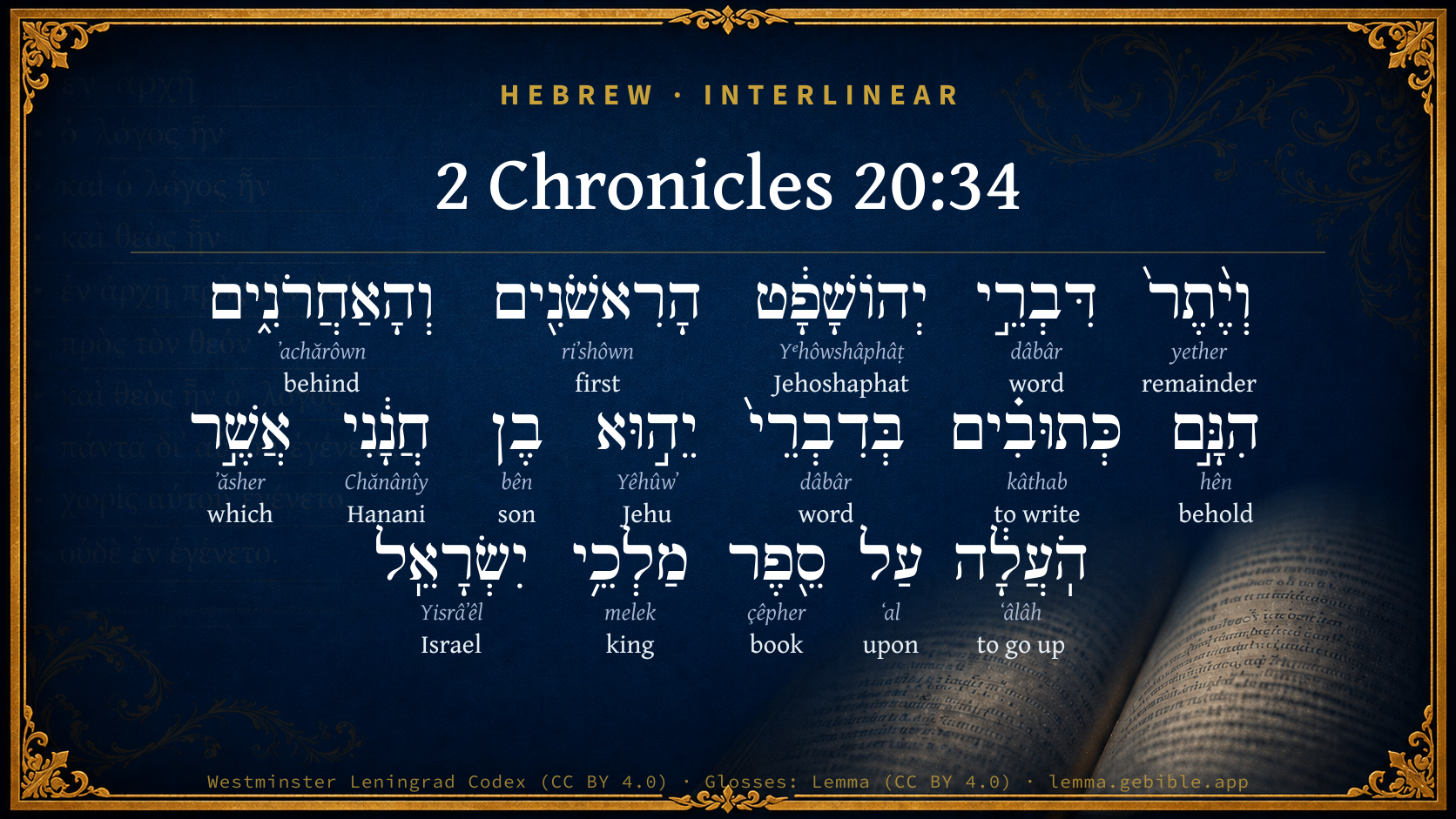
  1. וְיֶ֨תֶר֙ yether H3499 “and · remainder of” Conjunction + Noun, Common, Masculine, Singular, Construct
  2. דִּבְרֵ֣י dâbâr H1697 “words of” Noun, Common, Masculine, Plural, Construct
  3. יְהוֹשָׁפָ֔ט Yᵉhôwshâphâṭ H3092 “Jehoshaphat” Noun, Proper
  4. הָרִאשֹׁנִ֖ים riʼshôwn H7223 “the · first” Particle, Definite Article + Adjective, Adjective, Masculine, Plural, Absolute
  5. וְהָאַחֲרֹנִ֑ים ʼachărôwn H314 “and · the · behind” Conjunction + Particle, Definite Article + Adjective, Adjective, Masculine, Plural, Absolute
  6. הִנָּ֣ם hên H2005 “behold · them” Particle, Demonstrative + Suffix, Personal, 3rd Person, Masculine, Plural
  7. כְּתוּבִ֗ים kâthab H3789 “written” Verb, Qal, Participle Passive, Masculine, Plural, Absolute
  8. בְּדִבְרֵי֙ dâbâr H1697 “in/at · words of” Preposition + Noun, Common, Masculine, Plural, Construct
  9. יֵה֣וּא Yêhûwʼ H3058 “Jehu” Noun, Proper
  10. בֶן bên H1121 “son of” Noun, Common, Masculine, Singular, Construct
  11. אֲשֶׁ֣ר ʼăsher H834 “which” Particle, Relative
  12. הֹֽעֲלָ֔ה ʻâlâh H5927 “to go up” Verb, Hophal, Perfect, 3rd Person, Masculine, Singular
  13. עַל ʻal H5921 “upon” Preposition
  14. סֵ֖פֶר çêpher H5612 “book of” Noun, Common, Masculine, Singular, Construct
  15. מַלְכֵ֥י melek H4428 “kings of” Noun, Common, Masculine, Plural, Construct
  16. יִשְׂרָאֵֽל Yisrâʼêl H3478 “Israel” Noun, Proper

About this verse

These counts appear in no published source. They are computed here, from the morphology-tagged text and Lemma’s own curated glosses. What Lemma adds →

17
words
16
distinct lemmas
Historical
section

Notable vocabulary

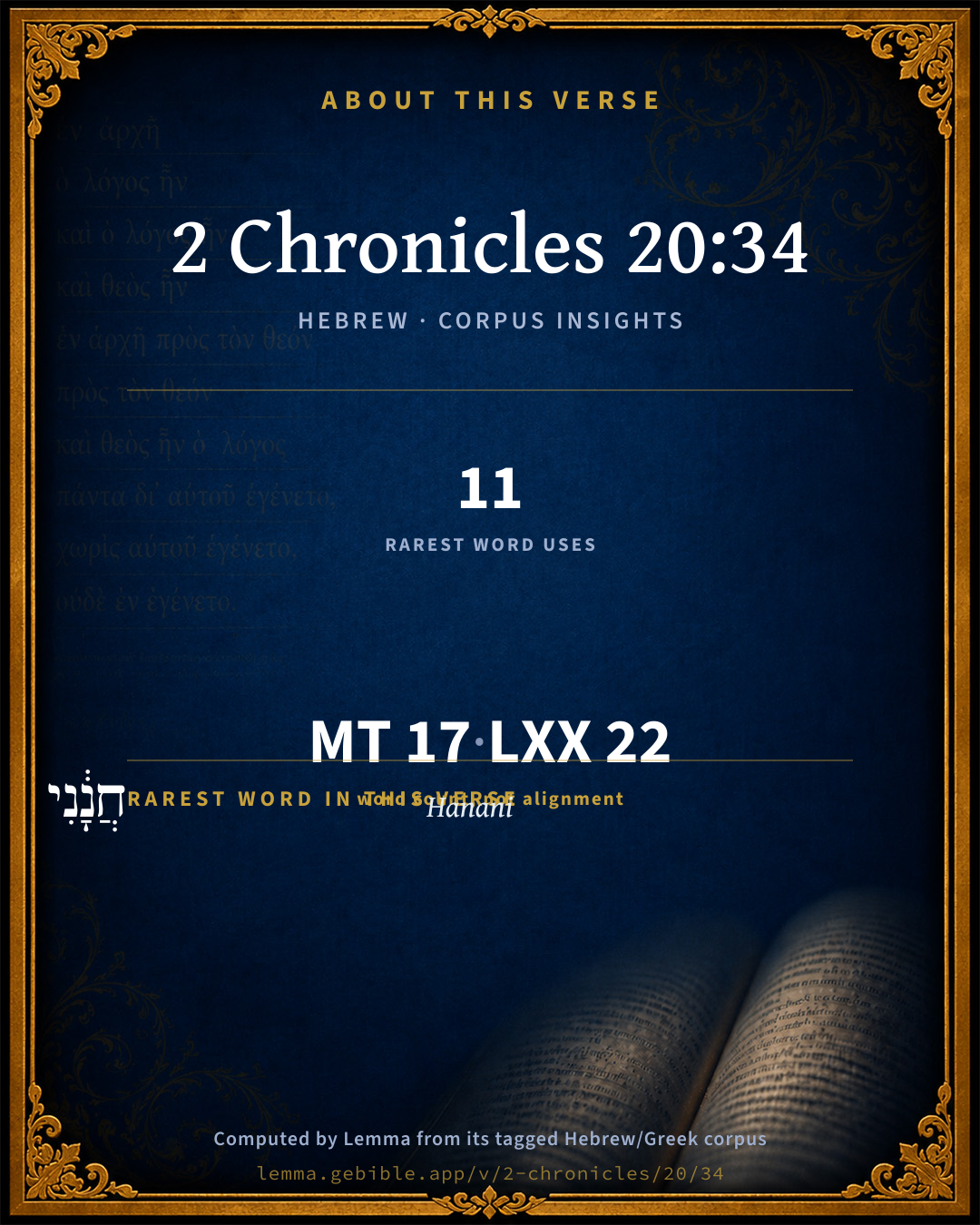
The rarest word here is חֲנָ֔נִי Hanani H2607 — appearing just 11 times in the whole Hebrew Bible.

Shared distinctive vocabulary

חֲנָ֔נִי Hanani H2607 occurs in 11 verses of the Hebrew Bible. Also found in:

Grammatical profile

  • 2 verbs
  • 10 nouns
  • 2 adjectives
  • 1 preposition
  • 2 particles

Verb forms

  • כְּתוּבִ֗ים Qal · Participle Passive
  • הֹֽעֲלָ֔ה Hophal · Perfect

Repetition

A word recurs within this verse — often emphatic in Hebrew:

  • דִּבְרֵ֣י word H1697 ×2

Hebrew & Septuagint length

In English translation the verse runs 35 words from the Hebrew and 35 from the Septuagint (LXX English) — the same length.

A rough comparison of the two English renderings, which tokenize alike — not a word-level alignment.

Word counts can differ between the Hebrew and the Greek without any difference in meaning — e.g. the Hebrew direct-object marker אֵת has no separate Greek word, and Greek often adds the article ὁ.

In the original languages it is 17 Hebrew tokens and 22 Greek tokens — but the two are counted differently (Hebrew bundles its prefixes and suffixes into one token; the Greek is in lemma form), so that isn’t a like-for-like length.

Cross-references

6

Topical passages linked to 2 Chronicles 20:34 in the Treasury of Scripture Knowledge — connected by theme and wording, ordered by reader-vote popularity; previews shown in the World English Bible.

  • 1 Kings 16:1 The word of Yahweh came to Jehu the son of Hanani against Baasha, saying,
  • 2 Chronicles 19:2 Jehu the son of Hanani the seer went out to meet him, and said to king Jehoshaphat, Should you help the wicked, and love those who hate Yahweh? for this thing wrath is on you from before Yahweh.
  • 1 Kings 16:7 Moreover by the prophet Jehu the son of Hanani came the word of Yahweh against Baasha, and against his house, both because of all the evil that he did in the sight of Yahweh, to provoke him to anger with the work of his hands, in being like the house of Jeroboam, and because he struck him.
  • 2 Chronicles 12:15 Now the acts of Rehoboam, first and last, aren't they written in the histories of Shemaiah the prophet and of Iddo the seer, after the manner of genealogies? There were wars between Rehoboam and Jeroboam continually.
  • 2 Chronicles 13:22 The rest of the acts of Abijah, and his ways, and his sayings, are written in the commentary of the prophet Iddo.
  • 2 Chronicles 16:11 Behold, the acts of Asa, first and last, behold, they are written in the book of the kings of Judah and Israel.

Cross-references courtesy of OpenBible.info (CC BY 4.0).

Hebrew and Greek witnesses Masoretic Hebrew ↔ Greek Septuagint

The same verse in the two great witnesses to the Old Testament, shown verse-for-verse.

These are two independent witnesses, not word-aligned to each other, and the Septuagint is shown in lemma (dictionary) form.

Hebrew 2 Chronicles 20:34 Masoretic · Westminster Leningrad Codex

וְיֶ֨תֶר֙ דִּבְרֵ֣י יְהוֹשָׁפָ֔ט הָרִאשֹׁנִ֖ים וְהָאַחֲרֹנִ֑ים הִנָּ֣ם כְּתוּבִ֗ים בְּדִבְרֵי֙ יֵה֣וּא בֶן חֲנָ֔נִי אֲשֶׁ֣ר הֹֽעֲלָ֔ה עַל סֵ֖פֶר מַלְכֵ֥י יִשְׂרָאֵֽל

Now the rest of the acts of Jehoshaphat, first and last, behold, they are written in the history of Jehu the son of Hanani, which is inserted in the book of the kings of Israel.

World English Bible · Public Domain

Greek LXX 2 Chronicles 20:34 Septuagint · lemma form

καί ὁ λοιπός λόγος ιωσαφατ ὁ πρῶτος καί ὁ ἔσχατος ἰδού γράφω ἐν λόγος ιου ὁ ανανι ὅς καταγράφω βιβλίον βασιλεύς ἰσραήλ

And the rest of the acts of Josaphat, the first and the last, behold, they are written in the history of Jeu the son of Anani, who wrote the book of the kings of Israel.

LXX2012 (modern English Septuagint) · Public Domain

On this verse, Whedon's Commentary on the Bible discusses the Septuagint’s reading. Read the note in Commentary ↓

Hebrew: Westminster Leningrad Codex (CC BY 4.0). Greek: Septuagint (public domain); English from LXX2012 (modern English Septuagint) (Public Domain). How the Septuagint differs from the Hebrew →

Commentary

Notes on 2 Chronicles 20:34 from classic Christian and Jewish commentators (each source and its license shown beneath its notes). The classic Christian expositions comment on the surrounding passage and are grouped to its opening verse, so a note may address several verses; the Jewish commentaries on the Tanakh (Rashi and others) are per-verse, so they appear only where the commentator wrote on this verse.

Lemma curates 59 commentaries, every one of them public domain or Creative Commons licensed, each selected and text-cleaned for this edition rather than reprinted as found. About our sources →

Trapp's Complete Commentary

John Trapp

2Ch 20:34 Now the rest of the acts of Jehoshaphat, first and last, behold, they [are] written in the book of Jehu the son of Hanani, who [is] mentioned in the book of the kings of Israel.

Ver. 34. Who is mentioned,] viz., 1Ki 16:5. Others render it, Who was commanded to register the same in the books of the kings of Israel, of part whereof they conceived him to have been the penman.

John Trapp, A Commentary or Exposition upon All the Books of the Old and New Testament (1647–1656) — public domain. Text from a community e-Sword module.

Adam Clarke's Commentary

Verse 34. In the book of Jehu] This is totally lost, though it is evident that it was in being when the books of Chronicles were written.

Adam Clarke's Commentary on the Bible (1810–1826) — public domain. Text from a community e-Sword/MySword module.

Ellicott's Commentary for English Readers

(34) Now the rest of the acts.—1Ki_22:45 : “Now the rest of the acts of Jehoshaphat, and his might that he shewed, and how he warred, are they not written in the book of the chronicles of the kings of Judah? “The expression how he warred hints at his victory over the three allies. “As to the historical foundation of this victory there can be no doubt, after what has been noted by Hitzig on Joel, Einleit. u. 4, 2; and by Ewald, Gesch. Isr. iii. 510, ff.” (Thenius).

In the book (story).—Literally, words.

Who is mentioned.—Which is inscribed (hâ’alâh, see 1Ki_9:21; 2Ch_8:8), or entered, in the book, &c. So the Syriac, “which is written in the book of the kings of Israel.” “The words of Jehu the son of Hanani is the title of a prophetic monograph here referred to as incorporated in the “Book of the Kings of Israel.”

A Bible Commentary for English Readers, edited by Charles John Ellicott (1878–1897) — public domain. Text from a community e-Sword module.

The Cambridge Bible for Schools and Colleges

gen. ed. J. J. S. Perowne

34. in the book of Jehu] R.V. in the history of Jehu.

Jehu] See 2Ch_19:2 (note).

who is mentioned] R.V. which is inserted. Chronicles of particular reigns were joined together to form one continuous Chronicle.

The Cambridge Bible for Schools and Colleges (gen. ed. J. J. S. Perowne; Cambridge University Press, 1878–1918) — public domain. Text from a community e-Sword module.

John Gill's Exposition

And after this did Jehoshaphat king of Judah join himself with Ahaziah king of Israel,.... Meaning, not after the invasion of the Moabites, &c. and the slaughter of them, but after Jehoshaphat returned from Ramothgilead, when he was reproved by a prophet for helping the ungodly, Ch2 19:1 so that it was a great aggravation of his folly and weakness, that after that, and quickly after that, he should join himself to a wicked prince, though not in war, but in trade; for so it must be, since Ahaziah reigned but two years, and those not complete, see Kg1 22:51, but is here related, that Jehoshaphat's weaknesses and blemishes might be laid together:

who did very wickedly; that is, Ahaziah, who walked in the ways of Ahab his father, and of Jezebel his mother, and of Jeroboam the son of Nebat, Kg1 22:52.

John Gill's Exposition of the Whole Bible (1746–1763) — public domain (CC PDM 1.0). Text via the HelloAO Bible API.

Albert Barnes' Notes on the Bible

Who is mentioned ... - Words which are now generally thought to mean “whose work was inserted into the Book of the Kings.”

Of Israel - “Israel” is probably used here inexactly for “Judah” (compare 2Ch 12:6; 2Ch 21:2, 2Ch 21:4).

Albert Barnes' Notes on the Bible (1834–1885) — public domain. Text from a community e-Sword/MySword module.

Haydock's Catholic Bible Commentary

Which. Sept. "who wrote a book of the kings of Israel." H. --- Jehu rebuked Josaphat, C. xix. C. --- His book is not extant. M.

George Leo Haydock (1774–1849), Haydock's Catholic Family Bible and Commentary, 1859 edition — public domain. Excludes Psalms (Douay-Rheims chapter numbering differs from Protestant) and Deuterocanonical books (Catholic canon only).

Whedon's Commentary on the Bible

Daniel D. Whedon

34. Who is mentioned in the book of the kings — Literally, as in the margin, who was made to ascend on the book, etc. The Septuagint renders it, who wrote, or described, (κατεγραψεν,) the book of the kings. Vulgate, the words of Jehu the son of Hanani, which he arranged (digessit) in the books of the kings of Israel. But most modern critics take the words to mean that Jehu’s work was incorporated in the book of the kings of Israel.

Daniel D. Whedon (gen. ed.), Commentary on the Old and New Testaments (1874–1909) — public domain. Text from a community e-Sword module.

The Pulpit Commentary

The rest of the acts of Jehoshaphat, etc. These "acts of Jehoshaphat" are said in this verse to find their record in the book of Jehu mentioned in the book of the kings of Israel. The parallel has, "in the book of the chronicles of the kings of Judah." For our "mentioned," note margin, literal, made to ascend and Revised Version "inserted." The "book of the kings of Israel" may (note also the remarkable apparent misnomers of our writer, as illustrated by (2Ch_12:6 2Ch_21:2, 2Ch_21:4) very possibly be one with the parallel, "book of the chronicles of the kings of Judah" (see our "Introduction," 1 Chronicles, pp. 7., 8.). Of this larger collected cyclopaedia of royal biography, Jehu"s account (yrebDi) of Jehoshaphat was one component part. Though Jehu"s (yrebdi) book is not mentioned elsewhere, he himself is particularly in 1Ki_16:1, as well as in our 2Ch_19:2.

The Pulpit Commentary (1880–1919), ed. H.D.M. Spence-Jones & Joseph S. Exell — public domain. Text from a community e-Sword module.

unfoldingWord translationNotes

Door43 World Missions Community

first and last

These two opposites are given to refer to everything concerning Jehoshaphat during his reign as king. AT: "from the beginning of his reign until he died" (See: Merism)

behold, they are written in the history ... Israel

The word "behold" is used here to add emphasis to the important information that follows. AT: "anyone can look in the history ... Israel and see that they are written there"

they are written in ... which is recorded in

This can be stated in active form. AT: "they are in ... which is in" (See: Active or Passive)

Hanani

Translate this man's name as you did in 2 Chronicles 16:7. (See: How to Translate Names)

the history of Jehu son of Hanani

This is a historical account that was written by Jehu.

the book of the kings of Israel

This is a book that no longer exists. See how you translated this in 2 Chronicles 16:11.

translationWords

Jehu

king

unfoldingWord translationNotes — © Distant Shores Media and the Door43 World Missions Community, licensed CC BY-SA 4.0. Source: git.door43.org/Door43/en_tn.

Rashi

Rabbi Shlomo Yitzchaki (Rashi)

in the words of Jehu the son of Hanani who said to King Jehoshaphat, (19:2) “[Did you go] to aid the wicked?”

Rashi on the Tanakh — English translations: “The Judaica Press complete Tanach with Rashi, translated by A. J. Rosenberg” (CC BY 4.0); “Pentateuch with Rashi's commentary by M. Rosenbaum and A.M. Silbermann, 1929-1934” (public domain); “The Metsudah Tanach series, Lakewood, N.J” (CC BY 4.0); and “The Book of Joshua, Metsudah Publications, 1997” (CC BY 4.0). Text via Sefaria.

Lesson kit

Teaching starters — assembled from the data on this page, not authored interpretation. Every prompt links to the verse data it draws on. Edit before teaching.

2 Chronicles, in the Historical, opens this verse with 17 words (16 distinct Hebrew lemmas). Its most distinctive word is Chănânîy (“Hanani”). A historical commentator’s framing appears above. Read the whole chapter for the surrounding context.

Discussion questions

  1. The word Chănânîy carries the sense “Hanani.” How does it shape the verse?
  2. How does 1 Kings 16:1, which shares the word «Hanani», read alongside this verse?
  3. What does the repetition of “word” (2× in this one verse) do in this verse?
  4. These translations render this verse differently; the difference is in the English rendering, not the original. What questions does that raise?
  5. «כְּתוּבִ֗ים» is a Qal Participle Passive verb. How does that grammatical form shape the action described?
  6. Compare how Trapp's Complete Commentary and Adam Clarke's Commentary read this verse. Where do they agree or differ?

Things to notice

Reading settings

Reading text

Shown beneath each verse's original-language words.

Old Testament
Old Testament edition

Read the OT as the Masoretic Hebrew (MT) or the Greek Septuagint (LXX).

English shown for the Greek Septuagint (in the Hebrew ↔ Greek comparison).

Comparing translations? Open the Compare panel on any verse page to stack up to four side by side.