
Judges 6:28

Hebrew (Westminster Leningrad Codex) Judges 6:28 appears in the Hebrew Old Testament. The text above is from the Westminster Leningrad Codex. Each word links to its Strong’s number, a concise gloss, and parsing drawn from the Open Scriptures Hebrew Bible morphology. Click any word for its full Brown-Driver-Briggs (BDB) entry.
Download image
Cite this verse

Judges 6:28 (World English Bible). Public Domain. Lemma interlinear Bible study tool, https://lemma.gebible.app/v/judges/6/28.

Show BibTeX & RIS
BibTeX
RIS
English Translation
When the men of the city arose early in the morning, behold, the altar of Baal was broken down, and the Asherah was cut down that was by it, and the second bull was offered on the altar that was built.
World English Bible · Public Domain
Download a study sheet

One document with this verse’s original text, its word-by-word gloss line, the meaning frame, cross-references with their text, attributed commentary, and full source and license credits — printable, and it pastes into notes with its structure intact.

This verse Autodidact and up

Study sheet (.html) Plain text (.txt)

A passage Seminary Student

Up to 50 verses in one chapter. A passage sheet keeps up to 6 commentary sources and 12 cross-references per verse, in the order this page ranks them, and says so on the sheet whenever that leaves anything out. Ask for a single verse and you get the Autodidact verse sheet above.

Everything on this page stays free to read, with no account — the sheet is a download of what is already on screen, not access to it.

Want to remove ads? Support Godless Engineer
Compare translations 3

The same verse in 3 English versions, stacked beneath the original-language interlinear above. Click any original word for its lexicon entry.

Each is an independent rendering of the whole verse — the interlinear is not word-aligned to these translations.

Highlighted words mark where these versions differ — a whole-verse word diff, not a word-by-word alignment.

  • World English Bible Public Domain
    When the men of the city arose early in the morning, behold, the altar of Baal was broken down, and the Asherah was cut down that was by it, and the second bull was offered on the altar that was built.
  • King James Version Public Domain
    And when the men of the city arose early in the morning, behold, the altar of Baal was cast down, and the grove was cut down that was by it, and the second bullock was offered upon the altar that was built.
  • unfoldingWord Literal Text CC BY-SA 4.0
    And the men of the city arose early in the morning, and behold, the altar of Baal was torn down, and the Asherah that beside it was cut down, and the second bullock had been offered on the built altar.

unfoldingWord Literal Text — © unfoldingWord, licensed CC BY-SA 4.0. Word-aligned USFM3 via Door43 (git.door43.org/unfoldingWord/en_ult).

Versions to compare (up to 4)

3 of 4 selected

Show all 18 translations

Every available English version of this verse, each an independent rendering of the whole verse.

  • World English Bible Public Domain
    When the men of the city arose early in the morning, behold, the altar of Baal was broken down, and the Asherah was cut down that was by it, and the second bull was offered on the altar that was built.
  • Berean Standard Bible Public Domain
    When the men of the city got up in the morning, there was Baal’s altar torn down, with the Asherah pole cut down beside it and the second bull offered up on the newly built altar.
  • Majority Standard Bible Public Domain
    When the men of the city got up in the morning, there was Baal’s altar torn down, with the Asherah pole cut down beside it and the second bull offered up on the newly built altar.
  • King James Version Public Domain
    And when the men of the city arose early in the morning, behold, the altar of Baal was cast down, and the grove was cut down that was by it, and the second bullock was offered upon the altar that was built.
  • American Standard Version (1901) Public Domain
    And when the men of the city arose early in the morning, behold, the altar of Baal was broken down, and the Asherah was cut down that was by it, and the second bullock was offered upon the altar that was built.
  • Revised Version (1885) Public Domain
    And when the men of the city arose early in the morning, behold, the altar of Baal was broken down, and the Asherah was cut down that was by it, and the second bullock was offered upon the altar that was built.
  • Geneva Bible (1599) Public Domain
    And when the men of the citie arose early in the morning, beholde, the altar of Baal was broken, and the groue cut downe that was by it, and the seconde bullocke offred vpon the altar that was made.
  • Douay-Rheims (1899) Public Domain
    Then Gedeon taking ten men of his servants, did as the Lord had commanded him. But fearing his father's house, and the men of that city, he would not do it by day, but did all by night.
  • Young's Literal Translation Public Domain
    And the men of the city rise early in the morning, and lo, broken down hath been the altar of Baal, and the shrine which is by it hath been cut down, and the second bullock hath been offered on the altar which is built.
  • Literal Standard Version CC BY-SA 4.0
    And the men of the city rise early in the morning, and behold, the altar of Ba‘al has been broken down, and the Asherah which is by it has been cut down, and the second bullock has been offered on the altar which is built.
  • Unlocked Literal Bible CC BY-SA 4.0
    In the morning when the men of the town got up, the altar of Baal was broken down, and the Asherah that was beside it was cut down, and the second bull had been offered on the altar that had been built.
  • unfoldingWord Literal Text CC BY-SA 4.0
    And the men of the city arose early in the morning, and behold, the altar of Baal was torn down, and the Asherah that beside it was cut down, and the second bullock had been offered on the built altar.
  • Darby Bible Public Domain
    When the men of the town rose early in the morning, behold, the altar of Ba'al was broken down, and the Ashe'rah beside it was cut down, and the second bull was offered upon the altar which had been built.
  • World Messianic Bible Public Domain
    When the men of the city arose early in the morning, behold, the altar of Baal was broken down, and the Asherah was cut down that was by it, and the second bull was offered on the altar that was built.
  • Webster's Bible Public Domain
    And when the men of the city arose early in the morning, behold, the altar of Baal was cast down, and the grove was cut down that was by it, and the second bullock was offered upon the altar that was built.
  • Free Bible Version CC BY-SA 4.0
    Early in the morning when the people of the town got up, they saw that the altar of Baal had been torn down and the Asherah pole beside it had been cut down, with the second bull sacrificed on the altar that had just been built.
  • Bible in Basic English Public Domain
    And the men of the town got up early in the morning, and they saw the altar of Baal broken down, and the holy tree which was by it cut down, and the ox offered on the altar which had been put up there.
  • JPS Tanakh (1917) Public Domain
    And when the men of the city arose early in the morning, behold, the altar of Baal was broken down, and the Asherah was cut down that was by it, and the second bullock was offered upon the altar that was built.

Literal Standard Version (2020), Covenant Press — licensed CC BY-SA 4.0. Text via the HelloAO Bible API (eBible.org). Unlocked Literal Bible (unfoldingWord) — licensed CC BY-SA 4.0. Text via the HelloAO Bible API (eBible.org). unfoldingWord Literal Text — © unfoldingWord, licensed CC BY-SA 4.0. Word-aligned USFM3 via Door43 (git.door43.org/unfoldingWord/en_ult). Free Bible Version, Dr. Jonathan Gallagher — licensed CC BY-SA 4.0. Text via the HelloAO Bible API (eBible.org).

Word by word

More ways to search: Search by grammar → Find every occurrence → Compare this word →

Practice this passage: Drill this verse → Learn its vocabulary →

וְהָאֲשֵׁרָ֥ה
ʼăshêrâh
H842
“and · the · Asherah”
Conjunction + Particle, Definite Article + Noun, Proper
Part of Speech
Conjunction + Particle + Noun
Type
Proper
Full BDB Definition

Origin: from H833

TWOT: 183h

Ashera(h) = "groves (for idol worship)" - a Babylonian (Astarte)-Canaanite goddess (of fortune and happiness), the supposed consort of Baal, her images - the goddess, goddesses - her images - sacred trees or poles set up near an altar
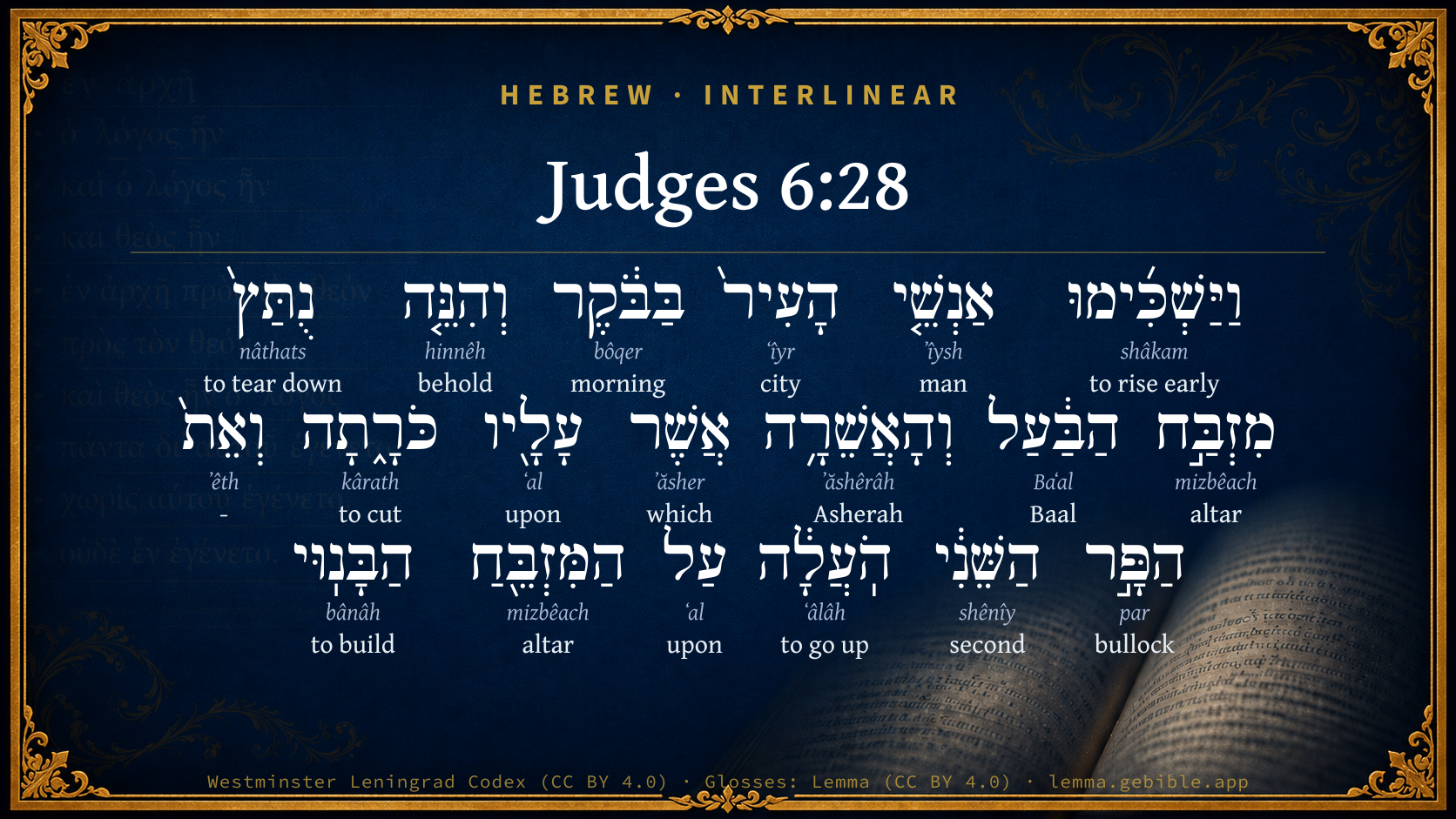
  1. וַיַּשְׁכִּ֜ימוּ shâkam H7925 “and · to rise early” Conjunction + Verb, Hiphil, Sequential Imperfect, 3rd Person, Masculine, Plural
  2. אַנְשֵׁ֤י ʼîysh H376 “men of” Noun, Common, Masculine, Plural, Construct
  3. הָעִיר֙ ʻîyr H5892 “the · city” Particle, Definite Article + Noun, Common, Feminine, Singular, Absolute
  4. בַּבֹּ֔קֶר bôqer H1242 “in/at the · morning” Preposition, Determined + Noun, Common, Masculine, Singular, Absolute
  5. וְהִנֵּ֤ה hinnêh H2009 “and · behold” Conjunction + Particle, Demonstrative
  6. נֻתַּץ֙ nâthats H5422 “to tear down” Verb, Pual, Perfect, 3rd Person, Masculine, Singular
  7. מִזְבַּ֣ח mizbêach H4196 “altar of” Noun, Common, Masculine, Singular, Construct
  8. הַבַּ֔עַל Baʻal H1168 “the · Baal” Particle, Definite Article + Noun, Proper
  9. אֲשֶׁר ʼăsher H834 “which” Particle, Relative
  10. עָלָ֖יו ʻal H5921 “upon · him” Preposition + Suffix, Personal, 3rd Person, Masculine, Singular
  11. כֹּרָ֑תָה kârath H3772 “to cut” Verb, Pual, Perfect, 3rd Person, Feminine, Singular
  12. וְאֵת֙ ʼêth H853 “and · -” Conjunction + Particle, Direct Object
  13. הַפָּ֣ר par H6499 “the · bullock” Particle, Definite Article + Noun, Common, Masculine, Singular, Absolute
  14. הַשֵּׁנִ֔י shênîy H8145 “the · second” Particle, Definite Article + Adjective, Ordinal number, Masculine, Singular, Absolute
  15. הֹֽעֲלָ֔ה ʻâlâh H5927 “to go up” Verb, Hophal, Perfect, 3rd Person, Masculine, Singular
  16. עַל ʻal H5921 “upon” Preposition
  17. הַמִּזְבֵּ֖חַ mizbêach H4196 “the · altar” Particle, Definite Article + Noun, Common, Masculine, Singular, Absolute
  18. הַבָּנֽוּי bânâh H1129 “the · built” Particle, Definite Article + Verb, Qal, Participle Passive, Masculine, Singular, Absolute

About this verse

These counts appear in no published source. They are computed here, from the morphology-tagged text and Lemma’s own curated glosses. What Lemma adds →

19
words
17
distinct lemmas
Historical
section

Shared distinctive vocabulary

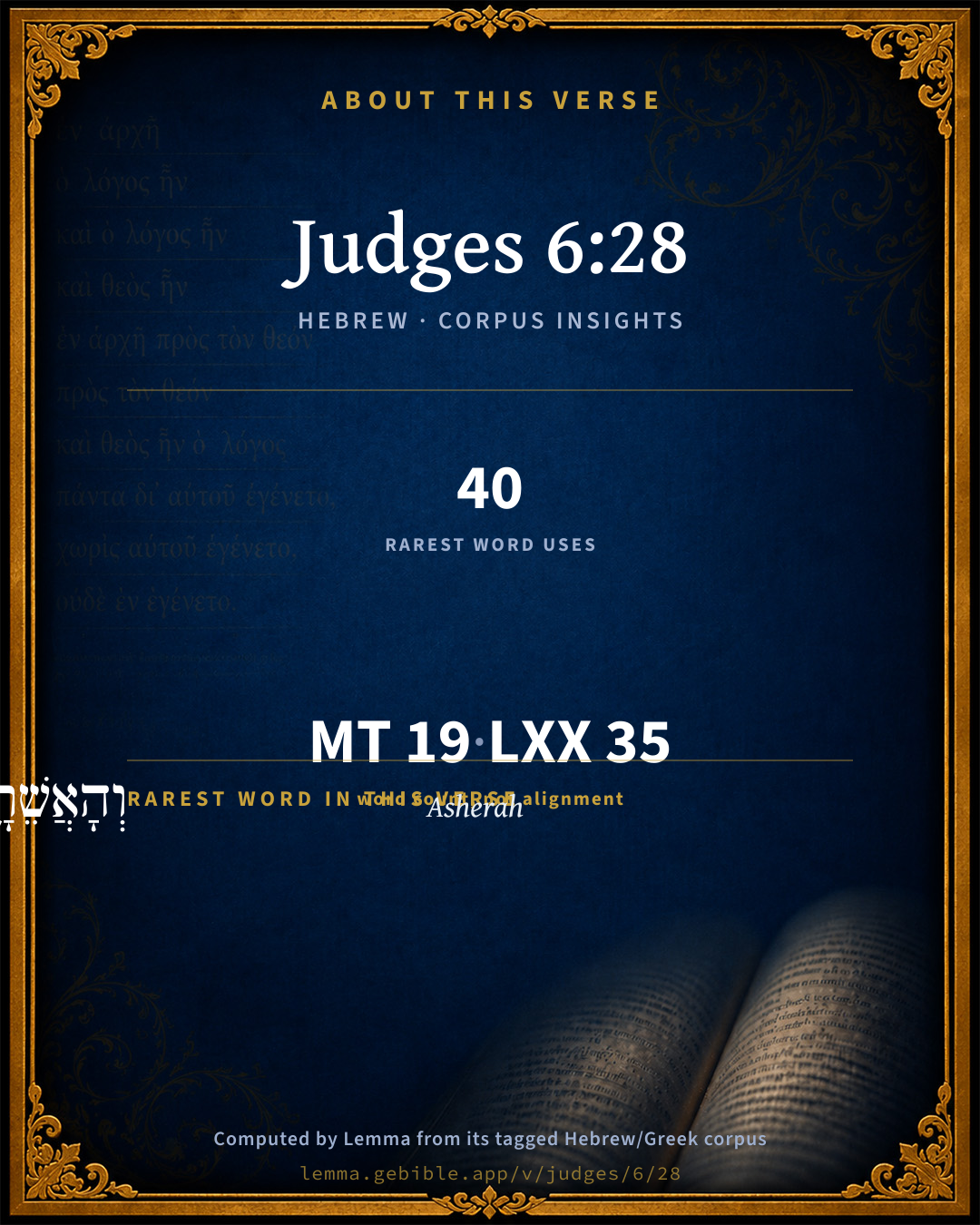
וְהָאֲשֵׁרָ֥ה Asherah H842 occurs in 40 verses of the Hebrew Bible. Also found in:

Grammatical profile

  • 5 verbs
  • 8 nouns
  • 1 adjective
  • 2 prepositions
  • 3 particles

Verb forms

  • וַיַּשְׁכִּ֜ימוּ Hiphil · Sequential Imperfect
  • נֻתַּץ֙ Pual · Perfect
  • כֹּרָ֑תָה Pual · Perfect
  • הֹֽעֲלָ֔ה Hophal · Perfect
  • הַבָּנֽוּי Qal · Participle Passive

Repetition

Words recur within this verse — often emphatic in Hebrew:

  • מִזְבַּ֣ח altar H4196 ×2
  • עָלָ֖יו upon H5921 ×2

Hebrew & Septuagint length

In English translation the verse runs 41 words from the Hebrew and 45 from the Septuagint (LXX English) — closely comparable.

A rough comparison of the two English renderings, which tokenize alike — not a word-level alignment.

Word counts can differ between the Hebrew and the Greek without any difference in meaning — e.g. the Hebrew direct-object marker אֵת has no separate Greek word, and Greek often adds the article ὁ.

In the original languages it is 19 Hebrew tokens and 35 Greek tokens — but the two are counted differently (Hebrew bundles its prefixes and suffixes into one token; the Greek is in lemma form), so that isn’t a like-for-like length.

Hebrew and Greek witnesses Masoretic Hebrew ↔ Greek Septuagint

The same verse in the two great witnesses to the Old Testament, shown verse-for-verse.

These are two independent witnesses, not word-aligned to each other, and the Septuagint is shown in lemma (dictionary) form.

Hebrew Judges 6:28 Masoretic · Westminster Leningrad Codex

וַיַּשְׁכִּ֜ימוּ אַנְשֵׁ֤י הָעִיר֙ בַּבֹּ֔קֶר וְהִנֵּ֤ה נֻתַּץ֙ מִזְבַּ֣ח הַבַּ֔עַל וְהָאֲשֵׁרָ֥ה אֲשֶׁר עָלָ֖יו כֹּרָ֑תָה וְאֵת֙ הַפָּ֣ר הַשֵּׁנִ֔י הֹֽעֲלָ֔ה עַל הַמִּזְבֵּ֖חַ הַבָּנֽוּי

When the men of the city arose early in the morning, behold, the altar of Baal was broken down, and the Asherah was cut down that was by it, and the second bull was offered on the altar that was built.

World English Bible · Public Domain

Greek LXX Judges 6:28 Septuagint · lemma form

καί ὀρθρίζω ὁ ἀνήρ ὁ πόλις ὁ πρωΐ καί ἰδού κατααἱρέω ὁ θυσιαστήριον ὁ βααλ καί ὁ ἄλσος ὁ ἐπί αὐτός ὀλεθρεύω καί ὁράω ὁ μόσχος ὁ δεύτερος ὅς ἀναφέρω ἐπί ὁ θυσιαστήριον ὁ οἰκοδομέω

And the men of the city rose up early in the morning; and behold, the altar of Baal had been demolished, and the grove by it had been destroyed; and they saw the second bullock, which Gedeon offered on the altar that had been built.

LXX2012 (modern English Septuagint) · Public Domain

Hebrew: Westminster Leningrad Codex (CC BY 4.0). Greek: Septuagint (public domain); English from LXX2012 (modern English Septuagint) (Public Domain). How the Septuagint differs from the Hebrew →

Targum (Aramaic paraphrase)

1

The Targum is the ancient Jewish Aramaic paraphrase of the Hebrew Scriptures — an interpretive translation, not the Hebrew text itself. Onkelos (literal) and Pseudo-Jonathan (expansive) render the Torah, and Jonathan the Prophets. Coverage is partial: where no permissively-licensed English translation exists for a verse, only the Aramaic is shown. This is verse-level text, not a word-by-word alignment to the Hebrew.

  1. Targum Jonathan Prophets (Joshua–Malachi)
    וְאַקְדִימוּ אֱנָשֵׁי קַרְתָּא בְּצַפְרָא וְהָא מִתְרַע אֱגוֹרָא דְבַעֲלָא וַאֲשֶׁרְתָּא דִי עֲלוֹהִי קְצִיצָא וְיַת תּוֹרָא תִנְיָנָא מִסַק עַל מַדְבְּחָא דְבָנוּי:

    (no public-domain English translation for this verse)

    Targum Jonathan — Aramaic: “Mikraot Gedolot” (public domain). English: “Sefaria Community Translation” (CC0 1.0 (public-domain dedication)); “London "Chaldee Paraphrase," 1871” (public domain). Text via Sefaria.

Commentary

Notes on Judges 6:28 from classic Christian and Jewish commentators (each source and its license shown beneath its notes). The classic Christian expositions comment on the surrounding passage and are grouped to its opening verse, so a note may address several verses; the Jewish commentaries on the Tanakh (Rashi and others) are per-verse, so they appear only where the commentator wrote on this verse.

Lemma curates 59 commentaries, every one of them public domain or Creative Commons licensed, each selected and text-cleaned for this edition rather than reprinted as found. About our sources →

Trapp's Complete Commentary

John Trapp

Jdg 6:28 And when the men of the city arose early in the morning, behold, the altar of Baal was cast down, and the grove was cut down that [was] by it, and the second bullock was offered upon the altar [that was] built.

Ver. 28. Early in the morning.] To do their devotions. So did Nestor in Homer, the Argonauts in Apollonius, the Persian Magi, the Roman Pinarii and Potitii, &c., for a shame to many Christians are late and lag in God’s service.

John Trapp, A Commentary or Exposition upon All the Books of the Old and New Testament (1647–1656) — public domain. Text from a community e-Sword module.

Joseph Benson's Commentary

Jdg 6:28-29. The bullock was offered — Not upon Baal’s altar, for which it was designed, but upon an altar erected in contempt of Baal. When they inquired, they said — Probably some of the persons employed in it.

Joseph Benson's Commentary on the Old and New Testaments (1811–1818) — public domain. Text from a community e-Sword module.

Geneva Bible (1599)

Geneva Bible translators

Meaning, the fat bull, which was kept to be offered unto Baal.

Geneva Bible (1599) marginal notes — public domain. Text via Bolls.life.

Adam Clarke's Commentary

Verse 28. The second bullock was offered] It appears that the second bullock was offered because it was just seven years old, Jdg 6:25, being calved about the time that the Midianitish oppression began; and it was now to be slain to indicate that their slavery should end with its life. The young bullock, Jdg 6:25, is supposed to have been offered for a peace-offering; the bullock of seven years old, for a burnt-offering.

Adam Clarke's Commentary on the Bible (1810–1826) — public domain. Text from a community e-Sword/MySword module.

Ellicott's Commentary for English Readers

(28) Arose early in the morning.—The habits of Orientals are early, and Baal-worship may well have involved some adoration of the rising sun.

Cast down.—They observed three things: viz., the demolished altar of Baal; the stump of the destroyed Asherah; and a new altar, with the remains of a burnt offering smoking upon it.

The second bullock.—It has been supposed that Gideon offered both bullocks, the first as a burnt offering for his family, and the second for the nation. Nothing, however, is said of the fate of the young bullock; and, apart from express direction, Gideon may have hesitated to offer to the Lord a sacrifice which may have been devoted to Baal.

A Bible Commentary for English Readers, edited by Charles John Ellicott (1878–1897) — public domain. Text from a community e-Sword module.

John Gill's Exposition

And they said one to another, who hath done this thing?.... They were struck with amazement, and could not devise who could be so daring and wicked as to do such an action:

and when they inquired and asked; one and another, everyone present, or they could think of as proper to inquire of; they were very diligent and industrious to find it out; and perhaps they inquired of the family and servants of Joash and Gideon, in whose ground the altar stood:

they said, Gideon the son of Joash hath done this thing; when they had inquired of everybody they could, and thought of one person and another, there was none appeared to them more likely to have done it, than Gideon; partly because they knew he was no friend of Baal, and partly because he was a man of spirit and courage, and they concluded none but such an one would have ventured to have done it; and besides, they considered he was the son of Joash, who perhaps was their chief magistrate, and that he might presume on his father's protection, as they might surprise; and being near the premises, he was the most likely person they could think of; and it is not improbable, that upon inquiry they got it out of the servants concerned, or that had knowledge of it from them, or from some that saw him that morning at the sacrifice, or returning from it, and therefore peremptorily assert he was the man that did it.

John Gill's Exposition of the Whole Bible (1746–1763) — public domain (CC PDM 1.0). Text via the HelloAO Bible API.

Matthew Poole's English Annotations

Not upon Baal’s altar, for which it was designed; but upon an altar erected in contempt of Baal.

Matthew Poole's English Annotations on the Holy Bible (1683–1685) — public domain. Text from a community e-Sword/MySword module.

Whedon's Commentary on the Bible

Daniel D. Whedon

28. Behold… the second bullock was offered — Its carcass was not yet consumed, but was smoking and burning still, when the men of the city arose; for it was probably near morning when Gideon and his ten men finished their work.

Daniel D. Whedon (gen. ed.), Commentary on the Old and New Testaments (1874–1909) — public domain. Text from a community e-Sword module.

The Pulpit Commentary

The grove. See ver. 25. The second bullock. There must be some special meaning in this description, the second. Can it refer to his place in the team, the young bullock being the leader, the first, and the seven-year-old the wheeler, the second?

The Pulpit Commentary (1880–1919), ed. H.D.M. Spence-Jones & Joseph S. Exell — public domain. Text from a community e-Sword module.

John Wesley's Explanatory Notes

Was offered - Not upon Baal's altar, for which it was designed; but upon an altar erected in contempt of Baal.

John Wesley, Explanatory Notes Upon the Whole Bible (1754–1765) — public domain. Text via the GEBible commentary corpus.

unfoldingWord translationNotes

Door43 World Missions Community

got up

"got up out of bed" or "woke up"

the altar of Baal was broken down, and the Asherah that was beside it was cut down, and the second bull had been offered on the altar that had been built

This can be stated in active form. AT: "they noticed that someone had broken down the altar of Baal, cut down the Asherah that was beside it, and built an altar and sacrificed the second bull on it" (See: Active or Passive)

translationWords

altar

Baal

Asherah

Gideon

Joash

unfoldingWord translationNotes — © Distant Shores Media and the Door43 World Missions Community, licensed CC BY-SA 4.0. Source: git.door43.org/Door43/en_tn.

Lesson kit

Teaching starters — assembled from the data on this page, not authored interpretation. Every prompt links to the verse data it draws on. Edit before teaching.

Judges, in the Historical, opens this verse with 19 words (17 distinct Hebrew lemmas). Its most distinctive word is ʼăshêrâh (“Asherah”). A historical commentator’s framing appears above. Read the whole chapter for the surrounding context.

Discussion questions

  1. The word ʼăshêrâh carries the sense “Asherah.” How does it shape the verse?
  2. Exodus 34:13 shares the word «Asherah» with this verse. How do the two illuminate each other?
  3. “altar” occurs 2× in this one verse. What is the effect of the repetition?
  4. These translations render this verse differently; the difference is in the English rendering, not the original. What questions does that raise?
  5. The verb «וַיַּשְׁכִּ֜ימוּ» is Hiphil Sequential Imperfect. How does its form color the action?
  6. Reading how Trapp's Complete Commentary and Joseph Benson's Commentary read this verse, where do the two commentators agree and where do they part?

Things to notice

Reading settings

Reading text

Shown beneath each verse's original-language words.

Old Testament
Old Testament edition

Read the OT as the Masoretic Hebrew (MT) or the Greek Septuagint (LXX).

English shown for the Greek Septuagint (in the Hebrew ↔ Greek comparison).

Comparing translations? Open the Compare panel on any verse page to stack up to four side by side.