
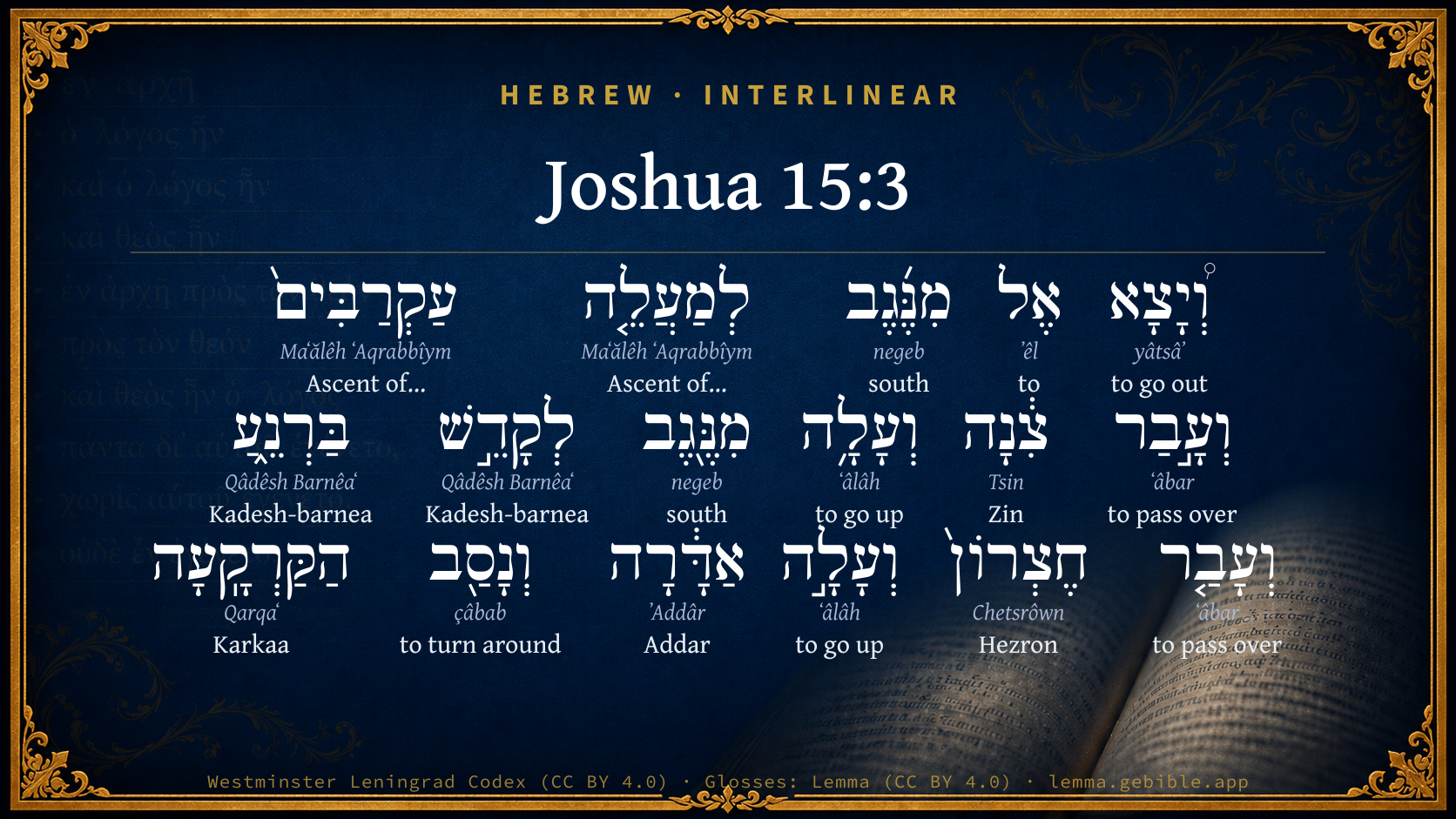
Joshua 15:3

Hebrew (Westminster Leningrad Codex) Joshua 15:3 appears in the Hebrew Old Testament. The text above is from the Westminster Leningrad Codex. Each word links to its Strong’s number, a concise gloss, and parsing drawn from the Open Scriptures Hebrew Bible morphology. Click any word for its full Brown-Driver-Briggs (BDB) entry.
Download image
Cite this verse

Joshua 15:3 (World English Bible). Public Domain. Lemma interlinear Bible study tool, https://lemma.gebible.app/v/joshua/15/3.

Show BibTeX & RIS
BibTeX
RIS
English Translation
and it went out southward of the ascent of Akrabbim, and passed along to Zin, and went up by the south of Kadesh-barnea, and passed along by Hezron, and went up to Addar, and turned about to Karka;
World English Bible · Public Domain
Highlights
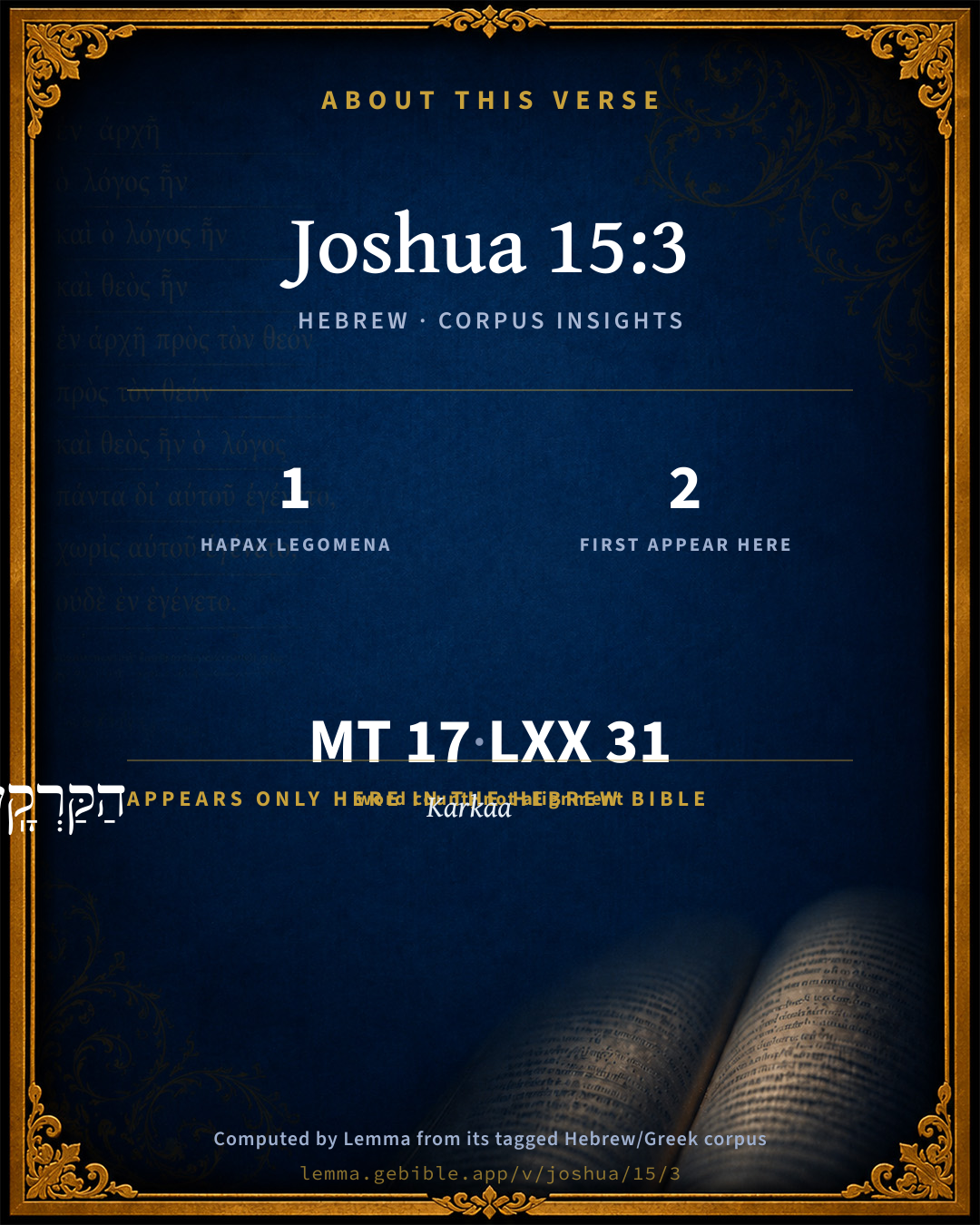
  • 1 hapax legomenon — only here in the Hebrew Bible
  • 2 first appearances in the Hebrew Bible
Full analysis ↓
Download a study sheet

One document with this verse’s original text, its word-by-word gloss line, the meaning frame, cross-references with their text, attributed commentary, and full source and license credits — printable, and it pastes into notes with its structure intact.

This verse Autodidact and up

Study sheet (.html) Plain text (.txt)

A passage Seminary Student

Up to 50 verses in one chapter. A passage sheet keeps up to 6 commentary sources and 12 cross-references per verse, in the order this page ranks them, and says so on the sheet whenever that leaves anything out. Ask for a single verse and you get the Autodidact verse sheet above.

Everything on this page stays free to read, with no account — the sheet is a download of what is already on screen, not access to it.

Want to remove ads? Support Godless Engineer
Compare translations 3

The same verse in 3 English versions, stacked beneath the original-language interlinear above. Click any original word for its lexicon entry.

Each is an independent rendering of the whole verse — the interlinear is not word-aligned to these translations.

Highlighted words mark where these versions differ — a whole-verse word diff, not a word-by-word alignment.

  • World English Bible Public Domain
    and it went out southward of the ascent of Akrabbim, and passed along to Zin, and went up by the south of Kadesh-barnea, and passed along by Hezron, and went up to Addar, and turned about to Karka;
  • King James Version Public Domain
    And it went out to the south side to Maalehacrabbim, and passed along to Zin, and ascended up on the south side unto Kadeshbarnea, and passed along to Hezron, and went up to Adar, and fetched a compass to Karkaa:
  • unfoldingWord Literal Text CC BY-SA 4.0
    And it went out to the south to the Ascent of Akrabbim, then it passed over to Zin, then it went up from the south to Kadesh Barnea, then it passed over to Hezron, then it went up to Addar, then it curved around to Karka.

unfoldingWord Literal Text — © unfoldingWord, licensed CC BY-SA 4.0. Word-aligned USFM3 via Door43 (git.door43.org/unfoldingWord/en_ult).

Versions to compare (up to 4)

3 of 4 selected

Show all 18 translations

Every available English version of this verse, each an independent rendering of the whole verse.

  • World English Bible Public Domain
    and it went out southward of the ascent of Akrabbim, and passed along to Zin, and went up by the south of Kadesh-barnea, and passed along by Hezron, and went up to Addar, and turned about to Karka;
  • Berean Standard Bible Public Domain
    proceeded south of the Ascent of Akrabbim, continued on to Zin, went over to the south of Kadesh-barnea, ran past Hezron up to Addar, and curved toward Karka.
  • Majority Standard Bible Public Domain
    proceeded south of the Ascent of Akrabbim, continued on to Zin, went over to the south of Kadesh-barnea, ran past Hezron up to Addar, and curved toward Karka.
  • King James Version Public Domain
    And it went out to the south side to Maalehacrabbim, and passed along to Zin, and ascended up on the south side unto Kadeshbarnea, and passed along to Hezron, and went up to Adar, and fetched a compass to Karkaa:
  • American Standard Version (1901) Public Domain
    and it went out southward of the ascent of Akrabbim, and passed along to Zin, and went up by the south of Kadesh-barnea, and passed along by Hezron, and went up to Addar, and turned about to Karka;
  • Revised Version (1885) Public Domain
    and it went out southward of the ascent of Akrabbim, and passed along to Zin, and went up by the south of Kadesh-barnea, and passed along by Hezron, and went up to Addar, and turned about to Karka:
  • Geneva Bible (1599) Public Domain
    And it went out on the Southside towarde Maaleth-akrabbim, and went along to Zin, and ascended vp on the Southside vnto Kadesh-barnea, and went along to Hezron, and went vp to Adar, and fet a compasse to Karkaa.
  • Douay-Rheims (1899) Public Domain
    And it goeth out towards the ascent of the Scorpion, and passeth on to Sina: and ascendeth into Cadesbarne, and reacheth into Esron, going up to Addar, and compassing Carcaa.
  • Young's Literal Translation Public Domain
    and it hath gone out unto the south to Maaleh-Akrabbim, and passed over to Zin, and gone up on the south to Kadesh-Barnea, and passed over `to' Hezron, and gone up to Adar, and turned round to Karkaa,
  • Literal Standard Version CC BY-SA 4.0
    and it has gone out to the south to Maaleh-Akrabbim, and passed over to Zin, and gone up on the south to Kadesh-Barnea, and passed over [to] Hezron, and gone up to Adar, and turned around to Karkaa,
  • Unlocked Literal Bible CC BY-SA 4.0
    Their boundary next went out to the south of the hill of Akrabbim and passed along to Zin, and went up south of Kadesh Barnea, along by Hezron, and up to Addar, where it turned about to Karka.
  • unfoldingWord Literal Text CC BY-SA 4.0
    And it went out to the south to the Ascent of Akrabbim, then it passed over to Zin, then it went up from the south to Kadesh Barnea, then it passed over to Hezron, then it went up to Addar, then it curved around to Karka.
  • Darby Bible Public Domain
    and it went out south of the ascent of Akrabbim, and passed on to Zin, and went up on the south of Kadesh-barnea, and passed to Hezron, and went up toward Addar, and turned toward Karkaah,
  • World Messianic Bible Public Domain
    and it went out southward of the ascent of Akrabbim, and passed along to Zin, and went up by the south of Kadesh Barnea, and passed along by Hezron, went up to Addar, and turned toward Karka;
  • Webster's Bible Public Domain
    And it went out to the south side to Maaleh-acrabbim, and passed along to Zin, and ascended on the south side to Kadesh-barnea, and passed along to Hezron, and went up to Adar, and fetched a compass to Karkaa:
  • Free Bible Version CC BY-SA 4.0
    and then went south of Scorpion Pass through the wilderness of Zin, then heading south from Kadesh-barnea to Hezron. From there it went up to Addar and then turned towards Karka,
  • Bible in Basic English Public Domain
    From there it goes south of the slope up to Akrabbim, and on to Zin, then south past Kadesh-barnea, and on by Hezron and up to Addar, turning in the direction of Karka:
  • JPS Tanakh (1917) Public Domain
    And it went out southward of the ascent of Akrabbim, and passed along to Zin, and went up by the south of Kadesh-barnea, and passed along by Hezron, and went up to Addar, and turned about to Karka.

Literal Standard Version (2020), Covenant Press — licensed CC BY-SA 4.0. Text via the HelloAO Bible API (eBible.org). Unlocked Literal Bible (unfoldingWord) — licensed CC BY-SA 4.0. Text via the HelloAO Bible API (eBible.org). unfoldingWord Literal Text — © unfoldingWord, licensed CC BY-SA 4.0. Word-aligned USFM3 via Door43 (git.door43.org/unfoldingWord/en_ult). Free Bible Version, Dr. Jonathan Gallagher — licensed CC BY-SA 4.0. Text via the HelloAO Bible API (eBible.org).

Word by word

More ways to search: Search by grammar → Find every occurrence → Compare this word →

Practice this passage: Drill this verse → Learn its vocabulary →

הַקַּרְקָֽעָה
Qarqaʻ
H7173
“the · Karkaa · toward”
Particle, Definite Article + Noun, Proper + Suffix, Demonstrative
Part of Speech
Particle + Noun
Type
Proper
Full BDB Definition

Origin: the same as H7172

TWOT: None

Karkaa = "floor" - a landmark on the southern boundary of Judah - site unknown
  1. וְ֠יָצָא yâtsâʼ H3318 “and · to go out” Conjunction + Verb, Qal, Perfect, 3rd Person, Masculine, Singular
  2. אֶל ʼêl H413 “to” Preposition
  3. מִנֶּ֜גֶב negeb H5045 “from · south” Preposition + Noun, Common, Masculine, Singular, Absolute
  4. לְמַעֲלֵ֤ה Maʻălêh ʻAqrabbîym H4610 “to/for · Ascent of Scorpions of” Preposition + Noun, Common, Masculine, Singular, Construct
  5. עַקְרַבִּים֙ Maʻălêh ʻAqrabbîym H4610 “Ascent of Scorpions” Noun, Proper
  6. וְעָ֣בַר ʻâbar H5674 “and · to pass over” Conjunction + Verb, Qal, Perfect, 3rd Person, Masculine, Singular
  7. צִ֔נָה Tsin H6790 “Zin · toward” Noun, Proper + Suffix, Demonstrative
  8. וְעָלָ֥ה ʻâlâh H5927 “and · to go up” Conjunction + Verb, Qal, Perfect, 3rd Person, Masculine, Singular
  9. מִנֶּ֖גֶב negeb H5045 “from · south” Preposition + Noun, Common, Masculine, Singular, Absolute
  10. לְקָדֵ֣שׁ Qâdêsh Barnêaʻ H6947 “to/for · Kadesh-barnea” Preposition + Noun, Proper
  11. בַּרְנֵ֑עַ Qâdêsh Barnêaʻ H6947 “Kadesh-barnea” Noun, Proper
  12. וְעָבַ֤ר ʻâbar H5674 “and · to pass over” Conjunction + Verb, Qal, Perfect, 3rd Person, Masculine, Singular
  13. חֶצְרוֹן֙ Chetsrôwn H2696 “Hezron” Noun, Proper
  14. וְעָלָ֣ה ʻâlâh H5927 “and · to go up” Conjunction + Verb, Qal, Perfect, 3rd Person, Masculine, Singular
  15. אַדָּ֔רָה ʼAddâr H146 “Addar · toward” Noun, Proper + Suffix, Demonstrative
  16. וְנָסַ֖ב çâbab H5437 “and · to turn around” Conjunction + Verb, Niphal, Perfect, 3rd Person, Masculine, Singular

About this verse

These counts appear in no published source. They are computed here, from the morphology-tagged text and Lemma’s own curated glosses. What Lemma adds →

17
words
12
distinct lemmas
Historical
section

Notable vocabulary

1 hapax legomenon — a word that appears only here in the entire Hebrew Bible:

  • הַקַּרְקָֽעָה Karkaa H7173

First appearance in Scripture

These words make their first canonical appearance in the Hebrew Bible here:

  • אַדָּ֔רָה Addar H146
  • הַקַּרְקָֽעָה Karkaa H7173

Shared distinctive vocabulary

אַדָּ֔רָה Addar H146 occurs in 2 verses of the Hebrew Bible. Also found in:

Grammatical profile

  • 6 verbs
  • 10 nouns
  • 1 preposition

Verb forms

  • וְ֠יָצָא Qal · Perfect
  • וְעָ֣בַר Qal · Perfect
  • וְעָלָ֥ה Qal · Perfect
  • וְעָבַ֤ר Qal · Perfect
  • וְעָלָ֣ה Qal · Perfect
  • וְנָסַ֖ב Niphal · Perfect

Repetition

Words recur within this verse — often emphatic in Hebrew:

  • מִנֶּ֜גֶב south H5045 ×2
  • לְמַעֲלֵ֤ה Ascent of Scorpions H4610 ×2
  • וְעָ֣בַר to pass over H5674 ×2
  • וְעָלָ֥ה to go up H5927 ×2
  • לְקָדֵ֣שׁ Kadesh-barnea H6947 ×2

Hebrew & Septuagint length

In English translation the verse runs 38 words from the Hebrew and 43 from the Septuagint (LXX English) — closely comparable.

A rough comparison of the two English renderings, which tokenize alike — not a word-level alignment.

Word counts can differ between the Hebrew and the Greek without any difference in meaning — e.g. the Hebrew direct-object marker אֵת has no separate Greek word, and Greek often adds the article ὁ.

In the original languages it is 17 Hebrew tokens and 31 Greek tokens — but the two are counted differently (Hebrew bundles its prefixes and suffixes into one token; the Greek is in lemma form), so that isn’t a like-for-like length.

Cross-references

5

Topical passages linked to Joshua 15:3 in the Treasury of Scripture Knowledge — connected by theme and wording, ordered by reader-vote popularity; previews shown in the World English Bible.

  • Numbers 34:4 and your border shall turn about southward of the ascent of Akrabbim, and pass along to Zin; and the goings out of it shall be southward of Kadesh-barnea; and it shall go forth to Hazar Addar, and pass along to Azmon;
  • Judges 1:36 The border of the Amorites was from the ascent of Akrabbim, from the rock, and upward.
  • Genesis 14:7 They returned, and came to En-mishpat (the same is Kadesh), and struck all the country of the Amalekites, and also the Amorites, that lived in Hazazon Tamar.
  • Numbers 20:1 The children of Israel, even the whole congregation, came into the wilderness of Zin in the first month: and the people abode in Kadesh; and Miriam died there, and was buried there.
  • Numbers 32:8 Thus did your fathers, when I sent them from Kadesh-barnea to see the land.

Cross-references courtesy of OpenBible.info (CC BY 4.0).

Hebrew and Greek witnesses Masoretic Hebrew ↔ Greek Septuagint

The same verse in the two great witnesses to the Old Testament, shown verse-for-verse.

These are two independent witnesses, not word-aligned to each other, and the Septuagint is shown in lemma (dictionary) form.

Hebrew Joshua 15:3 Masoretic · Westminster Leningrad Codex

וְ֠יָצָא אֶל מִנֶּ֜גֶב לְמַעֲלֵ֤ה עַקְרַבִּים֙ וְעָ֣בַר צִ֔נָה וְעָלָ֥ה מִנֶּ֖גֶב לְקָדֵ֣שׁ בַּרְנֵ֑עַ וְעָבַ֤ר חֶצְרוֹן֙ וְעָלָ֣ה אַדָּ֔רָה וְנָסַ֖ב הַקַּרְקָֽעָה

and it went out southward of the ascent of Akrabbim, and passed along to Zin, and went up by the south of Kadesh-barnea, and passed along by Hezron, and went up to Addar, and turned about to Karka;

World English Bible · Public Domain

Greek LXX Joshua 15:3 Septuagint · lemma form

καί διαπορεύομαι ἀπέναντι ὁ προσανάβασις ακραβιν καί ἐκ περιπορεύομαι σεννα καί ἀναβαίνω ἀπό λίψ ἐπί καδης βαρνη καί ἐκπορεύομαι ασωρων καί προσ ἀναβαίνω εἰς αδδαρα καί περιπορεύομαι ὁ κατά δυσμή καδης

And they proceed before the ascent of Acrabin, and go out round Sena, and go up from the south to Cades Barne; and go out to Asoron, and proceed up to Sarada, and go out by the way that is west of Cades.

LXX2012 (modern English Septuagint) · Public Domain

Hebrew: Westminster Leningrad Codex (CC BY 4.0). Greek: Septuagint (public domain); English from LXX2012 (modern English Septuagint) (Public Domain). How the Septuagint differs from the Hebrew →

Targum (Aramaic paraphrase)

1

The Targum is the ancient Jewish Aramaic paraphrase of the Hebrew Scriptures — an interpretive translation, not the Hebrew text itself. Onkelos (literal) and Pseudo-Jonathan (expansive) render the Torah, and Jonathan the Prophets. Coverage is partial: where no permissively-licensed English translation exists for a verse, only the Aramaic is shown. This is verse-level text, not a word-by-word alignment to the Hebrew.

  1. Targum Jonathan Prophets (Joshua–Malachi)
    וְנָפַק לְמִדָרוֹמָא לְמַסְקָנָא דְעַקְרַבִּין וַעֲבַר לְצִין וּסְלֵיק מִדָרוֹמָא לִרְקַם גֵיאָה וַעֲבַר לְחֶצְרוֹן וּסְלֵיק לְאַדָר וּמִסְתְּחַר לְקַרְקָעָה:

    (no public-domain English translation for this verse)

    Targum Jonathan — Aramaic: “Mikraot Gedolot” (public domain). English: “Sefaria Community Translation” (CC0 1.0 (public-domain dedication)); “London "Chaldee Paraphrase," 1871” (public domain). Text via Sefaria.

Commentary

Notes on Joshua 15:3 from classic Christian and Jewish commentators (each source and its license shown beneath its notes). The classic Christian expositions comment on the surrounding passage and are grouped to its opening verse, so a note may address several verses; the Jewish commentaries on the Tanakh (Rashi and others) are per-verse, so they appear only where the commentator wrote on this verse.

Lemma curates 59 commentaries, every one of them public domain or Creative Commons licensed, each selected and text-cleaned for this edition rather than reprinted as found. About our sources →

Trapp's Complete Commentary

John Trapp

Jos 15:3 And it went out to the south side to Maalehacrabbim, and passed along to Zin, and ascended up on the south side unto Kadeshbarnea, and passed along to Hezron, and went up to Adar, and fetched a compass to Karkaa:

Ver. 3. To Maalehacrabbim,] i.e., To the ascent of scorpions, or of the mountains that were crooked as scorpions, or that abounded with scorpions. {Jdg 1:36}

Passed along to Zin.] A city whence that wilderness, not the same with that of Sin or Sinai, had its name.

To Hezron, and went up to Adar.] These two places are {Num 34:4} called Hazaraddar.

John Trapp, A Commentary or Exposition upon All the Books of the Old and New Testament (1647–1656) — public domain. Text from a community e-Sword module.

Jamieson, Fausset & Brown

Robert Jamieson, A. R. Fausset & David Brown

Maaleh-akrabbim--Hebrew, "the ascent of scorpions"; a pass in the "bald mountain" (see on Jos 11:17), probably much infested by these venomous reptiles.

Jamieson, Fausset & Brown — Commentary Critical and Explanatory on the Whole Bible (1871) — public domain (CC PDM 1.0). Text via the HelloAO Bible API.

Adam Clarke's Commentary

Verse 3. Maaleh-acrabbim] The ascent of the Mount of Scorpions, probably so called from the multitude of those animals found in that place.

Kadesh-barnea] This place was called Enmishpat, Ge 14:7. It was on the edge of the wilderness of Paran, and about twenty-four miles from Hebron. Here Miriam, the sister of Moses and Aaron, died; and here Moses and Aaron rebelled against the Lord; hence the place was called Meribah-Kadesh, or the contention of Kadesh.

Karkaa] Supposed to be the Coracea of Ptolemy, in Arabia Petraea. - Calmet.

Adam Clarke's Commentary on the Bible (1810–1826) — public domain. Text from a community e-Sword/MySword module.

The Cambridge Bible for Schools and Colleges

gen. ed. J. J. S. Perowne

3. and it went out to the south] From this point the border ran in a tolerably direct course towards the south side of Maaleh-acrabbim, “the ascent of scorpions,” “the stiyinge vp of Scorpion,” Wyclif; “the going up to Akrabbim,” as it is given in Num_34:4; Jdg_1:36, a pass in “the bald mountain” (Jos_11:17; Jos_12:7), which “goeth up to Seir.” De Saulcy suggests it was the Wâdy Zouara, and testifies to “the scorpions” there found under every pebble. S. and P. 113, n.

and passed along to Zin] Thence it passed along to Zin, i.e. a certain spot in the desert of Zin not far from Kadesh-barnea, and passed over to Hezron, and went up to Adar, and fetched a compass or turned to Karkaa, and thence towards Azmon, and went out at the water-course of Egypt, i.e. the “torrent of Egypt, the Wady-el-Arish, already spoken of in ch. Jos_13:3. The border went directly southwards to Kadesh-barnea; south of Kadesh it turned westward, and came out finally at the “torrent of Egypt” and at the Mediterranean Sea. Hezron, Adar, Karkaa, Azmon, are unknown sites.

fetched a compass] Compare Fr. compas, It. compasso, a compass, circle; compasser, to compass, encircle; from Latin cum, passus. The word is used both as (1) a noun and (2) a verb. (a) In the sense of “circumference” it occurs in Exo_27:5; Exo_38:4, of “circuit” in 2Sa_5:23; 2Ki_3:9; Act_28:13. Here, to fetch a compass = simply to “turn,” to “go round.” Thus Fuller (Pisgah View, IV.II. 2:43) says: “Wicked men may for a time retard, not finally obstruct our access to happiness. It is but fetching a compass, making two steps for one; a little more pains and patience will do the deed;” and he says of the Jordan, “he fetcheth many turnings and windings, but all will not excuse him from falling into the Dead Sea” (Holy War, 1. 18).

The Cambridge Bible for Schools and Colleges (gen. ed. J. J. S. Perowne; Cambridge University Press, 1878–1918) — public domain. Text from a community e-Sword module.

John Gill's Exposition

And it went out to the south side of Maalehacrabbim,.... Or the ascent of Akrabbim, as it is called; see Gill on Num 34:4,

and passed along to Zin, and ascended upon the south side unto Kadeshbarnea; which perfectly agrees with the southern border of the land, as described in Num 34:4,

and passed along to Hezron, and went up to Adar; which two places being near to one another, as is very likely, are put together, as if one place, and called Hazaraddar, Num 34:4; and mention is made of Hezron, which is Hazor, Jos 15:25; but not of Adar:

and fetched a compass to Karkaa; which Jerom (w) calls Acchara, a village in the wilderness; and if the same with Carcaria, it was according to him a day's journey from Petra in Idumea; but that is not likely; see Jdg 8:10.

(w) De loc. Heb. fol. 88. E. 90. C.

John Gill's Exposition of the Whole Bible (1746–1763) — public domain (CC PDM 1.0). Text via the HelloAO Bible API.

Haydock's Catholic Bible Commentary

Scorpion. A mountain infested with those creatures, by which people travelled from Idumea into Chanaan, leaving Sina on the left.

George Leo Haydock (1774–1849), Haydock's Catholic Family Bible and Commentary, 1859 edition — public domain. Excludes Psalms (Douay-Rheims chapter numbering differs from Protestant) and Deuterocanonical books (Catholic canon only).

Matthew Poole's English Annotations

Concerning this description of the southern coast of Judah, see Num 34:3-5.

Matthew Poole's English Annotations on the Holy Bible (1683–1685) — public domain. Text from a community e-Sword/MySword module.

Whedon's Commentary on the Bible

Daniel D. Whedon

3. It went out to the south side — Or, on the south side. That is, it started out on its southward course.

Maaleh-acrabbim — The word means ascent of scorpions, and was probably the name of a pass in the bald mountain (Halak) eight miles south of the Dead Sea, described in note, Jos_11:17. It doubtless derived its name from its scorpions, which abound in all this region.

Passed along to Zin — That is, went along till it joined the edge of the wilderness of Zin, which stretches off to the west and southwest of Mount Hor.

Kadesh-barnea — The modern Ain Gadis. See Jos_10:41, note. Hezron, Adar, and Karkaa are now unknown. Compare Num_34:1-5.

Daniel D. Whedon (gen. ed.), Commentary on the Old and New Testaments (1874–1909) — public domain. Text from a community e-Sword module.

The Pulpit Commentary

And it went out to the south side to Maaleh-acrabbim. Or, perhaps, and it went to the southward of Maaleh-acrabbim, translated in Num_34:4, "the ascent of Acrabbim." The literal meaning of Maaleh-acrabbim is Scorpion Rise. (see Jud 1:36) Keil thinks that it was a pass in the Mount Halak, or the Smooth Mountain, mentioned in Jos_11:17, Jos_12:7. "De Saulcy suggests the Wady Zouara, and testifies to the scorpions found under every pebble" (Stanley, "Sinai and Palestine," p. 113). And Ainsworth, "Travels in Asia Minor," 2:354, says that some spots are almost uninhabitable in consequence. Knobel supposes it to be the pass es-Sufah on the road between Petra and Hebron. But the border of Judah seems to have gone in a southwesterly direction. To Zin. Rather, in the direction of Zin. On the south side unto Kadesh-barnea. Or, as above, southward of Kadesh-barnea. The exact position of Kadesh-Burnea has not been ascertained. It was between the wilderness of Zin and that of Paran. (Num_13:26 Num_20:1) Dean Stanley identifies it with Petra, which was about 30 miles in a northeasterly direction from the Gulf of Akaba on the Red Sea, and close to Mount Her. A more recent traveller (see Bartlett, "Egypt and Palestine," pp. 366-376) identifies it with Ain Gadis, about 60 miles to the westward of Petra, and he claims Winer, Kurz, Kalisch, and Knobel as supporters of his view. The latter founds his view on the discovery of Ain Gadis by Rowlands, and supports it by the authority of Ritter. Ritter, however, as his translator informs us, embodied the results of the investigations of Mr. Rowlands" while his work was preparing for the press, and did not give the matter that full consideration which he was accustomed to do. The chief objection to it is that (see ver. 1) Ain Gadis can hardly be described as on "the border of Edom." The general view is that it lay somewhat to the northeast of Hezron and to the northwest of Petra, at the foot of the range of mountains which form the southern boundary of Judesa. Here the spies brought their report to Moses. (Jos_14:6, 7 Num_13:26) Here Miriam was buried, and where Moses incurred the wrath of God from his mode of working the miracle which supplied the Israelites with water. (Nu 20) It was "a city in the uttermost border" of Edom, (Num_20:16) and it was some distance from Mount Hor, for we find it described as a journey; (Num_20:22) and by passing from Kadesh to Mount Hor and thence by the way of the Red Sea, the Israelites "compassed the land of Edom", (Num_21:4) a fact which seems to prove that Petra and Kadesh-barnea were not the same place. Kadesh is supposed by M. Chabas to be the "Qodesh of the country of the Amaor," or Amorites, in the monuments of Seti I and Rameses II It is depicted as "on a hillside with a stream on one side," and is thus distinguished from Qodesh of the Kheta or Hittites, which is in a flat country beside a lake (Tomkins, "Studies of the Time of Abraham," p. 84). Fetched a compass to Karkaa. Rather, was deflected in the direction of Karkaa. Nothing is known of the places here mentioned. Cf. Num_34:4, where Karkaa is not mentioned, but the deflection in the neighbourhood of Asmon is.

The Pulpit Commentary (1880–1919), ed. H.D.M. Spence-Jones & Joseph S. Exell — public domain. Text from a community e-Sword module.

unfoldingWord translationNotes

Door43 World Missions Community

Their boundary

"The border of the land belonging to the tribe of Judah"

Akrabbim ... Zin ... Hezron ... Addar ... Karka ... Azmon

These are the names of places. (See: How to Translate Names)

brook of Egypt

a small river of water at the southwestern edge of the land, near Egypt (See: How to Translate Names)

translationWords

Kadesh

Egypt

the sea

unfoldingWord translationNotes — © Distant Shores Media and the Door43 World Missions Community, licensed CC BY-SA 4.0. Source: git.door43.org/Door43/en_tn.

Rashi

Rabbi Shlomo Yitzchaki (Rashi)

And it extended southward to Maalei-Akrabim. The words: וְיָצָא, and it extended, וְנַסֵּב, and it encircled, and וְתָּאַר, and it encompassed, are used only in the place where the boundary line bulges outward, or is indented inward, and does not follow a straight line, and here it bulges outward and reaches to the south of Maalei-Akrabim, in the south of Maalei Akrabim. Thus Maalei-Akrabim is within the line, and [the line] passed it and continued westward,

To Tzin. (צִנָה) is the same as לְצִין, to Tzin. Every word that requires a lamed as, a prefix will have a hei as a suffix.

And went up. Whatever rises eastward towards Yerushalayim goes up higher; and from Yerushalayim and further it descends. From this we learn that Yerushalayim is higher than any place in Eretz Yisroel. Yerushalayim is actually not mentioned in the boundary since it was in the northern boundary of Yehudah as is stated later in this chapter.

And went up from the south to Kodeish-barneia. The line went from the south of Kodeish-barneiah; thus, Kodeish is within the [boundary] line.

And it passed Chetzron. He continues counting (the cities) westward until “and its boundary extended to the sea.”

Rashi on the Tanakh — English translations: “The Judaica Press complete Tanach with Rashi, translated by A. J. Rosenberg” (CC BY 4.0); “Pentateuch with Rashi's commentary by M. Rosenbaum and A.M. Silbermann, 1929-1934” (public domain); “The Metsudah Tanach series, Lakewood, N.J” (CC BY 4.0); and “The Book of Joshua, Metsudah Publications, 1997” (CC BY 4.0). Text via Sefaria.

Lesson kit

Teaching starters — assembled from the data on this page, not authored interpretation. Every prompt links to the verse data it draws on. Edit before teaching.

Joshua, in the Historical, opens this verse with 17 words (12 distinct Hebrew lemmas). Its most distinctive word is Qarqaʻ (“Karkaa”). A historical commentator’s framing appears above. Read the whole chapter for the surrounding context.

Discussion questions

  1. The word Qarqaʻ carries the sense “Karkaa.” How does it shape the verse?
  2. 1 word here appears nowhere else in the Hebrew Bible. Why might the author reach for such rare wording?
  3. 2 words make their first appearance in Scripture here. What does this debut establish?
  4. How does 1 Chronicles 8:3, which shares the word «Addar», read alongside this verse?
  5. What does the repetition of “south” (2× in this one verse) do in this verse?
  6. These translations render this verse differently; the difference is in the English rendering, not the original. What questions does that raise?
  7. «וְ֠יָצָא» is a Qal Perfect verb. How does that grammatical form shape the action described?
  8. Compare how Trapp's Complete Commentary and Jamieson, Fausset & Brown read this verse. Where do they agree or differ?

Things to notice

  • 1 word in this verse appears nowhere else in the Hebrew Bible.
  • 2 words make their first canonical appearance in Scripture here.
  • This verse counts 17 Hebrew ↔ 31 Greek words.
  • These translations choose different wording for 22 words in this verse.
  • “south” occurs 2× in this single verse.

Reading settings

Reading text

Shown beneath each verse's original-language words.

Old Testament
Old Testament edition

Read the OT as the Masoretic Hebrew (MT) or the Greek Septuagint (LXX).

English shown for the Greek Septuagint (in the Hebrew ↔ Greek comparison).

Comparing translations? Open the Compare panel on any verse page to stack up to four side by side.