
Ezra 1:11

Hebrew (Westminster Leningrad Codex) Ezra 1:11 appears in the Hebrew Old Testament. The text above is from the Westminster Leningrad Codex. Each word links to its Strong’s number, a concise gloss, and parsing drawn from the Open Scriptures Hebrew Bible morphology. Click any word for its full Brown-Driver-Briggs (BDB) entry.
Download image
Cite this verse

Ezra 1:11 (World English Bible). Public Domain. Lemma interlinear Bible study tool, https://lemma.gebible.app/v/ezra/1/11.

Show BibTeX & RIS
BibTeX
RIS
English Translation
All the vessels of gold and of silver were five thousand and four hundred. All these did Sheshbazzar bring up, when they of the captivity were brought up from Babylon to Jerusalem.
World English Bible · Public Domain
Download a study sheet

One document with this verse’s original text, its word-by-word gloss line, the meaning frame, cross-references with their text, attributed commentary, and full source and license credits — printable, and it pastes into notes with its structure intact.

This verse Autodidact and up

Study sheet (.html) Plain text (.txt)

A passage Seminary Student

Up to 50 verses in one chapter. A passage sheet keeps up to 6 commentary sources and 12 cross-references per verse, in the order this page ranks them, and says so on the sheet whenever that leaves anything out. Ask for a single verse and you get the Autodidact verse sheet above.

Everything on this page stays free to read, with no account — the sheet is a download of what is already on screen, not access to it.

Want to remove ads? Support Godless Engineer
Compare translations 3

The same verse in 3 English versions, stacked beneath the original-language interlinear above. Click any original word for its lexicon entry.

Each is an independent rendering of the whole verse — the interlinear is not word-aligned to these translations.

Highlighted words mark where these versions differ — a whole-verse word diff, not a word-by-word alignment.

  • World English Bible Public Domain
    All the vessels of gold and of silver were five thousand and four hundred. All these did Sheshbazzar bring up, when they of the captivity were brought up from Babylon to Jerusalem.
  • King James Version Public Domain
    All the vessels of gold and of silver were five thousand and four hundred. All these did Sheshbazzar bring up with them of the captivity that were brought up from Babylon unto Jerusalem.
  • unfoldingWord Literal Text CC BY-SA 4.0
    All the vessels of gold and of silver were 5,400. Sheshbazzar brought up all this with the going up of the exiles from Babylon to Jerusalem.

unfoldingWord Literal Text — © unfoldingWord, licensed CC BY-SA 4.0. Word-aligned USFM3 via Door43 (git.door43.org/unfoldingWord/en_ult).

Versions to compare (up to 4)

3 of 4 selected

Show all 18 translations

Every available English version of this verse, each an independent rendering of the whole verse.

  • World English Bible Public Domain
    All the vessels of gold and of silver were five thousand and four hundred. All these did Sheshbazzar bring up, when they of the captivity were brought up from Babylon to Jerusalem.
  • Berean Standard Bible Public Domain
    In all, there were 5,400 gold and silver articles. Sheshbazzar brought all these along when the exiles went up from Babylon to Jerusalem.
  • Majority Standard Bible Public Domain
    In all, there were 5,400 gold and silver articles. Sheshbazzar brought all these along when the exiles went up from Babylon to Jerusalem.
  • King James Version Public Domain
    All the vessels of gold and of silver were five thousand and four hundred. All these did Sheshbazzar bring up with them of the captivity that were brought up from Babylon unto Jerusalem.
  • American Standard Version (1901) Public Domain
    All the vessels of gold and of silver were five thousand and four hundred. All these did Sheshbazzar bring up, when they of the captivity were brought up from Babylon unto Jerusalem.
  • Revised Version (1885) Public Domain
    All the vessels of gold and of silver were five thousand and four hundred. All these did Sheshbazzar bring up, when they of the captivity were brought up from Babylon unto Jerusalem.
  • Geneva Bible (1599) Public Domain
    All the vessels of golde and siluer were fiue thousand and foure hundreth. Sheshbazzar brought vp all with them of the captiuitie that came vp from Babel to Ierusalem.
  • Douay-Rheims (1899) Public Domain
    All the vessels of gold and silver, five thousand four hundred: all these Sassabasar brought with them that came up from the captivity of Babylon to Jerusalem.
  • Young's Literal Translation Public Domain
    All the vessels of gold and of silver `are' five thousand and four hundred; the whole hath Sheshbazzar brought up with the going up of the removal from Babylon to Jerusalem.
  • Literal Standard Version CC BY-SA 4.0
    All the vessels of gold and of silver [are] five thousand and four hundred; the whole has Sheshbazzar brought up with the going up of the expulsion from Babylon to Jerusalem.
  • Unlocked Literal Bible CC BY-SA 4.0
    There were 5,400 gold and silver items in all. Sheshbazzar brought all of them when the exiles went from Babylon to Jerusalem.
  • unfoldingWord Literal Text CC BY-SA 4.0
    All the vessels of gold and of silver were 5,400. Sheshbazzar brought up all this with the going up of the exiles from Babylon to Jerusalem.
  • Darby Bible Public Domain
    All the vessels of gold and of silver were five thousand four hundred. The whole did Sheshbazzar bring up, when they of the captivity were brought up from Babylon to Jerusalem.
  • World Messianic Bible Public Domain
    All the vessels of gold and of silver were five thousand four hundred. Sheshbazzar brought all these up when the captives were brought up from Babylon to Jerusalem.
  • Webster's Bible Public Domain
    All the vessels of gold and of silver were five thousand and four hundred. All these did Sheshbazzar bring with them of the captivity that were brought from Babylon to Jerusalem.
  • Free Bible Version CC BY-SA 4.0
    In total there were 5,400 gold and silver items. When the exiles left Babylon to go to Jerusalem Sheshbazzar took all these along with them.
  • Bible in Basic English Public Domain
    There were five thousand, four hundred gold and silver vessels. All these were taken back by Sheshbazzar, when those who had been taken prisoner went up from Babylon to Jerusalem.
  • JPS Tanakh (1917) Public Domain
    All the vessels of gold and of silver were five thousand and four hundred. All these did Sheshbazzar bring up, when they of the captivity were brought up from Babylon unto Jerusalem.

Literal Standard Version (2020), Covenant Press — licensed CC BY-SA 4.0. Text via the HelloAO Bible API (eBible.org). Unlocked Literal Bible (unfoldingWord) — licensed CC BY-SA 4.0. Text via the HelloAO Bible API (eBible.org). unfoldingWord Literal Text — © unfoldingWord, licensed CC BY-SA 4.0. Word-aligned USFM3 via Door43 (git.door43.org/unfoldingWord/en_ult). Free Bible Version, Dr. Jonathan Gallagher — licensed CC BY-SA 4.0. Text via the HelloAO Bible API (eBible.org).

Word by word

More ways to search: Search by grammar → Find every occurrence → Compare this word →

Practice this passage: Drill this verse → Learn its vocabulary →

שֵׁשְׁבַּצַּ֗ר
Shêshᵉbatstsar
H8339
“Sheshbazzar”
Noun, Proper
Part of Speech
Noun
Type
Proper
Full BDB Definition

Origin: of foreign derivation

TWOT: None

Sheshbazzar = "worshipper of fire" - the prince of Judah at the first return from exile in Babylon; usually identified as the Babylonian name for Zerubbabel
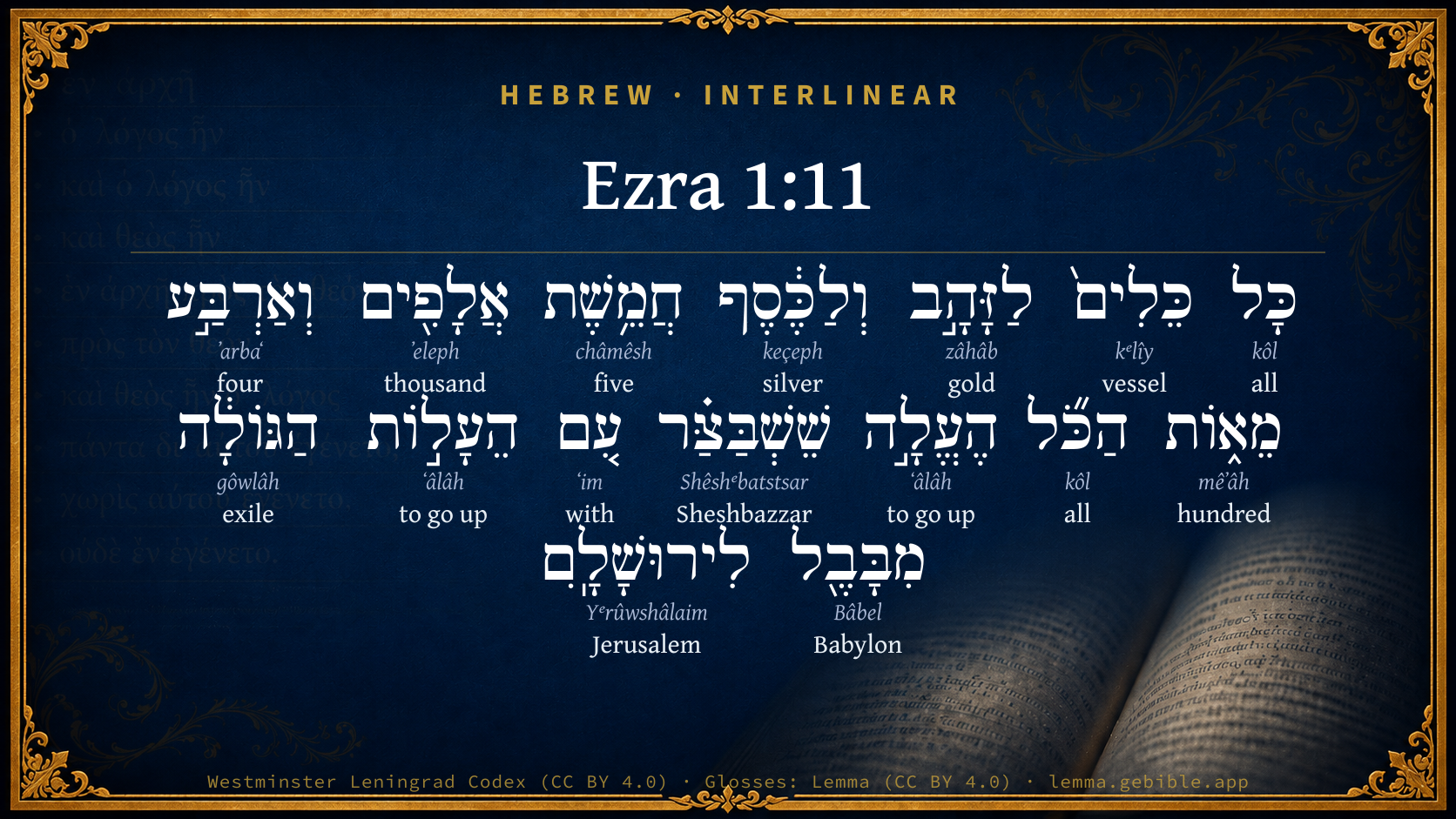
  1. כָּל kôl H3605 “all of” Noun, Common, Masculine, Singular, Construct
  2. כֵּלִים֙ kᵉlîy H3627 “vessels” Noun, Common, Masculine, Plural, Absolute
  3. לַזָּהָ֣ב zâhâb H2091 “to/for the · gold” Preposition, Determined + Noun, Common, Masculine, Singular, Absolute
  4. וְלַכֶּ֔סֶף keçeph H3701 “and · to/for the · silver” Conjunction + Preposition, Determined + Noun, Common, Masculine, Singular, Absolute
  5. חֲמֵ֥שֶׁת châmêsh H2568 “five” Adjective, Cardinal number, Masculine, Singular, Construct
  6. אֲלָפִ֖ים ʼeleph H505 “thousand” Adjective, Cardinal number, Both, Plural, Absolute
  7. וְאַרְבַּ֣ע ʼarbaʻ H702 “and · four” Conjunction + Adjective, Cardinal number, Feminine, Singular, Absolute
  8. מֵא֑וֹת mêʼâh H3967 “hundred” Adjective, Cardinal number, Both, Plural, Absolute
  9. הַכֹּ֞ל kôl H3605 “the · all” Particle, Definite Article + Noun, Common, Masculine, Singular, Absolute
  10. הֶעֱלָ֣ה ʻâlâh H5927 “to go up” Verb, Hiphil, Perfect, 3rd Person, Masculine, Singular
  11. עִ֚ם ʻim H5973 “with” Preposition
  12. הֵעָל֣וֹת ʻâlâh H5927 “to go up” Verb, Niphal, Infinitive Construct
  13. הַגּוֹלָ֔ה gôwlâh H1473 “the · exile” Particle, Definite Article + Noun, Common, Feminine, Singular, Absolute
  14. מִבָּבֶ֖ל Bâbel H894 “from · Babylon” Preposition + Noun, Proper
  15. לִירוּשָׁלִָֽם Yᵉrûwshâlaim H3389 “to/for · Jerusalem” Preposition + Noun, Proper

About this verse

These counts appear in no published source. They are computed here, from the morphology-tagged text and Lemma’s own curated glosses. What Lemma adds →

16
words
14
distinct lemmas
Historical
section

Notable vocabulary

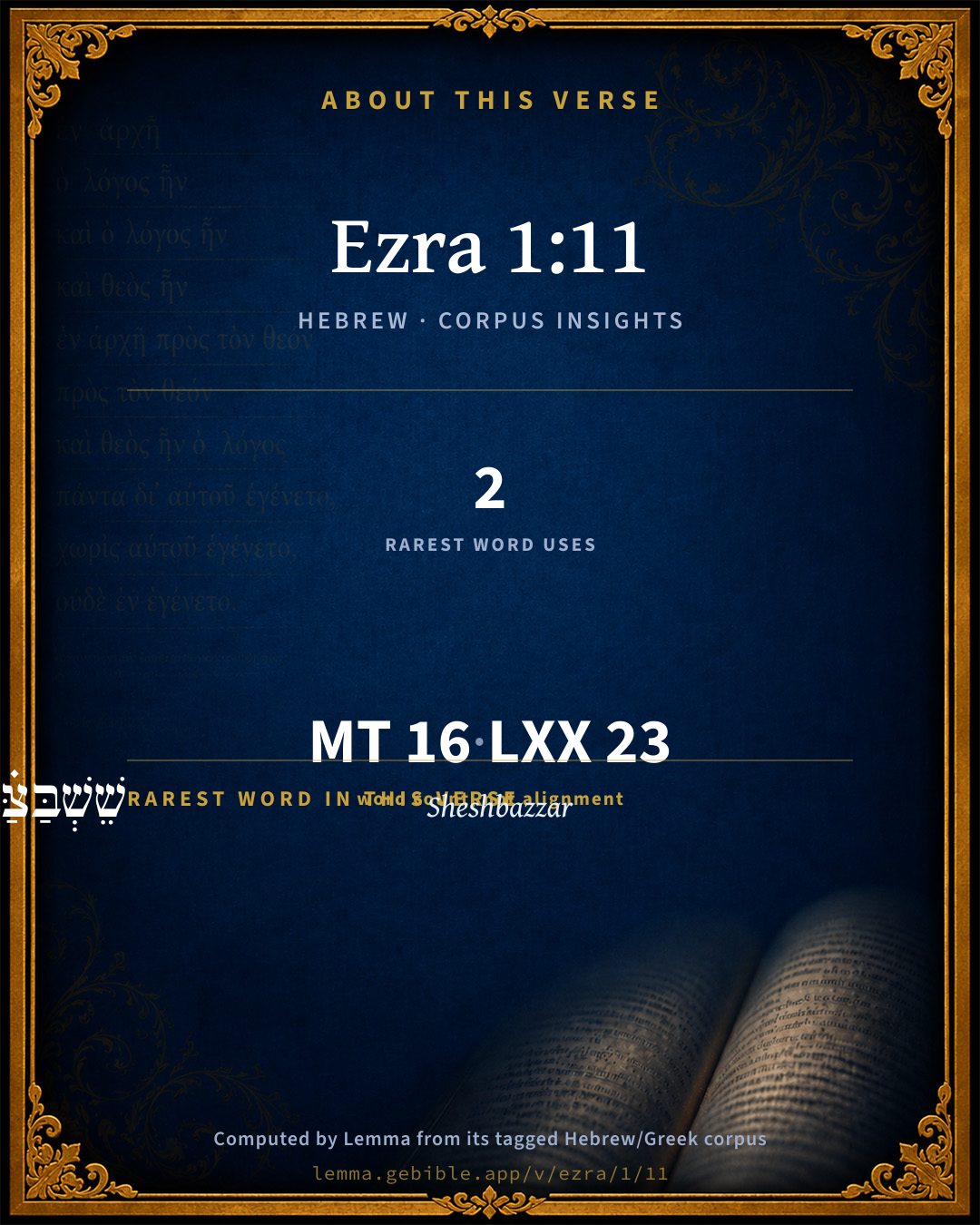
The rarest word here is שֵׁשְׁבַּצַּ֗ר Sheshbazzar H8339 — appearing just 2 times in the whole Hebrew Bible.

Shared distinctive vocabulary

שֵׁשְׁבַּצַּ֗ר Sheshbazzar H8339 occurs in 2 verses of the Hebrew Bible. Also found in:

Grammatical profile

  • 2 verbs
  • 9 nouns
  • 4 adjectives
  • 1 preposition

Verb forms

  • הֶעֱלָ֣ה Hiphil · Perfect
  • הֵעָל֣וֹת Niphal · Infinitive Construct

Repetition

Words recur within this verse — often emphatic in Hebrew:

  • כָּל all H3605 ×2
  • הֶעֱלָ֣ה to go up H5927 ×2

Hebrew & Septuagint length

In English translation the verse runs 32 words from the Hebrew and 27 from the Septuagint (LXX English) — closely comparable.

A rough comparison of the two English renderings, which tokenize alike — not a word-level alignment.

Word counts can differ between the Hebrew and the Greek without any difference in meaning — e.g. the Hebrew direct-object marker אֵת has no separate Greek word, and Greek often adds the article ὁ.

In the original languages it is 16 Hebrew tokens and 23 Greek tokens — but the two are counted differently (Hebrew bundles its prefixes and suffixes into one token; the Greek is in lemma form), so that isn’t a like-for-like length.

Cross-references

3

Topical passages linked to Ezra 1:11 in the Treasury of Scripture Knowledge — connected by theme and wording, ordered by reader-vote popularity; previews shown in the World English Bible.

  • Matthew 1:11–12 Josiah became the father of Jechoniah and his brothers, at the time of the exile to Babylon.
  • Romans 9:23 and that he might make known the riches of his glory on vessels of mercy, which he prepared beforehand for glory,
  • 2 Timothy 2:19–21 However God's firm foundation stands, having this seal, "The Lord knows those who are his," and, "Let every one who names the name of the Lord depart from unrighteousness."

Cross-references courtesy of OpenBible.info (CC BY 4.0).

Hebrew and Greek witnesses Masoretic Hebrew ↔ Greek Septuagint

The same verse in the two great witnesses to the Old Testament, shown verse-for-verse.

These are two independent witnesses, not word-aligned to each other, and the Septuagint is shown in lemma (dictionary) form.

Hebrew Ezra 1:11 Masoretic · Westminster Leningrad Codex

כָּל כֵּלִים֙ לַזָּהָ֣ב וְלַכֶּ֔סֶף חֲמֵ֥שֶׁת אֲלָפִ֖ים וְאַרְבַּ֣ע מֵא֑וֹת הַכֹּ֞ל הֶעֱלָ֣ה שֵׁשְׁבַּצַּ֗ר עִ֚ם הֵעָל֣וֹת הַגּוֹלָ֔ה מִבָּבֶ֖ל לִירוּשָׁלִָֽם

All the vessels of gold and of silver were five thousand and four hundred. All these did Sheshbazzar bring up, when they of the captivity were brought up from Babylon to Jerusalem.

World English Bible · Public Domain

Greek LXX Ezra 1:11 Septuagint · lemma form

πᾶς ὁ σκεῦος ὁ χρυσοῦς καί ὁ ἄργυρος πεντακισχίλιοι καί τετρακόσιοι ὁ πᾶς ἀναβαίνω μετά σασαβασαρ ἀπό ὁ ἀποικία ἐκ βαβυλών εἰς ἰερουσαλήμ

All the gold and silver vessels were five thousand four hundred, even all that went up with Sasabasar from the place of transportation, from Babylon to Jerusalem.

LXX2012 (modern English Septuagint) · Public Domain

In the Septuagint this is one book — Esdras B (2 Esdras): Ezra is chapters 1–10, Nehemiah 11–23.

On this verse, Keil & Delitzsch discusses the Septuagint’s reading. Read the note in Commentary ↓

Hebrew: Westminster Leningrad Codex (CC BY 4.0). Greek: Septuagint (public domain); English from LXX2012 (modern English Septuagint) (Public Domain). How the Septuagint differs from the Hebrew →

Commentary

Notes on Ezra 1:11 from classic Christian and Jewish commentators (each source and its license shown beneath its notes). The classic Christian expositions comment on the surrounding passage and are grouped to its opening verse, so a note may address several verses; the Jewish commentaries on the Tanakh (Rashi and others) are per-verse, so they appear only where the commentator wrote on this verse.

Lemma curates 59 commentaries, every one of them public domain or Creative Commons licensed, each selected and text-cleaned for this edition rather than reprinted as found. About our sources →

Trapp's Complete Commentary

John Trapp

Ezr 1:11 All the vessels of gold and of silver [were] five thousand and four hundred. All [these] did Sheshbazzar bring up with [them of] the captivity that were brought up from Babylon unto Jerusalem.

Ver. 11. All the vessels of gold and of silver] Those best of metals, and therefore fittest for his use and service who is good, Psa 106:1, better, Psa 108:9, best, Php 1:23, goodness itself, Mat 19:17. Whose great purse is the earth, with all that is either on it or in it, Psa 24:1; whose great storehouse are the stars and planets, the sun especially making these metals, and causing plenty, Deu 28:12. Let us lavish out of the bag, and when we have honoured the Lord with the best of our best, cry out with David, Of thine own, Lord, have we given thee, 1Ch 29:16; and with Justinian, dedicating a very rich communion table, τα σα εκ των σων σοι προσφερομεν οι δαυλοι σου, &c.

John Trapp, A Commentary or Exposition upon All the Books of the Old and New Testament (1647–1656) — public domain. Text from a community e-Sword module.

Keil & Delitzsch

C. F. Keil & F. Delitzsch

"All the vessels of gold and of silver were five thousand and four hundred." But only 30 + 1000 אנרטלים, 29 מחלפים, 30 + 410 covered goblets, and 1000 other vessels are enumerated, making together 2499. The same numbers are found in the lxx. Ancient interpreters reconciled the difference by the supposition that in the separate statements only the larger and more valuable vessels are specified, while in the sum-total the greater and lesser are reckoned together. This reconciliation of the discrepancy is, however, evidently arbitrary, and cannot be justified by a reference to Ch2 36:18, where the taking away of the greater and lesser vessels of the temple at the destruction of Jerusalem is spoken of. In Ezr 1:11 it is indisputably intended to give the sum-total according to the enumeration of the separate numbers. The difference between the two statements has certainly arisen from errors in the numbers, for the correction of which the means are indeed wanting. The error may be supposed to exist in the sum-total, where, instead of 5400, perhaps 2500 should be read, which sum may have been named in round numbers instead of 2499.

(Note: Ewald (Gesch. iv. p. 88) and Bertheau think they find in 1 Esdr. 2:12, 13, a basis for ascertaining the correct number. In this passage 1000 golden and 1000 silver σπονδεῖα, 29 silver θυΐ́σκαι, 30 golden and 2410 silver φιάλαι, and 1000 other vessels, are enumerated (1000 + 10000 + 29 + 30 + 2410 + 1000 = 5469); while the total is said to be 5469. But 1000 golden σπονδεῖα bear no proportion to 1000 silver, still less do 30 golden φιάλαι to 2410 silver. Hence Bertheau is of opinion that the more definite statement 30, of the Hebrew text, is to be regarded as original, instead of the first 1000; that, on the other hand, instead of the 30 golden כּפורים, 1000 originally stood in the text, making the total 5469. Ewald thinks that we must read 1030 instead of 1000 golden אגרטלים (σπονδεῖα), and make the total 5499. In opposition to these conjectures, we prefer abiding by the Hebrew text; for the numbers of 1 Esdras are evidently the result of an artificial, yet unskilful reconciliation of the discrepancy. It cannot be inferred, from the fact that Ezra subsequently, at his return to Jerusalem, brought with him 20 golden כּפורים, that the number of 30 such כּפורים given in this passage is too small.)

הגּולה העלות עם, at the bringing up of the carried away, i.e., when they were brought up from Babylon to Jerusalem. The infinitive Niphal העלות, with a passive signification, occurs also Jer 37:11.

Keil & Delitzsch — Biblical Commentary on the Old Testament (1861–1891) — public domain (CC PDM 1.0). Text via the HelloAO Bible API. (Old Testament only.)

Geneva Bible (1599)

Geneva Bible translators

With the Jews that had been kept captives in Babylon.

Geneva Bible (1599) marginal notes — public domain. Text via Bolls.life.

Jamieson, Fausset & Brown

Robert Jamieson, A. R. Fausset & David Brown

All the vessels of gold and of silver were five thousand and four hundred--The vessels here specified amount only to the number of 2499. Hence it is probable that the larger vases only are mentioned, while the inventory of the whole, including great and small, came to the gross sum stated in the text.

them of the captivity that were brought up from Babylon unto Jerusalem--All the Jewish exiles did not embrace the privilege which the Persian king granted them. The great proportion, born in Babylon, preferred continuing in their comfortable homes to undertaking a distant, expensive, and hazardous journey to a desolate land. Nor did the returning exiles all go at once. The first band went with Zerubbabel, others afterwards with Ezra, and a large number with Nehemiah at a still later period.

Next: Ezra Chapter 2

Jamieson, Fausset & Brown — Commentary Critical and Explanatory on the Whole Bible (1871) — public domain (CC PDM 1.0). Text via the HelloAO Bible API.

Adam Clarke's Commentary

Verse 11. All the vessels - were five thousand and four hundred.] This place is without doubt corrupted; here it is said the sum of all the vessels, of every quality and kind, was five thousand four hundred; but the enumeration of the articles, as given in Ezra 1:9; Ezra 1:10, gives the sum of two thousand four hundred and ninety-nine only. But we can correct this account from 1Esdras 2:13, 14.

I shall set both accounts down, that they may be compared together.

EZRA, Ezr 1:9-11.

Golden chargers ......

30

Silver chargers .......

1000

Knives ...................

29

Golden basons ........

30

Silver ditto, second sort ...

410

Other vessels .........

1000

------

Said to be 5400 .......

only 2499

------

Difference of the first account from itself ..

2901

1 ESDRAS, 1Esdras 2:13, 14.

Golden cups .......

1000

Silver cups .........

1000

Silver censers ....

29

Golden vials ........

30

Silver vials .........

2410

Other vessels ......

1000

------

Total ................

5469

------

Difference of the second account from the first ...

69

According, therefore, to the sum total in Ezra, the sum total in Esdras is only 69 different. See the next chapter.

It may be said that the vessels did actually amount to 5400, and that the chief of them only were intended to be specified; and these happen to amount to 2499; but that it was not the design of Ezra to insert the whole; and that the ninth verse should be considered as stating, And of the chief of them, that is, the gold and silver articles, this is the number. But the expression in Ezr 1:10, other vessels, sets this conjecture aside: the place is most manifestly corrupted.

Adam Clarke's Commentary on the Bible (1810–1826) — public domain. Text from a community e-Sword/MySword module.

The Cambridge Bible for Schools and Colleges

gen. ed. J. J. S. Perowne

11. All the vessels, &c., five thousand and four hundred] It is natural to expect that the words ‘all the vessels’ would give us the sum total of the different figures mentioned in Ezr_1:9-10. The sum total however mentioned here is 5400. The vessels enumerated under the six classes (in Ezr_1:9-10), when added together, make only 2499. Unless we concede that the text is incorrect, the only solution of the variation is to suppose that Ezr_1:9-10 omit a large number of less important vessels. This is unsatisfactory, since the words ‘and other vessels a thousand’ are obviously intended to cover the remainder.

It is probable therefore that the discrepancy arises from some ancient corruption in the text, which has been caused by copyists’ errors in transcribing numbers. This is a frequent source of mistake.

The LXX. has the same text as the Hebrew, so that the error is of very ancient origin. The 1st Book of Esdras has two variations in the list of items, reading (1) ‘1000’ for ‘30’ ‘chargers of gold’, (2) ‘2410’ for ‘410’ ‘silver bowls’ (reading ‘2000’ instead of ‘a second sort’), and gives a total corresponding to its figures, i.e. 5469.

Some scholars, seeing in the variations of 1 Esdras a clue to the true solution, maintain that the corruption of the text is to be found in the figures both of the items and of the total (a) They reject the variation of ‘1000’ for ‘30’ chargers as a round number inserted by 1 Esdras; (b) they read ‘1000’ for ‘30’ ‘bowls of gold’, on the ground that 30 is too small a figure, since Ezra himself brought 20 of this description (Ezr_8:28); (c) they read ‘2410’ for ‘410 of a second sort,’ on the authority of 1 Esdras. These alterations bring the total to 5469, agreeing with 1 Esdras.

Ewald (a) combining the reading of Ezra and 1 Esdras reads ‘1030’ for ‘30’ ‘chargers’, (b) keeping the ‘30’ ‘bowls of gold’, accepts the 1 Esdras reading of 2410, and thus obtains the total of 5499.

Keil suspecting that the corruption is to be found in the sum total rather than in the items, suggests that by an accidental transposition of figures the true number of 2500 has become altered to 5400.

In favour of this view, it must be admitted that (1) the figure of 5400 is surprisingly large, (2) copyists had a greater tendency to increase than to reduce numbers. But as the items are given in detail, so we should expect the sum total to be given exactly and not merely in a round number. As we have the two best texts agreeing in this total figure 5400, it is better to look for the error among the items. The reading of 1 Esdras ‘2410’ may possibly be correct.

But in the absence of further evidence we are left to conjecture either that some items have accidentally fallen out or that some of the present figures have been wrongly transcribed.

with them of the captivity that were brought up] R.V. when they of the captivity were brought up. The original here is rather condensed. The versions failed to translate the passage. LXX. τὰ πάντα τὰ ἀναβαίνοντα [μετὰ Σασαβασσὰρ] ἀπὸ τῆς ἀποικίας ἐκ Βαβυλῶνος. Vulg. ‘universa tulit Sassabasar cum his, qui ascendebant de transmigratione Babylonis’.

The meaning of the clause is practically the same. But the more precise sense conveyed by the R.V. is the only right translation, i.e. that Sheshbazzar brought up the vessels at the time when ‘the captivity’ was brought up. The emphasis is on the time of the removal—not on the caravan which accompanied it.

were brought up] the same word used of the ‘breaking up’ of a camp in Jer_37:11.

the captivity] the reader will notice that the journey of Sheshbazzar and his companions from Babylon to Jerusalem is disposed of in a single verse. We hear nothing of the details or of the difficulties of the journey, which must have lasted three or four months, cf. Ezr_7:8-9.

It has been suggested that here should be introduced the passage 1Es_5:1-6 ‘After this were the principal men of the families chosen according to their tribes, to go up with their wives and sons and daughters, with their menservants and maidservants and cattle. (2) And Darius sent with them a thousand horsemen, till they had brought them back to Jerusalem safely, and with musical [instruments] tablets and flutes. (3) And all their brethren played, and he made them go up together with them. (4) And these are the names of the men which went up, according to their families among their tribes, after their several heads. (5) The priests, the sons of Phinees, the son of Aaron: Jesus, the son of Josedec, the son of Saraias, and Joacim, the son of Zerobabel, the son of Salathiel, of the house of David, out of the kindred of Phares, of the tribe of Judah; (6) who spake wise sentences before Darius the king of Persia in the second year of his reign in the month Nisan which is the first month.’ The name Darius being taken as an error for Cyrus, and Ezr_1:5-6 being considered to be an interpolation, the passage would give us information as to (a) the orderly preparations, (b) the armed escort, for the expedition, (c) the festal character of the start, (d) the date of the departure, and would throw light upon ‘the seventh month’ mentioned in Ezr_3:1, and ‘the second year’ mentioned in Ezr_3:8.

The general style fairly corresponds with that of the books Ezra and Chronicles. But (a) it cannot be conceded that these verses join naturally on to chap. Ezr_2:1. (b) In the original context (1 Esdras 5) they have all the appearance of a gloss inserted to connect the legend of Darius and the Three young men (3, 4) with the resumption of the narrative (Ezr_5:7). (c) There is nothing impossible, supposing the passage to be a genuine extract from existing records, in such an expedition having been made in the second year of king Darius, and in supposing that the arrival of this priestly contingent would have encouraged the prophets Haggai and Zechariah in their task of arousing the people to complete the Temple (cf. the second year of Darius Hag_1:1; Zec_1:1).

The journey, which would have probably been N. and N.W. along the Euphrates by Haran as far as the fords of Carchemish, and then S.W. and S. through the territory of the old kingdoms of Hamath, Syria and Samaria, must have occupied a considerable interval of time. Ezra and his band took four months (ch. Ezr_7:8-9) in accomplishing the same distance. Perhaps no record was preserved of the incidents of the journey, and the compiler passes on to subjects for which he had written materials to draw from.

The Cambridge Bible for Schools and Colleges (gen. ed. J. J. S. Perowne; Cambridge University Press, 1878–1918) — public domain. Text from a community e-Sword module.

John Gill's Exposition

All the vessels of gold, and of silver, were five thousand and four hundred,.... Those that are mentioned make no more than 2499, which Aben Ezra thinks were the larger vessels; but this general sum takes in great and small, as in Ch2 36:18 in the letter of Cyrus, before mentioned, these vessels are more particularly described, and their several numbers given, which together amount to the exact number in the text, 5400; the apocryphal Ezra makes them 5469:

all these did Sheshbazzar bring up with them of the captivity, that were brought up from Babylon unto Jerusalem: of whom there is a large and particular account in the following chapter.

Next: Ezra Chapter 2

John Gill's Exposition of the Whole Bible (1746–1763) — public domain (CC PDM 1.0). Text via the HelloAO Bible API.

Albert Barnes' Notes on the Bible

The sum of the numbers as they stand in the present Hebrew text is 2,499, instead of 5,400. In the Apocryphal Book of Esdras the sum given is 5,469, and with this sum the items in that place exactly agree (1 Esdras 2:13, 14). Most commentators propose to correct Ezra by the passage of Esdras; but the items of Esdras are improbable. Probably the sum total in the present passage has suffered corruption.

Albert Barnes' Notes on the Bible (1834–1885) — public domain. Text from a community e-Sword/MySword module.

Haydock's Catholic Bible Commentary

Hundred. Only 2499 are specified. 3 Esdras reads, 5469. Josephus ([Antiquities?] xi. 1.) differs from all, reading 5210; which shews that the copies have varied, and that the Hebrew is incorrect. (Calmet) --- The use of number letters might cause this confusion. (Haydock) (Capel. iii. 20, 13.)

George Leo Haydock (1774–1849), Haydock's Catholic Family Bible and Commentary, 1859 edition — public domain. Excludes Psalms (Douay-Rheims chapter numbering differs from Protestant) and Deuterocanonical books (Catholic canon only).

Whedon's Commentary on the Bible

Daniel D. Whedon

11. Five thousand and four hundred — This sum does not agree with the preceding numbers, which are 30+1,000+29+30+410+1,000=2,499. In 1Es_2:13-14, the number of vessels mentioned amounts to 5,469. Some expositors think the enumeration of vessels (in Ezr_1:9-10) includes only the larger and more costly, while the gross sum here mentioned includes all, both small and great, which Nebuchadnezzar carried away. But that explanation is arbitrary and conjectural. The probability is that some of the numbers here are corrupt, but all attempts now to amend the text are mere conjectures.

Daniel D. Whedon (gen. ed.), Commentary on the Old and New Testaments (1874–1909) — public domain. Text from a community e-Sword module.

The Pulpit Commentary

All the vessels were five thousand and four hundred. The numbers previously given produce a total of only 2499, or less than half of this amount. There must be some corruption, but whether in the total or the items is uncertain. The apocryphal Esdras raises the total number of the vessels to 5469.

The Pulpit Commentary (1880–1919), ed. H.D.M. Spence-Jones & Joseph S. Exell — public domain. Text from a community e-Sword module.

Rashi

Rabbi Shlomo Yitzchaki (Rashi)

All the vessels Now he totals the sum of those counted and those who were not counted all into one number, but the important ones he counts.

when the exiles were brought up Heb. הֵעָלוֹת, [a passive] expression.

Rashi on the Tanakh — English translations: “The Judaica Press complete Tanach with Rashi, translated by A. J. Rosenberg” (CC BY 4.0); “Pentateuch with Rashi's commentary by M. Rosenbaum and A.M. Silbermann, 1929-1934” (public domain); “The Metsudah Tanach series, Lakewood, N.J” (CC BY 4.0); and “The Book of Joshua, Metsudah Publications, 1997” (CC BY 4.0). Text via Sefaria.

Lesson kit

Teaching starters — assembled from the data on this page, not authored interpretation. Every prompt links to the verse data it draws on. Edit before teaching.

Ezra, in the Historical, opens this verse with 16 words (14 distinct Hebrew lemmas). Its most distinctive word is Shêshᵉbatstsar (“Sheshbazzar”). A historical commentator’s framing appears above. Read the whole chapter for the surrounding context.

Discussion questions

  1. How does “Sheshbazzar” (Shêshᵉbatstsar) shape what this verse is saying?
  2. How does Ezra 1:8, which shares the word «Sheshbazzar», read alongside this verse?
  3. What does the repetition of “all” (2× in this one verse) do in this verse?
  4. These translations render this verse differently; the difference is in the English rendering, not the original. What questions does that raise?
  5. «הֶעֱלָ֣ה» is a Hiphil Perfect verb. How does that grammatical form shape the action described?
  6. Compare how Trapp's Complete Commentary and Keil & Delitzsch read this verse. Where do they agree or differ?

Things to notice

Reading settings

Reading text

Shown beneath each verse's original-language words.

Old Testament
Old Testament edition

Read the OT as the Masoretic Hebrew (MT) or the Greek Septuagint (LXX).

English shown for the Greek Septuagint (in the Hebrew ↔ Greek comparison).

Comparing translations? Open the Compare panel on any verse page to stack up to four side by side.