
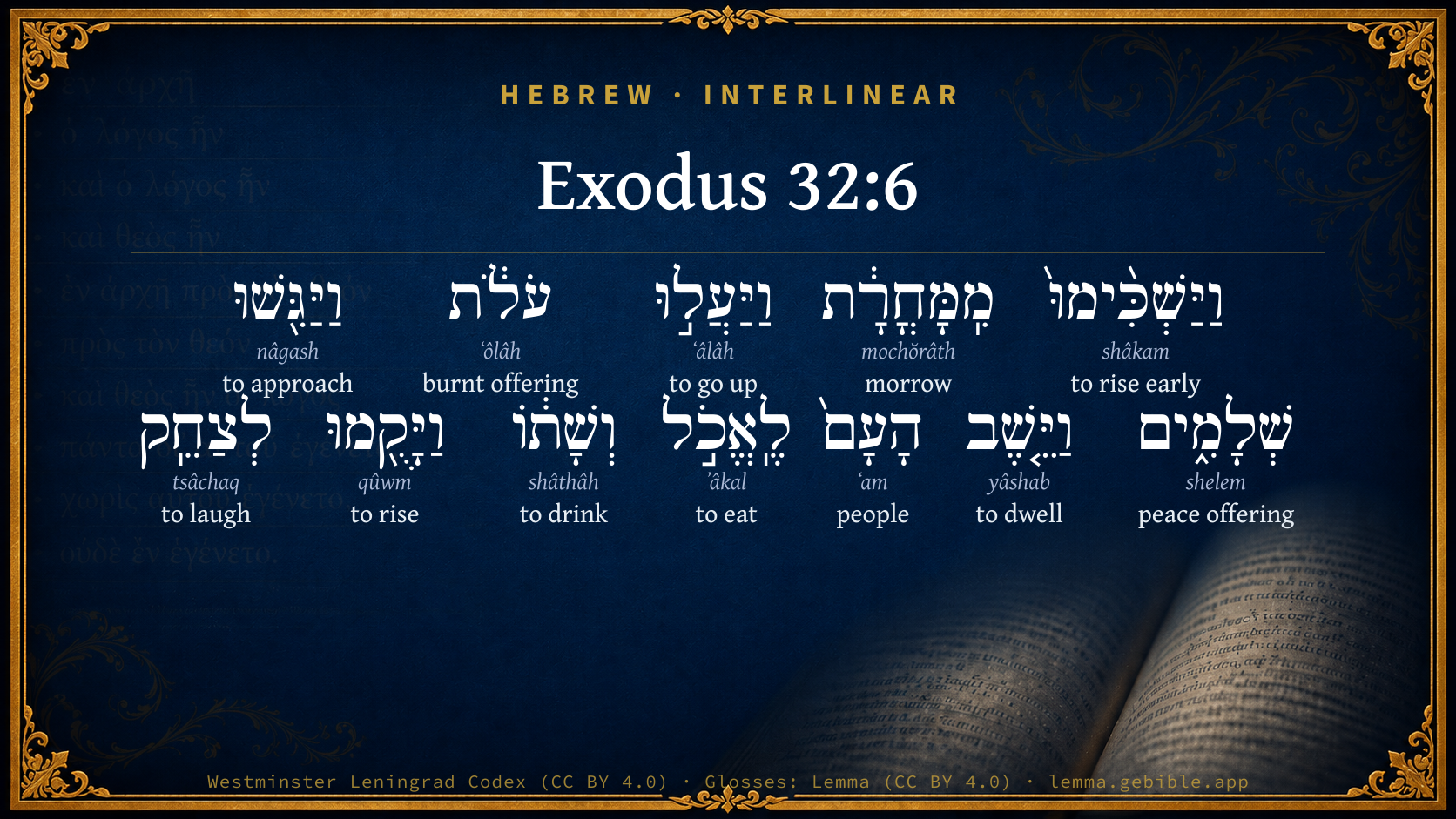
Exodus 32:6

Hebrew (Westminster Leningrad Codex) Exodus 32:6 appears in the Hebrew Old Testament. The text above is from the Westminster Leningrad Codex. Each word links to its Strong’s number, a concise gloss, and parsing drawn from the Open Scriptures Hebrew Bible morphology. Click any word for its full Brown-Driver-Briggs (BDB) entry.
Download image
Cite this verse

Exodus 32:6 (World English Bible). Public Domain. Lemma interlinear Bible study tool, https://lemma.gebible.app/v/exodus/32/6.

Show BibTeX & RIS
BibTeX
RIS
English Translation
They rose up early on the next day, and offered burnt offerings, and brought peace-offerings; and the people sat down to eat and to drink, and rose up to play.
World English Bible · Public Domain
Download a study sheet

One document with this verse’s original text, its word-by-word gloss line, the meaning frame, cross-references with their text, attributed commentary, and full source and license credits — printable, and it pastes into notes with its structure intact.

This verse Autodidact and up

Study sheet (.html) Plain text (.txt)

A passage Seminary Student

Up to 50 verses in one chapter. A passage sheet keeps up to 6 commentary sources and 12 cross-references per verse, in the order this page ranks them, and says so on the sheet whenever that leaves anything out. Ask for a single verse and you get the Autodidact verse sheet above.

Everything on this page stays free to read, with no account — the sheet is a download of what is already on screen, not access to it.

Want to remove ads? Support Godless Engineer
Compare translations 3

The same verse in 3 English versions, stacked beneath the original-language interlinear above. Click any original word for its lexicon entry.

Each is an independent rendering of the whole verse — the interlinear is not word-aligned to these translations.

Highlighted words mark where these versions differ — a whole-verse word diff, not a word-by-word alignment.

  • World English Bible Public Domain
    They rose up early on the next day, and offered burnt offerings, and brought peace-offerings; and the people sat down to eat and to drink, and rose up to play.
  • King James Version Public Domain
    And they rose up early on the morrow, and offered burnt offerings, and brought peace offerings; and the people sat down to eat and to drink, and rose up to play.
  • unfoldingWord Literal Text CC BY-SA 4.0
    And they arose early the next day and offered burnt offerings and brought peace offerings. And the people sat down to eat and to drink and got up to play.

unfoldingWord Literal Text — © unfoldingWord, licensed CC BY-SA 4.0. Word-aligned USFM3 via Door43 (git.door43.org/unfoldingWord/en_ult).

Versions to compare (up to 4)

3 of 4 selected

Show all 18 translations

Every available English version of this verse, each an independent rendering of the whole verse.

  • World English Bible Public Domain
    They rose up early on the next day, and offered burnt offerings, and brought peace-offerings; and the people sat down to eat and to drink, and rose up to play.
  • Berean Standard Bible Public Domain
    So the next day they arose, offered burnt offerings, and presented peace offerings. And the people sat down to eat and drink, and got up to indulge in revelry.
  • Majority Standard Bible Public Domain
    So the next day they arose, offered burnt offerings, and presented peace offerings. And the people sat down to eat and drink and got up to indulge in revelry.
  • King James Version Public Domain
    And they rose up early on the morrow, and offered burnt offerings, and brought peace offerings; and the people sat down to eat and to drink, and rose up to play.
  • American Standard Version (1901) Public Domain
    And they rose up early on the morrow, and offered burnt-offerings, and brought peace-offerings; and the people sat down to eat and to drink, and rose up to play.
  • Revised Version (1885) Public Domain
    And they rose up early on the morrow, and offered burnt offerings, and brought peace offerings; and the people sat down to eat and to drink, and rose up to play.
  • Geneva Bible (1599) Public Domain
    So they rose vp the next day in the morning, and offred burnt offerings, and brought peace offrings: also the people sate them downe to eate and drinke, and rose vp to play.
  • Douay-Rheims (1899) Public Domain
    And rising in the morning, they offered holocausts, and peace victims, and the people sat down to eat, and drink, and they rose up to play.
  • Young's Literal Translation Public Domain
    and they rise early on the morrow, and cause burnt-offerings to ascend, and bring nigh peace-offerings; and the people sit down to eat and to drink, and rise up to play.
  • Literal Standard Version CC BY-SA 4.0
    and they rise early on the next day, and cause burnt-offerings to ascend, and bring peace-offerings near; and the people sit down to eat and to drink, and rise up to play.
  • Unlocked Literal Bible CC BY-SA 4.0
    The people arose early the next day and offered burnt offerings and brought fellowship offerings. Then they sat down to eat and to drink, and then got up to carouse in wild celebration.
  • unfoldingWord Literal Text CC BY-SA 4.0
    And they arose early the next day and offered burnt offerings and brought peace offerings. And the people sat down to eat and to drink and got up to play.
  • Darby Bible Public Domain
    And they rose up early on the morrow, and offered up burnt-offerings, and brought peace-offerings; and the people sat down to eat and to drink, and rose up to sport.
  • World Messianic Bible Public Domain
    They rose up early on the next day, and offered burnt offerings, and brought peace offerings; and the people sat down to eat and to drink, and rose up to play.
  • Webster's Bible Public Domain
    And they rose early on the morrow, and offered burnt-offerings, and brought peace-offerings: and the people sat down to eat and to drink, and rose up to play.
  • Free Bible Version CC BY-SA 4.0
    Early the next day they sacrificed burnt offerings and presented peace offerings. Then they sat down to celebrate with eating and drinking. Then they got up to dance, and it became like an orgy.
  • Bible in Basic English Public Domain
    So early on the day after they got up and made burned offerings and peace-offerings; and took their seats at the feast, and then gave themselves to pleasure.
  • JPS Tanakh (1917) Public Domain
    And they rose up early on the morrow, and offered burnt-offerings, and brought peace-offerings; and the people sat down to eat and to drink, and rose up to make merry.

Literal Standard Version (2020), Covenant Press — licensed CC BY-SA 4.0. Text via the HelloAO Bible API (eBible.org). Unlocked Literal Bible (unfoldingWord) — licensed CC BY-SA 4.0. Text via the HelloAO Bible API (eBible.org). unfoldingWord Literal Text — © unfoldingWord, licensed CC BY-SA 4.0. Word-aligned USFM3 via Door43 (git.door43.org/unfoldingWord/en_ult). Free Bible Version, Dr. Jonathan Gallagher — licensed CC BY-SA 4.0. Text via the HelloAO Bible API (eBible.org).

Word by word

More ways to search: Search by grammar → Find every occurrence → Compare this word →

Practice this passage: Drill this verse → Learn its vocabulary →

לְצַחֵֽק
tsâchaq
H6711
“to laugh”
Preposition + Verb, Piel, Infinitive Construct
Part of Speech
Preposition + Verb
Stem
Piel
Form
Infinitive Construct
Full BDB Definition

Origin: a primitive root

TWOT: 1905

to laugh, mock, play - (Qal) to laugh - (Piel) - to jest - to sport, play, make sport, toy with, make a toy of
  1. וַיַּשְׁכִּ֨ימוּ֙ shâkam H7925 “and · to rise early” Conjunction + Verb, Hiphil, Sequential Imperfect, 3rd Person, Masculine, Plural
  2. מִֽמָּחֳרָ֔ת mochŏrâth H4283 “from · morrow” Preposition + Noun, Common, Feminine, Singular, Absolute
  3. וַיַּעֲל֣וּ ʻâlâh H5927 “and · to go up” Conjunction + Verb, Hiphil, Sequential Imperfect, 3rd Person, Masculine, Plural
  4. עֹלֹ֔ת ʻôlâh H5930 “burnt offerings” Noun, Common, Feminine, Plural, Absolute
  5. וַיַּגִּ֖שׁוּ nâgash H5066 “and · to approach” Conjunction + Verb, Hiphil, Sequential Imperfect, 3rd Person, Masculine, Plural
  6. שְׁלָמִ֑ים shelem H8002 “peace offerings” Noun, Common, Masculine, Plural, Absolute
  7. וַיֵּ֤שֶׁב yâshab H3427 “and · to dwell” Conjunction + Verb, Qal, Sequential Imperfect, 3rd Person, Masculine, Singular
  8. הָעָם֙ ʻam H5971 “the · people” Particle, Definite Article + Noun, Common, Masculine, Singular, Absolute
  9. לֶֽאֱכֹ֣ל ʼâkal H398 “to eat” Preposition + Verb, Qal, Infinitive Construct
  10. וְשָׁת֔וֹ shâthâh H8354 “and · to drink” Conjunction + Verb, Qal, Infinitive Absolute
  11. וַיָּקֻ֖מוּ qûwm H6965 “and · to rise” Conjunction + Verb, Qal, Sequential Imperfect, 3rd Person, Masculine, Plural

About this verse

These counts appear in no published source. They are computed here, from the morphology-tagged text and Lemma’s own curated glosses. What Lemma adds →

12
words
12
distinct lemmas
Pentateuch
section

Notable vocabulary

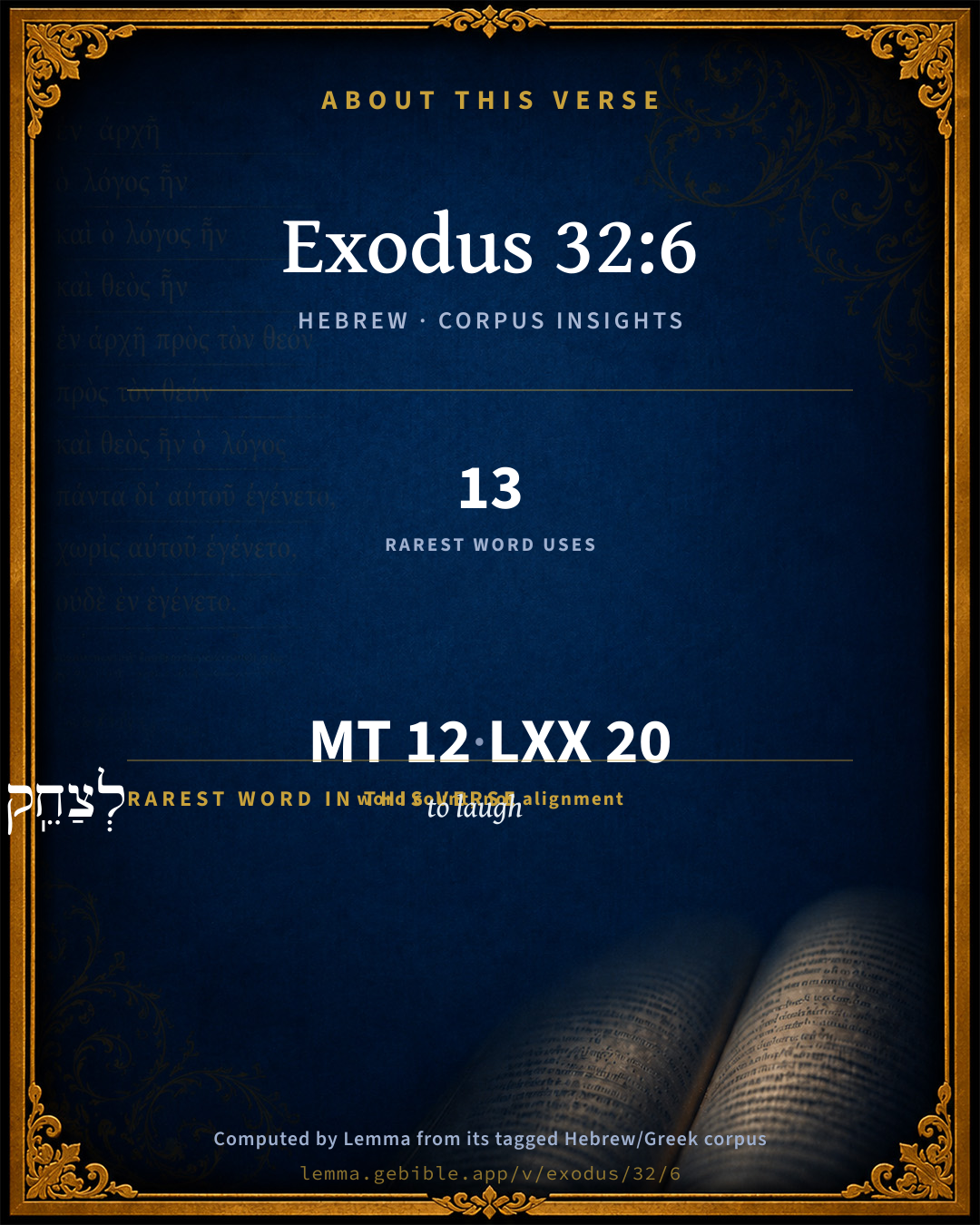
The rarest word here is לְצַחֵֽק to laugh H6711 — appearing just 13 times in the whole Hebrew Bible.

Shared distinctive vocabulary

לְצַחֵֽק to laugh H6711 occurs in 12 verses of the Hebrew Bible. Also found in:

Grammatical profile

  • 8 verbs
  • 4 nouns

Verb forms

  • וַיַּשְׁכִּ֨ימוּ֙ Hiphil · Sequential Imperfect
  • וַיַּעֲל֣וּ Hiphil · Sequential Imperfect
  • וַיַּגִּ֖שׁוּ Hiphil · Sequential Imperfect
  • וַיֵּ֤שֶׁב Qal · Sequential Imperfect
  • לֶֽאֱכֹ֣ל Qal · Infinitive Construct
  • וְשָׁת֔וֹ Qal · Infinitive Absolute
  • וַיָּקֻ֖מוּ Qal · Sequential Imperfect
  • לְצַחֵֽק Piel · Infinitive Construct

Hebrew & Septuagint length

In English translation the verse runs 30 words from the Hebrew and 30 from the Septuagint (LXX English) — the same length.

A rough comparison of the two English renderings, which tokenize alike — not a word-level alignment.

Word counts can differ between the Hebrew and the Greek without any difference in meaning — e.g. the Hebrew direct-object marker אֵת has no separate Greek word, and Greek often adds the article ὁ.

In the original languages it is 12 Hebrew tokens and 20 Greek tokens — but the two are counted differently (Hebrew bundles its prefixes and suffixes into one token; the Greek is in lemma form), so that isn’t a like-for-like length.

Cross-references

9

Topical passages linked to Exodus 32:6 in the Treasury of Scripture Knowledge — connected by theme and wording, ordered by reader-vote popularity; previews shown in the World English Bible.

  • 1 Corinthians 10:7 Neither be idolaters, as some of them were. As it is written, "The people sat down to eat and drink, and rose up to play."
  • Numbers 25:2 for they called the people to the sacrifices of their gods; and the people ate, and bowed down to their gods.
  • Acts 7:41–42 They made a calf in those days, and brought a sacrifice to the idol, and rejoiced in the works of their hands.
  • Exodus 32:17–19 When Joshua heard the noise of the people as they shouted, he said to Moses, "There is the noise of war in the camp."
  • Exodus 24:4–5 Moses wrote all the words of Yahweh, and rose up early in the morning, and built an altar under the mountain, and twelve pillars for the twelve tribes of Israel.
  • Judges 16:23–25 The lords of the Philistines gathered them together to offer a great sacrifice to Dagon their god, and to rejoice; for they said, Our god has delivered Samson our enemy into our hand.
  • Amos 2:8 And they lay themselves down beside every altar on clothes taken in pledge; And in the house of their God they drink the wine of those who have been fined.
  • Amos 8:10 I will turn your feasts into mourning, And all your songs into lamentation; And I will make you wear sackcloth on all your bodies, And baldness on every head. I will make it like the mourning for an only son, And the end of it like a bitter day.
  • Revelation 11:10 Those who dwell on the earth rejoice over them, and they will be glad. They will give gifts to one another, because these two prophets tormented those who dwell on the earth.

Cross-references courtesy of OpenBible.info (CC BY 4.0).

Hebrew and Greek witnesses Masoretic Hebrew ↔ Greek Septuagint

The same verse in the two great witnesses to the Old Testament, shown verse-for-verse.

These are two independent witnesses, not word-aligned to each other, and the Septuagint is shown in lemma (dictionary) form.

Hebrew Exodus 32:6 Masoretic · Westminster Leningrad Codex

וַיַּשְׁכִּ֨ימוּ֙ מִֽמָּחֳרָ֔ת וַיַּעֲל֣וּ עֹלֹ֔ת וַיַּגִּ֖שׁוּ שְׁלָמִ֑ים וַיֵּ֤שֶׁב הָעָם֙ לֶֽאֱכֹ֣ל וְשָׁת֔וֹ וַיָּקֻ֖מוּ לְצַחֵֽק

They rose up early on the next day, and offered burnt offerings, and brought peace-offerings; and the people sat down to eat and to drink, and rose up to play.

World English Bible · Public Domain

Greek LXX Exodus 32:6 Septuagint · lemma form

καί ὀρθρίζω ὁ ἐπαύριον ἀναβιβάζω ὁλοκαύτωμα καί προςφέρω θυσία σωτήριον καί καταἵζω ὁ λαός ἐσθίω καί πίνω καί ἀναἵστημι παίζω

And having risen early on the morrow, he offered whole burnt offerings, and offered a peace-offering; and the people sat down to eat and drink, and rose up to play.

LXX2012 (modern English Septuagint) · Public Domain

On this verse, Haydock's Catholic Bible Commentary discusses the Septuagint’s reading. Read the note in Commentary ↓

Hebrew: Westminster Leningrad Codex (CC BY 4.0). Greek: Septuagint (public domain); English from LXX2012 (modern English Septuagint) (Public Domain). How the Septuagint differs from the Hebrew →

Targum (Aramaic paraphrase)

2

The Targum is the ancient Jewish Aramaic paraphrase of the Hebrew Scriptures — an interpretive translation, not the Hebrew text itself. Onkelos (literal) and Pseudo-Jonathan (expansive) render the Torah, and Jonathan the Prophets. Coverage is partial: where no permissively-licensed English translation exists for a verse, only the Aramaic is shown. This is verse-level text, not a word-by-word alignment to the Hebrew.

  1. Targum Onkelos Torah (Genesis–Deuteronomy)
    וְאַקְדִימוּ בְּיוֹמָא דְבַתְרוֹהִי וְאַסִיקוּ עֲלָוָן וְקָרִיבוּ נִכְסִין וְאַסְחַר עַמָא לְמֵיכַל וּלְמִשְׁתֵּי וְקָמוּ לְחַיָכָא:

    (no public-domain English translation for this verse)

    Targum Onkelos — Aramaic: “Onkelos Genesis” (public domain); “Onkelos Exodus” (public domain); “Onkelos Leviticus” (public domain); “Onkelos Numbers” (public domain); “Onkelos Deuteronomy” (public domain). English: “Sefaria Community Translation” (CC0 1.0 (public-domain dedication)); “J.W. Etheridge. The Targums of Onkelos and Jonathan Ben Uzziel on the Pentateuch. London: Longmans, Green, 1862” (public domain). Text via Sefaria.

  2. Targum Pseudo-Jonathan Torah (Genesis–Deuteronomy)
    וְאַקְדִימוּ מִיּוֹמָא מָחְרָא וְאַסִיקוּ עֲלָוָון וּקְרִיבוּ נִיכְסִין וְאַסְחַר עַמָא לְמֵיכוֹל וּלְמִישְׁתֵּי וְקָמוּ לְהוֹן לִמְגַחֲכָא בְּפוּלְחָנָא נוּכְרָאָה

    And on the day following, they arose, and sacrificed burnt-offerings; and the people sat around to eat and to drink, and rose up to disport themselves with strange service.

    Targum Pseudo-Jonathan — Aramaic: “Targum Jonathan on Genesis” (public domain); “Targum Jonathan on Exodus” (public domain); “Targum Jonathan on Leviticus” (public domain); “Targum Jonathan on Numbers” (public domain); “Targum Jonathan on Deuteronomy” (public domain). English: “The Targum of Jonathan ben Uzziel, trans. J. W. Etheridge, London, 1862” (public domain). Text via Sefaria.

Commentary

Notes on Exodus 32:6 from classic Christian and Jewish commentators (each source and its license shown beneath its notes). The classic Christian expositions comment on the surrounding passage and are grouped to its opening verse, so a note may address several verses; the Jewish commentaries on the Tanakh (Rashi and others) are per-verse, so they appear only where the commentator wrote on this verse.

Lemma curates 59 commentaries, every one of them public domain or Creative Commons licensed, each selected and text-cleaned for this edition rather than reprinted as found. About our sources →

Trapp's Complete Commentary

John Trapp

Exo 32:6 And they rose up early on the morrow, and offered burnt offerings, and brought peace offerings; and the people sat down to eat and to drink, and rose up to play.

Ver. 6. Rose up to play.] To dance about the calf. Now, if they were so cheered and strengthened by those baneful bits, those murdering morsels; should not we much more by God’s spiritual provisions, to dance as David did, to do his work with all our might

John Trapp, A Commentary or Exposition upon All the Books of the Old and New Testament (1647–1656) — public domain. Text from a community e-Sword module.

Joseph Benson's Commentary

Exo 32:6. They rose up early — To show their zeal they began betimes in the morning, and seem not to have stayed for Aaron; and offered burnt- offerings, &c. — To this new-made image of Deity. And the people sat down to eat and drink — Of the remainder of what was sacrificed; and then rose up to play — To play the fool, to play the wanton. It was strange that any of the people, especially so great a number of them, should do such a thing. Had they not, but the other day, in this very place, heard the voice of the Lord God speaking to them out of the midst of the fire, “Thou shalt not make to thyself any graven image?” Yet they made a calf in Horeb, the very place where the law was given! It was especially strange that Aaron should be so deeply concerned, should make the calf, and proclaim the feast! Is this “Aaron the saint of the Lord?” Is this he that had not only seen, but had been employed in summoning the plagues of Egypt, and the judgments executed upon the gods of the Egyptians? What! and yet himself copying out the abandoned idolatries of Egypt? How true is it, that “the law made them priests which had infirmity, and needed first to offer for their own sins!”

Joseph Benson's Commentary on the Old and New Testaments (1811–1818) — public domain. Text from a community e-Sword module.

Tyndale Open Study Notes

Tyndale Open Resources

32:6 The Hebrew term translated pagan revelry is traditionally rendered they got up to play. As in English, the Hebrew word for play can have sexual overtones (see Gen 26:8, “caressing”), which is likely the case here. Worship of a fertility symbol such as a bull was often accompanied by sexual activities on the part of the worshipers (see 1 Cor 10:7-8).

Tyndale Open Study Notes — © Tyndale Open Resources, licensed CC BY-SA 4.0. Text via the HelloAO Bible API.

Adam Clarke's Commentary

Verse 6. The people sat down to eat and to drink] The burnt-offerings were wholly consumed; the peace-offerings, when the blood bad been poured out, became the food of the priests, c. When therefore the strictly religious part of these ceremonies was finished, the people sat down to eat of the peace-offerings, and this they did merely as the idolaters, eating and drinking to excess. And it appears they went much farther, for it is said they rose up to play, לצחק letsachek, a word of ominous import, which seems to imply here fornicating and adulterous intercourse and in some countries the verb to play is still used precisely in this sense. In this sense the original is evidently used, Ge 39:14.

Adam Clarke's Commentary on the Bible (1810–1826) — public domain. Text from a community e-Sword/MySword module.

Ellicott's Commentary for English Readers

(6) They rose up early.—Impatient to begin the new worship, the people rose with the dawn, and brought offerings, and offered sacrifice. Whether Aaron took part in these acts—which constituted the actual worship of the idol—is left doubtful.

Burnt offerings, and . . . peace offerings.—Sacrifices of both kinds were pre-Mosaical, not first originated by the Law, though deriving confirmation from it. Offerings of both kinds are noticed in Gen_4:3-4; Exo_18:12.

The people sat down to eat and to drink, and rose up to play.—A feast always followed a sacrifice (see Exo_18:12; Exo_24:5; Exo_24:11). In feasting therefore upon what they had offered, the Israelites did no wrong; but probably they indulged themselves in a license of feasting unsuited to a religious act, though common enough in the idol-festivals of the heathen. They “fed without fear” (Jud_1:12), transgressed the bounds of moderation, and turned what should have been a religious rite into an orgy. Then, having gratified their appetites and stimulated their passions, they ceased to eat and drink, and “rose up to play.” The “play” included dancing of an indecent kind (Exo_32:19; Exo_32:25), and would probably have terminated, as the heathen orgies too often did, in the grossest sensualism, had not the descent of Moses from Sinai, and his appearance on the scene, put a stop to the unhallowed doings.

A Bible Commentary for English Readers, edited by Charles John Ellicott (1878–1897) — public domain. Text from a community e-Sword module.

The Cambridge Bible for Schools and Colleges

gen. ed. J. J. S. Perowne

6. burnt offerings and peace offerings] Cf. on Exo_20:24.

to eat and to drink] i.e. to take part in the sacred meal accompanying the peace-offering; cf. on Exo_18:12.

to play] to amuse themselves, e.g. by singing and dancing, vv. 18, 19. Comp. the quotation in 1Co_10:7.

The Cambridge Bible for Schools and Colleges (gen. ed. J. J. S. Perowne; Cambridge University Press, 1878–1918) — public domain. Text from a community e-Sword module.

Haydock's Catholic Bible Commentary

They offered, by the hands of Aaron, to whom the Septuagint refer all this. "He offered," &c., appearing at the head of the idolaters. Cornelius a Lapide insinuates, that he wished to supplant his brother in the supreme command; and after a faint resistance, became the promoter of idolatry, to ingratiate himself with the people. The Scripture lays not this, however, to his charge. (Calmet) --- To eat of the victims. --- To play, dancing and singing in honour of their idol, probably with many indecent gestures, as was customary on such occasions among the nations of Chanaan. (Haydock) --- Tertullian (de jejunio) understands impure play. The word means also to dance, and to play on instruments of music. Ludere quæ vellem calamo permisit agresti. (Virgil, Eclogues i) (Calmet) --- Sulpitius says, the people abandoned themselves to drunkenness and gluttony, or debauchery, vinoque se & ventri dedisset. (Haydock) --- They might get wine from Madian. (Salien.) --- Foolish mirth is the daughter of gluttony, and the mother of idolatry. (St. Gregory, Mor. xxxi. 31.) (Worthington)

George Leo Haydock (1774–1849), Haydock's Catholic Family Bible and Commentary, 1859 edition — public domain. Excludes Psalms (Douay-Rheims chapter numbering differs from Protestant) and Deuterocanonical books (Catholic canon only).

Matthew Poole's English Annotations

Brought peace-offerings, but no sin-offerings, which they most needed.

The people sat down to eat and to drink; for the sacrifices were accompanied with feasting, both among the worshippers of the true God, and among idolaters. See Exo 18:12; 24:11.

Rose up to play, by shouting, and singing, and dancing, as it appears from Exo 32:17-19

Matthew Poole's English Annotations on the Holy Bible (1683–1685) — public domain. Text from a community e-Sword/MySword module.

Whedon's Commentary on the Bible

Daniel D. Whedon

6. Rose up early — It was to be a day of festivity and joy, and they were eager to begin it early.

Burnt offerings, and… peace offerings — See note on Exo_20:24.

Sat down to eat and to drink — Usual words for hilarious feasting. They ate, as was customary, of the flesh of the peace offerings. What they drank is not said, but we most naturally suppose wine, which was so common at jovial feasts.

Rose up to play — Comp, Exo_32:19; Exo_32:25. The meaning most probably is, that from feasting they proceeded to lewd forms of dancing. See note on Gen_21:9, and compare Herodotus’s account of the rude sports of the Egyptians at certain religious festivals. (Herod., 2:60.)

Daniel D. Whedon (gen. ed.), Commentary on the Old and New Testaments (1874–1909) — public domain. Text from a community e-Sword module.

The Pulpit Commentary

They rose up early on the morrow. The people were like a child with a new toy. They could scarcely sleep for thinking of it. So, as soon as it was day, they left their beds, and hastened to begin the new worship Burnt offerings and peace offerings. It is evident that both of these were customary forms of sacrifice neither of them first introduced by the Law, which had not except so far as the "Book of the Covenant" was concerned been promulgated. Compare Jethro"s offerings. (Exo_18:12) The people sat down to eat and drink. A feast almost always followed upon a sacrifice, only certain portions of the victim being commonly burnt, while the rest was consumed by the offerers. See the comment on Exo_18:3. And rose up to play. This "play" was scarcely of a harmless kind. The sensualism of idol-worship constantly led on to sensuality; and the feasts upon idol-sacrifices terminated in profligate orgies of a nature which cannot be described. See the application of the passage by St. Paul in the First Epistle to the Corinthians, (1Co_10:7) and compare verse 25.

The Pulpit Commentary (1880–1919), ed. H.D.M. Spence-Jones & Joseph S. Exell — public domain. Text from a community e-Sword module.

John Wesley's Explanatory Notes

And they rose up early on the morrow, and offered sacrifice to this new made deity. And the people sat down to eat and drink of the remainder of what was sacrificed, and then rose up to play - To play the fool, to play the wanton. It was strange that any of the people, especially so great a number of them, should do such a thing. Had they not, but the other day, in this very place, heard the voice of the Lord God speaking to them out of the midst of the fire, Thou shalt not make to thyself any graven image? - Yet They made a calf in Horeb, the very place where the law was given It was especially strange that Aaron should be so deeply concerned, should make the calf and proclaim the feast! Is this Aaron the saint of the Lord! Is this he that had not only seen, but had been employed in summoning the plagues of Egypt, and the judgments executed upon the gods of the Egyptians? What! And yet himself copying out the abandoned idolatries of Egypt? How true is it, that the law made them priests which had infirmity, and needed first to offer for their own sins?

John Wesley, Explanatory Notes Upon the Whole Bible (1754–1765) — public domain. Text via the GEBible commentary corpus.

Rashi

Rabbi Shlomo Yitzchaki (Rashi)

וישכימו AND THEY ROSE UP EARLY [IN THE MORNING] — Satan made them zealous in order that they might sin, for later on in the forenoon Moses actually came down from the mountain.

לצחק TO PLAY — There is implied in this term besides idolatry also sexual immorality, — as we find the word used in, (Genesis 39:17) “to mock (לצחק) me” where unchastity is meant as is evident from the context — and blood-shed, as it is said, (II Samuel 2:14) “Let the young men arise and play (וישחקו) before me; [and they caught every one his fellow by the head and thrust his sword in his fellows side]”— here, too, Hur was assassinated (Midrash Tanchuma 3:9:20).

Rashi on the Tanakh — English translations: “The Judaica Press complete Tanach with Rashi, translated by A. J. Rosenberg” (CC BY 4.0); “Pentateuch with Rashi's commentary by M. Rosenbaum and A.M. Silbermann, 1929-1934” (public domain); “The Metsudah Tanach series, Lakewood, N.J” (CC BY 4.0); and “The Book of Joshua, Metsudah Publications, 1997” (CC BY 4.0). Text via Sefaria.

Ramban (Nachmanides)

Rabbi Moshe ben Nachman (Ramban / Nachmanides)

AND THE PEOPLE SAT DOWN TO EAT AND TO DRINK. This means that they all sat down together to eat and drink inordinately, as they would do at feasts and on festivals, and afterwards they rose up to make merry with their idols and indulge in revelry. Scripture tells us this on account of what Moses [later] said, the noise of them that sing do I hear, for Moses found them acting riotously in front of him and his heart was lifted up in the ways of the Eternal, to take it from before them and to burn it in their presence [and scatter its powder upon the water] and make them drink of it.Now Scripture first completed the account of everything they had done with the calf, and afterwards told of what the Holy One, blessed be He, said to Moses, Go, get thee down. This communication, however, was given to Moses early that morning, when they worshipped the calf and sacrificed to it. When Moses came down from the mountain they had sat down to eat and to drink, and rose up to make merry, and he found them in revelry. This also is proof to what I have explained [that at first their intent was not to worship idols], since it was not said to Moses, Go, get thee down, for thy people have dealt corruptly on the day that Aaron made the [golden] calf and the altar, [for had they been made for the purpose of idolatry, Moses] would have come down immediately. Instead, it was only when the people sacrificed to it and worshipped it that He told Moses to go down.

Ramban (Nachmanides) on the Tanakh — English translation: “Commentary on the Torah by Ramban (Nachmanides). Translated and annotated by Charles B. Chavel. New York, Shilo Pub. House, 1971-1976” (CC BY 4.0). Text via Sefaria.

Lesson kit

Teaching starters — assembled from the data on this page, not authored interpretation. Every prompt links to the verse data it draws on. Edit before teaching.

Exodus, in the Pentateuch, opens this verse with 12 words (12 distinct Hebrew lemmas). Its most distinctive word is tsâchaq (“to laugh”). A historical commentator’s framing appears above. Read the whole chapter for the surrounding context.

Discussion questions

  1. How does “to laugh” (tsâchaq) shape what this verse is saying?
  2. How does Genesis 17:17, which shares the word «to laugh», read alongside this verse?
  3. The translations on this page render this verse differently — a whole-verse word diff, not a word-by-word alignment. What might account for the different wordings?
  4. «וַיַּשְׁכִּ֨ימוּ֙» is a Hiphil Sequential Imperfect verb. How does that grammatical form shape the action described?
  5. Compare how Trapp's Complete Commentary and Joseph Benson's Commentary read this verse. Where do they agree or differ?

Things to notice

Reading settings

Reading text

Shown beneath each verse's original-language words.

Old Testament
Old Testament edition

Read the OT as the Masoretic Hebrew (MT) or the Greek Septuagint (LXX).

English shown for the Greek Septuagint (in the Hebrew ↔ Greek comparison).

Comparing translations? Open the Compare panel on any verse page to stack up to four side by side.