
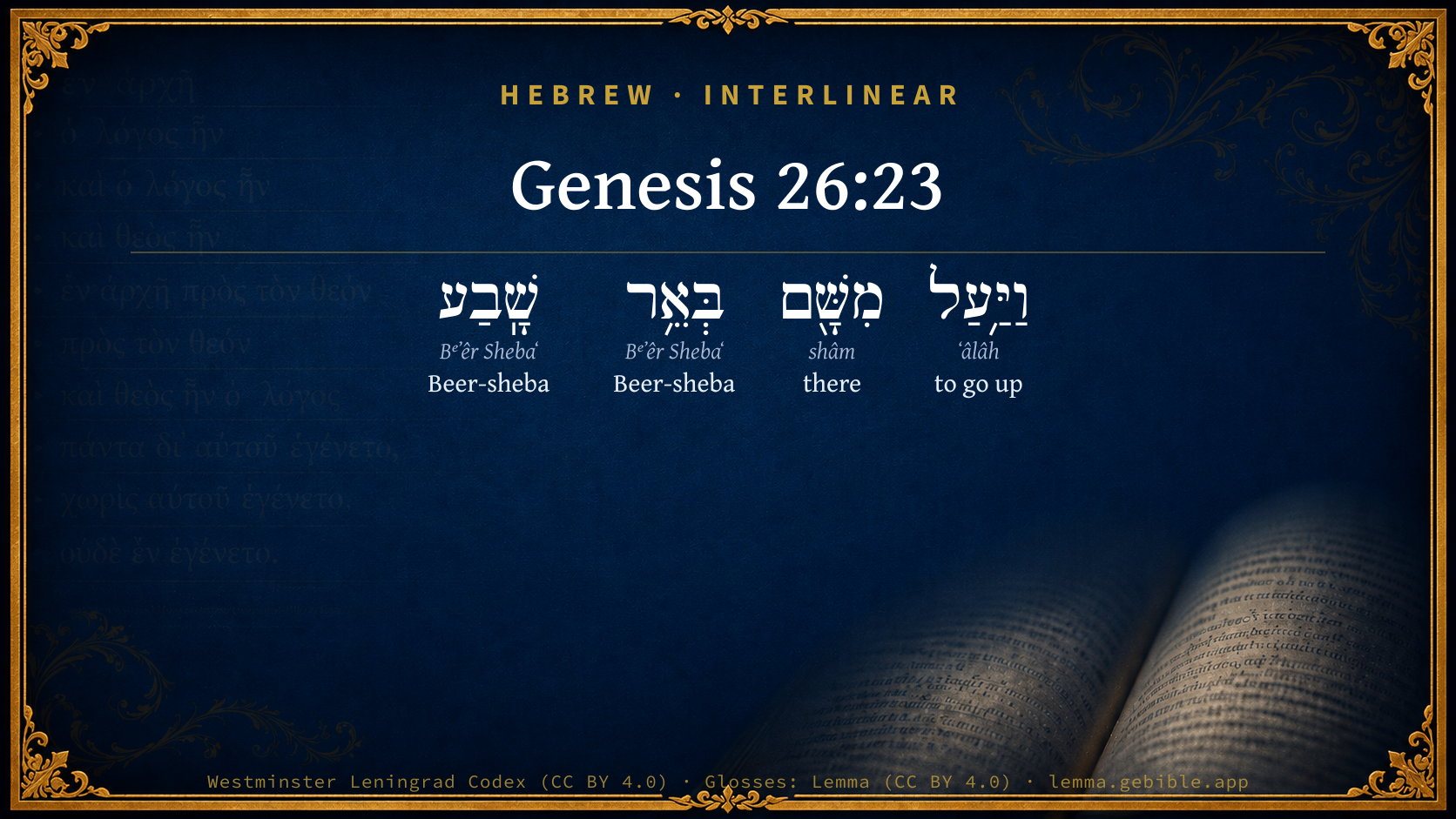
Genesis 26:23

Hebrew (Westminster Leningrad Codex) Genesis 26:23 appears in the Hebrew Old Testament. The text above is from the Westminster Leningrad Codex. Each word links to its Strong’s number, a concise gloss, and parsing drawn from the Open Scriptures Hebrew Bible morphology. Click any word for its full Brown-Driver-Briggs (BDB) entry.
Download image
Cite this verse

Genesis 26:23 (World English Bible). Public Domain. Lemma interlinear Bible study tool, https://lemma.gebible.app/v/genesis/26/23.

Show BibTeX & RIS
BibTeX
RIS
English Translation
He went up from there to Beersheba.
World English Bible · Public Domain
Download a study sheet

One document with this verse’s original text, its word-by-word gloss line, the meaning frame, cross-references with their text, attributed commentary, and full source and license credits — printable, and it pastes into notes with its structure intact.

This verse Autodidact and up

Study sheet (.html) Plain text (.txt)

A passage Seminary Student

Up to 50 verses in one chapter. A passage sheet keeps up to 6 commentary sources and 12 cross-references per verse, in the order this page ranks them, and says so on the sheet whenever that leaves anything out. Ask for a single verse and you get the Autodidact verse sheet above.

Everything on this page stays free to read, with no account — the sheet is a download of what is already on screen, not access to it.

Want to remove ads? Support Godless Engineer
Compare translations 3

The same verse in 3 English versions, stacked beneath the original-language interlinear above. Click any original word for its lexicon entry.

Each is an independent rendering of the whole verse — the interlinear is not word-aligned to these translations.

Highlighted words mark where these versions differ — a whole-verse word diff, not a word-by-word alignment.

  • World English Bible Public Domain
    He went up from there to Beersheba.
  • King James Version Public Domain
    And he went up from thence to Beersheba.
  • unfoldingWord Literal Text CC BY-SA 4.0
    Then from there he went up to Beersheba.

unfoldingWord Literal Text — © unfoldingWord, licensed CC BY-SA 4.0. Word-aligned USFM3 via Door43 (git.door43.org/unfoldingWord/en_ult).

Versions to compare (up to 4)

3 of 4 selected

Show all 18 translations

Every available English version of this verse, each an independent rendering of the whole verse.

  • World English Bible Public Domain
    He went up from there to Beersheba.
  • Berean Standard Bible Public Domain
    From there Isaac went up to Beersheba,
  • Majority Standard Bible Public Domain
    From there Isaac went up to Beersheba,
  • King James Version Public Domain
    And he went up from thence to Beersheba.
  • American Standard Version (1901) Public Domain
    And he went up from thence to Beer-sheba.
  • Revised Version (1885) Public Domain
    And he went up from thence to Beer-sheba.
  • Geneva Bible (1599) Public Domain
    So he went vp thence to Beer-sheba.
  • Douay-Rheims (1899) Public Domain
    And he went up from that place to Bersabee,
  • Young's Literal Translation Public Domain
    And he goeth up from thence `to' Beer-Sheba,
  • Literal Standard Version CC BY-SA 4.0
    And he goes up from there [to] Beer-Sheba,
  • Unlocked Literal Bible CC BY-SA 4.0
    Then Isaac went up from there to Beersheba.
  • unfoldingWord Literal Text CC BY-SA 4.0
    Then from there he went up to Beersheba.
  • Darby Bible Public Domain
    And he went up thence to Beer-sheba.
  • World Messianic Bible Public Domain
    He went up from there to Beersheba.
  • Webster's Bible Public Domain
    And he went up from thence to Beer-sheba.
  • Free Bible Version CC BY-SA 4.0
    From there he moved on to Beersheba.
  • Bible in Basic English Public Domain
    And from there he went on to Beer-sheba.
  • JPS Tanakh (1917) Public Domain
    And he went up from thence to Beer-sheba.

Literal Standard Version (2020), Covenant Press — licensed CC BY-SA 4.0. Text via the HelloAO Bible API (eBible.org). Unlocked Literal Bible (unfoldingWord) — licensed CC BY-SA 4.0. Text via the HelloAO Bible API (eBible.org). unfoldingWord Literal Text — © unfoldingWord, licensed CC BY-SA 4.0. Word-aligned USFM3 via Door43 (git.door43.org/unfoldingWord/en_ult). Free Bible Version, Dr. Jonathan Gallagher — licensed CC BY-SA 4.0. Text via the HelloAO Bible API (eBible.org).

Word by word

More ways to search: Search by grammar → Find every occurrence → Compare this word →

Practice this passage: Drill this verse → Learn its vocabulary →

About this verse

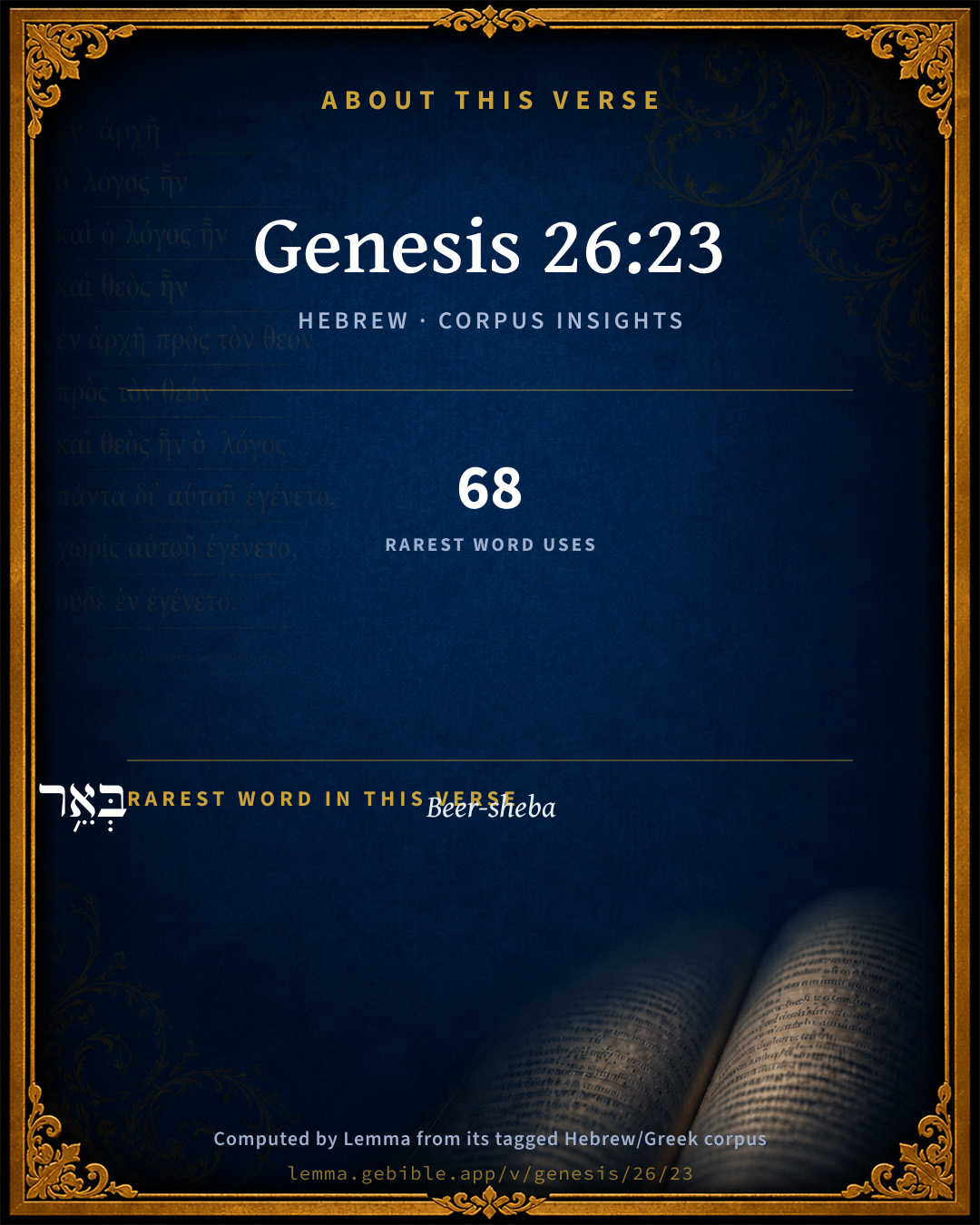
These counts appear in no published source. They are computed here, from the morphology-tagged text and Lemma’s own curated glosses. What Lemma adds →

4
words
3
distinct lemmas
Pentateuch
section

Grammatical profile

  • 1 verb
  • 2 nouns
  • 1 adverb

Verb forms

  • וַיַּ֥עַל Qal · Sequential Imperfect

Repetition

A word recurs within this verse — often emphatic in Hebrew:

  • בְּאֵ֥ר Beer-sheba H884 ×2

Hebrew & Septuagint length

In English translation the verse runs 7 words from the Hebrew and 11 from the Septuagint (LXX English) — the Septuagint runs noticeably longer here. See the side-by-side →

A rough comparison of the two English renderings, which tokenize alike — not a word-level alignment.

Word counts can differ between the Hebrew and the Greek without any difference in meaning — e.g. the Hebrew direct-object marker אֵת has no separate Greek word, and Greek often adds the article ὁ.

Cross-references

3

Topical passages linked to Genesis 26:23 in the Treasury of Scripture Knowledge — connected by theme and wording, ordered by reader-vote popularity; previews shown in the World English Bible.

  • Genesis 21:31 Therefore he called that place Beersheba, because they both swore there.
  • Genesis 46:1 Israel traveled with all that he had, and came to Beersheba, and offered sacrifices to the God of his father, Isaac.
  • Judges 20:1 Then all the children of Israel went out, and the congregation was assembled as one man, from Dan even to Beersheba, with the land of Gilead, to Yahweh at Mizpah.

Cross-references courtesy of OpenBible.info (CC BY 4.0).

Hebrew and Greek witnesses Masoretic Hebrew ↔ Greek Septuagint

The same verse in the two great witnesses to the Old Testament, shown verse-for-verse.

Here the Septuagint runs noticeably longer than the Hebrew — LXX2012 (modern English Septuagint) 11 words vs World English Bible 7. A rough length comparison of the two English translations, not a word-level alignment — read both below.

These are two independent witnesses, not word-aligned to each other, and the Septuagint is shown in lemma (dictionary) form.

Hebrew Genesis 26:23 Masoretic · Westminster Leningrad Codex

וַיַּ֥עַל מִשָּׁ֖ם בְּאֵ֥ר שָֽׁבַע

He went up from there to Beersheba.

World English Bible · Public Domain

Greek LXX Genesis 26:23 Septuagint · lemma form

ἀναβαίνω δέ ἐκεῖθεν ἐπί ὁ φρέαρ ὁ ὅρκος

And he went up thence to the well of the oath.

LXX2012 (modern English Septuagint) · Public Domain

Hebrew: Westminster Leningrad Codex (CC BY 4.0). Greek: Septuagint (public domain); English from LXX2012 (modern English Septuagint) (Public Domain). How the Septuagint differs from the Hebrew →

Targum (Aramaic paraphrase)

2

The Targum is the ancient Jewish Aramaic paraphrase of the Hebrew Scriptures — an interpretive translation, not the Hebrew text itself. Onkelos (literal) and Pseudo-Jonathan (expansive) render the Torah, and Jonathan the Prophets. Coverage is partial: where no permissively-licensed English translation exists for a verse, only the Aramaic is shown. This is verse-level text, not a word-by-word alignment to the Hebrew.

  1. Targum Onkelos Torah (Genesis–Deuteronomy)
    וְאִסְתַּלַּק מִתַּמָּן לִבְּאֵר שָׁבַע

    (no public-domain English translation for this verse)

    Targum Onkelos — Aramaic: “Onkelos Genesis” (public domain); “Onkelos Exodus” (public domain); “Onkelos Leviticus” (public domain); “Onkelos Numbers” (public domain); “Onkelos Deuteronomy” (public domain). English: “Sefaria Community Translation” (CC0 1.0 (public-domain dedication)); “J.W. Etheridge. The Targums of Onkelos and Jonathan Ben Uzziel on the Pentateuch. London: Longmans, Green, 1862” (public domain). Text via Sefaria.

  2. Targum Pseudo-Jonathan Torah (Genesis–Deuteronomy)
    וּסְלִיק מִתַּמָן לְבֵירָא דְשָׁבַע

    And he went up from thence unto Beersheba.

    Targum Pseudo-Jonathan — Aramaic: “Targum Jonathan on Genesis” (public domain); “Targum Jonathan on Exodus” (public domain); “Targum Jonathan on Leviticus” (public domain); “Targum Jonathan on Numbers” (public domain); “Targum Jonathan on Deuteronomy” (public domain). English: “The Targum of Jonathan ben Uzziel, trans. J. W. Etheridge, London, 1862” (public domain). Text via Sefaria.

Commentary

Notes on Genesis 26:23 from classic Christian and Jewish commentators (each source and its license shown beneath its notes). The classic Christian expositions comment on the surrounding passage and are grouped to its opening verse, so a note may address several verses; the Jewish commentaries on the Tanakh (Rashi and others) are per-verse, so they appear only where the commentator wrote on this verse.

Lemma curates 59 commentaries, every one of them public domain or Creative Commons licensed, each selected and text-cleaned for this edition rather than reprinted as found. About our sources →

Trapp's Complete Commentary

John Trapp

Gen 26:23 And he went up from thence to Beersheba.

Ver. 23. And he went up.] To the place of God’s worship. Strabo writeth that the Metapontines, when they were enriched by a good year of grain, dedicated to Apollo a golden harvest. {a}

{a} Dedicasse in Delphis χρυσουν θερος.

John Trapp, A Commentary or Exposition upon All the Books of the Old and New Testament (1647–1656) — public domain. Text from a community e-Sword module.

The Biblical Illustrator

Joseph S. Exell

Gen_26:23-25

Fear not, for I am with thee

Lessons

1.

The return from exilement to their own, God giveth to His sojourners as He pleaseth.

2. Beer-sheba is is more desirable to Isaac than Gerar. The place by covenant allotted, than the place envied by others (Gen_26:23).

3. Gods gracious appearance unto souls is usually in the time of their hardships, and where He calls them.

4. Gods special care of His in times of persecution from men, is to keep them from fear.

5. Gods relation to Abraham is a good ground to secure Abrahams seed from fears.

6. Gods gracious presence, revealed and believed, is security against fear of men.

7. Gods blessing of the faithful may justly set them above all affrightments from men.

8. Gods multiplying His Church is sufficient security against the fear of the worlds diminishing it (Gen_26:24).

9. Gods appearance to troubled souls requireth speedy and true worship from them to Him again.

10. Gracious souls are careful to give unto God right worship by right means.

11. Saints desire to have God dwell with them that they may dwell with God.

12. Where God dwelleth with His servants, they serve His providence in all honest labour for subsistence (Gen_26:25). (G. Hughes, B. D.)

The Biblical Illustrator, edited by Joseph S. Exell (c. 1880s–1900s) — public domain. Text from a community e-Sword module.

The Pulpit Commentary

CHAPTER 26:23-35

EXPOSITION.

And he (viz., Isaac) went up from thence (Rehoboth, where latterly he had been encamped) to Beer-sheba a former residence of Abraham, (Gen_21:33) situated "near the water-shed between the Mediterranean and the Salt Sea" (Murphy), hence approached from the low-lying wady by an ascent.

Vers. 23-35.

A good man"s environment.

I ISAAC AND JEHOVAH.

1. Jehovahs grace to Isaac.

(1) Revealing his presence. "The Lord appeared unto him." Similiar discoveries are now made to saints in "night" seasons, and at localities like Beersheba, previously consecrated by gracious revelations of himself.

(2) Proclaiming his character. "I am the God of thy father;" an appellation that must have sounded dear to Abraham s son, but not more than the God of our Lord Jesus Christ is to Christians.

(3) Comforting his servant. Fear not, for I am with thee." So a Christian has the best right to preserve equanimity amid life"s vicissitudes and tribulations, Christ"s command (Mat_10:31; Luk_12:32) and the best reason, Christ"s presence. (Mat_28:20 Mat_28:20)

(4) Renewing his promises. "I will bless thee and multiply thy seed." God renews his promises when he revives their impressions on the heart, which he does for his own glory as the faithful Promiser, and for his people"s comfort as necessity requires.

2. Isaacs gratitude to Jehovah.

(1) Building an altar; an act expressive of Isaac"s personal devotion. (1Th_5:18)

(2) Invoking God"s name; referring to the public recital of God"s goodness. (Gen_12:8) It becomes saints to remember God"s mercies, (Psa_48:9 Psa_103:1, Psa_103:2) and to speak of them to others. (Psa_66:16 Psa_78:4)

(3) Pitching a tent and digging a well; indicative of Isaac"s confidence in God. Grateful acknowledgment of past mercies, public celebration of present mercies, hopeful expectation of future mercies, are duties incumbent upon all, but especially on saints.

II ISAAC AND ABIMELECH.

1. Abimelech"s request of Isaac.

(1) The nature of demand for a formal alliance confirmed by the sanctions of religion. "Let there be now an oath betwixt us, and let us make a covenant with thee.

(2) The object of it: his own rather than Isaac"s protection. "That thou wilt do us no hurt." Most men suspect their neighbors sooner than themselves. Christianity requires saints to be as careful of their neighbor"s interests as of their own. (Php_2:4)

(3) The motive of it: partly selfish fear, and partly a recognition of Isaac"s goodness. "Thou art now the blessed of the Lord.

2. Isaacs reception of Abimelech.

(1) Cautious inquiry. "Wherefore come ye to me?" It is prudent to try injurious men before we trust them.

(2) Generous entertainment. "He made them a feast." Overlooking, as became a good man, their too favorable account of themselves, he gave them welcome to his hospitable board. God"s people should not be censorious even in judging enemies; when obliged to suffer, they should forget as well as forgive injuries, and never should they disdain overtures for peace, though made by those who have done them wrong.

1. Solemn adjuration. "And they swore one to another." Though religion does not lie within the sphere of politics, politics lie within the sphere of religion. Nothing should be done by a good man that he cannot sanctify by the word of God and prayer. (Col_3:17, Col_3:23)

2. Peaceful dismissal. "Isaac sent them away, and they departed from him in peace." Those who come for peace should never go without peace. It is the saint"s interest as well as duty to follow after peace. (Mat_5:9) No sooner had Isaac dismissed Abimelech and his ministers, than his servants came with tidings of their successful operations in sinking a well. Peace-makers seldom fail to find a recompense. (Jam_3:18)

III ISAAC AND ESAU.

1. Esau"s sinful marriage.

(1) He took more wives than one, which was against the fundamental law of marriage (Gen_2:24; Mat_19:5)

(2) he married Canaanitish women, which was against the will of God, as expressed by Abraham in regard to Isaac"s marriage, and doubtless also by Isaac with reference to Esau"s; and

(3) he acted contrary to "his parents" counsel in the matter, which was a violation of that filial duty which he owed his aged parents.

2. Isaacs bitter grief.

(1) Deeply seated as to its intensity, being bitterness of spirit; (Pro_18:14)

(2) truly religious as to its character, being occasioned chiefly by the circumstance that Esau"s ill-assorted marriages were not such as Heaven could approve; and

(3) sympathizingly shared by Rebekah, whoso motherly bosom was also stricken with sorrow at her son"s impiety.

Learn

1. That God"s gracious visits to his people are always admirably suited to their needs in respect of time, place, and manner.

2. That when a man"s ways please God he maketh even his enemies be at peace with him.

3. That while a wise son maketh a glad father, a foolish son is the heaviness of his mother.

The Pulpit Commentary (1880–1919), ed. H.D.M. Spence-Jones & Joseph S. Exell — public domain. Text from a community e-Sword module.

Lange's Commentary on the Holy Scriptures

FOURTH SECTION

Isaac in Beer-sheba. Treaty of Peace with Abimelech

Gen_26:23-33

23And he went up from thence to Beer-sheba. 24And the Lord appeared unto him the same [first] night, and said, I3 am the God of Abraham thy father; fear not, for I am with thee, and will bless thee, and multiply thy seed for my servant Abraham’s sake. 25And he builded an altar there, and called upon [witnessed to] the name of the Lord, and pitched his tent4 there: and there Isaac’s servants digged a well.

26Then [and] Abimelech went to him from Gerar, and Ahuzzath [possession, occupant] one of his friends, and Phichol the chief captain [see Gen_21:22, commander] of his army. 27And Isaac said unto them, Wherefore come ye to me, seeing ye hate me [have treated me with hatred], and have sent me away from you? 28And they said, We saw certainly5 that the Lord was with thee: and we said, Let there be now an oath betwixt us [on both sides], 29 even betwixt us and thee, and let us make a covenant with thee; That6 thou wilt do us no hurt, as we have not touched thee, and as we have done unto thee nothing but good, and have sent thee away in peace: thou art [thus art thou] now the blessed of the Lord. 30And he made, them a feast, and they did eat and drink. 31And they rose up betimes in the morning, and sware one to another: and Isaac sent them away, and they departed from him in peace. 32And it came to pass the same day, that Isaac’s servants came and told him concerning the well which they had digged, and said unto him, We have found water. 33And he called it Shebah [seven; here in its signification: oath]: therefore the name of the city is Beer-sheba unto this day.

EXEGETICAL AND CRITICAL

To Beer-sheba.—The former residence of Abraham (Gen_21:33), and Isaac’s former station for his flocks.—The appearance of Jehovah.—A night vision; a form which now enters more definitely into the history of the patriarchs.—The God of Abraham, thy father.—In this way Jehovah reminds him of the consistency of his covenant faithfulness, but especially of his covenant with Abraham.—Fear not.—This encouraging exhortation no doubt refers to the disposition of Isaac. Abraham needed such an encouragement, after having exposed himself to the revenge of the Eastern kings on account of his victory over them. Isaac needs it because of his modest, timid disposition, and on account of the enmity of the Philistines, by whom he was driven from place to place. Perhaps his heart foreboded that Abimelech would yet follow him. He consecrates his prolonged sojourn at Beer-sheba by the erection of an altar, the establishment of a regulated worship, and by a fixed settlement.—Then Abimelech went to him.—By comparing this covenant act with that between Abraham and Abimelech of Gerar, the difference appears more strikingly. Abimelech, in the present chapter, is accompanied not only by the chief captain of his army, but also by his friend, i.e., Ahuzzath, his private counsellor. Isaac animadverts on his hatred, but not like Abraham, on the wells that had been taken away from him (see Gen_21:25). Even in the boasting assertion of Abimelech respecting his conduct toward Isaac—which the facts will not sustain—we recognize, apparently, another Abimelech, less noble than the former. This appears also in his demand of the imprecatory oath (אלה). It is also peculiar to Isaac that he permits a banquet, a feast of peace as it were, to precede the making of the covenant. The same day, after the departure of Abimelech, the servants, who had commenced some time before to dig a new well, found water. Their message seems to be a new reward of blessing, immediately following the peaceable conduct of Isaac. Isaac names this well as Abraham had done the one before (Gen_21:31); thus the name Beer-sheba is given to it also. [It is not said that this name was here given for the first time; but as the covenant concluded was the renewal and confirmation of the covenant of Abraham with the previous Abimelech, so the name is the renewal and confirmation of that given by Abraham. The same name is appropriate to both occasions.—A. G.] The existence of both these wells bears witness to the credibility of this fact. Keil. Knobel, of course, regards this as an entirely different tradition. But Delitzsch remarks: To all appearance, Isaac, in the naming of this well, followed the example of his father in naming the well situated near it; since in other cases he renewed the old names of the wells.—Bunsen: To swear, to the Hebrew, signifies, “to take sevenfold,” or, “to bind oneself to seven holy things, referring to the Aramaic idea of God as Lord of Seven; i.e., of the seven planets (Sun, Moon, Venus, Mercury, Mars, Jupiter, Saturn).” The remembrance of the seven sacrifices or pledges of the covenant, is far more probable, unless the expression is to be regarded as signifying a seven-fold degree of ordinary certainty.

DOCTRINAL AND ETHICAL

1. Isaac’s holy elevation of soul at his return from the country of the Philistines to his old home, Beer-sheba, crowned by a promise and a glorious appearance of God.

2. The divine promise renewed; see above.

3. Isaac at Beer-sheba. He builds an altar to the Lord before a tent for himself. In the establishment of the worship of Jehovah, in this testimony to him, as he calls upon his name, and in his preaching, he is a worthy heir of his father.

4. Human covenants are well established, if a divine covenant precedes and constitutes their basis.

5. Isaac in his yielding, his patient endurance and concessions, a terror to the king.

6. Isaac’s feast of peace with Abimelech, a sign of his great inoffensiveness.

7. The solemnity of the well, and on the same day with the feast of peace, or, the blessing of noble conduct.

8. Abraham prefers to dwell in the plains (Moreh, Mamre), and he planted trees. Isaac prefers to reside at wells, and he is fond of digging wells.

HOMILETICAL AND PRACTICAL

See the Doctrinal and Ethical paragraphs. The rich contents of the term: God of Abraham. It declares: 1. That the eternal God has made a covenant with us imperishable beings (Luk_20:37-38); 2. the continuity, the unity, the unchangeableness, of the revelation of Jehovah through all times and developments; 3. the transmission of the hereditary blessing from the believing father to the believing children.—How the expression, in the history of the patriarchs, fear not (Gen_15:1; Gen_26:24; Gen_28:15), goes through the whole scriptures until it reaches its full development in the angelic message of the birth of Christ (Luk_2:10), and at the morning of his resurrection.

Starke: Cramer: God always supports his church, and builds it everywhere (Isa_51:6). Whatever a Christian undertakes, he ought to undertake in the name of the Lord (Col_3:17). When a man’s ways please the Lord, he maketh even his enemies to be at peace with him (Pro_16:7; Gen_33:4).—Lawful alliances and oaths are permitted (Deu_6:13).—Gerlach: At this place, remarkable, already, during the life of Abraham, the Lord renews the assurance of his grace, as afterwards to Jacob (Gen_46:1); whilst, in the consecration of individual places, he connected himself with the child-like faith of the patriarchs, and satisfied the want to which it gave rise.

Schröder: The least thing we sacrifice for the sake of God, he repays, by giving us himself (Berl. Bib.). Whenever Jehovah calls himself God of Ahraham, Isaac, and Jacob, he shows, thereby, in each day’s revelation of himself to Israel, the ground and occasion of the same in the revelation that is past—thus connecting the new with the old, while presenting the grace shown to the posterity, as a necessary consequence of that which he had covenanted to their fathers’ fathers. True religion is essentially historical; history (not fanciful myths) is its foundation and limits. God is our God, because he has made himself our God by repeated acts in history. In the kingdom of God everything develops and progresses; there is no past without a future, nor a future without a past.—Abraham received the promise respecting the Messiah in the name of all the faithful; if, now, Isaac and every believer be blessed for the sake of Abraham, he is blessed merely for the sake of the promise that was given to Abraham, and, therefore, for the sake of Christ (Roos).—Isaac is mindful of his sacerdotal office, as soon as he takes up his abode (Berl. Bib.).—The Abimelech mentioned here is more cunning than his father, for he pretends to know nothing about the taking away of Isaac’s wells by his servants (Luther).—Such is the course of the world. Now insolent, then mean. He who wishes to live in peace with it (which is true of all believers) must be able to bear and suffer (Roos).—The Abimelech of Genesis 21 uses Elohim, a word proper to him; the one in the present chapter, not caring much about the affair, says Jehovah, because he constantly heard Isaac make use of this divine name. He accommodates himself to the feast of Isaac, as Laban in Genesis 24 (Rom_12:20; Jos_9:14; 2Sa_3:20; Isa_25:6; Luk_14:17.)—The divine blessing of this conciliatory and humble love, did not exhaust itself in temporal things. Isaac contended and suffered for the sake of wells; as to the wells which he digged soon after his arrival at Beer-sheba, it happened on the very day he made the covenant and swore, etc.—The relation, of which the name Beer-sheba was the memorial, had ceased to exist. But by the repetition of the fact, the name regained its significance and power, and was the same as if now given for the first time (Hengstenberg).

Footnotes:

[3][Gen_26:24.—אָנֹכִי The pronoun is emphatic—I the God, etc.—A. G.]

[4][Gen_26:25.—‏‏יַיֶט. Not the usual word for the pitching a tent, see verse.17. The term may be chosen with reference to the permanence of his abode, or the increase of his family and retinue.—A. G.]

[5][Gen_26:28.—Lit., Seeing we have seen.—A. G.]

[6][Gen_26:29.—Lit., If thou shalt. The usual Hebrew form of an imprecation or oath.—A. G.]

Lange's Commentary on the Holy Scriptures (Critical, Doctrinal, and Homiletical), ed. John Peter Lange, English translation edited by Philip Schaff (1864–1880) — public domain. Text from a community e-Sword module.

Tyndale Open Study Notes

Tyndale Open Resources

26:23-25 At Beersheba, . . . the Lord appeared to Isaac to confirm his covenant (cp. 21:31-33). Isaac responded in faith as his father had done by building an altar to the Lord and proclaiming the Lord’s identity and nature (see study note on 12:8; 21:33).

Tyndale Open Study Notes — © Tyndale Open Resources, licensed CC BY-SA 4.0. Text via the HelloAO Bible API.

John Calvin's Commentaries

23. And he went up from thence to Beer-sheba. Next follows a more abundant consolation, and one affording effectual refreshment to the mind of the holy man. In the tranquil enjoyment of the well, he acknowledges the favor which God had showed him: but forasmuch as one word of God weighs more with the faithful than the accumulated mass of all good things, we cannot doubt that Isaac received this oracle more joyfully than if a thousand rivers of nectar had flowed unto him: and truly Moses designedly commemorates in lofty terms this act of favor, that the Lord encouraged him by his own word, (Genesis 26:24;) whence we may learn, in ascribing proper honor to each of the other gifts of God, still always to give the palm to that proof of his paternal love which he grants us in his word. Food, clothing, health, peace, and other advantages, afford us a taste of the Divine goodness; but when he addresses us familiarly, and expressly declares himself to be our Father, then indeed it is that he thoroughly refreshes us to satiety. Moses does not explain what had been the cause of Isaac’s removal to Beer-sheba, the ancient dwelling-place of his fathers. It might be that the Philistines ceased not occasionally to annoy him; and thus the holy man, worn out with their implacable malice, removed to a greater distance. It is indeed probable, taking the circumstance of the time into account, that he was sorrowful and anxious; for as soon as he had arrived at that place, God appeared unto him on the very first night. Here, then, something very opportune is noticed. Moreover, as often as Moses before related that God had appeared unto Abraham, he, at the same time, showed that the holy man was either tormented with grievous cares, or was held in suspense under some apprehension, or was plunged in sadness, or, after many distresses, was nearly borne down by fatigue, so as to render it apparent that the hand of God was seasonably stretched out to him as his necessity required, lest he should sink under the evils which surrounded him. So now, as I explain it, he came to Isaac, for the purpose of restoring him, already wearied and broken down by various miseries.

John Calvin's Commentaries (1540-1563) — public domain. Text from the Calvin Translation Society English edition (1840s-50s) via the Christian Classics Ethereal Library (ccel.org). Calvin's coverage is partial (roughly two-thirds of the Bible); uncommented books and verses are honest gaps, never fabricated. The 19th-century editor's footnotes and remarks are omitted so the notes are faithfully Calvin's own voice.

Ellicott's Commentary for English Readers

(23-25) He went up from thence to Beer-sheba.—This was a very serious act on Isaac’s part He leaves the solitudes where he had found a refuge from the enmity of the Philistines, and returns to a place scarcely five leagues distant from their city. Should the old rancour revive, it may now take the form of actual war. And next, he does not go back to the well Lahai-Roi, where he had so long resided, but to Beer-sheba, his father’s favourite home. It was a claim on his part to the rights and inheritance of Abraham, and the claim was admitted. The same night Jehovah appears to him, bids him put away his fears, and renews to him the promises which were his by the right of his birth.

My servant Abraham.—A title of high honour and significance, given to Moses repeatedly, to Joshua (Jos_24:29), to Israel (Isa_41:8), and to the Messiah (Isa_52:13). It means God’s prime minister and vicegerent.

He builded an altar.—In returning to Beer-sheba, Isaac had apparently faced the dangers of his position, through confidence in the promises made to his father, with whom he identified himself by taking up his abode at his home. And no sooner are the promises confirmed to him than he restores the public worship of God in the very place where Abraham had established it (Gen_21:33).

Digged a well.—The word is not that previously used in the chapter, but one that signifies the re-opening of the well which Abraham had dug, but which had become stopped by violence or neglect.

A Bible Commentary for English Readers, edited by Charles John Ellicott (1878–1897) — public domain. Text from a community e-Sword module.

John Gill's Exposition

And he builded an altar there,.... At Beersheba, where his father Abraham had planted a grove before, and very probably had built an altar also, though it might not be now standing, Gen 21:33,

and called upon the name of the Lord; and gave him thanks for all his mercies to him; for the care he had taken of him, and provision he had made for him and his during the time of famine; and for the protection and preservation of him in Gerar; and for his deliverance of him out of the hands of envious, malicious, and unreasonable men; as well as prayed unto him for present and future mercies, for providential care of him and his; and for communications of special grace, and for meetness for eternal glory; all which every good man daily prays to God for:

and pitched his tent there: intending to take up his abode and settle there:

and there Isaac's servants digged a well; in order to find water for the family, and for the flocks and herds; and which was necessary to be done, as they perceived their master designed to fix his habitation here; wells of water being of great moment and consequence in those hot and desert countries, as the above contentions about them abundantly show.

John Gill's Exposition of the Whole Bible (1746–1763) — public domain (CC PDM 1.0). Text via the HelloAO Bible API.

Matthew Poole's English Annotations

Where he lived before the famine drove him thence.

Matthew Poole's English Annotations on the Holy Bible (1683–1685) — public domain. Text from a community e-Sword/MySword module.

Keil & Delitzsch

C. F. Keil & F. Delitzsch

Isaac's Journey to Beersheba. - Here, where Abraham had spent a long time (Gen 21:33.), Jehovah appeared to him during the night and renewed the promises already given; upon which, Isaac built an altar and performed a solemn service. Here his servants also dug a well near to the tents.

Keil & Delitzsch — Biblical Commentary on the Old Testament (1861–1891) — public domain (CC PDM 1.0). Text via the HelloAO Bible API. (Old Testament only.)

unfoldingWord translationNotes

Door43 World Missions Community

Isaac went up from there to Beersheba

Here "went up" is probably a reference to going north. Say that he departed in the most natural way for your language. AT: "Isaac left there and went to Beersheba"

multiply your descendants

"will cause your descendants to increase greatly" or "will cause your descendants to be very many"

for my servant Abraham's sake

"for my servant Abraham" or you can make the full meaning explicit. AT: "because I promised my servant Abraham that I would do this" (See: Assumed Knowledge and Implicit Information)

Isaac built an altar there

You can make explicit why Isaac built an altar. AT: "Isaac built an altar there to sacrifice to Yahweh" (See: Assumed Knowledge and Implicit Information)

called on the name of Yahweh

To "call on" means to pray or to worship. Here "name" stands for Yahweh. AT: "prayed to Yahweh" or "worshiped Yahweh" (See: Metonymy)

translationWords

Beersheba

Yahweh

Abraham

bless

multiply

descend

servant

altar

name

tent

unfoldingWord translationNotes — © Distant Shores Media and the Door43 World Missions Community, licensed CC BY-SA 4.0. Source: git.door43.org/Door43/en_tn.

Radak

Rabbi David Kimhi (Radak)

ויעל משם באר שבע. This was not far away from Gerar as we already explained. As to the reason for the expression ויעל, “he went up,” the reason for this is that the part of the Land of Israel which is known as the traditional Land of Israel was on a spiritually higher level than the part occupied by the Philistines. This is also why we find the expression ויעלו פלשתים in Judges 15,9 (against Shimshon) as well as the phrase uttered by King Sha-ul in Samuel I 14,36 נרדה אחרי פלשתים, “Let us pursue the Philistines by descending.” This expression occurs again and again. [this seems unnecessary as any student of the topography of Eretz Yisrael knows that the Philistines lived in the coastal strip, i.e. the topographically lowest region of the country, so that considerations distinguishing between areas of higher sanctity and lesser sanctity are hardly needed to help us understand the wording of the Torah here. Ed.] All these stories about the digging of the wells and the names they were called by were intended to inform us that in the part of Eretz Yisrael traditionally promised to Avraham, his son Yitzchok was digging according to his undisputed right. In those areas he also did not encounter opposition when naming these wells. All of this was an indication to them of which parts of Eretz Yisrael G’d had meant for them to plant seed in, i.e. the part of the land that G’d would give to the Israelites in the first instance. (under Joshua).The regions in which the Philistines dwelled did not really come under full control of the Israelites until many hundreds of years later. This accounts for the ongoing wars at intervals between the Israelites and the Philistines. These skirmishes were basically border-wars, neither side planning to conquer the territory of the other permanently. [according to the author the problem would be permanently settled only in Messianic times. Ed.] It is an outstanding issue similar to the territory of three Canaanite tribes, the Kenite, Knizite and Kadmoni, which formed part of G’d’s promise to Avraham in chapter 15 at the covenant between the pieces but has never yet been under Jewish sovereignty.

Radak on the Tanakh — English translations: “Sefaria Community Translation” (CC0 1.0 (public-domain dedication)); “Eliyahu Munk, HaChut Hameshulash” (CC BY 4.0); “Rabbi Mike Feuer, Jerusalem Anthology” (CC BY 4.0); and “R. David Kimhi on the first book of Psalms, Translated by R.G. Finch, London, 1919” (public domain). Text via Sefaria.

Lesson kit

Teaching starters — assembled from the data on this page, not authored interpretation. Every prompt links to the verse data it draws on. Edit before teaching.

Genesis, in the Pentateuch, opens this verse with 4 words (3 distinct Hebrew lemmas). Its most distinctive word is Bᵉʼêr Shebaʻ (“Beer-sheba”). The Greek Septuagint runs longer here. A historical commentator’s framing appears above. Read the whole chapter for the surrounding context.

Discussion questions

  1. What does “Beer-sheba” (Bᵉʼêr Shebaʻ) contribute to the verse as a whole?
  2. How does Genesis 21:31, which shares this passage’s theme, read alongside this verse?
  3. What does the repetition of “Beer-sheba” (2× in this one verse) do in this verse?
  4. The Septuagint runs longer here than the Hebrew. What might account for the difference?
  5. These translations render this verse differently; the difference is in the English rendering, not the original. What questions does that raise?
  6. «וַיַּ֥עַל» is a Qal Sequential Imperfect verb. How does that grammatical form shape the action described?
  7. Compare how Trapp's Complete Commentary and The Biblical Illustrator read this verse. Where do they agree or differ?

Things to notice

  • These translations choose different wording for 2 words in this verse.
  • “Beer-sheba” occurs 2× in this single verse.
  • 3 distinct Hebrew lemmas span 4 words in this verse.

Reading settings

Reading text

Shown beneath each verse's original-language words.

Old Testament
Old Testament edition

Read the OT as the Masoretic Hebrew (MT) or the Greek Septuagint (LXX).

English shown for the Greek Septuagint (in the Hebrew ↔ Greek comparison).

Comparing translations? Open the Compare panel on any verse page to stack up to four side by side.