Leviticus 11:45

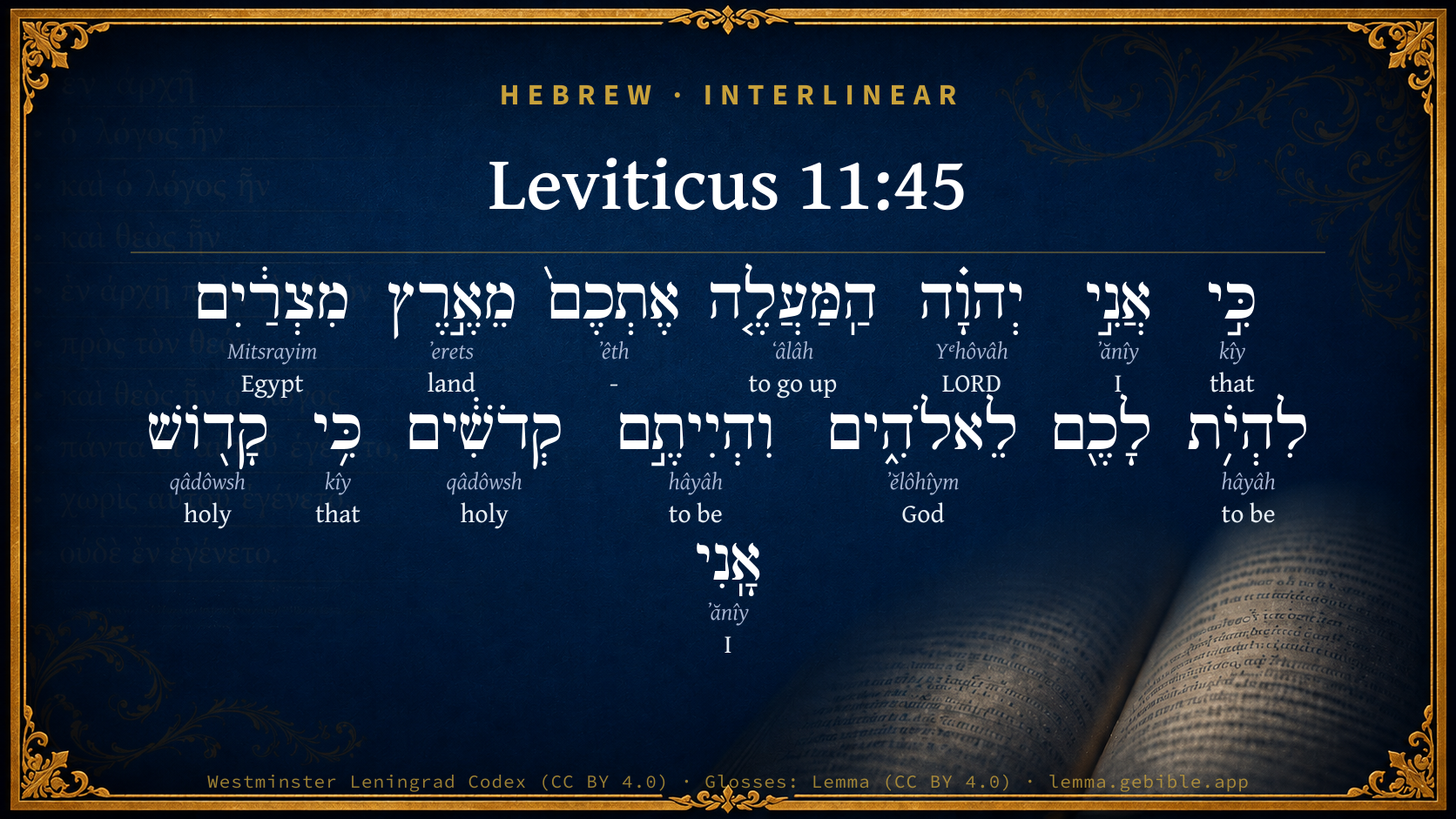
Hebrew (Westminster Leningrad Codex) Leviticus 11:45 appears in the Hebrew Old Testament. The text above is from the Westminster Leningrad Codex. Each word links to its Strong’s number, a concise gloss, and parsing drawn from the Open Scriptures Hebrew Bible morphology. Click any word for its full Brown-Driver-Briggs (BDB) entry.
Download image
Cite this verse

Leviticus 11:45 (World English Bible). Public Domain. Lemma interlinear Bible study tool, https://lemma.gebible.app/v/leviticus/11/45.

Show BibTeX & RIS
BibTeX
RIS
English Translation
For I am Yahweh who brought you up out of the land of Egypt, to be your God. You shall therefore be holy, for I am holy.
World English Bible · Public Domain
Download a study sheet

One document with this verse’s original text, its word-by-word gloss line, the meaning frame, cross-references with their text, attributed commentary, and full source and license credits — printable, and it pastes into notes with its structure intact.

This verse Autodidact and up

Study sheet (.html) Plain text (.txt)

A passage Seminary Student

Up to 50 verses in one chapter. A passage sheet keeps up to 6 commentary sources and 12 cross-references per verse, in the order this page ranks them, and says so on the sheet whenever that leaves anything out. Ask for a single verse and you get the Autodidact verse sheet above.

Everything on this page stays free to read, with no account — the sheet is a download of what is already on screen, not access to it.

Want to remove ads? Support Godless Engineer
Compare translations 3

The same verse in 3 English versions, stacked beneath the original-language interlinear above. Click any original word for its lexicon entry.

Each is an independent rendering of the whole verse — the interlinear is not word-aligned to these translations.

Highlighted words mark where these versions differ — a whole-verse word diff, not a word-by-word alignment.

  • World English Bible Public Domain
    For I am Yahweh who brought you up out of the land of Egypt, to be your God. You shall therefore be holy, for I am holy.
  • King James Version Public Domain
    For I am the LORD that bringeth you up out of the land of Egypt, to be your God: ye shall therefore be holy, for I am holy.
  • unfoldingWord Literal Text CC BY-SA 4.0
    For I Yahweh, the one bringing you up from the land of Egypt to be God for you. And you shall be holy, for I holy.

unfoldingWord Literal Text — © unfoldingWord, licensed CC BY-SA 4.0. Word-aligned USFM3 via Door43 (git.door43.org/unfoldingWord/en_ult).

Versions to compare (up to 4)

3 of 4 selected

Show all 18 translations

Every available English version of this verse, each an independent rendering of the whole verse.

  • World English Bible Public Domain
    For I am Yahweh who brought you up out of the land of Egypt, to be your God. You shall therefore be holy, for I am holy.
  • Berean Standard Bible Public Domain
    For I am the LORD, who brought you up out of the land of Egypt so that I would be your God; therefore be holy, because I am holy.
  • Majority Standard Bible Public Domain
    For I am the LORD, who brought you up out of the land of Egypt so that I would be your God; therefore be holy, because I am holy.
  • King James Version Public Domain
    For I am the LORD that bringeth you up out of the land of Egypt, to be your God: ye shall therefore be holy, for I am holy.
  • American Standard Version (1901) Public Domain
    For I am Jehovah that brought you up out of the land of Egypt, to be your God: ye shall therefore be holy, for I am holy.
  • Revised Version (1885) Public Domain
    For I am the LORD that brought you up out of the land of Egypt, to be your God: ye shall therefore be holy, for I am holy.
  • Geneva Bible (1599) Public Domain
    For I am the Lord that brought you out of the lande of Egypt, to be your God, and that you should be holy, for I am holy.
  • Douay-Rheims (1899) Public Domain
    For I am the Lord, who brought you out of the land of Egypt, that I might be your God.
  • Young's Literal Translation Public Domain
    for I `am' Jehovah who am bringing you up out of the land of Egypt to become your God; and ye have been holy, for I `am' holy.
  • Literal Standard Version CC BY-SA 4.0
    for I [am] YHWH who am bringing you up out of the land of Egypt to become your God; and you have been holy, for I [am] holy.
  • Unlocked Literal Bible CC BY-SA 4.0
    For I am Yahweh, who brought you up out of the land of Egypt, to be your God. You must therefore be holy, for I am holy.
  • unfoldingWord Literal Text CC BY-SA 4.0
    For I Yahweh, the one bringing you up from the land of Egypt to be God for you. And you shall be holy, for I holy.
  • Darby Bible Public Domain
    For I am Jehovah who brought you up out of the land of Egypt, to be your God: ye shall therefore be holy, for I am holy.
  • World Messianic Bible Public Domain
    For I am the LORD who brought you up out of the land of Egypt, to be your God. You shall therefore be holy, for I am holy.
  • Webster's Bible Public Domain
    For I am the LORD that bringeth you out of the land of Egypt, to be your God: ye shall therefore be holy, for I am holy.
  • Free Bible Version CC BY-SA 4.0
    I am the Lord who led you out of Egypt so that I could be your God. So be holy, because I am holy.
  • Bible in Basic English Public Domain
    For I am the Lord, who took you out of the land of Egypt, to be your God; so be you holy, for I am holy.
  • JPS Tanakh (1917) Public Domain
    For I am the LORD that brought you up out of the land of Egypt, to be your God; ye shall therefore be holy, for I am holy.

Literal Standard Version (2020), Covenant Press — licensed CC BY-SA 4.0. Text via the HelloAO Bible API (eBible.org). Unlocked Literal Bible (unfoldingWord) — licensed CC BY-SA 4.0. Text via the HelloAO Bible API (eBible.org). unfoldingWord Literal Text — © unfoldingWord, licensed CC BY-SA 4.0. Word-aligned USFM3 via Door43 (git.door43.org/unfoldingWord/en_ult). Free Bible Version, Dr. Jonathan Gallagher — licensed CC BY-SA 4.0. Text via the HelloAO Bible API (eBible.org).

Word by word

More ways to search: Search by grammar → Find every occurrence → Compare this word →

Practice this passage: Drill this verse → Learn its vocabulary →

קְדֹשִׁ֔ים
qâdôwsh
H6918
“holy”
Adjective, Adjective, Masculine, Plural, Absolute
Part of Speech
Adjective
Type
Adjective
Gender
Masculine
Number
Plural
State
Absolute
Full BDB Definition

Origin: from H6942

TWOT: 1990b

sacred, holy, Holy One, saint, set apart
  1. כִּ֣י kîy H3588 “that” Conjunction
  2. אֲנִ֣י ʼănîy H589 “I” Pronoun, Personal, 1st Person, Common, Singular
  3. יְהוָ֗ה Yᵉhôvâh H3068 “LORD” Noun, Proper
  4. הַֽמַּעֲלֶ֤ה ʻâlâh H5927 “the · going up” Particle, Definite Article + Verb, Hiphil, Participle Active, Masculine, Singular, Absolute
  5. אֶתְכֶם֙ ʼêth H853 “- · you” Particle, Direct Object + Suffix, Personal, 2nd Person, Masculine, Plural
  6. מֵאֶ֣רֶץ ʼerets H776 “from · land of” Preposition + Noun, Common, Both, Singular, Construct
  7. מִצְרַ֔יִם Mitsrayim H4714 “Egypt” Noun, Proper
  8. לִהְיֹ֥ת hâyâh H1961 “to be” Preposition + Verb, Qal, Infinitive Construct
  9. לֵאלֹהִ֑ים ʼĕlôhîym H430 “to/for · God(s)” Preposition + Noun, Common, Masculine, Plural, Absolute
  10. וִהְיִיתֶ֣ם hâyâh H1961 “and · to be” Conjunction + Verb, Qal, Sequential Perfect, 2nd Person, Common, Plural
  11. כִּ֥י kîy H3588 “that” Conjunction
  12. קָד֖וֹשׁ qâdôwsh H6918 “holy” Adjective, Adjective, Masculine, Singular, Absolute
  13. אָֽנִי ʼănîy H589 “I” Pronoun, Personal, 1st Person, Common, Singular

About this verse

These counts appear in no published source. They are computed here, from the morphology-tagged text and Lemma’s own curated glosses. What Lemma adds →

15
words
10
distinct lemmas
Pentateuch
section

Grammatical profile

  • 3 verbs
  • 4 nouns
  • 2 adjectives
  • 2 pronouns
  • 1 preposition
  • 2 conjunctions
  • 1 particle

Verb forms

  • הַֽמַּעֲלֶ֤ה Hiphil · Participle Active
  • לִהְיֹ֥ת Qal · Infinitive Construct
  • וִהְיִיתֶ֣ם Qal · Sequential Perfect

Repetition

Words recur within this verse — often emphatic in Hebrew:

  • לִהְיֹ֥ת to be H1961 ×2
  • קְדֹשִׁ֔ים holy H6918 ×2
  • כִּ֣י that H3588 ×2
  • אֲנִ֣י I H589 ×2

Hebrew & Septuagint length

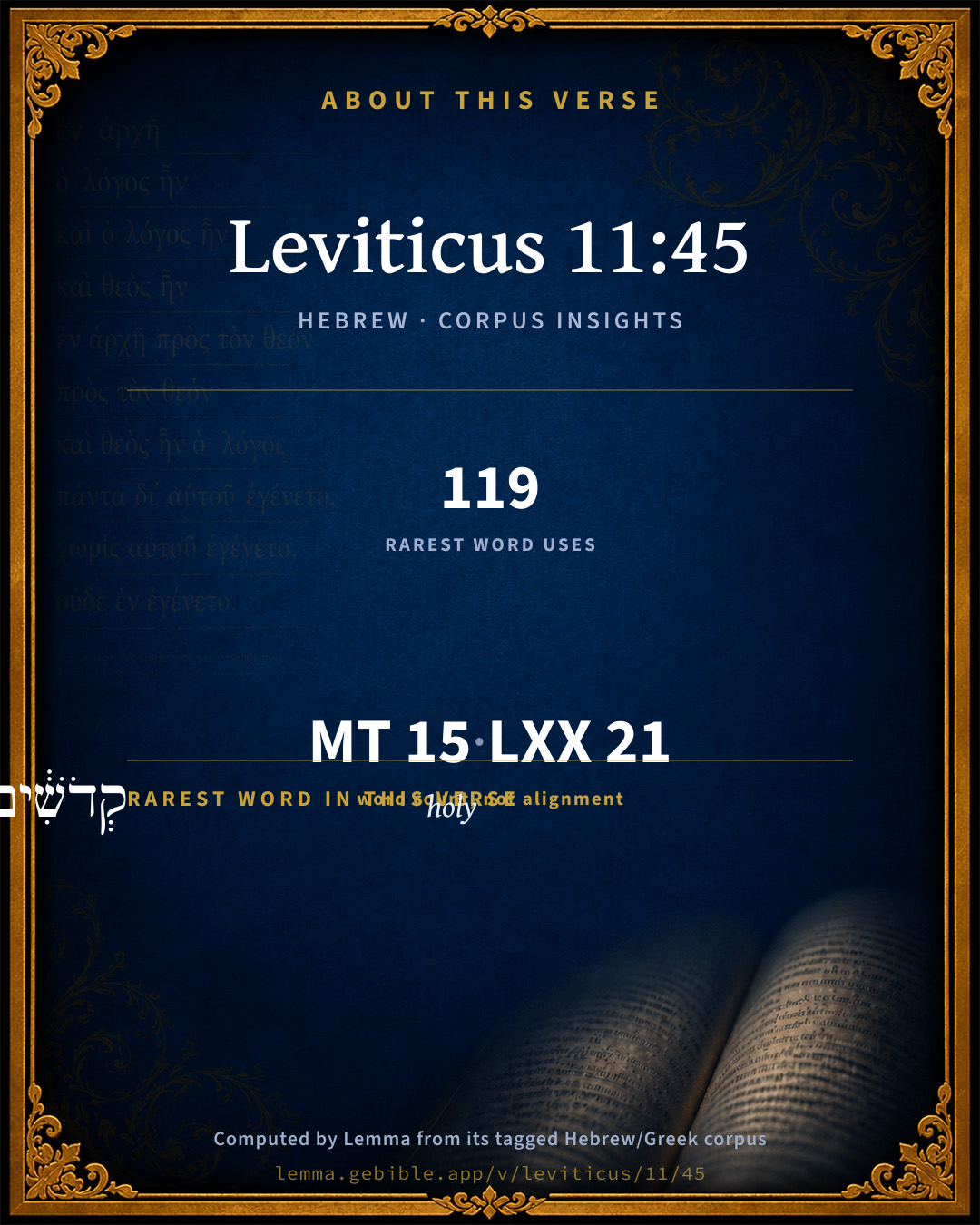
In English translation the verse runs 27 words from the Hebrew and 30 from the Septuagint (LXX English) — closely comparable.

A rough comparison of the two English renderings, which tokenize alike — not a word-level alignment.

Word counts can differ between the Hebrew and the Greek without any difference in meaning — e.g. the Hebrew direct-object marker אֵת has no separate Greek word, and Greek often adds the article ὁ.

In the original languages it is 15 Hebrew tokens and 21 Greek tokens — but the two are counted differently (Hebrew bundles its prefixes and suffixes into one token; the Greek is in lemma form), so that isn’t a like-for-like length.

Cross-references

8

Topical passages linked to Leviticus 11:45 in the Treasury of Scripture Knowledge — connected by theme and wording, ordered by reader-vote popularity; previews shown in the World English Bible.

  • Leviticus 11:44 For I am Yahweh your God. Sanctify yourselves therefore, and be holy; for I am holy: neither shall you defile yourselves with any kind of creeping thing that moves on the earth.
  • Exodus 20:2 "I am Yahweh your God, who brought you out of the land of Egypt, out of the house of bondage.
  • Exodus 6:7 and I will take you to me for a people, and I will be to you a God; and you shall know that I am Yahweh your God, who brings you out from under the burdens of the Egyptians.
  • 1 Peter 1:16 because it is written, "You shall be holy; for I am holy."
  • 1 Thessalonians 4:7 For God called us not for uncleanness, but in sanctification.
  • Psalms 105:43–45 He brought forth his people with joy, His chosen with singing.
  • Leviticus 25:38 I am Yahweh your God, who brought you forth out of the land of Egypt, to give you the land of Canaan, and to be your God.
  • Hosea 11:1 "When Israel was a child, then I loved him, And called my son out of Egypt.

Cross-references courtesy of OpenBible.info (CC BY 4.0).

Hebrew and Greek witnesses Masoretic Hebrew ↔ Greek Septuagint

The same verse in the two great witnesses to the Old Testament, shown verse-for-verse.

These are two independent witnesses, not word-aligned to each other, and the Septuagint is shown in lemma (dictionary) form.

Hebrew Leviticus 11:45 Masoretic · Westminster Leningrad Codex

כִּ֣י אֲנִ֣י יְהוָ֗ה הַֽמַּעֲלֶ֤ה אֶתְכֶם֙ מֵאֶ֣רֶץ מִצְרַ֔יִם לִהְיֹ֥ת לָכֶ֖ם לֵאלֹהִ֑ים וִהְיִיתֶ֣ם קְדֹשִׁ֔ים כִּ֥י קָד֖וֹשׁ אָֽנִי

For I am Yahweh who brought you up out of the land of Egypt, to be your God. You shall therefore be holy, for I am holy.

World English Bible · Public Domain

Greek LXX Leviticus 11:45 Septuagint · lemma form

ὅτι ἐγώ εἰμί κύριος ὁ ἀναἄγω σύ ἐκ γῆ αἴγυπτος εἰμί σύ θεός καί εἰμί ἅγιος ὅτι ἅγιος εἰμί ἐγώ κύριος

For I am the Lord who brought you up out of the land of Egypt to be your God; and you⌃ shall be holy, for I the Lord am holy.

LXX2012 (modern English Septuagint) · Public Domain

Hebrew: Westminster Leningrad Codex (CC BY 4.0). Greek: Septuagint (public domain); English from LXX2012 (modern English Septuagint) (Public Domain). How the Septuagint differs from the Hebrew →

Targum (Aramaic paraphrase)

2

The Targum is the ancient Jewish Aramaic paraphrase of the Hebrew Scriptures — an interpretive translation, not the Hebrew text itself. Onkelos (literal) and Pseudo-Jonathan (expansive) render the Torah, and Jonathan the Prophets. Coverage is partial: where no permissively-licensed English translation exists for a verse, only the Aramaic is shown. This is verse-level text, not a word-by-word alignment to the Hebrew.

  1. Targum Onkelos Torah (Genesis–Deuteronomy)
    אֲרֵי אֲנָא יְיָ דְאַסֵק יָתְכוֹן מֵאַרְעָא דְמִצְרַיִם לְמֶהֱוֵי לְכוֹן לֶאֱלָהּ וּתְהוֹן קַדִישִׁין אֲרֵי קַדִישׁ אֲנָא

    (no public-domain English translation for this verse)

    Targum Onkelos — Aramaic: “Onkelos Genesis” (public domain); “Onkelos Exodus” (public domain); “Onkelos Leviticus” (public domain); “Onkelos Numbers” (public domain); “Onkelos Deuteronomy” (public domain). English: “Sefaria Community Translation” (CC0 1.0 (public-domain dedication)); “J.W. Etheridge. The Targums of Onkelos and Jonathan Ben Uzziel on the Pentateuch. London: Longmans, Green, 1862” (public domain). Text via Sefaria.

  2. Targum Pseudo-Jonathan Torah (Genesis–Deuteronomy)
    אֲרוּם אֲנָא הוּא יְיָ דְאַסֵיקִית יַתְכוֹן פְּרִיקִין מִן אַרְעָא דְמִצְרַיִם מְטוּל לְמֶהֱוֵי לְכוֹן לֵאלָהָא וְתֶהֱווּן קַדִישִׁין אֲרוּם קַדִישׁ אֲנָא

    for I am the Lord who have brought you up free from the land of Mizraim, that I may be a God to you; and you may be holy, for I am Holy.

    Targum Pseudo-Jonathan — Aramaic: “Targum Jonathan on Genesis” (public domain); “Targum Jonathan on Exodus” (public domain); “Targum Jonathan on Leviticus” (public domain); “Targum Jonathan on Numbers” (public domain); “Targum Jonathan on Deuteronomy” (public domain). English: “The Targum of Jonathan ben Uzziel, trans. J. W. Etheridge, London, 1862” (public domain). Text via Sefaria.

Commentary

Notes on Leviticus 11:45 from classic Christian and Jewish commentators (each source and its license shown beneath its notes). The classic Christian expositions comment on the surrounding passage and are grouped to its opening verse, so a note may address several verses; the Jewish commentaries on the Tanakh (Rashi and others) are per-verse, so they appear only where the commentator wrote on this verse.

Lemma curates 59 commentaries, every one of them public domain or Creative Commons licensed, each selected and text-cleaned for this edition rather than reprinted as found. About our sources →

Trapp's Complete Commentary

John Trapp

Lev 11:45 For I [am] the LORD that bringeth you up out of the land of Egypt, to be your God: ye shall therefore be holy, for I [am] holy.

Ver. 45. That bringeth you up.] This is often inculcated. God’s blessings are binders; and every new deliverance calls for new obedience.

John Trapp, A Commentary or Exposition upon All the Books of the Old and New Testament (1647–1656) — public domain. Text from a community e-Sword module.

Joseph Benson's Commentary

Lev 11:45. That bringeth you up out of Egypt — This was a reason why they should cheerfully submit to distinguishing laws, who had been so honoured with distinguishing favours.

Joseph Benson's Commentary on the Old and New Testaments (1811–1818) — public domain. Text from a community e-Sword module.

Tyndale Open Study Notes

Tyndale Open Resources

11:45 brought you up from the land of Egypt: This or a similar phrase is found often throughout the Pentateuch (see 19:36; 22:33; 25:38; 26:13; Exod 13:9; 20:2; Num 15:41; Deut 4:37). Each time, it reminds the Israelites, God’s covenant people, of God’s great act in liberating them from Egypt. The Exodus event is frequently commemorated elsewhere in the Old Testament (Pss 80:8; 106:21; Isa 11:16; Jer 34:13; Hos 12:9; 13:4; Amos 2:10).

Tyndale Open Study Notes — © Tyndale Open Resources, licensed CC BY-SA 4.0. Text via the HelloAO Bible API.

Ellicott's Commentary for English Readers

(45) That bringeth you up out of the land of Egypt.—Having in a marvellous way delivered them from the land of bondage to be their God in a peculiar sense (comp. 2Sa_7:23), the Holy One of Israel had a special claim upon His redeemed people that they should obey His laws and keep themselves holy as their Redeemer. This signal act of redemption is repeatedly appealed to in the Scriptures, both to show the obligations which the Israelites are under to obey God’s commandments and to expose their ingratitude (Deu_8:14; Deu_13:6; Deu_20:1; Jos_24:17; Jdg_2:12, &c.).

A Bible Commentary for English Readers, edited by Charles John Ellicott (1878–1897) — public domain. Text from a community e-Sword module.

The Cambridge Bible for Schools and Colleges

gen. ed. J. J. S. Perowne

45. The reason for these prescriptions is given; it is the same as in H.

The Cambridge Bible for Schools and Colleges (gen. ed. J. J. S. Perowne; Cambridge University Press, 1878–1918) — public domain. Text from a community e-Sword module.

John Gill's Exposition

For I am the Lord that bringeth you up out of the land of Egypt,.... He had brought them out of it, and was now bringing them on in the wilderness towards Canaan's land, in order to settle them there; and this is observed, to show what obligations they lay under to him to observe his commands; for since he had done such great things for them, it became them to be obedient to him in all things: and the more, since his end herein was, as he observes to them,

to be your God; to make it appear that he was their God, and they were his special people, whom he had chosen for himself above all people upon the earth; that he was their King and their God, to protect and defend them, to provide for them, and take care of them, and bestow all good things on them proper for them:

ye shall therefore be holy, for I am holy; separate from all others as he was, living holy lives and conversations, agreeably to his will made known to them, in imitation or him who had chosen and called them to be his people; for, since holiness is his nature, it becomes them who are his house and family, his subjects and people.

John Gill's Exposition of the Whole Bible (1746–1763) — public domain (CC PDM 1.0). Text via the HelloAO Bible API.

Haydock's Catholic Bible Commentary

Your God. By these laws, the Jews were to be distinguished from other nations. (Haydock) --- They were also to be reminded, that God was very jealous of their interior sanctity, since he required so great a legal purity. Without the former, they might easily conclude that the latter would not please him. (Calmet)

George Leo Haydock (1774–1849), Haydock's Catholic Family Bible and Commentary, 1859 edition — public domain. Excludes Psalms (Douay-Rheims chapter numbering differs from Protestant) and Deuterocanonical books (Catholic canon only).

Whedon's Commentary on the Bible

Daniel D. Whedon

45. I am the Lord that bringeth you up out of… Egypt — Providential kindness in emancipation from the yoke of Egypt presents an additional motive to holiness. So does deliverance from the bondage of sin constitute a reason why every justified soul should be cleansed from the pollution of sin, and become perfectly holy in heart and in life.

Daniel D. Whedon (gen. ed.), Commentary on the Old and New Testaments (1874–1909) — public domain. Text from a community e-Sword module.

The Pulpit Commentary

High reasons for holiness.

The height of human character depends on the nature of the motives by which men allow themselves to be governed. It is certain

(1) that we are all actuated by a great variety of motives;

(2) that we are affected by many considerations in our choice of the better path;

(3) that of the right motives which actuate us some are much higher than others;

(4) that while it is well to be moved by every honourable impulse, we should seek to be mainly moved by the highest and best of all.

Here we have three of the highest possible motives for the best possible estate, three high reasons for holiness.

I GOD, IN HIS SOVEREIGNTY, COMMANDS IT, AND IT IS OUR HIGHEST DUTY TO OBEY HIM. "I am... your God: ye shall. Duty is one of the highest of all considerations, if not positively the very highest. Our duty to obey God when he says "ye shall" is clearly the highest of all duties.

II GOD HIMSELF IS THE HOLY ONE, AND IT IS OUR HIGHEST HONOUR TO BE LIKE HIM. "Ye shall be holy; for I am holy." He is the "Holy One of Israel," the "holy, holy, holy Lord God of hosts." "He is light, and in him is no darkness at all." There is no conceivable ambition man can cherish that is so high as the aspiration to be like God, the righteous Father of souls. (see Mat_5:48)

III GOD, OUR REDEEMER, DESIRES IT, AND IT IS OUR HIGHEST SATISFACTION TO PLEASE HIM. "I am the Lord that bringeth you up out of the land of Egypt." If there were anything we desired to withhold from him who is "our God," the God from whom we came, to whom we belong, and before whom we stand, still there can be nothing we will keep back from him who is our Redeemer, who has "brought us out of the land of Egypt, out of the house of bondage." "To Jesus, our Atoning Priest," we bring

(1) our promptest and devoutest attention,

(2) our unquestioning faith,

(3) our most cheerful obedience. We run to keep his commandments. C.

HOMILIES BY S.R. ALDRIDGE Ver. 45. Holiness and its requirements.

When a man has purified himself and taken upon himself vows of devotedness to God, then is he prepared to be the recipient of Divine communications. After Aaron"s consecration, he is instructed both separately, and conjointly with Moses. (Lev_10:8 Lev_11:1) The legislator and the priest act in harmony under a theocracy; the laws of God are the statutes of the nation.

I THE SANCTIFICATION REQUIRED OF THE PEOPLE OF GOD.

1. It is a necessary consequence of his character and of the relationship they sustain to him. What the Master loves, the servant must love; what the King is, that his subjects become. Sanctity is the glory of God. To be untarnished, free from taint, this is his prerogative and separates him from all idol gods. Holiness is not so much one special attribute as the all-embracing purity, the bright cloud that invests his excellences with spotless splendour. Evil flies from his presence. Unless, therefore, his people manifest this separation from impurity, how can be take delight in them and bless them? Unless they reflect something of his image, how can he acknowledge them as his children? He says, "Be ye holy; for I am holy.

2. The intention of God has been signified in delivering his people from bondage, He declares himself Jehovah, the bringer-up of the Israelites from the land of Egypt, in order to be to them for a God (Elohim). This same design is expressed in Lev_20:26, "I the Lord am holy, and have severed you from other people, that ye should be mine." To what purpose was the yoke of idolatrous sinful Egypt broken, if Israel remained impure and unholy? The intent of Jehovah would be frustrated. A similar line of argument is pursued in 1Pe_1:15-19, where the precept of the text is enforced by reference to the cost of redemption not corruptible things, but the precious blood of Christ being the price of our ransom. We make the grace of God and the gift of his Son of none effect if we continue in the former sins.

3. This same deliverance is appealed to as a claim upon his people"s gratitude and obedience. The very kindness of Jehovah in emancipating the nation and guiding them through the wilderness constituted a valid reason for abstaining from all that God forbade Unworthy are they of being the recipients of mercy who do not feel themselves bound thereby to please this merciful Lord. Shall not the love of Christ constrain us to live unto him, acknowledging that we are henceforth not our own? Conduct actuated by such motives is not servitude. It accords with the dictates of reason, conscience, and emotion. Compared with the bondage from which Christ releases us his yoke is easy, and his burden light indeed.

II WHAT THIS SANCTIFICATION INVOLVES.

1. Adherence to distinctions unknown to the world in general. Some animals were to be regarded as totally unfit for food, others unclean under certain conditions. It was not the business of these teachers to make the distinctions, but to explain and enforce them. The popular classification was adopted it would be the only one intelligible. Even in trivial waiters God"s people are to be distinguished from the heathen. These distinctions were not simply arbitrary; they depended on considerations sanitary, ethical, and instinctive. Thankful for the relief the gospel affords us from the burdensome ceremonies of the Law, knowing that "every creature of God is good," we have yet to do all, whether we eat or drink, to the glory of God. His gifts are to be received with thanksgiving, sanctified by the Word of God and prayer. We are not "subject to ordinances that perish with the using," yet are we to set our affection on things above, and to mortify our members which are upon the earth; observances which the majority of mankind practice not. The line of division between things pure and defiling is plainly marked if we apply our eyes to survey it. Others may call us bigoted, narrow-minded, straight-laced, but we prefer the commendation of our Master to the good-will of men.

2. Possible loss of property. How vexatious to an Israelite to be obliged to destroy a vessel because it was polluted (verse 33), or a cooking-range (verse 35), or some moistened seed (verse 38)! Many like a religion that costs them nothing, that is not particular about trifles. Yet real is that man"s religion who refuses to employ ill-gotten gain or dishonest measures, and who would renounce connection with a firm rather than be a party to unjust proceedings. Pity that so much evil should be condoned and defiling association suffered for sake of the profit it brings! If thy hand or thy foot cause thee to stumble, cast it off.

3. Continual care and trouble. To touch a dead animal necessitated ablution of the clothes, and the vessel which should be accidentally made "unclean" must be thoroughly washed, and both man and utensil remained ceremonially unclean till the evening. At any moment an Israelite might be compelled to repair the inroads of pollution, and constant caution was requisite to abstain from needlessly incurring stain. The sanctity God desires is a life-long work, and lovers of case had better not undertake it. To be like him who was "holy, undefiled, separate from sinners," is to take up the cross and deny one"s self. "Watch and pray unceasingly" must be our motto. Thanks be to him who hath opened a "fountain for sin and uncleanness," wherein at all seasons we may bathe and come forth white as snow! Thus shall we show forth the praises of him who hath called us. Let us learn to welcome the opportunity of testifying our love to him who gave himself for us. S.R.A.

The Pulpit Commentary (1880–1919), ed. H.D.M. Spence-Jones & Joseph S. Exell — public domain. Text from a community e-Sword module.

John Wesley's Explanatory Notes

That bringeth you up out of Egypt - This was a reason why they should cheerfully submit to distinguishing laws, who had been so honoured with distinguishing favours.

John Wesley, Explanatory Notes Upon the Whole Bible (1754–1765) — public domain. Text via the GEBible commentary corpus.

Rashi

Rabbi Shlomo Yitzchaki (Rashi)

כי אני ה׳ המעלה אתכם FOR I AM THE LORD THAT BRINGETH YOU UP [OUT OF THE LAND OF EGYPT] — On condition that you should accept My commandments did I bring you up (Sifra, Shemini, Chapter 12 4). Another explanation of: FOR I AM THE LORD THAT BRINGETH YOU UP — In all other places it is written, “I brought (you) forth”, and here it is written “that bringeth (you) up” — in reference to this it was taught in the school of R. Ishmael: If I had brought up Israel from Egypt only to effect this one thing — that they do not defile themselves by reptiles as do the other peoples, that should be sufficient for them (Bava Metzia 61b), and it should be regarded by them as an elevation for themselves — this is what is implied in the expression used here: מעלה (I raised you above the people of the land of Egypt).

Rashi on the Tanakh — English translations: “The Judaica Press complete Tanach with Rashi, translated by A. J. Rosenberg” (CC BY 4.0); “Pentateuch with Rashi's commentary by M. Rosenbaum and A.M. Silbermann, 1929-1934” (public domain); “The Metsudah Tanach series, Lakewood, N.J” (CC BY 4.0); and “The Book of Joshua, Metsudah Publications, 1997” (CC BY 4.0). Text via Sefaria.

Ibn Ezra

Rabbi Abraham ibn Ezra

For I am Adonoy. I only brought you out of Egypt to be your God, and if you will not be holy I will not be your God, therefore, if you want that I should be your God you must be holy.

Ibn Ezra on the Tanakh — English translations: “Sefaria Community Translation” (CC0 1.0 (public-domain dedication)); “Yalkut, Sifsei Chachomim Chumash, Metsudah Publications, 2009” (CC BY 4.0); and “Commentary of Ibn Ezra on Isaiah - trans. by M. Friedlander, 1873” (public domain). Text via Sefaria.

Lesson kit

Teaching starters — assembled from the data on this page, not authored interpretation. Every prompt links to the verse data it draws on. Edit before teaching.

Leviticus, in the Pentateuch, opens this verse with 15 words (10 distinct Hebrew lemmas). Its most distinctive word is qâdôwsh (“holy”). A historical commentator’s framing appears above. Read the whole chapter for the surrounding context.

Discussion questions

  1. What does “holy” (qâdôwsh) contribute to the verse as a whole?
  2. How does Leviticus 11:44, which shares this passage’s theme, read alongside this verse?
  3. What does the repetition of “to be” (2× in this one verse) do in this verse?
  4. These translations render this verse differently; the difference is in the English rendering, not the original. What questions does that raise?
  5. «הַֽמַּעֲלֶ֤ה» is a Hiphil Participle Active verb. How does that grammatical form shape the action described?
  6. Compare how Trapp's Complete Commentary and Joseph Benson's Commentary read this verse. Where do they agree or differ?

Things to notice

Reading settings

Reading text

Shown beneath each verse's original-language words.

Old Testament
Old Testament edition

Read the OT as the Masoretic Hebrew (MT) or the Greek Septuagint (LXX).

English shown for the Greek Septuagint (in the Hebrew ↔ Greek comparison).

Comparing translations? Open the Compare panel on any verse page to stack up to four side by side.