Genesis 41:5

Hebrew (Westminster Leningrad Codex) Genesis 41:5 appears in the Hebrew Old Testament. The text above is from the Westminster Leningrad Codex. Each word links to its Strong’s number, a concise gloss, and parsing drawn from the Open Scriptures Hebrew Bible morphology. Click any word for its full Brown-Driver-Briggs (BDB) entry.
Download image
Cite this verse

Genesis 41:5 (World English Bible). Public Domain. Lemma interlinear Bible study tool, https://lemma.gebible.app/v/genesis/41/5.

Show BibTeX & RIS
BibTeX
RIS
English Translation
He slept and dreamed a second time: and, behold, seven heads of grain came up on one stalk, healthy and good.
World English Bible · Public Domain
Highlights
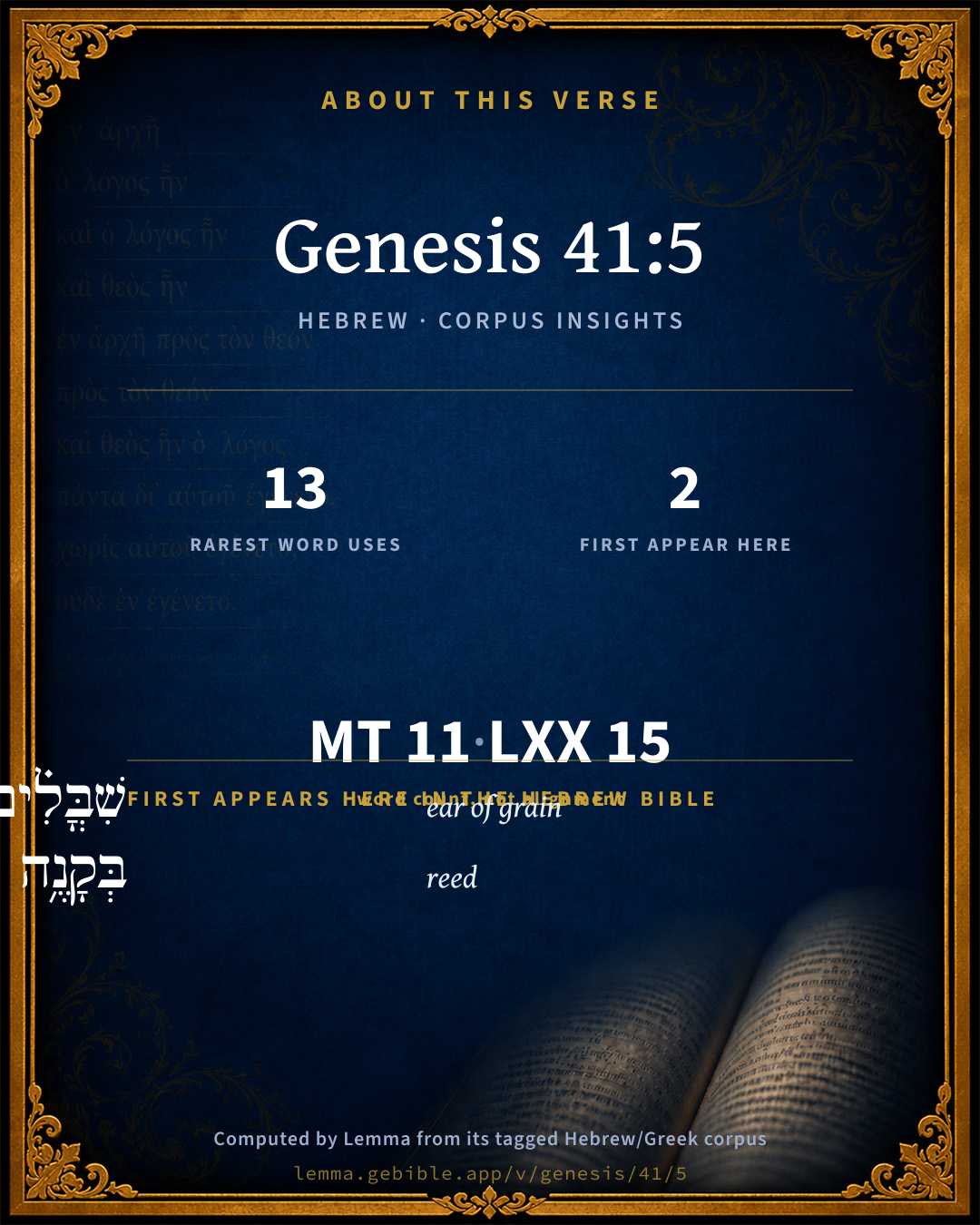
  • 2 first appearances in the Hebrew Bible
Full analysis ↓
Download a study sheet

One document with this verse’s original text, its word-by-word gloss line, the meaning frame, cross-references with their text, attributed commentary, and full source and license credits — printable, and it pastes into notes with its structure intact.

This verse Autodidact and up

Study sheet (.html) Plain text (.txt)

A passage Seminary Student

Up to 50 verses in one chapter. A passage sheet keeps up to 6 commentary sources and 12 cross-references per verse, in the order this page ranks them, and says so on the sheet whenever that leaves anything out. Ask for a single verse and you get the Autodidact verse sheet above.

Everything on this page stays free to read, with no account — the sheet is a download of what is already on screen, not access to it.

Want to remove ads? Support Godless Engineer
Compare translations 3

The same verse in 3 English versions, stacked beneath the original-language interlinear above. Click any original word for its lexicon entry.

Each is an independent rendering of the whole verse — the interlinear is not word-aligned to these translations.

Highlighted words mark where these versions differ — a whole-verse word diff, not a word-by-word alignment.

  • World English Bible Public Domain
    He slept and dreamed a second time: and, behold, seven heads of grain came up on one stalk, healthy and good.
  • King James Version Public Domain
    And he slept and dreamed the second time: and, behold, seven ears of corn came up upon one stalk, rank and good.
  • unfoldingWord Literal Text CC BY-SA 4.0
    Then he fell asleep and dreamed a second. And behold, seven heads of grain came up on one stalk, fat and good.

unfoldingWord Literal Text — © unfoldingWord, licensed CC BY-SA 4.0. Word-aligned USFM3 via Door43 (git.door43.org/unfoldingWord/en_ult).

Versions to compare (up to 4)

3 of 4 selected

Show all 17 translations

Every available English version of this verse, each an independent rendering of the whole verse.

  • World English Bible Public Domain
    He slept and dreamed a second time: and, behold, seven heads of grain came up on one stalk, healthy and good.
  • Berean Standard Bible Public Domain
    but he fell back asleep and dreamed a second time: Seven heads of grain, plump and ripe, came up on one stalk.
  • Majority Standard Bible Public Domain
    but he fell back asleep and dreamed a second time: Seven heads of grain, plump and ripe, came up on one stalk.
  • King James Version Public Domain
    And he slept and dreamed the second time: and, behold, seven ears of corn came up upon one stalk, rank and good.
  • American Standard Version (1901) Public Domain
    And he slept and dreamed a second time: and, behold, seven ears of grain came up upon one stalk, rank and good.
  • Revised Version (1885) Public Domain
    And he slept and dreamed a second time: and, behold, seven ears of corn came up upon one stalk, rank and good.
  • Geneva Bible (1599) Public Domain
    Againe he slept, and dreamed the second time: and beholde, seuen eares of corne grewe vpon one stalke, ranke and goodly.
  • Young's Literal Translation Public Domain
    And he sleepeth, and dreameth a second time, and lo, seven ears are coming up on one stalk, fat and good,
  • Literal Standard Version CC BY-SA 4.0
    And he sleeps, and dreams a second time, and behold, seven ears are coming up on one stalk, fat and good,
  • Unlocked Literal Bible CC BY-SA 4.0
    Then he slept and dreamed a second time. Behold, seven heads of grain came up on one stalk, wholesome and good.
  • unfoldingWord Literal Text CC BY-SA 4.0
    Then he fell asleep and dreamed a second. And behold, seven heads of grain came up on one stalk, fat and good.
  • Darby Bible Public Domain
    And he slept and dreamed the second time; and behold, seven ears of corn grew up on one stalk, fat and good.
  • World Messianic Bible Public Domain
    He slept and dreamed a second time; and behold, seven heads of grain came up on one stalk, healthy and good.
  • Webster's Bible Public Domain
    And he slept and dreamed the second time: and behold, seven ears of corn came up upon one stalk, rank and good.
  • Free Bible Version CC BY-SA 4.0
    Pharaoh fell asleep again and had a second dream. Seven heads of grain were growing on one stalk, ripe and healthy.
  • Bible in Basic English Public Domain
    But he went to sleep again and had a second dream, in which he saw seven heads of grain, full and good, all on one stem.
  • JPS Tanakh (1917) Public Domain
    And he slept and dreamed a second time: and, behold, seven ears of corn came up upon one stalk, rank and good.

Literal Standard Version (2020), Covenant Press — licensed CC BY-SA 4.0. Text via the HelloAO Bible API (eBible.org). Unlocked Literal Bible (unfoldingWord) — licensed CC BY-SA 4.0. Text via the HelloAO Bible API (eBible.org). unfoldingWord Literal Text — © unfoldingWord, licensed CC BY-SA 4.0. Word-aligned USFM3 via Door43 (git.door43.org/unfoldingWord/en_ult). Free Bible Version, Dr. Jonathan Gallagher — licensed CC BY-SA 4.0. Text via the HelloAO Bible API (eBible.org).

Word by word

More ways to search: Search by grammar → Find every occurrence → Compare this word →

Practice this passage: Drill this verse → Learn its vocabulary →

בְּרִיא֥וֹת
bârîyʼ
H1277
“fat”
Adjective, Adjective, Feminine, Plural, Absolute
Part of Speech
Adjective
Type
Adjective
Gender
Feminine
Number
Plural
State
Absolute
Full BDB Definition

Origin: from H1254 (in the sense of H1262 )

TWOT: 279a

fat - (TWOT) fat, fatter, fed, firm, plenteous, rank
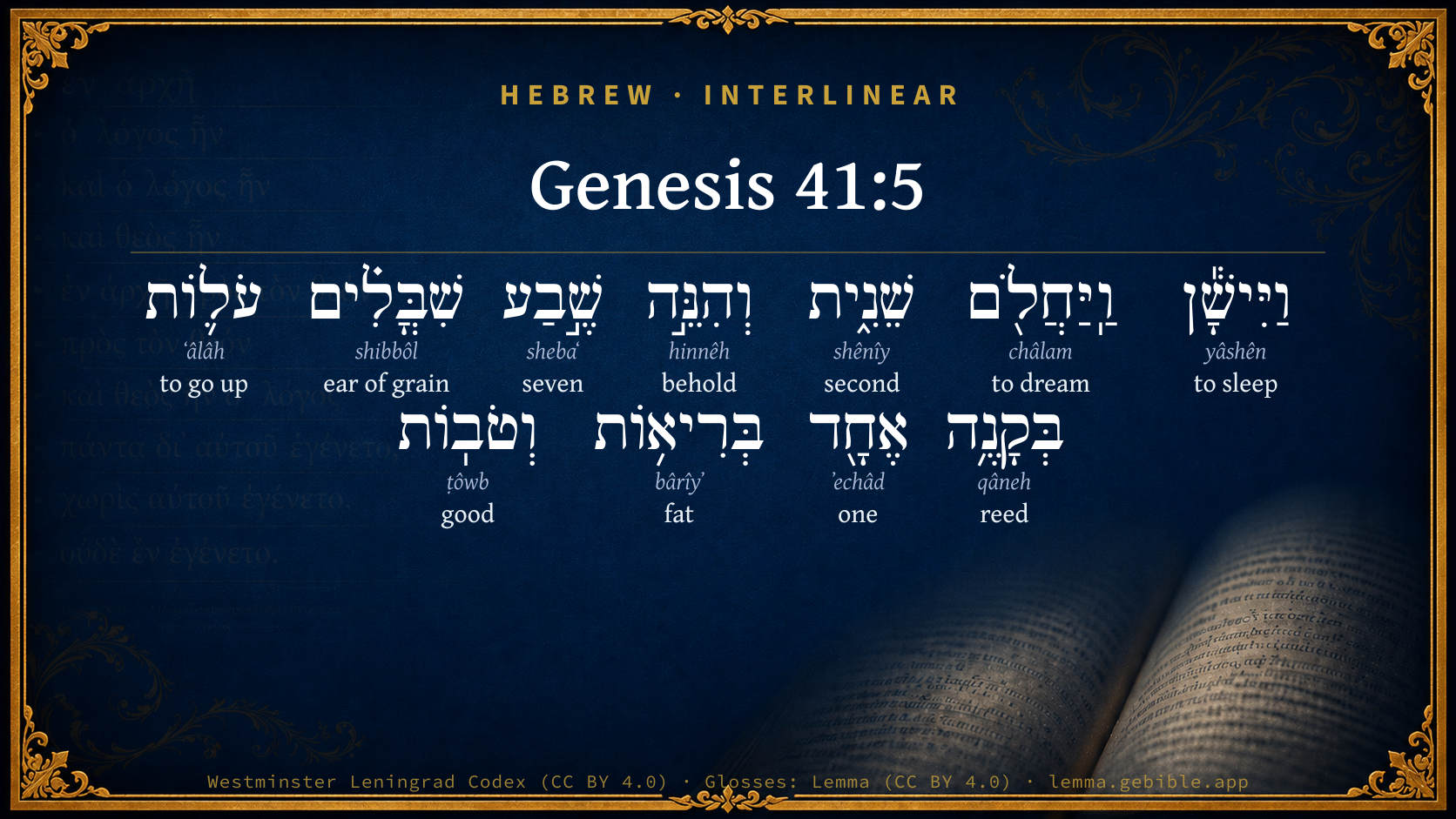
  1. וַיִּישָׁ֕ן yâshên H3462 “and · to sleep” Conjunction + Verb, Qal, Sequential Imperfect, 3rd Person, Masculine, Singular
  2. וַֽיַּחֲלֹ֖ם châlam H2492 “and · to dream” Conjunction + Verb, Qal, Sequential Imperfect, 3rd Person, Masculine, Singular
  3. שֵׁנִ֑ית shênîy H8145 “second” Adjective, Ordinal number, Feminine, Singular, Absolute
  4. וְהִנֵּ֣ה hinnêh H2009 “and · behold” Conjunction + Particle, Demonstrative
  5. שֶׁ֣בַע shebaʻ H7651 “seven” Adjective, Cardinal number, Feminine, Singular, Absolute
  6. שִׁבֳּלִ֗ים shibbôl H7641 “ears of grain” Noun, Common, Feminine, Plural, Absolute
  7. עֹל֛וֹת ʻâlâh H5927 “going up” Verb, Qal, Participle Active, Feminine, Plural, Absolute
  8. בְּקָנֶ֥ה qâneh H7070 “in/at · reed” Preposition + Noun, Common, Masculine, Singular, Absolute
  9. אֶחָ֖ד ʼechâd H259 “one” Adjective, Cardinal number, Masculine, Singular, Absolute
  10. וְטֹבֽוֹת ṭôwb H2896 “and · good” Conjunction + Adjective, Adjective, Feminine, Plural, Absolute

About this verse

These counts appear in no published source. They are computed here, from the morphology-tagged text and Lemma’s own curated glosses. What Lemma adds →

11
words
11
distinct lemmas
Pentateuch
section

Notable vocabulary

The rarest word here is בְּרִיא֥וֹת fat H1277 — appearing just 13 times in the whole Hebrew Bible.

First appearance in Scripture

These words make their first canonical appearance in the Hebrew Bible here:

  • שִׁבֳּלִ֗ים ear of grain H7641
  • בְּקָנֶ֥ה reed H7070

Shared distinctive vocabulary

בְּרִיא֥וֹת fat H1277 occurs in 13 verses of the Hebrew Bible. Also found in:

Grammatical profile

  • 3 verbs
  • 2 nouns
  • 5 adjectives
  • 1 particle

Verb forms

  • וַיִּישָׁ֕ן Qal · Sequential Imperfect
  • וַֽיַּחֲלֹ֖ם Qal · Sequential Imperfect
  • עֹל֛וֹת Qal · Participle Active

Hebrew & Septuagint length

In English translation the verse runs 21 words from the Hebrew and 16 from the Septuagint (LXX English) — closely comparable.

A rough comparison of the two English renderings, which tokenize alike — not a word-level alignment.

Word counts can differ between the Hebrew and the Greek without any difference in meaning — e.g. the Hebrew direct-object marker אֵת has no separate Greek word, and Greek often adds the article ὁ.

In the original languages it is 11 Hebrew tokens and 15 Greek tokens — but the two are counted differently (Hebrew bundles its prefixes and suffixes into one token; the Greek is in lemma form), so that isn’t a like-for-like length.

Cross-references

1

Topical passages linked to Genesis 41:5 in the Treasury of Scripture Knowledge — connected by theme and wording, ordered by reader-vote popularity; previews shown in the World English Bible.

  • Deuteronomy 32:14 Butter of the herd, and milk of the flock, With fat of lambs, Rams of the breed of Bashan, and goats, With the finest of the wheat; Of the blood of the grape you drank wine.

Cross-references courtesy of OpenBible.info (CC BY 4.0).

Hebrew and Greek witnesses Masoretic Hebrew ↔ Greek Septuagint

The same verse in the two great witnesses to the Old Testament, shown verse-for-verse.

These are two independent witnesses, not word-aligned to each other, and the Septuagint is shown in lemma (dictionary) form.

Hebrew Genesis 41:5 Masoretic · Westminster Leningrad Codex

וַיִּישָׁ֕ן וַֽיַּחֲלֹ֖ם שֵׁנִ֑ית וְהִנֵּ֣ה שֶׁ֣בַע שִׁבֳּלִ֗ים עֹל֛וֹת בְּקָנֶ֥ה אֶחָ֖ד בְּרִיא֥וֹת וְטֹבֽוֹת

He slept and dreamed a second time: and, behold, seven heads of grain came up on one stalk, healthy and good.

World English Bible · Public Domain

Greek LXX Genesis 41:5 Septuagint · lemma form

καί ἐνὑπνιάζω ὁ δεύτερος καί ἰδού ἑπτά στάχυς ἀναβαίνω ἐν πυθμήν εἷς ἐκλεκτός καί καλός

And he dreamed again. And, behold, seven ears came up on one stalk, choice and good.

LXX2012 (modern English Septuagint) · Public Domain

Hebrew: Westminster Leningrad Codex (CC BY 4.0). Greek: Septuagint (public domain); English from LXX2012 (modern English Septuagint) (Public Domain). How the Septuagint differs from the Hebrew →

Targum (Aramaic paraphrase)

2

The Targum is the ancient Jewish Aramaic paraphrase of the Hebrew Scriptures — an interpretive translation, not the Hebrew text itself. Onkelos (literal) and Pseudo-Jonathan (expansive) render the Torah, and Jonathan the Prophets. Coverage is partial: where no permissively-licensed English translation exists for a verse, only the Aramaic is shown. This is verse-level text, not a word-by-word alignment to the Hebrew.

  1. Targum Onkelos Torah (Genesis–Deuteronomy)
    וּדְמוּךְ וַחֲלַם תִּנְיָנוּת וְהָא שְׁבַע שֻׁבְּלַיָּא סָלְקָן בְּקַנְיָא חַד פַּטִּימָן וְטָבָן

    (no public-domain English translation for this verse)

    Targum Onkelos — Aramaic: “Onkelos Genesis” (public domain); “Onkelos Exodus” (public domain); “Onkelos Leviticus” (public domain); “Onkelos Numbers” (public domain); “Onkelos Deuteronomy” (public domain). English: “Sefaria Community Translation” (CC0 1.0 (public-domain dedication)); “J.W. Etheridge. The Targums of Onkelos and Jonathan Ben Uzziel on the Pentateuch. London: Longmans, Green, 1862” (public domain). Text via Sefaria.

  2. Targum Pseudo-Jonathan Torah (Genesis–Deuteronomy)
    וְדָמִיךְ וַחֲמָא חֶלְמָא תִּנְיָנוּת וְהָא שִׁבְעָה תּוּבְלֵי סַלְקָן בְּקַנְיָא חָד פַּטִימָן וְטָבָן

    And he slept, and saw a second dream; and, behold, seven ears arose on one stalk, full and good;

    Targum Pseudo-Jonathan — Aramaic: “Targum Jonathan on Genesis” (public domain); “Targum Jonathan on Exodus” (public domain); “Targum Jonathan on Leviticus” (public domain); “Targum Jonathan on Numbers” (public domain); “Targum Jonathan on Deuteronomy” (public domain). English: “The Targum of Jonathan ben Uzziel, trans. J. W. Etheridge, London, 1862” (public domain). Text via Sefaria.

Commentary

Notes on Genesis 41:5 from classic Christian and Jewish commentators (each source and its license shown beneath its notes). The classic Christian expositions comment on the surrounding passage and are grouped to its opening verse, so a note may address several verses; the Jewish commentaries on the Tanakh (Rashi and others) are per-verse, so they appear only where the commentator wrote on this verse.

Lemma curates 59 commentaries, every one of them public domain or Creative Commons licensed, each selected and text-cleaned for this edition rather than reprinted as found. About our sources →

Trapp's Complete Commentary

John Trapp

Gen 41:5 And he slept and dreamed the second time: and, behold, seven ears of corn came up upon one stalk, rank and good.

Ver. 5. And dreamed the second time.] Divine dreams use to be repeated, and to take deep impression, as this did. {Gen 41:8} "Pharaoh’s spirit was troubled"; Heb., behammered.

John Trapp, A Commentary or Exposition upon All the Books of the Old and New Testament (1647–1656) — public domain. Text from a community e-Sword module.

Joseph Benson's Commentary

Gen 41:5. Seven ears of corn on one stalk — These also were fit emblems of the thing intended, especially as the fertility of that country did chiefly consist in its producing abundance of corn.

Joseph Benson's Commentary on the Old and New Testaments (1811–1818) — public domain. Text from a community e-Sword module.

Tyndale Open Study Notes

Tyndale Open Resources

41:5-7 Pharaoh’s second dream carried a similar message. Seven plump . . . heads of grain on a single stalk were swallowed up by seven shriveled and withered heads that sprouted after them.

Tyndale Open Study Notes — © Tyndale Open Resources, licensed CC BY-SA 4.0. Text via the HelloAO Bible API.

Geneva Bible (1599)

Geneva Bible translators

All these means God used to deliver his servant, and to bring him into favor and authority.

Geneva Bible (1599) marginal notes — public domain. Text via Bolls.life.

Ellicott's Commentary for English Readers

(5) Seven ears . . . upon one stalk.—The wheat cultivated in Egypt is called triticum compositum, because it produces several ears upon the same stalk. The statement of Herodotus (ii. 36), that the Egyptians regarded it as disgraceful to feed upon wheat or barley, is disproved by the paintings in the temples, especially in the district of Thebes, which show that it was the main crop there, and its cultivation held in high honour. Maspero, Hist. Ancienne, p. 9, says, “In spite of Herodotus, the usual food of the people was wheat and other cereals, which the soil of Egypt produces in abundance.”

A Bible Commentary for English Readers, edited by Charles John Ellicott (1878–1897) — public domain. Text from a community e-Sword module.

The Cambridge Bible for Schools and Colleges

gen. ed. J. J. S. Perowne

5. a second time] Here, as in Gen_37:9 and Gen_40:16, the duplication of the dream seems to place its significance beyond dispute. The resemblance of the dreams is found in (1) the number “seven”; (2) in the good products being consumed by the bad. The first dream was concerned with the sacred animal of Egypt; the second with Egypt’s chief source of wealth.

rank] Heb. fat, i.e. rich and good.

The Cambridge Bible for Schools and Colleges (gen. ed. J. J. S. Perowne; Cambridge University Press, 1878–1918) — public domain. Text from a community e-Sword module.

John Gill's Exposition

And he slept, and dreamed the second time,.... He fell asleep again quickly, and dreamed another dream the same night, and to the same purpose, being much of the like kind with the former:

and, behold, seven ears of corn came up upon one stalk, rank and good; which were very uncommon even in those fruitful countries; though Dr. Shaw (e) observes of Barbary, which vied with Egypt for fruitfulness, that it sometimes happens that one stalk of wheat will bear two ears, while each of these ears will as often shoot out into a number of lesser ones, thereby affording a most plentiful increase.

(e) Travels, p. 137. Ed. 2.

John Gill's Exposition of the Whole Bible (1746–1763) — public domain (CC PDM 1.0). Text via the HelloAO Bible API.

Haydock's Catholic Bible Commentary

Another dream of the same import, (ver. 25,) to convince Pharao that the event would certainly take place, ver. 32. Thus Daniel had a double vision, Daniel vii. 2, 3. --- One stalk. It was of the species which Pliny (Natural History xviii. 10,) calls ramosum, branchy. What would strike Pharao the most was, that the last ears should devour the former ones. (Calmet)

George Leo Haydock (1774–1849), Haydock's Catholic Family Bible and Commentary, 1859 edition — public domain. Excludes Psalms (Douay-Rheims chapter numbering differs from Protestant) and Deuterocanonical books (Catholic canon only).

Matthew Poole's English Annotations

Ears of corn are fit and proper resemblances of the thing here intended, both because the fertility of a land doth mainly consist in the abundance and goodness of these; and because ears of corn appearing to any in a dream, did, in the judgment of the Egyptian wise men, signify years, as Josephus notes.

Matthew Poole's English Annotations on the Holy Bible (1683–1685) — public domain. Text from a community e-Sword/MySword module.

The Pulpit Commentary

And he slept and dreamed the second time (that same night): and, behold, seven ears of corn came up upon one stalk, rank (i.e. fat) and good. This clearly pointed to the corn of the Nile valley, the triticum compositum, which Bears seven ears upon one stalk. The assertion of Herodotus, that the Egyptians counted it a disgrace to live on wheat and barley (2:36), Wilkinson regards as incorrect, since "both wheat and barley are noticed in Lower Egypt long before Herodotus" time, (Exo_9:31, Exo_9:32) and the paintings of the Thebaid prove that they were grown extensively in that part of the country; they were among the offerings in the temples; and the king, at his coronation, cutting some ears of wheat, afterwards offered to the gods as the staple production of Egypt, shows how great a value was set on a grain which Herodotus would lead us to suppose was held in abhorrence" (Rawlinson"s "Hexodotus," vol. 2. p. 49).

The Pulpit Commentary (1880–1919), ed. H.D.M. Spence-Jones & Joseph S. Exell — public domain. Text from a community e-Sword module.

Rashi

Rabbi Shlomo Yitzchaki (Rashi)

בקנה אחד ON ONE STALK— Tuyau in old French

בריאות sains, English HEALTHY.

Rashi on the Tanakh — English translations: “The Judaica Press complete Tanach with Rashi, translated by A. J. Rosenberg” (CC BY 4.0); “Pentateuch with Rashi's commentary by M. Rosenbaum and A.M. Silbermann, 1929-1934” (public domain); “The Metsudah Tanach series, Lakewood, N.J” (CC BY 4.0); and “The Book of Joshua, Metsudah Publications, 1997” (CC BY 4.0). Text via Sefaria.

Lesson kit

Teaching starters — assembled from the data on this page, not authored interpretation. Every prompt links to the verse data it draws on. Edit before teaching.

Genesis, in the Pentateuch, opens this verse with 11 words (11 distinct Hebrew lemmas). Its most distinctive word is bârîyʼ (“fat”). A historical commentator’s framing appears above. Read the whole chapter for the surrounding context.

Discussion questions

  1. What does “fat” (bârîyʼ) contribute to the verse as a whole?
  2. 2 words here appear for the first time in Scripture. What is being introduced at this debut?
  3. Genesis 41:2 shares the word «fat» with this verse. How do the two illuminate each other?
  4. The translations on this page render this verse differently — a whole-verse word diff, not a word-by-word alignment. What might account for the different wordings?
  5. The verb «וַיִּישָׁ֕ן» is Qal Sequential Imperfect. How does its form color the action?
  6. Reading how Trapp's Complete Commentary and Joseph Benson's Commentary read this verse, where do the two commentators agree and where do they part?

Things to notice

Reading settings

Reading text

Shown beneath each verse's original-language words.

Old Testament
Old Testament edition

Read the OT as the Masoretic Hebrew (MT) or the Greek Septuagint (LXX).

English shown for the Greek Septuagint (in the Hebrew ↔ Greek comparison).

Comparing translations? Open the Compare panel on any verse page to stack up to four side by side.