
Exodus 1:10

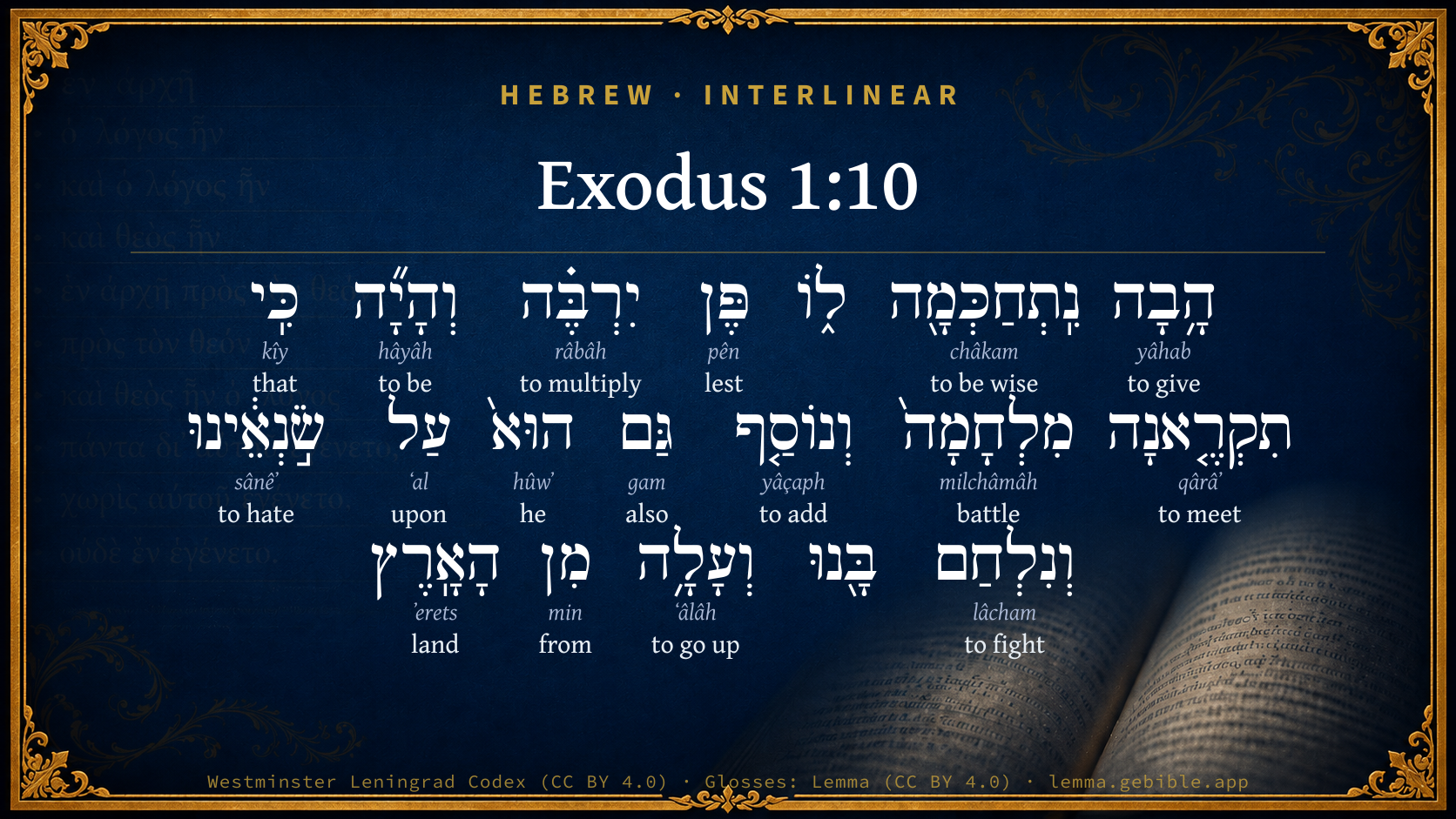
Hebrew (Westminster Leningrad Codex) Exodus 1:10 appears in the Hebrew Old Testament. The text above is from the Westminster Leningrad Codex. Each word links to its Strong’s number, a concise gloss, and parsing drawn from the Open Scriptures Hebrew Bible morphology. Click any word for its full Brown-Driver-Briggs (BDB) entry.
Download image
Cite this verse

Exodus 1:10 (World English Bible). Public Domain. Lemma interlinear Bible study tool, https://lemma.gebible.app/v/exodus/1/10.

Show BibTeX & RIS
BibTeX
RIS
English Translation
Come, let us deal wisely with them, lest they multiply, and it happen that when any war breaks out, they also join themselves to our enemies, and fight against us, and escape out of the land."
World English Bible · Public Domain
Highlights
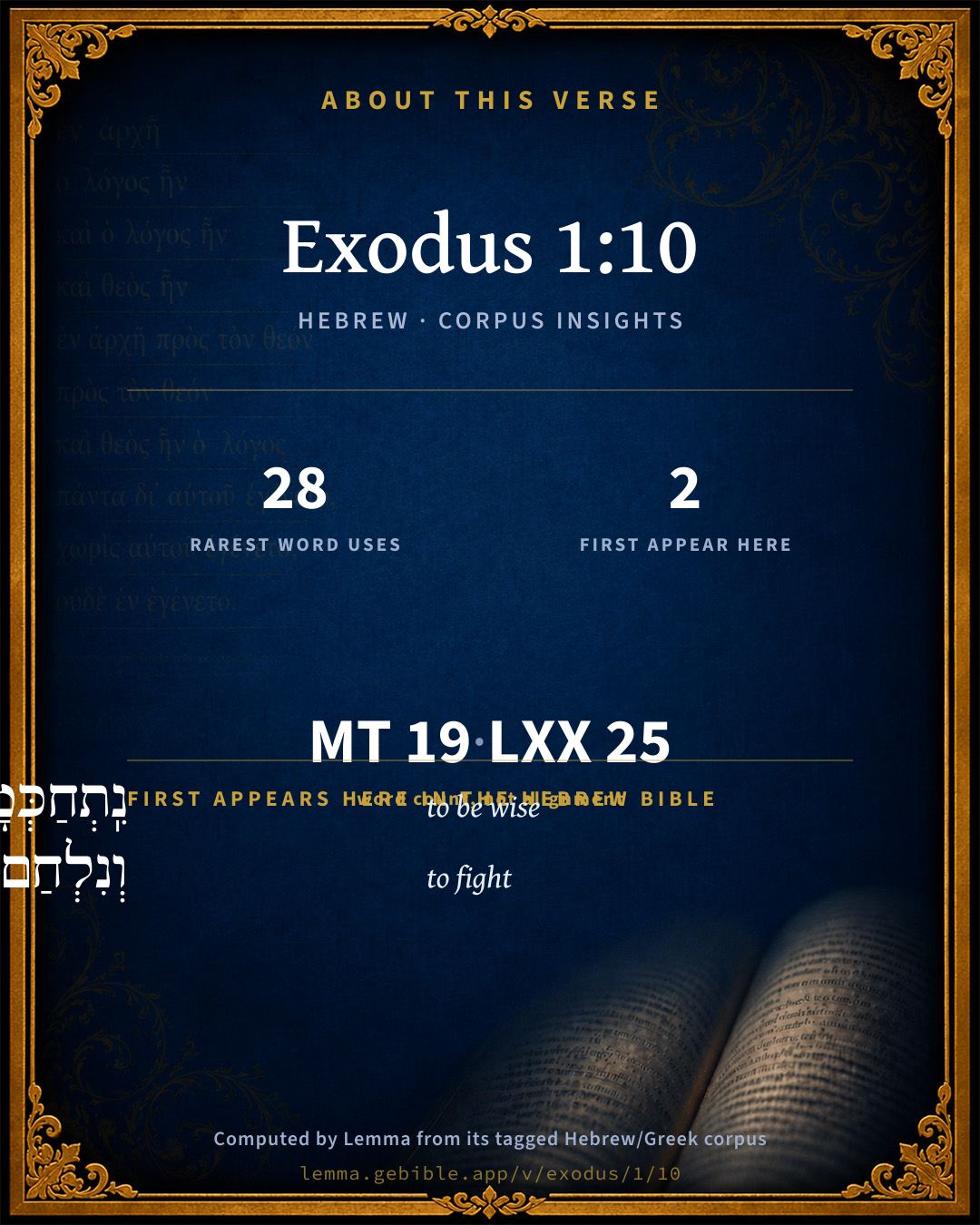
  • 2 first appearances in the Hebrew Bible
Full analysis ↓
Download a study sheet

One document with this verse’s original text, its word-by-word gloss line, the meaning frame, cross-references with their text, attributed commentary, and full source and license credits — printable, and it pastes into notes with its structure intact.

This verse Autodidact and up

Study sheet (.html) Plain text (.txt)

A passage Seminary Student

Up to 50 verses in one chapter. A passage sheet keeps up to 6 commentary sources and 12 cross-references per verse, in the order this page ranks them, and says so on the sheet whenever that leaves anything out. Ask for a single verse and you get the Autodidact verse sheet above.

Everything on this page stays free to read, with no account — the sheet is a download of what is already on screen, not access to it.

Want to remove ads? Support Godless Engineer
Compare translations 3

The same verse in 3 English versions, stacked beneath the original-language interlinear above. Click any original word for its lexicon entry.

Each is an independent rendering of the whole verse — the interlinear is not word-aligned to these translations.

Highlighted words mark where these versions differ — a whole-verse word diff, not a word-by-word alignment.

  • World English Bible Public Domain
    Come, let us deal wisely with them, lest they multiply, and it happen that when any war breaks out, they also join themselves to our enemies, and fight against us, and escape out of the land."
  • King James Version Public Domain
    Come on, let us deal wisely with them; lest they multiply, and it come to pass, that, when there falleth out any war, they join also unto our enemies, and fight against us, and so get them up out of the land.
  • unfoldingWord Literal Text CC BY-SA 4.0
    Come, let us act wisely toward him, lest he multiplies, and it happens that a battle occurs, and he even adds himself onto the ones hating us, and he fights with us, and he leaves from the land.”

unfoldingWord Literal Text — © unfoldingWord, licensed CC BY-SA 4.0. Word-aligned USFM3 via Door43 (git.door43.org/unfoldingWord/en_ult).

Versions to compare (up to 4)

3 of 4 selected

Show all 18 translations

Every available English version of this verse, each an independent rendering of the whole verse.

  • World English Bible Public Domain
    Come, let us deal wisely with them, lest they multiply, and it happen that when any war breaks out, they also join themselves to our enemies, and fight against us, and escape out of the land."
  • Berean Standard Bible Public Domain
    Come, let us deal shrewdly with them, or they will increase even more; and if a war breaks out, they may join our enemies, fight against us, and leave the country.”
  • Majority Standard Bible Public Domain
    Come, let us deal shrewdly with them, or they will increase even more; and if a war breaks out, they may join our enemies, fight against us, and leave the country.”
  • King James Version Public Domain
    Come on, let us deal wisely with them; lest they multiply, and it come to pass, that, when there falleth out any war, they join also unto our enemies, and fight against us, and so get them up out of the land.
  • American Standard Version (1901) Public Domain
    come, let us deal wisely with them, lest they multiply, and it come to pass, that, when there falleth out any war, they also join themselves unto our enemies, and fight against us, and get them up out of the land.
  • Revised Version (1885) Public Domain
    come, let us deal wisely with them; lest they multiply, and it come to pass, that, when there falleth out any war, they also join themselves unto our enemies, and fight against us, and get them up out of the land.
  • Geneva Bible (1599) Public Domain
    Come, let vs worke wisely with them, least they multiplie, and it come to passe, that if there be warre, they ioyne them selues also vnto our enemies, and fight against vs, and get them out of the land.
  • Douay-Rheims (1899) Public Domain
    Come, let us wisely oppress them, lest they multiply: and if any war shall rise against us, join with our enemies, and having overcome us, depart out of the land.
  • Young's Literal Translation Public Domain
    give help! let us act wisely concerning it, lest it multiply, and it hath come to pass, when war happeneth, that it hath been joined, even it, unto those hating us, and hath fought against us, and hath gone out up of the land.'
  • Literal Standard Version CC BY-SA 4.0
    Give help! Let us act wisely concerning it, lest it multiply, and it has come to pass, when war happens, that it has been joined, even it, to those hating us, and has fought against us, and has gone up out of the land.”
  • Unlocked Literal Bible CC BY-SA 4.0
    Come, let us deal with them wisely, otherwise they will continue to grow in numbers, and if war breaks out, they will join our enemies, fight against us, and leave the land.”
  • unfoldingWord Literal Text CC BY-SA 4.0
    Come, let us act wisely toward him, lest he multiplies, and it happens that a battle occurs, and he even adds himself onto the ones hating us, and he fights with us, and he leaves from the land.”
  • Darby Bible Public Domain
    Come on, let us deal wisely with them, lest they multiply, and it come to pass that, if war occur, they take side with our enemies and fight against us, and go up out of the land.
  • World Messianic Bible Public Domain
    Come, let’s deal wisely with them, lest they multiply, and it happen that when any war breaks out, they also join themselves to our enemies and fight against us, and escape out of the land.”
  • Webster's Bible Public Domain
    Come, let us deal wisely with them: lest they multiply, and it shall come to pass, that when there falleth out any war, they will join with our enemies, and fight against us, and depart from the land.
  • Free Bible Version CC BY-SA 4.0
    Let's deal wisely with them before they become so many that if there's a war they'll side with our enemies and fight us, and flee the country.”
  • Bible in Basic English Public Domain
    Let us take care for fear that their numbers may become even greater, and if there is a war, they may be joined with those who are against us, and make an attack on us, and go up out of the land.
  • JPS Tanakh (1917) Public Domain
    come, let us deal wisely with them, lest they multiply, and it come to pass, that, when there befalleth us any war, they also join themselves unto our enemies, and fight against us, and get them up out of the land.'

Literal Standard Version (2020), Covenant Press — licensed CC BY-SA 4.0. Text via the HelloAO Bible API (eBible.org). Unlocked Literal Bible (unfoldingWord) — licensed CC BY-SA 4.0. Text via the HelloAO Bible API (eBible.org). unfoldingWord Literal Text — © unfoldingWord, licensed CC BY-SA 4.0. Word-aligned USFM3 via Door43 (git.door43.org/unfoldingWord/en_ult). Free Bible Version, Dr. Jonathan Gallagher — licensed CC BY-SA 4.0. Text via the HelloAO Bible API (eBible.org).

Word by word

More ways to search: Search by grammar → Find every occurrence → Compare this word →

Practice this passage: Drill this verse → Learn its vocabulary →

נִֽתְחַכְּמָ֖ה
châkam
H2449
“to be wise”
Verb, Hithpael, Cohortative, 1st Person, Common, Plural
Part of Speech
Verb
Stem
Hithpael
Form
Cohortative
Person
1st Person
Gender
Common
Number
Plural
Full BDB Definition

Origin: a primitive root

TWOT: 647

to be wise - (Qal) to be or become wise, act wisely - (Piel) to make wise, teach wisdom, instruct - (Pual) to be made wise - (Hiphil) to make wise - (Hithpael) to show oneself wise, deceive, show one's wisdom
  1. הָ֥בָה yâhab H3051 “give” Verb, Qal, Imperative, 2nd Person, Masculine, Singular + Suffix, h
  2. פֶּן pên H6435 “lest” Conjunction
  3. יִרְבֶּ֗ה râbâh H7235 “to multiply” Verb, Qal, Imperfect, 3rd Person, Masculine, Singular
  4. וְהָיָ֞ה hâyâh H1961 “and · to be” Conjunction + Verb, Qal, Sequential Perfect, 3rd Person, Masculine, Singular
  5. כִּֽי kîy H3588 “that” Conjunction
  6. תִקְרֶ֤אנָה qârâʼ H7122 “to meet” Verb, Qal, Imperfect, 3rd Person, Feminine, Plural
  7. מִלְחָמָה֙ milchâmâh H4421 “battle” Noun, Common, Feminine, Singular, Absolute
  8. וְנוֹסַ֤ף yâçaph H3254 “and · to add” Conjunction + Verb, Niphal, Sequential Perfect, 3rd Person, Masculine, Singular
  9. גַּם gam H1571 “also” Particle, Accusative
  10. הוּא֙ hûwʼ H1931 “he” Pronoun, Personal, 3rd Person, Masculine, Singular
  11. עַל ʻal H5921 “upon” Preposition
  12. שֹׂ֣נְאֵ֔ינוּ sânêʼ H8130 “hating · us” Verb, Qal, Participle Active, Masculine, Plural, Construct + Suffix, Personal, 1st Person, Common, Plural
  13. וְנִלְחַם lâcham H3898 “and · to fight” Conjunction + Verb, Niphal, Sequential Perfect, 3rd Person, Masculine, Singular
  14. וְעָלָ֥ה ʻâlâh H5927 “and · to go up” Conjunction + Verb, Qal, Sequential Perfect, 3rd Person, Masculine, Singular
  15. מִן min H4480 “from” Preposition
  16. הָאָֽרֶץ ʼerets H776 “the · land” Particle, Definite Article + Noun, Common, Both, Singular, Absolute

About this verse

These counts appear in no published source. They are computed here, from the morphology-tagged text and Lemma’s own curated glosses. What Lemma adds →

19
words
17
distinct lemmas
Pentateuch
section

First appearance in Scripture

These words make their first canonical appearance in the Hebrew Bible here:

  • נִֽתְחַכְּמָ֖ה to be wise H2449
  • וְנִלְחַם to fight H3898

Shared distinctive vocabulary

נִֽתְחַכְּמָ֖ה to be wise H2449 occurs in 26 verses of the Hebrew Bible. Also found in:

Grammatical profile

  • 9 verbs
  • 2 nouns
  • 1 pronoun
  • 4 prepositions
  • 2 conjunctions
  • 1 particle

Verb forms

  • הָ֥בָה Qal · Imperative
  • נִֽתְחַכְּמָ֖ה Hithpael · Cohortative
  • יִרְבֶּ֗ה Qal · Imperfect
  • וְהָיָ֞ה Qal · Sequential Perfect
  • תִקְרֶ֤אנָה Qal · Imperfect
  • וְנוֹסַ֤ף Niphal · Sequential Perfect
  • שֹׂ֣נְאֵ֔ינוּ Qal · Participle Active
  • וְנִלְחַם Niphal · Sequential Perfect
  • וְעָלָ֥ה Qal · Sequential Perfect

Hebrew & Septuagint length

In English translation the verse runs 36 words from the Hebrew and 44 from the Septuagint (LXX English) — closely comparable.

A rough comparison of the two English renderings, which tokenize alike — not a word-level alignment.

Word counts can differ between the Hebrew and the Greek without any difference in meaning — e.g. the Hebrew direct-object marker אֵת has no separate Greek word, and Greek often adds the article ὁ.

In the original languages it is 19 Hebrew tokens and 25 Greek tokens — but the two are counted differently (Hebrew bundles its prefixes and suffixes into one token; the Greek is in lemma form), so that isn’t a like-for-like length.

Cross-references

12

Topical passages linked to Exodus 1:10 in the Treasury of Scripture Knowledge — connected by theme and wording, ordered by reader-vote popularity; previews shown in the World English Bible.

  • Psalms 83:3–4 They conspire with cunning against your people. They plot against your cherished ones.
  • Acts 7:19 The same took advantage of our race, and mistreated our fathers, and forced them to throw out their babies, so that they wouldn't stay alive.
  • Proverbs 1:11 If they say, "Come with us, Let's lay in wait for blood; Let's lurk secretly for the innocent without cause;
  • Psalms 105:25 He turned their heart to hate his people, To conspire against his servants.
  • Psalms 10:2 In arrogance, the wicked hunt down the weak; They are caught in the schemes that they devise.
  • Numbers 22:6 Please come now therefore curse me this people; for they are too mighty for me: peradventure I shall prevail, that we may strike them, and that I may drive them out of the land; for I know that he whom you bless is blessed, and he whom you curse is cursed.
  • Job 5:13 He takes the wise in their own craftiness; The counsel of the cunning is carried headlong.
  • Proverbs 16:25 There is a way which seems right to a man, But in the end it leads to death.
  • Proverbs 21:30 There is no wisdom nor understanding Nor counsel against Yahweh.
  • Acts 23:12 When it was day, some of the Jews banded together, and bound themselves under a curse, saying that they would neither eat nor drink until they had killed Paul.
  • 1 Corinthians 3:18–20 Let no one deceive himself. If anyone thinks that he is wise among you in this world, let him become a fool, that he may become wise.
  • James 3:15–18 This wisdom is not that which comes down from above, but is earthly, sensual, and demonic.

Cross-references courtesy of OpenBible.info (CC BY 4.0).

Hebrew and Greek witnesses Masoretic Hebrew ↔ Greek Septuagint

The same verse in the two great witnesses to the Old Testament, shown verse-for-verse.

These are two independent witnesses, not word-aligned to each other, and the Septuagint is shown in lemma (dictionary) form.

Hebrew Exodus 1:10 Masoretic · Westminster Leningrad Codex

הָ֥בָה נִֽתְחַכְּמָ֖ה ל֑וֹ פֶּן יִרְבֶּ֗ה וְהָיָ֞ה כִּֽי תִקְרֶ֤אנָה מִלְחָמָה֙ וְנוֹסַ֤ף גַּם הוּא֙ עַל שֹׂ֣נְאֵ֔ינוּ וְנִלְחַם בָּ֖נוּ וְעָלָ֥ה מִן הָאָֽרֶץ

Come, let us deal wisely with them, lest they multiply, and it happen that when any war breaks out, they also join themselves to our enemies, and fight against us, and escape out of the land."

World English Bible · Public Domain

Greek LXX Exodus 1:10 Septuagint · lemma form

δεῦτε οὖν κατασοφίζω αὐτός μήποτε πληθύνω καί ἡνίκα ἄν συνβαίνω ἐγώ πόλεμος προςτίθημι καί οὗτος πρός ὁ ὑπεναντίος καί ἐκπολεμέω ἐγώ ἐκἔρχομαι ἐκ ὁ γῆ

come then, let us deal craftily with them, lest at any time they be increased, and whenever war shall happen to us, these also shall be added to our enemies, and having prevailed against us in war, they will depart out of the land.

LXX2012 (modern English Septuagint) · Public Domain

On this verse, The Cambridge Bible for Schools and Colleges discusses the Septuagint’s reading. Read the note in Commentary ↓

Hebrew: Westminster Leningrad Codex (CC BY 4.0). Greek: Septuagint (public domain); English from LXX2012 (modern English Septuagint) (Public Domain). How the Septuagint differs from the Hebrew →

Targum (Aramaic paraphrase)

2

The Targum is the ancient Jewish Aramaic paraphrase of the Hebrew Scriptures — an interpretive translation, not the Hebrew text itself. Onkelos (literal) and Pseudo-Jonathan (expansive) render the Torah, and Jonathan the Prophets. Coverage is partial: where no permissively-licensed English translation exists for a verse, only the Aramaic is shown. This is verse-level text, not a word-by-word alignment to the Hebrew.

  1. Targum Onkelos Torah (Genesis–Deuteronomy)
    הָבוּ נִתְחַכַּם לְהוֹן דִלְמָא יִסְגוּן וִיהֵי אֲרֵי יְעַרְעִנָנָא קְרָב וְיִתּוֹסְפוּן אַף אִנוּן עַל סַנְאָנָא וִיגִיחוּן בָּנָא קְרָב וְיִסְקוּן מִן אַרְעָא:

    (no public-domain English translation for this verse)

    Targum Onkelos — Aramaic: “Onkelos Genesis” (public domain); “Onkelos Exodus” (public domain); “Onkelos Leviticus” (public domain); “Onkelos Numbers” (public domain); “Onkelos Deuteronomy” (public domain). English: “Sefaria Community Translation” (CC0 1.0 (public-domain dedication)); “J.W. Etheridge. The Targums of Onkelos and Jonathan Ben Uzziel on the Pentateuch. London: Longmans, Green, 1862” (public domain). Text via Sefaria.

  2. Targum Pseudo-Jonathan Torah (Genesis–Deuteronomy)
    אִיתוֹן כְּדוֹן נִתְיַעַט עֲלֵיהוֹן בְּהִלֵן דִינִין נַזְעַר יַתְהוֹן קֳדָם עַד לָא יִסְגוֹן וְיֶהֱוֵי אֲרוּם יָתָן סִדְרֵי קְרָבָא וְיִתּוֹסְפוּן לְחוֹד הִינוּן עַל סַנְאֵינָן וִישֵׁיצוּן יָתָנָא וְלָא יְשַׁיְירוּן מִינָן אוּף לָא חָד וּמִן בָּתַר כְּדֵין יִפְקוּן לְהוֹן מִן אַרְעָא

    Come, let us take counsel against them in these matters, to diminish them that they multiply not, so as that, should war be arrayed against us, they be not added to our adversaries, and destroy us that not one of us be left, and they afterward go forth from the land.

    Targum Pseudo-Jonathan — Aramaic: “Targum Jonathan on Genesis” (public domain); “Targum Jonathan on Exodus” (public domain); “Targum Jonathan on Leviticus” (public domain); “Targum Jonathan on Numbers” (public domain); “Targum Jonathan on Deuteronomy” (public domain). English: “The Targum of Jonathan ben Uzziel, trans. J. W. Etheridge, London, 1862” (public domain). Text via Sefaria.

Commentary

Notes on Exodus 1:10 from classic Christian and Jewish commentators (each source and its license shown beneath its notes). The classic Christian expositions comment on the surrounding passage and are grouped to its opening verse, so a note may address several verses; the Jewish commentaries on the Tanakh (Rashi and others) are per-verse, so they appear only where the commentator wrote on this verse.

Lemma curates 59 commentaries, every one of them public domain or Creative Commons licensed, each selected and text-cleaned for this edition rather than reprinted as found. About our sources →

Trapp's Complete Commentary

John Trapp

Exo 1:10 Come on, let us deal wisely with them; lest they multiply, and it come to pass, that, when there falleth out any war, they join also unto our enemies, and fight against us, and [so] get them up out of the land.

Ver. 10. Come on, let us deal wisely.] So as the world’s wizards use to do: but God taketh - δρασσομενος - these foxes in their own craft. {1Co 3:19} Your labouring men have the most and lustiest children. Every "oppressor" is a fool. {Pro 28:16}

Lest, when there falleth out any war.] It may seem - by 1Ch 7:21-22, compared with Psa 77:9 - that the Ephraimites, weary of the Egyptian bondage, and too hasty to enjoy the Promised Land, invaded the Philistines and plundered them; but were pursued and slain by the men of Gath, to the great grief of their father Ephraim, and to the further exasperating of the Egyptians against all the children of Israel; which might occasion also this cruel edict and proceeding against them. It is a singular skill to bear bondage or any other burden wisely and moderately. They that break prison before God’s time, get nothing but more irons laid upon them.

John Trapp, A Commentary or Exposition upon All the Books of the Old and New Testament (1647–1656) — public domain. Text from a community e-Sword module.

Joseph Benson's Commentary

Exo 1:10-11. Come on, let us deal wisely with them, lest they multiply — When men deal wickedly, it is common for them to imagine that they deal wisely, but the folly of sin will at last be manifested before all men. They set over them task-masters, to afflict them — With this very design. They not only made them serve, which was sufficient for Pharaoh’s profit, but they made them serve with rigour, so that their lives became bitter to them; intending hereby to break their spirits, and to rob them of every thing in them that was generous; to ruin their health, and shorten their days, and so diminish their numbers; to discourage them from marrying, since their children would be born to slavery; and to oblige them to desert the Hebrews, and incorporate with the Egyptians. And it is to be feared the oppression they were under did bring over many of them to join with the Egyptians in their idolatrous worship; for we read, Jos 24:14, that they served other gods in Egypt; and we find, Eze 20:8, that God had threatened to destroy them for it, even while they were in the land of Egypt. Treasure-cities — To keep the king’s money or corn, wherein a great part of the riches of Egypt consisted.

Joseph Benson's Commentary on the Old and New Testaments (1811–1818) — public domain. Text from a community e-Sword module.

Tyndale Open Study Notes

Tyndale Open Resources

1:10 The people whom Pharaoh referred to as our enemies would almost certainly have been the remnants of the Hyksos (see study note on 1:8-10).

Tyndale Open Study Notes — © Tyndale Open Resources, licensed CC BY-SA 4.0. Text via the HelloAO Bible API.

Geneva Bible (1599)

Geneva Bible translators

Or, go up out of the land.

Into Canaan, and so we shall lose our commodity.

Geneva Bible (1599) marginal notes — public domain. Text via Bolls.life.

Adam Clarke's Commentary

Verse 10. They join also unto our enemies] It has been conjectured that Pharaoh had probably his eye on the oppressions which Egypt had suffered under the shepherd-kings, who for a long series of years had, according to Manetho, governed the land with extreme cruelty. As the Israelites were of the same occupation, (viz., shepherds,) the jealous, cruel king found it easy to attribute to them the same motives; taking it for granted that they were only waiting for a favourable opportunity to join the enemies of Egypt, and so overrun the whole land.

Adam Clarke's Commentary on the Bible (1810–1826) — public domain. Text from a community e-Sword/MySword module.

Ellicott's Commentary for English Readers

(10) Let us deal wisely.—Instead of open force, the king proposes stratagem. He thinks that he has hit upon a wise scheme—a clever plan—by which the numbers of the Israelites will be kept down, and they will cease to be formidable. The nature of the plan appears in Exo_1:11.

When there falleth out any war.—The Egyptians were in general an aggressive people—a terror to their neighbours, and seldom the object of attack. But about the beginning of the nineteenth dynasty a change took place. “A great nation grew up beyond the frontier on the north-east to an importance and power which began to endanger the Egyptian supremacy in Western Asia” (Brugsch, History of Egypt, vol. ii. p. 2). War threatened them from this quarter, and the impending danger was felt to be great.

They join also.—Rather, they too join. It was not.likely that the Hebrews would have any real sympathy with the attacking nation, whether Arabs, Philistines, Syrians, or Hittites; but they might regard an invasion as affording them a good opportunity of striking a blow for freedom, and, therefore, attack the Egyptians simultaneously with their other foes. The Egyptians themselves would perhaps suppose a closer connection between them and the other Eastern races than really existed.

Get them up out of the land.—The Pharaohs of the nineteenth dynasty were excessively jealous of the withdrawal from Egypt of any of their subjects, and endeavoured both to hinder and to recover them. Immigration was encouraged, emigration sternly checked. The loss of the entire nation of the Hebrews could not be contemplated without extreme alarm.

A Bible Commentary for English Readers, edited by Charles John Ellicott (1878–1897) — public domain. Text from a community e-Sword module.

The Cambridge Bible for Schools and Colleges

gen. ed. J. J. S. Perowne

10. deal wisely] I.e., in a bad sense, craftily,—paraphrased by ‘deal subtilly’ in Psa_105:25. Such a people might be dangerous especially on the frontiers: the Pharaoh does not, however, propose to expel them from his territory: he will retain them as subjects, whose services might be profitable to him; but he will take measures to limit their freedom and check their increase.

falleth out] read, upon grammatical grounds, when any war befalleth us (תקראנו for תקראנה): so Sam. LXX. Pesh. Vulg. Onk. Di. &c.; cf. G.-K. § 47k.

unto our enemies] Egypt was particularly liable to the incursions of Shasu (Bedawin), and other Asiatic tribes, across its N.E. frontier, which indeed, as early as the time of Usertesen I, of the 12th dynasty (b.c. 1980–35 Breasted), had been strengthened against them by a line of military posts, or fortresses (Maspero, Dawn of Civil. pp. 351, 469 n., 471: cf. below, pp. 127, 141).

get them up (Heb. simply go up)] viz. from Egypt to the high ground of Canaan (which is at least in the narrator’s mind). So Gen_13:1, and frequently; and conversely go down, Gen_12:10; Gen_46:3, &c.

The Cambridge Bible for Schools and Colleges (gen. ed. J. J. S. Perowne; Cambridge University Press, 1878–1918) — public domain. Text from a community e-Sword module.

John Gill's Exposition

Come on,.... Which is a word of exhortation, stirring up to a quick dispatch of business, without delay, the case requiring haste, and some speedy and a matter of indifference:

let us deal wisely with them; form some wise schemes, take some crafty methods to weaken and diminish them gradually; not with open force of arms, but in a more private and secret manner, and less observed:

lest they multiply; yet more and more, so that in time it may be a very difficult thing to keep them under, and many disadvantages to the kingdom may arise from them, next observed:

and it come to pass, that when there falleth out any war, they join also unto our enemies; their neighbours the Arabians, and Phoenicians, and Ethiopians: with the latter the Egyptians had wars, as they had in the times of Moses, as Josephus (p) relates, and Artapanus (q), an Heathen writer, also: Sir John Marsham (r) thinks these enemies were the old Egyptians, with whom the Israelites had lived long in a friendly manner, and so more likely to join with them, the Thebans who lived in upper Egypt, and between whom and the pastor kings that reigned in lower Egypt there were frequent wars; but these had been expelled from Egypt some time ago:

and fight against us, and so get them up out of the land; take the opportunity, by joining their enemies and fighting against them, to get away from them out of Egypt into the land of Canaan, from whence they came: this, it seems, the Egyptians had some notion of, that they were meditating something of this kind, often speaking of the land of Canaan being theirs, and that they should in a short time inherit it; and though they were dreaded by the Egyptians, they did not care to part with them, being an industrious laborious people, and from whom the kingdom reaped many advantages.

(p) Antiqu. l. 2. c. 10. (q) Ut supra. (Apud Euseb. Praepar. Evangel. l. 9. c. 27. p. 431.) (r) Canon Chron. See 8. p. 107.

John Gill's Exposition of the Whole Bible (1746–1763) — public domain (CC PDM 1.0). Text via the HelloAO Bible API.

Albert Barnes' Notes on the Bible

Any war - The Northeastern frontier was infested by the neighboring tribes, the Shasous of Egyptian monuments, and war was waged with Egypt by the confederated nations of Western Asia under the reigns of the successors of Amosis. These incursions were repulsed with extreme difficulty. In language, features, costume, and partly also in habits, the Israelites probably resembled those enemies of Egypt.

Out of the land - The Pharaohs apprehended the loss of revenue and power, which would result from the withdrawal of a peaceful and industrious race.

Albert Barnes' Notes on the Bible (1834–1885) — public domain. Text from a community e-Sword/MySword module.

Matthew Poole's English Annotations

War was not unusual in that country. So get them up out of the land, which they might easily learn from some of the Hebrews, that they were in due time to do. And they were very unwilling to pint with them, because of the tribute and service which they did receive and expect from them.

Matthew Poole's English Annotations on the Holy Bible (1683–1685) — public domain. Text from a community e-Sword/MySword module.

Whedon's Commentary on the Bible

Daniel D. Whedon

10. There falleth… any war — Literally, When wars arise. (Nordh. Gr., 752.) He saw that there was being developed in the midst of his empire a hostile nation, which would be a dangerous internal enemy in time of war, and might at any time assert its independence.

Get them up out of the land — This incidental remark shows that Israel had not forgotten the great national promises made to their fathers, and that their national hopes were not unknown to the Egyptians even before Moses arose.

Daniel D. Whedon (gen. ed.), Commentary on the Old and New Testaments (1874–1909) — public domain. Text from a community e-Sword module.

The Pulpit Commentary

Come on. The "Come then" of Kalisch is better. Let us deal wisely. "The children of this world are in their generation wiser than the children of light." Severe grinding labour has often been used as a means of keeping down the aspirations of a people, if not of actually diminishing their numbers, and has been found to answer. Aristotle (Pol. 5:9) ascribes to this motive the building of the Pyramids and the great works of Polycrates of Samos, Pisistratus of Athens, and the Cypselidae of Corinth. The constructions of the last Tarquin are thought to have had the same object (Liv. 1:56; Niebuhr, "Roman History," vol. 1. p. 479). Lest, when there falleth out any war, they join also to our enemies. "At the accession of the nineteenth dynasty, though there was peace, war threatened. While the Egyptians, under the later monarchs of the eighteenth dynasty, had been quarrelling among themselves, a great nation upon their borders "had been growing up to an importance and power which began to endanger the Egyptian supremacy in Western Asia" (Brugsch, "History of Egypt," vol. 2. p. 2). Both Rameses I and his son Seti had almost immediately after their accession to engage in a war, which was rather defensive the, offensive, with the Khita, or Hittites, who were the great power of Syria (ib. pp. 9, 15, 16). At the commencement of his reign, Seti may well have feared a renewed invasion like that of the Hyksos, which would no doubt have been greatly helped by a rising of the Israelites. And so get them up out of the land. Literally, "And go up out of the land." The Pharaoh already fears that the Israelites will quit Egypt. As men of peaceful and industrious habits, and in some cases of considerable wealth (Joseph. "Ant. Jud:" 2:9, they at once increased the strength of Egypt and the revenue of the monarch. Egypt was always ready to receive refugees, and loth to lose them. We find in a treaty made by Rameses II, the son of Seti, with the Hittites, a proviso that any Egyptian subjects who quit the country, and transfer themselves to the dominion of the Hittite king, shall be sent back to Egypt ("Records of the Past," vol. 4. p. 30).

Vers. 10-12. The wisdom of the wise brought to nought.

God is wont to "destroy the wisdom of the wise, and bring to nothing the understanding of the prudent". (1Co_1:19) He "makes the devices of the people of none effect". (Psa_33:10) Humanly speaking, the Pharaoh had done "wisely," had counselled well: many a people has been crushed utterly under the yoke of an oppressor, ground down by hard labour even after a time well-nigh exterminated. It was a clever and crafty plan to avoid the risk and discredit of a massacre of unoffending subjects, and at the same time to gain advantage by their heavy labours while effectually thinning their ranks through the severity of the toils imposed on them. Unless God had interfered, and by his secret help supported and sustained his people; enabled them to retain their health and strength under the adverse circumstances; induced them, bitter and hopeless as their lot seemed, still to contract marriages, and blessed those marriages, not only with offspring, but with superabundant offspring (see verses 12 and 20) the result anticipated would without doubt have followed: the multiplication of the people would have been checked their numbers would soon have begun to diminish. But God had determined that so it should not be. He had promised Abraham an extraordinary increase in the number of his descendants, and was not going to permit a cruel and crafty king to interfere with the carrying out of his designs, the performance of his gracious promises. So the more that Pharaoh and his obsequious subjects afflicted them, "the more they multiplied and grew little one became a thousand, and the small one a strong nation the Lord "hastened it in his time". (Isa_60:22) Christians therefore need never fear the devices of their enemies, however politic they may seem. God has the power, and if he sees fit will exert it, to turn the wisdom of the world into foolishness, to upset all human calculations, confound all prudent counsels, and make each act done in opposition to his will help to work it out. In Israel"s case, the hard labour and unceasing toil which made their lives bitter (ver. 14), was at once needed to wean their minds from the recollection of the "fleshpots" and other delights of Egypt, and so make them content to quit it; and also it was required to brace them for the severe life of the wilderness the hard fare, the scant water, the scorching heat by day, the chill dews at night; to harden their frames, relaxed by a time of sensual indulgence, (Exo_16:3) and nerve their minds to endurance.

The Pulpit Commentary (1880–1919), ed. H.D.M. Spence-Jones & Joseph S. Exell — public domain. Text from a community e-Sword module.

John Wesley's Explanatory Notes

Come on, let us deal wisely with them, lest they multiply - When men deal wickedly it is common for them to imagine that they deal wisely, but the folly of sin will at last be manifested before all men.

John Wesley, Explanatory Notes Upon the Whole Bible (1754–1765) — public domain. Text via the GEBible commentary corpus.

Rashi

Rabbi Shlomo Yitzchaki (Rashi)

הבה נתחכמה COME ON, LET US DEAL WISELY — Wherever הבה is used it has the meaning of preparing oneself and making oneself ready to do a particular matter; it signifies as much as: get yourself ready for this (cf. Rashi on Genesis 11:4 and Rashi on Genesis 38:16).

נתחכמה לו LET US DEAL WISELY WITH THEM (לו more lit., with him) — i. e. with the people (the word לו, which is singular, refers to עם used in the preceding verse in the phrase עם בני ישראל): let us consider wisely what to do to them. Our Rabbis, however, explained that the singular לו refers to God, and that the words mean: “let us use our wisdom against Him who would show Himself Israel’s deliverer, by sentencing them to death by water, since He has already sworn that He will not bring another flood upon the world, and He will therefore be unable to punish us ‘measure for measure’, as is His way.”)

ועלה מן הארץ AND HE WILL GO UP OUT OF THE LAND, against our will. Our Rabbis explained that they spoke like a person who is pronouncing a curse against himself but attaches the curse to others (because he does not wish to use an ominous expression of himself), so that it is as though Scripture wrote “and we shall have to go up out of the land” and they will take possession of it (Sotah 11a).

Rashi on the Tanakh — English translations: “The Judaica Press complete Tanach with Rashi, translated by A. J. Rosenberg” (CC BY 4.0); “Pentateuch with Rashi's commentary by M. Rosenbaum and A.M. Silbermann, 1929-1934” (public domain); “The Metsudah Tanach series, Lakewood, N.J” (CC BY 4.0); and “The Book of Joshua, Metsudah Publications, 1997” (CC BY 4.0). Text via Sefaria.

Ramban (Nachmanides)

Rabbi Moshe ben Nachman (Ramban / Nachmanides)

COME, LET US DEAL WISELY WITH HIM. Pharaoh and his wise counsellors did not see fit to slay them by the sword, for it would have been a gross treachery to smite without reason a people that had come into the land by command of a former king. The people of the country also would not give the king consent to commit such perfidy since he took counsel with them, and all the more so since the children of Israel were a numerous and mighty people and would wage a great war against them. Rather, Pharaoh said he would do it wisely so that the Israelites would not feel that it was done in enmity against them.It is for this reason that he placed a levy upon them, as it was customary that strangers in a country contribute a levy to the king, as it is mentioned in the case of King Solomon. Afterwards he secretly commanded the midwives to kill the male children upon the birthstool so that even the mothers should not know it. Following that, he charged all his people, Every son that is born, ye — yourselves — shall cast into the river. Essentially, Pharaoh did not want to charge his executioners to slay them by the decree of the king or to cast them into the river. Rather, he said to the people that whoever would find a Jewish child should throw him into the river. Should the child’s father complain to the king or to the master of the city, they would tell him to bring witnesses and then they will exact vengeance [for the crime]. Now once the king’s restriction was removed, the Egyptians would search the houses, entering them at night, and indifferent [to the cries of the parents], would remove the children therefrom. It is therefore said, And when she could no longer hide him. It appears that this [decree to drown the Israelite children] lasted but a short time, for when Aaron was born [three years before Moses], 7:7. the decree was not yet in existence, and when [shortly after] Moses was born, it appears that the decree was revoked. Perhaps it was through Pharaoh’s daughter, who, in her compassion for the child Moses, said to her father that he should not act in that way. It may be that when it became known that this decree was enacted by the king, he revoked it, or again it may be that it was revoked on account of the astrologers, as is the opinion of the Rabbis, since it was all done dexterously by them in order that the crime not be known. This is the meaning of the complaint made to Moses our teacher [by the officers of the children of Israel], Ye have made our savor to be abhorred in the eyes of Pharaoh, and in the eyes of his servants, to put a sword in their hand to slay us, meaning, “Now they will increase their hatred of us and find justification for saying that we rebel against the government, and they will then openly slay us by the sword without the necessity of doing it slyly.”

AND HE WILL GO UP ‘MIN’ (OUT OF) THE LAND. “I.e., ‘against our will.’ Our Rabbis explained that they spoke like a person who is pronouncing a curse against himself but assigns the curse to others. Thus it is as if Scripture wrote, ‘And we shall have to go up out of the land, and they will possess it.’” These are the words of Rashi. But if the explanation is as the Rabbi has it, [i.e., that the Israelites will go up to wage war against the Egyptians], Scripture would have said, “And he will go up al (against) the land,” [instead of saying min ha’aretz (out of the land)]. Such is the correct expression concerning warriors: Nebuchadnezzar king of Babylon came up ‘al’ (against) all the fortified cities of Judah, and took them; Rezin the king of Aram… went up to Jerusalem to war ‘aleha’ (against it). Perhaps [Rashi will explain it by] saying that the meaning is that “he will come up against us from the land wherein he dwells,” meaning the land of Goshen.It is possible to explain that Pharaoh is saying that “if wars will occur, the Israelites may join forces with our enemies to take the spoil, and to take the prey., 10:6. They will get themselves up out of this land to the land of Canaan with all our belongings, and we will not be able to wreak our vengeance on them nor to war against them.” This is similar to the verses: that brought us up out of the land of Egypt; that brought up and that led the seed of the house of Israel out of the north country, and from all the countries whither I had driven them. Similarly, the verse, And they shall appoint themselves one head, and shall go up out of the land, means they shall appoint over themselves a captain and they shall go up to their land out of the country in which they had been exiled.

Ramban (Nachmanides) on the Tanakh — English translation: “Commentary on the Torah by Ramban (Nachmanides). Translated and annotated by Charles B. Chavel. New York, Shilo Pub. House, 1971-1976” (CC BY 4.0). Text via Sefaria.

Lesson kit

Teaching starters — assembled from the data on this page, not authored interpretation. Every prompt links to the verse data it draws on. Edit before teaching.

Exodus, in the Pentateuch, opens this verse with 19 words (17 distinct Hebrew lemmas). Its most distinctive word is châkam (“to be wise”). A historical commentator’s framing appears above. Read the whole chapter for the surrounding context.

Discussion questions

  1. What does “to be wise” (châkam) contribute to the verse as a whole?
  2. 2 words here appear for the first time in Scripture. What is being introduced at this debut?
  3. Deuteronomy 32:29 shares the word «to be wise» with this verse. How do the two illuminate each other?
  4. The translations on this page render this verse differently — a whole-verse word diff, not a word-by-word alignment. What might account for the different wordings?
  5. The verb «הָ֥בָה» is Qal Imperative. How does its form color the action?
  6. Reading how Trapp's Complete Commentary and Joseph Benson's Commentary read this verse, where do the two commentators agree and where do they part?

Things to notice

Reading settings

Reading text

Shown beneath each verse's original-language words.

Old Testament
Old Testament edition

Read the OT as the Masoretic Hebrew (MT) or the Greek Septuagint (LXX).

English shown for the Greek Septuagint (in the Hebrew ↔ Greek comparison).

Comparing translations? Open the Compare panel on any verse page to stack up to four side by side.