Nahum 2:8

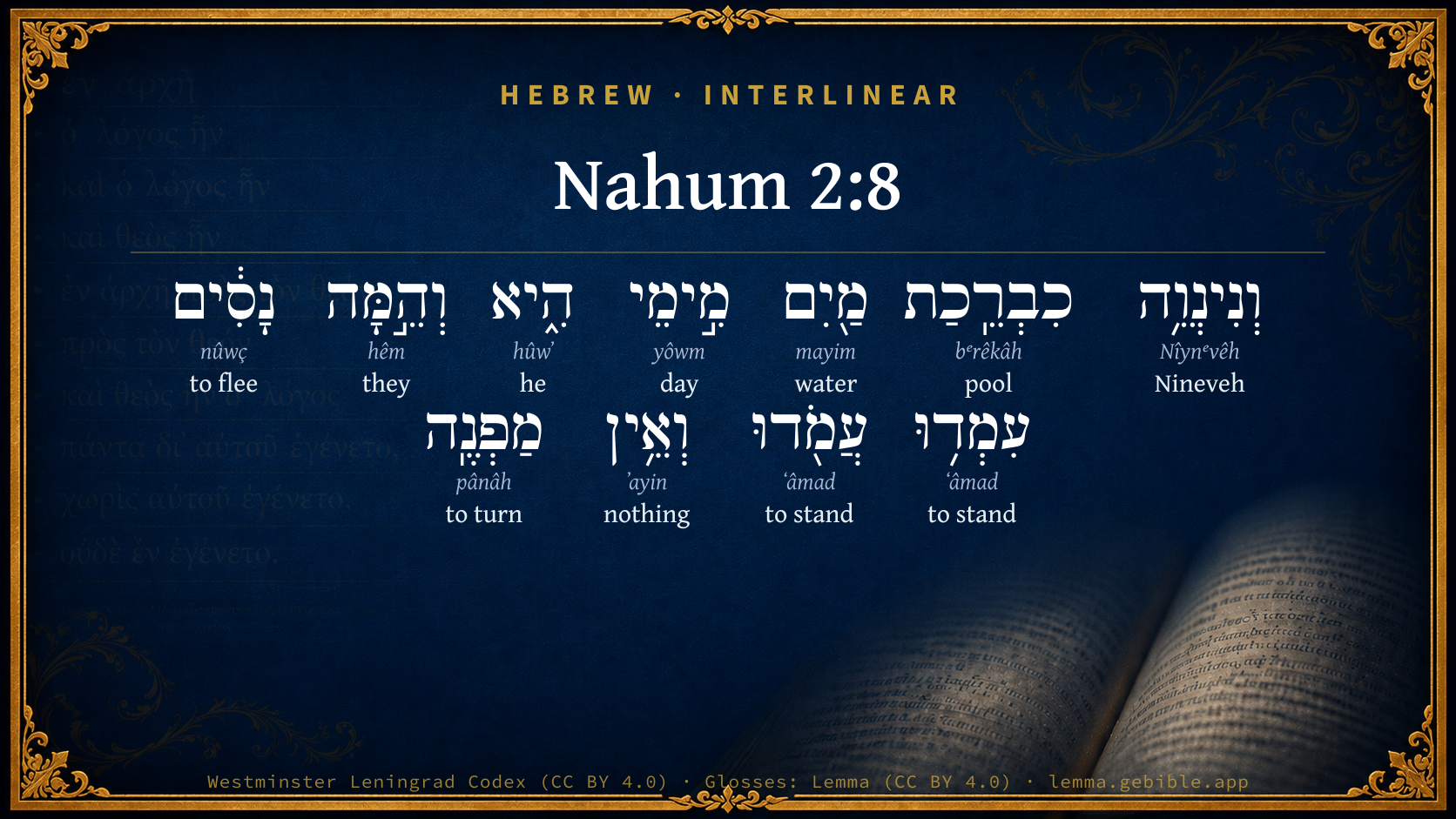
Hebrew (Westminster Leningrad Codex) Nahum 2:8 appears in the Hebrew Old Testament. The text above is from the Westminster Leningrad Codex. Each word links to its Strong’s number, a concise gloss, and parsing drawn from the Open Scriptures Hebrew Bible morphology. Click any word for its full Brown-Driver-Briggs (BDB) entry.
Download image
Cite this verse

Nahum 2:8 (World English Bible). Public Domain. Lemma interlinear Bible study tool, https://lemma.gebible.app/v/nahum/2/8.

Show BibTeX & RIS
BibTeX
RIS
English Translation
But Nineveh has been from of old like a pool of water, yet they flee away. "Stop! Stop!" they cry, but no one looks back.
World English Bible · Public Domain
Download a study sheet

One document with this verse’s original text, its word-by-word gloss line, the meaning frame, cross-references with their text, attributed commentary, and full source and license credits — printable, and it pastes into notes with its structure intact.

This verse Autodidact and up

Study sheet (.html) Plain text (.txt)

A passage Seminary Student

Up to 50 verses in one chapter. A passage sheet keeps up to 6 commentary sources and 12 cross-references per verse, in the order this page ranks them, and says so on the sheet whenever that leaves anything out. Ask for a single verse and you get the Autodidact verse sheet above.

Everything on this page stays free to read, with no account — the sheet is a download of what is already on screen, not access to it.

Want to remove ads? Support Godless Engineer
Compare translations 3

The same verse in 3 English versions, stacked beneath the original-language interlinear above. Click any original word for its lexicon entry.

Each is an independent rendering of the whole verse — the interlinear is not word-aligned to these translations.

Highlighted words mark where these versions differ — a whole-verse word diff, not a word-by-word alignment.

  • World English Bible Public Domain
    But Nineveh has been from of old like a pool of water, yet they flee away. "Stop! Stop!" they cry, but no one looks back.
  • King James Version Public Domain
    But Nineveh is of old like a pool of water: yet they shall flee away. Stand, stand, shall they cry; but none shall look back.
  • unfoldingWord Literal Text CC BY-SA 4.0
    Though Nineveh like a pool of water throughout her days, now they are fleeing away. “Stop, stop!” But there is no turning back.

unfoldingWord Literal Text — © unfoldingWord, licensed CC BY-SA 4.0. Word-aligned USFM3 via Door43 (git.door43.org/unfoldingWord/en_ult).

Versions to compare (up to 4)

3 of 4 selected

Show all 18 translations

Every available English version of this verse, each an independent rendering of the whole verse.

  • World English Bible Public Domain
    But Nineveh has been from of old like a pool of water, yet they flee away. "Stop! Stop!" they cry, but no one looks back.
  • Berean Standard Bible Public Domain
    Nineveh has been like a pool of water throughout her days, but now it is draining away. “Stop! Stop!” they cry, but no one turns back.
  • Majority Standard Bible Public Domain
    Nineveh has been like a pool of water throughout her days, but now it is draining away. “Stop! Stop!” they cry, but no one turns back.
  • King James Version Public Domain
    But Nineveh is of old like a pool of water: yet they shall flee away. Stand, stand, shall they cry; but none shall look back.
  • American Standard Version (1901) Public Domain
    But Nineveh hath been from of old like a pool of water: yet they flee away. Stand, stand, `they cry'; but none looketh back.
  • Revised Version (1885) Public Domain
    But Nineveh hath been from of old like a pool of water: yet they flee away; Stand, stand, they cry; but none looketh back.
  • Geneva Bible (1599) Public Domain
    But Nineueh is of olde like a poole of water: yet they shall flee away. Stande, stande, shall they crie: but none shall looke backe.
  • Douay-Rheims (1899) Public Domain
    And as for Ninive, her waters are like a great pool, but the men flee away. They cry: Stand, stand, but there is none that will return back.
  • Young's Literal Translation Public Domain
    And Nineveh `is' as a pool of waters, From of old it `is' -- and they are fleeing! `Stand ye, stand;' and none is turning!
  • Literal Standard Version CC BY-SA 4.0
    And Nineveh [is] as a pool of waters, || From of old it [is]—and they are fleeing! “Stand, stand”; and none is turning!
  • Unlocked Literal Bible CC BY-SA 4.0
    Nineveh is like a leaking pool of water, with its people fleeing away like rushing water. Others shout, “Stop, stop,” but no one looks back.
  • unfoldingWord Literal Text CC BY-SA 4.0
    Though Nineveh like a pool of water throughout her days, now they are fleeing away. “Stop, stop!” But there is no turning back.
  • Darby Bible Public Domain
    Nineveh hath been like a pool of water, since the day she existed, yet they flee away.... Stand! Stand! But none looketh back.
  • World Messianic Bible Public Domain
    But Nineveh has been from of old like a pool of water, yet they flee away. “Stop! Stop!” they cry, but no one looks back.
  • Webster's Bible Public Domain
    \\2:7\\And Huzzab shall be led away captive, she shall be brought up, and her maids shall lead her as with the voice of doves, tabering upon their breasts.
  • Free Bible Version CC BY-SA 4.0
    Nineveh is a leaky pool—its population is like water running away. “Stop! Stop” people shout, but nobody turns back.
  • Bible in Basic English Public Domain
    And the queen is uncovered, she is taken away and her servant-girls are weeping like the sound of doves, hammering on their breasts.
  • JPS Tanakh (1917) Public Domain
    (2-9) But Nineveh hath been from of old like a pool of water; yet they flee away; 'Stand, stand'; but none looketh back.

Literal Standard Version (2020), Covenant Press — licensed CC BY-SA 4.0. Text via the HelloAO Bible API (eBible.org). Unlocked Literal Bible (unfoldingWord) — licensed CC BY-SA 4.0. Text via the HelloAO Bible API (eBible.org). unfoldingWord Literal Text — © unfoldingWord, licensed CC BY-SA 4.0. Word-aligned USFM3 via Door43 (git.door43.org/unfoldingWord/en_ult). Free Bible Version, Dr. Jonathan Gallagher — licensed CC BY-SA 4.0. Text via the HelloAO Bible API (eBible.org).

Word by word

More ways to search: Search by grammar → Find every occurrence → Compare this word →

Practice this passage: Drill this verse → Learn its vocabulary →

וְנִינְוֵ֥ה
Nîynᵉvêh
H5210
“and · Nineveh”
Conjunction + Noun, Proper
Part of Speech
Conjunction + Noun
Type
Proper
Full BDB Definition

Origin: of foreign origin

TWOT: None

Nineveh = "abode of Ninus" - capital of the ancient kingdom of Assyria; located on the east bank of the Tigris river, 550 miles (880 kilometers) from its mouth and 250 miles (400 kilometers) north of Babylon
  1. כִבְרֵֽכַת bᵉrêkâh H1295 “like/as · pool of” Preposition + Noun, Common, Feminine, Singular, Construct
  2. מַ֖יִם mayim H4325 “water(s)” Noun, Common, Masculine, Plural, Absolute
  3. מִ֣ימֵי yôwm H3117 “from · days of” Preposition + Noun, Common, Masculine, Plural, Construct
  4. הִ֑יא hûwʼ H1931 “he” Pronoun, Personal, 3rd Person, Feminine, Singular
  5. וְהֵ֣מָּה hêm H1992 “and · they” Conjunction + Pronoun, Personal, 3rd Person, Masculine, Plural
  6. נָסִ֔ים nûwç H5127 “fleeing” Verb, Qal, Participle Active, Masculine, Plural, Absolute
  7. עִמְד֥וּ ʻâmad H5975 “stand” Verb, Qal, Imperative, 2nd Person, Masculine, Plural
  8. עֲמֹ֖דוּ ʻâmad H5975 “stand” Verb, Qal, Imperative, 2nd Person, Masculine, Plural
  9. וְאֵ֥ין ʼayin H369 “and · nothing” Conjunction + Particle, Negative
  10. מַפְנֶֽה pânâh H6437 “turning” Verb, Hiphil, Participle Active, Masculine, Singular, Absolute

About this verse

These counts appear in no published source. They are computed here, from the morphology-tagged text and Lemma’s own curated glosses. What Lemma adds →

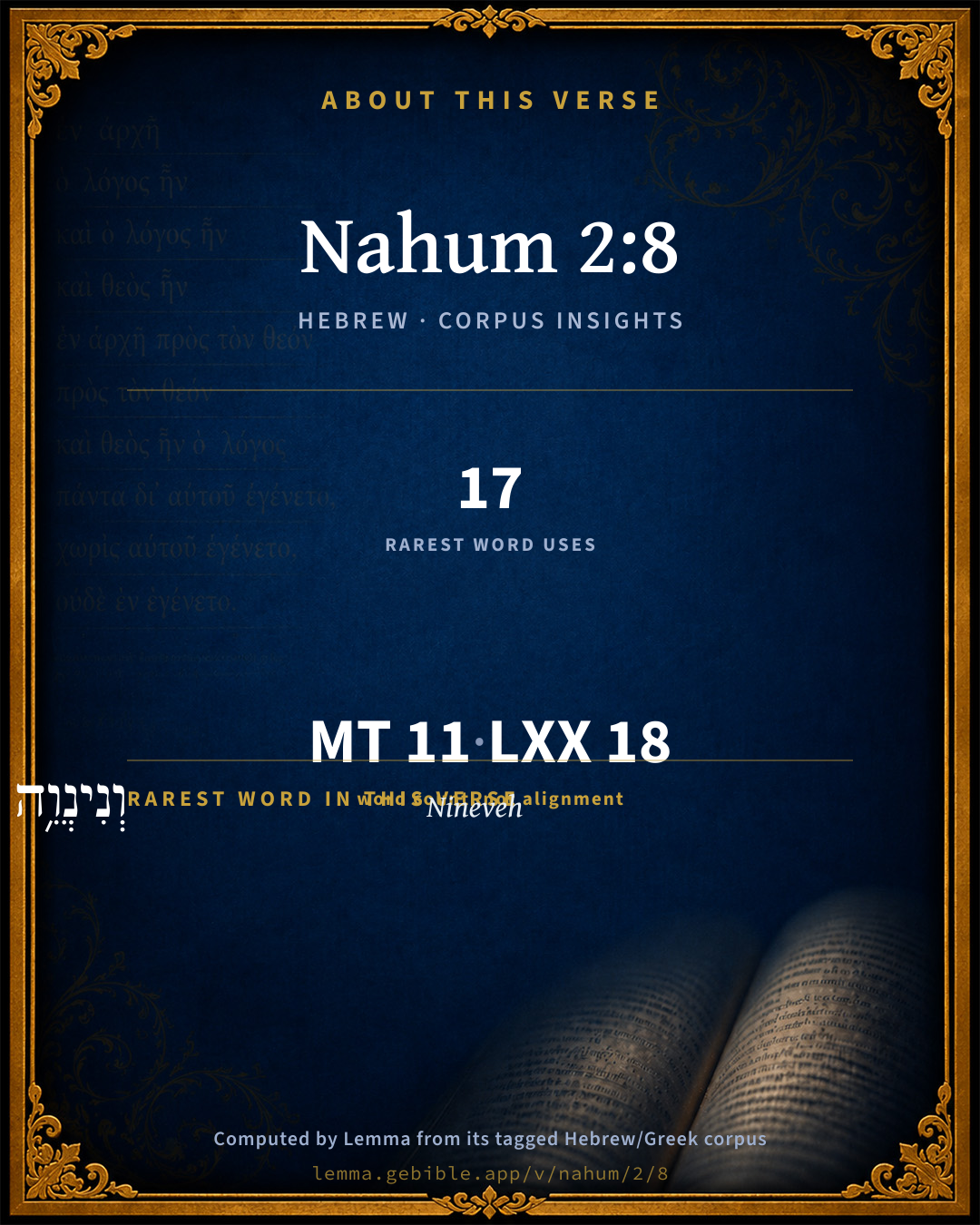
11
words
10
distinct lemmas
Prophets
section

Notable vocabulary

The rarest word here is וְנִינְוֵ֥ה Nineveh H5210 — appearing just 17 times in the whole Hebrew Bible.

Shared distinctive vocabulary

וְנִינְוֵ֥ה Nineveh H5210 occurs in 16 verses of the Hebrew Bible. Also found in:

Grammatical profile

  • 4 verbs
  • 4 nouns
  • 2 pronouns
  • 1 particle

Verb forms

  • נָסִ֔ים Qal · Participle Active
  • עִמְד֥וּ Qal · Imperative
  • עֲמֹ֖דוּ Qal · Imperative
  • מַפְנֶֽה Hiphil · Participle Active

Repetition

A word recurs within this verse — often emphatic in Hebrew:

  • עִמְד֥וּ to stand H5975 ×2

Hebrew & Septuagint length

In English translation the verse runs 25 words from the Hebrew and 26 from the Septuagint (LXX English) — closely comparable.

A rough comparison of the two English renderings, which tokenize alike — not a word-level alignment.

Word counts can differ between the Hebrew and the Greek without any difference in meaning — e.g. the Hebrew direct-object marker אֵת has no separate Greek word, and Greek often adds the article ὁ.

In the original languages it is 11 Hebrew tokens and 18 Greek tokens — but the two are counted differently (Hebrew bundles its prefixes and suffixes into one token; the Greek is in lemma form), so that isn’t a like-for-like length.

Cross-references

11

Topical passages linked to Nahum 2:8 in the Treasury of Scripture Knowledge — connected by theme and wording, ordered by reader-vote popularity; previews shown in the World English Bible.

  • Genesis 10:11 Out of that land he went forth into Assyria, and built Nineveh, Rehoboth Ir, Calah,
  • Isaiah 13:14 It shall happen, that as the chased roe, and as sheep that no man gathers, they shall turn every man to his own people, and shall flee every man to his own land.
  • Isaiah 47:13 You are wearied in the multitude of your counsels: let now the astrologers, the star-gazers, the monthly prognosticators, stand up, and save you from the things that shall come on you.
  • Isaiah 48:20 Go you forth from Babylon, flee you from the Chaldeans; with a voice of singing declare you, tell this, utter it even to the end of the earth: say you, Yahweh has redeemed his servant Jacob.
  • Jeremiah 46:5 Why have I seen it? they are dismayed and are turned backward; and their mighty ones are beaten down, and have fled apace, and don't look back: terror is on every side, says Yahweh.
  • Jeremiah 50:16 Cut off the sower from Babylon, and him who handles the sickle in the time of harvest: for fear of the oppressing sword they shall turn everyone to his people, and they shall flee everyone to his own land.
  • Jeremiah 51:13 You who dwell on many waters, abundant in treasures, your end is come, the measure of your covetousness.
  • Jeremiah 51:30 The mighty men of Babylon have forborne to fight, they remain in their strongholds; their might has failed; they are become as women: her dwelling-places are set on fire; her bars are broken.
  • Nahum 3:17 Your guards are like the locusts, and your officials like the swarms of locusts, which settle on the walls on a cold day, but when the sun appears, they flee away, and their place is not known where they are.
  • Revelation 17:1 One of the seven angels who had the seven bowls came and spoke with me, saying, "Come here. I will show you the judgment of the great prostitute who sits on many waters,
  • Revelation 17:15 He said to me, "The waters which you saw, where the prostitute sits, are peoples, multitudes, nations, and languages.

Cross-references courtesy of OpenBible.info (CC BY 4.0).

Hebrew and Greek witnesses Masoretic Hebrew ↔ Greek Septuagint

The same verse in the two great witnesses to the Old Testament, shown verse-for-verse.

These are two independent witnesses, not word-aligned to each other, and the Septuagint is shown in lemma (dictionary) form.

Hebrew Nahum 2:8 Masoretic · Westminster Leningrad Codex

וְנִינְוֵ֥ה כִבְרֵֽכַת מַ֖יִם מִ֣ימֵי הִ֑יא וְהֵ֣מָּה נָסִ֔ים עִמְד֥וּ עֲמֹ֖דוּ וְאֵ֥ין מַפְנֶֽה

But Nineveh has been from of old like a pool of water, yet they flee away. "Stop! Stop!" they cry, but no one looks back.

World English Bible · Public Domain

Greek LXX Nahum 2:8 Septuagint · lemma form

καί ὁ ὑπόστασις ἀποκαλύπτω καί οὗτος ἀναβαίνω καί ὁ δούλη αὐτός ἄγω καθώς περιστερά φθέγγομαι ἐν καρδία αὐτός

And as for Nineve, her waters shall be as a pool of water: and they fled, and staid not, and there was none to look back.

LXX2012 (modern English Septuagint) · Public Domain

On this verse, Ellicott's Commentary for English Readers discusses the Septuagint’s reading. Read the note in Commentary ↓

Hebrew: Westminster Leningrad Codex (CC BY 4.0). Greek: Septuagint (public domain); English from LXX2012 (modern English Septuagint) (Public Domain). How the Septuagint differs from the Hebrew →

Targum (Aramaic paraphrase)

1

The Targum is the ancient Jewish Aramaic paraphrase of the Hebrew Scriptures — an interpretive translation, not the Hebrew text itself. Onkelos (literal) and Pseudo-Jonathan (expansive) render the Torah, and Jonathan the Prophets. Coverage is partial: where no permissively-licensed English translation exists for a verse, only the Aramaic is shown. This is verse-level text, not a word-by-word alignment to the Hebrew.

  1. Targum Jonathan Prophets (Joshua–Malachi)
    וּמַלְכְּתָא יָתְבַת צִיבָא בְגָלַיָא נַפְקַת וְאַמְהָתָהָא מַדְבְּרָן אָזְלָן בַּתְרָאָה מְנַהֲמָן כְּקַל יוֹנִים מְטַרְפָן עַל לִבֵּיהוֹן:

    (no public-domain English translation for this verse)

    Targum Jonathan — Aramaic: “Mikraot Gedolot” (public domain). English: “Sefaria Community Translation” (CC0 1.0 (public-domain dedication)); “London "Chaldee Paraphrase," 1871” (public domain). Text via Sefaria.

Commentary

Notes on Nahum 2:8 from classic Christian and Jewish commentators (each source and its license shown beneath its notes). The classic Christian expositions comment on the surrounding passage and are grouped to its opening verse, so a note may address several verses; the Jewish commentaries on the Tanakh (Rashi and others) are per-verse, so they appear only where the commentator wrote on this verse.

Lemma curates 59 commentaries, every one of them public domain or Creative Commons licensed, each selected and text-cleaned for this edition rather than reprinted as found. About our sources →

Trapp's Complete Commentary

John Trapp

Nah 2:8 But Nineveh [is] of old like a pool of water: yet they shall flee away. Stand, stand, [shall they cry]; but none shall look back.

Ver. 8. But Nineveh is of old like a pool of water] Like a fish pool of water, and therefore happy. The word ( ברכה) here used for a pool, or pond, signifieth also a blessing. The Pope was wont to say of England, that it was puteus inexhaustus, his pit that could not be drawn dry. Such a pit or pool was Nineveh. Populous, wealthy, potent, &c., Isa 8:7, the magazine of the whole east, a rich Cargazon, and not unlike the island Cyprus, anciently called Macaria, that is, blessed for the plenty, prosperity, and pleasure there abounding. This invited the Romans to subdue it; as the pearls usually cast out at the flood, and gathered at the ebb, drew Caesar’s affection for the conquest of Britain; and as Nineveh’s fish pool did the Chaldean fishermen. The greater wealth the greater spoil awaiteth a people or person, Pro 1:19. As if a tree hath thick and large boughs, every man desires to be lopping at it. Nineveh’s antiquity is here also noted. Of old, or of a long time, she hath been Empress of the East; she was the seat of the first monarchy, which she also held longest of any, even over 1300 years. Howbeit this shall be now no protection to her, but an article or an argument against her, that she is an old sinner, and hath been long time heaping up and hoarding the mammon of unrighteousness.

Yet they shall flee away] As waters do when the banks of a pond are broken down; and as fish do when the water is drawn out or dried up; then they friggle any way. So shall the Ninevites flee away, when their city is once broken: pugnae obliti, pristinaeque virtutis.

Stand, stand, shall they cry] Their own commanders, desirous to rally them; or their enemies, desirous to ransack them, and make prize of them: Sed surdo fabulam.

But none shall look back] Or, cause them to turn. Nemo potest eos resupinare; their hearts are fallen into their heels, and they have much more mind to save themselves by flight than by fight.

John Trapp, A Commentary or Exposition upon All the Books of the Old and New Testament (1647–1656) — public domain. Text from a community e-Sword module.

Joseph Benson's Commentary

Nah 2:8. But Nineveh is of old like a pool of water — “Id est, supra modum populosa, nam aquæ populi.” That is, above measure populous, for waters signify people. — Grotius. Yet they shall flee away — But they shall all flee for fear of the enemy, and run away like water: compare Psa 58:7. Stand, stand, shall they cry, but none shall look back — Their commanders shall call out to them to stand, but none shall pay any regard to them, or cease to flee. The Hebrew is peculiarly animated, and highly poetical. It is literally, Nineveh is as a pool of water: waters is she, and they run away: Stand, stand, but none looketh back. As if he had said, Their commanders might as easily stop the flowing waters by bidding them stand, as cause the Ninevites to stand to their arms and resist the enemy. The words allude to what was foretold Nah 1:8, where see the note.

Joseph Benson's Commentary on the Old and New Testaments (1811–1818) — public domain. Text from a community e-Sword module.

Whedon's Commentary on the Bible

Daniel D. Whedon

Nah_2:8 describes the precipitate flight of the inhabitants.

Like a pool of water — Nineveh, now named for the first time in the prophecy proper, is likened to a pool of water, because in the city were gathered multitudes of individuals, as there are multitudes of drops of water in a pool. Nowack may be right in regarding the Hebrew translated “of old,” or “from of old,” due to dittography. With it omitted, the first clause reads, “Nineveh, like a pool of water is she.” The comparison is carried out in the rest of the verse.

They… flee away — The artificial pool is surrounded by a dam; when it bursts, the waters rush out; thus, with its walls battered down, the inhabitants of Nineveh scatter in every direction, and, though urged to stop, they pay no attention to the cry (Jer_46:5).

Daniel D. Whedon (gen. ed.), Commentary on the Old and New Testaments (1874–1909) — public domain. Text from a community e-Sword module.

The Preacher's Complete Homiletical Commentary

Joseph S. Exell (gen. ed.)

CRITICAL NOTES.

Nah_2:8. Old] From antiquity hath been like a pool of water; the confluence of people from all parts, like countless drops; an unbroken empire for 600 years. Stand] Stand is the cry, but all flee away.

Nah_2:9. Take] God bids the conquerors to plunder. “This does not happen by chance, but because God determines to avenge the injuries inflicted upon his people” [Calvin].

Nah_2:10. Empty] Lit. emptiness, and emptiedness and waste. The city is left, without its wealth and monuments, a complete ruin. The vanquished are horrified at the destruction, despond, can hardly keep on their feet, and turn pale. “The completeness of her judgment is declared first under that solemn number, Three, and the three words in Hebrew are nearly the same, with the same meaning, only each word fuller than the former, as picturing a growing desolation; and then under four heads (in all seven); also a growing fear” [Pusey].

HOMILETICS

THE FLIGHT OF THE INHABITANTS AND THE PLUNDER OF THE CITY.—Nah_2:8-10

Nineveh was a wealthy and populous city. Like a pool of water in multitude of men, but nothing could defend it.

I. The disgraceful flight. “Yet they shall flee away.”

1. The people lost courage. Effeminacy and lust beget weakness. God can dishearten the strongest and most courageous. Patriotism and confidence flee apace, and men are helpless as the reed when he pursues.

2. The people fled away. Panic seized them. Deaf to the call of a few leaders, none looked back, took a stand, or stopped in the flight. At Waterloo, Napoleon, observing the recoil of his columns and the confusion of all around him, cried out, “All is lost, save who can.” In Nineveh the discomfiture and flight were complete. In the day of judgment none can save themselves by flight. “The flight shall perish from the swift.”

II. The extensive plunder. Enormous wealth was treasured up in the city. Its reputation as a commercial city rivalled Tyre (Eze_27:23). Immense riches were acquired also by predatory war and taxes levied to the utmost degree.

1. Its gold and silver were taken. “Take ye the spoil of silver, take the spoil of gold.” Riches cannot deliver in the day of wrath. They rather tempt and entice the spoiler. Small articles of value have been found in the ruins of Nineveh, but no gold nor silver. “When thou shalt cease to spoil, thou shalt be spoiled.”

2. Its pleasant furniture was taken. “Glory out of all the pleasant furniture.” Everything considered costly, vessels of desire, treasures and utensils that yielded glory and reputation, were carried away. “The wealth of the sinner is laid up for the just.”

3. Its desolation was complete. “She is empty, and void, and waste.” (a) The city itself was destroyed. Worldly wealth is vain, emptiness and poverty are the end of worldly greatness. Those who heap up silver as dust, and prepare raiment as clay, only provide for another’s booty (Job_27:17). (b) The inhabitants were terror-struck. Their hearts melted like wax before the fire, and their knees trembled in weakness. Pain seized their loins, and paleness covered their faces. A guilty conscience turns the most hardy into cowards. Nineveh’s strength failed her in the day of need. The terror she had caused to Israel fell in just retribution upon herself, and this storehouse of plunder was utterly laid waste and destroyed.

HOMILETIC HINTS AND SUGGESTIONS

Nah_2:8. Wealth may be treasured up for ages, and increase in value and abundance, yet not be secure. Of old, yet flee away. Because God spares a people, and permits them to prosper in wickedness for a long time, it is no proof of security from coming judgment. Punishment is often sure and decreed; she shall be laid bare; they shall flee away.

Nah_2:9-10. Learn the folly of depending upon worldly resources.

1. Wealth may be taken away.

2. Numbers may fail and flee away.

3. The greatest defences may be levelled to the dust. “The greatest kingdoms finally come to nothing when the Lord inflicts upon them his penal judgments, and all their power is unable to quench and stop the fire of his wrath” [Lange].

Nah_2:10. The horrors of a guilty conscience.

1. Desponding minds.

2. Extreme pain.

3. Visible tokens of approaching ruin. The state of mind manifested in the attitudes of the body. Natural men despair in adversity, sink in courage when robbed of their earthly goods. “It is certainly a great loss when one loses money and goods, but not so great as when the heart falls into despair [Lange]. First, the heart, the seat of courage, and resolve, and high purpose, melteth; then the knees smite together, tremble, shake under their frame; then much pain is in all loins, lit. “strong pains as of a woman in travail,” writhing and doubling the whole body, and making it wholly powerless and unable to stand upright, shall bow the very loins, the seat of strength (Pro_31:17); and lastly, the faces of them all gather blackness (cf. Joe_2:6), the fruit of extreme pain, and the token of approaching dissolution [Pusey]. Joy and sorrow will show themselves in the face as in a glass. Now if for a temporal mischief there is so great a consternation in wicked men, what shall we think there is in hell? [Trapp].

The Preacher's Complete Homiletical Commentary (gen. ed. Joseph S. Exell; Funk & Wagnalls, c. 1892) — public domain (pre-1929). A full-Bible homiletical/sermon-outline anthology covering 65 of 66 books (2 John is absent from the source module). Text from a community e-Sword module.

Keil & Delitzsch

C. F. Keil & F. Delitzsch

At the conquest of Nineveh the numerous inhabitants flee, and the rich city is plundered. Nah 2:8. "And Nineveh like a water-pond all her days. And they flee! Stand ye, O stand! and no one turns round. Nah 2:9. Take silver as booty, take ye gold! And no end to the furnishing with immense quantity of all kinds of ornamental vessels. Nah 2:10. Emptying and devastation! and the heart has melted, and trembling of the knees, and labour pain in all loins, and the countenance of every one withdraws its ruddiness." Nineveh is compared to a pool, not merely with reference to the multitude of men who had gathered together there, but, as water is everywhere an element of life, also with reference to the wealth and prosperity which accrued to this imperial city out of the streaming together of so many men and so many different peoples. Compare Jer 51:13, where Babel is addressed as "Thou that dwellest on many waters, art rich in many treasures." מימי היא, since the days that she exists. היא = אשׁר היא, the relation being indicated by the construct state; מן הוא in Isa 18:2 is different. But they flee. The subject to נסים is not the waters, although nūs is applied to water in Psa 104:7, but, as what follows shows, the masses of men who are represented as water. These flee away without being stopped by the cry "Stand ye" (i.e., remain), or even paying any attention to it. Hiphnâh, lit., "to turn the back" (‛ōreph, Jer 48:39), to flee, but when applied to a person already fleeing, to turn round (cf. Jer 46:5). In Nah 2:9 the conquerors are summoned to plunder, not by their generals, but by God, who speaks through the prophet. The fact is hereby indicated, "that this does not happen by chance, but because God determines to avenge the injuries inflicted upon His people" (Calvin). With ואין קצה the prophecy passes into a simple description. There is no end lattekhūnâh, to the furnishing with treasures. Tekhūnâh, from kūn, not from tâkhan, lit., the setting up, the erection of a building (Eze 43:11); here the furnishing of Nineveh as the dwelling-place of the rulers of the world, whilst in Job 23:3 it is applied to the place where the throne of God has been established. In כּבד the ל might be thought of as still continuing in force (Ewald, Hitzig), but it answers better to the liveliness of the description to take כּבד as beginning a fresh sentence. כּבד written defectively, as in Gen 31:1 : glory, equivalent to the great amount of the wealth, as in Genesis (l.c.). Kelē chendâh, gold and silver vessels and jewels, as in Hos 13:15. That there were immense treasures of the precious metals and of costly vessels treasured up in Nineveh, may be inferred with certainty from the accounts of ancient writers, which border on the fabulous.

(Note: For proofs, see Layard's Nineveh, ii. 415ff., and Movers, Phnizier (iii. 1, pp. 40, 41). After quoting the statements of Ctesias, the latter observes that "these numbers are indeed fabulous; but they have their historical side, inasmuch as in the time of Ctesias the riches of Nineveh were estimated at an infinitely greater amount than the enormous treasures accumulated in the treasuries of the Persian empire. That the latter is quite in accordance with truth, may be inferred from the fact that the conquerors of Nineveh, the Medes and Chaldaeans, of whose immense booty, in the shape of gold, silver, and other treasures, even the prophet Nahum speaks, furnished Ecbatana and Babylon with gold and silver from the booty of Nineveh to an extent unparalleled in all history.")

Of all these treasures nothing was left but desolate emptiness. This is expressed by the combination of three synonymous words. Būqâh and mebhūqâh are substantive formations from būq = bâqaq, to empty out, and are combined to strengthen the idea, like similar combinations in Zep 1:15; Eze 33:29, and Isa 29:2. Mebhullâqâh is a synonymous noun formed from the participle pual, and signifying devastation (cf. Isa 24:1, where even bâlaq is combined with bâqaq). In Nah 2:11 the horror of the vanquished at the total devastation of Nineveh is described, also in short substantive clauses: "melted heart" (nâmēs is a participle), i.e., perfect despondency (see Isa 13:7; Jos 7:5); trembling of the knees, so that from terror men can hardly keep upon their feet (pı̄q for pūq; it only occurs here). Chalchâlâh formed by reduplication from chı̄l: spasmodic pains in all loins, like the labour pains of women in childbirth (cf. Isa 21:3). Lastly, the faces of all turning pale (see at Joe 2:6).

Keil & Delitzsch — Biblical Commentary on the Old Testament (1861–1891) — public domain (CC PDM 1.0). Text via the HelloAO Bible API. (Old Testament only.)

Tyndale Open Study Notes

Tyndale Open Resources

2:8 The people would run away as fast as water flows from a breached reservoir (see study note on 2:6).

Tyndale Open Study Notes — © Tyndale Open Resources, licensed CC BY-SA 4.0. Text via the HelloAO Bible API.

Geneva Bible (1599)

Geneva Bible translators

The Assyrians will flatter themselves and say, that Nineveh is so ancient that it can never perish, and is as a fishpool, whose waters they that walk on the banks cannot touch, but they shall be scattered, and shall not look back though men would call them.

Geneva Bible (1599) marginal notes — public domain. Text via Bolls.life.

Jamieson, Fausset & Brown

Robert Jamieson, A. R. Fausset & David Brown

But--rather, "Though" [G. V. SMITH].

of old--rather, "from the days that she hath been"; from the earliest period of her existence. Alluding to Nineveh's antiquity (Gen 10:11). "Though Nineveh has been of old defended by water surrounding her, yet her inhabitants shall flee away." GROTIUS, less probably (compare Nah 3:8-12), interprets, the "waters" of her numerous population (Isa 8:7; Jer 51:13; Rev 17:15).

Stand, stand, shall they cry--that is, the few patriotic citizens shall cry to their fleeing countrymen; "but none looketh back," much less stops in flight, so panic-stricken are they.

Jamieson, Fausset & Brown — Commentary Critical and Explanatory on the Whole Bible (1871) — public domain (CC PDM 1.0). Text via the HelloAO Bible API.

Adam Clarke's Commentary

Verse 8. But Nineveh is of old like a pool of water] מימי mimey, from days. Bp. Newcome translates the line thus: "And the waters of Nineveh are a pool of waters." There may be reference here to the fact given in the preceding note, the overflowing of the river by which the city was primarily destroyed.

Stand, stand] Consternation shall be at its utmost height, the people shall flee in all directions; and though quarter is offered, and they are assured of safety it they remain, yet not one looketh back.

Adam Clarke's Commentary on the Bible (1810–1826) — public domain. Text from a community e-Sword/MySword module.

John Calvin's Commentaries

The prophet here anticipates a doubt which might have weakened confidence in his words; for Nineveh not only flourished in power, but it had also confirmed its strength during a long course of time; and antiquity not only adds to the strength of kingdoms, but secures authority to them. As then the imperial power of the city Nineveh was ancient, it might seem to have been perpetual: “Why! Nineveh has ever ruled and possessed the sovereign power in all the east; can it be now shaken, or can its strength be now suddenly subverted? For where there is no beginning, we cannot believe that there will be any end.” And a beginning it had not, according to the common opinion; for we know how the Egyptians also fabled respecting their antiquity; they imagined that their kingdom was five thousand years before the world was made; that is, in numbering their ages they went back nearly five thousand years before the creation. The Ninevites, no doubt, boasted that they had ever been; and as they were fixed in this conceit respecting their antiquity, no one thought that they could ever fail. This is the reason why the Prophet expressly declares, that Nineveh had been like a pool of waters from ancient days; that is, Nineveh had been, as it were, separated from the rest of the world; for where there is a pool, it seems well fortified by its own banks, no one comes into it; when one walks on the land he does not enter into the waters. Thus, then, had Nineveh been in a quiet state not only for a short time, but for many ages. This circumstance shall not, however, prevent God from overturning now its dominion. How much soever, then, Nineveh took pride in the notion of its ancientness, it was yet God’s purpose to destroy it.

He says then, They flee: by fleeing, he means, that, though not beaten by their enemies, they would yet be overcome by their own fear. He then intimates, that Nineveh would not only be destroyed by slaughter, but that all the Assyrians would flee away, and despair would deliver them up to their enemies. Hence the Chaldeans would not only be victorious through their courage and the sword, but the Assyrians, distrusting their own forces, would flee away.

It afterwards follows, Stand ye, stand ye, and no one regards. Here the Prophet places, as it were, before our eyes, the effect of the dread of which he speaks. He might have given a single narrative, — that though one called them back they would not dare to look behind; and that, thinking that safety alone was in flight, they would pursue their course. The Prophet might have formed this sort of narrative: this he has not done; but he assumes the person of one calling back the fugitives, as though he saw them fleeing away, and tried to bring them back: No one, he says, regards We now see what the Prophet meant.

But from this passage we ought to learn that no trust is to be put in the number of men, nor in the defenses and strongholds of cities, nor in ancientness; for when men excel in power, God will hence take occasion to destroy them, inasmuch as pride is almost ever connected with strength. It can hardly be but that men arrogate too much to themselves when they think that they excel in any thing. Thus it happens, that on account of their strength they run headlong into ruin; not that God has any delight, as profane men imagine, when he turns upside down the face of the earth, but because men cannot bear their own success, nor keep themselves within moderate bounds, but many triumph against God: hence it is that human power recoils on the head of those who possess it. The same things must also be said of ancientness: for they who boast of their antiquity, know not for how long a time they have been provoking the wrath of God; for it cannot be otherwise but that abundance of itself generates licentiousness, or that it at least leads to excess; and further, they who are the most powerful are the most daring in corrupting others. Hence the increase at putridity; for men are like the dead when not ruled by the fear of God. A dead body becomes more and more fetid the longer it continues putrifying; and so it is with men. When they have been for a long time sinning, and still continue to sin, the fetidness of their sins increases, and the wrath of God is more and more provoked. There is then no reason why ancientness should deceive us. And if, at any time, we are tempted to think that men are sufficiently fortified by their own strength, or by numerous auxiliaries, or that they are, as it were sacred through their own ancientness, let what is said here come to our minds, — that Nineveh had been like a pool of waters from the ancient days; but that, when it was given up to destruction, it fled away; and that, when their enemies did not rout them, they yet, being driven by their own fear, ran away and would not stop, though one called them to return.

John Calvin's Commentaries (1540-1563) — public domain. Text from the Calvin Translation Society English edition (1840s-50s) via the Christian Classics Ethereal Library (ccel.org). Calvin's coverage is partial (roughly two-thirds of the Bible); uncommented books and verses are honest gaps, never fabricated. The 19th-century editor's footnotes and remarks are omitted so the notes are faithfully Calvin's own voice.

Ellicott's Commentary for English Readers

(8) We prefer to adopt the slight change of reading favoured by the LXX. (mêymeyhâ for mîmêy hî, and to render, And Nineveh, like a pool of water are her waters, and they [her inhabitants] are fleeing away. The waters which formerly flowed in river-courses and dykes are now one vast expanse of inundation. A panic thereupon seizes the inhabitants. If the present text be maintained, the rendering of the Authorised Version will stand. We may then suppose the heterogeneous population of Nineveh to be compared to “countless drops, full, untroubled, with no ebb or flow, fenced in from the days that she hath been, yet even therefore stagnant and corrupted; not ‘a fountain of living waters’” (Pusey). But this appears to us a farfetched comparison.

The pregnant terseness of the last part of the verse will give the English reader a good idea of Nahum’s style and the difficulties therewith connected.

A Bible Commentary for English Readers, edited by Charles John Ellicott (1878–1897) — public domain. Text from a community e-Sword module.

The Cambridge Bible for Schools and Colleges

gen. ed. J. J. S. Perowne

8. But Nineveh … a pool of water] And Nineveh was like a pool of water from her beginning, lit. from the days she was, during all her history.

shall flee away] but they flee away. The vast population of Nineveh, drawn from all quarters, is compared to a mass of waters; these break asunder and flee away. The figure of waters “fleeing,” Psa_104:7. The text is not beyond suspicion in the first clause of the verse. The prophet vividly realises the scene. Nothing will arrest the precipitate flight. The cry, Stand! is unheard, none looks back. Cf. Jer_46:21.

The Cambridge Bible for Schools and Colleges (gen. ed. J. J. S. Perowne; Cambridge University Press, 1878–1918) — public domain. Text from a community e-Sword module.

John Gill's Exposition

But Nineveh is of old like a pool of water,.... This was a very ancient city, built by Nimrod, as some say; or rather by Ashur, as appears from Gen 10:10 and it was like fish pool, full of people, as it was in the times of Jonah, who for their number may be compared both to water and to fish; and likewise full of wealth and riches, which for their instability may be signified by water also; and moreover, like a pool of standing water, had never been liable to any commotions and disturbances, but had remained from the beginning in a tranquil and prosperous state; besides, some regard may be had in a literal sense to its situation, being watered by the river Tigris, and which was for its profit and defence: so some copies of the Septuagint read the words,

"Nineveh is like a pool of water, the waters are her walls:''

and the Syriac version is,

"Nineveh is as a lake of water, and is among the waters;''

see Nah 1:6,

yet they shall flee away; the waters out of the pool, the sluices being opened, or the banks broken down; or the people out of the city, breaches being made in its walls, or its gates opened, and the enemy entering; when everyone would flee for his life, and make his escape in the best manner he could:

stand, stand, shall they cry; either the generals and officers of the king of Assyria's army, to the soldiers running away; or the more courageous inhabitants of the city, to those that were timorous and seized with a panic, fleeing in the utmost consternation; or the enemy, as Kimchi, who shall call to them to stop, promising to spare their lives upon a surrender of them to them:

but none shall look back; and stand to hear what is said unto them, but make the best of their way, and flee with all their might and main.

John Gill's Exposition of the Whole Bible (1746–1763) — public domain (CC PDM 1.0). Text via the HelloAO Bible API.

Albert Barnes' Notes on the Bible

But Nineveh is of old like a pool of water - that is, of many peoples Rev 17:1, gathered from all quarters and settled there, her multitudes being like the countless drops, full, untroubled, with no ebb or flow, fenced in, “from the days that she hath been,” yet even therefore stagnant and corrupted (see Jer 48:11), not “a fountain of living waters,” during 600 years of unbroken empire; even lately it had been assailed in vain ; now its hour was come, the sluices were broken; the waters poured out. It was full not of citizens only, but of other nations poured into it. An old historian says , “The chief and most powerful of those whom Ninus settled there, were the Assyrians, but also, of other nations, whoever willed.” Thus, the pool was filled; but at the rebuke of the Lord they flee. “Stand, stand,” the prophet speaks in the name of the widowed city; “shut the gates, go up on the walls, resist the enemy, gather yourselves together, form a band to withstand,” “but none shalt look back” to the mother-city which calls them; all is forgotten, except their fear; parents, wives, children, the wealth which is plundered, home, worldly repute. So will men leave all things, for the life of this world. “All that a man hath, will he give for his life” Job 2:4. Why not for the life to come?

Albert Barnes' Notes on the Bible (1834–1885) — public domain. Text from a community e-Sword/MySword module.

Haydock's Catholic Bible Commentary

Waters: multitudes, (Apocalypse xvii. 15.) and riches; (Calmet) or the flood bursting upon them makes them flee. (Haydock) --- The citizens run away when the enemy had made a breach, as water does when the dam is broken down; and though some more valiant will exhort them to tarry, they will not succeed, nor save the city. (Worthington)

George Leo Haydock (1774–1849), Haydock's Catholic Family Bible and Commentary, 1859 edition — public domain. Excludes Psalms (Douay-Rheims chapter numbering differs from Protestant) and Deuterocanonical books (Catholic canon only).

Matthew Poole's English Annotations

Nineveh is of old; a very ancient city, of great renown and strength.

Like a pool of water; very populous, like a pool of water which hath been long breeding of fish, and is full of them.

Yet they, yet these multitudes, shall not be a safety or protection to Nineveh, they shall flee away discomfited and terrified.

Stand, stand; as officers call to fleeing soldiers, and it is doubled to show the earnestness of the commanders desiring the soldier to stand and fight.

Shall they cry; the chieftains, and most valiant among the Ninevites. But none shall look back; a panic fear shall so possess them, that none of them shall dare to turn again, nor to look back upon the enemy.

Matthew Poole's English Annotations on the Holy Bible (1683–1685) — public domain. Text from a community e-Sword/MySword module.

The Pulpit Commentary

The prophet compares the past and present condition of Nineveh. But Nineveh is of old like a pool of water; and (or, though) Nineveh hath been like a pool of water all her days. Others, altering the points in accordance with the Septuagint and Vulgate, translate, "But as for Nineveh, her waters are like a pool of water." This is what she has come to, for "her waters" represent herself. She is compared to a pool or reservoir (Neh_2:15 Neh_3:15) from the multitude of her inhabitants gathered from all parts of the world, and streaming unto her, both as tributary and for commercial purposes. (comp. Jer_51:13 Rev_17:1, Rev_17:15) Yet they shall flee away. In spite of their numbers, the multitudes represented by "the waters" fly before the enemy. In vain the captains cry, Stand, stand. They pay no attention. None shall look back. No one of the fugitives turns rounder gives a thought to anything but his own safety.

The Pulpit Commentary (1880–1919), ed. H.D.M. Spence-Jones & Joseph S. Exell — public domain. Text from a community e-Sword module.

John Wesley's Explanatory Notes

Like a pool - Very populous, like a pool which hath been long breeding fish, and is full of them. Yet - Yet these multitudes shall flee discomfited and terrified. They - The chieftains, and most valiant among the Ninevites.

John Wesley, Explanatory Notes Upon the Whole Bible (1754–1765) — public domain. Text via the GEBible commentary corpus.

unfoldingWord translationNotes

Door43 World Missions Community

Nineveh is like a leaking pool of water, with its people fleeing away like rushing water

Nahum compares the way that the people flee from the city of Nineveh with the way that water gushes from a reservoir of water when the dam has been broken. (See: Simile)

Take the silver plunder ... Nineveh's beautiful things

It is not clear who is speaking here. This may be an apostrophe in which Nahum gives directions to the attackers, or the attackers may be speaking and giving directions to one another. (See: Apostrophe)

Take the silver plunder, take the gold plunder

The word "plunder" means things stolen by force, usually in war. AT: "Take the silver as plunder, take the gold as plunder" or "Take the silver, take the gold"

there is no end to it

The words "no end" are an exaggeration to express that there is a great amount of something. AT: "there is so much of it" (See: Hyperbole and Generalization)

to the splendor of all Nineveh's beautiful things

This phrase refers to the silver, gold, and other treasures in Nineveh. The verb may be supplied from the previous phrase. AT: "there is no end to the splendor of all Nineveh's beautiful treasures" (See: Ellipsis)

Everyone's heart melts

Nahum speaks of the people losing courage as if their hearts melt like wax. AT: "Everyone loses courage" (See: Metaphor)

everyone's knees strike together

This describes a physical response to great fear. The people's legs shake so badly that their knees knock together and they are unable to walk or run.

translationWords

Nineveh

water

people group

silver

gold

ruin

heart

unfoldingWord translationNotes — © Distant Shores Media and the Door43 World Missions Community, licensed CC BY-SA 4.0. Source: git.door43.org/Door43/en_tn.

Rashi

Rabbi Shlomo Yitzchaki (Rashi)

And the queen Heb. וְהֻצַּב. She is the queen who stands to the right of the king, as is stated (Ps. 45:10): “The queen stands to your right.”

has been exposed and taken away—In the open, she has gone into captivity and has been taken away from the city.

moan like the voice of doves—They moan with a lamentation like the voice of lamenting doves. moan Heb. מְנַהֲגוֹת, gemissant in French.

beating their breasts Striking their hand on their heart like the beating of a drum.

Rashi on the Tanakh — English translations: “The Judaica Press complete Tanach with Rashi, translated by A. J. Rosenberg” (CC BY 4.0); “Pentateuch with Rashi's commentary by M. Rosenbaum and A.M. Silbermann, 1929-1934” (public domain); “The Metsudah Tanach series, Lakewood, N.J” (CC BY 4.0); and “The Book of Joshua, Metsudah Publications, 1997” (CC BY 4.0). Text via Sefaria.

Lesson kit

Teaching starters — assembled from the data on this page, not authored interpretation. Every prompt links to the verse data it draws on. Edit before teaching.

Nahum, in the Prophets, opens this verse with 11 words (10 distinct Hebrew lemmas). Its most distinctive word is Nîynᵉvêh (“Nineveh”). A historical commentator’s framing appears above. Read the whole chapter for the surrounding context.

Discussion questions

  1. How does “Nineveh” (Nîynᵉvêh) shape what this verse is saying?
  2. How does Genesis 10:11, which shares the word «Nineveh», read alongside this verse?
  3. What does the repetition of “to stand” (2× in this one verse) do in this verse?
  4. The translations on this page render this verse differently — a whole-verse word diff, not a word-by-word alignment. What might account for the different wordings?
  5. «נָסִ֔ים» is a Qal Participle Active verb. How does that grammatical form shape the action described?
  6. Compare how Trapp's Complete Commentary and Joseph Benson's Commentary read this verse. Where do they agree or differ?

Things to notice

Reading settings

Reading text

Shown beneath each verse's original-language words.

Old Testament
Old Testament edition

Read the OT as the Masoretic Hebrew (MT) or the Greek Septuagint (LXX).

English shown for the Greek Septuagint (in the Hebrew ↔ Greek comparison).

Comparing translations? Open the Compare panel on any verse page to stack up to four side by side.