
1 Kings 10:5

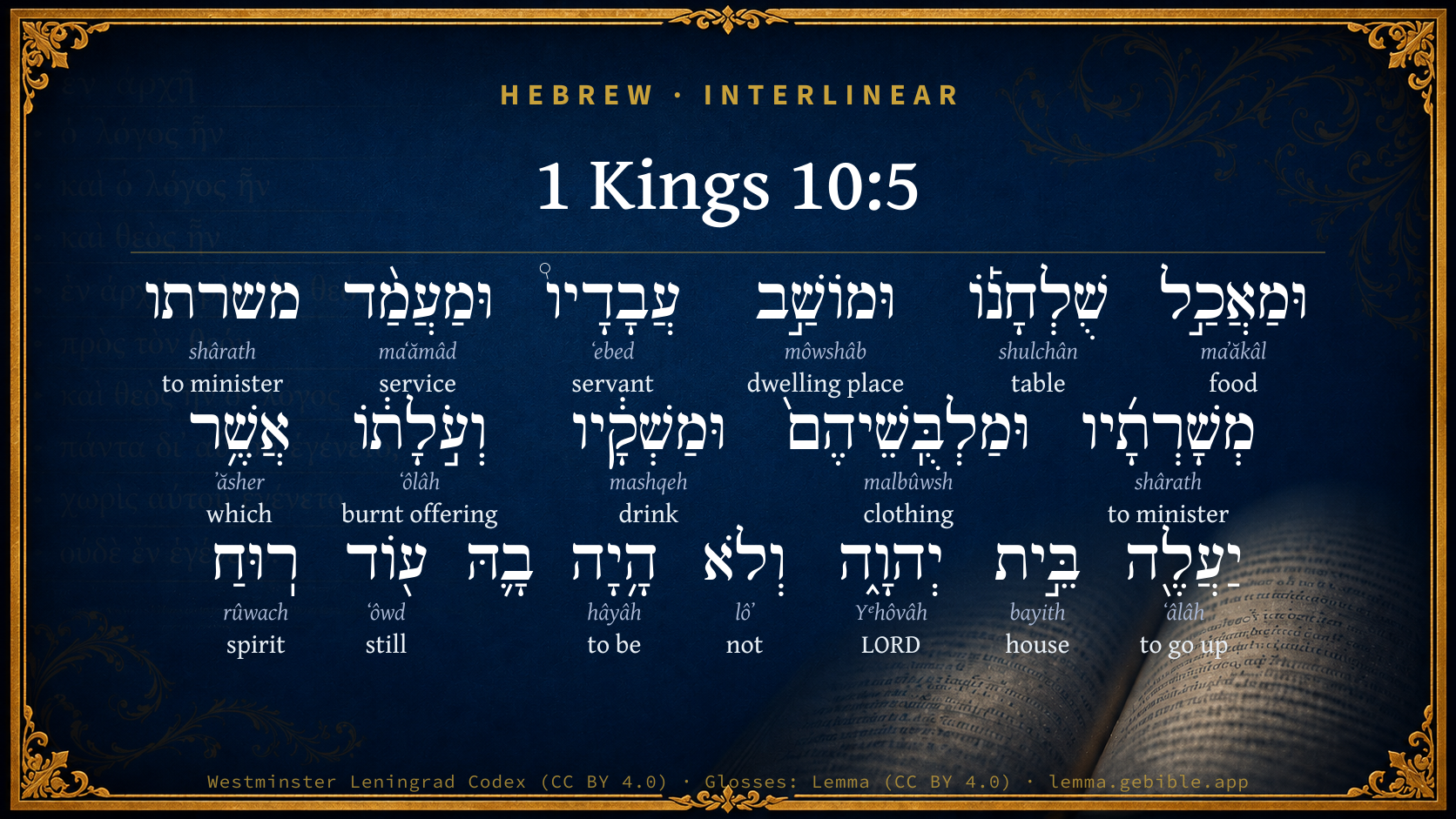
Hebrew (Westminster Leningrad Codex) 1 Kings 10:5 appears in the Hebrew Old Testament. The text above is from the Westminster Leningrad Codex. Each word links to its Strong’s number, a concise gloss, and parsing drawn from the Open Scriptures Hebrew Bible morphology. Click any word for its full Brown-Driver-Briggs (BDB) entry.
Download image
Cite this verse

1 Kings 10:5 (World English Bible). Public Domain. Lemma interlinear Bible study tool, https://lemma.gebible.app/v/1-kings/10/5.

Show BibTeX & RIS
BibTeX
RIS
English Translation
and the food of his table, and the sitting of his servants, and the attendance of his ministers, and their clothing, and his cup bearers, and his ascent by which he went up to the house of Yahweh; there was no more spirit in her.
World English Bible · Public Domain
Highlights
  • 2 first appearances in the Hebrew Bible
Full analysis ↓
Download a study sheet

One document with this verse’s original text, its word-by-word gloss line, the meaning frame, cross-references with their text, attributed commentary, and full source and license credits — printable, and it pastes into notes with its structure intact.

This verse Autodidact and up

Study sheet (.html) Plain text (.txt)

A passage Seminary Student

Up to 50 verses in one chapter. A passage sheet keeps up to 6 commentary sources and 12 cross-references per verse, in the order this page ranks them, and says so on the sheet whenever that leaves anything out. Ask for a single verse and you get the Autodidact verse sheet above.

Everything on this page stays free to read, with no account — the sheet is a download of what is already on screen, not access to it.

Want to remove ads? Support Godless Engineer
Compare translations 3

The same verse in 3 English versions, stacked beneath the original-language interlinear above. Click any original word for its lexicon entry.

Each is an independent rendering of the whole verse — the interlinear is not word-aligned to these translations.

Highlighted words mark where these versions differ — a whole-verse word diff, not a word-by-word alignment.

  • World English Bible Public Domain
    and the food of his table, and the sitting of his servants, and the attendance of his ministers, and their clothing, and his cup bearers, and his ascent by which he went up to the house of Yahweh; there was no more spirit in her.
  • King James Version Public Domain
    And the meat of his table, and the sitting of his servants, and the attendance of his ministers, and their apparel, and his cupbearers, and his ascent by which he went up unto the house of the LORD; there was no more spirit in her.
  • unfoldingWord Literal Text CC BY-SA 4.0
    and the food of his table and the seating of his servants and the service of his attendants and their apparel and his cupbearers and his burnt offerings that he offered the house of Yahweh. And no more breath was in her.

unfoldingWord Literal Text — © unfoldingWord, licensed CC BY-SA 4.0. Word-aligned USFM3 via Door43 (git.door43.org/unfoldingWord/en_ult).

Versions to compare (up to 4)

3 of 4 selected

Show all 18 translations

Every available English version of this verse, each an independent rendering of the whole verse.

  • World English Bible Public Domain
    and the food of his table, and the sitting of his servants, and the attendance of his ministers, and their clothing, and his cup bearers, and his ascent by which he went up to the house of Yahweh; there was no more spirit in her.
  • Berean Standard Bible Public Domain
    the food at his table, the seating of his servants, the service and attire of his attendants and cupbearers, and the burnt offerings he presented at the house of the LORD, it took her breath away.
  • Majority Standard Bible Public Domain
    the food at his table, the seating of his servants, the service and attire of his attendants, his cupbearers, and the burnt offerings he presented at the house of the LORD, it took her breath away.
  • King James Version Public Domain
    And the meat of his table, and the sitting of his servants, and the attendance of his ministers, and their apparel, and his cupbearers, and his ascent by which he went up unto the house of the LORD; there was no more spirit in her.
  • American Standard Version (1901) Public Domain
    and the food of his table, and the sitting of his servants, and the attendance of his ministers, and their apparel, and his cupbearers, and his ascent by which he went up unto the house of Jehovah; there was no more spirit in her.
  • Revised Version (1885) Public Domain
    and the meat of his table, and the sitting of his servants, and the attendance of his ministers, and their apparel, and his cupbearers, and his ascent by which he went up unto the house of the LORD; there was no more spirit in her.
  • Geneva Bible (1599) Public Domain
    And the meate of his table, and the sitting of his seruants, and the order of his ministers, and their apparel, and his drinking vessels, and his burnt offrings, that he offered in the house of the Lord, and she was greatly astonied.
  • Douay-Rheims (1899) Public Domain
    And the meat of his table, and the apartments of his servants, and the order of his ministers, and their apparel, and the cupbearers, and the holocausts, which he offered in the house of the Lord: she had no longer any spirit in her,
  • Young's Literal Translation Public Domain
    and the food of his table, and the sitting of his servants, and the standing of his ministers, and their clothing, and his butlers, and his burnt-offering that he causeth to ascend in the house of Jehovah, and there hath not been in her any more spirit.
  • Literal Standard Version CC BY-SA 4.0
    and the food of his table, and the sitting of his servants, and the standing of his ministers, and their clothing, and his butlers, and his burnt-offering that he causes to ascend in the house of YHWH, and there has not been anymore spirit in her.
  • Unlocked Literal Bible CC BY-SA 4.0
    the food on his table, the seating of his servants, the work of his servants and their clothing, also his cupbearers, and the manner in which he offered burnt offerings in the house of Yahweh, there was no more breath in her.
  • unfoldingWord Literal Text CC BY-SA 4.0
    and the food of his table and the seating of his servants and the service of his attendants and their apparel and his cupbearers and his burnt offerings that he offered the house of Yahweh. And no more breath was in her.
  • Darby Bible Public Domain
    and the food of his table, and the deportment of his servants, and the order of service of his attendants, and their apparel, and his cupbearers, and his ascent by which he went up to the house of Jehovah, there was no more spirit in her.
  • World Messianic Bible Public Domain
    the food of his table, the sitting of his servants, the attendance of his officials, their clothing, his cup bearers, and his ascent by which he went up to the LORD’s house, there was no more spirit in her.
  • Webster's Bible Public Domain
    And the provisions of his table, and the sitting of his servants, and the attendance of his ministers, and their apparel, and his cup-bearers, and his ascent by which he went up to the house of the LORD; there was no more spirit in her.
  • Free Bible Version CC BY-SA 4.0
    the food on the table, how his officials lived, how his servants operated and how they were dressed, the clothes of the waiters, and the burnt offerings he presented at the Lord's Temple, she was so astonished she could hardly breathe.
  • Bible in Basic English Public Domain
    And the food at his table, and all his servants seated there, and those who were waiting on him in their places, and their robes, and his wine-servants, and the burned offerings which he made in the house of the Lord, there was no more spirit in her.
  • JPS Tanakh (1917) Public Domain
    and the food of his table, and the sitting of his servants, and the attendance of his ministers, and their apparel, and his cupbearers, and his burnt-offering which he offered in the house of the LORD, there was no more spirit in her.

Literal Standard Version (2020), Covenant Press — licensed CC BY-SA 4.0. Text via the HelloAO Bible API (eBible.org). Unlocked Literal Bible (unfoldingWord) — licensed CC BY-SA 4.0. Text via the HelloAO Bible API (eBible.org). unfoldingWord Literal Text — © unfoldingWord, licensed CC BY-SA 4.0. Word-aligned USFM3 via Door43 (git.door43.org/unfoldingWord/en_ult). Free Bible Version, Dr. Jonathan Gallagher — licensed CC BY-SA 4.0. Text via the HelloAO Bible API (eBible.org).

Word by word

More ways to search: Search by grammar → Find every occurrence → Compare this word →

Practice this passage: Drill this verse → Learn its vocabulary →

וּמַעֲמַ֨ד
maʻămâd
H4612
“and · service of”
Conjunction + Noun, Common, Masculine, Singular, Construct
Part of Speech
Conjunction + Noun
Type
Common
Gender
Masculine
Number
Singular
State
Construct
Full BDB Definition

Origin: from H5975

TWOT: 1637d

attendance, office, function, service - station, office, post - office, function - service
  1. וּמַאֲכַ֣ל maʼăkâl H3978 “and · food of” Conjunction + Noun, Common, Masculine, Singular, Construct
  2. שֻׁלְחָנ֡וֹ shulchân H7979 “table · his” Noun, Common, Masculine, Singular, Construct + Suffix, Personal, 3rd Person, Masculine, Singular
  3. וּמוֹשַׁ֣ב môwshâb H4186 “and · dwelling place of” Conjunction + Noun, Common, Masculine, Singular, Construct
  4. עֲבָדָיו֩ ʻebed H5650 “servants · his” Noun, Common, Masculine, Plural, Construct + Suffix, Personal, 3rd Person, Masculine, Singular
  5. משרתו shârath H8334 “ministering · him” Verb, Piel, Participle Active, Masculine, Singular, Construct + Suffix, Personal, 3rd Person, Masculine, Singular
  6. מְשָׁרְתָ֜יו shârath H8334 “ministering · him” Verb, Piel, Participle Active, Masculine, Plural, Construct + Suffix, Personal, 3rd Person, Masculine, Singular
  7. וּמַלְבֻּֽשֵׁיהֶם֙ malbûwsh H4403 “and · clothing · their” Conjunction + Noun, Common, Masculine, Plural, Construct + Suffix, Personal, 3rd Person, Masculine, Plural
  8. וּמַשְׁקָ֔יו mashqeh H4945 “and · drinks · his” Conjunction + Noun, Common, Masculine, Plural, Construct + Suffix, Personal, 3rd Person, Masculine, Singular
  9. וְעֹ֣לָת֔וֹ ʻôlâh H5930 “and · burnt offering · his” Conjunction + Noun, Common, Feminine, Singular, Construct + Suffix, Personal, 3rd Person, Masculine, Singular
  10. אֲשֶׁ֥ר ʼăsher H834 “which” Particle, Relative
  11. יַעֲלֶ֖ה ʻâlâh H5927 “to go up” Verb, Hiphil, Imperfect, 3rd Person, Masculine, Singular
  12. בֵּ֣ית bayith H1004 “house of” Noun, Common, Masculine, Singular, Construct
  13. יְהוָ֑ה Yᵉhôvâh H3068 “LORD” Noun, Proper
  14. וְלֹא lôʼ H3808 “and · not” Conjunction + Particle, Negative
  15. הָ֥יָה hâyâh H1961 “to be” Verb, Qal, Perfect, 3rd Person, Masculine, Singular
  16. ע֖וֹד ʻôwd H5750 “still” Adverb
  17. רֽוּחַ rûwach H7307 “spirit” Noun, Common, Both, Singular, Absolute

About this verse

These counts appear in no published source. They are computed here, from the morphology-tagged text and Lemma’s own curated glosses. What Lemma adds →

19
words
17
distinct lemmas
Historical
section

Notable vocabulary

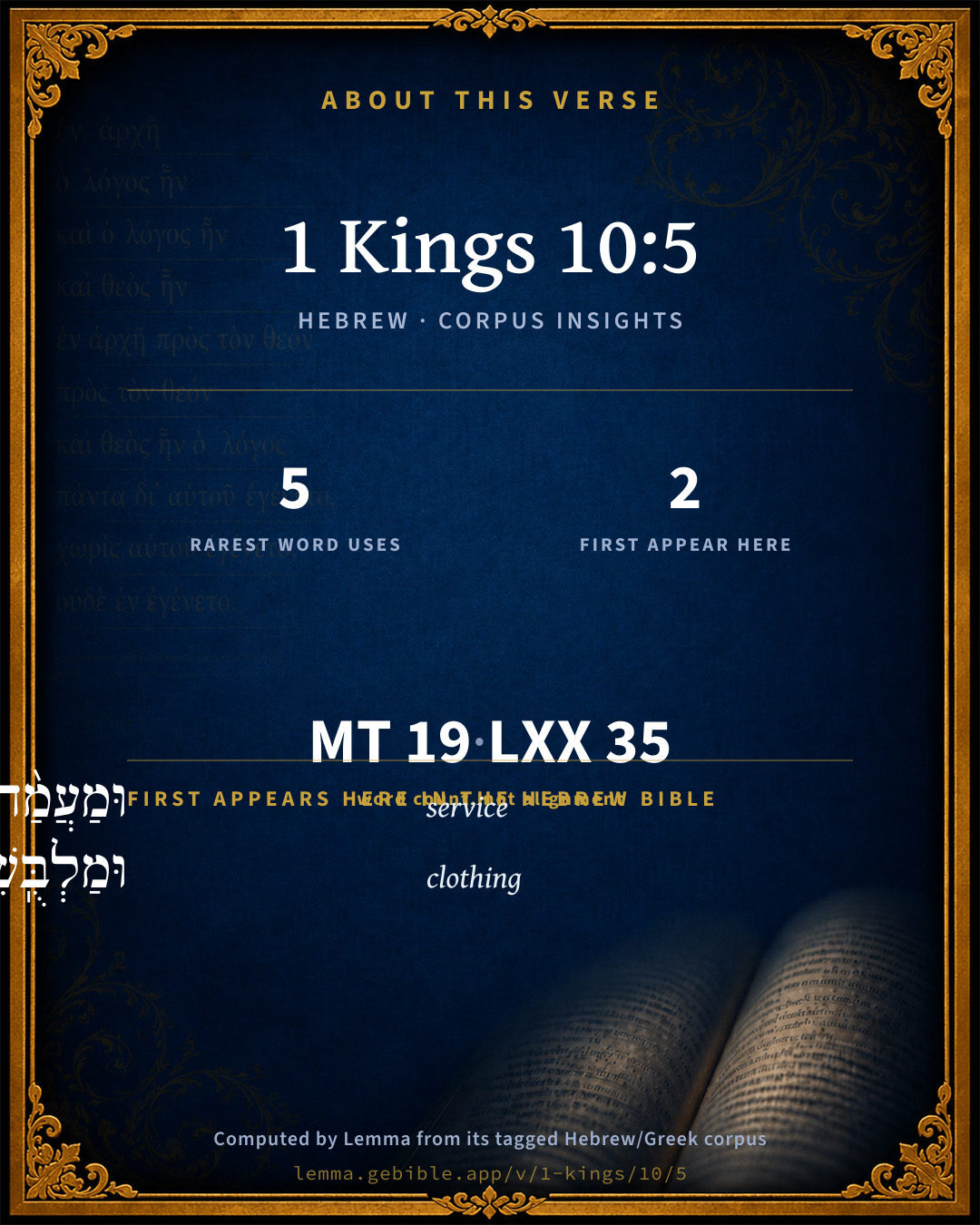
The rarest word here is וּמַעֲמַ֨ד service H4612 — appearing just 5 times in the whole Hebrew Bible.

First appearance in Scripture

These words make their first canonical appearance in the Hebrew Bible here:

  • וּמַעֲמַ֨ד service H4612
  • וּמַלְבֻּֽשֵׁיהֶם֙ clothing H4403

Shared distinctive vocabulary

וּמַעֲמַ֨ד service H4612 occurs in 5 verses of the Hebrew Bible. Also found in:

Grammatical profile

  • 4 verbs
  • 11 nouns
  • 1 preposition
  • 1 adverb
  • 2 particles

Verb forms

  • משרתו Piel · Participle Active
  • מְשָׁרְתָ֜יו Piel · Participle Active
  • יַעֲלֶ֖ה Hiphil · Imperfect
  • הָ֥יָה Qal · Perfect

Repetition

A word recurs within this verse — often emphatic in Hebrew:

  • משרתו to minister H8334 ×2

Hebrew & Septuagint length

In English translation the verse runs 45 words from the Hebrew and 42 from the Septuagint (LXX English) — closely comparable.

A rough comparison of the two English renderings, which tokenize alike — not a word-level alignment.

Word counts can differ between the Hebrew and the Greek without any difference in meaning — e.g. the Hebrew direct-object marker אֵת has no separate Greek word, and Greek often adds the article ὁ.

In the original languages it is 19 Hebrew tokens and 35 Greek tokens — but the two are counted differently (Hebrew bundles its prefixes and suffixes into one token; the Greek is in lemma form), so that isn’t a like-for-like length.

Cross-references

9

Topical passages linked to 1 Kings 10:5 in the Treasury of Scripture Knowledge — connected by theme and wording, ordered by reader-vote popularity; previews shown in the World English Bible.

  • 1 Chronicles 26:16 To Shuppim and Hosah westward, by the gate of Shallecheth, at the causeway that goes up, watch against watch.
  • Joshua 5:1 It happened, when all the kings of the Amorites, who were beyond the Jordan westward, and all the kings of the Canaanites, who were by the sea, heard how that Yahweh had dried up the waters of the Jordan from before the children of Israel, until we were passed over, that their heart melted, neither was there spirit in them any more, because of the children of Israel.
  • 1 Kings 4:22–23 Solomon's provision for one day was thirty measures of fine flour, and sixty measures of meal,
  • 2 Kings 16:18 The covered way for the Sabbath that they had built in the house, and the king's entry outside, turned he to the house of Yahweh, because of the king of Assyria.
  • 1 Chronicles 9:18 who hitherto [waited] in the king's gate eastward: they were the porters for the camp of the children of Levi.
  • 2 Chronicles 9:4 and the food of his table, and the sitting of his servants, and the attendance of his ministers, and their clothing, his cup bearers also, and their clothing, and his ascent by which he went up to the house of Yahweh; there was no more spirit in her.
  • 2 Chronicles 23:13 and she looked, and, behold, the king stood by his pillar at the entrance, and the captains and the trumpets by the king; and all the people of the land rejoiced, and blew trumpets; the singers also [played] on instruments of music, and led the singing of praise. Then Athaliah tore her clothes, and said, Treason! treason!
  • Ezekiel 44:3 As for the prince, he shall sit therein as prince to eat bread before Yahweh; he shall enter by the way of the porch of the gate, and shall go out by the way of the same.
  • Ezekiel 46:2 The prince shall enter by the way of the porch of the gate outside, and shall stand by the post of the gate; and the priests shall prepare his burnt-offering and his peace-offerings, and he shall worship at the threshold of the gate: then he shall go forth; but the gate shall not be shut until the evening.

Cross-references courtesy of OpenBible.info (CC BY 4.0).

Hebrew and Greek witnesses Masoretic Hebrew ↔ Greek Septuagint

The same verse in the two great witnesses to the Old Testament, shown verse-for-verse.

These are two independent witnesses, not word-aligned to each other, and the Septuagint is shown in lemma (dictionary) form.

Hebrew 1 Kings 10:5 Masoretic · Westminster Leningrad Codex

וּמַאֲכַ֣ל שֻׁלְחָנ֡וֹ וּמוֹשַׁ֣ב עֲבָדָיו֩ וּמַעֲמַ֨ד משרתו מְשָׁרְתָ֜יו וּמַלְבֻּֽשֵׁיהֶם֙ וּמַשְׁקָ֔יו וְעֹ֣לָת֔וֹ אֲשֶׁ֥ר יַעֲלֶ֖ה בֵּ֣ית יְהוָ֑ה וְלֹא הָ֥יָה בָ֛הּ ע֖וֹד רֽוּחַ

and the food of his table, and the sitting of his servants, and the attendance of his ministers, and their clothing, and his cup bearers, and his ascent by which he went up to the house of Yahweh; there was no more spirit in her.

World English Bible · Public Domain

Greek LXX 1 Kings 10:5 Septuagint · lemma form

καί ὁ βρῶμα σαλωμών καί ὁ καθέδρα παῖς αὐτός καί ὁ στάσις λειτουργός αὐτός καί ὁ ἱματισμός αὐτός καί ὁ οἰνοχόος αὐτός καί ὁ ὁλοκαύτωσις αὐτός ὅς ἀναφέρω ἐν οἶκος κύριος καί ἐκ ἑαυτοῦ γίγνομαι

and the provision of Solomon and the sitting of his attendants, and the standing of his servants, and his raiment, and his cupbearers, and his whole burnt offering which he offered in the house of the Lord, and she was utterly amazed.

LXX2012 (modern English Septuagint) · Public Domain

On this verse, Adam Clarke's Commentary discusses the Septuagint’s reading. Read the note in Commentary ↓

Hebrew: Westminster Leningrad Codex (CC BY 4.0). Greek: Septuagint (public domain); English from LXX2012 (modern English Septuagint) (Public Domain). How the Septuagint differs from the Hebrew →

Targum (Aramaic paraphrase)

1

The Targum is the ancient Jewish Aramaic paraphrase of the Hebrew Scriptures — an interpretive translation, not the Hebrew text itself. Onkelos (literal) and Pseudo-Jonathan (expansive) render the Torah, and Jonathan the Prophets. Coverage is partial: where no permissively-licensed English translation exists for a verse, only the Aramaic is shown. This is verse-level text, not a word-by-word alignment to the Hebrew.

  1. Targum Jonathan Prophets (Joshua–Malachi)
    וּמֵיכַל פָּתוֹרֵיהּ וְאַסְחָרוּת עַבְדוֹהִי וּמְקָם מְשׁוּמְשָׁנוֹהִי וּלְבוּשֵׁיהוֹן וְשַׁקָיוּתֵיהּ וַעֲלָתֵיהּ דְמַסִיק בֵּית מַקְדְשָׁא דַייָ וְלָא אִשְׁתָּאֵר בָּהּ עוֹד רוּחַ:

    (no public-domain English translation for this verse)

    Targum Jonathan — Aramaic: “Mikraot Gedolot” (public domain). English: “Sefaria Community Translation” (CC0 1.0 (public-domain dedication)); “London "Chaldee Paraphrase," 1871” (public domain). Text via Sefaria.

Commentary

Notes on 1 Kings 10:5 from classic Christian and Jewish commentators (each source and its license shown beneath its notes). The classic Christian expositions comment on the surrounding passage and are grouped to its opening verse, so a note may address several verses; the Jewish commentaries on the Tanakh (Rashi and others) are per-verse, so they appear only where the commentator wrote on this verse.

Lemma curates 59 commentaries, every one of them public domain or Creative Commons licensed, each selected and text-cleaned for this edition rather than reprinted as found. About our sources →

Trapp's Complete Commentary

John Trapp

1Ki 10:5 And the meat of his table, and the sitting of his servants, and the attendance of his ministers, and their apparel, and his cupbearers, and his ascent by which he went up unto the house of the LORD; there was no more spirit in her.

Ver. 5. And his ascent.] Called elsewhere the king’s entry, {2Ki 16:18} and the king’s gate. {1Ch 9:18} A costly and stately piece of work, doubtless. See 1Ki 10:12.

There was no more spirit in her.] She was in an ecstacy of deep admiration; like as afterwards was Nicostratus in Aelian, who finding a curious piece of work, and being wondered at by one, and asked what pleasure he could take to stand gazing as he did on the picture, answered, Hadst thou mine eyes, thou wouldst not wonder, but rather be ravished as I am, at the inimitable art of this rare piece.

John Trapp, A Commentary or Exposition upon All the Books of the Old and New Testament (1647–1656) — public domain. Text from a community e-Sword module.

The Biblical Illustrator

Joseph S. Exell

1Ki_10:5

The meat of his table, and the sitting of his servants.

At the kings table

To be carved for at table by a great prince would be counted as great a favour as the meal itself. To take outward blessings out of Gods hand, to see that He remembereth us, and sendeth in our provision at every turn; this endeareth the mercy, and increaseth our delight therein. What, indeed, would most men give if they could say, The queen herself carved for me, and was most anxious that I should be well supplied? But each believer has the Lord Himself for his Provider. He loads our table, and fills our cup. Providence is no other than God providing. He measures out our joys, weighs our sorrows, appoints our labours, and selects our trials. There is no morsel on the saints plate which is not of the Lords cawing, unless he has been so foolish as to put forth his hand unto iniquity. (C. H. Spurgeon.)

The king and his servants

Those who entertain a king reckon upon receiving his train. It is not fit that he should come alone. So those who receive Jesus by faith into their hearts, receive also His Church, His ministers, His Word, and His cause. They take the Saviour and all His belongings. As the old proverb hath it, Love me, love my dog, so they love all who belong to Jesus for their Lords sake. Where Jesus comes with pardon, He brings all the graces with Him and we are right glad to entertain them all: not only faith, but love, hope, patience, courage, zeal, and the whole band of virtues. It would be idle to say, Christ is in me, if none of the graces of His Spirit lodged within our souls. (C. H. Spurgeon.)

His ascent by which he went up into the house of the Lord.--

Ascent to worship

There are no such steps as these to be found anywhere in the world. A step to honour, a step to riches, a step to worldly glory, these are everywhere, but what are these to the steps by which men do ascend to the house of the Lord. He then that entereth into the house of the Lord is an ascending man; as it is said of Moses, he went up into the mount of God. It is ascending to go into the house of God. The world believes not this; they think it is going downward to go up to the house of God; but they are in a horrible mistake. The steps then by which men go up into the temple are, and ought to be, opposed to those which men take to their lusts and empty glories. Hence such steps are said not only to decline from God, but to take hold of the path to death and hell (Psa_44:18; Pro_2:18; Pro_5:5; Pro_7:25-27). (John Bunyan.)

The Biblical Illustrator, edited by Joseph S. Exell (c. 1880s–1900s) — public domain. Text from a community e-Sword module.

Geneva Bible (1599)

Geneva Bible translators

That is, the whole order, and trade of his house.

Hebrew, there was no more spirit in her.

Geneva Bible (1599) marginal notes — public domain. Text via Bolls.life.

Adam Clarke's Commentary

Verse 5. The meat of his table] The immense supply of all kinds of food daily necessary for the many thousands which were fed at and from his table. See 1Kgs 4:22-23, and the notes there.

And the sitting of his servants] The various orders and distinctions of his officers.

The attendance of his ministers] See the account of these and their attendance, 1Kg 4:1, c.

And their apparel] The peculiarity of their robes, and their splendour and costliness.

And his cup-bearers] The original משקיו mashkaiv may as well be applied to his beverage, or to his drinking utensils, as to his cup-bearers.

And his ascent by which he went up] It seems very strange that the steps to the temple should be such a separate matter of astonishment. The original is ועלתו אשר יעלה בית יהוה which all the versions have translated, And the holocausts which he offered in the house of the Lord. The Vulgate, Septuagint, Chaldee, Syriac, and Arabic, all express this sense: so does the German translation of Luther, from which, in this place, we have most pitifully departed: And seine Brandopfer, die er in dem Hause des Herrn opferte "And his burnt-offering which he offered in the house of the Lord."

There was no more spirit in her.] She was overpowered with astonishment; she fainted. I have seen precisely the same effect produced; a lady who was herself an artist, viewing some exquisitely finished oriental paintings, was so struck with astonishment that she twice nearly fainted, and was obliged to leave the room. What happened to the queen of Sheba is a natural and not an uncommon effect which will be produced in a delicate sensible mind at the sight of rare and extraordinary productions of art.

Of the profusion of Solomon's sacrifices we have already had proof, 1Kg 8:63; 1Kg 9:25.

Adam Clarke's Commentary on the Bible (1810–1826) — public domain. Text from a community e-Sword/MySword module.

The Cambridge Bible for Schools and Colleges

gen. ed. J. J. S. Perowne

5. the sitting of his servants] Here ‘servants’ signifies the officers and distinguished persons who were privileged to sit at the king’s table, and were ranged according to rank and in large numbers at the royal banquets.

the attendance of his ministers] This refers most probably to those persons who stood to serve the guests. The Hebrew word rendered ‘attendance’ is literally ‘standing.’ See A.V. marg.

and his ascent by which he went up unto the house of the Lord] This passage is rendered by the light of the parallel place in 2Ch_9:4. There the word ועליתו does mean ‘and his ascent’, but here the text gives ועלתו, which should be rendered ‘and his burnt offering.’ So that the margin of the R.V. (which is also accepted by Luther, Coverdale and the Geneva Bible) is correct for this verse, ‘and his burnt offering which he offered in the house of the Lord.’ If she had been present at a great sacrifice in the Temple it would doubtless have impressed her much. But it is possible that the scribe in one of these verses made a small error, and that they ought both to be the same. In that case we must decide whether it is more probable that after a list such as has gone before, about meat, servants, attendants, cupbearers, &c., there would follow some mention of a part of the building, a covered way or staircase by which the Temple could be reached from the king’s palace, or a description of a solemn act of religious worship. Most people will be inclined to agree that the A.V. and R.V. have exercised a correct judgement in disregarding the text here, and interpreting by the light of the verse in 2 Chron. The R.V. has however added the rendering of the Massoretic text on the margin, which had not been done in A.V.

The LXX. here gives ‘the burnt offering,’ τὴν ὁλοκαύτωσιν, but its rendering in 2Ch_9:4 is the same τὰ ὁλοκαυτώματα, where certainly the present Hebrew text should be translated ‘his ascent.’ Apparently the Greek translators regarded the verse before us as the true reading.

there was no more spirit in her] Apparently the queen had come with some hope that she might get the better of Solomon, either in her display of queenly splendour, or in the questions which she propounded. What she found was so far in excess of what she had expected, that all thought of comparison of herself with Solomon’s state was gone, and she was lost in admiration. For the expression cf. Jos_5:1.

The Cambridge Bible for Schools and Colleges (gen. ed. J. J. S. Perowne; Cambridge University Press, 1878–1918) — public domain. Text from a community e-Sword module.

John Gill's Exposition

And the meat of his table,.... The various sorts of it, the different dishes, and the multitude of them; see Kg1 4:22.

and the sitting of his servants; at table, either with him, or at tables by themselves, yet in his presence; for these were his nobles and courtiers, who were placed in order, according to their rank and degree, which showed wisdom:

and the attendance of his ministers; or the "standing" (q) of those that waited, both at the king's table, and the tables of the lords, who each had their proper place and business assigned; so that the utmost decorum was observed, and no confusion or disorder to be seen:

and their apparel: their several liveries, which were distinct according to the posts and offices in which they were, and which no doubt were rich and splendid, as well as various:

and his cup bearers; to serve him and his nobles with wine when called for; though the word signifies liquors (r), and may design the various sorts of wines, and other drinkables, used by him, of which there was great plenty:

and his ascent by which he went up unto the house of the Lord; the steps which he had made to go up from his palace to the temple; which were so curiously devised, and so artificially wrought, that it gave the queen, among other things, a sensible proof of his great wisdom, as well as of his religion and piety. The Septuagint, Vulgate Latin, Syriac, and Arabic versions, and some others, render the words, "and the burnt offerings which he offered in the house of the Lord"; and so Josephus (s) understood them; she was shown the service of the house of the Lord, as much as could be admitted, and perhaps was told the meaning of it; all which she saw, both in his own house, and in the house of God, and greatly surprised her:

so that there was no more spirit in her; she was quite astonished; like one in an ecstasy, she had no power for a time to speak, what she saw and heard so affected her.

(q) "statum", Tigurine version, Vatablus, Junius & Tremellius; "stationem", Piscator. (r) "et potum ejus", Tig. vers. so Abarbinel (s) Ut supra. (Antiqu. l. 8. c. 6. sect. 5.)

John Gill's Exposition of the Whole Bible (1746–1763) — public domain (CC PDM 1.0). Text via the HelloAO Bible API.

Albert Barnes' Notes on the Bible

And the meat of his table - Compare 1Ki 4:22-23. The scene here described receives very apt illustration from the Assyrian banquet scenes, where we have numerous guests sitting, dressed handsomely in fringed robes, with armlets upon their arms, and bracelets round their wrists, attendants standing behind them, and magnificent drinking-cups, evidently of a costly metal, in the hands of the guests, which are filled from a great wine-bowl at one end of the chamber.

And his ascent by which he went up - A rendering preferable to “the burnt-offering which he cffered in.” The “ascent” was probably a private way by which the king passed from his palace on the western hill, across the ravine (Tyropoeum) and up the eastern hill, to the west side of the temple area (compare the marginal reference).

Albert Barnes' Notes on the Bible (1834–1885) — public domain. Text from a community e-Sword/MySword module.

Haydock's Catholic Bible Commentary

In her. She fainted away in rapture and astonishment. (Haydock) --- Thus the church of the Gentiles is taught, by the gospel, to lay aside the spirit of pride, &c. (Worthington)

George Leo Haydock (1774–1849), Haydock's Catholic Family Bible and Commentary, 1859 edition — public domain. Excludes Psalms (Douay-Rheims chapter numbering differs from Protestant) and Deuterocanonical books (Catholic canon only).

Matthew Poole's English Annotations

The sitting of his servants, i.e. the order and manner in which his courtiers or other subjects (who all were his servants in a general sense) sat down at meals, at several tables in his court.

The attendance of his ministers, to wit, upon the king, both at his table, and elsewhere in his court; and when he went abroad to the temple or other places,

Their apparel; both the costliness of it:, and especially the conveniency of it to their several places and offices.

His ascent by which he went up unto the house of the Lord from his own palace. See 2Ki 16:18. But the ancients, and some others translate the words thus, and the burnt-offerings which he offered up in the house of the Lord; under which, as the chief, all other sacrifices are understood: when she saw the manner of his offering sacrifices to the Lord, which doubtless she would not neglect to see; and in the ordering of which she might discern really characters of excellent wisdom, especially when she had so excellent an interpreter as Solomon was to inform her of the reasons of all the circumstances of that service.

There was no more spirit in her; she was astonished, and rapt up in a kind of ecstasy, and could scarce determine whether she did really see these things, or whether it was not only a pleasant dream.

Matthew Poole's English Annotations on the Holy Bible (1683–1685) — public domain. Text from a community e-Sword/MySword module.

Whedon's Commentary on the Bible

Daniel D. Whedon

5. Meat of his table — The vast quantity and variety of his provisions.

See 1Ki_4:22-23.

The sitting of his servants — Rather, the seats, or dwelling-places, of his servants. The apartments in the royal palace where they kept themselves ready at any moment to obey the orders of the king.

The attendance — Or, the standing-places. The serving posts or positions of duty assigned to the ministers. All of these were doubtless arranged and adorned in a splendid style.

His ministers — משׁרתיו, a higher order of servants than those whose sitting-places have just been mentioned. They were attendants on the king’s person, stood in his presence, and all their duties brought them more or less into immediate proximity to Solomon.

Cup-bearers — Or butlers; whose office it was to take charge of the royal plate, and to pour out and bring wine to the king. See note on Neh_1:11. Some understand the word of the drinking-vessels which he used.

His ascent — Not the king’s gravity and pious demeanour as he went up to worship in the temple, (Henry,) nor the burnt offering which he offered in the house of the Lord, as the older versions and many commentators thought, but the private entrance or passage-way, magnificently wrought, by which he ascended to the temple from some part of his own house. Compare 2Ki_16:18; 1Ch_26:16. From this it appears that the palace was at a lower elevation than the temple, and probably on the southern slope of Moriah. See note at the beginning of chap. 7.

No more spirit in her — She was completely overwhelmed with wonder and astonishment.

Daniel D. Whedon (gen. ed.), Commentary on the Old and New Testaments (1874–1909) — public domain. Text from a community e-Sword module.

The Pulpit Commentary

And the meat of his table, 1Ki_4:22, 23 and the sitting "The rooms of the courtiers in attendance" (Keil). But b wOm may mean an assembly, (Psa_1:1) and possibly the queen saw them when gathered together for a meal of his servants, and the attendance Heb. standing. According to Keil, "the rooms of the inferior servants." But ver. 8 appears to be decisive against this view of his ministers i.e., those who ministered to him. The word "servants" is, perhaps, to be understood of state officers; the word "ministers" of personal attendants (as in Act_13:5, etc.) That the latter were an inferior class, the "standing" shows, and their apparel cf. Mat_6:29. The rich and costly dress of Eastern courtiers and attendants is sometimes furnished by the king Gen_45:22; 1Sa_18:4; 2Ki_5:5; Dan_5:7; Est_5:8 RAPC 1Ma 10:20. Cf. Chardin, "Voyage en Perse," 3:230, and his cupbearers By this word Keil would understand "drinking arrangements." But see 2Ch_9:4, "cupbearers (same word) and their apparel", and his ascent wOtlO. It is somewhat doubtful whether we are to interpret this word, ascent, or burnt offering. 2Ki_16:18, 1Ch_26:16, . 1Ki_9:25) which the queen witnessed; and

(2) that the sight of burnt offerings could not have caused her any astonishment (Keil). But their prodigious number may surely have done so; and we are certainly to understand that Solomon was remarkable for the scale of his sacrifices. Considering, however, that the word undoubtedly means "ascent" in; Eze_40:26, and that it is so paraphrased by the chronicler, it is perhaps safer to retain this rendering here there was no more spirit in her same expression Jos_5:1, and cf. 2:11. Forvarious legends as to this queen, see Stanley, "Jewish Ch." 2. pp. 234236.

The Pulpit Commentary (1880–1919), ed. H.D.M. Spence-Jones & Joseph S. Exell — public domain. Text from a community e-Sword module.

John Wesley's Explanatory Notes

Sitting - The order and manner in which his courtiers, or other subjects (who all were his servants in a general sense) sat down at meals, at several tables in his court. Attendance - Upon the king, both at his table, and in his court; and when he went abroad to the temple or other places. Apparel - Both the costliness of it, and especially the agreeableness of it to their several places and offices. Went up - From his own palace. See 2 Kings xvi, 18, but the ancients, and some others, translate the words thus, and the burnt-offerings which he offered up in the house of the Lord; under which, is the chief, all other sacrifices are understood: when she saw the manner of his offering sacrifices to the Lord; which doubtless she would not neglect to see; and in the ordering of which she might discern many characters of excellent wisdom, especially when she had so excellent an interpreter as Solomon was, to inform her of the reasons of all the circumstances of that service. No spirit - She was astonished, and could scarcely determine whether she really saw these things, or whether it was only a pleasant dream.

John Wesley, Explanatory Notes Upon the Whole Bible (1754–1765) — public domain. Text via the GEBible commentary corpus.

Rashi

Rabbi Shlomo Yitzchaki (Rashi)

And his elevated ramp by which he would go up to the Beis Hamikdosh of Adonoy. By means of a passageway that he had prepared from his house to the Beis Hamikdosh, by which he would go up to the House of God.

Rashi on the Tanakh — English translations: “The Judaica Press complete Tanach with Rashi, translated by A. J. Rosenberg” (CC BY 4.0); “Pentateuch with Rashi's commentary by M. Rosenbaum and A.M. Silbermann, 1929-1934” (public domain); “The Metsudah Tanach series, Lakewood, N.J” (CC BY 4.0); and “The Book of Joshua, Metsudah Publications, 1997” (CC BY 4.0). Text via Sefaria.

Lesson kit

Teaching starters — assembled from the data on this page, not authored interpretation. Every prompt links to the verse data it draws on. Edit before teaching.

1 Kings, in the Historical, opens this verse with 19 words (17 distinct Hebrew lemmas). Its most distinctive word is maʻămâd (“service”). A historical commentator’s framing appears above. Read the whole chapter for the surrounding context.

Discussion questions

  1. What does “service” (maʻămâd) contribute to the verse as a whole?
  2. 2 words make their first appearance in Scripture here. What does this debut establish?
  3. How does 1 Chronicles 23:28, which shares the word «service», read alongside this verse?
  4. What does the repetition of “to minister” (2× in this one verse) do in this verse?
  5. These translations render this verse differently. What is at stake in choosing one wording over another?
  6. «משרתו» is a Piel Participle Active verb. How does that grammatical form shape the action described?
  7. Compare how Trapp's Complete Commentary and The Biblical Illustrator read this verse. Where do they agree or differ?

Things to notice

Reading settings

Reading text

Shown beneath each verse's original-language words.

Old Testament
Old Testament edition

Read the OT as the Masoretic Hebrew (MT) or the Greek Septuagint (LXX).

English shown for the Greek Septuagint (in the Hebrew ↔ Greek comparison).

Comparing translations? Open the Compare panel on any verse page to stack up to four side by side.