
Leviticus 11:26

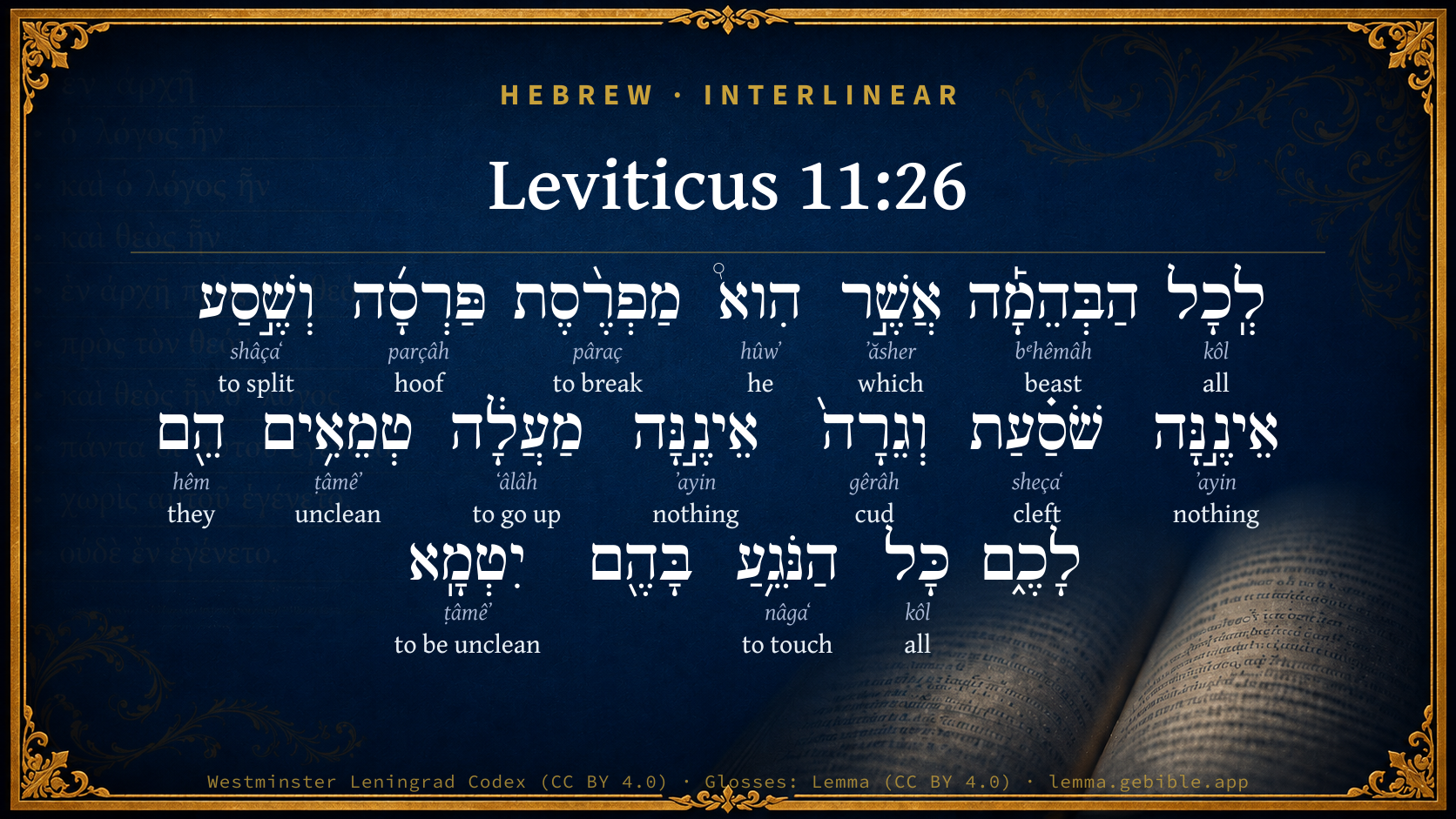
Hebrew (Westminster Leningrad Codex) Leviticus 11:26 appears in the Hebrew Old Testament. The text above is from the Westminster Leningrad Codex. Each word links to its Strong’s number, a concise gloss, and parsing drawn from the Open Scriptures Hebrew Bible morphology. Click any word for its full Brown-Driver-Briggs (BDB) entry.
Download image
Cite this verse

Leviticus 11:26 (World English Bible). Public Domain. Lemma interlinear Bible study tool, https://lemma.gebible.app/v/leviticus/11/26.

Show BibTeX & RIS
BibTeX
RIS
English Translation
"'Every animal which parts the hoof, and is not cloven-footed, nor chews the cud, is unclean to you. Everyone who touches them shall be unclean.
World English Bible · Public Domain
Download a study sheet

One document with this verse’s original text, its word-by-word gloss line, the meaning frame, cross-references with their text, attributed commentary, and full source and license credits — printable, and it pastes into notes with its structure intact.

This verse Autodidact and up

Study sheet (.html) Plain text (.txt)

A passage Seminary Student

Up to 50 verses in one chapter. A passage sheet keeps up to 6 commentary sources and 12 cross-references per verse, in the order this page ranks them, and says so on the sheet whenever that leaves anything out. Ask for a single verse and you get the Autodidact verse sheet above.

Everything on this page stays free to read, with no account — the sheet is a download of what is already on screen, not access to it.

Want to remove ads? Support Godless Engineer
Compare translations 3

The same verse in 3 English versions, stacked beneath the original-language interlinear above. Click any original word for its lexicon entry.

Each is an independent rendering of the whole verse — the interlinear is not word-aligned to these translations.

Highlighted words mark where these versions differ — a whole-verse word diff, not a word-by-word alignment.

  • World English Bible Public Domain
    "'Every animal which parts the hoof, and is not cloven-footed, nor chews the cud, is unclean to you. Everyone who touches them shall be unclean.
  • King James Version Public Domain
    The carcasses of every beast which divideth the hoof, and is not cloven-footed, nor cheweth the cud, are unclean unto you: every one that toucheth them shall be unclean.
  • unfoldingWord Literal Text CC BY-SA 4.0
    To any livestock that it dividing the hoof, but it is not splitting the cleft, and it is not making the cud go up—they unclean to you. Anyone who touches them will become unclean.

unfoldingWord Literal Text — © unfoldingWord, licensed CC BY-SA 4.0. Word-aligned USFM3 via Door43 (git.door43.org/unfoldingWord/en_ult).

Versions to compare (up to 4)

3 of 4 selected

Show all 18 translations

Every available English version of this verse, each an independent rendering of the whole verse.

  • World English Bible Public Domain
    "'Every animal which parts the hoof, and is not cloven-footed, nor chews the cud, is unclean to you. Everyone who touches them shall be unclean.
  • Berean Standard Bible Public Domain
    Every animal with hooves not completely divided or that does not chew the cud is unclean for you. Whoever touches any of them will be unclean.
  • Majority Standard Bible Public Domain
    Every animal with hooves not completely divided or that does not chew the cud is unclean for you. Whoever touches any of them will be unclean.
  • King James Version Public Domain
    The carcasses of every beast which divideth the hoof, and is not cloven-footed, nor cheweth the cud, are unclean unto you: every one that toucheth them shall be unclean.
  • American Standard Version (1901) Public Domain
    Every beast which parteth the hoof, and is not clovenfooted, nor cheweth the cud, is unclean unto you: every one that toucheth them shall be unclean.
  • Revised Version (1885) Public Domain
    Every beast which parteth the hoof, and is not clovenfooted, nor cheweth the cud, is unclean unto you: every one that toucheth them shall be unclean.
  • Geneva Bible (1599) Public Domain
    Euery beast that hath clawes deuided, and is not clouen footed, nor cheweth the cud, such shalbe vncleane vnto you: euery one that toucheth them, shalbe vncleane.
  • Douay-Rheims (1899) Public Domain
    Every beast that hath a hoof, but divideth it not, nor cheweth the cud, shall be unclean: and he that toucheth it, shall be defiled.
  • Young's Literal Translation Public Domain
    even every beast which is dividing the hoof, and is not cloven-footed, and the cud is not bringing up -- unclean they `are' to you; any one who is coming against them is unclean.
  • Literal Standard Version CC BY-SA 4.0
    even every beast which is dividing the hoof, and is not cloven-footed, and is not bringing up the cud—they [are] unclean to you; anyone who is coming against them is unclean.
  • Unlocked Literal Bible CC BY-SA 4.0
    Every animal which has a split hoof that is not completely divided or which does not chew the cud is unclean to you. Everyone who touches them will be unclean.
  • unfoldingWord Literal Text CC BY-SA 4.0
    To any livestock that it dividing the hoof, but it is not splitting the cleft, and it is not making the cud go up—they unclean to you. Anyone who touches them will become unclean.
  • Darby Bible Public Domain
    Every beast that hath cloven hoofs, but not feet quite split open, nor cheweth the cud, shall be unclean unto you: every one that toucheth them shall be unclean.
  • World Messianic Bible Public Domain
    “‘Every animal which has a split hoof that isn’t completely divided, or doesn’t chew the cud, is unclean to you. Everyone who touches them shall be unclean.
  • Webster's Bible Public Domain
    The carcasses of every beast which divideth the hoof, and is not cloven-footed, nor cheweth the cud, are unclean to you: every one that toucheth them shall be unclean.
  • Free Bible Version CC BY-SA 4.0
    Every animal with hooves that are not divided, or that does not chew the cud, is unclean for you. If you touch any of them you will be unclean.
  • Bible in Basic English Public Domain
    Every beast, in the horn of whose foot there is not a complete division, and whose food does not come back, is unclean to you: anyone touching one of these will be unclean.
  • JPS Tanakh (1917) Public Domain
    Every beast which parteth the hoof, but is not cloven footed, nor cheweth the cud, is unclean unto you; every one that toucheth them shall be unclean.

Literal Standard Version (2020), Covenant Press — licensed CC BY-SA 4.0. Text via the HelloAO Bible API (eBible.org). Unlocked Literal Bible (unfoldingWord) — licensed CC BY-SA 4.0. Text via the HelloAO Bible API (eBible.org). unfoldingWord Literal Text — © unfoldingWord, licensed CC BY-SA 4.0. Word-aligned USFM3 via Door43 (git.door43.org/unfoldingWord/en_ult). Free Bible Version, Dr. Jonathan Gallagher — licensed CC BY-SA 4.0. Text via the HelloAO Bible API (eBible.org).

Word by word

More ways to search: Search by grammar → Find every occurrence → Compare this word →

Practice this passage: Drill this verse → Learn its vocabulary →

שֹׁסַ֗עַת
sheçaʻ
H8157
“cleft”
Verb, Qal, Participle Active, Feminine, Singular, Absolute
Part of Speech
Verb
Stem
Qal
Form
Participle Active
Gender
Feminine
Number
Singular
State
Absolute
Full BDB Definition

Origin: from H8156

TWOT: 2427a

cleft, cloven, split
  1. לְֽכָל kôl H3605 “to/for · all of” Preposition + Noun, Common, Masculine, Singular, Construct
  2. הַבְּהֵמָ֡ה bᵉhêmâh H929 “the · beast” Particle, Definite Article + Noun, Common, Feminine, Singular, Absolute
  3. אֲשֶׁ֣ר ʼăsher H834 “which” Particle, Relative
  4. הִוא֩ hûwʼ H1931 “he” Pronoun, Personal, 3rd Person, Feminine, Singular
  5. מַפְרֶ֨סֶת pâraç H6536 “breaking” Verb, Hiphil, Participle Active, Feminine, Singular, Absolute
  6. פַּרְסָ֜ה parçâh H6541 “hoof” Noun, Common, Feminine, Singular, Absolute
  7. וְשֶׁ֣סַע shâçaʻ H8156 “and · cleft” Conjunction + Noun, Common, Masculine, Singular, Absolute
  8. אֵינֶ֣נָּה ʼayin H369 “nothing · her” Particle, Negative + Suffix, Personal, 3rd Person, Feminine, Singular
  9. וְגֵרָה֙ gêrâh H1625 “and · cud” Conjunction + Noun, Common, Feminine, Singular, Absolute
  10. אֵינֶ֣נָּה ʼayin H369 “nothing · her” Particle, Negative + Suffix, Personal, 3rd Person, Feminine, Singular
  11. מַעֲלָ֔ה ʻâlâh H5927 “going up” Verb, Hiphil, Participle Active, Feminine, Singular, Absolute
  12. טְמֵאִ֥ים ṭâmêʼ H2931 “unclean” Adjective, Adjective, Masculine, Plural, Absolute
  13. הֵ֖ם hêm H1992 “they” Pronoun, Personal, 3rd Person, Masculine, Plural
  14. כָּל kôl H3605 “all of” Noun, Common, Masculine, Singular, Construct
  15. הַנֹּגֵ֥עַ nâgaʻ H5060 “the · touching” Particle, Definite Article + Verb, Qal, Participle Active, Masculine, Singular, Absolute
  16. יִטְמָֽא ṭâmêʼ H2930 “to be unclean” Verb, Qal, Imperfect, 3rd Person, Masculine, Singular

About this verse

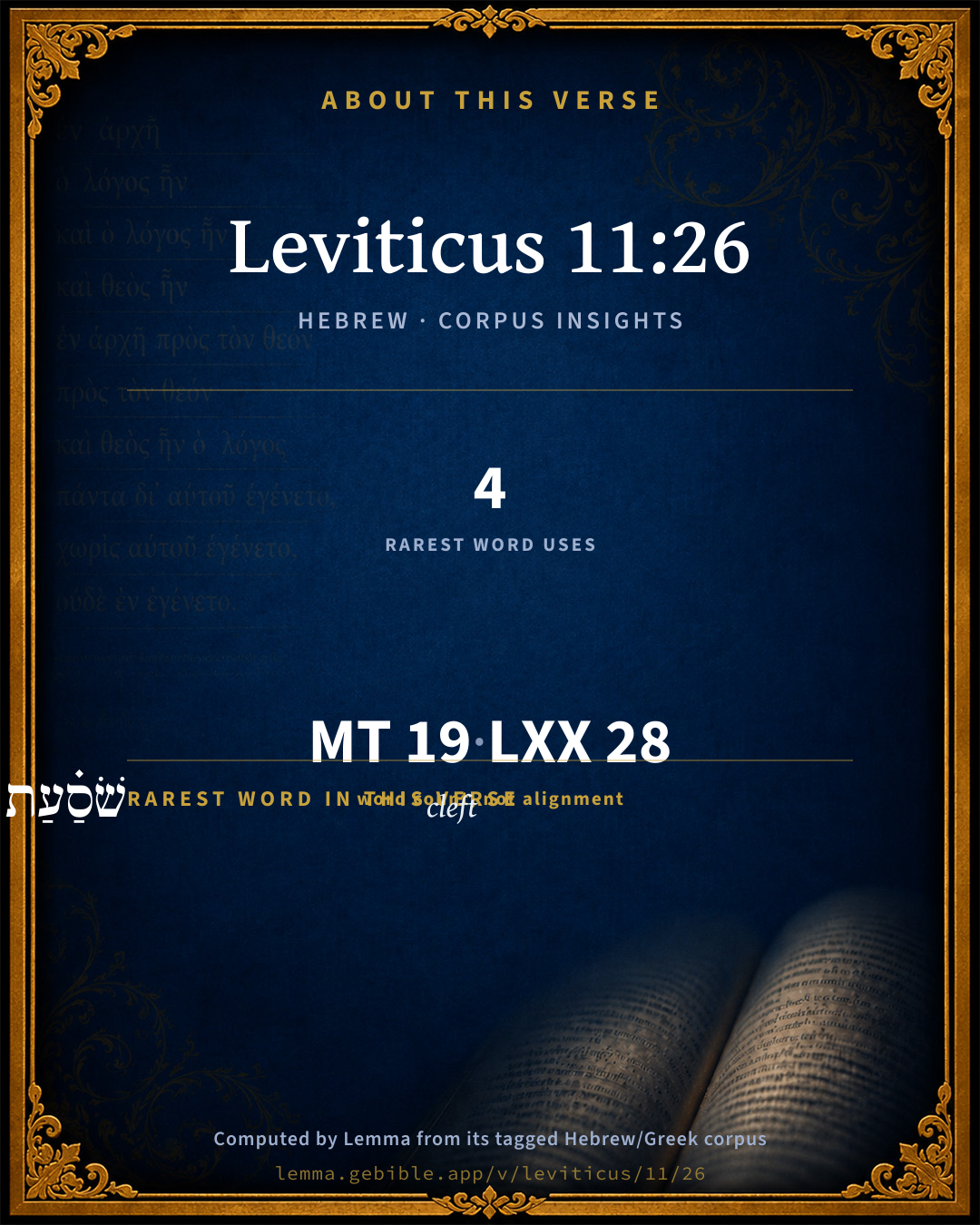
These counts appear in no published source. They are computed here, from the morphology-tagged text and Lemma’s own curated glosses. What Lemma adds →

19
words
15
distinct lemmas
Pentateuch
section

Notable vocabulary

The rarest word here is שֹׁסַ֗עַת cleft H8157 — appearing just 4 times in the whole Hebrew Bible.

Shared distinctive vocabulary

שֹׁסַ֗עַת cleft H8157 occurs in 4 verses of the Hebrew Bible. Also found in:

Grammatical profile

  • 5 verbs
  • 6 nouns
  • 1 adjective
  • 2 pronouns
  • 2 prepositions
  • 3 particles

Verb forms

  • מַפְרֶ֨סֶת Hiphil · Participle Active
  • שֹׁסַ֗עַת Qal · Participle Active
  • מַעֲלָ֔ה Hiphil · Participle Active
  • הַנֹּגֵ֥עַ Qal · Participle Active
  • יִטְמָֽא Qal · Imperfect

Repetition

Words recur within this verse — often emphatic in Hebrew:

  • לְֽכָל all H3605 ×2
  • אֵינֶ֣נָּה nothing H369 ×2

Hebrew & Septuagint length

In English translation the verse runs 25 words from the Hebrew and 34 from the Septuagint (LXX English) — closely comparable.

A rough comparison of the two English renderings, which tokenize alike — not a word-level alignment.

Word counts can differ between the Hebrew and the Greek without any difference in meaning — e.g. the Hebrew direct-object marker אֵת has no separate Greek word, and Greek often adds the article ὁ.

In the original languages it is 19 Hebrew tokens and 28 Greek tokens — but the two are counted differently (Hebrew bundles its prefixes and suffixes into one token; the Greek is in lemma form), so that isn’t a like-for-like length.

Hebrew and Greek witnesses Masoretic Hebrew ↔ Greek Septuagint

The same verse in the two great witnesses to the Old Testament, shown verse-for-verse.

These are two independent witnesses, not word-aligned to each other, and the Septuagint is shown in lemma (dictionary) form.

Hebrew Leviticus 11:26 Masoretic · Westminster Leningrad Codex

לְֽכָל הַבְּהֵמָ֡ה אֲשֶׁ֣ר הִוא֩ מַפְרֶ֨סֶת פַּרְסָ֜ה וְשֶׁ֣סַע אֵינֶ֣נָּה שֹׁסַ֗עַת וְגֵרָה֙ אֵינֶ֣נָּה מַעֲלָ֔ה טְמֵאִ֥ים הֵ֖ם לָכֶ֑ם כָּל הַנֹּגֵ֥עַ בָּהֶ֖ם יִטְמָֽא

"'Every animal which parts the hoof, and is not cloven-footed, nor chews the cud, is unclean to you. Everyone who touches them shall be unclean.

World English Bible · Public Domain

Greek LXX Leviticus 11:26 Septuagint · lemma form

ἐν πᾶς ὁ κτῆνος ὅς εἰμί διχηλέω ὁπλή καί ὀνυχιστήρ ὀνυχίζω καί μηρυκισμός οὐ μηρυκάομαι ἀκάθαρτος εἰμί σύ πᾶς ὁ ἅπτομαι ὁ θνησιμαῖος αὐτός ἀκάθαρτος εἰμί ἕως ἑσπέρα

And whichever among the beasts divides the hoof and makes claws, and does not chew the cud, shall be unclean to you; every one that touches their dead bodies shall be unclean till evening.

LXX2012 (modern English Septuagint) · Public Domain

Hebrew: Westminster Leningrad Codex (CC BY 4.0). Greek: Septuagint (public domain); English from LXX2012 (modern English Septuagint) (Public Domain). How the Septuagint differs from the Hebrew →

Targum (Aramaic paraphrase)

2

The Targum is the ancient Jewish Aramaic paraphrase of the Hebrew Scriptures — an interpretive translation, not the Hebrew text itself. Onkelos (literal) and Pseudo-Jonathan (expansive) render the Torah, and Jonathan the Prophets. Coverage is partial: where no permissively-licensed English translation exists for a verse, only the Aramaic is shown. This is verse-level text, not a word-by-word alignment to the Hebrew.

  1. Targum Onkelos Torah (Genesis–Deuteronomy)
    לְכָל בְּעִירָא דִי הִיא סְדִיקָא פַרְסָתָא וְטִלְפִין לֵיתָהָא מַטִלְפָא וּפִשְׁרָא לֵיתָהָא מַסְקָא מְסָאֲבִין אִנוּן לְכוֹן כָּל דְיִקְרַב בְּהוֹן יְהֵי מְסָאָב

    (no public-domain English translation for this verse)

    Targum Onkelos — Aramaic: “Onkelos Genesis” (public domain); “Onkelos Exodus” (public domain); “Onkelos Leviticus” (public domain); “Onkelos Numbers” (public domain); “Onkelos Deuteronomy” (public domain). English: “Sefaria Community Translation” (CC0 1.0 (public-domain dedication)); “J.W. Etheridge. The Targums of Onkelos and Jonathan Ben Uzziel on the Pentateuch. London: Longmans, Green, 1862” (public domain). Text via Sefaria.

  2. Targum Pseudo-Jonathan Torah (Genesis–Deuteronomy)
    לְכָל בְּעִירָא דְהִיא סְדִיקָא פַרְסָתָא וְטִילְפוּן לַיְתָהּ מְטַלְפָא וּפִישְׁרָא לֵיתָהָא מַסְקָא מְסָאֲבִין הִינוּן לְכוֹן כָּל דְיִקְרַב בְּהוֹן יְהֵי מְסָאָב

    All cattle which divide the hoof, but are not cloven-footed nor throw up the cud, are to be unclean to you any one who toucheth them shall be unclean.

    Targum Pseudo-Jonathan — Aramaic: “Targum Jonathan on Genesis” (public domain); “Targum Jonathan on Exodus” (public domain); “Targum Jonathan on Leviticus” (public domain); “Targum Jonathan on Numbers” (public domain); “Targum Jonathan on Deuteronomy” (public domain). English: “The Targum of Jonathan ben Uzziel, trans. J. W. Etheridge, London, 1862” (public domain). Text via Sefaria.

Commentary

Notes on Leviticus 11:26 from classic Christian and Jewish commentators (each source and its license shown beneath its notes). The classic Christian expositions comment on the surrounding passage and are grouped to its opening verse, so a note may address several verses; the Jewish commentaries on the Tanakh (Rashi and others) are per-verse, so they appear only where the commentator wrote on this verse.

Lemma curates 59 commentaries, every one of them public domain or Creative Commons licensed, each selected and text-cleaned for this edition rather than reprinted as found. About our sources →

Trapp's Complete Commentary

John Trapp

Lev 11:26 [The carcases] of every beast which divideth the hoof, and [is] not clovenfooted, nor cheweth the cud, [are] unclean unto you: every one that toucheth them shall be unclean.

Ver. 26. Not cloven footed.] See on Lev 11:5.

John Trapp, A Commentary or Exposition upon All the Books of the Old and New Testament (1647–1656) — public domain. Text from a community e-Sword module.

Joseph Benson's Commentary

Lev 11:26. The carcasses of every beast, &c., are unclean — They were prohibited from touching their dead bodies, but not their bodies when alive: for they used camels, horses, asses, &c., for necessary service, Lev 11:31.

Joseph Benson's Commentary on the Old and New Testaments (1811–1818) — public domain. Text from a community e-Sword module.

Whedon's Commentary on the Bible

Daniel D. Whedon

CONCERNING LARGER ANIMALS, Lev_11:26-28.

This section contains a prohibition of all quadrupeds not dividing the hoof and chewing the cud, together with the penalty for touching their carcasses. It is a summary of Lev_11:1-8, with the prohibition of whatsoever goeth upon his paws.

Daniel D. Whedon (gen. ed.), Commentary on the Old and New Testaments (1874–1909) — public domain. Text from a community e-Sword module.

Geneva Bible (1599)

Geneva Bible translators

Or, hath not his foot cloven in two.

Geneva Bible (1599) marginal notes — public domain. Text via Bolls.life.

Jamieson, Fausset & Brown

Robert Jamieson, A. R. Fausset & David Brown

every beast . . . not cloven-footed--The prohibited animals under this description include not only the beasts which have a single hoof, as horses and asses, but those also which divided the foot into paws, as lions, tigers, &c.

Jamieson, Fausset & Brown — Commentary Critical and Explanatory on the Whole Bible (1871) — public domain (CC PDM 1.0). Text via the HelloAO Bible API.

Ellicott's Commentary for English Readers

(26) The carcases of every beast.—The construction of this text constituted one of the differences between the Pharisees and the Sadducees during the second Temple. According to the Pharisees, or the National Church in the time of Christ, the phrase “that toucheth them” in the last part of this verse refers to “the carcases” of the unclean animals spoken of in the preceding verse. It was only when an unclean animal was dead, whether death was owing to natural causes, design, or accident, that contact with its body defiled (see Lev_11:8; Lev_11:31); but when alive, unclean animals were freely used. Hence camels, asses, horses, &c, were employed in daily life, though unclean (1Ch_12:40; Zec_14:15; Mat_21:2; Luk_13:15, &c.). The Authorised Version rightly expresses this sense by inserting “the carcases” in italics at the beginning of the verse, thus showing that “them” in the latter part of the verse refers to the bodies of unclean animals when dead. Indeed some MSS. have actually “that toucheth their carcases,” instead of “that toucheth them.” The Sadducees, however, took the expression “them” to refer to the living unclean animals, and hence maintained that touching the body of any animal described in this dietary list as unclean defiled. The difference which this interpretation of the text produced in the domestic life and social intercourse of the Jews can hardly be described, since, according to the doctrine of the Sadducees, it was exceedingly difficult to remain undefiled as soon as one of them stepped outside their dwellings.

A Bible Commentary for English Readers, edited by Charles John Ellicott (1878–1897) — public domain. Text from a community e-Sword module.

John Gill's Exposition

The carcasses of every beast which divideth the hoof, and is not cloven footed,.... As the camel:

nor cheweth the cud; though it may divide the hoof, as the swine; and on the other hand, such as may chew the cud, and yet not dividing the hoof, as the coney and hare; for the Scripture here, as Aben Ezra observes again, uses a short and concise way of speaking: these

are unclean unto you; to be reckoned by them such, and neither to be eaten nor touched:

everyone that toucheth them shall be unclean; until the evening; and obliged to washing, though not expressed: this is not to be understood of touching them while alive, as some Sadducees or Karaites understand it, according to Aben Ezra; for camels, horses, mules, &c. might be, and were rode upon, and so touched; but of them when dead, or their carcases, as is rightly supplied in the beginning of the verse; and the Jewish writers (c) understand this of the flesh of the carcass only, not of the bones, horns, and hoofs, which, they say, do not defile, only the flesh: this is repeated from Lev 11:8.

(c) Misn. Edaiot, c. 6. sect. 3. & Maimon. & Bartenora in ib.

John Gill's Exposition of the Whole Bible (1746–1763) — public domain (CC PDM 1.0). Text via the HelloAO Bible API.

Haydock's Catholic Bible Commentary

It. When dead. It was lawful to ride on a camel, but not to eat its flesh.

George Leo Haydock (1774–1849), Haydock's Catholic Family Bible and Commentary, 1859 edition — public domain. Excludes Psalms (Douay-Rheims chapter numbering differs from Protestant) and Deuterocanonical books (Catholic canon only).

Matthew Poole's English Annotations

The word carcasses is easily to be understood out of Lev 11:24,25, where it is expressed.

Matthew Poole's English Annotations on the Holy Bible (1683–1685) — public domain. Text from a community e-Sword/MySword module.

The Pulpit Commentary

Vers. 26-47. Unclean, creeping, and dead things.

It is evident, from the concluding verses of this chapter (see verses 43, 44), that these laws were designed to teach the nature of the holiness of God. It therefore follows, unless that holiness consist in not eating the flesh or touching the carcasses of certain creatures, which it would be absurd to suppose, these creatures must in their habits represent evils which men should abominate, and clean creatures, on the contrary, virtues which they should cultivate. Let us therefore seek the spiritual lessons from

I THE UNCLEAN CHEEPING THINGS THAT CREEP. These are opposed to creeping things that leap, some of which are clean (see verses 21, 22). Their steady attachment to the earth, never rising above it, represents an inveterate worldliness which a holy people must hold in abhorrence. Samples are given under the following groupings (see verse 42), viz.:

1. Those that have no feet, "Whatsoever goeth upon the belly.

(1) Serpents, snakes, vipers, and worms of all kinds are included under this description. The serpent has given its name to Satan ever since he enshrined himself in a creature of that kind. (see Gen_3:1 2Co_11:3 Rev_12:9 Rev_20:2) And wicked men are the "children of the devil," and so are described as the "seed of the serpent," and a "generation of vipers". (Gen_3:15 Mat_3:7)

(2) Serpents are abominable for their unclean habits, lurking in the dust or mire, and eating their meat from the dust. (Gen_3:14 Isa_65:25 Mic_7:17) Worms are bred in corruption and feast upon carrion. (Exo_16:20 Job_7:5 Job_19:24 Act_12:23) What a picture of those who wallow in sin! Serpents are double-tongued, (Psa_140:3) teaching us to abhor deception. They nourish poison, which is deadly, (Num_21:9) teaching us to detest malignity. (see Isa_41:24, margin; Rom_3:13) The worm of the damned dieth not. (Isa_66:24 Mar_9:44)

2. Those that have four feet, "Whatsoever goeth upon all four.

(1) The weasel and the ferret are remarkable for their stealthy sliding motion in closing upon their prey. They teach us that slyness and treachery arc an aggravation of violence, which should be held in abomination. The" mouse" (verse 29) is to be taken as the representative of everything of the mus kind; but it is difficult to say what animal is meant by the word (jzy) rendered" tortoise." By some it is thought to be the crocodile; by others the toad. Its name indicates some habit of swelling, and may teach us to abominate all impudence, ostentation, and vanity.

(2) The animal called "chameleon" (verse 30) is by some thought to be the mongoose, a creature which eats snakes, rats, mice, and other vermin; while Bochart concludes that the chameleon is intended by the word we translate "mole." Creatures of the lizard kind, excepting the aquatic sort, such as the crocodile, live on flies. God makes some unclean creatures useful in exterminating others; so he deals amongst wicked nations, punishing them by one another in their turn.

3. Those that have more feet.

(1) Under this description we have centipedes, caterpillars, perhaps, and innumerable creatures, with legs more in number than four. Amongst these there is scope for naturalists to describe qualities all which will convey moral lessons.

(2) The one thing we mark in creatures that "multiply feet," as the Hebrew expresses it, is the slowness yet steadiness and stillness of their progress. The stealthy, insinuating false teachers who troubled the early Churches, and who have their representatives ha modern times, are compared to these creeping things. (see 2Ti_3:6 Jud_1:4)

II THE LAWS OF CONTAMINATION. These are ranged under two heads:

1. The polluting of persons.

(1) This is done by their touching the carcass of an unclean creature. Whatsoever is unfit for food must not be touched. (see Gen_3:3) Whom we cannot commune with we must avoid.

(2) It may be done by their touching the carcass of a creature originally clean that has died of itself. Because in this case it could not be a type of Christ, who died voluntarily, for he had no sin of his own to doom him to die. All intercourse of Christians should be in Christ, who is our life.

2. The polluting of things.

(1) Vessels of any sort are rendered unclean by contact with the carcass of an unclean thing. These represent human beings in the capacity of servants, whether to God or man. (Rom_9:21 2Ti_2:20, 2Ti_2:21) Some being polluted are to be broken, to show that sin leads to destruction. (Rom_9:22) Others may be purified by water, to show that sin may be removed by the sanctifying grace of the Spirit of God. There is a happy time coming. (see Zec_14:20, Zec_14:21)

(2) Clean meat may become polluted by contact with anything unclean. This law teaches that "evil communications corrupt good manners.

(3) If an unclean thing fall into a fountain or well in which there is plenty of water, it does not render the water unclean (verse 36). The living water is an emblem of the Holy Spirit, who cannot be rendered unholy by anything that sinners may do. For a like reason, perhaps, seed that is to be sown, which is a figure of Christ, cannot be rendered impure (verse 37). But if water be put upon the seed for any other purpose, the figure is changed and the case is altered (verse 38). J.A.M.

The Pulpit Commentary (1880–1919), ed. H.D.M. Spence-Jones & Joseph S. Exell — public domain. Text from a community e-Sword module.

unfoldingWord translationNotes

Door43 World Missions Community

General Information:

Yahweh continues telling Moses and Aaron which animals the people are to consider unclean.

Every animal ... is unclean to you

These animals that God declared to be unfit for the people to eat are spoken of as if they were physically dirty. (See: Metaphor)

split hoof

This means a hoof that is split into two parts instead of being one whole. See how you translated these in Leviticus 11:3.

chew the cud

This means an animal that brings its food up from its stomach and chews it again. See how you translated these in Leviticus 11:3.

Everyone who touches them will be unclean

A person who is unacceptable for God's purposes because he has touched one of these animals is spoken of as if he were physically unclean. (See: Metaphor)

paws

animal feet with claws

until the evening

"until sunset"

translationWords

hoof

clean

unfoldingWord translationNotes — © Distant Shores Media and the Door43 World Missions Community, licensed CC BY-SA 4.0. Source: git.door43.org/Door43/en_tn.

Rashi

Rabbi Shlomo Yitzchaki (Rashi)

מפרסת פרסה ושסע איננה שסעת WHICH DIVIDETH THE HOOF AND IS NOT CLOVEN FOOTED, such as the camel, the hoof of which is split on top but is attached below (see Rashi on v. 3); here it tells you that the carcass of an unclean animal causes uncleanness and in the paragraph which is at the end of this section (vv. 39–40) it sets forth the law concerning the carcass of a clean animal.

Rashi on the Tanakh — English translations: “The Judaica Press complete Tanach with Rashi, translated by A. J. Rosenberg” (CC BY 4.0); “Pentateuch with Rashi's commentary by M. Rosenbaum and A.M. Silbermann, 1929-1934” (public domain); “The Metsudah Tanach series, Lakewood, N.J” (CC BY 4.0); and “The Book of Joshua, Metsudah Publications, 1997” (CC BY 4.0). Text via Sefaria.

Lesson kit

Teaching starters — assembled from the data on this page, not authored interpretation. Every prompt links to the verse data it draws on. Edit before teaching.

Leviticus, in the Pentateuch, opens this verse with 19 words (15 distinct Hebrew lemmas). Its most distinctive word is sheçaʻ (“cleft”). A historical commentator’s framing appears above. Read the whole chapter for the surrounding context.

Discussion questions

  1. What does “cleft” (sheçaʻ) contribute to the verse as a whole?
  2. Leviticus 11:3 shares the word «cleft» with this verse. How do the two illuminate each other?
  3. “all” occurs 2× in this one verse. What is the effect of the repetition?
  4. The translations on this page render this verse differently — a whole-verse word diff, not a word-by-word alignment. What might account for the different wordings?
  5. The verb «מַפְרֶ֨סֶת» is Hiphil Participle Active. How does its form color the action?
  6. Reading how Trapp's Complete Commentary and Joseph Benson's Commentary read this verse, where do the two commentators agree and where do they part?

Things to notice

Reading settings

Reading text

Shown beneath each verse's original-language words.

Old Testament
Old Testament edition

Read the OT as the Masoretic Hebrew (MT) or the Greek Septuagint (LXX).

English shown for the Greek Septuagint (in the Hebrew ↔ Greek comparison).

Comparing translations? Open the Compare panel on any verse page to stack up to four side by side.