Numbers 14:13

Hebrew (Westminster Leningrad Codex) Numbers 14:13 appears in the Hebrew Old Testament. The text above is from the Westminster Leningrad Codex. Each word links to its Strong’s number, a concise gloss, and parsing drawn from the Open Scriptures Hebrew Bible morphology. Click any word for its full Brown-Driver-Briggs (BDB) entry.
Download image
Cite this verse

Numbers 14:13 (World English Bible). Public Domain. Lemma interlinear Bible study tool, https://lemma.gebible.app/v/numbers/14/13.

Show BibTeX & RIS
BibTeX
RIS
English Translation
Moses said to Yahweh, Then the Egyptians will hear it; for you brought up this people in your might from among them;
World English Bible · Public Domain
Download a study sheet

One document with this verse’s original text, its word-by-word gloss line, the meaning frame, cross-references with their text, attributed commentary, and full source and license credits — printable, and it pastes into notes with its structure intact.

This verse Autodidact and up

Study sheet (.html) Plain text (.txt)

A passage Seminary Student

Up to 50 verses in one chapter. A passage sheet keeps up to 6 commentary sources and 12 cross-references per verse, in the order this page ranks them, and says so on the sheet whenever that leaves anything out. Ask for a single verse and you get the Autodidact verse sheet above.

Everything on this page stays free to read, with no account — the sheet is a download of what is already on screen, not access to it.

Want to remove ads? Support Godless Engineer
Compare translations 3

The same verse in 3 English versions, stacked beneath the original-language interlinear above. Click any original word for its lexicon entry.

Each is an independent rendering of the whole verse — the interlinear is not word-aligned to these translations.

Highlighted words mark where these versions differ — a whole-verse word diff, not a word-by-word alignment.

  • World English Bible Public Domain
    Moses said to Yahweh, Then the Egyptians will hear it; for you brought up this people in your might from among them;
  • King James Version Public Domain
    And Moses said unto the LORD, Then the Egyptians shall hear it, (for thou broughtest up this people in thy might from among them;)
  • unfoldingWord Literal Text CC BY-SA 4.0
    And Moses said to Yahweh, “And Egypt shall hear, for you brought this people up with your power from its midst,

unfoldingWord Literal Text — © unfoldingWord, licensed CC BY-SA 4.0. Word-aligned USFM3 via Door43 (git.door43.org/unfoldingWord/en_ult).

Versions to compare (up to 4)

3 of 4 selected

Show all 18 translations

Every available English version of this verse, each an independent rendering of the whole verse.

  • World English Bible Public Domain
    Moses said to Yahweh, Then the Egyptians will hear it; for you brought up this people in your might from among them;
  • Berean Standard Bible Public Domain
    But Moses said to the LORD, “The Egyptians will hear of it, for by Your strength You brought this people from among them.
  • Majority Standard Bible Public Domain
    But Moses said to the LORD, “The Egyptians will hear of it, for by Your strength You brought this people from among them.
  • King James Version Public Domain
    And Moses said unto the LORD, Then the Egyptians shall hear it, (for thou broughtest up this people in thy might from among them;)
  • American Standard Version (1901) Public Domain
    And Moses said unto Jehovah, Then the Egyptians will hear it; for thou broughtest up this people in thy might from among them;
  • Revised Version (1885) Public Domain
    And Moses said unto the LORD, Then the Egyptians shall hear it; for thou broughtest up this people in thy might from among them;
  • Geneva Bible (1599) Public Domain
    But Moses saide vnto the Lord, When the Egyptians shall heare it, (for thou broughtest this people by thy power from among them)
  • Douay-Rheims (1899) Public Domain
    And Moses said to the Lord: That the Egyptians, from the midst of whom thou hast brought forth this people,
  • Young's Literal Translation Public Domain
    And Moses saith unto Jehovah, `Then have the Egyptians heard! for Thou hast brought up with Thy power this people out of their midst,
  • Literal Standard Version CC BY-SA 4.0
    And Moses says to YHWH, “Then the Egyptians have heard! For with Your power You have brought up this people out of their midst,
  • Unlocked Literal Bible CC BY-SA 4.0
    Moses said to Yahweh, “If you do this, then the Egyptians will hear about it, because you rescued this people from them by your power.
  • unfoldingWord Literal Text CC BY-SA 4.0
    And Moses said to Yahweh, “And Egypt shall hear, for you brought this people up with your power from its midst,
  • Darby Bible Public Domain
    And Moses said to Jehovah, Then the Egyptians will hear it; for in thy might thou broughtest up this people from the midst of them;
  • World Messianic Bible Public Domain
    Moses said to the LORD, “Then the Egyptians will hear it; for you brought up this people in your might from among them.
  • Webster's Bible Public Domain
    And Moses said to the LORD, Then the Egyptians will hear it, (for thou broughtest up this people in thy might from among them;)
  • Free Bible Version CC BY-SA 4.0
    But Moses told the Lord, “The Egyptians will find out about it! It was by your power that you led the Israelites out from among them.
  • Bible in Basic English Public Domain
    And Moses said to the Lord, Then it will come to the ears of the Egyptians; for by your power you took this people out from among them;
  • JPS Tanakh (1917) Public Domain
    And Moses said unto the LORD: 'When the Egyptians shall hear — for Thou broughtest up this people in Thy might from among them —

Literal Standard Version (2020), Covenant Press — licensed CC BY-SA 4.0. Text via the HelloAO Bible API (eBible.org). Unlocked Literal Bible (unfoldingWord) — licensed CC BY-SA 4.0. Text via the HelloAO Bible API (eBible.org). unfoldingWord Literal Text — © unfoldingWord, licensed CC BY-SA 4.0. Word-aligned USFM3 via Door43 (git.door43.org/unfoldingWord/en_ult). Free Bible Version, Dr. Jonathan Gallagher — licensed CC BY-SA 4.0. Text via the HelloAO Bible API (eBible.org).

Word by word

More ways to search: Search by grammar → Find every occurrence → Compare this word →

Practice this passage: Drill this verse → Learn its vocabulary →

מִצְרַ֔יִם
Mitsrîy
H4713
“Egyptian”
Noun, Proper
Part of Speech
Noun
Type
Proper
Full BDB Definition

Origin: from H4714

TWOT: None

Egyptian = see Egypte " double straits" - Egyptian - an inhabitant or citizen of Egypt - an Egyptian - the Egyptian
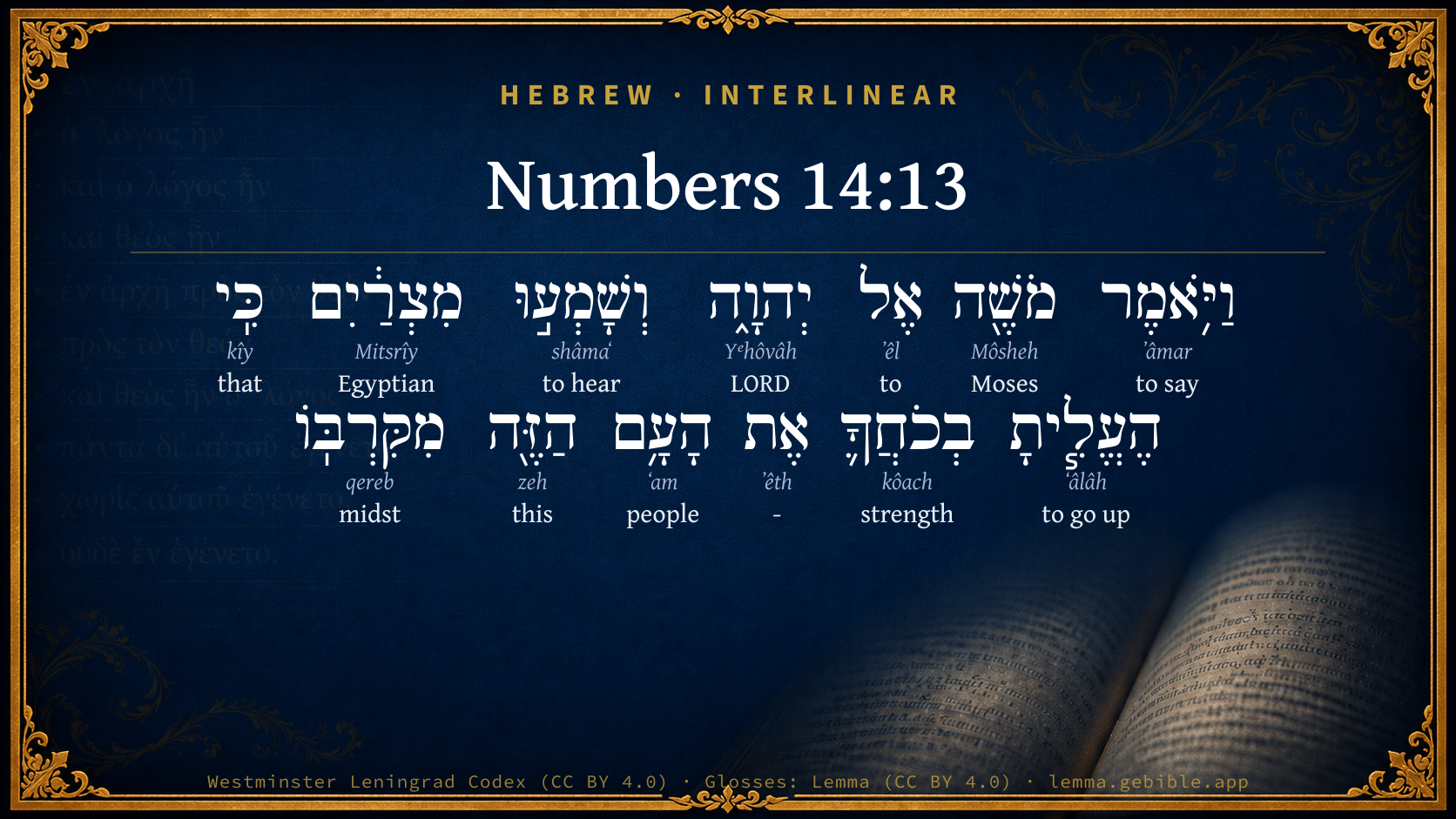
  1. וַיֹּ֥אמֶר ʼâmar H559 “and · to say” Conjunction + Verb, Qal, Sequential Imperfect, 3rd Person, Masculine, Singular
  2. מֹשֶׁ֖ה Môsheh H4872 “Moses” Noun, Proper
  3. אֶל ʼêl H413 “to” Preposition
  4. יְהוָ֑ה Yᵉhôvâh H3068 “LORD” Noun, Proper
  5. וְשָׁמְע֣וּ shâmaʻ H8085 “and · to hear” Conjunction + Verb, Qal, Sequential Perfect, 3rd Person, Common, Plural
  6. כִּֽי kîy H3588 “that” Conjunction
  7. הֶעֱלִ֧יתָ ʻâlâh H5927 “to go up” Verb, Hiphil, Perfect, 2nd Person, Masculine, Singular
  8. בְכֹחֲךָ֛ kôach H3581 “in/at · strength · your” Preposition + Noun, Common, Masculine, Singular, Construct + Suffix, Personal, 2nd Person, Masculine, Singular
  9. אֶת ʼêth H853 “-” Particle, Direct Object
  10. הָעָ֥ם ʻam H5971 “the · people” Particle, Definite Article + Noun, Common, Masculine, Singular, Absolute
  11. הַזֶּ֖ה zeh H2088 “the · this” Particle, Definite Article + Pronoun, Demonstrative, Masculine, Singular
  12. מִקִּרְבּֽוֹ qereb H7130 “from · midst · his” Preposition + Noun, Common, Masculine, Singular, Construct + Suffix, Personal, 3rd Person, Masculine, Singular

About this verse

These counts appear in no published source. They are computed here, from the morphology-tagged text and Lemma’s own curated glosses. What Lemma adds →

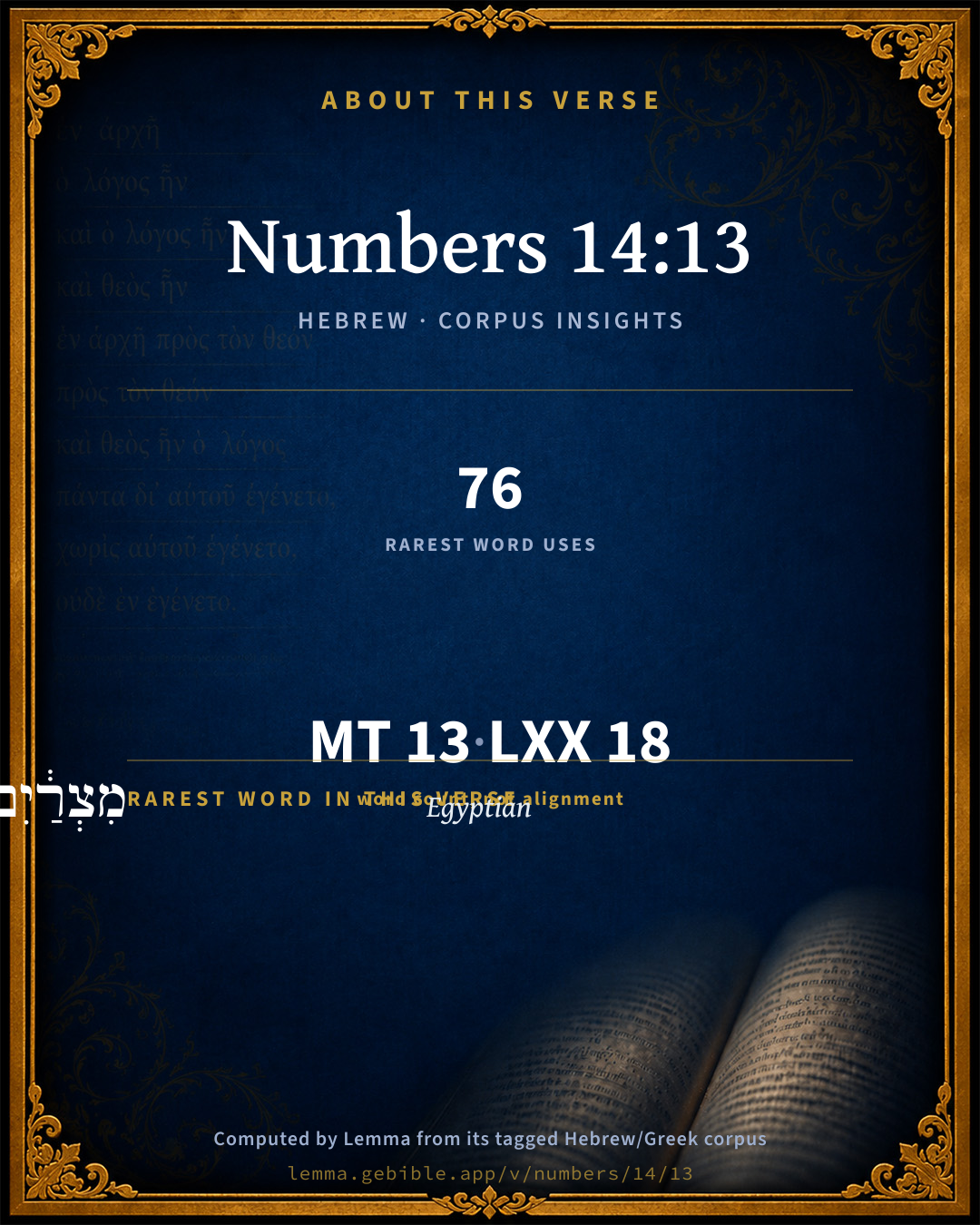
13
words
13
distinct lemmas
Pentateuch
section

Grammatical profile

  • 3 verbs
  • 6 nouns
  • 1 pronoun
  • 1 preposition
  • 1 conjunction
  • 1 particle

Verb forms

  • וַיֹּ֥אמֶר Qal · Sequential Imperfect
  • וְשָׁמְע֣וּ Qal · Sequential Perfect
  • הֶעֱלִ֧יתָ Hiphil · Perfect

Hebrew & Septuagint length

In English translation the verse runs 22 words from the Hebrew and 22 from the Septuagint (LXX English) — the same length.

A rough comparison of the two English renderings, which tokenize alike — not a word-level alignment.

Word counts can differ between the Hebrew and the Greek without any difference in meaning — e.g. the Hebrew direct-object marker אֵת has no separate Greek word, and Greek often adds the article ὁ.

In the original languages it is 13 Hebrew tokens and 18 Greek tokens — but the two are counted differently (Hebrew bundles its prefixes and suffixes into one token; the Greek is in lemma form), so that isn’t a like-for-like length.

Cross-references

7

Topical passages linked to Numbers 14:13 in the Treasury of Scripture Knowledge — connected by theme and wording, ordered by reader-vote popularity; previews shown in the World English Bible.

  • Psalms 106:23 Therefore he said that he would destroy them, Had Moses, his chosen, not stood before him in the breach, To turn away his wrath, so that he wouldn't destroy them.
  • Exodus 32:11–14 Moses begged Yahweh his God, and said, "Yahweh, why does your wrath burn hot against your people, that you have brought forth out of the land of Egypt with great power and with a mighty hand?
  • Deuteronomy 32:27 Were it not that I feared the provocation of the enemy, Lest their adversaries should judge wrongly, Lest they should say, Our hand is exalted, Yahweh has not done all this.
  • Ezekiel 20:9 But I worked for my name's sake, that it should not be profaned in the sight of the nations, among which they were, in whose sight I made myself known to them, in bringing them forth out of the land of Egypt.
  • Deuteronomy 9:26–28 I prayed to Yahweh, and said, Lord Yahweh, don't destroy your people and your inheritance, that you have redeemed through your greatness, that you have brought forth out of Egypt with a mighty hand.
  • Joshua 7:8–9 Oh, Lord, what shall I say, after that Israel has turned their backs before their enemies!
  • Ezekiel 20:14 But I worked for my name's sake, that it should not be profaned in the sight of the nations, in whose sight I brought them out.

Cross-references courtesy of OpenBible.info (CC BY 4.0).

Hebrew and Greek witnesses Masoretic Hebrew ↔ Greek Septuagint

The same verse in the two great witnesses to the Old Testament, shown verse-for-verse.

These are two independent witnesses, not word-aligned to each other, and the Septuagint is shown in lemma (dictionary) form.

Hebrew Numbers 14:13 Masoretic · Westminster Leningrad Codex

וַיֹּ֥אמֶר מֹשֶׁ֖ה אֶל יְהוָ֑ה וְשָׁמְע֣וּ מִצְרַ֔יִם כִּֽי הֶעֱלִ֧יתָ בְכֹחֲךָ֛ אֶת הָעָ֥ם הַזֶּ֖ה מִקִּרְבּֽוֹ

Moses said to Yahweh, Then the Egyptians will hear it; for you brought up this people in your might from among them;

World English Bible · Public Domain

Greek LXX Numbers 14:13 Septuagint · lemma form

καί εἶπον μωυσῆς πρός κύριος καί ἀκούω αἴγυπτος ὅτι ἀναἄγω ὁ ἰσχύς σύ ὁ λαός οὗτος ἐκ αὐτός

And Moses said to the Lord, So Egypt shall hear, for you have brought up this people from them by your might.

LXX2012 (modern English Septuagint) · Public Domain

On this verse, The Pulpit Commentary discusses the Septuagint’s reading. Read the note in Commentary ↓

Hebrew: Westminster Leningrad Codex (CC BY 4.0). Greek: Septuagint (public domain); English from LXX2012 (modern English Septuagint) (Public Domain). How the Septuagint differs from the Hebrew →

Targum (Aramaic paraphrase)

2

The Targum is the ancient Jewish Aramaic paraphrase of the Hebrew Scriptures — an interpretive translation, not the Hebrew text itself. Onkelos (literal) and Pseudo-Jonathan (expansive) render the Torah, and Jonathan the Prophets. Coverage is partial: where no permissively-licensed English translation exists for a verse, only the Aramaic is shown. This is verse-level text, not a word-by-word alignment to the Hebrew.

  1. Targum Onkelos Torah (Genesis–Deuteronomy)
    וַאֲמַר משֶׁה קֳדָם יְיָ וְיִשְׁמְעוּן מִצְרָאֵי אֲרֵי אַסֶקְתָּא בְחֵילָךְ יָת עַמָא הָדֵין מִבֵּינֵיהוֹן

    (no public-domain English translation for this verse)

    Targum Onkelos — Aramaic: “Onkelos Genesis” (public domain); “Onkelos Exodus” (public domain); “Onkelos Leviticus” (public domain); “Onkelos Numbers” (public domain); “Onkelos Deuteronomy” (public domain). English: “Sefaria Community Translation” (CC0 1.0 (public-domain dedication)); “J.W. Etheridge. The Targums of Onkelos and Jonathan Ben Uzziel on the Pentateuch. London: Longmans, Green, 1862” (public domain). Text via Sefaria.

  2. Targum Pseudo-Jonathan Torah (Genesis–Deuteronomy)
    וַאֲמַר משֶׁה וְיִשְׁמְעוּן בְּנֵיהוֹן דְמִצְרָאֵי דְאִשְׁתַּנָקוּ בְּיַמָא אֲרוּם אֲסֵיקְתָּא בְּחֵילָךְ יַת עַמָא הָדֵין מִבֵּינֵיהוֹן

    But Mosheh said, The children of the Mizraee, whom Thou didst drown in the sea, will hear that Thou didst bring up this people from among them by Thy power,

    Targum Pseudo-Jonathan — Aramaic: “Targum Jonathan on Genesis” (public domain); “Targum Jonathan on Exodus” (public domain); “Targum Jonathan on Leviticus” (public domain); “Targum Jonathan on Numbers” (public domain); “Targum Jonathan on Deuteronomy” (public domain). English: “The Targum of Jonathan ben Uzziel, trans. J. W. Etheridge, London, 1862” (public domain). Text via Sefaria.

Commentary

Notes on Numbers 14:13 from classic Christian and Jewish commentators (each source and its license shown beneath its notes). The classic Christian expositions comment on the surrounding passage and are grouped to its opening verse, so a note may address several verses; the Jewish commentaries on the Tanakh (Rashi and others) are per-verse, so they appear only where the commentator wrote on this verse.

Lemma curates 59 commentaries, every one of them public domain or Creative Commons licensed, each selected and text-cleaned for this edition rather than reprinted as found. About our sources →

Trapp's Complete Commentary

John Trapp

Num 14:13 And Moses said unto the LORD, Then the Egyptians shall hear [it], (for thou broughtest up this people in thy might from among them;)

Ver. 13. Then the Egyptians shall hear it.] And they will soon make comedies out of the Church’s tragedies.

John Trapp, A Commentary or Exposition upon All the Books of the Old and New Testament (1647–1656) — public domain. Text from a community e-Sword module.

The Biblical Illustrator

Joseph S. Exell

Num_14:13-19

Pardon, I beseech Thee, the iniquity of this people.

Moses expostulation

What book but the Bible has the courage to represent a man standing in this attitude before his God and addressing his Sovereign in such persuasive terms? This incident brings before us the vast subject of the collateral considerations which are always operating in human life. Things are not straight and simple, lying in rows of direct lines to be numbered off, checked off and done with. Lines bisect and intersect and thicken into great knots and tangle, and who can unravel or disentangle the great heap? Things bear relations which can only be detected by the imagination, which cannot be compassed by arithmetical numbers, but which force upon men a new science of calculation, and create a species of moral algebra, by which, through the medium and help of symbols, that is done which was impossible to common arithmetic. Moses was a great leader; he thought of Egypt: what will the enemy say? The enemy will put a false construction upon this. As if he had said, This will be turned against Heaven; the Egyptians do not care what becomes of the people, if they can laugh at the Providence which they superstitiously trusted; the verdict passed by the heathen will be:--God was not able to do what He promised, so He had recourse to the vulgar artifice of murder. The Lord in this way developed Moses. In reality, Moses was not anticipating the Divine purpose, but God was training the man by saying what He, the Lord, would do, and by the very exaggeration of His strength called up Moses to his noblest consciousness. We do this amongst ourselves. By using a species of language adapted to touch the innermost nerve and feeling of our hearers, we call those hearers to their best selves. If the Lord had spoken a hesitant language, or had fallen into what we may call a tone of despair, Moses himself might have been seduced into a kindred dejection; but the Lord said, I will smite, I will disinherit, I will make an end; and Moses became priest, intercessor, mighty pleader--the very purpose which God had in view--to keep the head right, the leading man in tune with His purposes. So Moses said, Pardon; the Lord said, Smite; and Moses said, Pardon--that is the true smiting. The Lord meant it; the Lord taught Moses that prayer which Moses seemed to invent himself. The Lord trains us, sometimes, by shocking our sensibilities; and by the very denunciation of His judgments He drives us to tenderer prayer. (J. Parker, D. D.)

The intercession of Moses for the doomed nation

I. The petition which he presented.

II. The pleas by which he urged his petition.

1. The honour of the Divine name amongst the heathen.

(1) The relations of God with Israel and His doings for Israel were well known amongst neighbouring nations.

(2) If God should destroy Israel at a stroke, that also would be known amongst these nations.

(3) The interpretation of such destruction by the nations would be such as would reflect on the honour of God. They would conclude that His resources were exhausted; that His power had failed to sustain and lead Israel onward: and thus His glory would be tarnished.

(4) That this might not be the case Moses entreats the Lord not to disinherit the rebellious people.

2. The Divine character as revealed to Moses.

3. The truth of the Divine word.

4. The forgiveness which God had already bestowed.

Conclusion: From this intercession of Moses let us learn--

1. How to plead with God for ourselves.

2. How to plead with God for others, and especially for His people. (W. Jones.)

Gods pardoning grace in the past an encouragement to seek for the same in the present

I. God is as able and as willing to forgive now as ever he has been.

II. Man is now, as much as ever he has been, the object of Gods compassion.

III. Gods purpose with regard to the human race is now what it ever has been. (David Lloyd.)

The power of intercession

The intercession of Christians, who are already formed, is the leaven which is to leaven the whole earth with Christianity. It is one of the destined instruments, in the hand of God, for hastening the glory of the latter days. Take the world at large, and the doctrine of intercession, as an engine of mighty power, is derided as one of the reveries of fanaticism. This is a subject on which the men of the world are in a deep slumber; but there are watchmen who never hold their peace day nor night, and to them God addresses these remarkable words: Ye that make mention of the Lord, keep not silence, and give Him no rest till He establish and till He make Jerusalem a praise in the earth. (T. Chalmers.)

The mercy of God

(Num_14:18):--

I. What we are to understand by the mercy of god. It is His goodness to them that are in misery, or liable to it. Thus the mercy of God is usually, in Scripture, set forth to us by the affection of pity and compassion; which is an affection that causeth a sensible commotion in us, upon the apprehension of some great evil that lies upon another, or hangs over him. Hence it is that God is said, in Scripture, to be grieved and afflicted for the miseries of men. But though God is pleased in this manner to set forth His mercy and tenderness towards us, yet we must take heed how we clothe the Divine nature with the infirmities of human passions. When God is said to pity us, we must take away the imperfection of His passion, the commotion and disturbance of it, and not imagine any such thing in God; but we are to conceive that the mercy and compassion of God, without producing the disquiet, do produce the effects of the most sensible pity.

II. That this perfection belongs to God. I will only produce some of those many texts of Scripture which attribute this perfection to God. The Lord, the Lord God, merciful and gracious (Exo_34:6). The Lord thy God is a merciful God (Deu_4:31). The Lord your God is gracious and merciful (2Ch_34:9). Ready to pardon, gracious and merciful (Neh_9:17). All the paths of the Lord are mercy (Psa_25:10). Unto Thee, O Lord, belongeth mercy (Psa_62:12). Merciful and gracious (Psa_103:8). With the Lord there is mercy (Psa_130:7). And so (Jer_3:12; Joe_2:13; Jon_4:2; Luk_6:36), Be ye therefore merciful, as your Father also is merciful. The Scripture speaks of this as most natural to Him. In 2Co_1:3, He is called the Father of mercies.

III. The degree of it. A God of great mercy. Scripture speaks of it as if God was wholly taken up with it, as if it was His constant employment, so that, in comparison of it, He doth hardly display any other excellency; All the paths of the Lord are mercy (Psa_25:10); as if, in this world, God had a design to advance His mercy above His other attributes. The mercy of God is now in the throne; this is the day of mercy; and God doth display it, many times, with a seeming dishonour to His other attributes, His justice, and holiness, and truth.

1. Preventing mercy. Does not that man owe more to his physician who prevents his sickness, than he who, after the languishing, the pains of several months, is at length cured by him?

2. Forbearing mercy. And this is the patience of God, which consists in the deferring or moderating of our deserved punishment. Hence it is that slow to anger, and of great mercy, do so often go together.

3. Comforting mercy (2Co_1:3).

4. His relieving mercy, in supplying those that are in want, and delivering those that are in trouble.

5. Pardoning mercy. And here the greatness and fulness of Gods mercy appears, because our sins are great (Psa_78:38). And the multitude of Gods mercies because our sins are many (Psa_51:1).

Uses--

1. We ought with thankfulness to acknowledge and admire the great mercy of God to us.

2. The great mercy of God to us should stir up in us shame and sorrow for sin. The judgments of God may break us; but the consideration of Gods mercy should rather melt us into tears (Luk_7:47).

3. Let us imitate the merciful nature of God.

4. If the mercy of God be so great, this may comfort us against despair.

5. By way of caution against the presumptuous sinner. If there be any that encourage themselves in sin, upon the hopes of His mercy; let such know that God is just, as well as merciful. (Abp. Tillotson.)

Long-suffering of God

We may safely assert that Jeremy Taylor is none the less vigorous for illustrating the long-suffering of God by the Rabbinical story that the archangel Michael, being Gods messenger of vengeance, had but one wing, that he might labour in his flight, while Gabriel had two wings, that he might fly swiftly when bringing the message of peace. (J. Pilkington.)

Great mercy

Gods mercy is so great that it forgives great sins to great sinners after great lengths of time, and then gives great favours and great privileges, and raises us up to great enjoyments in the great heaven of the great God. As John Bunyan well says, It must be great mercy or no mercy, for little mercy will never serve my turn. (C. H. Spurgeon.)

The Biblical Illustrator, edited by Joseph S. Exell (c. 1880s–1900s) — public domain. Text from a community e-Sword module.

Tyndale Open Study Notes

Tyndale Open Resources

14:13-25 Moses interceded on behalf of his people, reminding God that his reputation was bound up with that of Israel and appealing to his faithfulness.

Tyndale Open Study Notes — © Tyndale Open Resources, licensed CC BY-SA 4.0. Text via the HelloAO Bible API.

Ellicott's Commentary for English Readers

(13, 14) And Moses said unto the Lord . . . —There is considerable difficulty as to the correct rendering of these verses. They may be rendered in accordance with the Authorised Version, or they may be rendered as follows:—And Moses said unto the LORD, The Egyptians have both heard that thou hast brought up this people from among them by thy might, and they have also told (it) to the inhabitants of this land (i.e., the land of Canaan, as in Num_14:3); they (i.e., the Egyptians and the Canaanites) have heard that thou LORD art in the midst of this people, for thou LORD art seen face to face, and thy cloud standeth over them, and thou goest before them, &c. &c. Reference may be made to the following passages in illustration of the argument by which Moses enforced his intercessory prayer on behalf of Israel:—Deu_32:26-27; Jos_7:9; Isa_48:9; Isa_48:11; Eze_36:22-23.

A Bible Commentary for English Readers, edited by Charles John Ellicott (1878–1897) — public domain. Text from a community e-Sword module.

The Cambridge Bible for Schools and Colleges

gen. ed. J. J. S. Perowne

13–16. The thought of Jehovah destroying His own people raised a great problem. Jehovah must maintain justice, and yet He must also maintain His own honour among the surrounding nations. The same problem was felt by Ezekiel in regard to the punishment of the exile, but he solved it by the certainty of a glorious return of a purified people in the future (Eze_36:18-28; Eze_39:21-29).

The Cambridge Bible for Schools and Colleges (gen. ed. J. J. S. Perowne; Cambridge University Press, 1878–1918) — public domain. Text from a community e-Sword module.

John Gill's Exposition

And Moses said unto the Lord,.... In an abrupt manner, as the following words show, his mind being greatly disturbed and distressed by the above threatening:

then the Egyptians shall hear it; that the Lord had smitten the Israelites with the pestilence; the Targum of Jonathan interprets it of the children of the Egyptians who were suffocated in the sea:

for thou broughtest up this people in thy might from among them; they were once sojourners among them, and slaves unto them, and they were delivered from them by the mighty hand of the Lord upon the Egyptians, destroying their firstborn; and therefore when they shall hear that the Israelites were all destroyed at once by a pestilence in the wilderness, it will be a pleasure to them, as follows.

John Gill's Exposition of the Whole Bible (1746–1763) — public domain (CC PDM 1.0). Text via the HelloAO Bible API.

Albert Barnes' Notes on the Bible

The syntax of these verses is singularly broken. As did Paul when deeply moved, so Moses presses his arguments one on the other without pausing to ascertain the grammatical finish of his expressions. He speaks here as if in momentary apprehension of an outbreak of God’s wrath, unless he could perhaps arrest it by crowding in every topic of deprecation and intercession that he could mention on the instant.

Albert Barnes' Notes on the Bible (1834–1885) — public domain. Text from a community e-Sword/MySword module.

Haydock's Catholic Bible Commentary

That the. The sentence is left imperfect, to signify the agitation and distress with which Moses was oppressed, as if he had said, Thou wilt thus afford a pretext, that the Egyptians and Chanaanites may say to one another, that thou couldst not perform what thou hadst promised; and therefore, that in vexation thou hadst destroyed thy people. (Haydock) --- Hebrew, "Then the Egyptians shall hear it....and will tell it to the inhabitants of this land....because the Lord could not," &c., ver. 16. (Calmet) --- Thus they will blaspheme thy holy name. (Menochius)

George Leo Haydock (1774–1849), Haydock's Catholic Family Bible and Commentary, 1859 edition — public domain. Excludes Psalms (Douay-Rheims chapter numbering differs from Protestant) and Deuterocanonical books (Catholic canon only).

Matthew Poole's English Annotations

Then, i.e. in case thou dost utterly destroy them.

Thou broughtest up this people, whereby thou didst get great honour to thyself, which now thou wilt certainly lose.

Matthew Poole's English Annotations on the Holy Bible (1683–1685) — public domain. Text from a community e-Sword/MySword module.

Whedon's Commentary on the Bible

Daniel D. Whedon

13. The Egyptians shall hear — They who had felt the judgments of Jehovah in terrible national judgments on account of Israel will gladly hear of his downfall, and spread the news abroad among all the nations, especially among the Canaanites, who “faint” because of their terror of the Hebrews. Jos_2:9. The arguments of Moses in this intercession are exactly such as man would use with man. This implies that Moses conceived of God as personal, and possessing reason and sensibilities corresponding to those faculties in the human race, who are created in his image. The philosophic conception of God of which deism boasts affords no motive to believing and importunate prayer.

Daniel D. Whedon (gen. ed.), Commentary on the Old and New Testaments (1874–1909) — public domain. Text from a community e-Sword module.

The Pulpit Commentary

And Moses said unto the Lord. The words which follow are so confused, and the construction so dislocated, that they afford the strongest evidence that we have here the ipsissima verba of the mediator, disordered as they were in the moment of utterance by passionate earnestness and an agonizing fear. Had Moses been ever so eloquent, a facility of speech at such a moment would have been alike unnatural and unlovely. What we can see in the words is this: that Moses had no thought for himself, and that it never occurred to him to entertain the tempting offer made to him by God; that he knew God too well, and (if we may say so) cared for God too much, to let him so compromise his honour among the nations, and so thwart his own purposes, without making one effort (however audacious) to turn his wrath aside. We can see that it is (as in Exo_32:11, Exo_32:12, only much more boldly and abruptly) the thought of what the heathen would say which he wishes to thrust upon the Almighty; but we cannot be sure of the right translation of the words. The most literal rendering would seem to be, "Both the Egyptians have heard (Wmvw) that thou broughtest out this people from among them with thy might, and they have told it (Wrmaw) to the inhabitants of this land; they have heard (Wmv, repeated) that thou, Lord, art amongst this people," &c. The Septuagint, however, translates the first verb by a future (;kai akousetai Aiguptov ), and, as this gives a much clearer sense, it is followed by the Targum Palestine and most of the versions.

Vers. 13-19. Moses" view of the position.

God has presented some of the considerations which needed to be presented; Moses now presents others; and all taken together produce the decision actually arrived at. What God had said it was not for Moses to say, and so what Moses said it was not for God to say; nevertheless, all needed to be said.

I NOTE THE CHARACTER IN WHICH MOSES CHIEFLY APPEARS. His first words indicate a concern for the reputation of Jehovah among the nations, and it would be wrong to suppose that this was not a matter of real concern, but it is evident the chief thought in his mind was how to secure mercy for rebellious Israel. He is the intercessor. All considerations he can appropriately urge are urged with the ingenuity of one who feels the calamity of others as his own. He is consistent here with past appearances on similar occasions.

II NOTE THE CONSIDERATIONS WHICH HE URGES.

1. He makes no attempt to extenuate the wickedness of the people. He can say nothing by way of excuse, lie does not plead as Abraham concerning Sodom, on the chance of a righteous remnant being found in the multitude. He does not distinctly plead for another trial, like the dresser in the vineyard. (Luk_13:8, Luk_13:9) The sin was fresh, patent, monstrous, coming as the climax of so much that had gone before. He does not attempt to make the sin of the people look less than the sin of the spies, but leaves all in its enormity. So we may say it is better for us not to go excusing self, when too often excuse but adds to existing sin. Our danger is to underestimate our sin, to think of our sorrows and trials rather than our disobedience and ingratitude. God knows what may be said for us. At all times, and in all our transgressions, he remembers that we are dust. Let us rather aim to get a due sense of how much, how very much, needs to be done in us to make us holy and perfect.

2. He makes God"s reputation among surrounding nations a matter of great concern. In God"s government of the world, the consideration of his real glory is ever to be kept in view, and this of course is not dependent on what any man may think. Nevertheless, what men may think and say is by no means to be neglected. Whatever is done, some will criticize and jeer. Strange things have been said, and are said still, concerning the God revealed in the history of Israel. A monster of hideous attributes is conjured up and represented as the Deity of the Hebrews. Now as among men it is a consideration that their good should not be evil spoken of, if they can possibly arrange it otherwise, so, reverently be it said, a similar consideration may be present to God when he reveals himself in human affairs. What he said here asserted that there was no need for further probation of these Israelites. What Moses now suggests is that there was no need to cut them down at once, and good reason to do otherwise, so as to stop the mouth of Egypt and the nations of Canaan.

3. One more act of mercy would be consistent with God"s character. God had said, upon the making of the two tables to replace the former two, (Ex 34) that though he could not treat iniquity as a trifle, and must ever stamp on it signs of the serious way in which he regarded it, yet he was a God merciful and gracious, and disposed to pardon. Moses now humbly reminds God of these words, and pleads an application of them to the present transgression, tie does not seem to have meant much by the word pardon; it was simply that God might turn away the pestilence. Indeed, for anything more it was not in the power of Moses to ask. A full pardon, a full reconciliation to God, these demand, as a pre-requisite, full repentance. And so far Israel had made no sign. Perhaps the people were dumb and stupefied with terror. Other people may ask pardon for us in a certain sense, but such pardon as will be complete can only come from the cry of awakened, enlightened, and truly penitent souls. Y.

The Pulpit Commentary (1880–1919), ed. H.D.M. Spence-Jones & Joseph S. Exell — public domain. Text from a community e-Sword module.

unfoldingWord translationNotes

Door43 World Missions Community

you are seen face to face

Possible meanings are 1) Moses speaks of God showing himself to his people as if God had allowed them to actually see his face. AT: "they have seen you" or 2) Moses speaks of the intimate relationship between him and God as if Moses could see God's face when God spoke to him. This can be stated in active form. AT: "you speak directly to me" (See: Metaphorand Active or Passive)

translationWords

Egypt

face

column

fire

unfoldingWord translationNotes — © Distant Shores Media and the Door43 World Missions Community, licensed CC BY-SA 4.0. Source: git.door43.org/Door43/en_tn.

Rashi

Rabbi Shlomo Yitzchaki (Rashi)

ושמעו מצרים WHEN THE EGYPTIANS SHALL HEAR IT — i.e. when they hear how you are killing them, [as stated in the previous verse].

כי העלית — The word כי here is used in the sense of אשר, “that”, and the meaning is: they have seen that Thou broughtest them forth in Thy great strength from their midst, and when they hear that Thou art killing them they will not say that it is because they have sinned against Thee, but they will say that against them Thou wast able to fight, but against the in habitants of the Land of Canaan, however, Thou wast unable to fight; and this is the meaning of —

Rashi on the Tanakh — English translations: “The Judaica Press complete Tanach with Rashi, translated by A. J. Rosenberg” (CC BY 4.0); “Pentateuch with Rashi's commentary by M. Rosenbaum and A.M. Silbermann, 1929-1934” (public domain); “The Metsudah Tanach series, Lakewood, N.J” (CC BY 4.0); and “The Book of Joshua, Metsudah Publications, 1997” (CC BY 4.0). Text via Sefaria.

Ramban (Nachmanides)

Rabbi Moshe ben Nachman (Ramban / Nachmanides)

AND THE EGYPTIANS SHALL HEAR ‘KI HE’ELITHA’ IN THY MIGHT. “And the Egyptians shall hear that you have killed them. Ki he’elitha. The word ki [here] means ‘that,’ [the meaning of the expression thus being:] ‘they have seen that Thou broughtest them up in Thy might from among them, and when they hear that You have killed them they will not say that [it is because] they sinned against You, but [they will say] that against them [the Egyptians themselves] You were able to fight, but not against the inhabitants of this land [of Canaan].’ And this is the meaning of [the phrase]: and they will say ‘el’ the inhabitants of this land usually means “to”, but in this context, as Rashi is pointing out, the Egyptians were not saying anything “to” the Canaanites, but “about” or “concerning” them. — what will they say concerning them? That which is stated at the end of the subject: Because the Eternal was not able to bring this people into the Land — because the inhabitants of the land are strong and mighty, and Pharaoh [alone] is not like thirty-one kings [who ruled in the land of Canaan].” This is the language of Rashi. If so, the expression ‘el’ yosheiv [literally: ‘to’ the inhabitants] usually means “to”, but in this context, as Rashi is pointing out, the Egyptians were not saying anything “to” the Canaanites, but “about” or “concerning” them. will be like ‘al’yosheiv, (“concerning” the inhabitants), and there are also many such examples.In my opinion, [however], Moses our teacher did not mean [to say] in [presenting] this argument that [the Egyptians will say that] the Canaanites are strong and mighty in battle and that Pharaoh [alone] cannot be compared to thirty-one kings — for G-d had smitten the Egyptians with a plague and killed their firstborns in one moment, and brought upon them great punishments out of heaven, [so they knew] that it is but a light thing in the sight of the Eternal to destroy the strong and mighty by a plague, just as [He can destroy] the feeble and weak, [by means of special plagues]. But the meaning of this prayer [of Moses] was as if to say: “The Egyptians will think and say that the gods of Canaan have power to save the inhabitants from Your hand, since You executed judgments on the Egyptians and their gods before You brought this people out of their midst, but You could not do the same to the Canaanites and their gods. Thus this will constitute a profanation of G-d’s Name, and the hands of the idol-worshippers will be strengthened!” If so, it is possible that the expression, and they will say ‘el’ the inhabitants of this land usually means “to”, but in this context, as Rashi is pointing out, the Egyptians were not saying anything “to” the Canaanites, but “about” or “concerning” them. is to be understood literally, that is, the Egyptians will say “to” the people of the land of Canaan, “Because the Eternal was not able etc., for surely god is in you, there is no other god.”. Ramban, in following his customary style throughout his commentary, uses the verse with some change and thereby puts it in the mouths of the Egyptians who are saying it to the Canaanites about their idols.

Ramban (Nachmanides) on the Tanakh — English translation: “Commentary on the Torah by Ramban (Nachmanides). Translated and annotated by Charles B. Chavel. New York, Shilo Pub. House, 1971-1976” (CC BY 4.0). Text via Sefaria.

Lesson kit

Teaching starters — assembled from the data on this page, not authored interpretation. Every prompt links to the verse data it draws on. Edit before teaching.

Numbers, in the Pentateuch, opens this verse with 13 words (13 distinct Hebrew lemmas). Its most distinctive word is Mitsrîy (“Egyptian”). A historical commentator’s framing appears above. Read the whole chapter for the surrounding context.

Discussion questions

  1. What does “Egyptian” (Mitsrîy) contribute to the verse as a whole?
  2. How does Psalms 106:23, which shares this passage’s theme, read alongside this verse?
  3. The translations on this page render this verse differently — a whole-verse word diff, not a word-by-word alignment. What might account for the different wordings?
  4. «וַיֹּ֥אמֶר» is a Qal Sequential Imperfect verb. How does that grammatical form shape the action described?
  5. Compare how Trapp's Complete Commentary and The Biblical Illustrator read this verse. Where do they agree or differ?

Things to notice

Reading settings

Reading text

Shown beneath each verse's original-language words.

Old Testament
Old Testament edition

Read the OT as the Masoretic Hebrew (MT) or the Greek Septuagint (LXX).

English shown for the Greek Septuagint (in the Hebrew ↔ Greek comparison).

Comparing translations? Open the Compare panel on any verse page to stack up to four side by side.