Numbers 13:30

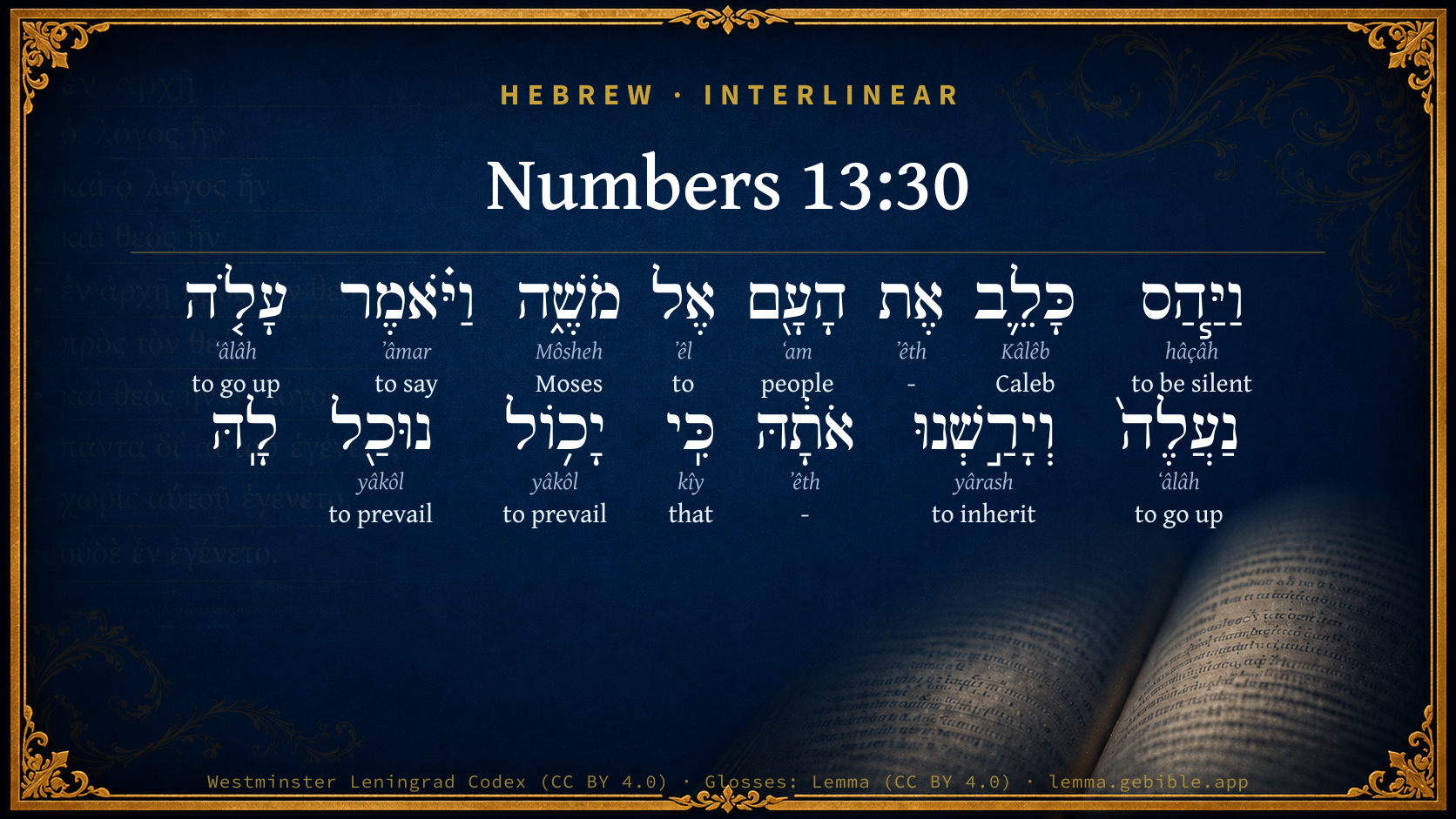
Hebrew (Westminster Leningrad Codex) Numbers 13:30 appears in the Hebrew Old Testament. The text above is from the Westminster Leningrad Codex. Each word links to its Strong’s number, a concise gloss, and parsing drawn from the Open Scriptures Hebrew Bible morphology. Click any word for its full Brown-Driver-Briggs (BDB) entry.
Download image
Cite this verse

Numbers 13:30 (World English Bible). Public Domain. Lemma interlinear Bible study tool, https://lemma.gebible.app/v/numbers/13/30.

Show BibTeX & RIS
BibTeX
RIS
English Translation
Caleb stilled the people before Moses, and said, Let us go up at once, and possess it; for we are well able to overcome it.
World English Bible · Public Domain
Highlights Full analysis ↓
Download a study sheet

One document with this verse’s original text, its word-by-word gloss line, the meaning frame, cross-references with their text, attributed commentary, and full source and license credits — printable, and it pastes into notes with its structure intact.

This verse Autodidact and up

Study sheet (.html) Plain text (.txt)

A passage Seminary Student

Up to 50 verses in one chapter. A passage sheet keeps up to 6 commentary sources and 12 cross-references per verse, in the order this page ranks them, and says so on the sheet whenever that leaves anything out. Ask for a single verse and you get the Autodidact verse sheet above.

Everything on this page stays free to read, with no account — the sheet is a download of what is already on screen, not access to it.

Want to remove ads? Support Godless Engineer
Compare translations 3

The same verse in 3 English versions, stacked beneath the original-language interlinear above. Click any original word for its lexicon entry.

Each is an independent rendering of the whole verse — the interlinear is not word-aligned to these translations.

Highlighted words mark where these versions differ — a whole-verse word diff, not a word-by-word alignment.

  • World English Bible Public Domain
    Caleb stilled the people before Moses, and said, Let us go up at once, and possess it; for we are well able to overcome it.
  • King James Version Public Domain
    And Caleb stilled the people before Moses, and said, Let us go up at once, and possess it; for we are well able to overcome it.
  • unfoldingWord Literal Text CC BY-SA 4.0
    And Caleb hushed the people to Moses, and he said, “Going up, we will go up, and we will possess it, for being able, we are able against it.”

unfoldingWord Literal Text — © unfoldingWord, licensed CC BY-SA 4.0. Word-aligned USFM3 via Door43 (git.door43.org/unfoldingWord/en_ult).

Versions to compare (up to 4)

3 of 4 selected

Show all 18 translations

Every available English version of this verse, each an independent rendering of the whole verse.

  • World English Bible Public Domain
    Caleb stilled the people before Moses, and said, Let us go up at once, and possess it; for we are well able to overcome it.
  • Berean Standard Bible Public Domain
    Then Caleb quieted the people before Moses and said, “We must go up and take possession of the land, for we can certainly conquer it!”
  • Majority Standard Bible Public Domain
    Then Caleb quieted the people before Moses and said, “We must go up and take possession of the land, for we can certainly conquer it!”
  • King James Version Public Domain
    And Caleb stilled the people before Moses, and said, Let us go up at once, and possess it; for we are well able to overcome it.
  • American Standard Version (1901) Public Domain
    And Caleb stilled the people before Moses, and said, Let us go up at once, and possess it; for we are well able to overcome it.
  • Revised Version (1885) Public Domain
    And Caleb stilled the people before Moses, and said, Let us go up at once, and possess it; for we are well able to overcome it.
  • Geneva Bible (1599) Public Domain
    The Amalekites dwell in the South countrey, and the Hittites, and the Iebusites, and the Amorites dwell in the mountaines, and the Canaanites dwell by the sea, and by the coast of Iorden.
  • Douay-Rheims (1899) Public Domain
    Amalec dwelleth in the south, the Hethite and the Jebusite and the Amorrhite in the mountains: but the Chanaanite abideth by the sea and near the streams of the Jordan.
  • Young's Literal Translation Public Domain
    And Caleb stilleth the people concerning Moses, and saith, `Let us certainly go up -- and we have possessed it; for we are thoroughly able for it.'
  • Literal Standard Version CC BY-SA 4.0
    And Caleb stills the people concerning Moses and says, “Let us certainly go up—and we have possessed it; for we are thoroughly able to [do] it.”
  • Unlocked Literal Bible CC BY-SA 4.0
    Then Caleb silenced the people who were before Moses and said, “Let us go up and take possession of the land, for we are certainly able to conquer it.”
  • unfoldingWord Literal Text CC BY-SA 4.0
    And Caleb hushed the people to Moses, and he said, “Going up, we will go up, and we will possess it, for being able, we are able against it.”
  • Darby Bible Public Domain
    And Caleb stilled the people before Moses, and said, Let us go up boldly and possess it, for we are well able to do it.
  • World Messianic Bible Public Domain
    Caleb stilled the people before Moses, and said, “Let’s go up at once, and possess it; for we are well able to overcome it!”
  • Webster's Bible Public Domain
    And Caleb stilled the people before Moses, and said, Let us go up at once, and possess it; for we are well able to overcome it.
  • Free Bible Version CC BY-SA 4.0
    Then Caleb asked for quiet as the people stood before Moses and told them, “Let's go and take over the land. We can conquer the country, no doubt about it!”
  • Bible in Basic English Public Domain
    Then Caleb made signs to the people to keep quiet, and said to Moses, Let us go up straight away and take this land; for we are well able to overcome it.
  • JPS Tanakh (1917) Public Domain
    And Caleb stilled the people toward Moses, and said: 'We should go up at once, and possess it; for we are well able to overcome it.'

Literal Standard Version (2020), Covenant Press — licensed CC BY-SA 4.0. Text via the HelloAO Bible API (eBible.org). Unlocked Literal Bible (unfoldingWord) — licensed CC BY-SA 4.0. Text via the HelloAO Bible API (eBible.org). unfoldingWord Literal Text — © unfoldingWord, licensed CC BY-SA 4.0. Word-aligned USFM3 via Door43 (git.door43.org/unfoldingWord/en_ult). Free Bible Version, Dr. Jonathan Gallagher — licensed CC BY-SA 4.0. Text via the HelloAO Bible API (eBible.org).

Word by word

More ways to search: Search by grammar → Find every occurrence → Compare this word →

Practice this passage: Drill this verse → Learn its vocabulary →

וַיַּ֧הַס
hâçâh
H2013
“and · to be silent”
Conjunction + Verb, Hiphil, Sequential Imperfect, 3rd Person, Masculine, Singular
Part of Speech
Conjunction + Verb
Stem
Hiphil
Form
Sequential Imperfect
Person
3rd Person
Gender
Masculine
Number
Singular
Full BDB Definition

Origin: a primitive root

TWOT: 511

(Piel) hush, keep silence, be silent, hold peace, hold tongue, still (interjection) - (CLBL) to hush (verb) - (Hiphil) to command to be silent
  1. כָּלֵ֛ב Kâlêb H3612 “Caleb” Noun, Proper
  2. אֶת ʼêth H853 “-” Particle, Direct Object
  3. הָעָ֖ם ʻam H5971 “the · people” Particle, Definite Article + Noun, Common, Masculine, Singular, Absolute
  4. אֶל ʼêl H413 “to” Preposition
  5. מֹשֶׁ֑ה Môsheh H4872 “Moses” Noun, Proper
  6. וַיֹּ֗אמֶר ʼâmar H559 “and · to say” Conjunction + Verb, Qal, Sequential Imperfect, 3rd Person, Masculine, Singular
  7. עָלֹ֤ה ʻâlâh H5927 “to go up” Verb, Qal, Infinitive Absolute
  8. נַעֲלֶה֙ ʻâlâh H5927 “to go up” Verb, Qal, Imperfect, 1st Person, Common, Plural
  9. וְיָרַ֣שְׁנוּ yârash H3423 “and · to inherit” Conjunction + Verb, Qal, Sequential Perfect, 1st Person, Common, Plural
  10. אֹתָ֔הּ ʼêth H853 “- · her” Particle, Direct Object + Suffix, Personal, 3rd Person, Feminine, Singular
  11. כִּֽי kîy H3588 “that” Conjunction
  12. יָכ֥וֹל yâkôl H3201 “to prevail” Verb, Qal, Infinitive Absolute
  13. נוּכַ֖ל yâkôl H3201 “to prevail” Verb, Qal, Imperfect, 1st Person, Common, Plural

About this verse

These counts appear in no published source. They are computed here, from the morphology-tagged text and Lemma’s own curated glosses. What Lemma adds →

15
words
11
distinct lemmas
Pentateuch
section

Notable vocabulary

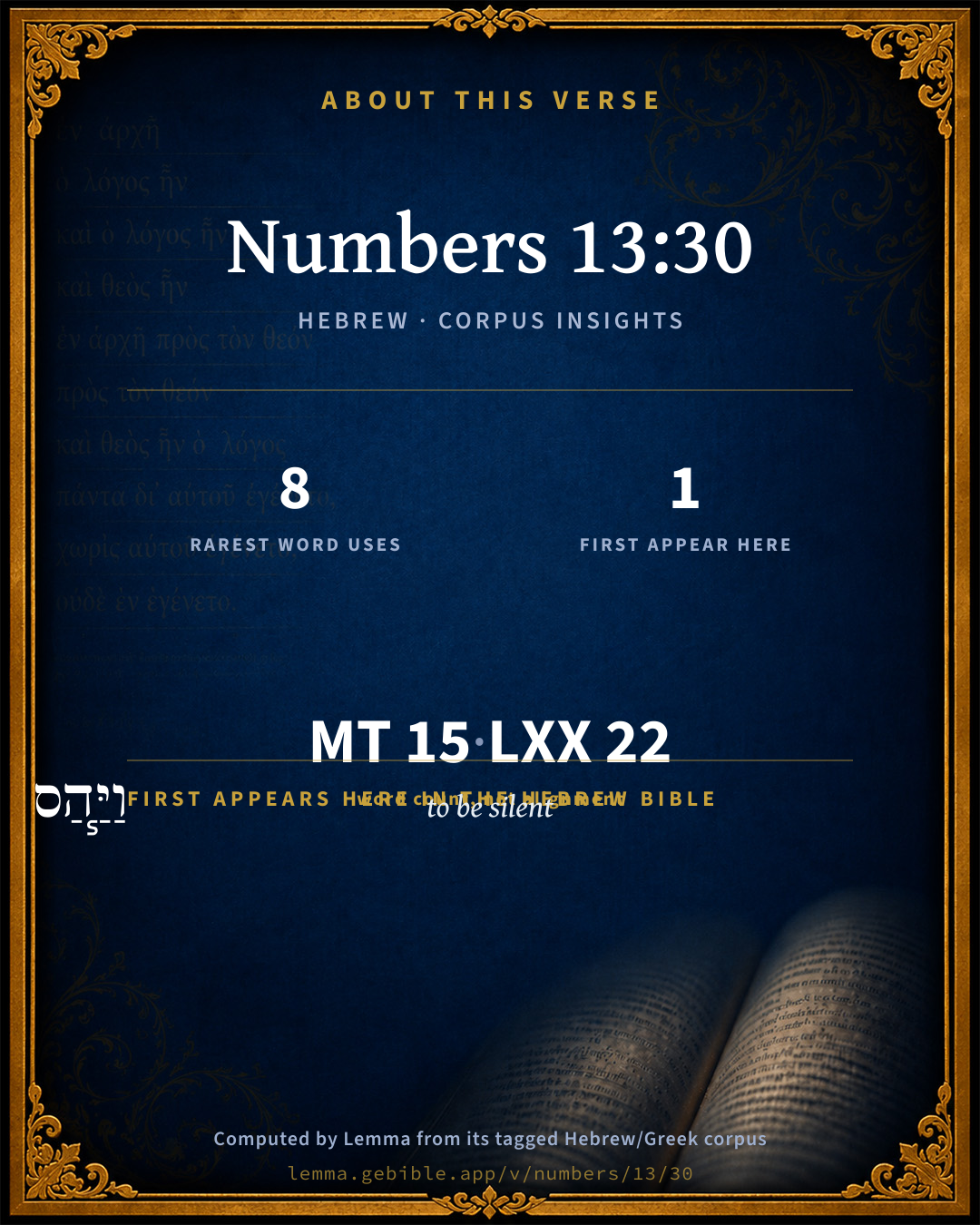
The rarest word here is וַיַּ֧הַס to be silent H2013 — appearing just 8 times in the whole Hebrew Bible.

First appearance in Scripture

This word makes its first canonical appearance in the Hebrew Bible here:

  • וַיַּ֧הַס to be silent H2013

Shared distinctive vocabulary

וַיַּ֧הַס to be silent H2013 occurs in 8 verses of the Hebrew Bible. Also found in:

Grammatical profile

  • 7 verbs
  • 3 nouns
  • 2 prepositions
  • 1 conjunction
  • 2 particles

Verb forms

  • וַיַּ֧הַס Hiphil · Sequential Imperfect
  • וַיֹּ֗אמֶר Qal · Sequential Imperfect
  • עָלֹ֤ה Qal · Infinitive Absolute
  • נַעֲלֶה֙ Qal · Imperfect
  • וְיָרַ֣שְׁנוּ Qal · Sequential Perfect
  • יָכ֥וֹל Qal · Infinitive Absolute
  • נוּכַ֖ל Qal · Imperfect

Repetition

Words recur within this verse — often emphatic in Hebrew:

  • עָלֹ֤ה to go up H5927 ×2
  • יָכ֥וֹל to prevail H3201 ×2

Hebrew & Septuagint length

In English translation the verse runs 25 words from the Hebrew and 38 from the Septuagint (LXX English) — the Septuagint runs noticeably longer here. See the side-by-side →

A rough comparison of the two English renderings, which tokenize alike — not a word-level alignment.

Word counts can differ between the Hebrew and the Greek without any difference in meaning — e.g. the Hebrew direct-object marker אֵת has no separate Greek word, and Greek often adds the article ὁ.

In the original languages it is 15 Hebrew tokens and 22 Greek tokens — but the two are counted differently (Hebrew bundles its prefixes and suffixes into one token; the Greek is in lemma form), so that isn’t a like-for-like length.

Cross-references

11

Topical passages linked to Numbers 13:30 in the Treasury of Scripture Knowledge — connected by theme and wording, ordered by reader-vote popularity; previews shown in the World English Bible.

  • Numbers 14:24 but my servant Caleb, because he had another spirit with him, and has followed me fully, him will I bring into the land into which he went; and his seed shall possess it.
  • Romans 8:31 What then shall we say about these things? If God is for us, who can be against us?
  • Philippians 4:13 I can do all things through Christ, who strengthens me.
  • Psalms 60:12 Through God we shall do valiantly, For it is he who will tread down our adversaries.
  • Numbers 14:6–9 Joshua the son of Nun and Caleb the son of Jephunneh, who were of those who spied out the land, tore their clothes:
  • Isaiah 41:10–16 Don't you be afraid, for I am with you; don't be dismayed, for I am your God; I will strengthen you; yes, I will help you; yes, I will uphold you with the right hand of my righteousness.
  • Romans 8:37 No, in all these things, we are more than conquerors through him who loved us.
  • Hebrews 11:33 who, through faith subdued kingdoms, worked out righteousness, obtained promises, stopped the mouths of lions,
  • Joshua 14:6–8 Then the children of Judah drew near to Joshua in Gilgal: and Caleb the son of Jephunneh the Kenizzite said to him, You know the thing that Yahweh spoke to Moses the man of God concerning me and concerning you in Kadesh-barnea.
  • Psalms 118:10–11 All the nations surrounded me, But in the name of Yahweh, I cut them off.
  • Psalms 27:1–2 Yahweh is my light and my salvation. Whom shall I fear? Yahweh is the strength of my life. Of whom shall I be afraid?

Cross-references courtesy of OpenBible.info (CC BY 4.0).

Hebrew and Greek witnesses Masoretic Hebrew ↔ Greek Septuagint

The same verse in the two great witnesses to the Old Testament, shown verse-for-verse.

Here the Septuagint runs noticeably longer than the Hebrew — LXX2012 (modern English Septuagint) 38 words vs World English Bible 25. A rough length comparison of the two English translations, not a word-level alignment — read both below.

These are two independent witnesses, not word-aligned to each other, and the Septuagint is shown in lemma (dictionary) form.

Hebrew Numbers 13:30 Masoretic · Westminster Leningrad Codex

וַיַּ֧הַס כָּלֵ֛ב אֶת הָעָ֖ם אֶל מֹשֶׁ֑ה וַיֹּ֗אמֶר עָלֹ֤ה נַעֲלֶה֙ וְיָרַ֣שְׁנוּ אֹתָ֔הּ כִּֽי יָכ֥וֹל נוּכַ֖ל לָֽהּ

Caleb stilled the people before Moses, and said, Let us go up at once, and possess it; for we are well able to overcome it.

World English Bible · Public Domain

Greek LXX Numbers 13:30 Septuagint · lemma form

καί κατασιωπάω χαλεβ ὁ λαός πρός μωυσῆς καί εἶπον αὐτός οὐ ἀλλά ἀναβαίνω ἀναβαίνω καί κατακληρονομέω αὐτός ὅτι δυνατός δύναμαι πρός αὐτός

And Amalec dwells in the land toward the south: and the Chettite and the Evite, and the Jebusite, and the Amorite dwells in the hill country: and the Chananite dwells by the sea, and by the river Jordan.

LXX2012 (modern English Septuagint) · Public Domain

Hebrew: Westminster Leningrad Codex (CC BY 4.0). Greek: Septuagint (public domain); English from LXX2012 (modern English Septuagint) (Public Domain). How the Septuagint differs from the Hebrew →

Targum (Aramaic paraphrase)

2

The Targum is the ancient Jewish Aramaic paraphrase of the Hebrew Scriptures — an interpretive translation, not the Hebrew text itself. Onkelos (literal) and Pseudo-Jonathan (expansive) render the Torah, and Jonathan the Prophets. Coverage is partial: where no permissively-licensed English translation exists for a verse, only the Aramaic is shown. This is verse-level text, not a word-by-word alignment to the Hebrew.

  1. Targum Onkelos Torah (Genesis–Deuteronomy)
    וַאֲצֵית כָּלֵב יָת עַמָא לְמשֶׁה וַאֲמַר מֵיסַק נִיסַק וְנִירַת יָתַהּ אֲרֵי מֵיכַל נֵיכוּל לָהּ

    (no public-domain English translation for this verse)

    Targum Onkelos — Aramaic: “Onkelos Genesis” (public domain); “Onkelos Exodus” (public domain); “Onkelos Leviticus” (public domain); “Onkelos Numbers” (public domain); “Onkelos Deuteronomy” (public domain). English: “Sefaria Community Translation” (CC0 1.0 (public-domain dedication)); “J.W. Etheridge. The Targums of Onkelos and Jonathan Ben Uzziel on the Pentateuch. London: Longmans, Green, 1862” (public domain). Text via Sefaria.

  2. Targum Pseudo-Jonathan Torah (Genesis–Deuteronomy)
    וּשְׁתִיק כָּלֵב יַת עַמָא וְאֵיצֵתִינוּן לְוַת משֶׁה וַאֲמַר מֵיסַק נֵיסַק וְנִירַת יָתָהּ אֲרוּם מֵיכַל נֵיכוֹל לָהּ

    And Kaleb stilled the people, and made them listen to Mosheh, and said: Let us go up and possess it, for we are able to take it.

    Targum Pseudo-Jonathan — Aramaic: “Targum Jonathan on Genesis” (public domain); “Targum Jonathan on Exodus” (public domain); “Targum Jonathan on Leviticus” (public domain); “Targum Jonathan on Numbers” (public domain); “Targum Jonathan on Deuteronomy” (public domain). English: “The Targum of Jonathan ben Uzziel, trans. J. W. Etheridge, London, 1862” (public domain). Text via Sefaria.

Commentary

Notes on Numbers 13:30 from classic Christian and Jewish commentators (each source and its license shown beneath its notes). The classic Christian expositions comment on the surrounding passage and are grouped to its opening verse, so a note may address several verses; the Jewish commentaries on the Tanakh (Rashi and others) are per-verse, so they appear only where the commentator wrote on this verse.

Lemma curates 59 commentaries, every one of them public domain or Creative Commons licensed, each selected and text-cleaned for this edition rather than reprinted as found. About our sources →

The Biblical Illustrator

Joseph S. Exell

Num_13:30

Let us go up at once, and possess it.

The ancient Canaan a type of heaven

I. In what respects the ancient canaan was a type of heaven.

1. It was a promised land, and the right of possession was founded on the promise.

2. It was a land in which God was peculiarly present.

3. It was a land of fruition.

4. It was a free gift.

II. The Israelites had dangers, difficulties, and discouragements in the wilderness, in their way to Canaan; so have Christians in their progress to heaven.

1. There are formidable foes to be encountered. The corrupt heart, the evil world, and that apostate spirit, the devil.

2. There are adversaries in timid and faint-hearted associates.

3. The Israelites in their progress were made dependent on the Lord for all things.

III. The resolution--let us go up at once, and possess it.

1. The title to it is sure. It is pledged in Christ; as heirs of God and joint heirs with Christ. He is our Joshua and is gone to take possession for us.

2. We have means and ordinances by which needed strength is supplied, and we are invited and enjoined to feed in the spiritual manner, and to drink of the spiritual rock.

3. Here we have many foretastes of the good land. (Sketches of Four Hundred Sermons.)

Difficulties in the way

1. The kingdom of heaven challenges the inquiry of all men. It addresses an appeal to human reason, and to human trust. Though itself a revelation, and therefore not to be handled as a common thing, nor to be tested by common instruments, yet Christianity invites the most careful inquest. It does not seek to rest upon the human intellect as a burden, but to shine upon it as a light. ]f Christianity may be represented under the image of a land, such as ancient Canaan, then it is fair to say of it, that it offers right of way over its hills and through its valleys, that its fruits and flowers are placed at the disposal of all travellers, and that he who complains that the land is shut against him speaks not only ungratefully but most falsely.

2. Different reports will, of course, be brought by the inquirers. The result of the survey will be according to the peculiarities of the surveyors. As streams are impregnated by the soils over which they flow, so subjects are affected by the individualism of the minds through which they pass. Thus Christianity may be said to be different things to different minds. To the speculative man it is a great attempt to solve deep problems in theology; to the controversialist it is a challenge to debate profound subjects on new ground; to the poet it is a dream, a wondrous vision many-coloured as the rainbow, a revelation many-voiced as the tunes of the wind or the harmonies of the sea.

(1) Some inquirers will see all the hindrances.

(2) All will confess that there is something good in the laud.

(3) Those who hold back by reason of the difficulties will come to a miserable end.

(a) We dont escape by false reasoning.

(b) We dont escape by fear.

Application:

1. Some have shown the spirit of Caleb--what is voter testimony?

2. Will you resolve, in Divine strength, to follow the Lord fully? (J. Parker, D. D.)

The decision and exertion incumbent upon Christians in all things

I. The passage serves to illustrate the believers duty in general. Go forward. This is the command of God to His people, with reference to every obligation that devolves upon them, and at every critical moment, amidst all our difficulties we encounter from the world. Nothing but this heroism will suit the dignity and the decision of Christian character.

II. The passage serves to illustrate the more special duty of the people of God with reference to missionary exertion. And that I conceive to be one of the pressing duties of the Church of Christ in the present day. (W. H. Cooper.)

The magnanimous character and wisdom of Caleb

1. He stilled the people. Stillness engenders thoughtfulness.

2. He seeks to secure unity of faith. Let us go up.

3. Promptness. At once.

4. He directs their minds to their ability.

Conclusion: The world belongs to Christ by creation and by preservation. In Gods name the Church may claim Christs prerogative for the conquest of the world. (W. Mudge.)

Good witnesses for God

I. God hath ever had some witnesses of his truth Nicodemus. Joseph of Arimathea. And how can it be otherwise, for the truth shall never decay from the earth, but be spread abroad from place to place, and from generation to generation for ever (Psa_119:89). We perish, for all flesh is as grass, and all the glory of man is as the flower of the field, but the word of the Lord abideth for ever (1Pe_1:24). God will have this never to die, never to wither. He hath the hearts of all men in His own hand, to turn them at His pleasure (Act_9:15). So saith Christ, I tell you if these should hold their peace, the stones would cry (Luk_19:40), and therefore He can never be without some witness to maintain His truth.

1. This teacheth us that God is most glorious and powerful, and will be known in the earth (Psa_8:1-2; Mat_21:15; Act_14:17).

2. Great is His truth and prevaileth; He hath always had a Church upon the face of the earth, and He never forsaketh it, though multitudes conspire against it, it shall have the upper hand at last.

3. Be not discouraged when the truth is oppressed, because God is able to maintain it, and raiseth up His enemies oftentimes to defend it.

4. This should persuade every one of us how to carry ourselves, namely, that we should not take any approbation or liking of the evil of other, neither ought we to imitate any in sin, how holy soever they seem to be, neither give consent to them by our practice, forasmuch as Gods hand hath overtaken them at one time or other.

II. The evil of others, yea, although they be many, may not re followed of us. The reasons.

1. Whatsoever is in itself evil cannot be made good and lawful by any example, nor by many examples. It cannot be warranted by the law of man, much less by the pure law of God Himself.

2. No greatness, no multitude can save a man from judgments due to the least sin; for though hand join in hand, the wicked shall not go unpunished (Pro_5:1-23; Pro_11:21). This serveth to reprove many carnal and formal Christians that oftentimes encourage themselves in evil, and strengthen themselves by the example of others.

3. We may gather from hence a reproof of ignorant recusants grounding only upon their forefathers; such as can give no other reason of their religion but that they were born and bred in it (Psa_78:8).

III. It is the duty: of Gods children to exhort and stir up one another to good things. And that for divers reasons.

1. We are quickly hardened in sin. We are quickly dull to all good; exhortation made by others setteth an edge upon us, and putteth life into us (Pro_27:17).

2. Such as continue to the end are made partakers of Christ, and with Him of all other graces; this ought to provoke us to practise this duty, the rather seeing so great fruit cometh by it, the blessing of all blessings, Christ Jesus is made ours (Heb_3:13-14).

3. We have other reasons used by the same apostle (Heb_10:25-26). Fearful judgments remain for all backsliders.

4. The day of the Lord draweth near, and we must take heed that it take us not unprepared; we must therefore stir up ourselves and others to look for it and to long after it. Lastly, we see evil men do it in evil and to evil. They labour by all means to make others as bad as themselves. This also we see in this place, much more therefore ought we to teach and instruct one another, and be helpers to the most holy faith one of another. (W. Attersoll.)

A campaign for God

The Israelites sent twelve spies into Paran and Kadesh to reconnoitre. I suppose they wanted to see if Gods word was true. Thats always the way with unbelievers. God had said to them, Go over. Ill help you. It will be yours. Its a land flowing with milk and honey. All youve got to do is to go and take it. But they thought they would first find out for themselves what it was worth, and whether they would be able to take it. They brought back what we would call in these days a majority and minority report. Ten said that it would be impossible to take the country. All admitted that what God had told them was true about the milk and honey. Only Caleb and Joshua confirmed the Lord in regard to taking the land. All admitted that the land was good, but ten said they saw giants, and walls, and castles, and that the Israelites would not be able to overcome these. I can imagine these fellows in camp, telling their comrades that they had stood alongside these giants, and had been obliged to look up to see their faces, and that they were to them but as grasshoppers. When we believe, we are able to overcome giants, and walls and everything. A lie generally travels faster than the truth. It is an old saying that a lie will go round the world before the truth can get his boots on to follow him. The world always seems to rejoice whenever anything goes wrong with religion. So thus he went round the camp and found favour with the Jews. I would rather go back to Egypt and make bricks without straw again. I would rather hear the crack of the slaveholders whip again, than encounter these terrors. Thats the way the Israelites talked, and that is the talk of the unbeliever. I am one of the spies sent out to look at the promised land. I have found it flowing with milk and honey. Let us say whether we fear anything now. Let us go up at once and take the land. I tell you that it is good. If Calebs voice had prevailed, the Israelites might have saved forty years in the wilderness. To-day I say that four-fifths of the professed children are not able to reach the land, simply on account of their unbelief. Many persons have told me that I mustnt expect so great a success as I had in the old country. If I dont expect it, I wont have it. We must go at once and take the land. We are able to do it. Their defence has gone from them. How easy it is for God to pour out His blessings in such profusion that we will not be able to receive them. That was the difference between Caleb and Joshua and the ten. The ten got their eyes on the walls and the giants, but Caleb and Joshua lifted theirs above and saw Him on His throne. They said that it was easy for God to give them that country as He promised. They remembered how easily He had taken them across the Red Sea; how He had fed them with manna in the wilderness, and how He had made the water gush forth from the barren rock. If God wishes to aid you, then you are well able to go up and take the land. That is the difference between a man who has God with him, and the one who has not. The greatest difficulty we have to encounter is, therefore, the unbelief so current among Christians. Oh, would that God would sweep it away! Our God is able to do it. Let us not limit the power of the Holy One of Israel. Look upward and see Him who sitteth on the right hand of God, and press forward. (D. L. Moody.)

Calebs spirit

Was Caleb, then, a giant--larger than any of the sons of Anak? Was he a Hercules and a Samson in one? Was his arm so terrific that every stroke of it was a conquest? We are not told so; the one thing we are told about Caleb is that he was a man of another spirit. That determines the quality of the man. Character is a question of spirit. It is an affair of inward and spiritual glow. Caleb had been upon the preliminary search; Caleb had seen the walls, and the Anakim, and the fortresses, and he came back saying, We can do this, not because we have so many arms only, or so many resources of a material kind, but because he was a man of another spirit. In the long run, spirit wins; in the outcome of all history, spirit will be uppermost. The great battles of life are not controversies of body against body, but, as far as God is in them, they are a question of spirit against body, thought against iron, prayer against storming and blustering of boastful men. While the cloud hangs over the field, and the dust of the strife is very thick, and the tumult roars until it deafens those who listen, we cannot see the exact proportions, colours, and bearings of things; but if we read history instead of studying the events of the day which have not yet settled themselves into order and final meaning, we shall discover that spirit is mightier than body, that knowledge is power, that righteousness exalteth a nation, and that they who bear the white banner of a pure cause ultimately triumph because God is with them. (J. Parker, D. D.)

Difficulties may be overcome

It is impossible! said some, when Peter the Great determined on a voyage of discovery; and the cold and uninhabited region over which he reigned furnished nothing but some larch-trees to construct his vessels. But, though the iron, the cordage, the sails, and all that was necessary, except the provisions for victualling them, were to be carried through the immense deserts of Siberia, down rivers of difficult navigation, and along roads almost impassable, the thing was done; for the command of the sovereign and the perseverance of the people surmounted every obstacle.

The Biblical Illustrator, edited by Joseph S. Exell (c. 1880s–1900s) — public domain. Text from a community e-Sword module.

Joseph Benson's Commentary

Num 13:30. Caleb — Together with Joshua, as is manifest from chap. Num 14:6-7; Num 14:30; but Caleb alone is here mentioned, possibly because he spake first and most, which he might better do, because he might be presumed to be more impartial than Joshua, who, being Moses’s minister, might be thought to speak only what he knew his master would like. Stilled the people — Which implies either that they had begun to murmur, or that by their looks and carriage, they discovered the anger which boiled in their breasts.

Before Moses — Or, toward Moses, against whom they were incensed, as the man who had brought them into such sad circumstances. Let us go up and possess it. He does not say, Let us go up and conquer it. He looks on that to be as good as done already: but, Let us go up and possess it! There is nothing to be done but to enter without delay, and take the possession which our great Lord is now ready to give us! Thus difficulties that lie in the way of salvation, vanish away before a lively faith.

Joseph Benson's Commentary on the Old and New Testaments (1811–1818) — public domain. Text from a community e-Sword module.

Tyndale Open Study Notes

Tyndale Open Resources

13:30 Caleb and Joshua (see 14:6, 10, 30) were more optimistic in their assessment of the land than the other spies were (cp. 14:31-33).

Tyndale Open Study Notes — © Tyndale Open Resources, licensed CC BY-SA 4.0. Text via the HelloAO Bible API.

Ellicott's Commentary for English Readers

(30) And Caleb stilled the people.—The fact that Caleb alone is mentioned in this place is by no means inconsistent with the statement which is contained in Num_14:6-9, from which it appears that Joshua and Caleb concurred in exhorting the people to go up and take possession of the land of promise. It appears, moreover, from Deu_1:29, &c., that Moses also remonstrated earnestly with the people, and yet neither here nor in the following chapter is mention made of that remonstrance.

A Bible Commentary for English Readers, edited by Charles John Ellicott (1878–1897) — public domain. Text from a community e-Sword module.

The Cambridge Bible for Schools and Colleges

gen. ed. J. J. S. Perowne

30. we are well able to overcome if] we shall certainly prevail against it.

The Cambridge Bible for Schools and Colleges (gen. ed. J. J. S. Perowne; Cambridge University Press, 1878–1918) — public domain. Text from a community e-Sword module.

Haydock's Catholic Bible Commentary

South. They had already routed the Amalecites; but the spies insidiously recall to their remembrance, that they would be again in arms to obstruct their passage. --- Hethites, dwelt nearest the Philistines, in the country which fell to the shares of Simeon and of Dan. The Jebusites occupied Jerusalem; and the Amorrhites, the most powerful of all those nations, held possession of most of the territory which was allotted to Juda. Nearer the Dead Sea, on the same mountains, dwelt the Cinezeans and the Cineans. Bonfrere places the Chanaanites on the banks of the Jordan, from the lake of Sodom as far as the sea of Tiberias. But they dwelt also near the Mediterranean; and the Phœnicians maintained themselves at Tyre and Sidon, against the most powerful kings of the Jews, and extended their commerce over the old world, to many parts of which they sent out colonies. (Calmet)

George Leo Haydock (1774–1849), Haydock's Catholic Family Bible and Commentary, 1859 edition — public domain. Excludes Psalms (Douay-Rheims chapter numbering differs from Protestant) and Deuterocanonical books (Catholic canon only).

Matthew Poole's English Annotations

Caleb, together with Joshua, as is manifest from Num 14:6,7,30; but Caleb alone is here mentioned, possibly because he spake first and most, which he might better do, because he might be presumed to be more impartial than Joshua, who being Moses’s minister might be thought to speak only what he knew his master would like.

Stilled the people; which implies either that they had began to murmur, or that by their looks and carriages they discovered that grief and anger which boiled in their breasts.

Before Moses, or toward Moses, against whom they were incensed, as the man who had brought them into such sad circumstances.

We are well able; partly in moral probability, because we are one people united under one head, whereas they are divided into several nations, and governments of differing counsels, and interests, and inclinations; and principally because of the assistance of the Almighty God.

Matthew Poole's English Annotations on the Holy Bible (1683–1685) — public domain. Text from a community e-Sword/MySword module.

Whedon's Commentary on the Bible

Daniel D. Whedon

30. Caleb — The spy from the tribe of Judah here begins the minority report, which is characterized by an unwavering trust in Jehovah. “A discrepancy indicating diversity of author-ship is here again alleged, in that here and in Num_14:24, as well as in Deu_1:36, Caleb is spoken of alone; whereas in Num_14:30; Num_26:65; Num_32:12, Caleb and Joshua are spoken of as having acted together on this occasion, Caleb being first named, and in Num_14:6, it is Joshua and Caleb. The simple explanation of which is, that in the first instance, when the spies were making their report to Moses, Caleb was outspoken in his declaration that the people had no real cause for fear; and subsequently, when the murmurs of the people were louder and more pronounced, and took the form of open rebellion against Moses and Aaron, (Num_14:2-4,) Joshua and Caleb were both active in endeavouring to suppress the disturbance by encouraging the people and bringing them to a sense of their duty. Num_13:6, etc. Comp. Jos_14:6, where Caleb, in referring to this event, in speaking to Joshua first joins both together, ‘me and thee,’ and then proceeds to describe his own share in the transaction without any allusion to Joshua.” — Dr. Edersheim.

Stilled the people — The bitter wail of despair was resounding through the vast throng.

Let us go up at once — Genuine faith grasps a present God and an instantaneous salvation. Caleb was wise to counsel going up to the assault at once, for there is no better cure for fear than action. Old soldiers say that the trying time is when waiting to begin the battle. Hesitation weakens resolution. When we are sure that any thing is God’s will the sooner we are at work doing it the better for ourselves and for the vigour of our efforts.

For we are well able — The ground of Caleb’s confidence is stated in Num_14:8-9. This report is a marvel of condensation, terseness, and vigour — just what we should expect from a speaker who is permitted to utter but one sentence amid the uproar of a mob.

Daniel D. Whedon (gen. ed.), Commentary on the Old and New Testaments (1874–1909) — public domain. Text from a community e-Sword module.

The Pulpit Commentary

Caleb stilled the people. That Caleb alone is named here, whereas Joshua is elsewhere joined with him in the matter, (as in Num_14:6, Num_14:30) has been considered strange; but it is not difficult to supply a probable explanation. Joshua was the special companion and minister of Moses, his alter ego in those things wherein he was employed: for that reason he may very well have given place to Caleb as a more impartial witness, and one more likely to be listened to in the present temper of the people; for it is evident from Deuteronomy 1, that that temper had already declared itself for evil. (see on Num_14:24)

Vers. 30-33. Conflicting counsels.

The report has been received, such as it is, and the next question comes: What shall be done? "Caleb stilled the people before Moses." This intimates the excitement and turbulence of their feeling. The chances are that a good deal of disparagement of Canaan had come to their ears, losing nothing as it passed from one tongue to another. Notice the temporary effacement, as it were, of Moses. It is Caleb who here takes the lead. Moses is nothing save as the mouth-piece of God, and the time is not quite ripe for God to speak. But Caleb, who, here as afterwards, shows himself a courageous man, prompt and ready, has formed his opinion, and at once expresses it; to be immediately followed by opinions just as decided in the opposite direction. We need not here so much to consider who was right and who wrong; God himself brings all out presently into the clearest of light. The great matter to be noticed is that the people were now exposed to conflicting counsels.

I THESE CONFLICTING COUNSELS WERE THE CONSEQUENCE OF BACKSLIDING FROM GOD. The people had turned away from their true Guide, and the consequence of being in a wrong path very soon appears. God is one, and in his infinite wisdom and power can make all things work together for good to them that love him, and are called according to his purpose. But men are many and diverse, and if those who are called according to his purpose fad from the obedience which shows their love, how shall they make things work together for good? To God the scheme of human affairs is as a machine, complicated and intricate indeed, but well under control, and producing large results. To men it is, more or less, a maze of motions. They understand it a little in parts, but are hopelessly divided as to the meaning and service of the whole.

II THE PREPONDERANCE IN THESE CONFLICTING COUNSELS WAS AGAINST THE COURSE WHICH GOD HAD ALREADY LAID OUT. God had promised the land, kept it before the people, and brought them to the very verge; yet ten out of twelve men responsible men in the tribes, men who had journeyed through the land for forty days declared that it was beyond the strength of Israel to obtain. What a satire on vox populi vox Dei! What a humbling revelation of the motives that work most powerfully in unregenerate human nature! How easy it is to exaggerate difficulties when one"s heart is not in a work; to see, not everything that is to be seen, but only what the eye wants to see, and to see in a particular way! It is a part of spiritual prudence to reckon that, whatever strength there may be in mere numbers, in brute force and material appliances, they cannot be counted on in advancing the kingdom of God. With all these resources heaped up around them, craven spirits will still cry out that there is a lion in the way.

III IT IS EVERYTHING TO RECOLLECT THAT THERE WERE CONFLICTING COUNSELS. Cowardice, carnality, and backsliding did not altogether get their own way. Things were bad enough, but after all Caleb and Joshua counted for a great deal on the other side. We must not only count men, but weigh them. There are times when it is no credit to men, when it says but little for their piety or their humanity, that they are found among majorities. It is the glory of God"s cause on earth that it never loses its hold on at least a few. There is always a Caleb to fling to the wind considerations of base expediency. Y.

The Pulpit Commentary (1880–1919), ed. H.D.M. Spence-Jones & Joseph S. Exell — public domain. Text from a community e-Sword module.

John Wesley's Explanatory Notes

Caleb - Together with Joshua, as is manifest from chap. xiv, 6, 7, 30, but Caleb alone is here mentioned, possibly because he spake first and most, which he might better do, because he might be presumed to be more impartial than Joshua, who being Moses's minister might be thought to speak only what he knew his master would like. Stilled the people -Which implies either that they had began to murmur, or that by their looks and carriage, they discovered the anger which boiled in their breasts. Before Moses - Or, towards Moses, against whom they were incensed, as the man who had brought them into such sad circumstances. Let us go up and possess it - He does not say, Let us go up and conquer it. He looks on that to be as good as done already: but, Let us go up and possess it! There is nothing to be done, but to enter without delay, and take the possession which our great Lord is now ready to give us! Thus difficulties that lie in the way of salvation, vanish away before a lively faith.

John Wesley, Explanatory Notes Upon the Whole Bible (1754–1765) — public domain. Text via the GEBible commentary corpus.

Keil & Delitzsch

C. F. Keil & F. Delitzsch

As these tidings respecting the towns and inhabitants of Canaan were of a character to excite the people, Caleb calmed them before Moses by saying, "We will go up and take it; for we shall overcome it." The fact that Caleb only is mentioned, though, according to Num 14:6, Joshua also stood by his side, may be explained on the simple ground, that at first Caleb was the only one to speak and maintain the possibility of conquering Canaan.

Keil & Delitzsch — Biblical Commentary on the Old Testament (1861–1891) — public domain (CC PDM 1.0). Text via the HelloAO Bible API. (Old Testament only.)

unfoldingWord translationNotes

Door43 World Missions Community

translationWords

Caleb

courage

unfoldingWord translationNotes — © Distant Shores Media and the Door43 World Missions Community, licensed CC BY-SA 4.0. Source: git.door43.org/Door43/en_tn.

Rashi

Rabbi Shlomo Yitzchaki (Rashi)

ויהס כלב AND CALEB STILLED [THE PEOPLE] — he caused all of them to be silent.

אל משה means he silenced them that they should hear what he was going to say about Moses. He cried aloud saying: “Is this the only thing the son of Amram has done to us?!" — One who heard him thus speaking believed that he was about to speak to his disparagement, and because they had something in their mind against Moses through the spies’ statements, all of them kept silent to hear his disparagement. He, however, said: “Did he not divide the Red Sea for us, and bring down the Manna for us, and collect the quails for us?!” (Sotah 35a).

עלה נעלה WE CAN INDEED GO UP — even to heaven, if he were to say “Make ladders and go up there”, we should listen to him because we would be successful in all his words (in all he bids us do) (Sotah 35a).

ויהס is an expression denoting silence. Similar is, (Zechariah 2:17) “Be silent, (הס) O all flesh”; (Amos 6:10) “Be silent (הס): for we may not mention [the name of the Lord]”. So is the manner of people: he who wishes to silence a group of men says “sst” (This sibilant sound is therefore used to command silence).

Rashi on the Tanakh — English translations: “The Judaica Press complete Tanach with Rashi, translated by A. J. Rosenberg” (CC BY 4.0); “Pentateuch with Rashi's commentary by M. Rosenbaum and A.M. Silbermann, 1929-1934” (public domain); “The Metsudah Tanach series, Lakewood, N.J” (CC BY 4.0); and “The Book of Joshua, Metsudah Publications, 1997” (CC BY 4.0). Text via Sefaria.

Lesson kit

Teaching starters — assembled from the data on this page, not authored interpretation. Every prompt links to the verse data it draws on. Edit before teaching.

Numbers, in the Pentateuch, opens this verse with 15 words (11 distinct Hebrew lemmas). Its most distinctive word is hâçâh (“to be silent”). The Greek Septuagint runs longer here. A historical commentator’s framing appears above. Read the whole chapter for the surrounding context.

Discussion questions

  1. How does “to be silent” (hâçâh) shape what this verse is saying?
  2. This is the first place “to be silent” appears in Scripture (first appears here). What does its debut here establish?
  3. How does Judges 3:19, which shares the word «to be silent», read alongside this verse?
  4. What does the repetition of “to go up” (2× in this one verse) do in this verse?
  5. The Septuagint runs longer here than the Hebrew. What might account for the difference?
  6. These translations render this verse differently. What is at stake in choosing one wording over another?
  7. «וַיַּ֧הַס» is a Hiphil Sequential Imperfect verb. How does that grammatical form shape the action described?
  8. Compare how The Biblical Illustrator and Joseph Benson's Commentary read this verse. Where do they agree or differ?

Things to notice

Reading settings

Reading text

Shown beneath each verse's original-language words.

Old Testament
Old Testament edition

Read the OT as the Masoretic Hebrew (MT) or the Greek Septuagint (LXX).

English shown for the Greek Septuagint (in the Hebrew ↔ Greek comparison).

Comparing translations? Open the Compare panel on any verse page to stack up to four side by side.