
Exodus 19:24

Hebrew (Westminster Leningrad Codex) Exodus 19:24 appears in the Hebrew Old Testament. The text above is from the Westminster Leningrad Codex. Each word links to its Strong’s number, a concise gloss, and parsing drawn from the Open Scriptures Hebrew Bible morphology. Click any word for its full Brown-Driver-Briggs (BDB) entry.
Download image
Cite this verse

Exodus 19:24 (World English Bible). Public Domain. Lemma interlinear Bible study tool, https://lemma.gebible.app/v/exodus/19/24.

Show BibTeX & RIS
BibTeX
RIS
English Translation
Yahweh said to him, "Go down and you shall bring Aaron up with you, but don't let the priests and the people break through to come up to Yahweh, lest he break forth on them."
World English Bible · Public Domain
Download a study sheet

One document with this verse’s original text, its word-by-word gloss line, the meaning frame, cross-references with their text, attributed commentary, and full source and license credits — printable, and it pastes into notes with its structure intact.

This verse Autodidact and up

Study sheet (.html) Plain text (.txt)

A passage Seminary Student

Up to 50 verses in one chapter. A passage sheet keeps up to 6 commentary sources and 12 cross-references per verse, in the order this page ranks them, and says so on the sheet whenever that leaves anything out. Ask for a single verse and you get the Autodidact verse sheet above.

Everything on this page stays free to read, with no account — the sheet is a download of what is already on screen, not access to it.

Want to remove ads? Support Godless Engineer
Compare translations 3

The same verse in 3 English versions, stacked beneath the original-language interlinear above. Click any original word for its lexicon entry.

Each is an independent rendering of the whole verse — the interlinear is not word-aligned to these translations.

Highlighted words mark where these versions differ — a whole-verse word diff, not a word-by-word alignment.

  • World English Bible Public Domain
    Yahweh said to him, "Go down and you shall bring Aaron up with you, but don't let the priests and the people break through to come up to Yahweh, lest he break forth on them."
  • King James Version Public Domain
    And the LORD said unto him, Away, get thee down, and thou shalt come up, thou, and Aaron with thee: but let not the priests and the people break through to come up unto the LORD, lest he break forth upon them.
  • unfoldingWord Literal Text CC BY-SA 4.0
    And Yahweh said to him, “Go, climb down. And you shall come back up, you and Aaron with you; and the priests and the people shall not break through to come up to Yahweh, lest he burst out against them.”

unfoldingWord Literal Text — © unfoldingWord, licensed CC BY-SA 4.0. Word-aligned USFM3 via Door43 (git.door43.org/unfoldingWord/en_ult).

Versions to compare (up to 4)

3 of 4 selected

Show all 18 translations

Every available English version of this verse, each an independent rendering of the whole verse.

  • World English Bible Public Domain
    Yahweh said to him, "Go down and you shall bring Aaron up with you, but don't let the priests and the people break through to come up to Yahweh, lest he break forth on them."
  • Berean Standard Bible Public Domain
    And the LORD replied, “Go down and bring Aaron with you. But the priests and the people must not break through to come up to the LORD, or He will break out against them.”
  • Majority Standard Bible Public Domain
    And the LORD replied, “Go down and bring Aaron with you. But the priests and the people must not break through to come up to the LORD, or He will break out against them.”
  • King James Version Public Domain
    And the LORD said unto him, Away, get thee down, and thou shalt come up, thou, and Aaron with thee: but let not the priests and the people break through to come up unto the LORD, lest he break forth upon them.
  • American Standard Version (1901) Public Domain
    And Jehovah said unto him, Go, get thee down; and thou shalt come up, thou, and Aaron with thee: but let not the priests and the people break through to come up unto Jehovah, lest he break forth upon them.
  • Revised Version (1885) Public Domain
    And the LORD said unto him, Go, get thee down; and thou shalt come up, thou, and Aaron with thee: but let not the priests and the people break through to come up unto the LORD, lest he break forth upon them.
  • Geneva Bible (1599) Public Domain
    And the Lord sayd vnto him, Go, get thee downe, and come vp, thou, and Aaron with thee: but let not the Priestes and the people breake their boundes to come vp vnto the Lord, least he destroy them.
  • Douay-Rheims (1899) Public Domain
    And the Lord said to him: Go, get thee down: and thou shalt come up, thou and Aaron with thee: but let not the priests and the people pass the limits, nor come up to the Lord, lest he kill them.
  • Young's Literal Translation Public Domain
    And Jehovah saith unto him, `Go, descend, then thou hast come up, thou, and Aaron with thee; and the priests and the people do not break through, to come up unto Jehovah, lest He break forth upon them.'
  • Literal Standard Version CC BY-SA 4.0
    And YHWH says to him, “Go, descend, then you have come up, you and Aaron with you; and the priests and the people do not break through to come up to YHWH, lest He break forth on them.”
  • Unlocked Literal Bible CC BY-SA 4.0
    Yahweh said to him, “Go, get down the mountain, and bring up Aaron with you, but do not let the priests and the people break through the barrier to come up to me, or I will attack them.”
  • unfoldingWord Literal Text CC BY-SA 4.0
    And Yahweh said to him, “Go, climb down. And you shall come back up, you and Aaron with you; and the priests and the people shall not break through to come up to Yahweh, lest he burst out against them.”
  • Darby Bible Public Domain
    And Jehovah said to him, Go, descend, and thou shalt come up, thou, and Aaron with thee; but the priests and the people shall not break through to go up to Jehovah, lest he break forth on them.
  • World Messianic Bible Public Domain
    The LORD said to him, “Go down! You shall bring Aaron up with you, but don’t let the priests and the people break through to come up to the LORD, lest he break out against them.”
  • Webster's Bible Public Domain
    And the LORD said to him, Away, go down, and thou shalt come up, thou, and Aaron with thee: But let not the priests and the people break through, to come up to the LORD, lest he break forth upon them.
  • Free Bible Version CC BY-SA 4.0
    The Lord told him, “Go down and bring Aaron back up with you. But the priests and the people must not force their way to come up to the Lord, or he will punish them.”
  • Bible in Basic English Public Domain
    And the Lord said to him, Go down, and you and Aaron may come up; but let not the priests and the people make their way through to the Lord, or he will come on them suddenly.
  • JPS Tanakh (1917) Public Domain
    And the LORD said unto him: 'Go, get thee down, and thou shalt come up, thou, and Aaron with thee; but let not the priests and the people break through to come up unto the LORD, lest He break forth upon them.'

Literal Standard Version (2020), Covenant Press — licensed CC BY-SA 4.0. Text via the HelloAO Bible API (eBible.org). Unlocked Literal Bible (unfoldingWord) — licensed CC BY-SA 4.0. Text via the HelloAO Bible API (eBible.org). unfoldingWord Literal Text — © unfoldingWord, licensed CC BY-SA 4.0. Word-aligned USFM3 via Door43 (git.door43.org/unfoldingWord/en_ult). Free Bible Version, Dr. Jonathan Gallagher — licensed CC BY-SA 4.0. Text via the HelloAO Bible API (eBible.org).

Word by word

More ways to search: Search by grammar → Find every occurrence → Compare this word →

Practice this passage: Drill this verse → Learn its vocabulary →

יֶֽהֶרְס֛וּ
hâraç
H2040
“to tear down”
Verb, Qal, Jussive, 3rd Person, Masculine, Plural
Part of Speech
Verb
Stem
Qal
Form
Jussive
Person
3rd Person
Gender
Masculine
Number
Plural
Full BDB Definition

Origin: a primitive root

TWOT: 516

to tear down, break down, overthrow, beat down, break, break through, destroy, pluck down, pull down, throw down, ruined, destroyer, utterly - (Qal) - to throw down, tear down - to break through - to break down, break away - (Niphal) to be torn down, be thrown down - (Piel) - to overthrow, tear down - destroyer (participle)
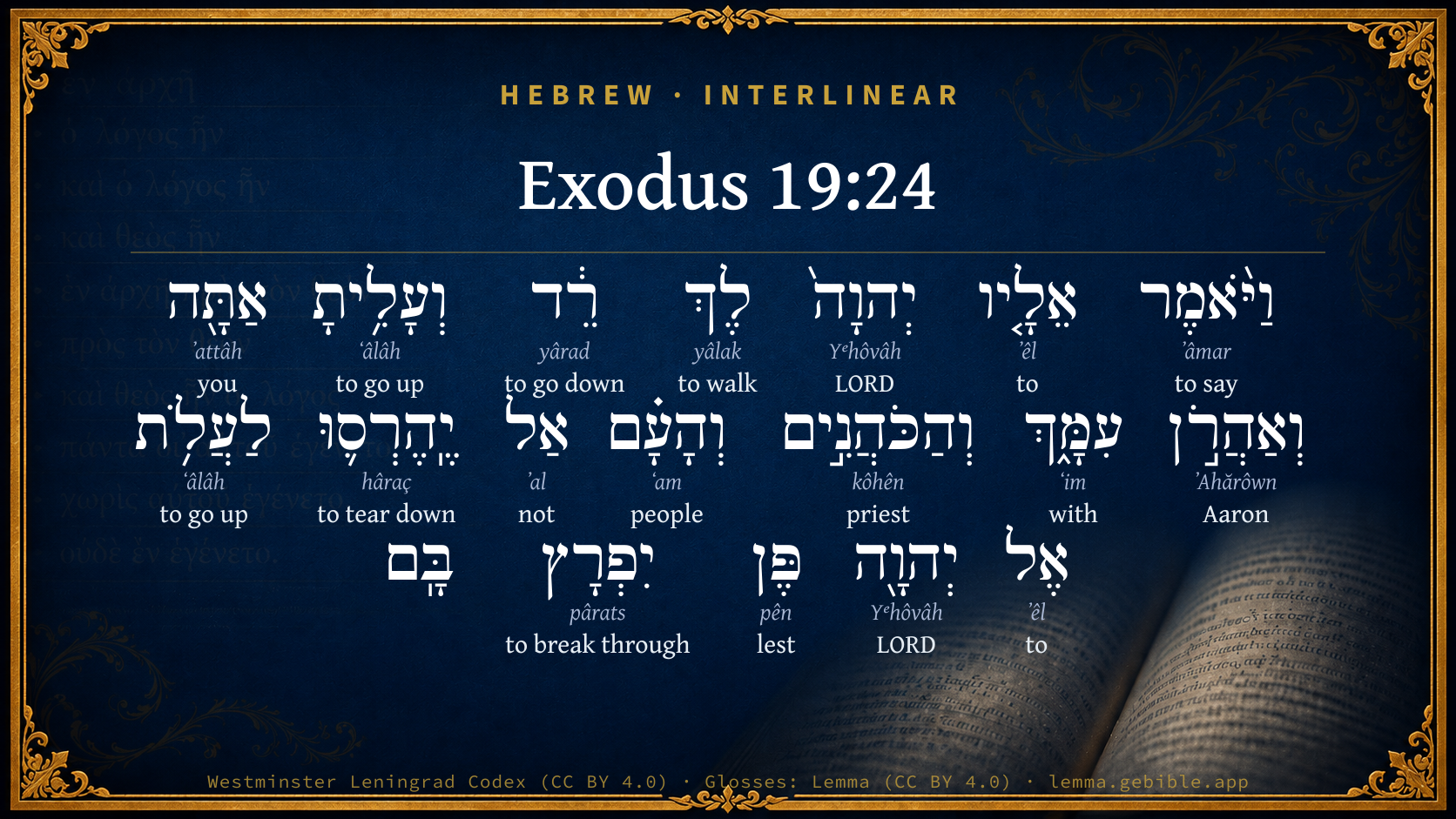
  1. וַיֹּ֨אמֶר ʼâmar H559 “and · to say” Conjunction + Verb, Qal, Sequential Imperfect, 3rd Person, Masculine, Singular
  2. אֵלָ֤יו ʼêl H413 “to · him” Preposition + Suffix, Personal, 3rd Person, Masculine, Singular
  3. יְהוָה֙ Yᵉhôvâh H3068 “LORD” Noun, Proper
  4. לֶךְ yâlak H3212 “walk” Verb, Qal, Imperative, 2nd Person, Masculine, Singular
  5. רֵ֔ד yârad H3381 “go down” Verb, Qal, Imperative, 2nd Person, Masculine, Singular
  6. וְעָלִ֥יתָ ʻâlâh H5927 “and · to go up” Conjunction + Verb, Qal, Sequential Perfect, 2nd Person, Masculine, Singular
  7. אַתָּ֖ה ʼattâh H859 “you” Pronoun, Personal, 2nd Person, Masculine, Singular
  8. וְאַהֲרֹ֣ן ʼAhărôwn H175 “and · Aaron” Conjunction + Noun, Proper
  9. עִמָּ֑ךְ ʻim H5973 “with · you” Preposition + Suffix, Personal, 2nd Person, Feminine, Singular
  10. וְהַכֹּהֲנִ֣ים kôhên H3548 “and · the · priests” Conjunction + Particle, Definite Article + Noun, Common, Masculine, Plural, Absolute
  11. וְהָעָ֗ם ʻam H5971 “and · the · people” Conjunction + Particle, Definite Article + Noun, Common, Masculine, Singular, Absolute
  12. אַל ʼal H408 “not” Particle, Negative
  13. לַעֲלֹ֥ת ʻâlâh H5927 “to go up” Preposition + Verb, Qal, Infinitive Construct
  14. אֶל ʼêl H413 “to” Preposition
  15. יְהוָ֖ה Yᵉhôvâh H3068 “LORD” Noun, Proper
  16. פֶּן pên H6435 “lest” Conjunction
  17. יִפְרָץ pârats H6555 “to break through” Verb, Qal, Imperfect, 3rd Person, Masculine, Singular

About this verse

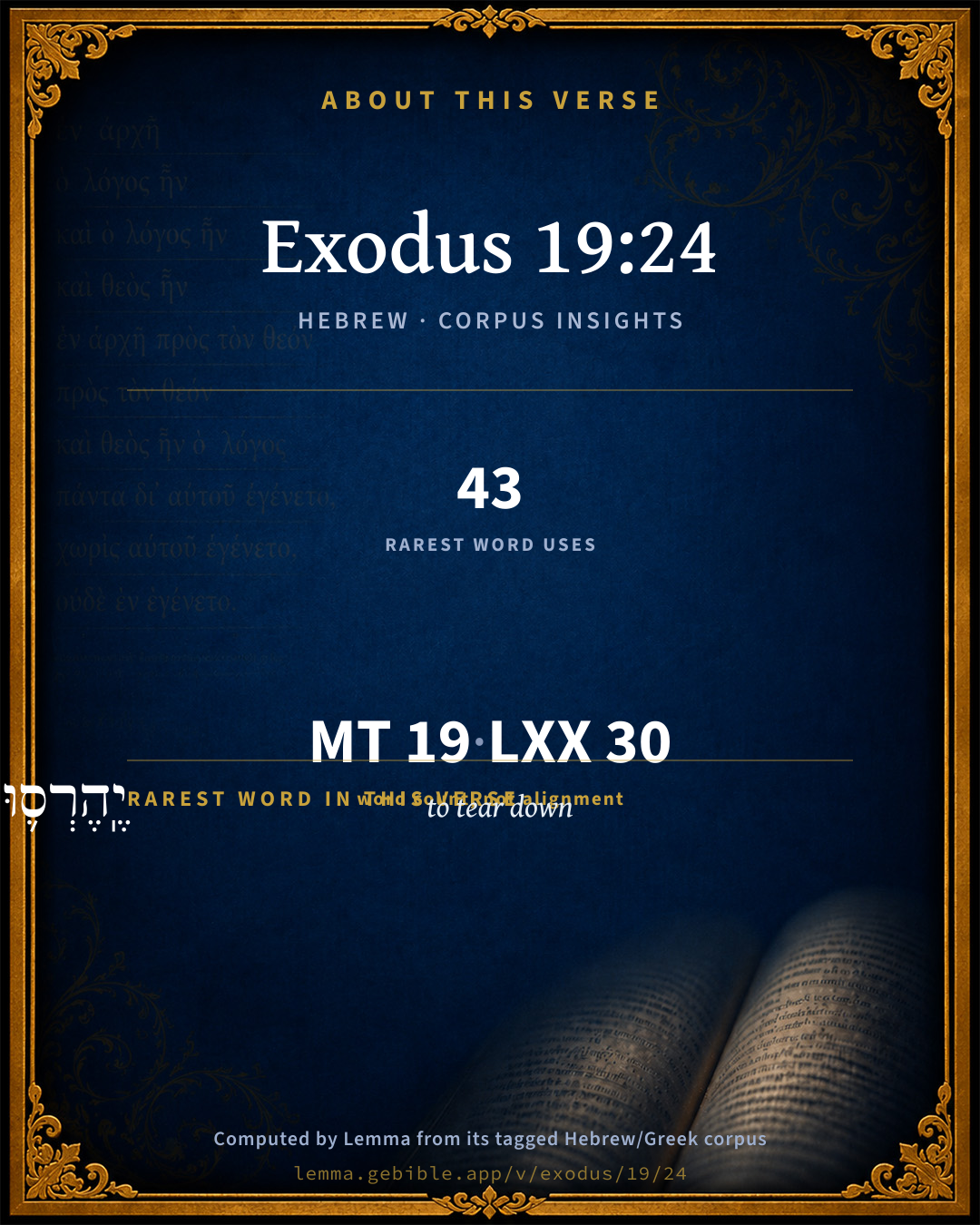
These counts appear in no published source. They are computed here, from the morphology-tagged text and Lemma’s own curated glosses. What Lemma adds →

19
words
15
distinct lemmas
Pentateuch
section

Shared distinctive vocabulary

יֶֽהֶרְס֛וּ to tear down H2040 occurs in 42 verses of the Hebrew Bible. Also found in:

Grammatical profile

  • 7 verbs
  • 5 nouns
  • 1 pronoun
  • 4 prepositions
  • 1 conjunction
  • 1 particle

Verb forms

  • וַיֹּ֨אמֶר Qal · Sequential Imperfect
  • לֶךְ Qal · Imperative
  • רֵ֔ד Qal · Imperative
  • וְעָלִ֥יתָ Qal · Sequential Perfect
  • יֶֽהֶרְס֛וּ Qal · Jussive
  • לַעֲלֹ֥ת Qal · Infinitive Construct
  • יִפְרָץ Qal · Imperfect

Repetition

Words recur within this verse — often emphatic in Hebrew:

  • יְהוָה֙ LORD H3068 ×2
  • וְעָלִ֥יתָ to go up H5927 ×2
  • אֵלָ֤יו to H413 ×2

Hebrew & Septuagint length

In English translation the verse runs 35 words from the Hebrew and 39 from the Septuagint (LXX English) — closely comparable.

A rough comparison of the two English renderings, which tokenize alike — not a word-level alignment.

Word counts can differ between the Hebrew and the Greek without any difference in meaning — e.g. the Hebrew direct-object marker אֵת has no separate Greek word, and Greek often adds the article ὁ.

In the original languages it is 19 Hebrew tokens and 30 Greek tokens — but the two are counted differently (Hebrew bundles its prefixes and suffixes into one token; the Greek is in lemma form), so that isn’t a like-for-like length.

Cross-references

17

Topical passages linked to Exodus 19:24 in the Treasury of Scripture Knowledge — connected by theme and wording, ordered by reader-vote popularity; previews shown in the World English Bible.

  • Hebrews 4:16 Let us therefore draw near with boldness to the throne of grace, that we may receive mercy, and may find grace for help in time of need.
  • Hebrews 12:18–25 For you have not come to a mountain that might be touched, and that burned with fire, and to blackness, darkness, tempest,
  • Hebrews 12:29 for our God is a consuming fire.
  • Exodus 19:12 You shall set bounds to the people round about, saying, 'Be careful that you don't go up onto the mountain, or touch its border. Whoever touches the mountain shall be surely put to death.
  • Exodus 19:21–22 Yahweh said to Moses, "Go down, charge the people, lest they break through to Yahweh to gaze, and many of them perish.
  • Exodus 24:1 He said to Moses, "Come up to Yahweh, you, and Aaron, Nadab, and Abihu, and seventy of the elders of Israel; and worship from a distance.
  • Exodus 24:9 Then Moses, Aaron, Nadab, Abihu, and seventy of the elders of Israel went up.
  • Matthew 11:12 From the days of John the Baptizer until now, the Kingdom of Heaven suffers violence, and the violent take it by force.
  • Luke 13:24 "Strive to enter in by the narrow door, for many, I tell you, will seek to enter in, and will not be able.
  • Luke 16:16 The law and the prophets were until John. From that time the Gospel of the Kingdom of God is preached, and everyone is forcing his way into it.
  • John 1:17 For the law was given through Moses. Grace and truth came through Jesus Christ.
  • Romans 4:15 For the law works wrath, for where there is no law, neither is there disobedience.
  • 2 Corinthians 3:7–9 But if the service of death, written engraved on stones, came with glory, so that the children of Israel could not look steadfastly on the face of Moses for the glory of his face; which was passing away:
  • Galatians 3:10–11 For as many as are of the works of the law are under a curse. For it is written, "Cursed is everyone who doesn't continue in all things that are written in the book of the law, to do them."
  • Galatians 3:19 What then is the law? It was added because of transgressions, until the seed should come to whom the promise has been made. It was ordained through angels by the hand of a mediator.
  • Galatians 3:22 But the Scriptures shut up all things under sin, that the promise by faith in Jesus Christ might be given to those who believe.
  • Hebrews 10:19–22 Having therefore, brothers, boldness to enter into the holy place by the blood of Jesus,

Cross-references courtesy of OpenBible.info (CC BY 4.0).

Hebrew and Greek witnesses Masoretic Hebrew ↔ Greek Septuagint

The same verse in the two great witnesses to the Old Testament, shown verse-for-verse.

These are two independent witnesses, not word-aligned to each other, and the Septuagint is shown in lemma (dictionary) form.

Hebrew Exodus 19:24 Masoretic · Westminster Leningrad Codex

וַיֹּ֨אמֶר אֵלָ֤יו יְהוָה֙ לֶךְ רֵ֔ד וְעָלִ֥יתָ אַתָּ֖ה וְאַהֲרֹ֣ן עִמָּ֑ךְ וְהַכֹּהֲנִ֣ים וְהָעָ֗ם אַל יֶֽהֶרְס֛וּ לַעֲלֹ֥ת אֶל יְהוָ֖ה פֶּן יִפְרָץ בָּֽם

Yahweh said to him, "Go down and you shall bring Aaron up with you, but don't let the priests and the people break through to come up to Yahweh, lest he break forth on them."

World English Bible · Public Domain

Greek LXX Exodus 19:24 Septuagint · lemma form

εἶπον δέ αὐτός κύριος βαδίζω καταβαίνω καί ἀναβαίνω σύ καί ααρων μετά σύ ὁ δέ ἱερεύς καί ὁ λαός μή βιάζομαι ἀναβαίνω πρός ὁ θεός μήποτε ἀποὀλλύω ἀπό αὐτός κύριος

And the Lord said to him, Go, descend, and come up you and Aaron with you; but let not the priests and the people force their way to come up to God, lest the Lord destroy some of them.

LXX2012 (modern English Septuagint) · Public Domain

On this verse, Haydock's Catholic Bible Commentary discusses the Septuagint’s reading. Read the note in Commentary ↓

Hebrew: Westminster Leningrad Codex (CC BY 4.0). Greek: Septuagint (public domain); English from LXX2012 (modern English Septuagint) (Public Domain). How the Septuagint differs from the Hebrew →

Targum (Aramaic paraphrase)

2

The Targum is the ancient Jewish Aramaic paraphrase of the Hebrew Scriptures — an interpretive translation, not the Hebrew text itself. Onkelos (literal) and Pseudo-Jonathan (expansive) render the Torah, and Jonathan the Prophets. Coverage is partial: where no permissively-licensed English translation exists for a verse, only the Aramaic is shown. This is verse-level text, not a word-by-word alignment to the Hebrew.

  1. Targum Onkelos Torah (Genesis–Deuteronomy)
    וַאֲמַר לֵהּ יְיָ אִזֵיל חוּת וְתִסַק אַתְּ וְאַהֲרֹן עִמָךְ וְכָהֲנַיָא וְעַמָא לָא יְפַגְרוּן לְמִסַק לִקֳדָם יְיָ דִילְמָא יִקְטוֹל בְּהוֹן:

    (no public-domain English translation for this verse)

    Targum Onkelos — Aramaic: “Onkelos Genesis” (public domain); “Onkelos Exodus” (public domain); “Onkelos Leviticus” (public domain); “Onkelos Numbers” (public domain); “Onkelos Deuteronomy” (public domain). English: “Sefaria Community Translation” (CC0 1.0 (public-domain dedication)); “J.W. Etheridge. The Targums of Onkelos and Jonathan Ben Uzziel on the Pentateuch. London: Longmans, Green, 1862” (public domain). Text via Sefaria.

  2. Targum Pseudo-Jonathan Torah (Genesis–Deuteronomy)
    וַאֲמַר לֵיהּ יְיָ אִיזֵל חוֹת וְתִיסַק אַנְתְּ וְאַהֲרן עִמָּךְ וְכַהֲנַיָא וְעַמָּא לָא יְכַוְונוּן לְמִיסוּק לְמִסְתַּכְּלָא קֳדָם יְיָ דִּילְמָא יִקְטוֹל בְּהוֹן

    And the Lord said to him, Go down, and then ascend, thou and Aharon with thee; but let not the, priests or the people directly come up to gaze before the Lord, lest He slay them.

    Targum Pseudo-Jonathan — Aramaic: “Targum Jonathan on Genesis” (public domain); “Targum Jonathan on Exodus” (public domain); “Targum Jonathan on Leviticus” (public domain); “Targum Jonathan on Numbers” (public domain); “Targum Jonathan on Deuteronomy” (public domain). English: “The Targum of Jonathan ben Uzziel, trans. J. W. Etheridge, London, 1862” (public domain). Text via Sefaria.

Commentary

Notes on Exodus 19:24 from classic Christian and Jewish commentators (each source and its license shown beneath its notes). The classic Christian expositions comment on the surrounding passage and are grouped to its opening verse, so a note may address several verses; the Jewish commentaries on the Tanakh (Rashi and others) are per-verse, so they appear only where the commentator wrote on this verse.

Lemma curates 59 commentaries, every one of them public domain or Creative Commons licensed, each selected and text-cleaned for this edition rather than reprinted as found. About our sources →

Trapp's Complete Commentary

John Trapp

Exo 19:24 And the LORD said unto him, Away, get thee down, and thou shalt come up, thou, and Aaron with thee: but let not the priests and the people break through to come up unto the LORD, lest he break forth upon them.

Ver. 24. Away, get thee down.] Abundans cautela non nocet. It is fit that men should know and keep their distance.

Thou, and Aaron with thee.] These only, who were types of Christ’s princely and priestly office, might come up unto the Lord.

John Trapp, A Commentary or Exposition upon All the Books of the Old and New Testament (1647–1656) — public domain. Text from a community e-Sword module.

Geneva Bible (1599)

Geneva Bible translators

Neither dignity nor multitude have authority to pass the bounds that God’s word prescribeth.

Geneva Bible (1599) marginal notes — public domain. Text via Bolls.life.

Adam Clarke's Commentary

Verse 24. Let not the priests and the people break through] God knew that they were heedless, criminally curious, and stupidly obstinate; and therefore his mercy saw it right to give them line upon line, that they might not transgress to their own destruction.

FROM the very solemn and awful manner in which the LAW was introduced, we may behold it as the ministration of terror and death, 2Co 3:7, appearing rather to exclude men from God than to bring them nigh; and from this we may learn that an approach to God would have been for ever impossible, had not infinite mercy found out the Gospel scheme of salvation. By this, and this alone, we draw nigh to God; for we have an entrance into the holiest by the blood of Jesus, Heb 10:19. "For," says the apostle, "ye are not come unto the mount that might be touched, and that burned with fire; nor unto blackness, and darkness, and tempest, and to the sound of a trumpet, and the voice of words; which voice they that heard entreated that the word should not be spoken to them any more, (for they could not endure that which was commanded, And if so much as a beast touch the mountain it shall be stoned, or thrust through with a dart: and so terrible was the sight that Moses said, I exceedingly fear and quake:) but ye are come unto Mount Sion, and unto the city of the living God, the heavenly Jerusalem, and to an innumerable company of angels, to the general assembly and Church of the first-born, which are written in heaven; and to God, the Judge of all; and to the spirits of just men made perfect; and to Jesus the MEDIATOR of the NEW COVENANT; and to the blood of sprinkling, that speaketh better things than that of Abel;" Heb 12:18-24.

Reader, art thou still under the influence and condemning power of that fiery law which proceeded from his right hand? Art thou yet afar off? Remember, thou canst only come nigh by the blood of sprinkling; and till justified by his blood, thou art under the curse. Consider the terrible majesty of God. If thou have his favour thou hast life; if his frown, death. Be instantly reconciled to God, for though thou hast deeply sinned, and he is just, yet he is the justifier of him that believeth in Christ Jesus. Believe on him, receive his salvation, OBEY his voice indeed, and KEEP his covenant, and THEN shalt thou be a king and a priest unto God and the Lamb, and be finally saved with all the power of an endless life. Amen.

Adam Clarke's Commentary on the Bible (1810–1826) — public domain. Text from a community e-Sword/MySword module.

Ellicott's Commentary for English Readers

(24) Away, get thee down.—He “with whom is no variableness, neither shadow of turning” (Jas_1:17) overrules the objection of Moses, and persists. The warning is required, and is to be given. Moses, submissive as usual, yields, and “goes down unto the people and speaks unto them.” The result is that no attempt to break through the barrier is made.

A Bible Commentary for English Readers, edited by Charles John Ellicott (1878–1897) — public domain. Text from a community e-Sword module.

The Cambridge Bible for Schools and Colleges

gen. ed. J. J. S. Perowne

24. thou, and Aaron with thee, &c.] This command is nowhere stated to have been carried out: in Exo_20:21 (E) Moses goes in before God alone; in Exo_24:1; Exo_24:9 Moses and Aaron are accompanied by Nadab and Abihu and seventy elders.

with thee: but, &c.] Or, with thee, and the priests: but let not the people break through, &c.: cf. v. 22a (‘which come near to Y.’), and on v. 13b.

break through … make a breach in] as vv. 21, 22.

The Cambridge Bible for Schools and Colleges (gen. ed. J. J. S. Perowne; Cambridge University Press, 1878–1918) — public domain. Text from a community e-Sword module.

John Gill's Exposition

And the Lord said unto him, away, get thee down,.... And prevent the people and priests from breaking through the bounds and gazing, to which their curiosity would tempt them; as the Lord knew better than Moses, and it was high time for him to be gone, the matter required haste, the people were under great temptations of indulging their curiosity, to the peril of their lives:

and thou shall come up, thou, and Aaron with thee; which is thought to be an answer to the question, who might come up? only himself and Aaron, who was his prophet and spokesman, and concerned with him in his miracles, and in conducting the people of Israel; and who was to be chief priest as Moses was to be, and was the leader and governor of the people:

but let not the priests and the people break through to come up unto the Lord, lest he break forth upon them; it required the immediate presence of Moses below, and immediate care was to be taken by him, lest the priests and people, led by a vain curiosity, should attempt to ascend the mount, and come where God was, to see if they could observe any likeness of him; which would so provoke him, that in just retaliation, as they had broke through the bounds set, he would break forth on them by inflicting sudden death upon them.

John Gill's Exposition of the Whole Bible (1746–1763) — public domain (CC PDM 1.0). Text via the HelloAO Bible API.

Haydock's Catholic Bible Commentary

Pass. Septuagint, "contend violently to pass." The kingdom of heaven suffereth violence, Matthew xi. 12. (Menochius) --- Moses was the mediator of this covenant, and Aaron his interpreter, to explain to the people the orders of Moses. (Calmet) --- Thus we have seen the dreadful apparatus of the law of fear, with the preface to it, and the approbation of the people.

George Leo Haydock (1774–1849), Haydock's Catholic Family Bible and Commentary, 1859 edition — public domain. Excludes Psalms (Douay-Rheims chapter numbering differs from Protestant) and Deuterocanonical books (Catholic canon only).

The Pulpit Commentary

And the Lord said Away, Get thee down. God wholly rejected the plea of Moses, that there was no need to give an additional warning. He knew best, and would not have issued the order to "go down and charge the people "(ver. 21), unless there had been a need for it. In the abrupt words "Away, get thee down," we may see a rebuke, addressed to Moses, for his folly in thinking that he could change the purposes of God. Thou and Aaron with thee. This is the first express mention of Aaron as called to ascend with Moses. But it is quite possible that he may have accompanied his brother in either or both the previous ascents. (vers. 3, 20. Compare Exo_10:1, 3 12:21, 28; etc.) But let not the priests and the people break through. Both the priests and the people were to be again solemnly warned that it would be death to break through the fence. This warning seems to have been sufficient.

The Pulpit Commentary (1880–1919), ed. H.D.M. Spence-Jones & Joseph S. Exell — public domain. Text from a community e-Sword module.

Rashi

Rabbi Shlomo Yitzchaki (Rashi)

לך רד GO, GO DOWN and warn them a second time. God said this, because the rule is that one admonishes a person before an action is to be done and then one again admonishes him at the very moment when the action is to be done (cf. (Mekhilta).

ועלית אתה ואהרן עמך והכהנים AND THOU SHALT COME UP, THOU AND AARON WITH THEE AND THE PRIESTS — One might think that they (the priests) shall also be with thee! Therefore it states “and thou shalt come up”. Consequently you must now admit that this is what God spake to him: thou hast a designated place for thyself, and Aaron a designated place for himself and they a designated place for themselves — Moses approached closer than Aaron and Aaron closer than the priests — but let the people under no circumstances break down their position to go up to the Lord (Mekhilta).

פן יפרץ בם LEST HE BURST FORTH UPON THEM — Although it (the word יִפְרָץ) is punctuated with a Chataf Kametz (our Kamets Chataf — short Kametz), it has not departed from its normal grammatical form, for thus is the way of every word which has the vowel Melopum (our חולם) in its hit syllable, that being a closed syllable: when it comes with a Makkef (a hyphen) after it the vowelling is changed to a Chataf Kametz (our short Kametz).

Rashi on the Tanakh — English translations: “The Judaica Press complete Tanach with Rashi, translated by A. J. Rosenberg” (CC BY 4.0); “Pentateuch with Rashi's commentary by M. Rosenbaum and A.M. Silbermann, 1929-1934” (public domain); “The Metsudah Tanach series, Lakewood, N.J” (CC BY 4.0); and “The Book of Joshua, Metsudah Publications, 1997” (CC BY 4.0). Text via Sefaria.

Lesson kit

Teaching starters — assembled from the data on this page, not authored interpretation. Every prompt links to the verse data it draws on. Edit before teaching.

Exodus, in the Pentateuch, opens this verse with 19 words (15 distinct Hebrew lemmas). Its most distinctive word is hâraç (“to tear down”). A historical commentator’s framing appears above. Read the whole chapter for the surrounding context.

Discussion questions

  1. The word hâraç carries the sense “to tear down.” How does it shape the verse?
  2. Exodus 15:7 shares the word «to tear down» with this verse. How do the two illuminate each other?
  3. “LORD” occurs 2× in this one verse. What is the effect of the repetition?
  4. These translations render this verse differently. What is at stake in choosing one wording over another?
  5. The verb «וַיֹּ֨אמֶר» is Qal Sequential Imperfect. How does its form color the action?
  6. Reading how Trapp's Complete Commentary and Geneva Bible (1599) read this verse, where do the two commentators agree and where do they part?

Things to notice

Reading settings

Reading text

Shown beneath each verse's original-language words.

Old Testament
Old Testament edition

Read the OT as the Masoretic Hebrew (MT) or the Greek Septuagint (LXX).

English shown for the Greek Septuagint (in the Hebrew ↔ Greek comparison).

Comparing translations? Open the Compare panel on any verse page to stack up to four side by side.