Joshua 2:6

Hebrew (Westminster Leningrad Codex) Joshua 2:6 appears in the Hebrew Old Testament. The text above is from the Westminster Leningrad Codex. Each word links to its Strong’s number, a concise gloss, and parsing drawn from the Open Scriptures Hebrew Bible morphology. Click any word for its full Brown-Driver-Briggs (BDB) entry.
Download image
Cite this verse

Joshua 2:6 (World English Bible). Public Domain. Lemma interlinear Bible study tool, https://lemma.gebible.app/v/joshua/2/6.

Show BibTeX & RIS
BibTeX
RIS
English Translation
But she had brought them up to the roof, and hid them with the stalks of flax, which she had laid in order on the roof.
World English Bible · Public Domain
Download a study sheet

One document with this verse’s original text, its word-by-word gloss line, the meaning frame, cross-references with their text, attributed commentary, and full source and license credits — printable, and it pastes into notes with its structure intact.

This verse Autodidact and up

Study sheet (.html) Plain text (.txt)

A passage Seminary Student

Up to 50 verses in one chapter. A passage sheet keeps up to 6 commentary sources and 12 cross-references per verse, in the order this page ranks them, and says so on the sheet whenever that leaves anything out. Ask for a single verse and you get the Autodidact verse sheet above.

Everything on this page stays free to read, with no account — the sheet is a download of what is already on screen, not access to it.

Want to remove ads? Support Godless Engineer
Compare translations 3

The same verse in 3 English versions, stacked beneath the original-language interlinear above. Click any original word for its lexicon entry.

Each is an independent rendering of the whole verse — the interlinear is not word-aligned to these translations.

Highlighted words mark where these versions differ — a whole-verse word diff, not a word-by-word alignment.

  • World English Bible Public Domain
    But she had brought them up to the roof, and hid them with the stalks of flax, which she had laid in order on the roof.
  • King James Version Public Domain
    But she had brought them up to the roof of the house, and hid them with the stalks of flax, which she had laid in order upon the roof.
  • unfoldingWord Literal Text CC BY-SA 4.0
    (Now she had brought them up to the roof and had hidden them in the stalks of flax arranged by her on the roof.)

unfoldingWord Literal Text — © unfoldingWord, licensed CC BY-SA 4.0. Word-aligned USFM3 via Door43 (git.door43.org/unfoldingWord/en_ult).

Versions to compare (up to 4)

3 of 4 selected

Show all 18 translations

Every available English version of this verse, each an independent rendering of the whole verse.

  • World English Bible Public Domain
    But she had brought them up to the roof, and hid them with the stalks of flax, which she had laid in order on the roof.
  • Berean Standard Bible Public Domain
    (But Rahab had taken them up to the roof and hidden them among the stalks of flax that she had laid out there.)
  • Majority Standard Bible Public Domain
    (But Rahab had taken them up to the roof and hidden them among the stalks of flax that she had laid out there.)
  • King James Version Public Domain
    But she had brought them up to the roof of the house, and hid them with the stalks of flax, which she had laid in order upon the roof.
  • American Standard Version (1901) Public Domain
    But she had brought them up to the roof, and hid them with the stalks of flax, which she had laid in order upon the roof.
  • Revised Version (1885) Public Domain
    But she had brought them up to the roof, and hid them with the stalks of flax, which she had laid in order upon the roof.
  • Geneva Bible (1599) Public Domain
    (But she had brought them vp to the roofe of the house, and hidde them with the stalkes of flaxe, which she had spread abroad vpon the roofe)
  • Douay-Rheims (1899) Public Domain
    But she made the men go up to the top of her house, and covered them with the stalks of flax, which was there.
  • Young's Literal Translation Public Domain
    and she hath caused them to go up on the roof, and hideth them with the flax wood, which is arranged for her on the roof.
  • Literal Standard Version CC BY-SA 4.0
    and she has caused them to go up on the roof, and hides them with the flax wood, which is arranged for her on the roof.
  • Unlocked Literal Bible CC BY-SA 4.0
    But she had taken them up to the roof and hidden them with the stalks of flax that she had laid out on the roof.
  • unfoldingWord Literal Text CC BY-SA 4.0
    (Now she had brought them up to the roof and had hidden them in the stalks of flax arranged by her on the roof.)
  • Darby Bible Public Domain
    But she had taken them up to the roof, and secreted them under the stalks of flax, which she had laid out on the roof.
  • World Messianic Bible Public Domain
    But she had brought them up to the roof, and hidden them under the stalks of flax which she had laid in order on the roof.
  • Webster's Bible Public Domain
    But she had brought them up to the roof of the house, and hid them with the stalks of flax, which she had laid in order upon the roof.
  • Free Bible Version CC BY-SA 4.0
    (She had taken them up to the roof and hidden them under some bundles of flax that she had lying there.)
  • Bible in Basic English Public Domain
    But she had taken them up to the roof, covering them with the stems of flax which she had put out in order there.
  • JPS Tanakh (1917) Public Domain
    But she had brought them up to the roof, and hid them with the stalks of flax, which she had spread out upon the roof.

Literal Standard Version (2020), Covenant Press — licensed CC BY-SA 4.0. Text via the HelloAO Bible API (eBible.org). Unlocked Literal Bible (unfoldingWord) — licensed CC BY-SA 4.0. Text via the HelloAO Bible API (eBible.org). unfoldingWord Literal Text — © unfoldingWord, licensed CC BY-SA 4.0. Word-aligned USFM3 via Door43 (git.door43.org/unfoldingWord/en_ult). Free Bible Version, Dr. Jonathan Gallagher — licensed CC BY-SA 4.0. Text via the HelloAO Bible API (eBible.org).

Word by word

More ways to search: Search by grammar → Find every occurrence → Compare this word →

Practice this passage: Drill this verse → Learn its vocabulary →

בְּפִשְׁתֵּ֣י
pishteh
H6593
“in/at · linen of”
Preposition + Noun, Common, Masculine, Plural, Construct
Part of Speech
Preposition + Noun
Type
Common
Gender
Masculine
Number
Plural
State
Construct
Full BDB Definition

Origin: from the same as H6580 as in the sense of comminuting

TWOT: 1848

flax, linen - fibre used as material for garments
  1. וְהִ֖יא hûwʼ H1931 “and · he” Conjunction + Pronoun, Personal, 3rd Person, Feminine, Singular
  2. הֶעֱלָ֣תַם ʻâlâh H5927 “to go up · them” Verb, Hiphil, Perfect, 3rd Person, Feminine, Singular + Suffix, Personal, 3rd Person, Masculine, Plural
  3. הַגָּ֑גָה gâg H1406 “the · roof · toward” Particle, Definite Article + Noun, Common, Masculine, Singular, Absolute + Suffix, Demonstrative
  4. וַֽתִּטְמְנֵם֙ ṭâman H2934 “and · to hide · them” Conjunction + Verb, Qal, Sequential Imperfect, 3rd Person, Feminine, Singular + Suffix, Personal, 3rd Person, Masculine, Plural
  5. הָעֵ֔ץ ʻêts H6086 “the · tree” Particle, Definite Article + Noun, Common, Masculine, Singular, Absolute
  6. הָעֲרֻכ֥וֹת ʻârak H6186 “the · arranged” Particle, Definite Article + Verb, Qal, Participle Passive, Feminine, Plural, Absolute
  7. עַל ʻal H5921 “upon” Preposition
  8. הַגָּֽג gâg H1406 “the · roof” Particle, Definite Article + Noun, Common, Masculine, Singular, Absolute

About this verse

These counts appear in no published source. They are computed here, from the morphology-tagged text and Lemma’s own curated glosses. What Lemma adds →

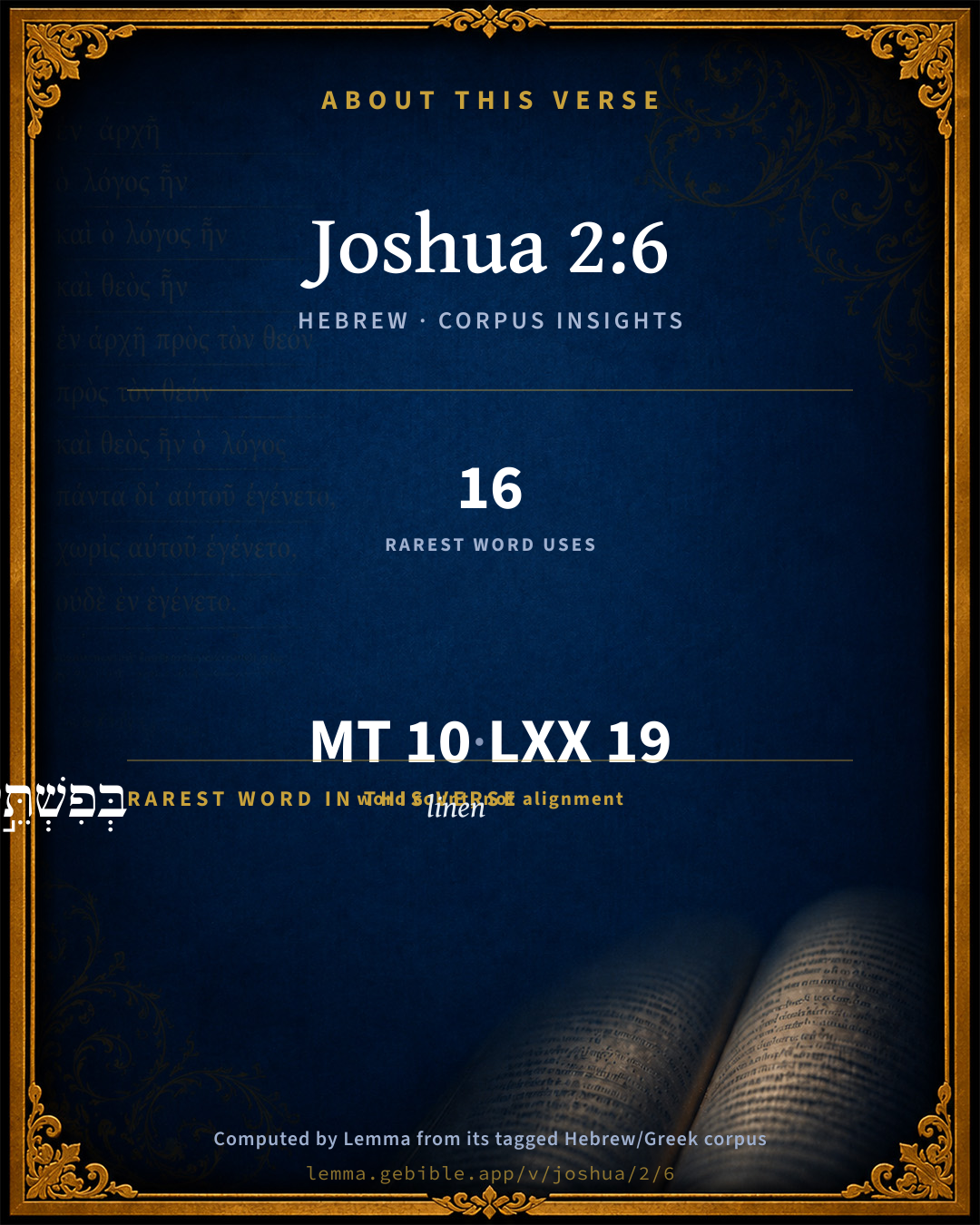
10
words
8
distinct lemmas
Historical
section

Notable vocabulary

The rarest word here is בְּפִשְׁתֵּ֣י linen H6593 — appearing just 16 times in the whole Hebrew Bible.

Shared distinctive vocabulary

בְּפִשְׁתֵּ֣י linen H6593 occurs in 15 verses of the Hebrew Bible. Also found in:

Grammatical profile

  • 3 verbs
  • 4 nouns
  • 1 pronoun
  • 2 prepositions

Verb forms

  • הֶעֱלָ֣תַם Hiphil · Perfect
  • וַֽתִּטְמְנֵם֙ Qal · Sequential Imperfect
  • הָעֲרֻכ֥וֹת Qal · Participle Passive

Repetition

A word recurs within this verse — often emphatic in Hebrew:

  • הַגָּ֑גָה roof H1406 ×2

Hebrew & Septuagint length

In English translation the verse runs 26 words from the Hebrew and 23 from the Septuagint (LXX English) — closely comparable.

A rough comparison of the two English renderings, which tokenize alike — not a word-level alignment.

Word counts can differ between the Hebrew and the Greek without any difference in meaning — e.g. the Hebrew direct-object marker אֵת has no separate Greek word, and Greek often adds the article ὁ.

In the original languages it is 10 Hebrew tokens and 19 Greek tokens — but the two are counted differently (Hebrew bundles its prefixes and suffixes into one token; the Greek is in lemma form), so that isn’t a like-for-like length.

Cross-references

14

Topical passages linked to Joshua 2:6 in the Treasury of Scripture Knowledge — connected by theme and wording, ordered by reader-vote popularity; previews shown in the World English Bible.

  • Hebrews 11:23 By faith, Moses, when he was born, was hidden for three months by his parents, because they saw that he was a beautiful child, and they were not afraid of the king's commandment.
  • James 2:25 In like manner wasn't Rahab the prostitute also justified by works, in that she received the messengers, and sent them out another way?
  • 2 Samuel 17:19 The woman took and spread the covering over the well's mouth, and strewed bruised grain thereon; and nothing was known.
  • Colossians 3:3 For you died, and your life is hidden with Christ in God.
  • Exodus 1:15–21 The king of Egypt spoke to the Hebrew midwives, of whom the name of the one was Shiphrah, and the name of the other Puah,
  • Exodus 2:2 The woman conceived, and bore a son. When she saw that he was a fine child, she hid him three months.
  • Deuteronomy 22:8 When you build a new house, then you shall make a battlement for your roof, that you don't bring blood on your house, if any man fall from there.
  • Joshua 2:8 Before they were laid down, she came up to them on the roof;
  • 2 Samuel 11:2 It happened at evening, that David arose from off his bed, and walked on the roof of the king's house: and from the roof he saw a woman bathing; and the woman was very beautiful to look on.
  • 1 Kings 18:4 for it was so, when Jezebel cut off the prophets of Yahweh, that Obadiah took one hundred prophets, and hid them by fifty in a cave, and fed them with bread and water.)
  • 1 Kings 18:13 Wasn't it told my lord what I did when Jezebel killed the prophets of Yahweh, how I hid one hundred men of Yahweh's prophets by fifty in a cave, and fed them with bread and water?
  • 2 Kings 11:2 But Jehosheba, the daughter of king Joram, sister of Ahaziah, took Joash the son of Ahaziah, and stole him away from among the king's sons who were slain, even him and his nurse, [and put them] in the bedchamber; and they hid him from Athaliah, so that he was not slain;
  • Jeremiah 36:26 The king commanded Jerahmeel the king's son, and Seraiah the son of Azriel, and Shelemiah the son of Abdeel, to take Baruch the scribe and Jeremiah the prophet; but Yahweh hid them.
  • Matthew 24:17 Let him who is on the housetop not go down to take out things that are in his house.

Cross-references courtesy of OpenBible.info (CC BY 4.0).

Hebrew and Greek witnesses Masoretic Hebrew ↔ Greek Septuagint

The same verse in the two great witnesses to the Old Testament, shown verse-for-verse.

These are two independent witnesses, not word-aligned to each other, and the Septuagint is shown in lemma (dictionary) form.

Hebrew Joshua 2:6 Masoretic · Westminster Leningrad Codex

וְהִ֖יא הֶעֱלָ֣תַם הַגָּ֑גָה וַֽתִּטְמְנֵם֙ בְּפִשְׁתֵּ֣י הָעֵ֔ץ הָעֲרֻכ֥וֹת לָ֖הּ עַל הַגָּֽג

But she had brought them up to the roof, and hid them with the stalks of flax, which she had laid in order on the roof.

World English Bible · Public Domain

Greek LXX Joshua 2:6 Septuagint · lemma form

αὐτός δέ ἀναβιβάζω αὐτός ἐπί ὁ δῶμα καί κρύπτω αὐτός ἐν ὁ λινοκαλάμη ὁ στοιβάζω αὐτός ἐπί ὁ δῶμα

But she had brought them up upon the house, and hid them in the flax-stalks that were spread by her on the house.

LXX2012 (modern English Septuagint) · Public Domain

On this verse, The Pulpit Commentary discusses the Septuagint’s reading. Read the note in Commentary ↓

Hebrew: Westminster Leningrad Codex (CC BY 4.0). Greek: Septuagint (public domain); English from LXX2012 (modern English Septuagint) (Public Domain). How the Septuagint differs from the Hebrew →

Targum (Aramaic paraphrase)

1

The Targum is the ancient Jewish Aramaic paraphrase of the Hebrew Scriptures — an interpretive translation, not the Hebrew text itself. Onkelos (literal) and Pseudo-Jonathan (expansive) render the Torah, and Jonathan the Prophets. Coverage is partial: where no permissively-licensed English translation exists for a verse, only the Aramaic is shown. This is verse-level text, not a word-by-word alignment to the Hebrew.

  1. Targum Jonathan Prophets (Joshua–Malachi)
    וְהִיא אַסְקַתְנוּן לְאִגְרָא וְאַטְמַרַתְנוּן בִּטְעוּנֵי כִתָּנָא דִסְדִירִין לָהּ עַל אִגְרָא:

    (no public-domain English translation for this verse)

    Targum Jonathan — Aramaic: “Mikraot Gedolot” (public domain). English: “Sefaria Community Translation” (CC0 1.0 (public-domain dedication)); “London "Chaldee Paraphrase," 1871” (public domain). Text via Sefaria.

Commentary

Notes on Joshua 2:6 from classic Christian and Jewish commentators (each source and its license shown beneath its notes). The classic Christian expositions comment on the surrounding passage and are grouped to its opening verse, so a note may address several verses; the Jewish commentaries on the Tanakh (Rashi and others) are per-verse, so they appear only where the commentator wrote on this verse.

Lemma curates 59 commentaries, every one of them public domain or Creative Commons licensed, each selected and text-cleaned for this edition rather than reprinted as found. About our sources →

Trapp's Complete Commentary

John Trapp

Jos 2:6 But she had brought them up to the roof of the house, and hid them with the stalks of flax, which she had laid in order upon the roof.

Ver. 6. But she had brought them up to the roof of the house.] {a} Which was built flat in those parts, as they are also at this day in Italy.

Which she had laid in order upon the roof.] That it might be fully dried, as {Nah 1:10} the wicked are, that they may burn the better: like grapes, they ripen in the sunshine, for the winepress of God’s wrath. {Rev 14:19}

{a} Septuag., δωμα: ut et 1Sa 9:25.

John Trapp, A Commentary or Exposition upon All the Books of the Old and New Testament (1647–1656) — public domain. Text from a community e-Sword module.

Joseph Benson's Commentary

Jos 2:6-7. Up to the roof — In those countries the roofs of the houses were made quite flat, and it is probable it might be customary to lay the stalks of flax upon them that they might be dried by the heat of the sun. Fords — Or, passages; that is, the places where people used to pass over Jordan, whether by boats or bridges. The gate — Of the city, to prevent the escape of the spies, if peradventure Rahab was mistaken, and they yet lurked therein.

Joseph Benson's Commentary on the Old and New Testaments (1811–1818) — public domain. Text from a community e-Sword module.

Tyndale Open Study Notes

Tyndale Open Resources

2:6 The inner fibers of flax were processed to make linen. The first step involved laying out the flax stems to dry on the flat rooftop.

Tyndale Open Study Notes — © Tyndale Open Resources, licensed CC BY-SA 4.0. Text via the HelloAO Bible API.

Geneva Bible (1599)

Geneva Bible translators

Meaning, upon the house: for then their houses were flat above, so that they might do their business thereupon.

Geneva Bible (1599) marginal notes — public domain. Text via Bolls.life.

Jamieson, Fausset & Brown

Robert Jamieson, A. R. Fausset & David Brown

she had brought them up to the roof of the house, and hid them with the stalks of flax--Flax, with other vegetable productions, is at a certain season spread out on the flat roofs of Eastern houses to be dried in the sun; and, after lying awhile, it is piled up in numerous little stacks, which, from the luxuriant growth of the flax, rise to a height of three or four feet. Behind some of these stacks Rahab concealed the spies.

Jamieson, Fausset & Brown — Commentary Critical and Explanatory on the Whole Bible (1871) — public domain (CC PDM 1.0). Text via the HelloAO Bible API.

Adam Clarke's Commentary

Verse 6. Hid then with the stalks of flax] It is a matter of little consequence whether we translate פסתי העיץ pistey haets stalks of flax, or stalks of hemp: the word עץ ets, which signifies wood, serves to show that whether it was hemp or flax, it was in its rough, unmanufactured state; and as this was about the season, viz., the end of March or the beginning of April, in which the flax is ripe in that country, consequently Rahab's flax might have been recently pulled, and was now drying on the roof of her house. The reader may find some useful remarks upon this subject in Harmer's Observations, vol. iv., p. 97, c.

Upon the roof.] We have already seen that all the houses in the east were made flat-roofed for which a law is given De 22:8. On these flat roofs the Asiatics to this day walk, converse, and oftentimes even sleep and pass the night. It is probable that this hiding was after that referred to in the fourth verse.

Adam Clarke's Commentary on the Bible (1810–1826) — public domain. Text from a community e-Sword/MySword module.

Ellicott's Commentary for English Readers

(6) The stalks of flax.—It is remarked that flax and barley are both early crops (Exo_9:31), and that the first month (see Jos_4:19) was the time of barley harvest. (Comp. 2Sa_21:9.)

A Bible Commentary for English Readers, edited by Charles John Ellicott (1878–1897) — public domain. Text from a community e-Sword module.

The Cambridge Bible for Schools and Colleges

gen. ed. J. J. S. Perowne

6. the roof of the house] The roofs of Eastern houses were flat (St Mar_2:4), and were made useful for various purposes, as drying corn, hanging up linen, and preparing figs and raisins. They were also used as (a) places of recreation in the evening; (b) sleeping-places at night, when the interior apartments were too hot or sultry for refreshing repose; (c) places for devotion and even idolatrous worship. Comp. 1Sa_9:25-26; 2Sa_11:2; 2Sa_16:22; 2Ki_23:12; Dan_4:29; Act_2:1; Act_10:9. The Jewish Law required that they should have a battlement, in order that guilt of blood might not come upon the house through any one falling from it (Deu_22:8). “Parts of Roman houses were also furnished with such roofs called solaria, because they lay exposed on all sides to the sun, and also mœniana, as the Italians now also call them altana.” Lange’s Commentary.

the stalks of flax] “stubble of flaxe,” Wyclif. Unbroken flax is here meant, the stalks of which, about Jericho and in Egypt, reached a height of more than three feet and the thickness of a reed. It was anciently one of the most important crops in Palestine (Hos_2:5; Hos_2:9).

The Cambridge Bible for Schools and Colleges (gen. ed. J. J. S. Perowne; Cambridge University Press, 1878–1918) — public domain. Text from a community e-Sword module.

John Gill's Exposition

But she had brought them up to the roof of the house,.... Before the messengers came; though Abarbinel thinks it was after they were gone, when she took them from the place of their concealment, and had them to the roof of the house, where she thought they would be safe and secure, should the messengers return, or others come in search of them, who would not, as she imagined, look for them there:

and hid them with the stalks of flax; that is, under them, or "in flax of wood", or "a tree" (b); which may with as much propriety, or more, be called a tree than hyssop, Kg1 4:33; as it is in the Misnah (c). Moreover, there was a sort of flax which grew in the upper part of Egypt towards Arabia, as Pliny says (d), which they called "xylon", or wood, of which were made "lina xylina": though the words may be rightly transposed, as by as, "stalks of flax", which are large and strong before the flax is stripped or beaten off of them; the Targum renders it bundles of flax, or handfuls and sheaves of them, as they were when cut down and gathered:

which she had laid in order upon the roof; to be dried, as Kimchi observes; and Pliny (e) speaks of flax being bound up in bundles, and hung up and dried in the sun; which was done that it might be more easily stripped and beaten off; and the roofs of houses in those countries being flat, were very fit for such a purpose; See Gill on Deu 22:8; and these being now laid there were very suitable and convenient to conceal the men under them. This seems to be in favour of Rahab, as being a virtuous and industrious woman; see Pro 31:13.

(b) "in linis ligni", Montanus; "vel arboris", Vatablus. (c) Sabbat, c. 2. sect. 3. & Bartenora in ib. (d) Nat. Hist. l. 19. c. 1. (e) Nat. Hist. l. 19. c. 1.

John Gill's Exposition of the Whole Bible (1746–1763) — public domain (CC PDM 1.0). Text via the HelloAO Bible API.

Albert Barnes' Notes on the Bible

Stalks of flax - literally, “the carded fibres of the tree.” The flax in Palestine grew to more than three feet in height, with a stalk as thick as a cane. It was probably with the flax stalks, recently cut (compare Exo 9:31, note) and laid out on the house roof to dry, that Rahab hid the spies.

Albert Barnes' Notes on the Bible (1834–1885) — public domain. Text from a community e-Sword/MySword module.

Haydock's Catholic Bible Commentary

There. The roofs were flat in that country, and consequently very proper to dry flax, or "cotton," as Masius understands.

George Leo Haydock (1774–1849), Haydock's Catholic Family Bible and Commentary, 1859 edition — public domain. Excludes Psalms (Douay-Rheims chapter numbering differs from Protestant) and Deuterocanonical books (Catholic canon only).

Matthew Poole's English Annotations

Up to the roof, which was plain, after the manner. See Deu 22:8; Mat 10:27; Mar 2:4; Act 10:9. Laid in order upon the roof, that they may be dried by the heat of the sun.

Matthew Poole's English Annotations on the Holy Bible (1683–1685) — public domain. Text from a community e-Sword/MySword module.

Whedon's Commentary on the Bible

Daniel D. Whedon

6. She had brought them up to the roof of the house — This verse more fully explains Jos_2:4, by detailing the place and manner of her concealing the spies. Eastern houses have flat roofs, surrounded with a parapet to prevent falling off. Deu_28:8. Here the family often sleep, sit, walk, and store such articles as will not be damaged by the exposure. Sometimes the roof is shaded by means of an awning supported by posts. See note on Act_10:9.

Stalks of flax — Hebrews flax of the tree; that is, flax in the tree or stalk. Some render these words stalks or pods of cotton, but without sufficient authority. Flax is said to grow in Egypt to a great size, and its stalks attain the thickness of a cane, and so it doubtless did in the rich plain of Jericho. To dry stalks of such thickness much exposure to the sun would be necessary, and they were laid out in such abundance on Rahab’s house that the two men could be easily concealed among them.

Daniel D. Whedon (gen. ed.), Commentary on the Old and New Testaments (1874–1909) — public domain. Text from a community e-Sword module.

The Pulpit Commentary

But she had brought them up. Literally, and she caused them to ascend; but our version has very properly (see ver. 4) given the preterit the pluperfect sense here. "Two strangers, Israelites, spies, have a safe harbour provided them, even amongst their enemies, against the proclamation of a king." "Where cannot the God of heaven either find or raise up friends to His own causes and servants?" (Bp. Hall.) To the roof of the house. The flat roofs of Oriental, and even of Greek and Italian houses, are used for all kinds of purposes, especially for drying corn and other things for domestic use. (see 1Sa_9:25, 26 2Sa_11:2 2Sa_16:22 2Ki_23:12. Also Act_10:9, where the roof is used as a place of retirement and repose) Stalks of flax. Literally, flax of the tree. The word translated flax either of the raw material or of the linen made from it. Here it must mean flax as it came cut from the field; that is, as our version translates it, the stalks of flax (linokalamh , LXX), which grows in Egypt to a height of three feet, and may be presumed to have attained a height not much less at Jericho. The word dr which signifies to lay in a row, and is used of the wood on the altar in Gen_22:9, and of the shew bread in Lev_24:6, confirms this view. It is obvious that this would have formed a most sufficient hiding place for the fugitives. "Either faith or friendship are not tried but in extremities. To show countenance to the messengers of God while the publique face of the State smiles upon them, is but a courtesy of course; but to hide our own lives in theirs when they are persecuted is an act which looks for a reward" (Bp. Hall).

The Pulpit Commentary (1880–1919), ed. H.D.M. Spence-Jones & Joseph S. Exell — public domain. Text from a community e-Sword module.

John Wesley's Explanatory Notes

Roof - Which was flat after their manner. Upon the roof - That they might be dried by the heat of the sun.

John Wesley, Explanatory Notes Upon the Whole Bible (1754–1765) — public domain. Text via the GEBible commentary corpus.

unfoldingWord translationNotes

Door43 World Missions Community

But she had taken them ... on the roof

This is background information and explains how she had hidden the men in Joshua 2:4. (See: Background Information)

the roof

The roof was flat and strong, so people could walk around on it.

flax

a plant that is grown for its fibers, which is used in making cloth

the men pursued them

The men pursued the spies because of what Rahab had told them in Joshua 2:5.

fords

places where a river or other body of water is shallow enough for people to get to the other side by walking through it

translationWords

Jordan River

gate

unfoldingWord translationNotes — © Distant Shores Media and the Door43 World Missions Community, licensed CC BY-SA 4.0. Source: git.door43.org/Door43/en_tn.

Rashi

Rabbi Shlomo Yitzchaki (Rashi)

Stalks of flax. with their pods.

Rashi on the Tanakh — English translations: “The Judaica Press complete Tanach with Rashi, translated by A. J. Rosenberg” (CC BY 4.0); “Pentateuch with Rashi's commentary by M. Rosenbaum and A.M. Silbermann, 1929-1934” (public domain); “The Metsudah Tanach series, Lakewood, N.J” (CC BY 4.0); and “The Book of Joshua, Metsudah Publications, 1997” (CC BY 4.0). Text via Sefaria.

Lesson kit

Teaching starters — assembled from the data on this page, not authored interpretation. Every prompt links to the verse data it draws on. Edit before teaching.

Joshua, in the Historical, opens this verse with 10 words (8 distinct Hebrew lemmas). Its most distinctive word is pishteh (“linen”). A historical commentator’s framing appears above. Read the whole chapter for the surrounding context.

Discussion questions

  1. What does “linen” (pishteh) contribute to the verse as a whole?
  2. Leviticus 13:47 shares the word «linen» with this verse. How do the two illuminate each other?
  3. “roof” occurs 2× in this one verse. What is the effect of the repetition?
  4. These translations render this verse differently; the difference is in the English rendering, not the original. What questions does that raise?
  5. The verb «הֶעֱלָ֣תַם» is Hiphil Perfect. How does its form color the action?
  6. Reading how Trapp's Complete Commentary and Joseph Benson's Commentary read this verse, where do the two commentators agree and where do they part?

Things to notice

Reading settings

Reading text

Shown beneath each verse's original-language words.

Old Testament
Old Testament edition

Read the OT as the Masoretic Hebrew (MT) or the Greek Septuagint (LXX).

English shown for the Greek Septuagint (in the Hebrew ↔ Greek comparison).

Comparing translations? Open the Compare panel on any verse page to stack up to four side by side.