
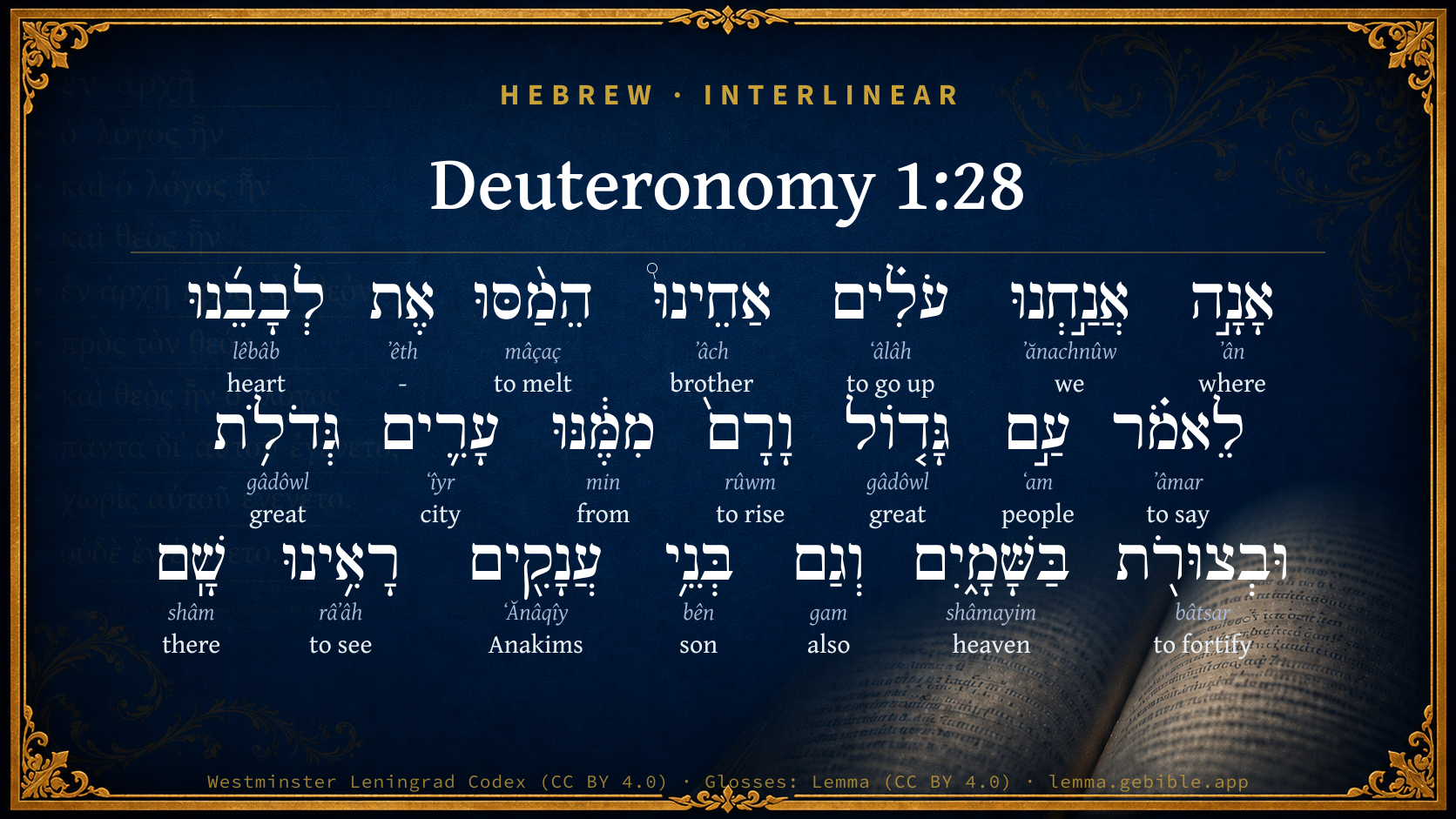
Deuteronomy 1:28

Hebrew (Westminster Leningrad Codex) Deuteronomy 1:28 appears in the Hebrew Old Testament. The text above is from the Westminster Leningrad Codex. Each word links to its Strong’s number, a concise gloss, and parsing drawn from the Open Scriptures Hebrew Bible morphology. Click any word for its full Brown-Driver-Briggs (BDB) entry.
Download image
Cite this verse

Deuteronomy 1:28 (World English Bible). Public Domain. Lemma interlinear Bible study tool, https://lemma.gebible.app/v/deuteronomy/1/28.

Show BibTeX & RIS
BibTeX
RIS
English Translation
Where are we going up? our brothers have made our heart to melt, saying, The people are greater and taller than we; the cities are great and fortified up to the sky; and moreover we have seen the sons of the Anakim there.
World English Bible · Public Domain
Highlights
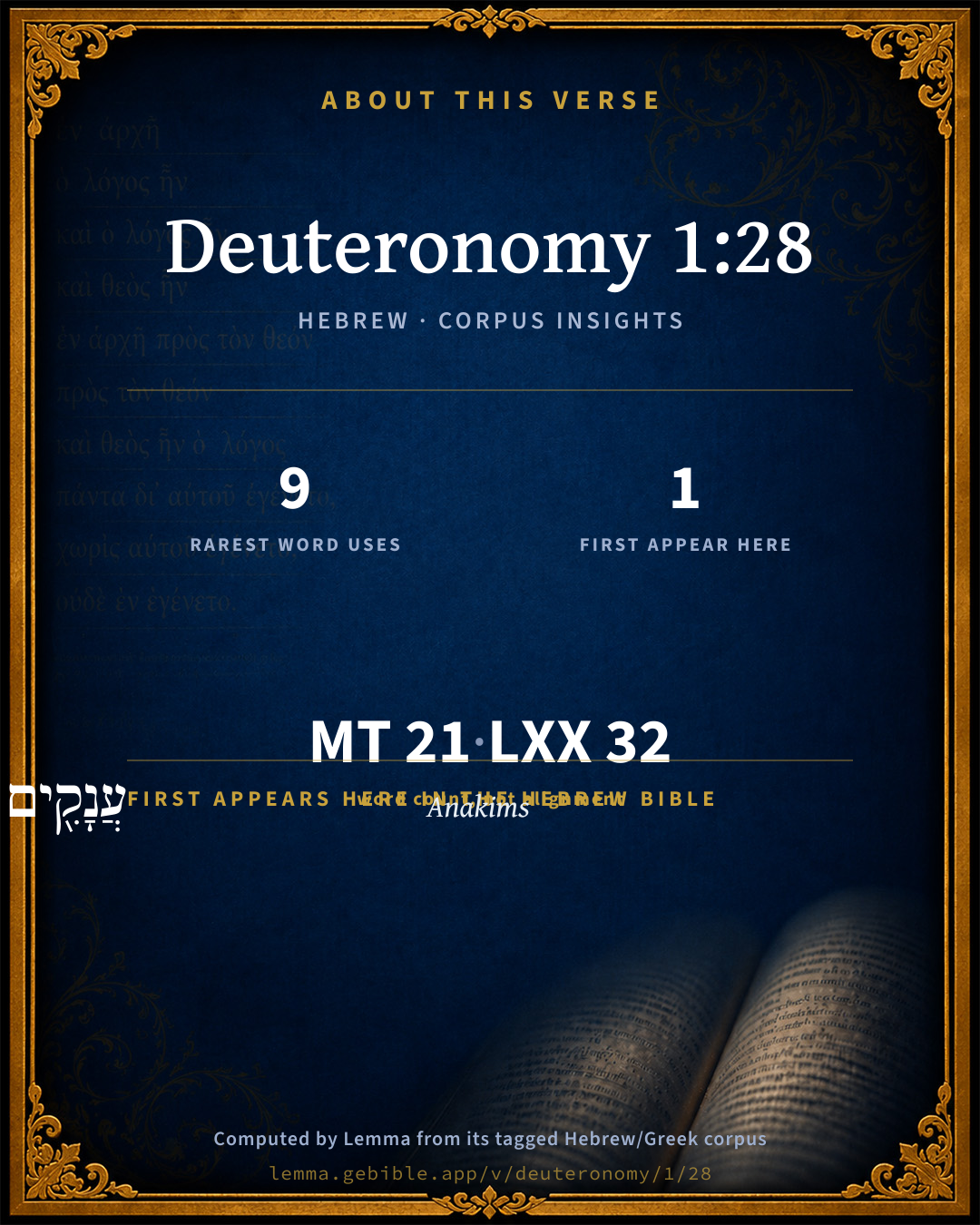
  • 1 first appearance in the Hebrew Bible
Full analysis ↓
Download a study sheet

One document with this verse’s original text, its word-by-word gloss line, the meaning frame, cross-references with their text, attributed commentary, and full source and license credits — printable, and it pastes into notes with its structure intact.

This verse Autodidact and up

Study sheet (.html) Plain text (.txt)

A passage Seminary Student

Up to 50 verses in one chapter. A passage sheet keeps up to 6 commentary sources and 12 cross-references per verse, in the order this page ranks them, and says so on the sheet whenever that leaves anything out. Ask for a single verse and you get the Autodidact verse sheet above.

Everything on this page stays free to read, with no account — the sheet is a download of what is already on screen, not access to it.

Want to remove ads? Support Godless Engineer
Compare translations 3

The same verse in 3 English versions, stacked beneath the original-language interlinear above. Click any original word for its lexicon entry.

Each is an independent rendering of the whole verse — the interlinear is not word-aligned to these translations.

Highlighted words mark where these versions differ — a whole-verse word diff, not a word-by-word alignment.

  • World English Bible Public Domain
    Where are we going up? our brothers have made our heart to melt, saying, The people are greater and taller than we; the cities are great and fortified up to the sky; and moreover we have seen the sons of the Anakim there.
  • King James Version Public Domain
    Whither shall we go up? our brethren have discouraged our heart, saying, The people is greater and taller than we; the cities are great and walled up to heaven; and moreover we have seen the sons of the Anakims there.
  • unfoldingWord Literal Text CC BY-SA 4.0
    Where we go up? Our brothers have caused our heart to melt, saying, “The people greater and taller than us, cities great and fortified to the heavens; and also, we have seen the sons of the Anakites there.”’

unfoldingWord Literal Text — © unfoldingWord, licensed CC BY-SA 4.0. Word-aligned USFM3 via Door43 (git.door43.org/unfoldingWord/en_ult).

Versions to compare (up to 4)

3 of 4 selected

Show all 18 translations

Every available English version of this verse, each an independent rendering of the whole verse.

  • World English Bible Public Domain
    Where are we going up? our brothers have made our heart to melt, saying, The people are greater and taller than we; the cities are great and fortified up to the sky; and moreover we have seen the sons of the Anakim there.
  • Berean Standard Bible Public Domain
    Where can we go? Our brothers have made our hearts melt, saying: ‘The people are larger and taller than we are; the cities are large, with walls up to the heavens. We even saw the descendants of the Anakim there.’”
  • Majority Standard Bible Public Domain
    Where can we go? Our brothers have made our hearts melt, saying: ‘The people are larger and taller than we are; the cities are large, with walls up to the heavens. We even saw the descendants of the Anakim there.’”
  • King James Version Public Domain
    Whither shall we go up? our brethren have discouraged our heart, saying, The people is greater and taller than we; the cities are great and walled up to heaven; and moreover we have seen the sons of the Anakims there.
  • American Standard Version (1901) Public Domain
    Whither are we going up? our brethren have made our heart to melt, saying, The people are greater and taller than we; the cities are great and fortified up to heaven; and moreover we have seen the sons of the Anakim there.
  • Revised Version (1885) Public Domain
    Whither are we going up? our brethren have made our heart to melt, saying, The people is greater and taller than we; the cities are great and fenced up to heaven; and moreover we have seen the sons of the Anakim there.
  • Geneva Bible (1599) Public Domain
    Whither shall we go vp? our brethren haue discouraged our hearts, saying, The people is greater, and taller then we: the cities are great and walled vp to heauen: and moreouer we haue seene the sonnes of the Anakims there.
  • Douay-Rheims (1899) Public Domain
    And you would not go up, but being incredulous to the word of the Lord our God,
  • Young's Literal Translation Public Domain
    whither are we going up? our brethren have melted our heart, saying, A people greater and taller than we, cities great and fenced to heaven, and also sons of Anakim -- we have seen there.
  • Literal Standard Version CC BY-SA 4.0
    to where are we going up? Our brothers have melted our heart, saying, [The] people [are] greater and taller than we; [the] cities [are] great and fortified up to the heavens, and we have also seen sons of Anakim there.
  • Unlocked Literal Bible CC BY-SA 4.0
    Where can we go now? Our brothers have made our heart to melt, saying, 'Those people are bigger and taller than we are; their cities are large and are fortified up to the heavens; moreover, we have seen the sons of the Anakim there.'”
  • unfoldingWord Literal Text CC BY-SA 4.0
    Where we go up? Our brothers have caused our heart to melt, saying, “The people greater and taller than us, cities great and fortified to the heavens; and also, we have seen the sons of the Anakites there.”’
  • Darby Bible Public Domain
    Whither shall we go up? Our brethren have made our hearts melt, saying, [They are] a people greater and taller than we; the cities are great and walled up to heaven; and moreover we have seen the sons of the Anakim there.
  • World Messianic Bible Public Domain
    Where are we going up? Our brothers have made our heart melt, saying, ‘The people are greater and taller than we. The cities are great and fortified up to the sky. Moreover we have seen the sons of the Anakim there!’”
  • Webster's Bible Public Domain
    Whither shall we go up? our brethren have discouraged our heart, saying, The people are greater and taller than we; the cities are great and walled up to heaven; and moreover, we have seen the sons of the Anakims there.
  • Free Bible Version CC BY-SA 4.0
    Where are we going? Our brothers terrified us because they told us: ‘The people are bigger and taller than us; the towns are large, with high walls that reach the sky. We even saw the descendants of the giant Anak there!’”
  • Bible in Basic English Public Domain
    Where are we going up? Our brothers have made our hearts feeble with fear by saying, The people are greater and taller than we are, and the towns are great and walled up to heaven; and more than this, we have seen the sons of the Anakim there.
  • JPS Tanakh (1917) Public Domain
    Whither are we going up? our brethren have made our heart to melt, saying: The people is greater and taller than we; the cities are great and fortified up to heaven; and moreover we have seen the sons of the Anakim there.'

Literal Standard Version (2020), Covenant Press — licensed CC BY-SA 4.0. Text via the HelloAO Bible API (eBible.org). Unlocked Literal Bible (unfoldingWord) — licensed CC BY-SA 4.0. Text via the HelloAO Bible API (eBible.org). unfoldingWord Literal Text — © unfoldingWord, licensed CC BY-SA 4.0. Word-aligned USFM3 via Door43 (git.door43.org/unfoldingWord/en_ult). Free Bible Version, Dr. Jonathan Gallagher — licensed CC BY-SA 4.0. Text via the HelloAO Bible API (eBible.org).

Word by word

More ways to search: Search by grammar → Find every occurrence → Compare this word →

Practice this passage: Drill this verse → Learn its vocabulary →

עֲנָקִ֖ים
ʻĂnâqîy
H6062
“Anakims”
Noun, Common, Masculine, Plural, Absolute
Part of Speech
Noun
Type
Common
Gender
Masculine
Number
Plural
State
Absolute
Full BDB Definition

Origin: from H6061

TWOT: None

Anakims = "long-necked" - a tribe of giants, descendants of Anak, which dwelled in southern Canaan
  1. אָנָ֣ה ʼân H575 “where” Adverb
  2. אֲנַ֣חְנוּ ʼănachnûw H587 “we” Pronoun, Personal, 1st Person, Common, Plural
  3. עֹלִ֗ים ʻâlâh H5927 “going up” Verb, Qal, Participle Active, Masculine, Plural, Absolute
  4. אַחֵינוּ֩ ʼâch H251 “brothers · our” Noun, Common, Masculine, Plural, Construct + Suffix, Personal, 1st Person, Common, Plural
  5. הֵמַ֨סּוּ mâçaç H4549 “to melt” Verb, Hiphil, Perfect, 3rd Person, Common, Plural
  6. אֶת ʼêth H853 “-” Particle, Direct Object
  7. לְבָבֵ֜נוּ lêbâb H3824 “heart · our” Noun, Common, Masculine, Singular, Construct + Suffix, Personal, 1st Person, Common, Plural
  8. לֵאמֹ֗ר ʼâmar H559 “to say” Preposition + Verb, Qal, Infinitive Construct
  9. עַ֣ם ʻam H5971 “people” Noun, Common, Masculine, Singular, Absolute
  10. גָּד֤וֹל gâdôwl H1419 “great” Adjective, Adjective, Masculine, Singular, Absolute
  11. וָרָם֙ rûwm H7311 “and · rising” Conjunction + Verb, Qal, Participle Active, Masculine, Singular, Absolute
  12. מִמֶּ֔נּוּ min H4480 “from · us” Preposition + Suffix, Personal, 1st Person, Common, Plural
  13. עָרִ֛ים ʻîyr H5892 “cities” Noun, Common, Feminine, Plural, Absolute
  14. גְּדֹלֹ֥ת gâdôwl H1419 “great” Adjective, Adjective, Feminine, Plural, Absolute
  15. וּבְצוּרֹ֖ת bâtsar H1219 “and · fortified” Conjunction + Adjective, Adjective, Feminine, Plural, Absolute
  16. בַּשָּׁמָ֑יִם shâmayim H8064 “in/at the · heaven(s)” Preposition, Determined + Noun, Common, Masculine, Plural, Absolute
  17. וְגַם gam H1571 “and · also” Conjunction + Particle, Accusative
  18. בְּנֵ֥י bên H1121 “sons of” Noun, Common, Masculine, Plural, Construct
  19. רָאִ֥ינוּ râʼâh H7200 “to see” Verb, Qal, Perfect, 1st Person, Common, Plural
  20. שָֽׁם shâm H8033 “there” Adverb

About this verse

These counts appear in no published source. They are computed here, from the morphology-tagged text and Lemma’s own curated glosses. What Lemma adds →

21
words
20
distinct lemmas
Pentateuch
section

Notable vocabulary

The rarest word here is עֲנָקִ֖ים Anakims H6062 — appearing just 9 times in the whole Hebrew Bible.

First appearance in Scripture

This word makes its first canonical appearance in the Hebrew Bible here:

  • עֲנָקִ֖ים Anakims H6062

Shared distinctive vocabulary

עֲנָקִ֖ים Anakims H6062 occurs in 9 verses of the Hebrew Bible. Also found in:

Grammatical profile

  • 5 verbs
  • 7 nouns
  • 3 adjectives
  • 1 pronoun
  • 1 preposition
  • 2 adverbs
  • 2 particles

Verb forms

  • עֹלִ֗ים Qal · Participle Active
  • הֵמַ֨סּוּ Hiphil · Perfect
  • לֵאמֹ֗ר Qal · Infinitive Construct
  • וָרָם֙ Qal · Participle Active
  • רָאִ֥ינוּ Qal · Perfect

Repetition

A word recurs within this verse — often emphatic in Hebrew:

  • גָּד֤וֹל great H1419 ×2

Hebrew & Septuagint length

In English translation the verse runs 43 words from the Hebrew and 43 from the Septuagint (LXX English) — the same length.

A rough comparison of the two English renderings, which tokenize alike — not a word-level alignment.

Word counts can differ between the Hebrew and the Greek without any difference in meaning — e.g. the Hebrew direct-object marker אֵת has no separate Greek word, and Greek often adds the article ὁ.

In the original languages it is 21 Hebrew tokens and 32 Greek tokens — but the two are counted differently (Hebrew bundles its prefixes and suffixes into one token; the Greek is in lemma form), so that isn’t a like-for-like length.

Cross-references

15

Topical passages linked to Deuteronomy 1:28 in the Treasury of Scripture Knowledge — connected by theme and wording, ordered by reader-vote popularity; previews shown in the World English Bible.

  • Numbers 13:28–33 However the people who dwell in the land are strong, and the cities are fortified, [and] very great: and moreover we saw the children of Anak there.
  • Deuteronomy 9:1–2 Hear, Israel: you are to pass over the Jordan this day, to go in to dispossess nations greater and mightier than yourself, cities great and fortified up to the sky,
  • Joshua 11:22 There was none of the Anakim left in the land of the children of Israel: only in Gaza, in Gath, and in Ashdod, did some remain.
  • Joshua 14:8 Nevertheless my brothers who went up with me made the heart of the people melt; but I wholly followed Yahweh my God.
  • Joshua 15:14 Caleb drove out there the three sons of Anak: Sheshai, and Ahiman, and Talmai, the children of Anak.
  • Judges 1:20 They gave Hebron to Caleb, as Moses had spoken: and he drove out there the three sons of Anak.
  • 2 Samuel 21:16–22 and Ishbibenob, who was of the sons of the giant, the weight of whose spear was three hundred [shekels] of brass in weight, he being girded with a new [sword], thought to have slain David.
  • Exodus 15:15 Then the chiefs of Edom were dismayed. Trembling takes hold of the mighty men of Moab. All the inhabitants of Canaan are melted away.
  • Deuteronomy 20:8 The officers shall speak further to the people, and they shall say, What man is there who is fearful and faint-hearted? let him go and return to his house, lest his brother's heart melt as his heart.
  • Joshua 2:9 and she said to the men, I know that Yahweh has given you the land, and that the fear of you is fallen on us, and that all the inhabitants of the land melt away before you.
  • Joshua 2:11 As soon as we had heard it, our hearts did melt, neither did there remain any more spirit in any man, because of you: for Yahweh your God, he is God in heaven above, and on earth beneath.
  • Joshua 2:24 They said to Joshua, Truly Yahweh has delivered into our hands all the land; and moreover all the inhabitants of the land do melt away before us.
  • Judges 1:10 Judah went against the Canaanites who lived in Hebron (now the name of Hebron before was Kiriath Arba); and they struck Sheshai, and Ahiman, and Talmai.
  • Isaiah 13:7 Therefore shall all hands be feeble, and every heart of man shall melt:
  • Ezekiel 21:7 It shall be, when they tell you, Why do you sigh? that you shall say, Because of the news, for it comes; and every heart shall melt, and all hands shall be feeble, and every spirit shall faint, and all knees shall be weak as water: behold, it comes, and it shall be done, says the Lord Yahweh.

Cross-references courtesy of OpenBible.info (CC BY 4.0).

Hebrew and Greek witnesses Masoretic Hebrew ↔ Greek Septuagint

The same verse in the two great witnesses to the Old Testament, shown verse-for-verse.

These are two independent witnesses, not word-aligned to each other, and the Septuagint is shown in lemma (dictionary) form.

Hebrew Deuteronomy 1:28 Masoretic · Westminster Leningrad Codex

אָנָ֣ה אֲנַ֣חְנוּ עֹלִ֗ים אַחֵינוּ֩ הֵמַ֨סּוּ אֶת לְבָבֵ֜נוּ לֵאמֹ֗ר עַ֣ם גָּד֤וֹל וָרָם֙ מִמֶּ֔נּוּ עָרִ֛ים גְּדֹלֹ֥ת וּבְצוּרֹ֖ת בַּשָּׁמָ֑יִם וְגַם בְּנֵ֥י עֲנָקִ֖ים רָאִ֥ינוּ שָֽׁם

Where are we going up? our brothers have made our heart to melt, saying, The people are greater and taller than we; the cities are great and fortified up to the sky; and moreover we have seen the sons of the Anakim there.

World English Bible · Public Domain

Greek LXX Deuteronomy 1:28 Septuagint · lemma form

ποῦ ἐγώ ἀναβαίνω ὁ ἀδελφός σύ ἀποἵστημι σύ ὁ καρδία λέγω ἔθνος μέγας καί πολύς καί δυνατός ἐγώ καί πόλις μέγας καί τειχίζω ἕως ὁ οὐρανός ἀλλά καί υἱός γίγας ὁράω ἐκεῖ

Whither do we go up? and your brethren drew away your heart, saying, It is a great nation and populous, and mightier than we; and there are cities great and walled up to heaven: moreover we saw there the sons of the giants.

LXX2012 (modern English Septuagint) · Public Domain

On this verse, The Cambridge Bible for Schools and Colleges discusses the Septuagint’s reading. Read the note in Commentary ↓

Hebrew: Westminster Leningrad Codex (CC BY 4.0). Greek: Septuagint (public domain); English from LXX2012 (modern English Septuagint) (Public Domain). How the Septuagint differs from the Hebrew →

Targum (Aramaic paraphrase)

2

The Targum is the ancient Jewish Aramaic paraphrase of the Hebrew Scriptures — an interpretive translation, not the Hebrew text itself. Onkelos (literal) and Pseudo-Jonathan (expansive) render the Torah, and Jonathan the Prophets. Coverage is partial: where no permissively-licensed English translation exists for a verse, only the Aramaic is shown. This is verse-level text, not a word-by-word alignment to the Hebrew.

  1. Targum Onkelos Torah (Genesis–Deuteronomy)
    לְאָן אֲנַחְנָא סָלְקִין אֲחָנָא תְבָרוּ יָת לִבָּנָא לְמֵימַר עַם רַב וְתַקִיף מִנָנָא קִרְוִין רַבְרְבָן וּכְרִיכָן עַד צֵית שְׁמַיָא וְאַף בְּנֵי גִבָּרָאֵי חֲזֵינָא תַמָן

    (no public-domain English translation for this verse)

    Targum Onkelos — Aramaic: “Onkelos Genesis” (public domain); “Onkelos Exodus” (public domain); “Onkelos Leviticus” (public domain); “Onkelos Numbers” (public domain); “Onkelos Deuteronomy” (public domain). English: “Sefaria Community Translation” (CC0 1.0 (public-domain dedication)); “J.W. Etheridge. The Targums of Onkelos and Jonathan Ben Uzziel on the Pentateuch. London: Longmans, Green, 1862” (public domain). Text via Sefaria.

  2. Targum Pseudo-Jonathan Torah (Genesis–Deuteronomy)
    לְאָן אֲנַחְנָא סַלְקִין אָחָנָא מַסְמִיסַן יַת לִיבָּנָא לְמֵימָר עַם רַב וּתְקֵיף מִנָנָא קִירְוַון רַבְרְבָן וּכְרִיכַן עַד צֵית שְׁמַיָא וְאוּף בְּנֵי עֶפְרוֹן גִּבָּרָא חֲמֵינָא תַּמָן

    How shall we go up? Our brethren have dissolved our hearts, saying, The people are greater and mightier than we; their cities are vast, and walled to the height of heaven, and we saw there also the sons of Ephron the giant.

    Targum Pseudo-Jonathan — Aramaic: “Targum Jonathan on Genesis” (public domain); “Targum Jonathan on Exodus” (public domain); “Targum Jonathan on Leviticus” (public domain); “Targum Jonathan on Numbers” (public domain); “Targum Jonathan on Deuteronomy” (public domain). English: “The Targum of Jonathan ben Uzziel, trans. J. W. Etheridge, London, 1862” (public domain). Text via Sefaria.

Commentary

Notes on Deuteronomy 1:28 from classic Christian and Jewish commentators (each source and its license shown beneath its notes). The classic Christian expositions comment on the surrounding passage and are grouped to its opening verse, so a note may address several verses; the Jewish commentaries on the Tanakh (Rashi and others) are per-verse, so they appear only where the commentator wrote on this verse.

Lemma curates 59 commentaries, every one of them public domain or Creative Commons licensed, each selected and text-cleaned for this edition rather than reprinted as found. About our sources →

The Biblical Illustrator

Joseph S. Exell

Deu_1:28

Our brethren have discouraged our heart.

Do not be discouraged

To be discouraged is to lose ones energy and vitality. When a man is discouraged he is of no use; his power has gone out of him. Courage is a large and noble quality, and necessary in all the relations of life. It is not merely shown in the boldness which confronts danger and is self-possessed in peril. It also is needed to face other difficulties promptly, to do ones duty cheerfully when the hope of success is small; to stand alone for the truth and right; not to be discouraged by disappointment, nor by the censures and reproofs of the hostile, nor by the indifference of the unsympathising. In short, courage is the quality which is opposed to all discouragement. No wonder people admire courage. It is indispensable to nobleness of life. How much courage some men and women display in taking on themselves new responsibilities, in going promptly to perform untried and difficult duties, in keeping up the struggle of life amid many discouragements. Courage is a virtue needed by women no less than by men. How many poor women there are who work on to support their families, rising early and going late to bed, and eating the bread of care. They keep their children tidy and neat, keep them at school, exhaust every contrivance to maintain themselves, try every possible means of overcoming the daily difficulties of life, and so hold on, year after year, when strong men might have been discouraged and have given up. I think as much heroism is shown every day in such ways as by the soldiers who hold an important position in a battle against overwhelming odds. There is no more important work in this world, no greater duty, than to help others to keep up their courage. He is our best friend whoso words of cheerful confidence give more life to our heart, and he is our enemy who by his words of doubt and his spirit of fear saps this ardour, and takes from us our courage. And yet how many there are whoso habit it is to look at the dark and discouraging side of life. They dwell on the faults and follies of men; they retail every petty scandal they hear; they exaggerate the amount of evil in the world; they suggest a low and selfish motive as the root of good actions; they quench the ardour of generous enthusiasm by a cold scepticism. Whenever we have talked with such persons we have been inclined to say, Our brethren have discouraged our heart. (J. F. Clarke.)

Discouragers

Here is a man like a cloud, and a cloud without any silver lining. He gets between you and the sun. He makes everything dark. He puts the worst constructions, and attributes the worst motives, and takes the darkest view. You do not like to meet the murksome man. You do not wish to be overcast. Perhaps today you are hopeful. You have difficulties, but by Gods blessing you can work out. Your church is struggling, but you think you see a brighter day. You have some sorry apples in your basket, but you have gotten the big ones on top. You have a skeleton or two in your closet, but they are out of sight. The sun is shining today up on the high places and valleys of your landscape. And here comes that human cloud, with his shadow creeping on before him. You avoid him. You take the other side of the street. Because you know in ten minutes he would get all the small apples on the top of your basket. He would have all the skeletons out of your closet, because he likes their company. You escape him, because you do not want him to cool your iron, for it is hot and you have made up your mind to strike it. Such a man may be a Christian; but he has a great besetting sin, which he must watch and pray against. Let him add this petition to his litany: From all blue devils; from all dismal dejection; from all bilious despondency; from all funereal gloom, and from all unchristian hopelessness--good Lord, deliver us. (R. S. Barrett.)

The Biblical Illustrator, edited by Joseph S. Exell (c. 1880s–1900s) — public domain. Text from a community e-Sword module.

Joseph Benson's Commentary

Deu 1:28. The people is greater — In number, and strength, and valour. The cities are great, and walled up to heaven — An hyperbole, signifying that their cities were fenced with very high walls, which Moses himself allows to be true, Deu 9:1. But, however strong they were, the Israelites had no reason to fear, since they were assured of the divine protection and aid in the execution of his command.

Joseph Benson's Commentary on the Old and New Testaments (1811–1818) — public domain. Text from a community e-Sword module.

Tyndale Open Study Notes

Tyndale Open Resources

1:28 Anak was a well-known man of gigantic physical stature (2:10, 21; 9:2; Num 13:33). Goliath (1 Sam 17:4) might have been one of the descendants of Anak who migrated to the Philistine coastal plain (Deut 2:23; Josh 11:21-23; 15:14; 1 Chr 20:4-8).

Tyndale Open Study Notes — © Tyndale Open Resources, licensed CC BY-SA 4.0. Text via the HelloAO Bible API.

Geneva Bible (1599)

Geneva Bible translators

The other ten, not Caleb and Joshua.

Geneva Bible (1599) marginal notes — public domain. Text via Bolls.life.

Jamieson, Fausset & Brown

Robert Jamieson, A. R. Fausset & David Brown

the cities are great, and walled up to heaven--an Oriental metaphor, meaning very high. The Arab marauders roam about on horseback, and hence the walls of St. Catherine's monastery on Sinai are so lofty that travellers are drawn up by a pulley in a basket.

Anakims--(See on Num 13:33). The honest and uncompromising language of Moses, in reminding the Israelites of their perverse conduct and outrageous rebellion at the report of the treacherous and fainthearted scouts, affords a strong evidence of the truth of this history as well as of the divine authority of his mission. There was great reason for his dwelling on this dark passage in their history, as it was their unbelief that excluded them from the privilege of entering the promised land (Heb 3:19); and that unbelief was a marvellous exhibition of human perversity, considering the miracles which God had wrought in their favor, especially in the daily manifestations they had of His presence among them as their leader and protector.

Jamieson, Fausset & Brown — Commentary Critical and Explanatory on the Whole Bible (1871) — public domain (CC PDM 1.0). Text via the HelloAO Bible API.

Adam Clarke's Commentary

Verse 28. Cities - walled up to heaven] That is, with very high walls which could not be easily scaled. High walls around houses, c., in these parts of Arabia are still deemed a sufficient defence against the Arabs, who scarcely ever attempt any thing in the way of plunder but on horseback. The monastery on Mount Sinai is surrounded with very high walls without any gate in the upper part of the wall there is a sort of window, or opening, from which a basket is suspended by a pulley, by which both persons and goods are received into and sent from the place. It is the same with the convent of St. Anthony, in Egypt; and this sort of wall is deemed a sufficient defence against the Arabs, who, as we have already observed, scarcely ever like to alight from their horses.

Adam Clarke's Commentary on the Bible (1810–1826) — public domain. Text from a community e-Sword/MySword module.

Ellicott's Commentary for English Readers

(28) Whither shall we go up? our brethren have discouraged our heart.—So Caleb says in Jos_14:8, “My brethren made the heart of the people melt.” For the rest of the verse see Num_13:28.

A Bible Commentary for English Readers, edited by Charles John Ellicott (1878–1897) — public domain. Text from a community e-Sword module.

The Cambridge Bible for Schools and Colleges

gen. ed. J. J. S. Perowne

28. Whither are we going up?] That is, to what kind of a land or a fate? In the Hex. the Heb. prep is used only of place by JE and D, only of time by P.

made our heart to melt] In the Hex. the phrase either thus or with the intrans. form of the verb is found only here, Deu_20:8, and in the deuteronomic Jos_2:11; Jos_5:1.

greater and taller] Sam. and LXX greater and more numerous, J, Num_13:28; Num_13:31, strong … stronger than we; E id. 33, we were in our own sight as grasshoppers; P, id. 32, men of great stature.

cities] So Sam.; LXX and cities.

great and fenced up to heaven] So Deu_9:1; J, Num_13:28, fenced, very great. The presumably pre-Israelite walls of two cities have been excavated: Lachish (Bliss, A Mound of Many Cities, 27 ff.) and Gezer (Macalister, Bible Side Lights from … Gezer, 141 ff.). Each is about 14 ft thick; the latter (a little later than 1450 b.c.) still in parts from 10 to 14 ft. high ‘can hardly be regarded as much more than the underground foundations.’ If, as is usually reckoned, the thickness was from ⅓ to ⅔ of the height this wall was from 21 to 42 ft, its impressive-ness increased by the scarps and slopes from which it rose and by the towers that crowned it. Sellin has laid bare in Jericho a ‘cyclopean’ outer stone wall 5 m. (16.4 ft), crowned by a brick wall 2 m. thick and 6 or 8 m. (19½ to 26¼ ft) high. So that up to heaven, the height at which birds fly, is hardly an exaggeration.

Emerging from the desert, Israel were startled by two facts which still startle the tent-dwelling nomads—the walls of cities and the stature of the settled inhabitants. No Arab enters without fear a walled city for the first time, nor willingly passes the night there. Egyptian bas-reliefs and paintings distinguish the ampler figures of settled Syrians from the lean and meagre desert Arabs. To-day, as the present writer has frequently noticed, the same difference of average stature is obvious between the two classes. Cp. Burton (Pilgrimage to Al-Medinah and Mecca, ii. 83, mem. ed.) on the short stature of the Arabs of the Hiǧaz. The cause of this is the difference in nutriment (Doughty, Ar. Des. passim, Musil, Ar. Petr. iii.). That early Israel felt these two impressions is one of many indications that they belonged to the nomad or Arab type of Semite. So far we are in the region of fact.

sons of the Anakim] Heb. without the art. as in Deu_9:2 a; but sons of the ‘A. Deu_2:11; sons of ‘Anak, Deu_9:2 b; J, Num_13:28, children of (yelîdê, Scot. ‘bairns’) the ‘Anak; cp. 22, 33. Both forms in Jos_15:14. The Ar. ‘anaḳa is ‘to overtop,’ ‘unḳ, ‘neck,’ and in plur. ‘outstanding men,’ a‘naḳ, ‘long-necked,’ ‘tall’ (‘anḳa, a mythical beast, Wellh. Reste, 158, 216). In Jos_15:13; Jos_22:11 (P or edit.) ‘Anaḳ has become the name of the ancestor of the ‘Anaḳim (cp. LXX mother-city of the ‘A., which shows how the personification arose). The root still occurs in place names ‘Ain ‘Eneḳ, S. of Ma‘ân, and Jebel ‘Eneiḳ, S. of ‘Ain Ḳudeis, due perhaps to the shape of the ground. E, Num_13:33, has there we have seen the Nephilim (to which an edit. hand has added sons of ‘Anaḳ which come from the N.) who in Gen_6:4 are said to be sprung from the sons of God and daughters of men, mighty men (LXX giants) of old, men of renown. LXX also render N. Giants, and Nephîla was the Aram. name for Orion, Giant par excellence. A note, Deu_2:11 (below), connects the ‘Anaḳîm with another racial name, Repha’îm, of whom ‘Ôg, of the great sarcophagus, was one of the last, Deu_3:11. R. is also the name in later Heb. literature for shades or ghosts of the dead, as if flaccid or powerless. Applied to an aboriginal race of giants (cp. the allied collective form The Raphah, 2Sa_21:16) it may have meant either the exhausted and vanishing or the shadowy race, or perhaps limp and flaccid, in derision of the notorious flabbiness of monstrously tall men. LXX render R. by giants or Titans (Gen_14:5; 2Sa_5:15, etc.).

Note on the Giants. The O.T. associates this vanishing race of giants with the neighbourhood of Hebron and the E. of Jordan, where structures of huge stones abound, and individual giants are said to have lived in the time of David. The latter notices are perfectly credible; single giants being then as possible as they have been at all other periods. The present writer saw in the asylum at Asfuriyeh a Syrian of unusual height, who was born with six fingers on each hand like the giant in 2Sa_21:20. But the question of gigantic races in primitive ages vanishing before historic man must be judged in the light of the following. First, stories of such giant races are universal, e.g. among the Babylonians (Jeremias, Das A. T. im Lichte des alten Orients, 76, 120 f., 359), Phoenicians (Eusebius, Praep. Evang. i. 10 from Philo Bybl.), Greeks (the stories of Titans and Cyclopes), the nations of N. Europe, modern Arabs and Syrians (Thomson, Land and Book, 586 f.; Doughty, Ar. Des. i. 22). Second, many of these traditions are associated with remains of cyclopean masonry, and have obviously arisen in order to account for these, the giant races being nearly always described as builders; moreover the giants are generally derived by birth from the gods. Third, though stories have been current from time to time of the discovery of monstrous human skeletons and bones, e g. Plutarch, Pliny and even as late as Buffon, yet where it has been possible to test these the bones have been recognised as those of elephants, mastodons, etc.; while the discovered remains of pre-historic man show generally a stature under the average; this is also true of Mr Macalister’s finds of pre-Semitic remains in Gezer (the sole exception seems to be the average of the Cro-Magnon remains and this is only 5.839 feet). Fourth, the Hebrew tradition of a giant race exhibits the features already noted in such stories elsewhere: the race has disappeared, its memory is connected with cyclopean remains, it is said to have descended from the union of divine and human beings. These marks, along with the mythical names given to the race, Nephîlîm and Repha’îm, make it clear that, like its analogies among other peoples, Israel’s tradition of a primitive race of giants is borrowed from an imaginative folk-lore.

The Cambridge Bible for Schools and Colleges (gen. ed. J. J. S. Perowne; Cambridge University Press, 1878–1918) — public domain. Text from a community e-Sword module.

John Gill's Exposition

Whither shall we go up?.... What way can we go up into the land? where is there any access for us? the mountain we are come to, and directed to go up, is possessed by the Amorites, a strong and mighty people, who keep and guard the passes, that there is no entrance:

our brethren have discouraged our hearts; ten of the spies; for Joshua and Caleb encouraged them with very powerful arguments, which had they listened to, it would have been well for them:

saying, the people is greater and taller than we; more in number, larger in bulk of body, and higher in stature:

the cities are great, and walled up to heaven; an hyperbolical expression; their fears exaggerated the account of the spies; they told them they were great, large, and populous, walled, and strongly fortified; which appeared in their frightened imaginations as if their walls were so high as to reach up to heaven, so that it was impossible to scale them, or get possession of them:

and, moreover, we have seen the sons of the Anakims there; the giants so called from Anak, the son of Arba, the father of them; their names are given, Num 13:22.

John Gill's Exposition of the Whole Bible (1746–1763) — public domain (CC PDM 1.0). Text via the HelloAO Bible API.

Matthew Poole's English Annotations

The people is greater, in number and strength and valour.

Up to heaven, i.e. to a great height. A common hyperbole, as Gen 11:4; Psa 107:26. The Anakims; the children of Anak or Enak. See Jdg 1:10,20.

Matthew Poole's English Annotations on the Holy Bible (1683–1685) — public domain. Text from a community e-Sword/MySword module.

Whedon's Commentary on the Bible

Daniel D. Whedon

28. Our brethren have discouraged our heart — The report of the men sent to explore the land had doubtless magnified the size of the cities and the stature of the inhabitants.

Daniel D. Whedon (gen. ed.), Commentary on the Old and New Testaments (1874–1909) — public domain. Text from a community e-Sword module.

The Pulpit Commentary

Our brethren have discouraged our heart; literally, hate melted or made to flow down our heart (WSmhe, Hiph. cf ssm; to flow down or melt), have made us fainthearted. The cities are great and walled up to heaven; literally, are great and fortified in the heavens. To their excited imagination, the walls and towers of the cities seemed as if they reached the very sky; so when men cease to have faith in God, difficulties appear insurmountable, and the power of the adversary is exaggerated until courage is paralyzed and despair banishes hope. Sons of the Anakims; elsewhere (Num_13:22; Jos_15:14; Jud_1:20) children or sons of the Anak. "Anak may originally have been the proper name of an individual, but it appears m the Bible rather as the designation of the tribe. It is the word for neck, and this race, which were strong and powerful men, or their progenitor, may have been remarkable for thickness of neck; this, at least, is more probable than that it was from length of neck (Gesenius) that they got the name, for a long neck is usually associated with weakness rather than strength. Some have supposed the Anakim to have been originally Cushites; but the origin of the tribe is involved in obscurity.

The Pulpit Commentary (1880–1919), ed. H.D.M. Spence-Jones & Joseph S. Exell — public domain. Text from a community e-Sword module.

John Wesley's Explanatory Notes

Greater - In number and strength and valour.

John Wesley, Explanatory Notes Upon the Whole Bible (1754–1765) — public domain. Text via the GEBible commentary corpus.

Rashi

Rabbi Shlomo Yitzchaki (Rashi)

ערים גדלת ובצורת בשמים THE CITIES ARE GREAT AND FORTIFIED TO HEAVEN — Scriptural texts sometimes speak in exaggerated terms (Sifrei Devarim 25:4; Chullin 90b).

Rashi on the Tanakh — English translations: “The Judaica Press complete Tanach with Rashi, translated by A. J. Rosenberg” (CC BY 4.0); “Pentateuch with Rashi's commentary by M. Rosenbaum and A.M. Silbermann, 1929-1934” (public domain); “The Metsudah Tanach series, Lakewood, N.J” (CC BY 4.0); and “The Book of Joshua, Metsudah Publications, 1997” (CC BY 4.0). Text via Sefaria.

Lesson kit

Teaching starters — assembled from the data on this page, not authored interpretation. Every prompt links to the verse data it draws on. Edit before teaching.

Deuteronomy, in the Pentateuch, opens this verse with 21 words (20 distinct Hebrew lemmas). Its most distinctive word is ʻĂnâqîy (“Anakims”). A historical commentator’s framing appears above. Read the whole chapter for the surrounding context.

Discussion questions

  1. What does “Anakims” (ʻĂnâqîy) contribute to the verse as a whole?
  2. The word “Anakims” first appears here in Scripture. What is being introduced at this debut?
  3. Deuteronomy 2:10 shares the word «Anakims» with this verse. How do the two illuminate each other?
  4. “great” occurs 2× in this one verse. What is the effect of the repetition?
  5. The translations on this page render this verse differently — a whole-verse word diff, not a word-by-word alignment. What might account for the different wordings?
  6. The verb «עֹלִ֗ים» is Qal Participle Active. How does its form color the action?
  7. Reading how The Biblical Illustrator and Joseph Benson's Commentary read this verse, where do the two commentators agree and where do they part?

Things to notice

Reading settings

Reading text

Shown beneath each verse's original-language words.

Old Testament
Old Testament edition

Read the OT as the Masoretic Hebrew (MT) or the Greek Septuagint (LXX).

English shown for the Greek Septuagint (in the Hebrew ↔ Greek comparison).

Comparing translations? Open the Compare panel on any verse page to stack up to four side by side.