
Exodus 34:4

Hebrew (Westminster Leningrad Codex) Exodus 34:4 appears in the Hebrew Old Testament. The text above is from the Westminster Leningrad Codex. Each word links to its Strong’s number, a concise gloss, and parsing drawn from the Open Scriptures Hebrew Bible morphology. Click any word for its full Brown-Driver-Briggs (BDB) entry.
Download image
Cite this verse

Exodus 34:4 (World English Bible). Public Domain. Lemma interlinear Bible study tool, https://lemma.gebible.app/v/exodus/34/4.

Show BibTeX & RIS
BibTeX
RIS
English Translation
He chiseled two tablets of stone like the first; and Moses rose up early in the morning, and went up to Mount Sinai, as Yahweh had commanded him, and took in his hand two stone tablets.
World English Bible · Public Domain
Download a study sheet

One document with this verse’s original text, its word-by-word gloss line, the meaning frame, cross-references with their text, attributed commentary, and full source and license credits — printable, and it pastes into notes with its structure intact.

This verse Autodidact and up

Study sheet (.html) Plain text (.txt)

A passage Seminary Student

Up to 50 verses in one chapter. A passage sheet keeps up to 6 commentary sources and 12 cross-references per verse, in the order this page ranks them, and says so on the sheet whenever that leaves anything out. Ask for a single verse and you get the Autodidact verse sheet above.

Everything on this page stays free to read, with no account — the sheet is a download of what is already on screen, not access to it.

Want to remove ads? Support Godless Engineer
Compare translations 3

The same verse in 3 English versions, stacked beneath the original-language interlinear above. Click any original word for its lexicon entry.

Each is an independent rendering of the whole verse — the interlinear is not word-aligned to these translations.

Highlighted words mark where these versions differ — a whole-verse word diff, not a word-by-word alignment.

  • World English Bible Public Domain
    He chiseled two tablets of stone like the first; and Moses rose up early in the morning, and went up to Mount Sinai, as Yahweh had commanded him, and took in his hand two stone tablets.
  • King James Version Public Domain
    And he hewed two tables of stone like unto the first; and Moses rose up early in the morning, and went up unto mount Sinai, as the LORD had commanded him, and took in his hand the two tables of stone.
  • unfoldingWord Literal Text CC BY-SA 4.0
    And he carved two tablets of stone like the first, and Moses got up early in the morning and went up to Mount Sinai as Yahweh had commanded him. And he took the two tablets of stone in his hand.

unfoldingWord Literal Text — © unfoldingWord, licensed CC BY-SA 4.0. Word-aligned USFM3 via Door43 (git.door43.org/unfoldingWord/en_ult).

Versions to compare (up to 4)

3 of 4 selected

Show all 18 translations

Every available English version of this verse, each an independent rendering of the whole verse.

  • World English Bible Public Domain
    He chiseled two tablets of stone like the first; and Moses rose up early in the morning, and went up to Mount Sinai, as Yahweh had commanded him, and took in his hand two stone tablets.
  • Berean Standard Bible Public Domain
    So Moses chiseled out two stone tablets like the originals. He rose early in the morning, and taking the two stone tablets in his hands, he went up Mount Sinai as the LORD had commanded him.
  • Majority Standard Bible Public Domain
    So Moses chiseled out two stone tablets like the originals. He rose early in the morning, and taking the two stone tablets in his hands, he went up Mount Sinai as the LORD had commanded him.
  • King James Version Public Domain
    And he hewed two tables of stone like unto the first; and Moses rose up early in the morning, and went up unto mount Sinai, as the LORD had commanded him, and took in his hand the two tables of stone.
  • American Standard Version (1901) Public Domain
    And he hewed two tables of stone like unto the first; and Moses rose up early in the morning, and went up unto mount Sinai, as Jehovah had commanded him, and took in his hand two tables of stone.
  • Revised Version (1885) Public Domain
    And he hewed two tables of stone like unto the first; and Moses rose up early in the morning, and went up unto mount Sinai, as the LORD had commanded him, and took in his hand two tables of stone.
  • Geneva Bible (1599) Public Domain
    Then Moses hewed two Tables of stone like vnto the first, and rose vp earely in the morning, and went vp vnto the mount of Sinai, as the Lord had commanded him, and tooke in his hande two Tables of stone.
  • Douay-Rheims (1899) Public Domain
    Then he cut out two tables of stone, such as had been before: and rising very early he went up into the mount Sinai, as the Lord had commanded him, carrying with him the tables.
  • Young's Literal Translation Public Domain
    And he heweth two tables of stone like the first, and Moses riseth early in the morning, and goeth up unto mount Sinai, as Jehovah commanded him, and he taketh in his hand two tables of stone.
  • Literal Standard Version CC BY-SA 4.0
    And he hews two tablets of stone like the first, and Moses rises early in the morning, and goes up to Mount Sinai as YHWH commanded him, and takes [the] two tablets of stone in his hand.
  • Unlocked Literal Bible CC BY-SA 4.0
    So Moses cut two tablets of stone like the first ones, and he got up early in the morning and went up Mount Sinai, as Yahweh had instructed him. Moses carried the tablets of stone in his hand.
  • unfoldingWord Literal Text CC BY-SA 4.0
    And he carved two tablets of stone like the first, and Moses got up early in the morning and went up to Mount Sinai as Yahweh had commanded him. And he took the two tablets of stone in his hand.
  • Darby Bible Public Domain
    And he hewed two tables of stone like the first; and Moses rose up early in the morning and went up to mount Sinai, as Jehovah had commanded him, and took in his hand the two tables of stone.
  • World Messianic Bible Public Domain
    He chiseled two tablets of stone like the first; then Moses rose up early in the morning, and went up to Mount Sinai, as the LORD had commanded him, and took in his hand two stone tablets.
  • Webster's Bible Public Domain
    And he hewed two tables of stone, like the first; and Moses rose up early in the morning, and went up to mount Sinai, as the LORD had commanded him, and took in his hand the two tables of stone.
  • Free Bible Version CC BY-SA 4.0
    So Moses cut out two stone tablets like the previous ones and went up Mount Sinai early in the morning as the Lord had ordered him, taking with him the two stone tablets.
  • Bible in Basic English Public Domain
    So Moses got two stones cut like the first; and early in the morning he went up Mount Sinai, as the Lord had said, with the two stones in his hand.
  • JPS Tanakh (1917) Public Domain
    And he hewed two tables of stone like unto the first; and Moses rose up early in the morning, and went up unto mount Sinai, as the LORD had commanded him, and took in his hand two tables of stone.

Literal Standard Version (2020), Covenant Press — licensed CC BY-SA 4.0. Text via the HelloAO Bible API (eBible.org). Unlocked Literal Bible (unfoldingWord) — licensed CC BY-SA 4.0. Text via the HelloAO Bible API (eBible.org). unfoldingWord Literal Text — © unfoldingWord, licensed CC BY-SA 4.0. Word-aligned USFM3 via Door43 (git.door43.org/unfoldingWord/en_ult). Free Bible Version, Dr. Jonathan Gallagher — licensed CC BY-SA 4.0. Text via the HelloAO Bible API (eBible.org).

Word by word

More ways to search: Search by grammar → Find every occurrence → Compare this word →

Practice this passage: Drill this verse → Learn its vocabulary →

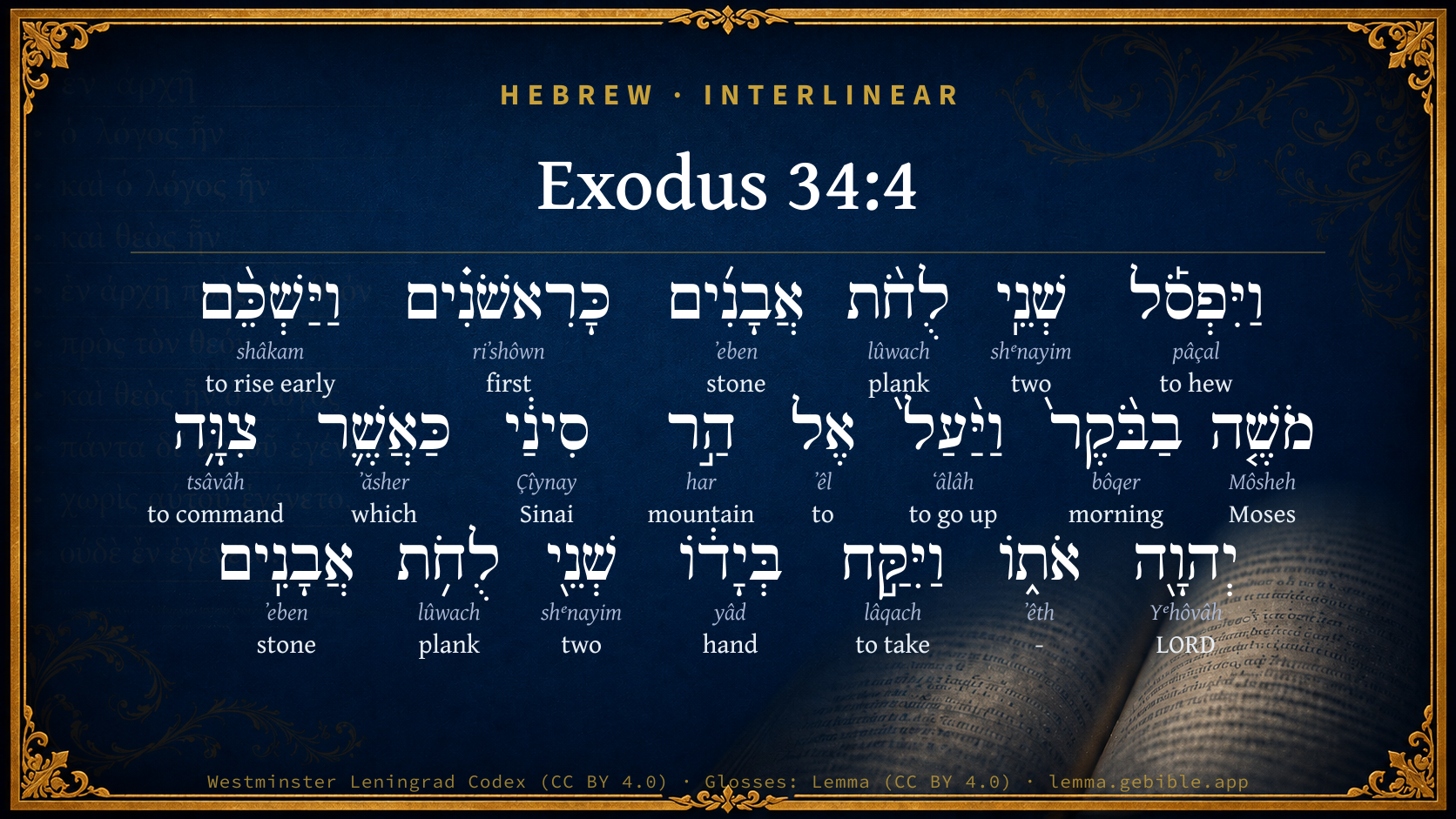
וַיִּפְסֹ֡ל
pâçal
H6458
“and · to hew”
Conjunction + Verb, Qal, Sequential Imperfect, 3rd Person, Masculine, Singular
Part of Speech
Conjunction + Verb
Stem
Qal
Form
Sequential Imperfect
Person
3rd Person
Gender
Masculine
Number
Singular
Full BDB Definition

Origin: a primitive root

TWOT: 1788

to cut, hew, hew into shape - (Qal) to hew, hew out, quarry
  1. שְׁנֵֽי shᵉnayim H8147 “two” Adjective, Cardinal number, Masculine, Dual, Construct
  2. לֻחֹ֨ת lûwach H3871 “planks of” Noun, Common, Masculine, Plural, Construct
  3. אֲבָנִ֜ים ʼeben H68 “stones” Noun, Common, Feminine, Plural, Absolute
  4. כָּרִאשֹׁנִ֗ים riʼshôwn H7223 “like/as the · first” Preposition, Determined + Adjective, Adjective, Masculine, Plural, Absolute
  5. וַיַּשְׁכֵּ֨ם shâkam H7925 “and · to rise early” Conjunction + Verb, Hiphil, Sequential Imperfect, 3rd Person, Masculine, Singular
  6. מֹשֶׁ֤ה Môsheh H4872 “Moses” Noun, Proper
  7. בַבֹּ֨קֶר֙ bôqer H1242 “in/at the · morning” Preposition, Determined + Noun, Common, Masculine, Singular, Absolute
  8. וַיַּ֨עַל֙ ʻâlâh H5927 “and · to go up” Conjunction + Verb, Qal, Sequential Imperfect, 3rd Person, Masculine, Singular
  9. אֶל ʼêl H413 “to” Preposition
  10. הַ֣ר har H2022 “mountain of” Noun, Common, Masculine, Singular, Construct
  11. סִינַ֔י Çîynay H5514 “Sinai” Noun, Proper
  12. כַּאֲשֶׁ֛ר ʼăsher H834 “like/as · which” Preposition + Particle, Relative
  13. צִוָּ֥ה tsâvâh H6680 “to command” Verb, Piel, Perfect, 3rd Person, Masculine, Singular
  14. יְהוָ֖ה Yᵉhôvâh H3068 “LORD” Noun, Proper
  15. אֹת֑וֹ ʼêth H853 “- · him” Particle, Direct Object + Suffix, Personal, 3rd Person, Masculine, Singular
  16. וַיִּקַּ֣ח lâqach H3947 “and · to take” Conjunction + Verb, Qal, Sequential Imperfect, 3rd Person, Masculine, Singular
  17. בְּיָד֔וֹ yâd H3027 “in/at · hand · his” Preposition + Noun, Common, Both, Singular, Construct + Suffix, Personal, 3rd Person, Masculine, Singular
  18. שְׁנֵ֖י shᵉnayim H8147 “two” Adjective, Cardinal number, Masculine, Dual, Construct
  19. לֻחֹ֥ת lûwach H3871 “planks of” Noun, Common, Masculine, Plural, Construct
  20. אֲבָנִֽים ʼeben H68 “stones” Noun, Common, Feminine, Plural, Absolute

About this verse

These counts appear in no published source. They are computed here, from the morphology-tagged text and Lemma’s own curated glosses. What Lemma adds →

21
words
18
distinct lemmas
Pentateuch
section

Notable vocabulary

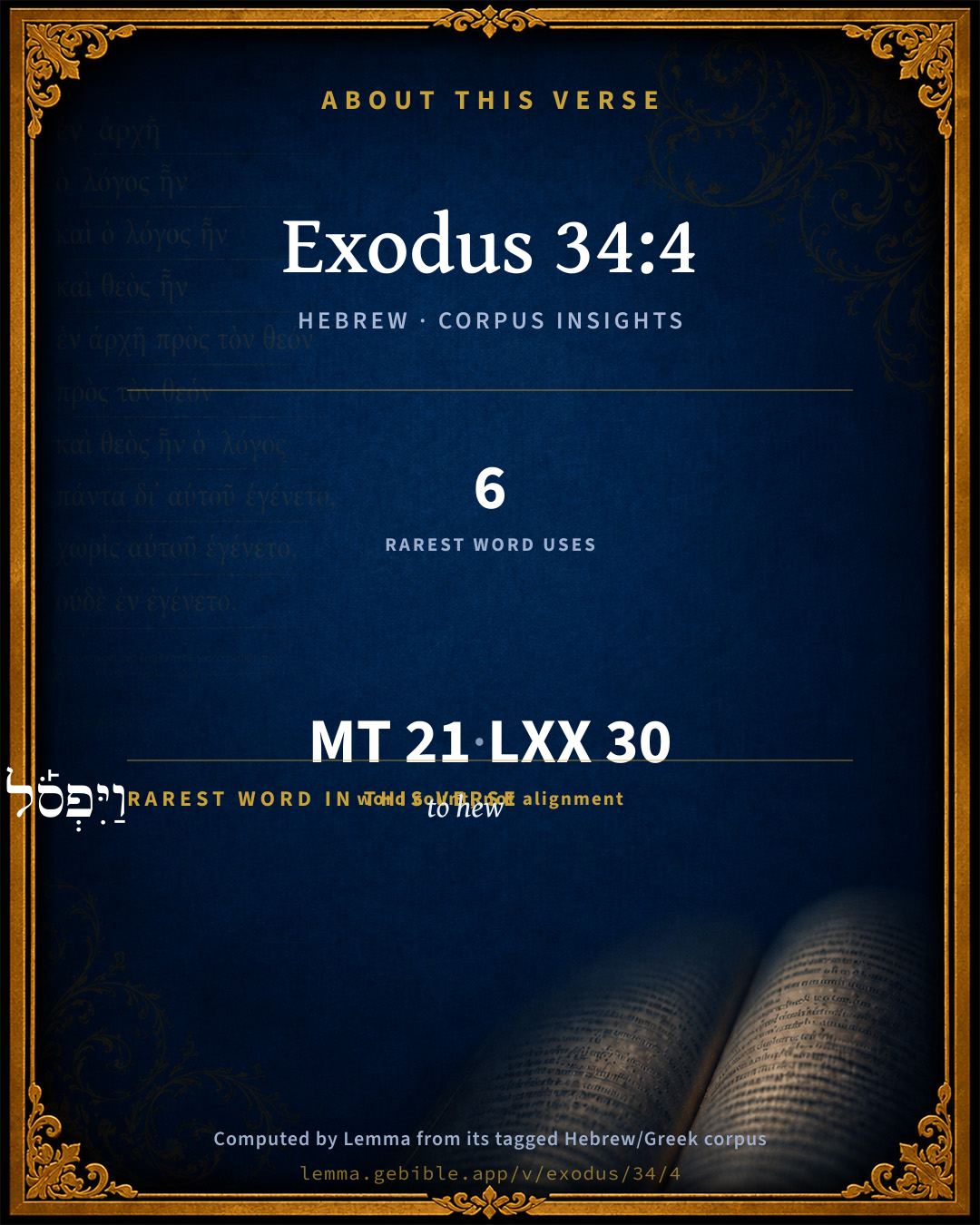
The rarest word here is וַיִּפְסֹ֡ל to hew H6458 — appearing just 6 times in the whole Hebrew Bible.

Shared distinctive vocabulary

וַיִּפְסֹ֡ל to hew H6458 occurs in 6 verses of the Hebrew Bible. Also found in:

Grammatical profile

  • 5 verbs
  • 10 nouns
  • 3 adjectives
  • 1 preposition
  • 2 particles

Verb forms

  • וַיִּפְסֹ֡ל Qal · Sequential Imperfect
  • וַיַּשְׁכֵּ֨ם Hiphil · Sequential Imperfect
  • וַיַּ֨עַל֙ Qal · Sequential Imperfect
  • צִוָּ֥ה Piel · Perfect
  • וַיִּקַּ֣ח Qal · Sequential Imperfect

Repetition

Words recur within this verse — often emphatic in Hebrew:

  • שְׁנֵֽי two H8147 ×2
  • לֻחֹ֨ת plank H3871 ×2
  • אֲבָנִ֜ים stone H68 ×2

Hebrew & Septuagint length

In English translation the verse runs 36 words from the Hebrew and 36 from the Septuagint (LXX English) — the same length.

A rough comparison of the two English renderings, which tokenize alike — not a word-level alignment.

Word counts can differ between the Hebrew and the Greek without any difference in meaning — e.g. the Hebrew direct-object marker אֵת has no separate Greek word, and Greek often adds the article ὁ.

In the original languages it is 21 Hebrew tokens and 30 Greek tokens — but the two are counted differently (Hebrew bundles its prefixes and suffixes into one token; the Greek is in lemma form), so that isn’t a like-for-like length.

Hebrew and Greek witnesses Masoretic Hebrew ↔ Greek Septuagint

The same verse in the two great witnesses to the Old Testament, shown verse-for-verse.

These are two independent witnesses, not word-aligned to each other, and the Septuagint is shown in lemma (dictionary) form.

Hebrew Exodus 34:4 Masoretic · Westminster Leningrad Codex

וַיִּפְסֹ֡ל שְׁנֵֽי לֻחֹ֨ת אֲבָנִ֜ים כָּרִאשֹׁנִ֗ים וַיַּשְׁכֵּ֨ם מֹשֶׁ֤ה בַבֹּ֨קֶר֙ וַיַּ֨עַל֙ אֶל הַ֣ר סִינַ֔י כַּאֲשֶׁ֛ר צִוָּ֥ה יְהוָ֖ה אֹת֑וֹ וַיִּקַּ֣ח בְּיָד֔וֹ שְׁנֵ֖י לֻחֹ֥ת אֲבָנִֽים

He chiseled two tablets of stone like the first; and Moses rose up early in the morning, and went up to Mount Sinai, as Yahweh had commanded him, and took in his hand two stone tablets.

World English Bible · Public Domain

Greek LXX Exodus 34:4 Septuagint · lemma form

καί λαξεύω δύο πλάξ λίθινος καθάπερ καί ὁ πρῶτος καί ὀρθρίζω μωυσῆς ἀναβαίνω εἰς ὁ ὄρος ὁ σινα καθότι συντάσσω αὐτός κύριος καί λαμβάνω μωυσῆς ὁ δύο πλάξ ὁ λίθινος

And Moses hewed two tables of stone, as also the first were; and Moses having arisen early, went up to the mount Sina, as the Lord appointed him; and Moses took the two tables of stone.

LXX2012 (modern English Septuagint) · Public Domain

Hebrew: Westminster Leningrad Codex (CC BY 4.0). Greek: Septuagint (public domain); English from LXX2012 (modern English Septuagint) (Public Domain). How the Septuagint differs from the Hebrew →

Targum (Aramaic paraphrase)

2

The Targum is the ancient Jewish Aramaic paraphrase of the Hebrew Scriptures — an interpretive translation, not the Hebrew text itself. Onkelos (literal) and Pseudo-Jonathan (expansive) render the Torah, and Jonathan the Prophets. Coverage is partial: where no permissively-licensed English translation exists for a verse, only the Aramaic is shown. This is verse-level text, not a word-by-word alignment to the Hebrew.

  1. Targum Onkelos Torah (Genesis–Deuteronomy)
    וּפְסַל תְּרֵין לוּחֵי אַבְנַיָא כְּקַדְמָאֵי וְאַקְדֵם משֶׁה בְּצַפְרָא וּסְלֵיק לְטוּרָא דְסִינַי כְּמָא דְפַקֵד יְיָ יָתֵהּ וּנְסֵב בִּידֵהּ תְּרֵין לוּחֵי אַבְנַיָא:

    (no public-domain English translation for this verse)

    Targum Onkelos — Aramaic: “Onkelos Genesis” (public domain); “Onkelos Exodus” (public domain); “Onkelos Leviticus” (public domain); “Onkelos Numbers” (public domain); “Onkelos Deuteronomy” (public domain). English: “Sefaria Community Translation” (CC0 1.0 (public-domain dedication)); “J.W. Etheridge. The Targums of Onkelos and Jonathan Ben Uzziel on the Pentateuch. London: Longmans, Green, 1862” (public domain). Text via Sefaria.

  2. Targum Pseudo-Jonathan Torah (Genesis–Deuteronomy)
    וּפְסַל תְּרֵין לוּחֵי אַבְנִין הֵי כְקַדְמָאֵי וְאַקְדִים משֶׁה בְּצַפְרָא וּסְלֵיק לְטַוְורָא דְסִינַי הֵיכְמָא דְפַקֵּיד יְיָ יָתֵיהּ וּנְסֵיב בִּידֵיהּ תְּרֵין לוּחֵי אַבְנַיָא

    And he hewed two tables of stone like the former: and Mosheh arose in the morning and ascended Mount Sinai, as the Lord had instructed him, and took in his hand the two tables of stone.

    Targum Pseudo-Jonathan — Aramaic: “Targum Jonathan on Genesis” (public domain); “Targum Jonathan on Exodus” (public domain); “Targum Jonathan on Leviticus” (public domain); “Targum Jonathan on Numbers” (public domain); “Targum Jonathan on Deuteronomy” (public domain). English: “The Targum of Jonathan ben Uzziel, trans. J. W. Etheridge, London, 1862” (public domain). Text via Sefaria.

Commentary

Notes on Exodus 34:4 from classic Christian and Jewish commentators (each source and its license shown beneath its notes). The classic Christian expositions comment on the surrounding passage and are grouped to its opening verse, so a note may address several verses; the Jewish commentaries on the Tanakh (Rashi and others) are per-verse, so they appear only where the commentator wrote on this verse.

Lemma curates 59 commentaries, every one of them public domain or Creative Commons licensed, each selected and text-cleaned for this edition rather than reprinted as found. About our sources →

Trapp's Complete Commentary

John Trapp

Exo 34:4 And he hewed two tables of stone like unto the first; and Moses rose up early in the morning, and went up unto mount Sinai, as the LORD had commanded him, and took in his hand the two tables of stone.

Ver. 4. And he hewed two tables.] Moses hewed them. The first tables were hewn out of the sapphire of the throne of God’s glory, say the Jewish doctors.

John Trapp, A Commentary or Exposition upon All the Books of the Old and New Testament (1647–1656) — public domain. Text from a community e-Sword module.

Geneva Bible (1599)

Geneva Bible translators

Or, polished.

Geneva Bible (1599) marginal notes — public domain. Text via Bolls.life.

Jamieson, Fausset & Brown

Robert Jamieson, A. R. Fausset & David Brown

Moses . . . took in his hand the two tables of stone--As Moses had no attendant to divide the labor of carrying them, it is evident that they must have been light, and of no great dimensions--probably flat slabs of shale or slate, such as abound in the mountainous region of Horeb. An additional proof of their comparatively small size appears in the circumstance of their being deposited in the ark of the most holy place (Exo 25:10).

Jamieson, Fausset & Brown — Commentary Critical and Explanatory on the Whole Bible (1871) — public domain (CC PDM 1.0). Text via the HelloAO Bible API.

John Gill's Exposition

And he hewed two tables of stone like unto the first,.... Which may be an emblem of the ministry of men, which God makes use of in hewing of his people, and bringing them to a sense of their sins, the breach of his law, and repentance for them, Hos 6:5,

and Moses rose up early in the morning: which, according to the Jews (g), was the twenty ninth of Ab or July, which showed his ready and cheerful obedience to the divine will, and the quick dispatch he had made in hewing the tables; which whether he did with his own hands only, or made use of others whom he directed, is not very material; though the phrase "hew thee", or "hew unto thee", seems as if he were to do it himself, and not another:

and went up unto Mount Sinai, as the Lord had commanded him; which was the third time of his going there, and every time he continued forty days and forty nights, as Aben Ezra observes, see Deu 9:18,

and took in his hand the two tables of stone; which could not be very thick and heavy to carry in one hand up a mountain, but must be a sort of marble slab or slate: at this same time an ark was ordered to be made, and was made, to put the tables into, which was a type of Christ, the fulfilling end of the law for righteousness, Deu 10:1.

(g) Seder Olam Rabba, c. 6. p. 19.

John Gill's Exposition of the Whole Bible (1746–1763) — public domain (CC PDM 1.0). Text via the HelloAO Bible API.

The Pulpit Commentary

Moses obeys all the directions given him to the letter hews, or causes to be hewn, the two tables, making them as like as he can to the former ones rises early, and ascends the mountain to the appointed spot and takes with him the tables, for God to perform his promise (ver. 1)of writing the commandments upon them. It has been questioned whether God did actually write the words upon the second tables; but Kurtz"s arguments upon the point are unanswerable. (History of the Old Covenant, vol. 3. p. 186, E. T.)

The Pulpit Commentary (1880–1919), ed. H.D.M. Spence-Jones & Joseph S. Exell — public domain. Text from a community e-Sword module.

Lesson kit

Teaching starters — assembled from the data on this page, not authored interpretation. Every prompt links to the verse data it draws on. Edit before teaching.

Exodus, in the Pentateuch, opens this verse with 21 words (18 distinct Hebrew lemmas). Its most distinctive word is pâçal (“to hew”). A historical commentator’s framing appears above. Read the whole chapter for the surrounding context.

Discussion questions

  1. The word pâçal carries the sense “to hew.” How does it shape the verse?
  2. How does Exodus 34:1, which shares the word «to hew», read alongside this verse?
  3. What does the repetition of “two” (2× in this one verse) do in this verse?
  4. The translations on this page render this verse differently — a whole-verse word diff, not a word-by-word alignment. What might account for the different wordings?
  5. «וַיִּפְסֹ֡ל» is a Qal Sequential Imperfect verb. How does that grammatical form shape the action described?
  6. Compare how Trapp's Complete Commentary and Geneva Bible (1599) read this verse. Where do they agree or differ?

Things to notice

Reading settings

Reading text

Shown beneath each verse's original-language words.

Old Testament
Old Testament edition

Read the OT as the Masoretic Hebrew (MT) or the Greek Septuagint (LXX).

English shown for the Greek Septuagint (in the Hebrew ↔ Greek comparison).

Comparing translations? Open the Compare panel on any verse page to stack up to four side by side.