2 Kings 12:5

Hebrew (Westminster Leningrad Codex) 2 Kings 12:5 appears in the Hebrew Old Testament. The text above is from the Westminster Leningrad Codex. Each word links to its Strong’s number, a concise gloss, and parsing drawn from the Open Scriptures Hebrew Bible morphology. Click any word for its full Brown-Driver-Briggs (BDB) entry.
Download image
Cite this verse

2 Kings 12:5 (World English Bible). Public Domain. Lemma interlinear Bible study tool, https://lemma.gebible.app/v/2-kings/12/5.

Show BibTeX & RIS
BibTeX
RIS
English Translation
let the priests take it to them, every man from his acquaintance; and they shall repair the breaches of the house, wherever any breach shall be found.
World English Bible · Public Domain
Highlights
  • 2 first appearances in the Hebrew Bible
Full analysis ↓
Download a study sheet

One document with this verse’s original text, its word-by-word gloss line, the meaning frame, cross-references with their text, attributed commentary, and full source and license credits — printable, and it pastes into notes with its structure intact.

This verse Autodidact and up

Study sheet (.html) Plain text (.txt)

A passage Seminary Student

Up to 50 verses in one chapter. A passage sheet keeps up to 6 commentary sources and 12 cross-references per verse, in the order this page ranks them, and says so on the sheet whenever that leaves anything out. Ask for a single verse and you get the Autodidact verse sheet above.

Everything on this page stays free to read, with no account — the sheet is a download of what is already on screen, not access to it.

Want to remove ads? Support Godless Engineer
Compare translations 3

The same verse in 3 English versions, stacked beneath the original-language interlinear above. Click any original word for its lexicon entry.

Each is an independent rendering of the whole verse — the interlinear is not word-aligned to these translations.

Highlighted words mark where these versions differ — a whole-verse word diff, not a word-by-word alignment.

  • World English Bible Public Domain
    let the priests take it to them, every man from his acquaintance; and they shall repair the breaches of the house, wherever any breach shall be found.
  • King James Version Public Domain
    Let the priests take it to them, every man of his acquaintance: and let them repair the breaches of the house, wheresoever any breach shall be found.
  • unfoldingWord Literal Text CC BY-SA 4.0
    the priests shall take for themselves, a man from his acquaintance, and they shall strengthen the damage of the house in every where damage is found there.”

unfoldingWord Literal Text — © unfoldingWord, licensed CC BY-SA 4.0. Word-aligned USFM3 via Door43 (git.door43.org/unfoldingWord/en_ult).

Versions to compare (up to 4)

3 of 4 selected

Show all 18 translations

Every available English version of this verse, each an independent rendering of the whole verse.

  • World English Bible Public Domain
    let the priests take it to them, every man from his acquaintance; and they shall repair the breaches of the house, wherever any breach shall be found.
  • Berean Standard Bible Public Domain
    Let every priest receive it from his constituency, and let it be used to repair any damage found in the temple.”
  • Majority Standard Bible Public Domain
    Let every priest receive it from his constituency, and let it be used to repair any damage found in the temple.”
  • King James Version Public Domain
    Let the priests take it to them, every man of his acquaintance: and let them repair the breaches of the house, wheresoever any breach shall be found.
  • American Standard Version (1901) Public Domain
    let the priests take it to them, every man from his acquaintance; and they shall repair the breaches of the house, wheresoever any breach shall be found.
  • Revised Version (1885) Public Domain
    let the priests take it to them, every man from his acquaintance: and they shall repair the breaches of the house, wheresoever any breach shall be found.
  • Geneva Bible (1599) Public Domain
    Let the Priestes take it to them, euery man of his acquaintance: and they shall repaire the broken places of the house, wheresoeuer any decay is founde.
  • Douay-Rheims (1899) Public Domain
    Let the priests take it according to their order, and repair the house, wheresoever they shall see any thing that wanteth repairing.
  • Young's Literal Translation Public Domain
    do the priests take to them, each from his acquaintance, and they strengthen the breach of the house, in all `places' where there is found a breach.'
  • Literal Standard Version CC BY-SA 4.0
    the priests take to themselves, each from his acquaintance, and they strengthen the breach of the house in all [places] there where a breach is found.”
  • Unlocked Literal Bible CC BY-SA 4.0
    the priests should receive the money from one of their treasurers and repair whatever damage is found in the temple.”
  • unfoldingWord Literal Text CC BY-SA 4.0
    the priests shall take for themselves, a man from his acquaintance, and they shall strengthen the damage of the house in every where damage is found there.”
  • Darby Bible Public Domain
    let the priests take it, every man of his acquaintance; and let them repair the breaches of the house, wherever any breach is found.
  • World Messianic Bible Public Domain
    let the priests take it to them, each man from his donor; and they shall repair the damage to the house, wherever any damage is found.”
  • Webster's Bible Public Domain
    Let the priests take it to them, every man of his acquaintance: and let them repair the breaches of the house, wherever any breach shall be found.
  • Free Bible Version CC BY-SA 4.0
    Let each priest receive the money from those who give, and use it to repair whatever damage is discovered in the Temple.”
  • Bible in Basic English Public Domain
    Let the priests take, every man from his friends and neighbours, to make good what is damaged in the house, wherever it is to be seen.
  • JPS Tanakh (1917) Public Domain
    (12-6) let the priests take it to them, every man from him that bestoweth it upon him; and they shall repair the breaches of the house, wheresoever any breach shall be found.'

Literal Standard Version (2020), Covenant Press — licensed CC BY-SA 4.0. Text via the HelloAO Bible API (eBible.org). Unlocked Literal Bible (unfoldingWord) — licensed CC BY-SA 4.0. Text via the HelloAO Bible API (eBible.org). unfoldingWord Literal Text — © unfoldingWord, licensed CC BY-SA 4.0. Word-aligned USFM3 via Door43 (git.door43.org/unfoldingWord/en_ult). Free Bible Version, Dr. Jonathan Gallagher — licensed CC BY-SA 4.0. Text via the HelloAO Bible API (eBible.org).

Word by word

More ways to search: Search by grammar → Find every occurrence → Compare this word →

Practice this passage: Drill this verse → Learn its vocabulary →

מַכָּר֑וֹ
makkâr
H4378
“friend · his”
Noun, Common, Masculine, Singular, Construct + Suffix, Personal, 3rd Person, Masculine, Singular
Part of Speech
Noun
Type
Common
Gender
Masculine
Number
Singular
State
Construct
Full BDB Definition

Origin: from H5234

TWOT: 1368f

acquaintance, friend
  1. יִקְח֤וּ lâqach H3947 “to take” Verb, Qal, Jussive, 3rd Person, Masculine, Plural
  2. הַכֹּ֣הֲנִ֔ים kôhên H3548 “the · priests” Particle, Definite Article + Noun, Common, Masculine, Plural, Absolute
  3. אִ֖ישׁ ʼîysh H376 “man” Noun, Common, Masculine, Singular, Absolute
  4. מֵאֵ֣ת ʼêth H854 “from · with” Preposition + Preposition
  5. וְהֵ֗ם hêm H1992 “and · they” Conjunction + Pronoun, Personal, 3rd Person, Masculine, Plural
  6. יְחַזְּקוּ֙ châzaq H2388 “to strengthen” Verb, Piel, Imperfect, 3rd Person, Masculine, Plural
  7. אֶת ʼêth H853 “-” Particle, Direct Object
  8. בֶּ֣דֶק bedeq H919 “breach of” Noun, Common, Masculine, Singular, Construct
  9. הַבַּ֔יִת bayith H1004 “the · house” Particle, Definite Article + Noun, Common, Masculine, Singular, Absolute
  10. לְכֹ֛ל kôl H3605 “to/for · all” Preposition + Noun, Common, Masculine, Singular, Absolute
  11. אֲשֶׁר ʼăsher H834 “which” Particle, Relative
  12. יִמָּצֵ֥א mâtsâʼ H4672 “to find” Verb, Niphal, Imperfect, 3rd Person, Masculine, Singular
  13. שָׁ֖ם shâm H8033 “there” Adverb
  14. בָּֽדֶק bedeq H919 “breach” Noun, Common, Masculine, Singular, Absolute

About this verse

These counts appear in no published source. They are computed here, from the morphology-tagged text and Lemma’s own curated glosses. What Lemma adds →

16
words
14
distinct lemmas
Historical
section

Notable vocabulary

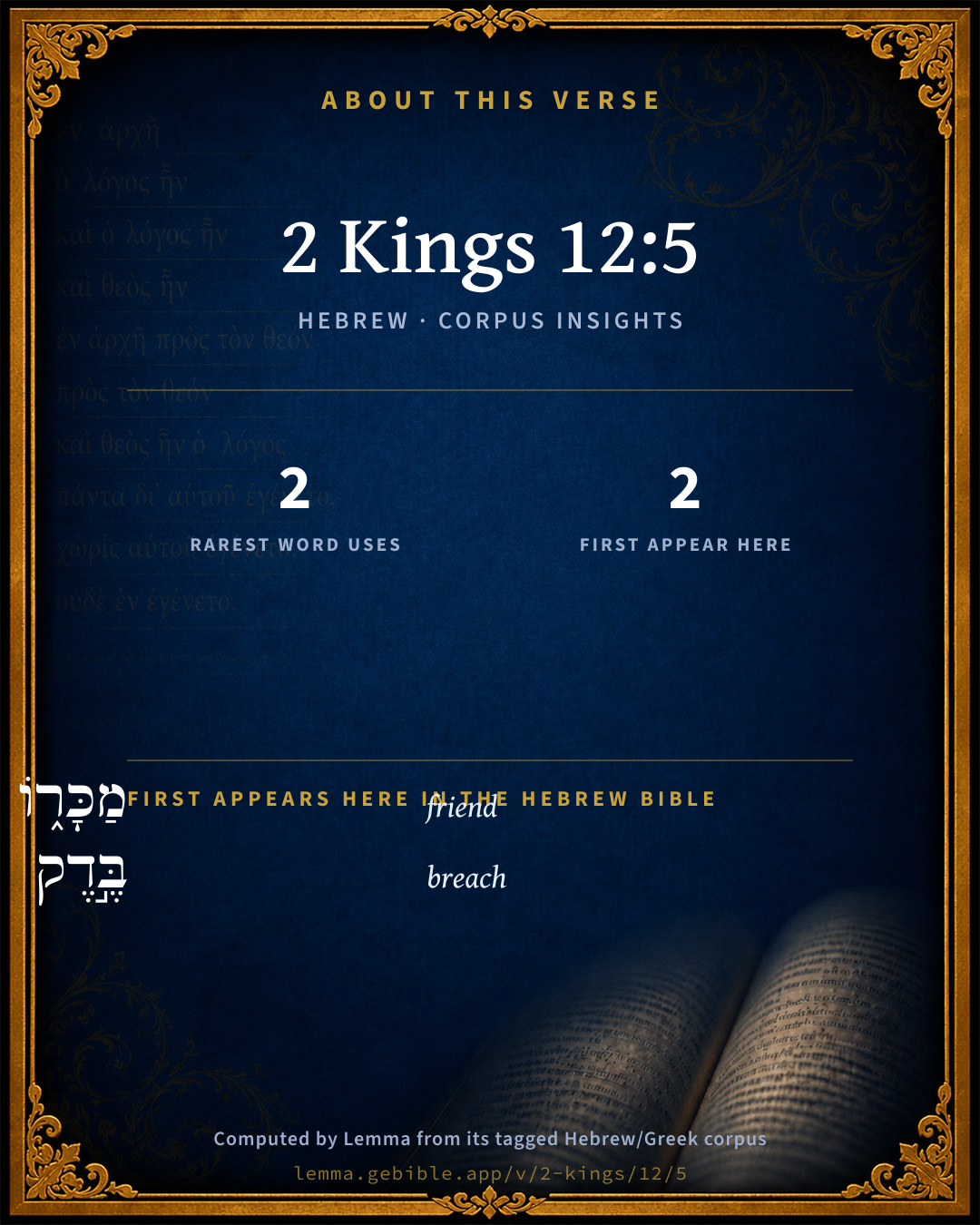
The rarest word here is מַכָּר֑וֹ friend H4378 — appearing just 2 times in the whole Hebrew Bible.

First appearance in Scripture

These words make their first canonical appearance in the Hebrew Bible here:

  • מַכָּר֑וֹ friend H4378
  • בֶּ֣דֶק breach H919

Shared distinctive vocabulary

מַכָּר֑וֹ friend H4378 occurs in 2 verses of the Hebrew Bible. Also found in:

Grammatical profile

  • 3 verbs
  • 7 nouns
  • 1 pronoun
  • 2 prepositions
  • 1 adverb
  • 2 particles

Verb forms

  • יִקְח֤וּ Qal · Jussive
  • יְחַזְּקוּ֙ Piel · Imperfect
  • יִמָּצֵ֥א Niphal · Imperfect

Repetition

A word recurs within this verse — often emphatic in Hebrew:

  • בֶּ֣דֶק breach H919 ×2

Hebrew & Septuagint length

In English translation the verse runs 27 words from the Hebrew and 33 from the Septuagint (LXX English) — closely comparable.

A rough comparison of the two English renderings, which tokenize alike — not a word-level alignment.

Word counts can differ between the Hebrew and the Greek without any difference in meaning — e.g. the Hebrew direct-object marker אֵת has no separate Greek word, and Greek often adds the article ὁ.

Cross-references

6

Topical passages linked to 2 Kings 12:5 in the Treasury of Scripture Knowledge — connected by theme and wording, ordered by reader-vote popularity; previews shown in the World English Bible.

  • Isaiah 58:12 Those who shall be of you shall build the old waste places; you shall raise up the foundations of many generations; and you shall be called The repairer of the breach, The restorer of paths to dwell in.
  • 1 Kings 11:27 This was the reason why he lifted up his hand against the king: Solomon built Millo, and repaired the breach of the city of David his father.
  • 2 Kings 12:12 and to the masons and the stone cutters, and for buying timber and hewn stone to repair the breaches of the house of Yahweh, and for all that was laid out for the house to repair it.
  • 2 Kings 22:5–6 and let them deliver it into the hand of the workmen who have the oversight of the house of Yahweh; and let them give it to the workmen who are in the house of Yahweh, to repair the breaches of the house,
  • 2 Chronicles 24:5 He gathered together the priests and the Levites, and said to them, Go out to the cities of Judah, and gather of all Israel money to repair the house of your God from year to year; and see that you hasten the matter. However the Levites didn't hurry.
  • 2 Chronicles 24:7 For the sons of Athaliah, that wicked woman, had broken up the house of God; and also all the dedicated things of the house of Yahweh did they bestow on the Baals.

Cross-references courtesy of OpenBible.info (CC BY 4.0).

Hebrew and Greek witnesses Masoretic Hebrew ↔ Greek Septuagint

The same verse in the two great witnesses to the Old Testament, shown verse-for-verse.

These are two independent witnesses, not word-aligned to each other, and the Septuagint is shown in lemma (dictionary) form.

Hebrew 2 Kings 12:5 Masoretic · Westminster Leningrad Codex

יִקְח֤וּ לָהֶם֙ הַכֹּ֣הֲנִ֔ים אִ֖ישׁ מֵאֵ֣ת מַכָּר֑וֹ וְהֵ֗ם יְחַזְּקוּ֙ אֶת בֶּ֣דֶק הַבַּ֔יִת לְכֹ֛ל אֲשֶׁר יִמָּצֵ֥א שָׁ֖ם בָּֽדֶק

let the priests take it to them, every man from his acquaintance; and they shall repair the breaches of the house, wherever any breach shall be found.

World English Bible · Public Domain

Greek LXX 2 Kings 12:5 Septuagint · lemma form

καί εἶπον ιωας πρός ὁ ἱερεύς πᾶς ὁ ἀργύριον ὁ ἅγιος ὁ εἰσοδιάζω ἐν ὁ οἶκος κύριος ἀργύριον συντίμησις ἀνήρ ἀργύριον λαμβάνω συντίμησις πᾶς ἀργύριον ὅς ἐάν ἀναβαίνω ἐπί καρδία ἀνήρ φέρω ἐν οἶκος κύριος

let the priests take it to themselves, every man from the proceeds of his sale: and they shall repair the breaches of the house in all places wherever a breach shall be found.

LXX2012 (modern English Septuagint) · Public Domain

On this verse, The Cambridge Bible for Schools and Colleges discusses the Septuagint’s reading. Read the note in Commentary ↓

Hebrew: Westminster Leningrad Codex (CC BY 4.0). Greek: Septuagint (public domain); English from LXX2012 (modern English Septuagint) (Public Domain). How the Septuagint differs from the Hebrew →

Targum (Aramaic paraphrase)

1

The Targum is the ancient Jewish Aramaic paraphrase of the Hebrew Scriptures — an interpretive translation, not the Hebrew text itself. Onkelos (literal) and Pseudo-Jonathan (expansive) render the Torah, and Jonathan the Prophets. Coverage is partial: where no permissively-licensed English translation exists for a verse, only the Aramaic is shown. This is verse-level text, not a word-by-word alignment to the Hebrew.

  1. Targum Jonathan Prophets (Joshua–Malachi)
    וַאֲמַר יְהוֹאָשׁ לְכַהֲנַיָא כֹּל כְּסַף קוּדְשַׁיָא דְמִתָּעַל לְבֵית מַקְדְשָׁא דַיְיָ כְּסַף תִּקְלַיָא דַעֲבַר עַל מִנְיָן גַבְרַיָא כְּסַף פּוּרְקַן נַפְשָׁתָא דְמִתַּן גְבַר פּוּרְקַן נַפְשֵׁיהּ אַף כָּל כְּסַף דְמִתְנַדַב גְבַר בְּלִבֵּיהּ לְאַיְתָאָה לְבֵית מַקְדְשָׁא דַיָי:

    (no public-domain English translation for this verse)

    Targum Jonathan — Aramaic: “Mikraot Gedolot” (public domain). English: “Sefaria Community Translation” (CC0 1.0 (public-domain dedication)); “London "Chaldee Paraphrase," 1871” (public domain). Text via Sefaria.

Commentary

Notes on 2 Kings 12:5 from classic Christian and Jewish commentators (each source and its license shown beneath its notes). The classic Christian expositions comment on the surrounding passage and are grouped to its opening verse, so a note may address several verses; the Jewish commentaries on the Tanakh (Rashi and others) are per-verse, so they appear only where the commentator wrote on this verse.

Lemma curates 59 commentaries, every one of them public domain or Creative Commons licensed, each selected and text-cleaned for this edition rather than reprinted as found. About our sources →

Trapp's Complete Commentary

John Trapp

2Ki 12:5 Let the priests take [it] to them, every man of his acquaintance: and let them repair the breaches of the house, wheresoever any breach shall be found.

Ver. 5. And let them repair the breaches of the house.] Labes domus, rupturas, fissuras, scissuras, such as the temple had contracted, either by antiquity, for it had stood one hundred and fifty-five years, or by the iniquity of the times. See 2Ch 24:7.

John Trapp, A Commentary or Exposition upon All the Books of the Old and New Testament (1647–1656) — public domain. Text from a community e-Sword module.

Joseph Benson's Commentary

2Ki 12:5. Let the priests take it to them, &c. — Let them go abroad through all the parts of the land, as they have acquaintance and interest, and gather up the money, and bring it to Jerusalem. Let them repair, &c., wheresoever any breach shall be found — Either through decay, or by ill accidents; or by the malice of Athaliath, or her relations; of which see 2Ch 24:7.

Joseph Benson's Commentary on the Old and New Testaments (1811–1818) — public domain. Text from a community e-Sword module.

Whedon's Commentary on the Bible

Daniel D. Whedon

5. Every man of his acquaintance — From this, and more particularly from Chronicles, (2Ki_12:5,) it appears that the priests and Levites were not to wait at the temple to receive contributions, but were to “go out unto the cities of Judah, and gather of all Israel money to repair the house of God from year to year.” But this method failed, probably because the priests took little interest in the measure, and received little or no more than was sufficient for their own subsistence. The people, too, seemed little inclined to fall in with this measure, for when a new method was adopted, and a chest set by the temple to receive their offerings, they “rejoiced, and brought in, and cast into the chest, until they had made an end.” 2Ch_24:8-10. So in other ages of the Church, travelling agents sent forth to collect funds have often cost more than the amounts they collected, and have injured the cause besides.

Daniel D. Whedon (gen. ed.), Commentary on the Old and New Testaments (1874–1909) — public domain. Text from a community e-Sword module.

Geneva Bible (1599)

Geneva Bible translators

For the Temple which was built an hundred fifty and five years before, had many things decayed in it, both by the negligence of the King’s predecessors, and also by the wickedness of the idolaters.

Geneva Bible (1599) marginal notes — public domain. Text via Bolls.life.

Ellicott's Commentary for English Readers

(5) Every man of his acquaintance.—See 2Ch_24:5. From that passage it is evident that the chronicler understood that the priests were required to collect such moneys, each in his own city and district, year by year. Our text, taken alone, would seem to imply that persons going to the Temple to have the value of vows estimated, or to make free-will offerings, resorted to the priests whom they knew. (The word rendered “acquaintance” only occurs in this account.)

The breaches of the house.—The dilapidations of the Temple were serious, not because of its age—it had only stood about 130 years—but owing to the wanton attacks of Athaliah and her sons (comp. 2Ch_24:7), who had, moreover, diverted the revenues of the sanctuary to the support of the Baalworship.

A Bible Commentary for English Readers, edited by Charles John Ellicott (1878–1897) — public domain. Text from a community e-Sword module.

The Cambridge Bible for Schools and Colleges

gen. ed. J. J. S. Perowne

5. let the priests take it to them, every man of his acquaintance] This passage is not easy to understand until we have along with it the parallel account of the Chronicler. From 2 Kings it might be thought that the words of Jehoash applied to such offerings as were made at the temple, and then it would be hard to see what a man’s acquaintance had to do with such a matter. But in 2 Chron. we are told that the priests and Levites were bidden ‘to go out unto the cities of Judah and gather money of all Israel’. Hence nothing was more natural than that each should go among the people to whom he was best known, and from whom he would have the best chance of bringing in contributions, Josephus (Ant. IX. 8. 2) says that ‘the priests and Levites were sent through the whole land to ask half a shekel from each person for the furniture and restoration of the temple, which had been broken up by Joram and Athaliah and her sons’.

and let them repair] R.V. they shall repair. This is literal, and besides allows more emphasis to be given to the pronoun ‘they’ which is placed in a marked position in the original. The wish of the king at first was to put the whole matter in the charge of the priest.

the breaches] The Hebrew word, which the LXX. merely transliterates (βεδέκ), is found only in this chapter and 2Ki_22:5, and in Eze_27:9; Eze_27:27. But in the last-mentioned passages it is used of the filling up, by calking, of the chinks in ships. Hence we can understand the sort of decay which had taken place in the temple-building. Years of neglect had allowed the walls to crumble and crack and similar damages to arise in every part.

The Cambridge Bible for Schools and Colleges (gen. ed. J. J. S. Perowne; Cambridge University Press, 1878–1918) — public domain. Text from a community e-Sword module.

John Gill's Exposition

But it was so, that in the twenty and third year of King Jehoash, the priests had not repaired the breaches of the house. Either the people being backward to pay in the money, or the priests converted it to their own use: or, however, were negligent of doing the work enjoined them by the king, either in collecting the money, or in using it as they were directed.

But it was so, that in the twenty and third year of King Jehoash, the priests had not repaired the breaches of the house. Either the people being backward to pay in the money, or the priests converted it to their own use: or, however, were negligent of doing the work enjoined them by the king, either in collecting the money, or in using it as they were directed.

2 Kings 12:7

kg2 12:7

kg2 12:7

kg2 12:7Then King Jehoash called for Jehoiada the priest, and the other priests,.... The common priests, Jehoiada being high priest:

and said unto them, why repair ye not the breaches of the house? in which they appeared to him very dilatory; the reason might be, the people were not forward to pay in their money, and they might not choose to begin the repairs until they had got it all in, or at least what was sufficient to carry them through them:

now therefore receive no more money of your acquaintance; suspecting that what they had received they kept for their own use:

but deliver it for the breaches of the house; into other hands for that use, and so dismissed them at once from collecting the money, and being concerned in the repairs of the temple.

John Gill's Exposition of the Whole Bible (1746–1763) — public domain (CC PDM 1.0). Text via the HelloAO Bible API.

Albert Barnes' Notes on the Bible

The collection was not to be made in Jerusalem only, but in all “the cities of Judah” 2Ch 24:5; the various priests and Levites being collectors in their own neighborhoods.

Breaches - The word in the original includes every kind and degree of ruin or dilapidation.

Albert Barnes' Notes on the Bible (1834–1885) — public domain. Text from a community e-Sword/MySword module.

Haydock's Catholic Bible Commentary

Order. Hebrew, "acquaintance." Let them receive the contributions on the spot where they reside; or, let those who are on duty in the temple take them. (Calmet) --- Thing. Hebrew, "breach," badek, a term which the Septuagint retain. (Haydock)

George Leo Haydock (1774–1849), Haydock's Catholic Family Bible and Commentary, 1859 edition — public domain. Excludes Psalms (Douay-Rheims chapter numbering differs from Protestant) and Deuterocanonical books (Catholic canon only).

Matthew Poole's English Annotations

Let the priests take it to them; let them go abroad through all the parts of the land, as they have acquaintance and interest, and gather up the money, and bring it to Jerusalem.

Wheresoever any breach shall be found; either through decay, or by ill accidents, or by the malice of Athaliah or her relations; of which see 2Ch 24:7.

Matthew Poole's English Annotations on the Holy Bible (1683–1685) — public domain. Text from a community e-Sword/MySword module.

The Pulpit Commentary

Let the priests take it to them, every man of his acquaintance. The money was to be gathered of "all Israel," out of all "the cities of Judah". (2Ch_24:5) The priests of each locality were to be the collectors, and would therefore gather "of their acquaintance." As we cannot suppose that very much would accrue from either the first or second source, since a census was rarely taken, and personal vows were not very common, we must regard the command of Joash as, in the main, the authorization of a general collection throughout the kingdom of voluntary contributions towards the temple repairs, and so as analogous to the "letters" which our own sovereigns, or archbishops, issue from time to time for collections in churches for special objects. And let them repair the breaches of the house, wheresoever any breach shall be found. The "breaches," or dilapidations, may have been caused, partly by the neglect of necessary repairs during the reigns of Jehoram, Ahaziah, and Athaliah; but they were mainly the result of the willful violence of Athaliah. (2Ch_24:7) Apparently, the damage done must have been very great.

The Pulpit Commentary (1880–1919), ed. H.D.M. Spence-Jones & Joseph S. Exell — public domain. Text from a community e-Sword module.

Rashi

Rabbi Shlomo Yitzchaki (Rashi)

The half-shekel [given by every male over twenty,] and donations representing the value of one’s age. Two types of money are mentioned here. “Everyone who passes the numbering,” [The first type is] the money of anyone who passes the numbering, i.e., the money of the annual shekalim, about which it is stated, and [the second type is] anyone who volunteers his own value, i.e., one who says, “My value shall be incumbent upon me [to donate].”

All monies that [a person’s heart] inspires him, etc. E.g., one who says, “I obligate myself to donate a maneh for making repairs to the Beis [Hamikdosh],

Rashi on the Tanakh — English translations: “The Judaica Press complete Tanach with Rashi, translated by A. J. Rosenberg” (CC BY 4.0); “Pentateuch with Rashi's commentary by M. Rosenbaum and A.M. Silbermann, 1929-1934” (public domain); “The Metsudah Tanach series, Lakewood, N.J” (CC BY 4.0); and “The Book of Joshua, Metsudah Publications, 1997” (CC BY 4.0). Text via Sefaria.

Lesson kit

Teaching starters — assembled from the data on this page, not authored interpretation. Every prompt links to the verse data it draws on. Edit before teaching.

2 Kings, in the Historical, opens this verse with 16 words (14 distinct Hebrew lemmas). Its most distinctive word is makkâr (“friend”). A historical commentator’s framing appears above. Read the whole chapter for the surrounding context.

Discussion questions

  1. How does “friend” (makkâr) shape what this verse is saying?
  2. 2 words here appear for the first time in Scripture. What is being introduced at this debut?
  3. 2 Kings 12:7 shares the word «friend» with this verse. How do the two illuminate each other?
  4. “breach” occurs 2× in this one verse. What is the effect of the repetition?
  5. These translations render this verse differently; the difference is in the English rendering, not the original. What questions does that raise?
  6. The verb «יִקְח֤וּ» is Qal Jussive. How does its form color the action?
  7. Reading how Trapp's Complete Commentary and Joseph Benson's Commentary read this verse, where do the two commentators agree and where do they part?

Things to notice

  • 2 words make their first canonical appearance in Scripture here.
  • These translations choose different wording for 12 words in this verse.
  • “breach” occurs 2× in this single verse.
  • 14 distinct Hebrew lemmas span 16 words in this verse.

Reading settings

Reading text

Shown beneath each verse's original-language words.

Old Testament
Old Testament edition

Read the OT as the Masoretic Hebrew (MT) or the Greek Septuagint (LXX).

English shown for the Greek Septuagint (in the Hebrew ↔ Greek comparison).

Comparing translations? Open the Compare panel on any verse page to stack up to four side by side.