
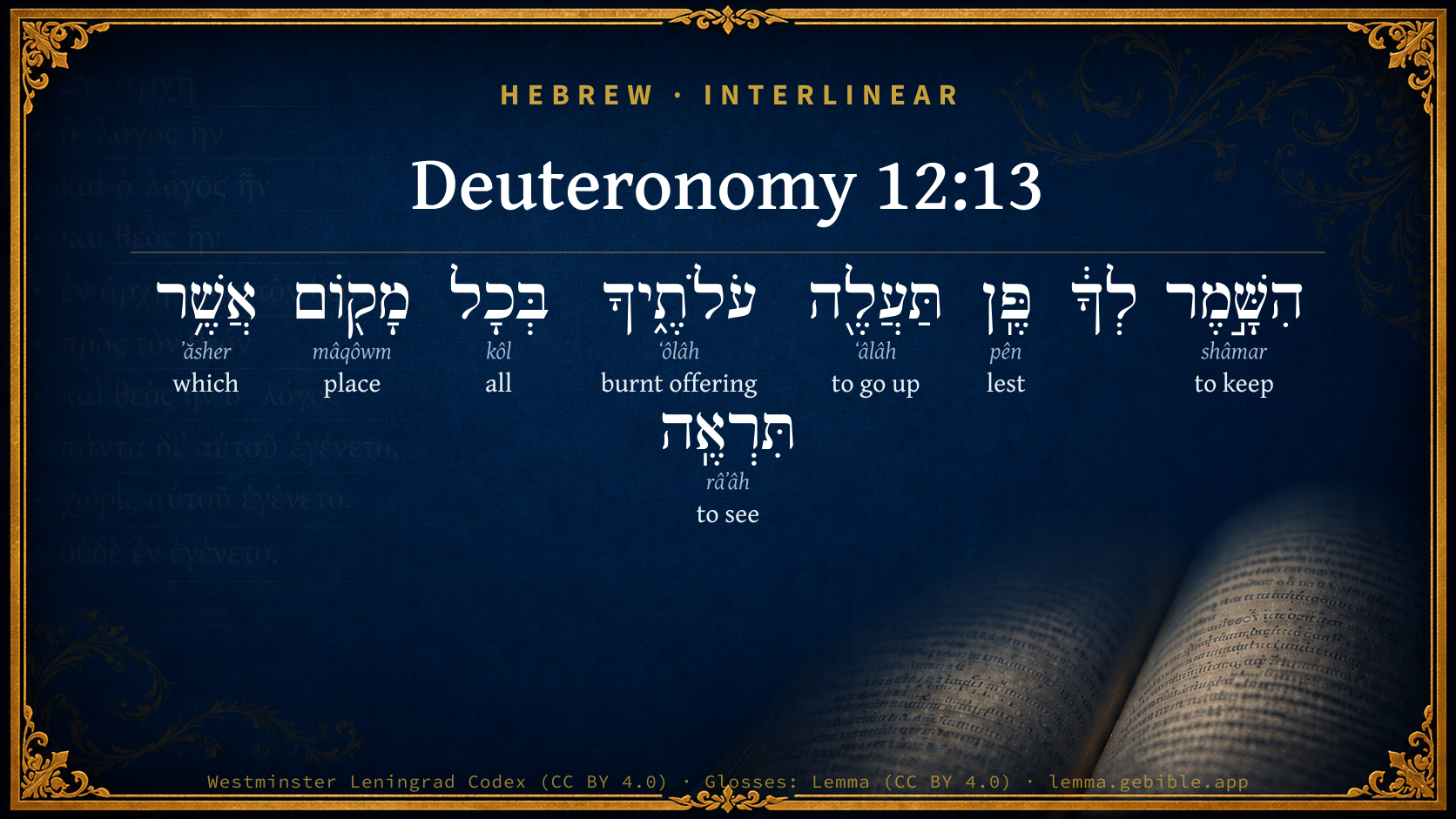
Deuteronomy 12:13

Hebrew (Westminster Leningrad Codex) Deuteronomy 12:13 appears in the Hebrew Old Testament. The text above is from the Westminster Leningrad Codex. Each word links to its Strong’s number, a concise gloss, and parsing drawn from the Open Scriptures Hebrew Bible morphology. Click any word for its full Brown-Driver-Briggs (BDB) entry.
Download image
Cite this verse

Deuteronomy 12:13 (World English Bible). Public Domain. Lemma interlinear Bible study tool, https://lemma.gebible.app/v/deuteronomy/12/13.

Show BibTeX & RIS
BibTeX
RIS
English Translation
Take heed to yourself that you don't offer your burnt offerings in every place that you see;
World English Bible · Public Domain
Download a study sheet

One document with this verse’s original text, its word-by-word gloss line, the meaning frame, cross-references with their text, attributed commentary, and full source and license credits — printable, and it pastes into notes with its structure intact.

This verse Autodidact and up

Study sheet (.html) Plain text (.txt)

A passage Seminary Student

Up to 50 verses in one chapter. A passage sheet keeps up to 6 commentary sources and 12 cross-references per verse, in the order this page ranks them, and says so on the sheet whenever that leaves anything out. Ask for a single verse and you get the Autodidact verse sheet above.

Everything on this page stays free to read, with no account — the sheet is a download of what is already on screen, not access to it.

Want to remove ads? Support Godless Engineer
Compare translations 3

The same verse in 3 English versions, stacked beneath the original-language interlinear above. Click any original word for its lexicon entry.

Each is an independent rendering of the whole verse — the interlinear is not word-aligned to these translations.

Highlighted words mark where these versions differ — a whole-verse word diff, not a word-by-word alignment.

  • World English Bible Public Domain
    Take heed to yourself that you don't offer your burnt offerings in every place that you see;
  • King James Version Public Domain
    Take heed to thyself that thou offer not thy burnt offerings in every place that thou seest:
  • unfoldingWord Literal Text CC BY-SA 4.0
    Watch yourself lest you offer your burnt offerings at every place that you see;

unfoldingWord Literal Text — © unfoldingWord, licensed CC BY-SA 4.0. Word-aligned USFM3 via Door43 (git.door43.org/unfoldingWord/en_ult).

Versions to compare (up to 4)

3 of 4 selected

Show all 18 translations

Every available English version of this verse, each an independent rendering of the whole verse.

  • World English Bible Public Domain
    Take heed to yourself that you don't offer your burnt offerings in every place that you see;
  • Berean Standard Bible Public Domain
    Be careful not to offer your burnt offerings in just any place you see;
  • Majority Standard Bible Public Domain
    Be careful not to offer your burnt offerings in just any place you see;
  • King James Version Public Domain
    Take heed to thyself that thou offer not thy burnt offerings in every place that thou seest:
  • American Standard Version (1901) Public Domain
    Take heed to thyself that thou offer not thy burnt-offerings in every place that thou seest;
  • Revised Version (1885) Public Domain
    Take heed to thyself that thou offer not thy burnt offerings in every place that thou seest:
  • Geneva Bible (1599) Public Domain
    Take heede that thou offer not thy burnt offrings in euery place that thou seest:
  • Douay-Rheims (1899) Public Domain
    Beware lest thou offer thy holocausts in every place that thou shalt see:
  • Young's Literal Translation Public Domain
    `Take heed to thee, lest thou cause thy burnt-offerings to ascend in any place which thou seest,
  • Literal Standard Version CC BY-SA 4.0
    Take heed to yourself lest you cause your burnt-offerings to ascend in any place which you see;
  • Unlocked Literal Bible CC BY-SA 4.0
    Pay attention to yourself that you do not offer your burnt offerings at every place that you see;
  • unfoldingWord Literal Text CC BY-SA 4.0
    Watch yourself lest you offer your burnt offerings at every place that you see;
  • Darby Bible Public Domain
    Take heed to thyself that thou offer not thy burnt-offerings in every place that thou seest;
  • World Messianic Bible Public Domain
    Be careful that you don’t offer your burnt offerings in every place that you see;
  • Webster's Bible Public Domain
    Take heed to thyself that thou offer not thy burnt-offerings in every place that thou seest:
  • Free Bible Version CC BY-SA 4.0
    Make sure you don't present your burnt offerings just anywhere you want.
  • Bible in Basic English Public Domain
    Take care that you do not make your burned offerings in any place you see:
  • JPS Tanakh (1917) Public Domain
    Take heed to thyself that thou offer not thy burnt-offerings in every place that thou seest;

Literal Standard Version (2020), Covenant Press — licensed CC BY-SA 4.0. Text via the HelloAO Bible API (eBible.org). Unlocked Literal Bible (unfoldingWord) — licensed CC BY-SA 4.0. Text via the HelloAO Bible API (eBible.org). unfoldingWord Literal Text — © unfoldingWord, licensed CC BY-SA 4.0. Word-aligned USFM3 via Door43 (git.door43.org/unfoldingWord/en_ult). Free Bible Version, Dr. Jonathan Gallagher — licensed CC BY-SA 4.0. Text via the HelloAO Bible API (eBible.org).

Word by word

More ways to search: Search by grammar → Find every occurrence → Compare this word →

Practice this passage: Drill this verse → Learn its vocabulary →

About this verse

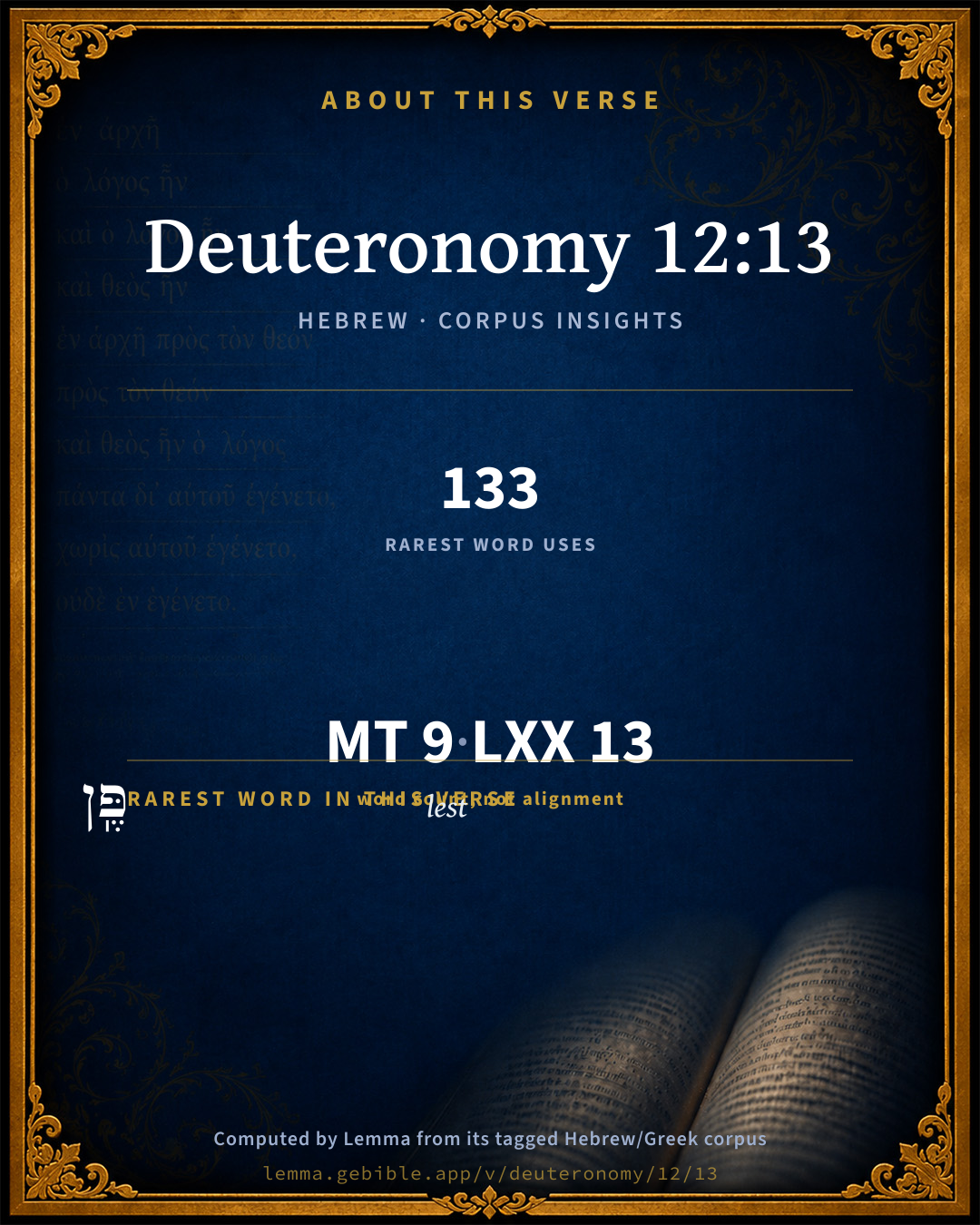
These counts appear in no published source. They are computed here, from the morphology-tagged text and Lemma’s own curated glosses. What Lemma adds →

9
words
8
distinct lemmas
Pentateuch
section

Grammatical profile

  • 3 verbs
  • 3 nouns
  • 1 preposition
  • 1 conjunction
  • 1 particle

Verb forms

  • הִשָּׁ֣מֶר Niphal · Imperative
  • תַּעֲלֶ֖ה Hiphil · Imperfect
  • תִּרְאֶֽה Qal · Imperfect

Hebrew & Septuagint length

In English translation the verse runs 17 words from the Hebrew and 19 from the Septuagint (LXX English) — closely comparable.

A rough comparison of the two English renderings, which tokenize alike — not a word-level alignment.

Word counts can differ between the Hebrew and the Greek without any difference in meaning — e.g. the Hebrew direct-object marker אֵת has no separate Greek word, and Greek often adds the article ὁ.

In the original languages it is 9 Hebrew tokens and 13 Greek tokens — but the two are counted differently (Hebrew bundles its prefixes and suffixes into one token; the Greek is in lemma form), so that isn’t a like-for-like length.

Cross-references

5

Topical passages linked to Deuteronomy 12:13 in the Treasury of Scripture Knowledge — connected by theme and wording, ordered by reader-vote popularity; previews shown in the World English Bible.

  • Leviticus 17:2–5 "Speak to Aaron, and to his sons, and to all the children of Israel, and say to them: 'This is the thing which Yahweh has commanded,
  • Deuteronomy 12:6 and there you shall bring your burnt offerings, and your sacrifices, and your tithes, and the heave-offering of your hand, and your vows, and your freewill-offerings, and the firstborn of your herd and of your flock:
  • 1 Kings 12:28–32 Whereupon the king took counsel, and made two calves of gold; and he said to them, It is too much for you to go up to Jerusalem: see your gods, Israel, which brought you up out of the land of Egypt.
  • 1 Kings 15:34 He did that which was evil in the sight of Yahweh, and walked in the way of Jeroboam, and in his sin with which he made Israel to sin.
  • 2 Chronicles 15:17 But the high places were not taken away out of Israel: nevertheless the heart of Asa was perfect all his days.

Cross-references courtesy of OpenBible.info (CC BY 4.0).

Hebrew and Greek witnesses Masoretic Hebrew ↔ Greek Septuagint

The same verse in the two great witnesses to the Old Testament, shown verse-for-verse.

These are two independent witnesses, not word-aligned to each other, and the Septuagint is shown in lemma (dictionary) form.

Hebrew Deuteronomy 12:13 Masoretic · Westminster Leningrad Codex

הִשָּׁ֣מֶר לְךָ֔ פֶּֽן תַּעֲלֶ֖ה עֹלֹתֶ֑יךָ בְּכָל מָק֖וֹם אֲשֶׁ֥ר תִּרְאֶֽה

Take heed to yourself that you don't offer your burnt offerings in every place that you see;

World English Bible · Public Domain

Greek LXX Deuteronomy 12:13 Septuagint · lemma form

προςἔχω σεαυτοῦ μή ἀναφέρω ὁ ὁλοκαύτωμα σύ ἐν πᾶς τόπος οὗ ἐάν ὁράω

Take heed to yourself that you offer not your whole burnt offerings in any place which you shall see;

LXX2012 (modern English Septuagint) · Public Domain

On this verse, The Cambridge Bible for Schools and Colleges discusses the Septuagint’s reading. Read the note in Commentary ↓

Hebrew: Westminster Leningrad Codex (CC BY 4.0). Greek: Septuagint (public domain); English from LXX2012 (modern English Septuagint) (Public Domain). How the Septuagint differs from the Hebrew →

Targum (Aramaic paraphrase)

2

The Targum is the ancient Jewish Aramaic paraphrase of the Hebrew Scriptures — an interpretive translation, not the Hebrew text itself. Onkelos (literal) and Pseudo-Jonathan (expansive) render the Torah, and Jonathan the Prophets. Coverage is partial: where no permissively-licensed English translation exists for a verse, only the Aramaic is shown. This is verse-level text, not a word-by-word alignment to the Hebrew.

  1. Targum Onkelos Torah (Genesis–Deuteronomy)
    אִסְתַּמַר לָךְ דִילְמָא תַסֵק עֲלָוָתָךְ בְּכָל אַתְרָא דִי תֶחֱזֵי

    (no public-domain English translation for this verse)

    Targum Onkelos — Aramaic: “Onkelos Genesis” (public domain); “Onkelos Exodus” (public domain); “Onkelos Leviticus” (public domain); “Onkelos Numbers” (public domain); “Onkelos Deuteronomy” (public domain). English: “Sefaria Community Translation” (CC0 1.0 (public-domain dedication)); “J.W. Etheridge. The Targums of Onkelos and Jonathan Ben Uzziel on the Pentateuch. London: Longmans, Green, 1862” (public domain). Text via Sefaria.

  2. Targum Pseudo-Jonathan Torah (Genesis–Deuteronomy)
    אִסְתַּמָּרוּ לְכוֹן דִּילְמָא תַסְקוּן עֲלָוַותְכוֹן בְּכָל אַתְרָא דְאַתּוּן חַמְיָין

    Beware lest you offer your sacrifices in any place which thou mayest see;

    Targum Pseudo-Jonathan — Aramaic: “Targum Jonathan on Genesis” (public domain); “Targum Jonathan on Exodus” (public domain); “Targum Jonathan on Leviticus” (public domain); “Targum Jonathan on Numbers” (public domain); “Targum Jonathan on Deuteronomy” (public domain). English: “The Targum of Jonathan ben Uzziel, trans. J. W. Etheridge, London, 1862” (public domain). Text via Sefaria.

Commentary

Notes on Deuteronomy 12:13 from classic Christian and Jewish commentators (each source and its license shown beneath its notes). The classic Christian expositions comment on the surrounding passage and are grouped to its opening verse, so a note may address several verses; the Jewish commentaries on the Tanakh (Rashi and others) are per-verse, so they appear only where the commentator wrote on this verse.

Lemma curates 59 commentaries, every one of them public domain or Creative Commons licensed, each selected and text-cleaned for this edition rather than reprinted as found. About our sources →

The Cambridge Bible for Schools and Colleges

gen. ed. J. J. S. Perowne

13–19. Third Statement of the Law of the One Sanctuary

In the Sg. address and with phrases characteristic of that form. In substance much the same as the two previous statements, the zebaḥim being curiously omitted from the list of offerings. Deu_12:15 f. are clearly a later insertion. We see from this statement how a law tended in the hands of the deuteronomists to grow both in content and form.

Deu_12:13. Take heed to thyself] See on Deu_6:12.

burnt offerings] ‘Olôth alone without zebaḥim. This may have been the original form of the law. Contrast Deu_12:6; Deu_12:11.

in every place that thou seest] Peculiar to this statement: i.e. every sacred place used as such by the Canaanites on the conspicuous positions described in Deu_12:2. Thou seest, cp. Eze_20:28, when I had brought them into the land … then they saw (or looked out for) every high hill and every thick tree and offered there, etc.

Deu_12:14. See on Deu_12:5 : here in one of thy tribes instead of out of all thy tribes.

Deu_12:15-16. Notwithstanding … Only] Both = Heb. raḳ, used to introduce exceptions or qualifications to the laws, 10 times, and 10 more in the rest of the book (see on Deu_10:15). On the contents of these verses see Deu_12:20-25 which they anticipate, disturbing at the same time the list of offerings begun in Deu_12:13-14 and continued in Deu_12:17. The immediate connection of Deu_12:17 with Deu_12:14 is clear. On these grounds Deu_12:15-16 are generally taken as a later insertion. Note, too, the Pl. ye shall not eat in 16. The Pl. does not occur in the rest of this statement of the law and may well be due to the hand that has made this addition; as so many of these sporadic changes of address are found in editorial additions. The LXX confirms the Pl. here: the Sam. Sg. may be due to harmonising.

Deu_12:17. Direct continuation of Deu_12:13-14, completing the list of offerings to be brought to the one altar. On the contents see on Deu_12:6; Deu_12:11 : the phraseology is however, characteristic of the Sg. passages.

Thou mayest not] Heb., lit. thou shalt not be able: in the sense thou must or darest not only in Sg. passages: here, Deu_16:5, Deu_17:15, Deu_22:3, or with he, Deu_21:16; Deu_22:19; Deu_22:29; Deu_24:4.

within thy gates] Thy homestead or town of residence: used almost exclusively with Sg. (Deu_5:14, Deu_12:17 f., 21, Deu_14:21; Deu_14:27-29, Deu_15:22, Deu_16:11; Deu_16:14, Deu_17:8, Deu_24:14, Deu_26:12, Deu_31:12, cp. Deu_28:57). Only one Pl. passage has it, Deu_12:12.

Deu_12:18. See on Deu_12:5; Deu_12:7; Deu_12:12.

Deu_12:19. Take heed, etc.] See on Deu_6:12.

thou forsake not the Levite, etc.] So Deu_14:27.

The Cambridge Bible for Schools and Colleges (gen. ed. J. J. S. Perowne; Cambridge University Press, 1878–1918) — public domain. Text from a community e-Sword module.

Trapp's Complete Commentary

John Trapp

Deu 12:13 Take heed to thyself that thou offer not thy burnt offerings in every place that thou seest:

Ver. 13. Take heed.] See Deu 11:16 Lev 17:4.

John Trapp, A Commentary or Exposition upon All the Books of the Old and New Testament (1647–1656) — public domain. Text from a community e-Sword module.

Joseph Benson's Commentary

Deu 12:13. Thy burnt-offerings — Nor the other things mentioned above, this one and most eminent kind being put for all the rest.

Joseph Benson's Commentary on the Old and New Testaments (1811–1818) — public domain. Text from a community e-Sword module.

Ellicott's Commentary for English Readers

(13, 14) Take heed to thyself that thou offer not thy burnt offerings in every place that thou seest: But in the place which the Lord shall choose.—An attempt is made by some modern writers to establish a contradiction between this precept and the one in Exo_20:24 : “In all places where I record my name I will come unto thee, and I will bless thee.” But they are not really contradictory. The choice of Jehovah makes the place of acceptance. He need not always choose the same spot-Either this law in Deuteronomy was written by Moses or it was not. If it was, it must be taken in the same sense as Exo_20:24. If it was the work of later times, the writer must have known perfectly that Jehovah had varied His choice from time to time, and therefore the injunction must still have the same sense. Rashi remarks upon the words “Take heed that thou offer not . . . in every place that thou seest”—i.e. which comes into thy mind—“but thou must offer at the command of a prophet, as, for instance, Elijah on Mount Carmel.” It seems clear that the general principle inculcated here is the same with that of Exodus 20 and of Leviticus 17. The choice of Jehovah makes the place of worship. Details may safely be left to the direction of the authorised Divine representatives at any given time. If the Jews themselves saw no difficulty or discrepancy in these Scriptures, is it any proof of wisdom for us to make difficulties? Do we not rather prove the imperfection of our own understanding?

A Bible Commentary for English Readers, edited by Charles John Ellicott (1878–1897) — public domain. Text from a community e-Sword module.

John Gill's Exposition

Take heed to thyself, that thou offer not thy burnt offerings,.... And so any other, this is put for all the rest:

in every place that thou seest; which might take with their fancy, seem pleasant, and so a proper and suitable place to sacrifice in, as on high places, and under green trees; but they were not to indulge their own fancies and imaginations, or follow the customs of others, but keep to the rules prescribed them by the Lord, and to the place fixed by him for his worship.

John Gill's Exposition of the Whole Bible (1746–1763) — public domain (CC PDM 1.0). Text via the HelloAO Bible API.

Haydock's Catholic Bible Commentary

See. On the high places, &c., as the heathens did, (ver. 2,) or in any other place but that which God appointed.

George Leo Haydock (1774–1849), Haydock's Catholic Family Bible and Commentary, 1859 edition — public domain. Excludes Psalms (Douay-Rheims chapter numbering differs from Protestant) and Deuterocanonical books (Catholic canon only).

Matthew Poole's English Annotations

Nor the other things mentioned above, this one and most eminent kind being put for all the rest, as is usual; for being all expressed before, it was needless to repeat them again.

In every place that thou seest, to wit, with complacency and approbation, which thou thinkest very fit and proper for such a work, as one might possibly judge of some high places, or groves, or gardens.

Matthew Poole's English Annotations on the Holy Bible (1683–1685) — public domain. Text from a community e-Sword/MySword module.

The Pulpit Commentary

Vers. 13-16. They were to beware of offering sacrifice in any place that might seem to them best; their offerings were to be presented only in that place which God should choose. But this did not imply that they were not to kill and eat in their own abodes whatever they desired for food, according to the blessing of Jehovah their God. Only they were to abstain from eating of blood (cf. Gen_9:4; Lev_7:26) that they were to pour on the earth as if it were water. Burnt offering; this is named instar omnium, as the principal offering. Whatsoever thy soul lusteth after. To "lust," in old English, means simply to will, choose, desire; it is the same word as "list," or, as it is sometimes spelt, "lest," and does not, as now, imply anything evil. As of the roebuck, and as of the hart; probably the gazelle and fallow deer. As these were animals that could not be offered in sacrifice, the distinction between clean and unclean, on the part of the eaters, did not come into consideration.

The Pulpit Commentary (1880–1919), ed. H.D.M. Spence-Jones & Joseph S. Exell — public domain. Text from a community e-Sword module.

John Wesley's Explanatory Notes

Thy burnt-offerings - Nor the other things mentioned above, this one and most eminent kind being put for all the rest.

John Wesley, Explanatory Notes Upon the Whole Bible (1754–1765) — public domain. Text via the GEBible commentary corpus.

unfoldingWord translationNotes

Door43 World Missions Community

General Information:

Moses continues speaking to the people of Israel.

Pay attention to yourself

"Be careful"

every place that you see

"any place that pleases you" or "wherever you want"

but it is at the place that Yahweh will choose

The burnt offerings are to be made at the tabernacle. Yahweh himself would choose where the tabernacle would be located.

translationWords

burnt offering

tribe

command

unfoldingWord translationNotes — © Distant Shores Media and the Door43 World Missions Community, licensed CC BY-SA 4.0. Source: git.door43.org/Door43/en_tn.

Rashi

Rabbi Shlomo Yitzchaki (Rashi)

השמר לך TAKE HEED TO THYSELF [LEST THOU OFFER THY BURNT OFFERINGS IN EVERY PLACE THAT THOU SEEST] — This negative form of the positive command in v. 11, is stated in order to attach a negative command (לאו) to this matter (Sifrei Devarim 70:1).

בכל מקום אשר תראה IN EVERY PLACE THAT “THOU” SEEST — i.e., that enters thy mind, but thou mayest offer anywhere by the command of a prophet, as, for instance, Elijah did on Mount Carmel (1 Kings 18:21 ff.) (Sifrei Devarim 70:3).

Rashi on the Tanakh — English translations: “The Judaica Press complete Tanach with Rashi, translated by A. J. Rosenberg” (CC BY 4.0); “Pentateuch with Rashi's commentary by M. Rosenbaum and A.M. Silbermann, 1929-1934” (public domain); “The Metsudah Tanach series, Lakewood, N.J” (CC BY 4.0); and “The Book of Joshua, Metsudah Publications, 1997” (CC BY 4.0). Text via Sefaria.

Lesson kit

Teaching starters — assembled from the data on this page, not authored interpretation. Every prompt links to the verse data it draws on. Edit before teaching.

Deuteronomy, in the Pentateuch, opens this verse with 9 words (8 distinct Hebrew lemmas). Its most distinctive word is pên (“lest”). A historical commentator’s framing appears above. Read the whole chapter for the surrounding context.

Discussion questions

  1. What does “lest” (pên) contribute to the verse as a whole?
  2. Leviticus 17:2–5 shares this passage’s theme. How do the two illuminate each other?
  3. These translations render this verse differently. What is at stake in choosing one wording over another?
  4. The verb «הִשָּׁ֣מֶר» is Niphal Imperative. How does its form color the action?
  5. Reading how The Cambridge Bible for Schools and Colleges and Trapp's Complete Commentary read this verse, where do the two commentators agree and where do they part?

Things to notice

Reading settings

Reading text

Shown beneath each verse's original-language words.

Old Testament
Old Testament edition

Read the OT as the Masoretic Hebrew (MT) or the Greek Septuagint (LXX).

English shown for the Greek Septuagint (in the Hebrew ↔ Greek comparison).

Comparing translations? Open the Compare panel on any verse page to stack up to four side by side.