
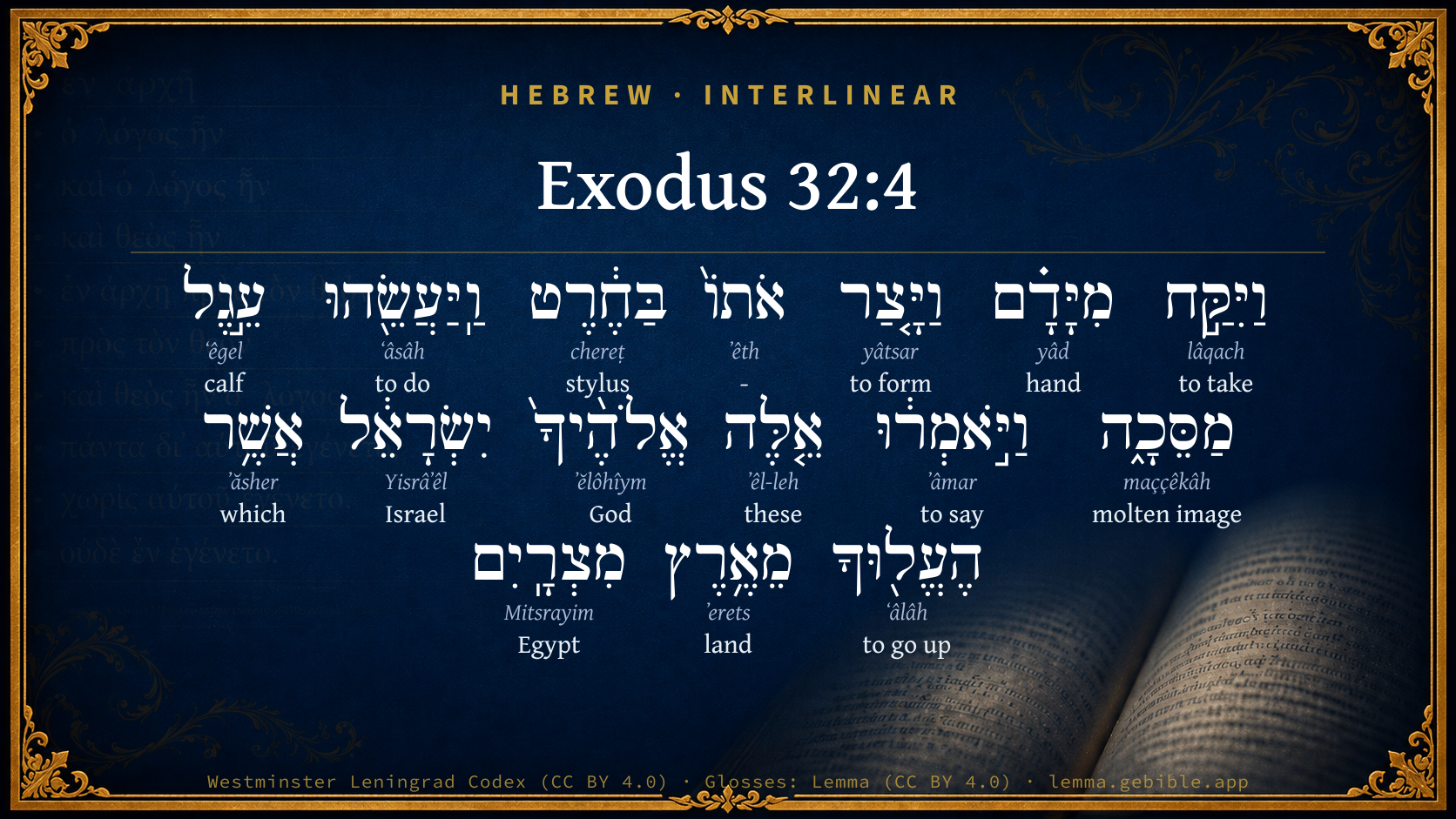
Exodus 32:4

Hebrew (Westminster Leningrad Codex) Exodus 32:4 appears in the Hebrew Old Testament. The text above is from the Westminster Leningrad Codex. Each word links to its Strong’s number, a concise gloss, and parsing drawn from the Open Scriptures Hebrew Bible morphology. Click any word for its full Brown-Driver-Briggs (BDB) entry.
Download image
Cite this verse

Exodus 32:4 (World English Bible). Public Domain. Lemma interlinear Bible study tool, https://lemma.gebible.app/v/exodus/32/4.

Show BibTeX & RIS
BibTeX
RIS
English Translation
He received what they handed him, and fashioned it with an engraving tool, and made it a molten calf; and they said, "These are your gods, Israel, which brought you up out of the land of Egypt."
World English Bible · Public Domain
Highlights
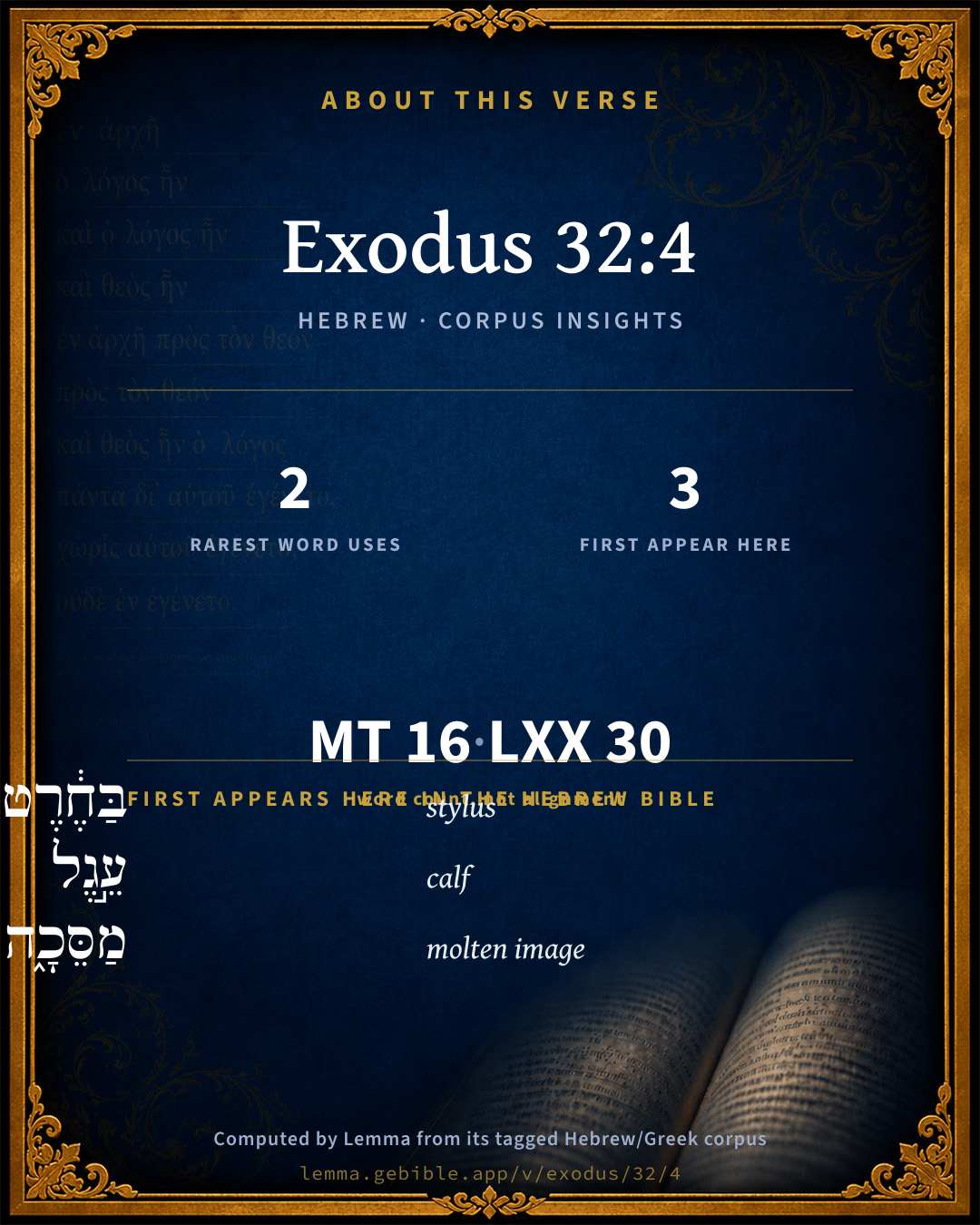
  • 3 first appearances in the Hebrew Bible
Full analysis ↓
Download a study sheet

One document with this verse’s original text, its word-by-word gloss line, the meaning frame, cross-references with their text, attributed commentary, and full source and license credits — printable, and it pastes into notes with its structure intact.

This verse Autodidact and up

Study sheet (.html) Plain text (.txt)

A passage Seminary Student

Up to 50 verses in one chapter. A passage sheet keeps up to 6 commentary sources and 12 cross-references per verse, in the order this page ranks them, and says so on the sheet whenever that leaves anything out. Ask for a single verse and you get the Autodidact verse sheet above.

Everything on this page stays free to read, with no account — the sheet is a download of what is already on screen, not access to it.

Want to remove ads? Support Godless Engineer
Compare translations 3

The same verse in 3 English versions, stacked beneath the original-language interlinear above. Click any original word for its lexicon entry.

Each is an independent rendering of the whole verse — the interlinear is not word-aligned to these translations.

Highlighted words mark where these versions differ — a whole-verse word diff, not a word-by-word alignment.

  • World English Bible Public Domain
    He received what they handed him, and fashioned it with an engraving tool, and made it a molten calf; and they said, "These are your gods, Israel, which brought you up out of the land of Egypt."
  • King James Version Public Domain
    And he received them at their hand, and fashioned it with a graving tool, after he had made it a molten calf: and they said, These be thy gods, O Israel, which brought thee up out of the land of Egypt.
  • unfoldingWord Literal Text CC BY-SA 4.0
    And he took it from their hand, and fashioned it with a tool, and he made a calf of molten metal. And they said, “These are your gods, Israel, who brought you up from the land of Egypt.”

unfoldingWord Literal Text — © unfoldingWord, licensed CC BY-SA 4.0. Word-aligned USFM3 via Door43 (git.door43.org/unfoldingWord/en_ult).

Versions to compare (up to 4)

3 of 4 selected

Show all 18 translations

Every available English version of this verse, each an independent rendering of the whole verse.

  • World English Bible Public Domain
    He received what they handed him, and fashioned it with an engraving tool, and made it a molten calf; and they said, "These are your gods, Israel, which brought you up out of the land of Egypt."
  • Berean Standard Bible Public Domain
    He took the gold from their hands, and with an engraving tool he fashioned it into a molten calf. And they said, “These, O Israel, are your gods, who brought you up out of the land of Egypt!”
  • Majority Standard Bible Public Domain
    He took the gold from their hands, and with an engraving tool he fashioned it into a molten calf. And they said, “These, O Israel, are your gods, who brought you up out of the land of Egypt!”
  • King James Version Public Domain
    And he received them at their hand, and fashioned it with a graving tool, after he had made it a molten calf: and they said, These be thy gods, O Israel, which brought thee up out of the land of Egypt.
  • American Standard Version (1901) Public Domain
    And he received it at their hand, and fashioned it with a graving tool, and made it a molten calf: and they said, These are thy gods, O Israel, which brought thee up out of the land of Egypt.
  • Revised Version (1885) Public Domain
    And he received it at their hand, and fashioned it with a graving tool, and made it a molten calf: and they said, These be thy gods, O Israel, which brought thee up out of the land of Egypt.
  • Geneva Bible (1599) Public Domain
    Who receiued them at their handes, and facioned it with the grauing toole, and made of it a molte calfe: then they said, These be thy gods, O Israel, which brought thee out of ye lad of Egypt
  • Douay-Rheims (1899) Public Domain
    And when he had received them, he fashioned them by founders' work, and made of them a molten calf. And they said: These are thy gods, O Israel, that have brought thee out of the land of Egypt.
  • Young's Literal Translation Public Domain
    and he receiveth from their hand, and doth fashion it with a graving tool, and doth make it a molten calf, and they say, `These thy gods, O Israel, who brought thee up out of the land of Egypt.'
  • Literal Standard Version CC BY-SA 4.0
    and he receives [it] from their hand, and fashions it with an engraving tool, and makes it [into] a molten calf, and they say, “These [are] your gods, O Israel, who brought you up out of the land of Egypt!”
  • Unlocked Literal Bible CC BY-SA 4.0
    He received the gold from them, fashioned it in a mold, and made it into a molded calf. Then the people said, “Israel, this is your god who brought you up out of the land of Egypt.”
  • unfoldingWord Literal Text CC BY-SA 4.0
    And he took it from their hand, and fashioned it with a tool, and he made a calf of molten metal. And they said, “These are your gods, Israel, who brought you up from the land of Egypt.”
  • Darby Bible Public Domain
    And he took [them] out of their hand, and fashioned it with a chisel and made of it a molten calf: and they said, This is thy god, Israel, who has brought thee up out of the land of Egypt!
  • World Messianic Bible Public Domain
    He received what they handed him, fashioned it with an engraving tool, and made it a molded calf. Then they said, “These are your gods, Israel, which brought you up out of the land of Egypt.”
  • Webster's Bible Public Domain
    And he received them at their hand, and fashioned it with a graving tool, after he had made it a molten calf: and they said, These are thy gods, O Israel, which brought thee out of the land of Egypt.
  • Free Bible Version CC BY-SA 4.0
    He took what they gave him and using a molding tool cast an idol in the shape of a bull calf. They shouted out, “Israel, these are the gods that brought you out of the land of Egypt.”
  • Bible in Basic English Public Domain
    And he took the gold from them and, hammering it with an instrument, he made it into the metal image of a young ox: and they said, This is your god, O Israel, who took you out of the land of Egypt.
  • JPS Tanakh (1917) Public Domain
    And he received it at their hand, and fashioned it with a graving tool, and made it a molten calf; and they said: 'This is thy god, O Israel, which brought thee up out of the land of Egypt.'

Literal Standard Version (2020), Covenant Press — licensed CC BY-SA 4.0. Text via the HelloAO Bible API (eBible.org). Unlocked Literal Bible (unfoldingWord) — licensed CC BY-SA 4.0. Text via the HelloAO Bible API (eBible.org). unfoldingWord Literal Text — © unfoldingWord, licensed CC BY-SA 4.0. Word-aligned USFM3 via Door43 (git.door43.org/unfoldingWord/en_ult). Free Bible Version, Dr. Jonathan Gallagher — licensed CC BY-SA 4.0. Text via the HelloAO Bible API (eBible.org).

Word by word

More ways to search: Search by grammar → Find every occurrence → Compare this word →

Practice this passage: Drill this verse → Learn its vocabulary →

בַּחֶ֔רֶט
chereṭ
H2747
“in/at the · stylus”
Preposition, Determined + Noun, Common, Masculine, Singular, Absolute
Part of Speech
Preposition + Noun
Type
Common
Gender
Masculine
Number
Singular
State
Absolute
Full BDB Definition

Origin: from a primitive root meaning to engrave

TWOT: 738a

an engraving tool, stylus, chisel, graving tool - graving tool - stylus
  1. וַיִּקַּ֣ח lâqach H3947 “and · to take” Conjunction + Verb, Qal, Sequential Imperfect, 3rd Person, Masculine, Singular
  2. מִיָּדָ֗ם yâd H3027 “from · hand · their” Preposition + Noun, Common, Both, Singular, Construct + Suffix, Personal, 3rd Person, Masculine, Plural
  3. וַיָּ֤צַר yâtsar H3335 “and · to form” Conjunction + Verb, Qal, Sequential Imperfect, 3rd Person, Masculine, Singular
  4. אֹתוֹ֙ ʼêth H853 “- · him” Particle, Direct Object + Suffix, Personal, 3rd Person, Masculine, Singular
  5. וַֽיַּעֲשֵׂ֖הוּ ʻâsâh H6213 “and · to do · him” Conjunction + Verb, Qal, Sequential Imperfect, 3rd Person, Masculine, Singular + Suffix, Personal, 3rd Person, Masculine, Singular
  6. עֵ֣גֶל ʻêgel H5695 “calf” Noun, Common, Masculine, Singular, Absolute
  7. מַסֵּכָ֑ה maççêkâh H4541 “molten image” Noun, Common, Feminine, Singular, Absolute
  8. וַיֹּ֣אמְר֔וּ ʼâmar H559 “and · to say” Conjunction + Verb, Qal, Sequential Imperfect, 3rd Person, Masculine, Plural
  9. אֵ֤לֶּה ʼêl-leh H428 “these” Pronoun, Demonstrative, Common, Plural
  10. אֱלֹהֶ֨יךָ֙ ʼĕlôhîym H430 “God(s) · your” Noun, Common, Masculine, Plural, Construct + Suffix, Personal, 2nd Person, Masculine, Singular
  11. יִשְׂרָאֵ֔ל Yisrâʼêl H3478 “Israel” Noun, Proper
  12. אֲשֶׁ֥ר ʼăsher H834 “which” Particle, Relative
  13. הֶעֱל֖וּךָ ʻâlâh H5927 “to go up · you” Verb, Hiphil, Perfect, 3rd Person, Common, Plural + Suffix, Personal, 2nd Person, Masculine, Singular
  14. מֵאֶ֥רֶץ ʼerets H776 “from · land of” Preposition + Noun, Common, Both, Singular, Construct
  15. מִצְרָֽיִם Mitsrayim H4714 “Egypt” Noun, Proper

About this verse

These counts appear in no published source. They are computed here, from the morphology-tagged text and Lemma’s own curated glosses. What Lemma adds →

16
words
16
distinct lemmas
Pentateuch
section

Notable vocabulary

The rarest word here is בַּחֶ֔רֶט stylus H2747 — appearing just 2 times in the whole Hebrew Bible.

First appearance in Scripture

These words make their first canonical appearance in the Hebrew Bible here:

  • בַּחֶ֔רֶט stylus H2747
  • עֵ֣גֶל calf H5695
  • מַסֵּכָ֑ה molten image H4541

Shared distinctive vocabulary

בַּחֶ֔רֶט stylus H2747 occurs in 2 verses of the Hebrew Bible. Also found in:

Grammatical profile

  • 5 verbs
  • 8 nouns
  • 1 pronoun
  • 2 particles

Verb forms

  • וַיִּקַּ֣ח Qal · Sequential Imperfect
  • וַיָּ֤צַר Qal · Sequential Imperfect
  • וַֽיַּעֲשֵׂ֖הוּ Qal · Sequential Imperfect
  • וַיֹּ֣אמְר֔וּ Qal · Sequential Imperfect
  • הֶעֱל֖וּךָ Hiphil · Perfect

Hebrew & Septuagint length

In English translation the verse runs 37 words from the Hebrew and 40 from the Septuagint (LXX English) — closely comparable.

A rough comparison of the two English renderings, which tokenize alike — not a word-level alignment.

Word counts can differ between the Hebrew and the Greek without any difference in meaning — e.g. the Hebrew direct-object marker אֵת has no separate Greek word, and Greek often adds the article ὁ.

In the original languages it is 16 Hebrew tokens and 30 Greek tokens — but the two are counted differently (Hebrew bundles its prefixes and suffixes into one token; the Greek is in lemma form), so that isn’t a like-for-like length.

Cross-references

24

Topical passages linked to Exodus 32:4 in the Treasury of Scripture Knowledge — connected by theme and wording, ordered by reader-vote popularity; previews shown in the World English Bible.

  • Nehemiah 9:18 Yes, when they had made them a molten calf, and said, This is your God who brought you up out of Egypt, and had committed awful blasphemies;
  • Deuteronomy 9:16 I looked, and, behold, you had sinned against Yahweh your God; you had made you a molten calf: you had turned aside quickly out of the way which Yahweh had commanded you.
  • 1 Kings 12:28 Whereupon the king took counsel, and made two calves of gold; and he said to them, It is too much for you to go up to Jerusalem: see your gods, Israel, which brought you up out of the land of Egypt.
  • Acts 7:41 They made a calf in those days, and brought a sacrifice to the idol, and rejoiced in the works of their hands.
  • Exodus 32:8 They have turned aside quickly out of the way which I commanded them. They have made themselves a molten calf, and have worshiped it, and have sacrificed to it, and said, 'These are your gods, Israel, which brought you up out of the land of Egypt.'"
  • Isaiah 44:9–10 Those who fashion an engraved image are all of them vanity; and the things that they delight in shall not profit; and their own witnesses don't see, nor know: that they may be disappointed.
  • 2 Kings 10:29 However from the sins of Jeroboam the son of Nebat, with which he made Israel to sin, Jehu didn't depart from after them, [to wit], the golden calves that were in Bethel, and that were in Dan.
  • Hosea 8:4–5 They have set up kings, but not by me. They have made princes, and I didn't approve. Of their silver and their gold they have made themselves idols, That they may be cut off.
  • Hosea 13:2 Now they sin more and more, And have made themselves molten images of their silver, Even idols according to their own understanding, All of them the work of the craftsmen. They say of them, "They offer human sacrifice and kiss the calves."
  • Romans 1:21–23 Because, knowing God, they didn't glorify him as God, neither gave thanks, but became vain in their reasoning, and their senseless heart was darkened.
  • Exodus 20:2 "I am Yahweh your God, who brought you out of the land of Egypt, out of the house of bondage.
  • Exodus 20:23 You shall most certainly not make alongside of me gods of silver, or gods of gold for yourselves.
  • 2 Chronicles 11:15 and he appointed him priests for the high places, and for the male goats, and for the calves which he had made.
  • 2 Chronicles 13:8 Now you think to withstand the kingdom of Yahweh in the hand of the sons of David; and you are a great multitude, and there are with you the golden calves which Jeroboam made you for gods.
  • Psalms 106:19–21 They made a calf in Horeb, And worshiped a molten image.
  • Isaiah 40:18–19 To whom then will you liken God? or what likeness will you compare to him?
  • Isaiah 46:6 Some pour out gold from the bag, and weigh silver in the balance. They hire a goldsmith, and he makes it a god. They fall down--yes, they worship.
  • Hosea 10:5 The inhabitants of Samaria will be in terror for the calves of Beth Aven; For its people will mourn over it, Along with its priests who rejoiced over it, For its glory, because it has departed from it.
  • Acts 17:29 Being then the offspring of God, we ought not to think that the Divine Nature is like gold, or silver, or stone, engraved by art and design of man.
  • Exodus 32:1 When the people saw that Moses delayed to come down from the mountain, the people gathered themselves together to Aaron, and said to him, "Come, make us gods, which shall go before us; for as for this Moses, the man who brought us up out of the land of Egypt, we don't know what has become of him."
  • Judges 17:3–4 He restored the eleven hundred [pieces] of silver to his mother; and his mother said, I most assuredly dedicate the silver to Yahweh from my hand for my son, to make an engraved image and a molten image: now therefore I will restore it to you.
  • Exodus 28:9 You shall take two onyx stones, and engrave on them the names of the children of Israel:
  • Exodus 28:11 With the work of an engraver in stone, like the engravings of a signet, shall you engrave the two stones, according to the names of the children of Israel: you shall make them to be enclosed in settings of gold.
  • 1 Kings 12:32 Jeroboam ordained a feast in the eighth month, on the fifteenth day of the month, like the feast that is in Judah, and he went up to the altar; so did he in Bethel, sacrificing to the calves that he had made: and he placed in Bethel the priests of the high places that he had made.

Cross-references courtesy of OpenBible.info (CC BY 4.0).

Hebrew and Greek witnesses Masoretic Hebrew ↔ Greek Septuagint

The same verse in the two great witnesses to the Old Testament, shown verse-for-verse.

These are two independent witnesses, not word-aligned to each other, and the Septuagint is shown in lemma (dictionary) form.

Hebrew Exodus 32:4 Masoretic · Westminster Leningrad Codex

וַיִּקַּ֣ח מִיָּדָ֗ם וַיָּ֤צַר אֹתוֹ֙ בַּחֶ֔רֶט וַֽיַּעֲשֵׂ֖הוּ עֵ֣גֶל מַסֵּכָ֑ה וַיֹּ֣אמְר֔וּ אֵ֤לֶּה אֱלֹהֶ֨יךָ֙ יִשְׂרָאֵ֔ל אֲשֶׁ֥ר הֶעֱל֖וּךָ מֵאֶ֥רֶץ מִצְרָֽיִם

He received what they handed him, and fashioned it with an engraving tool, and made it a molten calf; and they said, "These are your gods, Israel, which brought you up out of the land of Egypt."

World English Bible · Public Domain

Greek LXX Exodus 32:4 Septuagint · lemma form

καί δέχομαι ἐκ ὁ χείρ αὐτός καί πλάσσω αὐτός ἐν ὁ γραφίς καί ποιέω αὐτός μόσχος χωνευτός καί εἶπον οὗτος ὁ θεός σύ ἰσραήλ ὅστις ἀναβιβάζω σύ ἐκ γῆ αἴγυπτος

And he received them at their hands, and formed them with a graving tool; and he made them a molten calf, and said, These are your gods, O Israel, which have brought you up out of the land of Egypt.

LXX2012 (modern English Septuagint) · Public Domain

Hebrew: Westminster Leningrad Codex (CC BY 4.0). Greek: Septuagint (public domain); English from LXX2012 (modern English Septuagint) (Public Domain). How the Septuagint differs from the Hebrew →

Targum (Aramaic paraphrase)

2

The Targum is the ancient Jewish Aramaic paraphrase of the Hebrew Scriptures — an interpretive translation, not the Hebrew text itself. Onkelos (literal) and Pseudo-Jonathan (expansive) render the Torah, and Jonathan the Prophets. Coverage is partial: where no permissively-licensed English translation exists for a verse, only the Aramaic is shown. This is verse-level text, not a word-by-word alignment to the Hebrew.

  1. Targum Onkelos Torah (Genesis–Deuteronomy)
    וּנְסִיב מִידֵיהוֹן וְצַר יָתֵהּ בְּזִיפָא וְעָבְדֵהּ עֵגֶל מַתְּכָא וַאֲמָרוּ אִלֵין דַחַלְתָּךְ יִשְׂרָאֵל דִי אַסְקוּךְ מֵאַרְעָא דְמִצְרָיִם:

    (no public-domain English translation for this verse)

    Targum Onkelos — Aramaic: “Onkelos Genesis” (public domain); “Onkelos Exodus” (public domain); “Onkelos Leviticus” (public domain); “Onkelos Numbers” (public domain); “Onkelos Deuteronomy” (public domain). English: “Sefaria Community Translation” (CC0 1.0 (public-domain dedication)); “J.W. Etheridge. The Targums of Onkelos and Jonathan Ben Uzziel on the Pentateuch. London: Longmans, Green, 1862” (public domain). Text via Sefaria.

  2. Targum Pseudo-Jonathan Torah (Genesis–Deuteronomy)
    וּנְסֵיב מִידֵיהוֹן וְצַר יָתֵיהּ בְּשׁוֹשִׁיפָא וּרְמָא יָתֵיהּ בְּטוּפְרָא וְעַבְדֵיהּ עֵיגַל מַתְּכָא וַאֲמָרוּ אִלֵּין דַּחַלְתָּךְ יִשְרָאֵל דְּהַנְפָקוּךְ מֵאַרְעָא דְמִצְרָיִם

    And he took them from their hands, and bound them in a wrapper, and wrought it with a tool, having made a molten calf; and he said, These, Israel, are thy gods, which brought thee forth from the land of Mizraim.

    Targum Pseudo-Jonathan — Aramaic: “Targum Jonathan on Genesis” (public domain); “Targum Jonathan on Exodus” (public domain); “Targum Jonathan on Leviticus” (public domain); “Targum Jonathan on Numbers” (public domain); “Targum Jonathan on Deuteronomy” (public domain). English: “The Targum of Jonathan ben Uzziel, trans. J. W. Etheridge, London, 1862” (public domain). Text via Sefaria.

Commentary

Notes on Exodus 32:4 from classic Christian and Jewish commentators (each source and its license shown beneath its notes). The classic Christian expositions comment on the surrounding passage and are grouped to its opening verse, so a note may address several verses; the Jewish commentaries on the Tanakh (Rashi and others) are per-verse, so they appear only where the commentator wrote on this verse.

Lemma curates 59 commentaries, every one of them public domain or Creative Commons licensed, each selected and text-cleaned for this edition rather than reprinted as found. About our sources →

Trapp's Complete Commentary

John Trapp

Exo 32:4 And he received [them] at their hand, and fashioned it with a graving tool, after he had made it a molten calf: and they said, These [be] thy gods, O Israel, which brought thee up out of the land of Egypt.

Ver. 4. A molten calf.] In imitation of the Egyptian idol Apis, a pied-bull. A man may pass through Ethiopia unchanged; but he cannot dwell there, and not be discoloured. How oft, alas, have we abused God’s mercy; taking his jewels, and making a golden calf of them!

John Trapp, A Commentary or Exposition upon All the Books of the Old and New Testament (1647–1656) — public domain. Text from a community e-Sword module.

Joseph Benson's Commentary

Exo 32:4. He made it a molten calf — He melted it down, and, having a mould prepared, poured the melted gold into it, and then produced it in the shape of an ox or calf giving it some finishing strokes with a graving tool. “They made a calf,” says David, “in Horeb, and worshipped the molten image: they changed their glory into the similitude of an ox that eateth grass.” It is probable that the origin of this idolatry was from Egypt. The Scriptures inform us that the Israelites in Egypt imitated the Egyptian superstitions, Jos 24:14; Eze 20:7-8. Now that the Egyptians worshipped animals as early as these days, appears from Exo 8:26. An ox or calf in particular was their great idol. So that we may with certainty conclude, notwithstanding what some late commentators have alleged, that Aaron, in compliance with the prejudices of the people, made this calf after the model of what the Israelites had seen in Egypt, consecrating it to Jehovah as the Egyptians had consecrated similar symbols to their principal deity Osiris. Aaron’s compliance with the popular clamour was, undoubtedly, highly criminal: he ought to have opposed them with all his might, nay, he ought rather to have suffered death than to have yielded to their will in any degree. Accordingly, we find it recorded, (Deu 9:20,) that “the Lord was very angry with him to have destroyed him,” but that Moses “prayed for him.” They said, These be thy gods — Or as Nehemiah expresses, (Neh 9:18,) This is thy God; that is, This is the image or symbol of thy God; who brought thee out of Egypt — For they intended to worship the true God, by this image, as afterward Jeroboam did by the same image, it being incredible that the generality of the Israelites should be so void of all sense and reason, as to think that this new-made calf brought them out of Egypt, even before its own creation, and that this was the same Jehovah that had so lately spoken to them from heaven with an audible voice, saying, “I am the Lord thy God who brought thee out of the land of Egypt.”

Joseph Benson's Commentary on the Old and New Testaments (1811–1818) — public domain. Text from a community e-Sword module.

Tyndale Open Study Notes

Tyndale Open Resources

32:4 the shape of a calf: The idol might actually have been an image of a bull, like the images of the Egyptian god Amon-Re that the people had known in Egypt. The bull represented power, domination, and fertility. The writer would then be using the term calf as a way of expressing contempt for the idol. Alternatively, Aaron might have made a calf, feeling that this sin was not as serious as if the idol were a full-sized bull. • these are the gods who brought you out: The people attributed to the idol what they had just said that Moses had done (32:1). Idolatry expresses the belief that the divine realm and the visible world are continuous with one another. This worldview sees it as possible to lay hold of divine power through ritual manipulation of the god by means of the idol. God had been insisting that the very opposite is true: God is not contained in or restrained by his creation, and his blessings cannot be procured by manipulating creation, either ritually or otherwise. The blessings of God are for those who surrender their own efforts to make themselves secure and come to him using the ways and means that he has decreed.

Tyndale Open Study Notes — © Tyndale Open Resources, licensed CC BY-SA 4.0. Text via the HelloAO Bible API.

Geneva Bible (1599)

Geneva Bible translators

They smelled of their leaven of Egypt, where they saw calves, oxen and serpents worshipped.

Geneva Bible (1599) marginal notes — public domain. Text via Bolls.life.

Jamieson, Fausset & Brown

Robert Jamieson, A. R. Fausset & David Brown

fashioned it with a graving tool, after he had made it a molten calf--The words are transposed, and the rendering should be, "he framed with a graving tool the image to be made, and having poured the liquid gold into the mould, he made it a molten calf." It is not said whether it was of life size, whether it was of solid gold or merely a wooden frame covered with plates of gold. This idol seems to have been the god Apis, the chief deity of the Egyptians, worshipped at Memphis under the form of a live ox, three years old. It was distinguished by a triangular white spot on its forehead and other peculiar marks. Images of it in the form of a whole ox, or of a calf's head on the end of a pole, were very common; and it makes a great figure on the monuments where it is represented in the van of all processions, as borne aloft on men's shoulders.

they said, These be thy gods, O Israel, which brought thee up out of the land of Egypt--It is inconceivable that they, who but a few weeks before had witnessed such amazing demonstrations of the true God, could have suddenly sunk to such a pitch of infatuation and brutish stupidity, as to imagine that human art or hands could make a god that should go before them. But it must be borne in mind, that though by election and in name they were the people of God, they were as yet, in feelings and associations, in habits and tastes, little, if at all different, from Egyptians. They meant the calf to be an image, a visible sign or symbol of Jehovah, so that their sin consisted not in a breach of the FIRST [Exo 20:3], but of the SECOND commandment [Exo 20:4-6].

Jamieson, Fausset & Brown — Commentary Critical and Explanatory on the Whole Bible (1871) — public domain (CC PDM 1.0). Text via the HelloAO Bible API.

Adam Clarke's Commentary

Verse 4. Fashioned it with a graving tool] There has been much controversy about the meaning of the word חרט cheret in the text: some make it a mould, others a garment, cloth, or apron; some a purse or bag, and others a graver. It is likely that some mould was made on this occasion, that the gold when fused was cast into it, and that afterwards it was brought into form and symmetry by the action of the chisel and graver.

These be thy gods, O Israel] The whole of this is a most strange and unaccountable transaction. Was it possible that the people could have so soon lost sight of the wonderful manifestations of God upon the mount? Was it possible that Aaron could have imagined that he could make any god that could help them? And yet it does not appear that he ever remonstrated with the people! Possibly he only intended to make them some symbolical representation of the Divine power and energy, that might be as evident to them as the pillar of cloud and fire had been, and to which God might attach an always present energy and influence; or in requiring them to sacrifice their ornaments, he might have supposed they would have desisted from urging their request: but all this is mere conjecture, with very little probability to support it. It must however be granted that Aaron does not appear to have even designed a worship that should supersede the worship of the Most High; hence we find him making proclamation, To-morrow is a feast to the LORD, (יהוה); and we find farther that some of the proper rites of the true worship were observed on this occasion, for they brought burnt-offerings and peace-offerings, Ex 32:6-7: hence it is evident he intended that the true God should be the object of their worship, though he permitted and even encouraged them to offer this worship through an idolatrous medium, the molten calf. It has been supposed that this was an exact resemblance of the famous Egyptian god Apis who was worshipped under the form of an ox, which worship the Israelites no doubt saw often practised in Egypt. Some however think that this worship of Apis was not then established; but we have already had sufficient proof that different animals were sacred among the Egyptians, nor have we any account of any worship in Egypt earlier than that offered to Apis, under the figure of an OX.

Adam Clarke's Commentary on the Bible (1810–1826) — public domain. Text from a community e-Sword/MySword module.

Ellicott's Commentary for English Readers

(4) And he received them at their hand, and fashioned it with a graving tool.—Rather, and he received it (i.e., the gold) at their hand, and bound it in a bag. So Gesenius, Rosenmüller, Fürst, Knobel, Kurtz, Maurer, Seröder, Cook, &c. “Fashioned it with a graving tool” is a possible rendering of the Hebrew words, but will not suit here, since the next clause tells us that the image was a molten one, and if it had been intended to say that the image was first molten and then finished with a graving too!, the order of the two clauses would have been inverted. A similar phrase to that here used has the sense of “bound in a bag” in 2Ki_5:23.

After he had made it a molten calf.—This is a quite impossible rendering. The original gives “and,” not “after.” The action of this clause must either be simultaneous with that of the last or subsequent. Translate, and made it into a molten calf.

A molten calf.—It has been usual to regard the selection of the “calf” form for the image as due to Egyptian influences. But the Egyptian calf-worship, or, rather, bull-worship, was not a worship of images, but of living animals. A sacred bull, called Apis, was worshipped at Memphis, and another, called Mnevis, at Heliopolis, both being regarded as actual incarnate deities. Had Egyptian ideas been in the ascendant, it would have been natural to select a living bull, which might have “gone before” the people literally. The “molten calf,” which had no very exact counterpart in Egypt, perhaps points back to an older idolatry, such as is glanced at in Jos_24:14, where the Israelites are warned to “put away the gods which their fathers served on the other side of the flood,” i.e., of the Euphrates. Certainly the bull form was more distinctive of the Babylonian and Assyrian than of the Egyptian worship, and it may he suspected that the emigrants from Chaldæa had clung through all their wanderings to the mystic symbolism which had been elaborated in that primæval land, and which they would contrast favourably with the coarse animal worship of Egypt. In Chaldæa, the bull, generally winged and human-headed, represented the combination of wisdom, strength, and omnipresence, which characterises divinity; and this combination might well have seemed to carnal minds no unapt symbol of Jehovah.

These be thy gods.—Rather, This is thy god.

A Bible Commentary for English Readers, edited by Charles John Ellicott (1878–1897) — public domain. Text from a community e-Sword module.

The Cambridge Bible for Schools and Colleges

gen. ed. J. J. S. Perowne

4. fashioned it, &c.] the earrings having naturally been previously melted down, and cast approximately into the shape of a young bull. The image may either have been of solid gold, or, in spite of the term ‘molten’ (see Isa_30:22; and cf. Deu_7:25, Isa_40:19), have consisted of a wooden core, overlaid with gold: v. 24b—though the terms used can hardly be pressed—would suggest the former view, v. 20 would favour the latter.

a graving tool] a pointed metal instrument: the word rendered ‘pen’ (i.e. a sharp metal stylus) in Isa_8:1.

calf] The Heb. ‘çgel means a young bull, just as the fem. ‘eglâh (EVV. usually ‘heifer’) means a young cow; but it does not mean necessarily an animal as young as a ‘calf’: the ‘eglâh for instance might be three years old (Gen_15:9), and give milk (Isa_7:21), or plough (Jdg_14:18).

These be thy gods] Cf. almost the same words in 1Ki_12:28 : in the allusion, Neh_9:18, the sing. ‘This’ is used. ‘These’ must refer to an actual plural, and is of course quite suitable in speaking of Jeroboam’s two calves; here it seems as if the narrator had used the plural for the purpose of introducing a covert polemic against the calf-worship of the N. kingdom. So v. 8.

which brought thee, &c.] They recognize in the calf, not only the god who should in the future (v. 1) go before them, but also the god who had already led them forth out of Egypt.

The Cambridge Bible for Schools and Colleges (gen. ed. J. J. S. Perowne; Cambridge University Press, 1878–1918) — public domain. Text from a community e-Sword module.

John Gill's Exposition

And when Aaron saw it,.... In what form it was, and what a figure it made, and how acceptable it was to the Israelites. The Targums of Jonathan and Jerusalem paraphrase it,"and Aaron saw Hur slain before him;''for reproving them for their idolatry, as the Midrash (e), quoted by Jarchi, says: and Aaron fearing they would take away his life if he opposed them:

he built an altar before it; that sacrifice might be offered on it to it:

and Aaron made proclamation, and said, tomorrow is a feast to the Lord; that is, he gave orders to have it published throughout the camp, there would be solemn sacrifices offered up to the Lord, as represented by this calf, and a feast thereon, which was a public invitation of them to the solemnity: though some think this was a protracting time, and putting the people off till the morrow, who would have been for offering sacrifice immediately, hoping that Moses would come down from the mount before that time, and prevent their idolatry.

(e) So Pirke Eliezer, c. 45.

John Gill's Exposition of the Whole Bible (1746–1763) — public domain (CC PDM 1.0). Text via the HelloAO Bible API.

Haydock's Catholic Bible Commentary

Received them, "in a purse, (as Gideon did afterwards, Judges viii. 25,) he made a molten calf." (Jonathan) --- Perhaps he engraved on it the peculiar marks of the Egyptian idol, Apis; a square white spot on the forehead, and a crescent upon the side. For it is generally believed, that this calf was designed to imitate that object of worship, to which the Hebrews had been too much accustomed. (Acts vii. 39, 41.; St. Jerome in Osee iv.) The Egyptians adored not only the living ox, but also its image, which they kept in their temple. (Porphyrius, Abst. ii. Mela. i. 8.) Some of the fathers think, that the head of a calf only appeared. (St. Ambrose; Lactantius, &c.) The rest of the figure was perhaps human, as Osiris was represented with the head of an ox, as well as Astarte and Serapis. Monceau pretends that Aaron represented the true God, under the form of a cherub, in which he falsely asserts he had appeared on Mount Sinai, and that his fault consisted only in giving occasion of superstition to the people. But his opinion (though adopted by many Protestants, who excuse all from the guilt of idolatry, but papists; Haydock) has been condemned at Rome, and refuted by Visorius, &c. --- Thy gods, &c. Thus spoke the infatuated ringleaders. (Calmet) --- And they changed their glory, the true God, into the likeness of a calf that eateth grass, Psalm cv. 19. --- They forgot God, who saved them, (Psalm cv. 21,) and forsook Him, (Deuteronomy xxxii. 18,) to adore the calf. (Worthington)

George Leo Haydock (1774–1849), Haydock's Catholic Family Bible and Commentary, 1859 edition — public domain. Excludes Psalms (Douay-Rheims chapter numbering differs from Protestant) and Deuterocanonical books (Catholic canon only).

Matthew Poole's English Annotations

A molten calf: the meaning of this translation is, that Aaron, to wit, by artificers, did first melt the god into one mass, and then by the graving-tool form it into the shape of a calf, and polish it; or as others render the words, he

formed it in a type or mould, made in the shape of a calf, into which he cast the molten gold, and so made it a molten calf. But the words may be translated thus, He put it, or them, into a purse; for so the Hebrew verb and noun are both used, 2Ki 5:23; and in like manner Gideon disposed the earrings given him for the like use, Jdg 8:24; and afterwards he made of them a molten calf. Now the people desired, and Aaron in compliance with them made this in the form of a

calf, or an ox, (for the word signifies both,) in imitation of the Egyptians, as Philo the Jew expressly affirms, and the learned generally agree; and it may thus appear:

1. The great idols of the Egyptians, Apis, Seraphis, and Isis, were oxen and cows, as is confessed.

2. The Egyptians, besides the creatures which they adored as gods, did also make, and keep, and worship their images, as even the heathen writers, Mela and Strabo, affirm.

3. The Israelites, whilst they were in Egypt, were many of them infected with the Egyptian idolatry, as it appears from Jos 24:14; Eze 20:7,8; 23:3; Act 7:39. And it is not unlikely divers of them hankered no less after the idols, than after the garlic and onions of Egypt. And being now, as they thought, forsaken by Moses, they might think of returning to Egypt, as afterwards they did, and therefore chose a god of the Egyptian mode, that they might more willingly receive them again.

These be thy gods, i.e. this is thy god, the plural number being put for the singular, as it is usual in this case. The meaning is, This is the sign, or symbol, or image of thy god; for such expressions are very frequent: thus this image of a calf is called a calf frequently, and the images of the temple of Diana are called shrines or little temples, Ac 19. So they intended to worship the true God by this image, as afterwards Jeroboam did by the same image, as we shall plainly see when we come to that place of Scripture. And it is absolutely incredible that the generality of the Israelites should be so void of all sense and reason, as to think that this new-made calf did bring them out Egypt before its own creation, and that this was the same Jehovah who had even now spoken to them from heaven with an audible voice, saying, I am the Lord thy God who brought thee out of the land of Egypt.

Matthew Poole's English Annotations on the Holy Bible (1683–1685) — public domain. Text from a community e-Sword/MySword module.

Whedon's Commentary on the Bible

Daniel D. Whedon

4. Fashioned it with a graving tool — This is the most natural import of the unpointed Hebrew text, but seems hardly in harmony with the next statement, which is not correctly translated after he had made it, but, simply, and he made it a molten calf. It is manifestly incongruous to speak of forming a molten calf with a graving tool. Hence many critics propose to read חרישׂ, a money bag, or purse, instead of חרשׂ, here translated graving tool, which occurs elsewhere only at Isa_8:1, and there means a pen, or stylus. The statement would then be: And he received (the earrings) from their hand, and collected (ויצר, from צור, to bind or collect together in one mass) it (the gold) in a bag, and made it a molten calf. It is no valid objection to this view to ask, with Keil, “Why should Aaron first bind up the golden earrings in a bag?” For it may with equal force be answered, Why should he not? What better or more appropriate way of receiving and retaining the large amount of gold until it was converted into the golden idol? This, on the whole, is more satisfactory than the view which supplies in thought a wooden mould or model after the word fashioned, for such an idea would have required some clearer form of statement; more satisfactory, also, than to assume that the molten calf was cast over a carved image of wood, or that it was finished up by means of a graver’s tool after it had been cast. On this last supposition, the graver’s work should have been mentioned after, not before, the fusion of the golden ornaments.

According to Jos_24:14; Eze_20:7-8; Eze_23:3; Eze_23:8, Israel had been contaminated with Egyptian idolatry, and the most natural explanation of the construction of this image in the form of a calf is, that it was modelled after the form of Apis, the sacred bull which was worshipped at Memphis. See note and cut at Exo_8:26, page 406. It is hardly credible that during their long sojourn in Egypt the leading men of Israel had not become familiar with the worship of the sacred bull. But it is to be noticed that they did not worship the golden idol as an Egyptian god, but exclaimed before it, These be thy gods, O Israel, which brought thee up out of the land of Egypt. The plural here, as in Exo_32:1, does not oblige us to translate and explain the words in a polytheistic sense. The next verse shows that they worshipped Jehovah under the symbol of a calf, and so violated the second rather than the first commandment of the decalogue. See notes on Exo_20:4-5. Exo_32:8 of this chapter shows that they did not thus ignorantly worship, but knew that they were violating one of the commandments.

Daniel D. Whedon (gen. ed.), Commentary on the Old and New Testaments (1874–1909) — public domain. Text from a community e-Sword module.

The Pulpit Commentary

And fashioned it with a graving tool. Rather, "and bound it (the gold) in a bag." Compare 2Ki_5:23, where the same two Hebrew words occur in the same sense. It is impossible to extract from the original the sense given in the Authorised Version, since the simple copula van cannot mean "after." When two verbs in the same tense are conjoined by van "and," the two actions must be simultaneous, or the latter follow the former. But the calf cannot have been graven first, and then molten. It is objected to the rendering, "he bound it in a bag," that that action is so trivial that it would be superfluous to mention it (Keil) But it is quite consonant with the simplicity of Scripture to mention very trivial circumstances. The act of putting up in bags is mentioned both here and also in 2Ki_5:23, and 2Ki_12:9. They said. The fashioners of the image said this. These be thy gods. Rather, "This is thy God." Why Aaron selected the form of the calf as that which he would present to the Israelites to receive their worship, has been generally explained by supposing that his thoughts reverted to Egypt, and found in the Apis of Memphis or the Mnevis of Hellopolis the pattern which he thought it best to follow. But there are several objections to this view.

1. The Egyptian gods had just been discredited by their powerlessnessbeing manifested it was an odd time at which to fly to them.

2. Apis and Mnevis were not molten calves, but live bulls. If the design had been to revert to Egypt, would not a living animal have been selected?

3. The calf when made was not viewed as an image of any Egyptian god,but as a representation of Jehovah (ver. 5).

4. The Israelites are never taxed with having worshipped the idols of Egyptanywhere else than in Egypt. (Jos_24:14; Eze_20:8 Eze_23:3) To us it seems probable that Aaron reverted to an earlier period than the time of the sojourn in Egypt, that he went back to those "gods on the other side of the flood," which Joshua warned the Israelites some sixty years later, to "put away". The subject is one too large for discussion here; but may not the winged and human-headed bull, which was the emblem of divine power from a very early date in Babylon, have retained a place in the recollections of the people in all their wanderings, and have formed a portion of their religions symbolism? May it not have been this conception which lay at the root of the cherubic forms, and the revival of which now seemed to Aaron the smallest departure from pure monotheism with which the people would be contented?

The Pulpit Commentary (1880–1919), ed. H.D.M. Spence-Jones & Joseph S. Exell — public domain. Text from a community e-Sword module.

Rashi

Rabbi Shlomo Yitzchaki (Rashi)

ויצר אתו בחרט — One can translate this in two ways. The one is: to take ויצר in the sense of “tying up” (Hiphil of צרר) and בחרט in the sense of “a garment”, similar to (Isaiah 3:22) “and the mantles and the scarfs (והחריטים)”; ‎(2 Kings 5:23) “and bound (ויצר) two talents of silver in two cloths (חריטים)”. The other way is: to take ויצר in the sense of “forming figures” (Hiphil of צור) and חרט as denoting goldsmiths’ tool with which they engrave and cut figures into gold, like a writer’s stylus that incises letters on boards and tablets, as we find it in, (Isaiah 8:1) ‘‘[Take a great roll] and write on it with a man’s pen (חרט)”. This (the second explanation) is what Onkelos means when he renders the passage by וצר יתיה בזיפא and he formed it with a “זיפא”, a term which is connected with the word זיוף “forgery”. It is a tool with which letters and modelled figures are engraved in gold — a kind of work which they term niel in old French (cf. Rashi and our Note on Exodus 25:33), and by means of which seals are forged (מזיפין)‎.

עגל מסכה A MOLTEN CALF — As soon as he (Aaron) had thrown it (the gold) into the fire in a melting pot the magicians amongst the mixed multitude who had come up with them from Egypt came and made it (the golden calf) by their magic art. There are some who say that Micah the idolator mentioned in Judges ch. 17, was there, who had been drawn forth from the foundations of a building in Egypt where he was nearly crushed. He had in his possession a “supernatural name” (שם) and a plate upon which Moses had written: “Come up, ox, come up, ox!” in order to raise the coffin of Joseph who is compared to an ox (cf. Deuteronomy 33:17) out of the Nile, and he cast it (the plate) into the melting pot and the calf (the young ox) came out (ויצא העגל הזה) (Midrash Tanchuma, Ki Tisa 19).

מסכה MOLTEN is a term connected with מתכת, molten metal (ס and ת being interchanged in these words). Another explanation is: there were used in it (for making the golden calf) 125 talents of gold, corresponding to the numerical value of מסכה, which is 125 (Midrash Tanchuma, Ki Tisa 19).

אלה אלהיך THESE ARE THY GODS, [O ISRAEL] — It does not state that they said “these are our gods, [O Israel]”; hence we may learn that it was the mixed multitude which came up from Egypt that gathered themselves together against Aaron, and it was they who made it and afterwards led Israel astray after it (Midrash Tanchuma, Ki Tisa 19).

Rashi on the Tanakh — English translations: “The Judaica Press complete Tanach with Rashi, translated by A. J. Rosenberg” (CC BY 4.0); “Pentateuch with Rashi's commentary by M. Rosenbaum and A.M. Silbermann, 1929-1934” (public domain); “The Metsudah Tanach series, Lakewood, N.J” (CC BY 4.0); and “The Book of Joshua, Metsudah Publications, 1997” (CC BY 4.0). Text via Sefaria.

Ramban (Nachmanides)

Rabbi Moshe ben Nachman (Ramban / Nachmanides)

AND THEY SAID, THESE ARE THY GODS, O ISRAEL, WHICH BROUGHT THEE UP OUT OF THE LAND OF EGYPT. This verse also will teach you [that they had no intention of worshipping it as an idol], for there is no fool in the world who would think that this gold which was in their ears is that which brought them up out of the land of Egypt. Rather, they said that the power of that figure brought them up out of there. Thus you will find that in no place does it say of the calf, “which brought us ‘out’ of Egypt,” for they acknowledged Him Who said, I am the Eternal thy G-d, who brought thee ‘out’ of the land of Egypt, and that it was by His Great Name that He delivered them from there. Instead, they said in many places who brought thee ‘up,’ for they took it to be in place of the great hand, 14:31. — that dried up the sea, the waters of the great deep; that made the depths of the sea a way for the redeemed to pass over. It is with this intention that Scripture says, Thus they exchanged their Glory for the likeness of an ox that eateth grass, and there it is said, They forgot G-d Who had delivered them, Who had done great things in Egypt; wondrous works in the land of Ham, terrible things by the Red Sea., Verses 21-22. They forgot His word which He commanded them. Thus they transgressed the prohibition, Thou shalt have no other gods before Me, as I have hinted there, and you will understand this.

Ramban (Nachmanides) on the Tanakh — English translation: “Commentary on the Torah by Ramban (Nachmanides). Translated and annotated by Charles B. Chavel. New York, Shilo Pub. House, 1971-1976” (CC BY 4.0). Text via Sefaria.

Lesson kit

Teaching starters — assembled from the data on this page, not authored interpretation. Every prompt links to the verse data it draws on. Edit before teaching.

Exodus, in the Pentateuch, opens this verse with 16 words (16 distinct Hebrew lemmas). Its most distinctive word is chereṭ (“stylus”). A historical commentator’s framing appears above. Read the whole chapter for the surrounding context.

Discussion questions

  1. How does “stylus” (chereṭ) shape what this verse is saying?
  2. 3 words make their first appearance in Scripture here. What does this debut establish?
  3. How does Isaiah 8:1, which shares the word «stylus», read alongside this verse?
  4. These translations render this verse differently; the difference is in the English rendering, not the original. What questions does that raise?
  5. «וַיִּקַּ֣ח» is a Qal Sequential Imperfect verb. How does that grammatical form shape the action described?
  6. Compare how Trapp's Complete Commentary and Joseph Benson's Commentary read this verse. Where do they agree or differ?

Things to notice

Reading settings

Reading text

Shown beneath each verse's original-language words.

Old Testament
Old Testament edition

Read the OT as the Masoretic Hebrew (MT) or the Greek Septuagint (LXX).

English shown for the Greek Septuagint (in the Hebrew ↔ Greek comparison).

Comparing translations? Open the Compare panel on any verse page to stack up to four side by side.