
Exodus 13:19

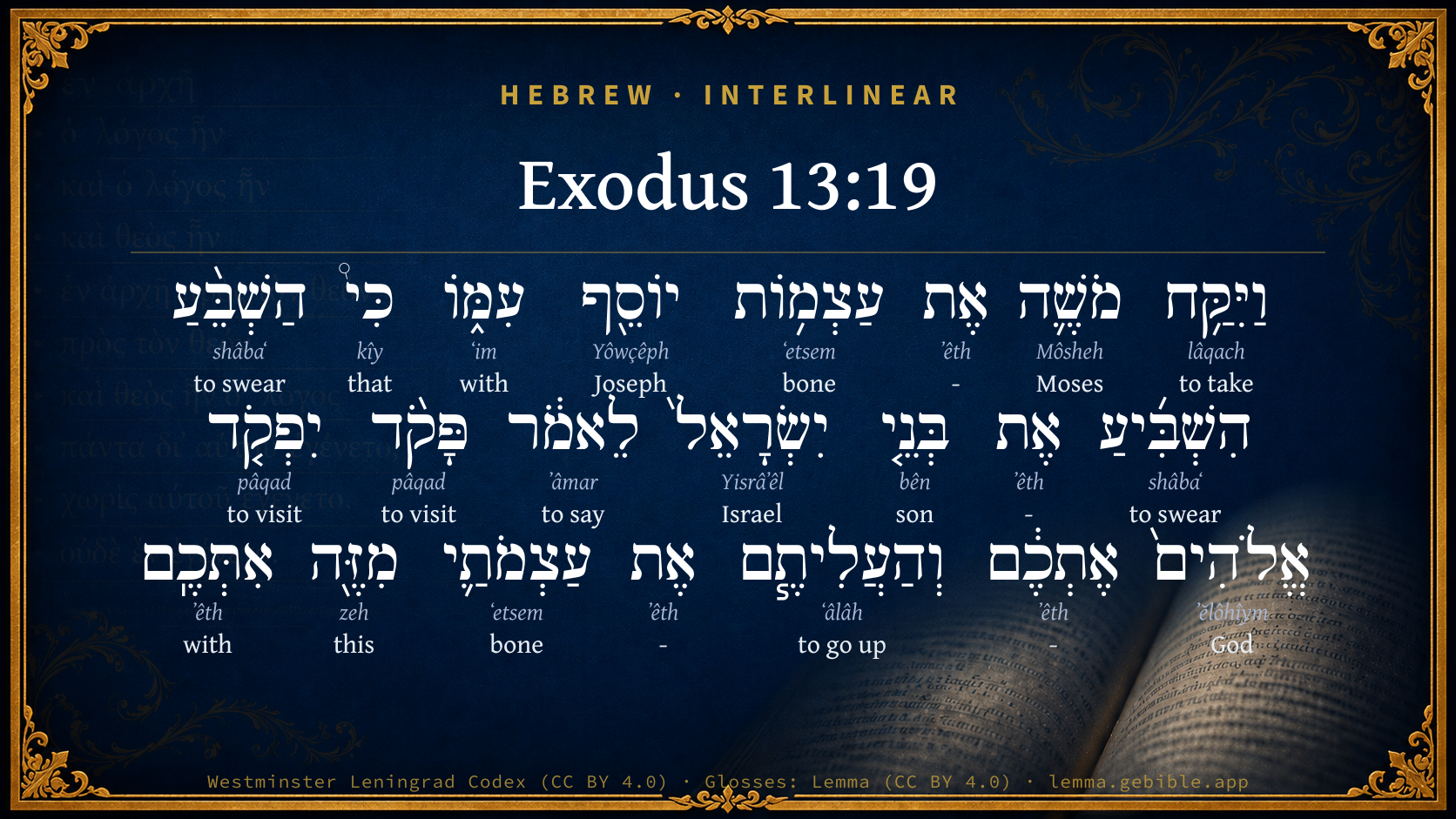
Hebrew (Westminster Leningrad Codex) Exodus 13:19 appears in the Hebrew Old Testament. The text above is from the Westminster Leningrad Codex. Each word links to its Strong’s number, a concise gloss, and parsing drawn from the Open Scriptures Hebrew Bible morphology. Click any word for its full Brown-Driver-Briggs (BDB) entry.
Download image
Cite this verse

Exodus 13:19 (World English Bible). Public Domain. Lemma interlinear Bible study tool, https://lemma.gebible.app/v/exodus/13/19.

Show BibTeX & RIS
BibTeX
RIS
English Translation
Moses took the bones of Joseph with him, for he had made the children of Israel swear, saying, "God will surely visit you, and you shall carry up my bones away from here with you."
World English Bible · Public Domain
Download a study sheet

One document with this verse’s original text, its word-by-word gloss line, the meaning frame, cross-references with their text, attributed commentary, and full source and license credits — printable, and it pastes into notes with its structure intact.

This verse Autodidact and up

Study sheet (.html) Plain text (.txt)

A passage Seminary Student

Up to 50 verses in one chapter. A passage sheet keeps up to 6 commentary sources and 12 cross-references per verse, in the order this page ranks them, and says so on the sheet whenever that leaves anything out. Ask for a single verse and you get the Autodidact verse sheet above.

Everything on this page stays free to read, with no account — the sheet is a download of what is already on screen, not access to it.

Want to remove ads? Support Godless Engineer
Compare translations 3

The same verse in 3 English versions, stacked beneath the original-language interlinear above. Click any original word for its lexicon entry.

Each is an independent rendering of the whole verse — the interlinear is not word-aligned to these translations.

Highlighted words mark where these versions differ — a whole-verse word diff, not a word-by-word alignment.

  • World English Bible Public Domain
    Moses took the bones of Joseph with him, for he had made the children of Israel swear, saying, "God will surely visit you, and you shall carry up my bones away from here with you."
  • King James Version Public Domain
    And Moses took the bones of Joseph with him: for he had straitly sworn the children of Israel, saying, God will surely visit you; and ye shall carry up my bones away hence with you.
  • unfoldingWord Literal Text CC BY-SA 4.0
    And Moses took the bones of Joseph with him, for he had certainly caused the sons of Israel to vow, saying, “God will certainly attend to you, and you shall bring my bones up with you from here.”

unfoldingWord Literal Text — © unfoldingWord, licensed CC BY-SA 4.0. Word-aligned USFM3 via Door43 (git.door43.org/unfoldingWord/en_ult).

Versions to compare (up to 4)

3 of 4 selected

Show all 18 translations

Every available English version of this verse, each an independent rendering of the whole verse.

  • World English Bible Public Domain
    Moses took the bones of Joseph with him, for he had made the children of Israel swear, saying, "God will surely visit you, and you shall carry up my bones away from here with you."
  • Berean Standard Bible Public Domain
    Moses took the bones of Joseph with him because Joseph had made the sons of Israel swear a solemn oath when he said, “God will surely attend to you, and then you must carry my bones with you from this place.”
  • Majority Standard Bible Public Domain
    Moses took the bones of Joseph with him because Joseph had made the sons of Israel swear a solemn oath when he said, “God will surely attend to you, and then you must carry my bones with you from this place.”
  • King James Version Public Domain
    And Moses took the bones of Joseph with him: for he had straitly sworn the children of Israel, saying, God will surely visit you; and ye shall carry up my bones away hence with you.
  • American Standard Version (1901) Public Domain
    And Moses took the bones of Joseph with him: for he had straitly sworn the children of Israel, saying, God will surely visit you; and ye shall carry up my bones away hence with you.
  • Revised Version (1885) Public Domain
    And Moses took the bones of Joseph with him: for he had straitly sworn the children of Israel, saying, God will surely visit you; and ye shall carry up my bones away hence with you.
  • Geneva Bible (1599) Public Domain
    (And Moses tooke the bones of Ioseph with him: for he had made the children of Israel sweare, saying, God will surely visite you, and ye shall take my bones away hence with you)
  • Douay-Rheims (1899) Public Domain
    And Moses took Joseph's bones with him: because he had adjured the children of Israel, saying: God shall visit you, carry out my bones from hence with you.
  • Young's Literal Translation Public Domain
    And Moses taketh the bones of Joseph with him, for he certainly caused the sons of Israel to swear, saying, `God doth certainly inspect you, and ye have brought up my bones from this with you.'
  • Literal Standard Version CC BY-SA 4.0
    And Moses takes the bones of Joseph with him, for he certainly caused the sons of Israel to swear, saying, “God certainly inspects you, and you have brought up my bones from this [place] with you.”
  • Unlocked Literal Bible CC BY-SA 4.0
    Moses took the bones of Joseph with him, for Joseph had made the Israelites solemnly swear and said, “God will surely rescue you, and you must carry away my bones with you.”
  • unfoldingWord Literal Text CC BY-SA 4.0
    And Moses took the bones of Joseph with him, for he had certainly caused the sons of Israel to vow, saying, “God will certainly attend to you, and you shall bring my bones up with you from here.”
  • Darby Bible Public Domain
    And Moses took the bones of Joseph with him; for he had made the children of Israel swear an oath, saying, God will be sure to visit you; then ye shall carry my bones with you hence.
  • World Messianic Bible Public Domain
    Moses took the bones of Joseph with him, for he had made the children of Israel swear, saying, “God will surely visit you, and you shall carry up my bones away from here with you.”
  • Webster's Bible Public Domain
    And Moses took the bones of Joseph with him: for he had strictly sworn the children of Israel, saying, God will surely visit you; and ye shall carry up my bones hence with you.
  • Free Bible Version CC BY-SA 4.0
    Moses carried Joseph's bones with him because Joseph had made the sons of Israel swear a solemn promise, saying, “God will definitely take care of you, and then you must take my bones with you when you leave here.”
  • Bible in Basic English Public Domain
    And Moses took the bones of Joseph with him, for Joseph had made the children of Israel take an oath, saying, God will certainly keep you in mind; and you are to take my bones away with you.
  • JPS Tanakh (1917) Public Domain
    And Moses took the bones of Joseph with him; for he had straitly sworn the children of Israel, saying: 'God will surely remember you; and ye shall carry up my bones away hence with you.'

Literal Standard Version (2020), Covenant Press — licensed CC BY-SA 4.0. Text via the HelloAO Bible API (eBible.org). Unlocked Literal Bible (unfoldingWord) — licensed CC BY-SA 4.0. Text via the HelloAO Bible API (eBible.org). unfoldingWord Literal Text — © unfoldingWord, licensed CC BY-SA 4.0. Word-aligned USFM3 via Door43 (git.door43.org/unfoldingWord/en_ult). Free Bible Version, Dr. Jonathan Gallagher — licensed CC BY-SA 4.0. Text via the HelloAO Bible API (eBible.org).

Word by word

More ways to search: Search by grammar → Find every occurrence → Compare this word →

Practice this passage: Drill this verse → Learn its vocabulary →

עַצְמ֥וֹת
ʻetsem
H6106
“bones of”
Noun, Common, Feminine, Plural, Construct
Part of Speech
Noun
Type
Common
Gender
Feminine
Number
Plural
State
Construct
Full BDB Definition

Origin: from H6105

TWOT: 1673c

bone, essence, substance - bone - body, limbs, members, external body - bone (of animal) - substance, self
  1. וַיִּקַּ֥ח lâqach H3947 “and · to take” Conjunction + Verb, Qal, Sequential Imperfect, 3rd Person, Masculine, Singular
  2. מֹשֶׁ֛ה Môsheh H4872 “Moses” Noun, Proper
  3. אֶת ʼêth H853 “-” Particle, Direct Object
  4. יוֹסֵ֖ף Yôwçêph H3130 “Joseph” Noun, Proper
  5. עִמּ֑וֹ ʻim H5973 “with · him” Preposition + Suffix, Personal, 3rd Person, Masculine, Singular
  6. כִּי֩ kîy H3588 “that” Conjunction
  7. הַשְׁבֵּ֨עַ shâbaʻ H7650 “to swear” Verb, Hiphil, Infinitive Absolute
  8. הִשְׁבִּ֜יעַ shâbaʻ H7650 “to swear” Verb, Hiphil, Perfect, 3rd Person, Masculine, Singular
  9. אֶת ʼêth H853 “-” Particle, Direct Object
  10. בְּנֵ֤י bên H1121 “sons of” Noun, Common, Masculine, Plural, Construct
  11. יִשְׂרָאֵל֙ Yisrâʼêl H3478 “Israel” Noun, Proper
  12. לֵאמֹ֔ר ʼâmar H559 “to say” Preposition + Verb, Qal, Infinitive Construct
  13. פָּקֹ֨ד pâqad H6485 “to visit” Verb, Qal, Infinitive Absolute
  14. יִפְקֹ֤ד pâqad H6485 “to visit” Verb, Qal, Imperfect, 3rd Person, Masculine, Singular
  15. אֱלֹהִים֙ ʼĕlôhîym H430 “God(s)” Noun, Common, Masculine, Plural, Absolute
  16. אֶתְכֶ֔ם ʼêth H853 “- · you” Particle, Direct Object + Suffix, Personal, 2nd Person, Masculine, Plural
  17. וְהַעֲלִיתֶ֧ם ʻâlâh H5927 “and · to go up” Conjunction + Verb, Hiphil, Sequential Perfect, 2nd Person, Masculine, Plural
  18. אֶת ʼêth H853 “-” Particle, Direct Object
  19. עַצְמֹתַ֛י ʻetsem H6106 “bones · my” Noun, Common, Feminine, Plural, Construct + Suffix, Personal, 1st Person, Common, Singular
  20. מִזֶּ֖ה zeh H2088 “from · this” Preposition + Pronoun, Demonstrative, Masculine, Singular
  21. אִתְּכֶֽם ʼêth H854 “with · you” Preposition + Suffix, Personal, 2nd Person, Masculine, Plural

About this verse

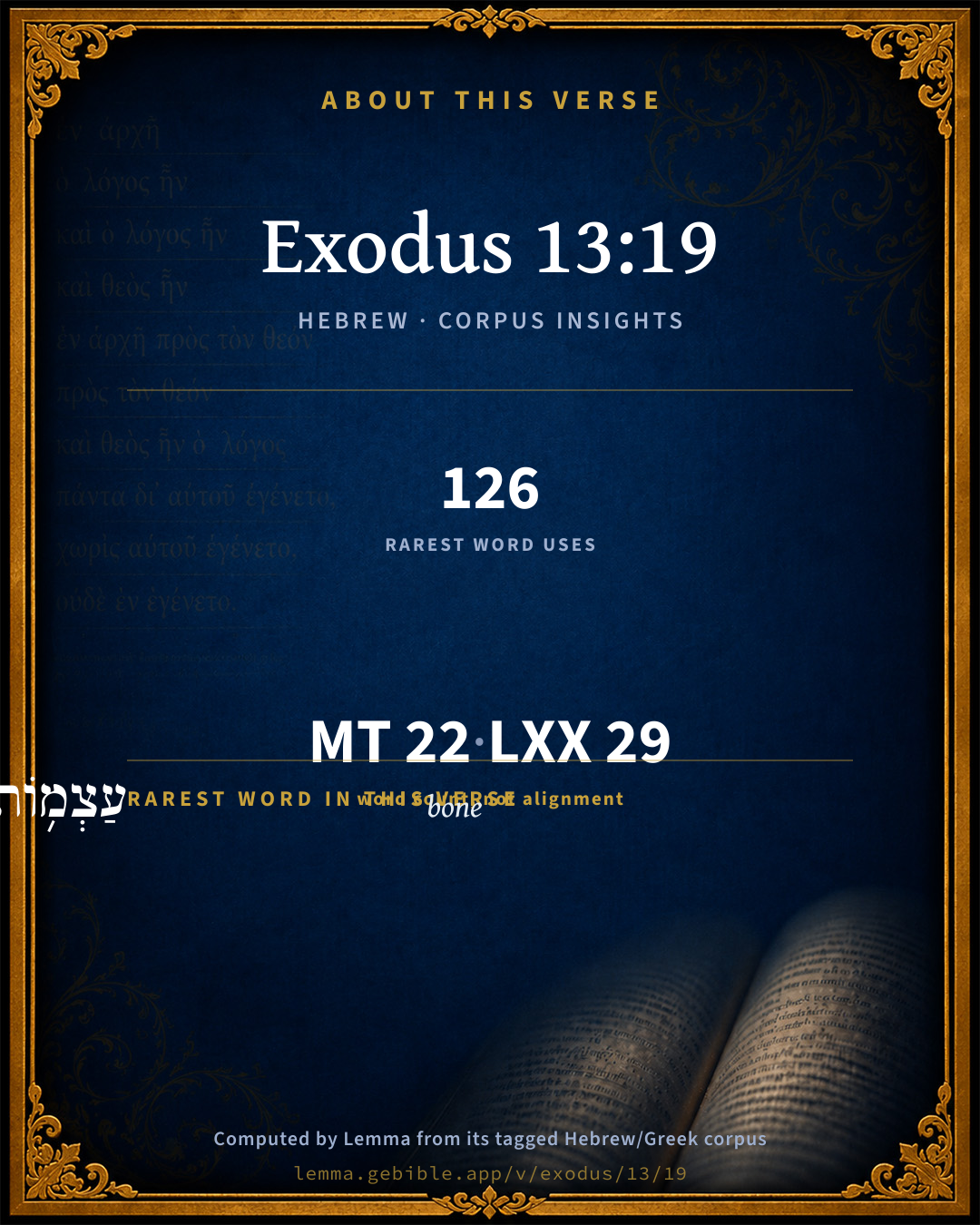
These counts appear in no published source. They are computed here, from the morphology-tagged text and Lemma’s own curated glosses. What Lemma adds →

22
words
16
distinct lemmas
Pentateuch
section

Grammatical profile

  • 7 verbs
  • 7 nouns
  • 1 pronoun
  • 2 prepositions
  • 1 conjunction
  • 4 particles

Verb forms

  • וַיִּקַּ֥ח Qal · Sequential Imperfect
  • הַשְׁבֵּ֨עַ Hiphil · Infinitive Absolute
  • הִשְׁבִּ֜יעַ Hiphil · Perfect
  • לֵאמֹ֔ר Qal · Infinitive Construct
  • פָּקֹ֨ד Qal · Infinitive Absolute
  • יִפְקֹ֤ד Qal · Imperfect
  • וְהַעֲלִיתֶ֧ם Hiphil · Sequential Perfect

Repetition

Words recur within this verse — often emphatic in Hebrew:

  • עַצְמ֥וֹת bone H6106 ×2
  • הַשְׁבֵּ֨עַ to swear H7650 ×2
  • פָּקֹ֨ד to visit H6485 ×2

Hebrew & Septuagint length

In English translation the verse runs 35 words from the Hebrew and 34 from the Septuagint (LXX English) — closely comparable.

A rough comparison of the two English renderings, which tokenize alike — not a word-level alignment.

Word counts can differ between the Hebrew and the Greek without any difference in meaning — e.g. the Hebrew direct-object marker אֵת has no separate Greek word, and Greek often adds the article ὁ.

In the original languages it is 22 Hebrew tokens and 29 Greek tokens — but the two are counted differently (Hebrew bundles its prefixes and suffixes into one token; the Greek is in lemma form), so that isn’t a like-for-like length.

Cross-references

7

Topical passages linked to Exodus 13:19 in the Treasury of Scripture Knowledge — connected by theme and wording, ordered by reader-vote popularity; previews shown in the World English Bible.

  • Genesis 50:24–25 Joseph said to his brothers, "I am dying, but God will surely visit you, and bring you up out of this land to the land which he swore to Abraham, to Isaac, and to Jacob."
  • Joshua 24:32 The bones of Joseph, which the children of Israel brought up out of Egypt, buried they in Shechem, in the parcel of ground which Jacob bought of the sons of Hamor the father of Shechem for a hundred pieces of money: and they became the inheritance of the children of Joseph.
  • Acts 7:16 and they were brought back to Shechem, and laid in the tomb that Abraham bought for a price in silver from the children of Hamor of Shechem.
  • Genesis 48:21 Israel said to Joseph, "Behold, I am dying, but God will be with you, and bring you again to the land of your fathers.
  • Exodus 4:31 The people believed, and when they heard that Yahweh had visited the children of Israel, and that he had seen their affliction, then they bowed their heads and worshiped.
  • Luke 1:58 Her neighbors and her relatives heard that the Lord had magnified his mercy towards her, and they rejoiced with her.
  • Luke 7:16 Fear took hold of all, and they glorified God, saying, "A great prophet has arisen among us!" and, "God has visited his people!"

Cross-references courtesy of OpenBible.info (CC BY 4.0).

Hebrew and Greek witnesses Masoretic Hebrew ↔ Greek Septuagint

The same verse in the two great witnesses to the Old Testament, shown verse-for-verse.

These are two independent witnesses, not word-aligned to each other, and the Septuagint is shown in lemma (dictionary) form.

Hebrew Exodus 13:19 Masoretic · Westminster Leningrad Codex

וַיִּקַּ֥ח מֹשֶׁ֛ה אֶת עַצְמ֥וֹת יוֹסֵ֖ף עִמּ֑וֹ כִּי֩ הַשְׁבֵּ֨עַ הִשְׁבִּ֜יעַ אֶת בְּנֵ֤י יִשְׂרָאֵל֙ לֵאמֹ֔ר פָּקֹ֨ד יִפְקֹ֤ד אֱלֹהִים֙ אֶתְכֶ֔ם וְהַעֲלִיתֶ֧ם אֶת עַצְמֹתַ֛י מִזֶּ֖ה אִתְּכֶֽם

Moses took the bones of Joseph with him, for he had made the children of Israel swear, saying, "God will surely visit you, and you shall carry up my bones away from here with you."

World English Bible · Public Domain

Greek LXX Exodus 13:19 Septuagint · lemma form

καί λαμβάνω μωυσῆς ὁ ὀστέον ιωσηφ μετά ἑαυτοῦ ὅρκος γάρ ὁρκίζω ιωσηφ ὁ υἱός ἰσραήλ λέγω ἐπισκοπή ἐπισκέπτω σύ κύριος καί συν ἀναφέρω ἐγώ ὁ ὀστέον ἐντεῦθεν μετά σύ

And Moses took the bones of Joseph with him, for he had solemnly adjured the children of Israel, saying, God will surely visit you, and you⌃ shall carry up my bones hence with you.

LXX2012 (modern English Septuagint) · Public Domain

Hebrew: Westminster Leningrad Codex (CC BY 4.0). Greek: Septuagint (public domain); English from LXX2012 (modern English Septuagint) (Public Domain). How the Septuagint differs from the Hebrew →

Targum (Aramaic paraphrase)

2

The Targum is the ancient Jewish Aramaic paraphrase of the Hebrew Scriptures — an interpretive translation, not the Hebrew text itself. Onkelos (literal) and Pseudo-Jonathan (expansive) render the Torah, and Jonathan the Prophets. Coverage is partial: where no permissively-licensed English translation exists for a verse, only the Aramaic is shown. This is verse-level text, not a word-by-word alignment to the Hebrew.

  1. Targum Onkelos Torah (Genesis–Deuteronomy)
    וְאַסִיק משֶׁה יָת גַרְמֵי יוֹסֵף עִמֵהּ אֲרֵי אוֹמָאָה אוֹמִי יָת בְּנֵי יִשְׂרָאֵל לְמֵימָר מִדְכַּר דְכִיר יְיָ יָתְכוֹן וְתַסְקוּן יָת גַרְמַי מִכָּא עִמְכוֹן:

    (no public-domain English translation for this verse)

    Targum Onkelos — Aramaic: “Onkelos Genesis” (public domain); “Onkelos Exodus” (public domain); “Onkelos Leviticus” (public domain); “Onkelos Numbers” (public domain); “Onkelos Deuteronomy” (public domain). English: “Sefaria Community Translation” (CC0 1.0 (public-domain dedication)); “J.W. Etheridge. The Targums of Onkelos and Jonathan Ben Uzziel on the Pentateuch. London: Longmans, Green, 1862” (public domain). Text via Sefaria.

  2. Targum Pseudo-Jonathan Torah (Genesis–Deuteronomy)
    וְאַסֵּק משֶׁה יַת אֲרוֹנָא דְגַרְמֵי יוֹסֵף בְּגַוֵּיהּ מִן נִילוֹס וַהֲוָה מַדְבַּר עִמֵּיהּ אֲרֵי אוֹמָאָה אוֹמֵי יַת בְּנֵי יִשְרָאֵל לְמֵימַר מִדְכַּר יַדְכַּר יְיָ יַתְכוֹן וְתִסְקוּן יַת גַּרְמַי מִיכָּא עִמְכוֹן

    And Mosheh carried up the ark in which were the bones of Joseph, from out of the Nilos, and took them with him; because, adjuring, he adjured the sons of Israel, saving, The Lord will surely remember you, and you shall carry up my bones with you.

    Targum Pseudo-Jonathan — Aramaic: “Targum Jonathan on Genesis” (public domain); “Targum Jonathan on Exodus” (public domain); “Targum Jonathan on Leviticus” (public domain); “Targum Jonathan on Numbers” (public domain); “Targum Jonathan on Deuteronomy” (public domain). English: “The Targum of Jonathan ben Uzziel, trans. J. W. Etheridge, London, 1862” (public domain). Text via Sefaria.

Commentary

Notes on Exodus 13:19 from classic Christian and Jewish commentators (each source and its license shown beneath its notes). The classic Christian expositions comment on the surrounding passage and are grouped to its opening verse, so a note may address several verses; the Jewish commentaries on the Tanakh (Rashi and others) are per-verse, so they appear only where the commentator wrote on this verse.

Lemma curates 59 commentaries, every one of them public domain or Creative Commons licensed, each selected and text-cleaned for this edition rather than reprinted as found. About our sources →

Trapp's Complete Commentary

John Trapp

Exo 13:19 And Moses took the bones of Joseph with him: for he had straitly sworn the children of Israel, saying, God will surely visit you; and ye shall carry up my bones away hence with you.

Ver. 19. And Moses took the bones of Joseph.] And with those, as it is likely, the bones of the other patriarchs too. {Act 7:16}

John Trapp, A Commentary or Exposition upon All the Books of the Old and New Testament (1647–1656) — public domain. Text from a community e-Sword module.

The Biblical Illustrator

Joseph S. Exell

Exo_13:19

Moses took the bones of Joseph.

An interesting incident in Israels departure from Egypt

I. The discharge of a sacred trust (Gen_50:24-25). Pay attention to the requests of the dead.

II. THE fulfilment of an ancient prophecy (Gen_1:25). God can kindle the fire of prophecy in the soul of a dying saint, that the sorrowful may be encouraged.

III. The giving of a timely encouragement.

IV. The bestowal of an appropriate honour on an illustrious ancestor. (J. S. Exell, M. A.)

A memento and a pledge

And Moses took the bones of Joseph with him. This rendered the march a kind of funeral procession, and such as no other history relates. Never was body so long in its conveyance to the grave, for forty years were taken up in bearing Joseph to his burial. We read at the death of Joseph that they embalmed him, and he was put in a coffin in Egypt. The precious deposit, likely to be cared for by some of the descendants of his own family, was dear to all. It was a memento of the vanity of human greatness. It was also a moral as well as a mortal memento. Joseph was a very pious character; he had been highly exemplary in every relation and condition of life, and much of God, of providence, and of grace was to be read in his history. What an advantage to be always reminded of such a man in having his remains always in the midst of them! But the body would be above all valuable as a pledge of their future destination. It was a present palpable sign of Gods covenant with their fathers in their behalf. (A. Nevin, D. D.)

Rest in native land

Sir Bartle Frere was often asked at the Cape, What do you expect when you reach England? His reply, which was found written on a slip in his Bible after his death, was thus expressed:

Where in the summer sun the early grasses grow,

Six feet of English ground, a Britons grave,

Rest in my native land is all I crave.

Burial places

It is the almost universal custom in America, and seems to be growing in favour here, for great men to be buried in the place where they have mostly lived, and among their own kith and kin. Washington lies at Mount Vernon; Lincoln at Springfield; Emerson and Hawthorne under the pines of New England; Irving on the banks of the Hudson; Clay in Kentucky. They are laid to rest not in some central city or great structure, but where they have lived, and where their families and neighbours may accompany them in their long sleep. (H. O. Mackey.)

The Biblical Illustrator, edited by Joseph S. Exell (c. 1880s–1900s) — public domain. Text from a community e-Sword module.

Tyndale Open Study Notes

Tyndale Open Resources

13:19 Joseph had recognized that God would not leave his people in Egypt indefinitely because he had promised Canaan to them (see Gen 50:24-25).

Tyndale Open Study Notes — © Tyndale Open Resources, licensed CC BY-SA 4.0. Text via the HelloAO Bible API.

Jamieson, Fausset & Brown

Robert Jamieson, A. R. Fausset & David Brown

Moses took the bones of Joseph with him--in fulfilment of the oath he exacted from his brethren (Gen 50:25-26). The remains of the other patriarchs (not noticed from their obscurity) were also carried out of Egypt (Act 7:15-16); and there would be no difficulty as to the means of conveyance--a few camels bearing these precious relics would give a true picture of Oriental customs, such as is still to be seen in the immense pilgrimages to Mecca.

Jamieson, Fausset & Brown — Commentary Critical and Explanatory on the Whole Bible (1871) — public domain (CC PDM 1.0). Text via the HelloAO Bible API.

Adam Clarke's Commentary

Verse 19. Moses took the bones of Joseph] See Clarke on Ge 50:25. It is supposed that the Israelites carried with them the bones or remains of all the twelve sons of Jacob, each tribe taking care of the bones of its own patriarch, while Moses took care of the bones of Joseph. St. Stephen expressly says, Ac 7:15-16, that not only Jacob, but the fathers were carried from Egypt into Sychem; and this, as Calmet remarks, was the only opportunity that seems to have presented itself for doing this: and certainly the reason that rendered it proper to remove the bones of Joseph to the promised land, had equal weight in reference to those of the other patriarchs. See Clarke on Ge 49:29.

Adam Clarke's Commentary on the Bible (1810–1826) — public domain. Text from a community e-Sword/MySword module.

Ellicott's Commentary for English Readers

(19) Moses took the bones of Joseph.—Joseph’s body had been embalmed according to the Egyptian fashion (Gen_1:26). He had ordered it to be conveyed to Canaan when the Israelites went there (Gen_1:25).

A Bible Commentary for English Readers, edited by Charles John Ellicott (1878–1897) — public domain. Text from a community e-Sword module.

The Cambridge Bible for Schools and Colleges

gen. ed. J. J. S. Perowne

19. See Gen_50:25; and cf. Jos_24:32.

The Cambridge Bible for Schools and Colleges (gen. ed. J. J. S. Perowne; Cambridge University Press, 1878–1918) — public domain. Text from a community e-Sword module.

John Gill's Exposition

And Moses took the bones of Joseph with him,.... And his remains might well be called bones, since at such a distance from his death the flesh must be gone, and nothing but bones left; of the place where Joseph's coffin was laid; see Gill on Gen 50:26. The Jews pretend, that Moses was informed where Joseph was buried by Sarah, the daughter of Asher, who they say was living at this time (q); and many other fables they relate concerning the manner of finding him, which are not worthy of any notice. Jarchi thinks, that the bones of all the tribes, or of the sons of Jacob, were carried with them, but that does not appear from the text; though it seems, according to Stephen's account, that they were carried over to Canaan; but then, whether immediately after their death, or at this time, and also by whom, is not certain, see Act 7:15,

for he had straitly sworn the children of Israel; his brethren; or "in swearing had caused them to swear" (r), had given them a very strict oath, and which they had related to their children, and so from one generation to another, and thus it became known, and Moses looked upon himself and the people of Israel as bound to observe it:

saying, God will surely visit you; in a way of mercy and goodness, and bring you out of Egypt, and put you it possession of the land of Canaan:

and ye shall carry up my bones away hence with you; See Gill on Gen 50:25.

(q) T. Bab. Sotah, fol. 13. 1. (r) "adjurando adjuraverat", Pagninus, Montanus, Drusius.

John Gill's Exposition of the Whole Bible (1746–1763) — public domain (CC PDM 1.0). Text via the HelloAO Bible API.

Haydock's Catholic Bible Commentary

Joseph’s. This attention to the dead is commended, Hebrews xi. (Worthington) --- St. Stephen assures us, that the bones of the other patriarchs were deposited at Sichen; and we may conclude, that they were transported on this occasion by their respective families, Acts vii. 16.

George Leo Haydock (1774–1849), Haydock's Catholic Family Bible and Commentary, 1859 edition — public domain. Excludes Psalms (Douay-Rheims chapter numbering differs from Protestant) and Deuterocanonical books (Catholic canon only).

Matthew Poole's English Annotations

The bones of Joseph, and the other patriarchs, as appears from Act 7:16. The oath was taken only by the parents, but because the matter of it was not personal, and of particular concernment to them, but common to them and their children, therefore it obliged both the parents and their children, as Moses here signifieth.

Matthew Poole's English Annotations on the Holy Bible (1683–1685) — public domain. Text from a community e-Sword/MySword module.

Whedon's Commentary on the Bible

Daniel D. Whedon

19. And Moses took the bones of Joseph — Joseph’s dying charge and Israel’s solemn vow, made more than a century before, (Gen_50:24-25,) are now sacredly remembered. His body had not been carried to the Land of Promise, like that of Jacob, nor buried in Egypt, like those of his brethren the fathers of the tribes, but, wrapped in its fragrant bandages, it waited the fulfilment of the patriarch’s prophecy, “God will surely visit you, and ye shall carry up my bones from hence.” Through all the years of their bondage the mummied form of their famous ancestor had been a perpetual prophecy and admonition. It ever held before their eyes the great promises made to Abraham, Isaac, and Jacob, and the sublime destiny that awaited Israel.

Only in Egypt would such a century-long “object-lesson” have been possible. The mummied form of the dead was there often kept for months, and sometimes for years, before final burial, in a closet made in the house for the purpose, with folding doors, and standing upon a sledge, so that it could be drawn to an altar where were offered “prayers for the dead.” It was this idolatrous superstition which Moses so expressly forbade, Lev_19:28; Lev_21:1. It was, however, deemed a calamity for the dead to remain thus unburied unless there were especial reasons, which the friends were careful to have made known, and thus the fact that so eminent a person as Joseph remained unburied would give rise to constant inquiry and explanation. (Wilkinson’s Ancient Egyptians, chap. 10.) How wonderfully adapted was this act of Joseph to ensure the resurrection of Israel’s life from the grave of Egyptian heathenism!

Daniel D. Whedon (gen. ed.), Commentary on the Old and New Testaments (1874–1909) — public domain. Text from a community e-Sword module.

The Pulpit Commentary

Moses took the bones of Joseph i.e. , his body, which had been embalmed, and deposited in a mummy case, (Gen_50:26) most probably at Tanis, which was the capital of the Shepherd kings, no less than of Menephthah. He had straitly sworn the children of Israel. See Gen_50:25. Joseph, firmly believing in the promise of God to give Canaan to the descendants of Abraham had made them swear to take his body with them when they left Egypt. The desire to be laid in their native earth was common to most of the nations of antiquity, and, in the case of the Israelites, was intensified by Canaan being the "laud of promise." Jacob had had the same feeling as Joseph, and had been buried by Joseph in the cave of Math-pelah. (Gen_50:13)

It is a Christian duty to carry with us on the path of life the bones of our dead.

Joseph had sworn the Israelites to carry his bones with them out of Egypt at their departure; and they were thus in a special way bound to do it. But, apart from any such oath, or any positive wish expressed, it would have been well for them to have taken him with them. We are intimately bound up with the men of the generation before our own, and cannot too carefully carry along with us their memory. Men may be considered to carry their dead with them on their course through life

I WHEN THEY BEAR IN MIND AND HAVE RESPECT TO THEIR FATHERS IN THE FAITH, ESPECIALLY THOSE NEAR TO THEM IN TIME. It is almost impossible to measure adequately the amount of our debt to those who have immediately preceded us in life who have set us an example of a consistent Christian course and shown us its possibility. What living Christian man does not feel that to some other Christian man, older than himself, still alive or else passed away, he is indebted for the impetus which changed his path in life, turned him from the dumb idols which he was following, and led him to the worship of the living God? What gratitude is not due in each such case! Such memories are to be cherished, clung to not relinquished, because he to whom we owe so much is dead. Being dead, such a one "still speaketh;" and it is well that our hearts should still hear his voice, and be thankful for it.

II WHEN THEY CHERISH THE MEMORY OF THE FRIENDS AND RELATIONS WHOM THEY HAVE LOST. It is too common a practice, with men especially, to shut out the memory of the deceased. Bereavement is so terrible a thing, so poignant a grief, that to spare themselves men mostly make a sort of resolve that they will not think upon their dead. And it is quite possible, after a while, so to turn from the thought as to make it both transient and rare. But the better course the true Christian course is to retain our dead in our thoughts. The recollection can do us nothingbut good. It is sobering, chastening, yet elevating. It is apt to wean us from the world; to soften us; to draw us into communion with the unseen; to help our higher nature in its struggle with the lower.

III WHEN THEY BEAR IN REMEMBRANCE THE WORST SINS THAT THEY HAVE COMMITTED. The most terrible death to which we poor human creatures are subject is that "body of death," which we bear about with us in our flesh, and under which we "groan, being burthened viz, sin. There are persons who succeed in putting away the memory of their past sins, and who are as gay and light-hearted as if there were nothing against them in God"s book. But it is a wiser course to bear about with us always this "death" also, and not seek to hush it up or put it out of sight. The thought of our past sins is well calculated to make us humble, penitent, forgiving; to save us from presumption, and make us throw ourselves absolutely for justification on the merits and atoning blood of Christ.

Joseph"s bones.

A premise, and most of all a promise to the dead, is to be regarded as sacred. Amidst the haste of their departure the Israelites did not forget to take with them the bones of Joseph. They probably carried away also the bones of the other patriarchs. (Act_7:16) In this touching incident, see

I FAITH"S ANTICIPATIONS VERIFIED. Joseph had said, "God will surely visit you". (Gen_50:25) He had died in faith, not having received the promises, but having seen them afar off. (Heb_11:13-22) At the time of Joseph"s death the tokens were scant that Israel would grow to be so great a people, and would be led forth, many thousands strong, to go to Canaan. Joseph"s faith rested on God"s naked word. God had said that this time would come, and it did. We are never wrong in depending on the Divine promise. Those who trust it, however the world may ridicule them as devout enthusiasts, will prove to be right in the long run. Events will verify their confidence. Apply, e.g. , to the ultimate triumph of Christianity.

II FAITH"S CHOICE GIVEN EFFECT TO. He had strictly sworn the children of Israel, saying, "Ye shall surely carry up my bones away hence with you." Notwithstanding the splendour of his position in Egypt, Joseph"s heart was still with his own people. To his clear moral vision, the godless character of the Egyptian civilisation was sufficiently apparent. The Hebrews were as yet but a handful of shepherds; but he discerned in them a spiritual greatness which was wanting to Egypt, and he had faith in the magnificent future which God"s Word pledged to them. So he was not ashamed to call the humble settlers in Goshen his brethren, and to declare that he preferred a grave with them to the proudest mausoleum that Egypt could erect for him. He left a charge that when they departed, they were to take his bones with them, and lay them in Canaan, as subsequently they did. (Jos_24:22) He thus anticipated Moses in choosing the better part, and in preferring union with God"s people to all the treasures and renown of the land of his adoption. We act in the same spirit when we set the things which are "unseen and eternal" before those which are "seen and temporal," and count it our highest honour to be enrolled among "God"s children.

III A HINT OF THE RESURRECTION. Whence this care of Joseph for the bestowal of his bones? What matters it it may be asked where the dust is laid, if only the spirit is secure? In one way it matters very little, though affection naturally inspires the wish to sleep beside one"s kindred. There may have been more than this. The care of the body in Egypt was, as we now know, connected with a hope of its revival. And there are good grounds for believing that the same hope had to do with this command of Joseph, and with the loving care shown by the patriarchs generally in the bestowal of their dead. (See the point discussed in Fairbairn"s Typology, vol. 1. p. 355, et seq. ). The believer"s body is a sacred deposit. Destined to share with the soul in the glory yet to be revealed, there is a fitness in treating it with reverence, and in laying it in a place consecrated to the Christian dead. J.O.

The Pulpit Commentary (1880–1919), ed. H.D.M. Spence-Jones & Joseph S. Exell — public domain. Text from a community e-Sword module.

unfoldingWord translationNotes

Door43 World Missions Community

camped at Etham

Etham is located south of the route heading towards the Philistines, at the border of the wilderness. (See: How to Translate Names)

pillar of cloud ... pillar of fire

"a cloud in the shape of a column ... fire in the shape of a column." God is with them in a cloud by day and in a fire by night.

translationWords

Moses

Joseph (OT)

Israel

oath

Succoth

desert

column

fire

light

unfoldingWord translationNotes — © Distant Shores Media and the Door43 World Missions Community, licensed CC BY-SA 4.0. Source: git.door43.org/Door43/en_tn.

Rashi

Rabbi Shlomo Yitzchaki (Rashi)

השבע השביע HE HAD STRAITLY ADJURED — He had made them swear that they would make their children swear. But why did he not make his sons swear that they would take him to the land of Canaan immediately on his death, as Jacob had made his sons swear? Joseph said: I was a ruler in Egypt and I had sufficient power to do what my father desired; but my sons — the Egyptians will not permit them to do this. Consequently he made them swear that when they would be delivered and would go forth from there that they would take him up with them (Mekhilta).

והעליתם את עצמתי מזה אתכם THEN YE SHALL BRING UP MY BONES AWAY HENCE WITH YOU — It was his brothers whom he made swear thus; consequently this tells us that they (the Israelites who left Egypt) must have brought up with them the bones of all Jacob’s sons (lit., the tribes) since it is said “with you” (with your own bones) (Mekhilta).

Rashi on the Tanakh — English translations: “The Judaica Press complete Tanach with Rashi, translated by A. J. Rosenberg” (CC BY 4.0); “Pentateuch with Rashi's commentary by M. Rosenbaum and A.M. Silbermann, 1929-1934” (public domain); “The Metsudah Tanach series, Lakewood, N.J” (CC BY 4.0); and “The Book of Joshua, Metsudah Publications, 1997” (CC BY 4.0). Text via Sefaria.

Lesson kit

Teaching starters — assembled from the data on this page, not authored interpretation. Every prompt links to the verse data it draws on. Edit before teaching.

Exodus, in the Pentateuch, opens this verse with 22 words (16 distinct Hebrew lemmas). Its most distinctive word is ʻetsem (“bone”). A historical commentator’s framing appears above. Read the whole chapter for the surrounding context.

Discussion questions

  1. The word ʻetsem carries the sense “bone.” How does it shape the verse?
  2. Genesis 50:24–25 shares this passage’s theme. How do the two illuminate each other?
  3. “bone” occurs 2× in this one verse. What is the effect of the repetition?
  4. These translations render this verse differently; the difference is in the English rendering, not the original. What questions does that raise?
  5. The verb «וַיִּקַּ֥ח» is Qal Sequential Imperfect. How does its form color the action?
  6. Reading how Trapp's Complete Commentary and The Biblical Illustrator read this verse, where do the two commentators agree and where do they part?

Things to notice

Reading settings

Reading text

Shown beneath each verse's original-language words.

Old Testament
Old Testament edition

Read the OT as the Masoretic Hebrew (MT) or the Greek Septuagint (LXX).

English shown for the Greek Septuagint (in the Hebrew ↔ Greek comparison).

Comparing translations? Open the Compare panel on any verse page to stack up to four side by side.