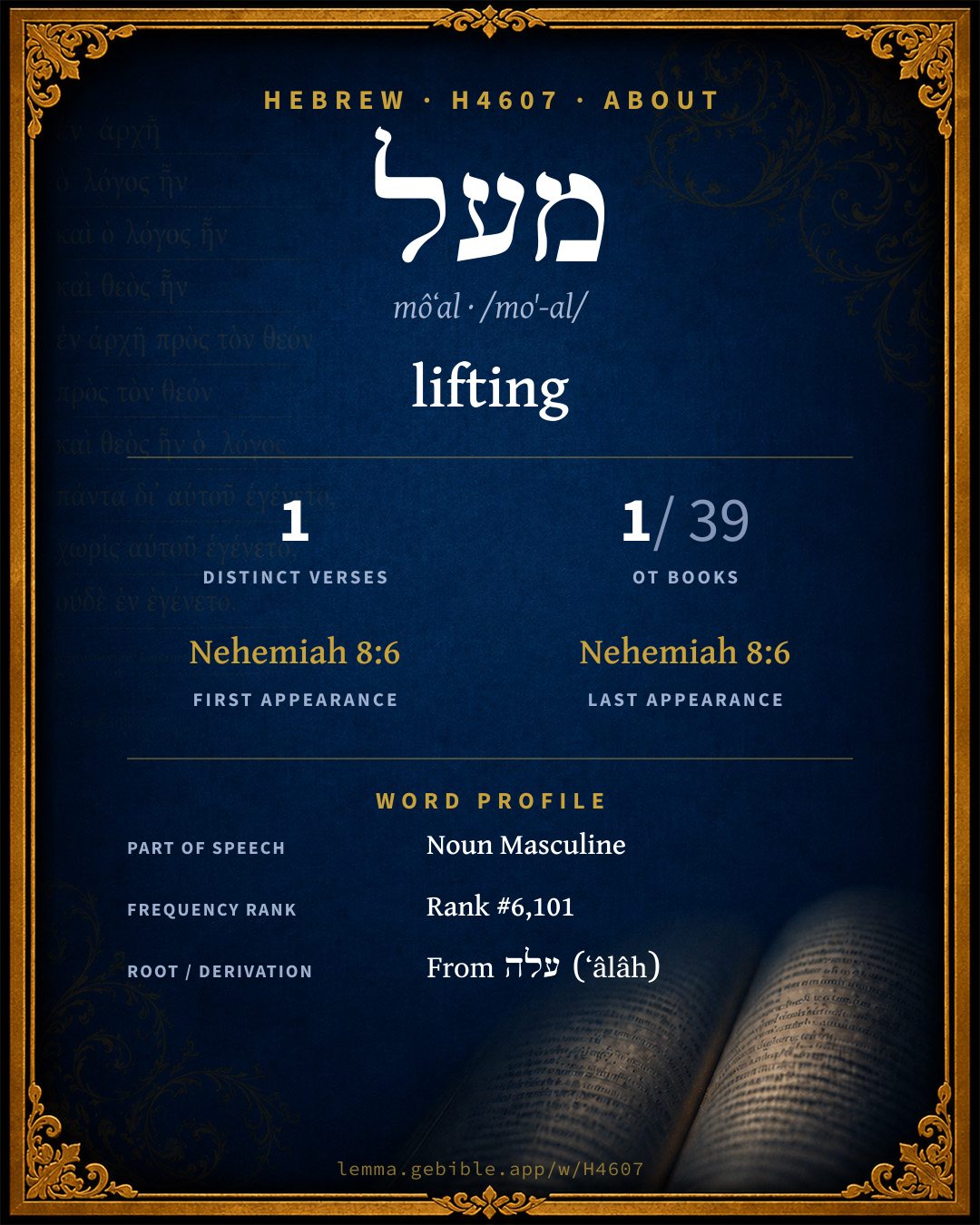
מֹ֫עַל
lifting
Full lexicon entry — Brown-Driver-Briggs (BDB)
From Brown-Driver-Briggs (BDB)
Where this word appears
Grammar key — what these labels mean
Noun type
- Common
- A common noun — a general class of person, place, or thing (“king,” “city,” “water”), not a specific name.
State
- Construct
- A noun bound to a following noun in a possessive / “of” relationship (the construct chain).
Gender
- Masculine
- Grammatically masculine.
Number
- Singular
- One.
Every verse where H4607 appears — 1 distinct verse across 1 book. Click any verse to open its interlinear word-by-word view. Verse text shown in the World English Bible for context — . Each verse’s Hebrew form is shown with its reference; the English is not keyword-highlighted, since the data carries no word-level English alignment. Use “Compare translations” on any verse to read it across multiple English versions. This concordance covers the Hebrew Bible; Septuagint (Greek Old Testament) occurrences are not indexed here.
Nehemiah 1 verse
About this entry
At a glance — auto-summarized from this page’s data, not written by a person. Every figure links to its source below. This summary describes the numbers; it doesn’t interpret them.
At its core, מעל (môʻal) means “lifting.” It is rare — just 1 verse in the entire Hebrew Bible. The word gravitates to Nehemiah (100%). Found nowhere else but Nehemiah 8:6. It clusters with עלה, מעל and מעלה under a shared root. Each statement above links to its evidence; the full detail follows below.
Gloss history
Strong's 1890 vs modern scholarship
About this word
Strong's H4607 catalogs a Hebrew word from the Hebrew Old Testament.
These counts are not copied from any lexicon or concordance. They are computed here, from the morphology-tagged Hebrew Old Testament. What Lemma adds →
- 1
- distinct verses
- The word appears in 1 distinct verse.
- 1 / 39
- OT books
- The word appears in 1 of 39 Old Testament books.
- #6,101
- by frequency
- Rank #6,101 (rank 6,101 of 8,640 Hebrew words by occurrence).
View all 1 occurrence in the concordance →
Most concentrated in
- Nehemiah 1 verse 100%
By section of the Old Testament
By traditional corpus
Conventional, traditional groupings — biblical authorship is debated, so this is a traditional corpus grouping, not an authorship claim. Each share is this word’s portion of its verses in that division of the Hebrew canon. Each figure is a share of the word’s 1 distinct verse.
- Writings (Ketuvim) 1 verse · 100%
How translations render this word
Counts come from each version’s own published word-to-Strong’s tagging or interlinear alignment — an approximate guide to how each version renders this word, not a word-level alignment the data otherwise carries. Because each total is that version’s own tagged count, the per-version totals vary from one another and need not match the appearance or distinct-verse counts above. These counts may also differ from a printed concordance because Lemma counts each distinctly tagged rendering and does not collapse phrase taggings into a single head-word total. This is a fixed set of word-tagged versions (KJV, ASV, BSB, ULT) and does not change with the reading translation you choose elsewhere. Each version’s license is shown beside its name below (and on Sources).
- King James Version: Lifting up 1×
- American Standard Version: Lifting up 1×
- Berean Standard Bible: Uplifted 1×
- unfoldingWord Literal Text: Uplifted 1×, With 1×
King James Version Public Domain
Renders H4607 across 1 tagged occurrence — most commonly:
American Standard Version Public Domain
Renders H4607 across 1 tagged occurrence — most commonly:
Berean Standard Bible Public Domain
Renders H4607 across 1 tagged occurrence — most commonly:
unfoldingWord Literal Text CC BY-SA 4.0
Renders H4607 across 2 tagged occurrences — most commonly:
Senses in BDB
The 1 sense BDB distinguishes for this word, in lexicon order (not ranked by frequency or importance). The full entry — with sub-senses — is in the Lexicon Entry tab.
- lifting
Word origin
I, II. מַעֲלָה v. sub עלה.
— Brown-Driver-Briggs (Oxford 1906, public domain), digitized via Sefaria, supplemented by the OpenScriptures HebrewLexicon (CC BY 4.0). See Sources.
Derived from עלה (ʻâlâh) (H5927) — to go up.
Jastrow Dictionary
A second Hebrew/Aramaic lexicon for comparison, covering Aramaic and post-biblical (Talmudic, Targumic, Midrashic) usage that the biblical-Hebrew BDB does not. Matched by lemma rather than by Strong’s number, so a lemma may carry more than one Jastrow headword (shown separately below), and the entries cover usage well beyond the Bible.
מֵעַל
- (adopted fr. Deut. XXV, 9) [from on,] upper of the shoe. Yeb. 102ᵃ התודה אמרה מ׳ ולא מ׳ דמ׳ the text says ‘from on’ (his foot) but not the cover of a cover, i.e. the upper must be immediate to the skin of the foot, v. אַפַּנְתָּא. Ib. א"כ ליכתוב רחמנא במ׳ רגלו if it were so (that חלץ, Deut. l. c. meant ‘to fasten’), the text ought to have read ‘on the upper part of his foot’. e.g. Deuteronomy 25:9
מַעַל
- circumvention; fraud, adulteration, faithlessness. Yalk. Ex. 343, v. דֶּלֶם. Num. R. s. 7, v. next w.
מָעַל
- denom. of preced.) to circumvent, defraud. Sifré Num. 7 (ref. to Num. V, 12) ומָעֲלָה בו מ׳ על דבר ערוה וכ׳ does ‘she was faithless to him’ refer to marital betrayal or to money matters?; v. מְעִילָה.—Esp. to make inappropriate use of sacred property, to be guilty of transgressing, be amenable to, the law concerning מְעִילָה (Lev. V, 15, sq.). Meïl. I, 1 מוֹעֲלִים בהן in using them inadvertently one commits m’ʿilah (i.e. they retain their sacred character in spite of a mistake made at their slaughtering). Ib. אין מוֹעֲלִין בה it has no longer a sacred character. Ib. III, 2 לא נהנין ולא מועלין בהן you must not make use of them, but if you did, you are not amenable to &c.; a. v. fr.—[Yalk. Num. 765 מועל ומשקר, read מְעַוֵּל, v. עָוַל.] e.g. Numbers 5:12
מְעַל
- Meïl. 14ᵇ דקמָעֵיל בקודשא that he makes improper use of sacred property; ib. דקא מועיל בקדשים (corr. acc.).
A Dictionary of the Targumim, the Talmud Babli and Yerushalmi, and the Midrashic Literature (Marcus Jastrow; London, Luzac, 1903) — Public Domain. Digitized via Sefaria. Digitized via Sefaria. Full attribution on Sources.
Same root — word family
Other BDB entries built from the same root as H4607, grouped by Strong’s listed origin. These share a root / origin per the lexicon — not necessarily a shared meaning. Each links to that word’s own entry.
Derives from
Shares the same root
- מעל maʻal H4605 above
- מעלה maʻăleh H4608 ascent
- על ʻal H5920 above
- עלה ʻâleh H5929 leaf
- עלה ʻôlâh H5930 burnt offering
- עלה ʻillâh H5931 matter
- עלי ʻĕlîy H5940 pestle
- עלי ʻillîy H5942 upper
- עליה ʻălîyâh H5944 roof chamber
- עלית ʻallîyth H5952 roof chamber
- תעלה tᵉʻâlâh H8585 conduit
Proper names from this root
People and places named from this root — a name, not an additional meaning of the word.
Compare all same-root words → Showing 4 of 17 — not the complete family. 4 of the same-root words are proper names (people or places). They share a root, not necessarily a meaning.