
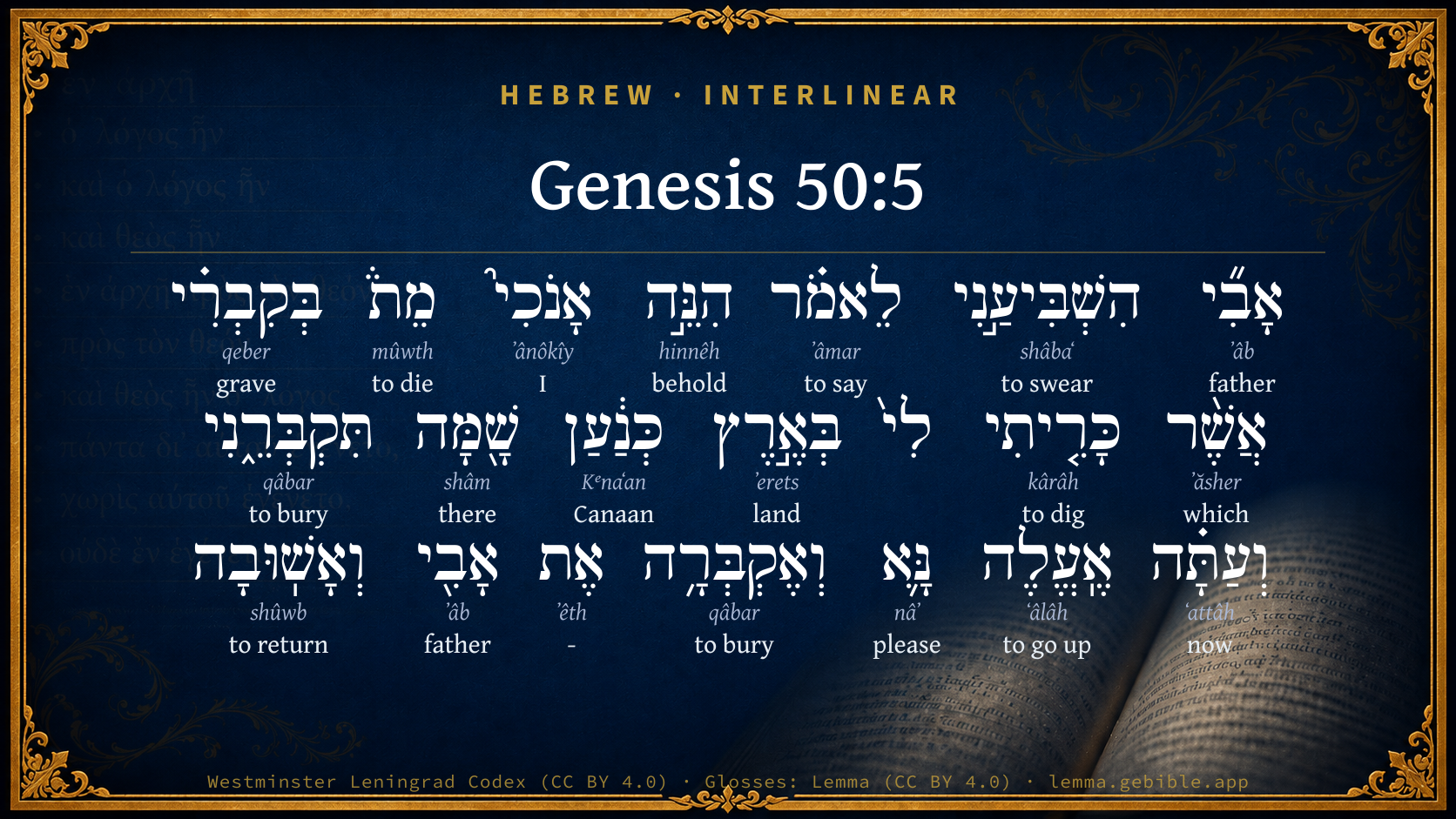
Genesis 50:5

Hebrew (Westminster Leningrad Codex) Genesis 50:5 appears in the Hebrew Old Testament. The text above is from the Westminster Leningrad Codex. Each word links to its Strong’s number, a concise gloss, and parsing drawn from the Open Scriptures Hebrew Bible morphology. Click any word for its full Brown-Driver-Briggs (BDB) entry.
Download image
Cite this verse

Genesis 50:5 (World English Bible). Public Domain. Lemma interlinear Bible study tool, https://lemma.gebible.app/v/genesis/50/5.

Show BibTeX & RIS
BibTeX
RIS
English Translation
'My father made me swear, saying, "Behold, I am dying. Bury me in my grave which I have dug for myself in the land of Canaan." Now therefore, please let me go up and bury my father, and I will come again.'"
World English Bible · Public Domain
Download a study sheet

One document with this verse’s original text, its word-by-word gloss line, the meaning frame, cross-references with their text, attributed commentary, and full source and license credits — printable, and it pastes into notes with its structure intact.

This verse Autodidact and up

Study sheet (.html) Plain text (.txt)

A passage Seminary Student

Up to 50 verses in one chapter. A passage sheet keeps up to 6 commentary sources and 12 cross-references per verse, in the order this page ranks them, and says so on the sheet whenever that leaves anything out. Ask for a single verse and you get the Autodidact verse sheet above.

Everything on this page stays free to read, with no account — the sheet is a download of what is already on screen, not access to it.

Want to remove ads? Support Godless Engineer
Compare translations 3

The same verse in 3 English versions, stacked beneath the original-language interlinear above. Click any original word for its lexicon entry.

Each is an independent rendering of the whole verse — the interlinear is not word-aligned to these translations.

Highlighted words mark where these versions differ — a whole-verse word diff, not a word-by-word alignment.

  • World English Bible Public Domain
    'My father made me swear, saying, "Behold, I am dying. Bury me in my grave which I have dug for myself in the land of Canaan." Now therefore, please let me go up and bury my father, and I will come again.'"
  • King James Version Public Domain
    My father made me swear, saying, Lo, I die: in my grave which I have digged for me in the land of Canaan, there shalt thou bury me. Now therefore let me go up, I pray thee, and bury my father, and I will come again.
  • unfoldingWord Literal Text CC BY-SA 4.0
    ‘My father made me swear, saying, “Behold, I am dying. In my grave that I dug for myself in the land of Canaan, there you must bury me.” So now, please let me go up and bury my father, then I will return.’”

unfoldingWord Literal Text — © unfoldingWord, licensed CC BY-SA 4.0. Word-aligned USFM3 via Door43 (git.door43.org/unfoldingWord/en_ult).

Versions to compare (up to 4)

3 of 4 selected

Show all 18 translations

Every available English version of this verse, each an independent rendering of the whole verse.

  • World English Bible Public Domain
    'My father made me swear, saying, "Behold, I am dying. Bury me in my grave which I have dug for myself in the land of Canaan." Now therefore, please let me go up and bury my father, and I will come again.'"
  • Berean Standard Bible Public Domain
    my father made me swear an oath when he said, ‘I am about to die. You must bury me in the tomb that I dug for myself in the land of Canaan.’ Now let me go and bury my father, and then return.”
  • Majority Standard Bible Public Domain
    my father made me swear an oath when he said, ‘I am about to die. You must bury me in the tomb that I dug for myself in the land of Canaan.’ Now let me go and bury my father, and then return.”
  • King James Version Public Domain
    My father made me swear, saying, Lo, I die: in my grave which I have digged for me in the land of Canaan, there shalt thou bury me. Now therefore let me go up, I pray thee, and bury my father, and I will come again.
  • American Standard Version (1901) Public Domain
    My father made me swear, saying, Lo, I die: in my grave which I have digged for me in the land of Canaan, there shalt thou bury me. Now therefore let me go up, I pray thee, and bury my father, and I will come again.
  • Revised Version (1885) Public Domain
    My father made me swear, saying, Lo, I die: in my grave which I have digged for me in the land of Canaan, there shalt thou bury me. Now therefore let me go up, I pray thee, and bury my father, and I will come again.
  • Geneva Bible (1599) Public Domain
    My father made me sweare, saying, Loe, I die, bury me in my graue, which I haue made me in the land of Canaan: now therefore let me go, I pray thee, and bury my father, and I wil come againe.
  • Douay-Rheims (1899) Public Domain
    For my father made me swear to him, saying: Behold I die: thou shalt bury me in my sepulchre which I have digged for myself in the land of Chanaan. So I will go up and bury my father, and return.
  • Young's Literal Translation Public Domain
    My father caused me to swear, saying, Lo, I am dying; in my burying-place which I have prepared for myself in the land of Canaan, there dost thou bury me; and now, let me go up, I pray thee, and bury my father, and return;'
  • Literal Standard Version CC BY-SA 4.0
    My father caused me to swear, saying, Behold, I am dying; in my burying-place which I have prepared for myself in the land of Canaan, there you bury me; and now, please let me go up and bury my father, then I return”;
  • Unlocked Literal Bible CC BY-SA 4.0
    'My father made me swear, saying, “See, I am about to die. Bury me in my tomb that I dug for myself in the land of Canaan. There you will bury me.” Now let me go up and bury my father, and then I will return.'”
  • unfoldingWord Literal Text CC BY-SA 4.0
    ‘My father made me swear, saying, “Behold, I am dying. In my grave that I dug for myself in the land of Canaan, there you must bury me.” So now, please let me go up and bury my father, then I will return.’”
  • Darby Bible Public Domain
    My father made me swear, saying, Behold, I die; in my grave which I have dug myself in the land of Canaan, there shalt thou bury me. And now, let me go up, I pray thee, that I may bury my father; and I will come again.
  • World Messianic Bible Public Domain
    ‘My father made me swear, saying, “Behold, I am dying. Bury me in my grave which I have dug for myself in the land of Canaan.” Now therefore, please let me go up and bury my father, and I will come again.’”
  • Webster's Bible Public Domain
    My father made me swear, saying, Lo, I die: in my grave which I have digged for me in the land of Canaan, there shalt thou bury me. Now therefore let me go, I pray thee, and bury my father, and I will come again.
  • Free Bible Version CC BY-SA 4.0
    my father made me swear an oath, telling me, ‘You must bury me in the tomb I've prepared for myself in Canaan. Please allow me to go and bury my father and then I'll return.’”
  • Bible in Basic English Public Domain
    My father made me take an oath, saying, When I am dead, put me to rest in the place I have made ready for myself in the land of Canaan. So now let me go and put my father in his last resting-place, and I will come back again.
  • JPS Tanakh (1917) Public Domain
    My father made me swear, saying: Lo, I die; in my grave which I have digged for me in the land of Canaan, there shalt thou bury me. Now therefore let me go up, I pray thee, and bury my father, and I will come back.'

Literal Standard Version (2020), Covenant Press — licensed CC BY-SA 4.0. Text via the HelloAO Bible API (eBible.org). Unlocked Literal Bible (unfoldingWord) — licensed CC BY-SA 4.0. Text via the HelloAO Bible API (eBible.org). unfoldingWord Literal Text — © unfoldingWord, licensed CC BY-SA 4.0. Word-aligned USFM3 via Door43 (git.door43.org/unfoldingWord/en_ult). Free Bible Version, Dr. Jonathan Gallagher — licensed CC BY-SA 4.0. Text via the HelloAO Bible API (eBible.org).

Word by word

More ways to search: Search by grammar → Find every occurrence → Compare this word →

Practice this passage: Drill this verse → Learn its vocabulary →

כָּרִ֤יתִי
kârâh
H3738
“to dig”
Verb, Qal, Perfect, 1st Person, Common, Singular
Part of Speech
Verb
Stem
Qal
Form
Perfect
Person
1st Person
Gender
Common
Number
Singular
Full BDB Definition

Origin: a primitive root

TWOT: 1033 , 1034 , 1035

to dig, excavate, dig through - (Qal) to dig - (Niphal) to be dug - (Qal) to give a banquet or feast - (Qal) to get by trade, trade, buy
  1. אָבִ֞י ʼâb H1 “father · my” Noun, Common, Masculine, Singular, Construct + Suffix, Personal, 1st Person, Common, Singular
  2. הִשְׁבִּיעַ֣נִי shâbaʻ H7650 “to swear · me” Verb, Hiphil, Perfect, 3rd Person, Masculine, Singular + Suffix, Personal, 1st Person, Common, Singular
  3. לֵאמֹ֗ר ʼâmar H559 “to say” Preposition + Verb, Qal, Infinitive Construct
  4. הִנֵּ֣ה hinnêh H2009 “behold” Particle, Demonstrative
  5. אָנֹכִי֮ ʼânôkîy H595 “I” Pronoun, Personal, 1st Person, Common, Singular
  6. מֵת֒ mûwth H4191 “dying” Verb, Qal, Participle Active, Masculine, Singular, Absolute
  7. בְּקִבְרִ֗י qeber H6913 “in/at · grave · my” Preposition + Noun, Common, Masculine, Singular, Construct + Suffix, Personal, 1st Person, Common, Singular
  8. אֲשֶׁ֨ר ʼăsher H834 “which” Particle, Relative
  9. בְּאֶ֣רֶץ ʼerets H776 “in/at · land of” Preposition + Noun, Common, Both, Singular, Construct
  10. כְּנַ֔עַן Kᵉnaʻan H3667 “Canaan” Noun, Proper
  11. שָׁ֖מָּה shâm H8033 “there · toward” Adverb + Suffix, Demonstrative
  12. תִּקְבְּרֵ֑נִי qâbar H6912 “bury · me” Verb, Qal, Imperative, 2nd Person, Masculine, Singular + Suffix, Personal, 1st Person, Common, Singular
  13. וְעַתָּ֗ה ʻattâh H6258 “and · now” Conjunction + Adverb
  14. אֶֽעֱלֶה ʻâlâh H5927 “to go up” Verb, Qal, Cohortative, 1st Person, Common, Singular
  15. נָּ֛א nâʼ H4994 “please” Particle, Interjection
  16. וְאֶקְבְּרָ֥ה qâbar H6912 “and · to bury” Conjunction + Verb, Qal, Cohortative, 1st Person, Common, Singular
  17. אֶת ʼêth H853 “-” Particle, Direct Object
  18. אָבִ֖י ʼâb H1 “father · my” Noun, Common, Masculine, Singular, Construct + Suffix, Personal, 1st Person, Common, Singular
  19. וְאָשֽׁוּבָה shûwb H7725 “and · to return” Conjunction + Verb, Qal, Imperfect, 1st Person, Common, Singular

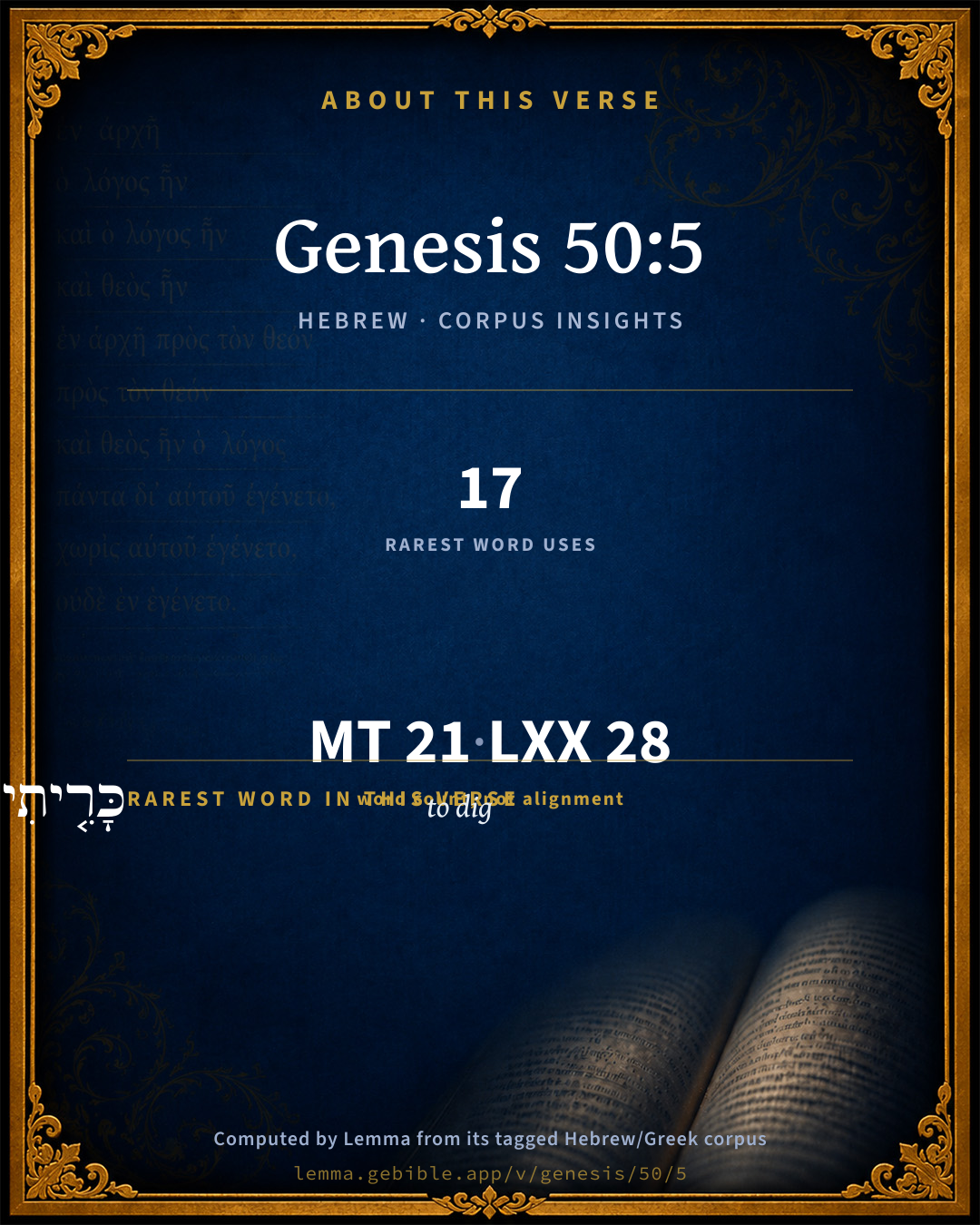
About this verse

These counts appear in no published source. They are computed here, from the morphology-tagged text and Lemma’s own curated glosses. What Lemma adds →

21
words
18
distinct lemmas
Pentateuch
section

Notable vocabulary

The rarest word here is כָּרִ֤יתִי to dig H3738 — appearing just 17 times in the whole Hebrew Bible.

Shared distinctive vocabulary

כָּרִ֤יתִי to dig H3738 occurs in 17 verses of the Hebrew Bible. Also found in:

Grammatical profile

  • 8 verbs
  • 5 nouns
  • 1 pronoun
  • 1 preposition
  • 2 adverbs
  • 4 particles

Verb forms

  • הִשְׁבִּיעַ֣נִי Hiphil · Perfect
  • לֵאמֹ֗ר Qal · Infinitive Construct
  • מֵת֒ Qal · Participle Active
  • כָּרִ֤יתִי Qal · Perfect
  • תִּקְבְּרֵ֑נִי Qal · Imperative
  • אֶֽעֱלֶה Qal · Cohortative
  • וְאֶקְבְּרָ֥ה Qal · Cohortative
  • וְאָשֽׁוּבָה Qal · Imperfect

Repetition

Words recur within this verse — often emphatic in Hebrew:

  • אָבִ֞י father H1 ×2
  • תִּקְבְּרֵ֑נִי to bury H6912 ×2

Hebrew & Septuagint length

In English translation the verse runs 42 words from the Hebrew and 36 from the Septuagint (LXX English) — closely comparable.

A rough comparison of the two English renderings, which tokenize alike — not a word-level alignment.

Word counts can differ between the Hebrew and the Greek without any difference in meaning — e.g. the Hebrew direct-object marker אֵת has no separate Greek word, and Greek often adds the article ὁ.

In the original languages it is 21 Hebrew tokens and 28 Greek tokens — but the two are counted differently (Hebrew bundles its prefixes and suffixes into one token; the Greek is in lemma form), so that isn’t a like-for-like length.

Cross-references

17

Topical passages linked to Genesis 50:5 in the Treasury of Scripture Knowledge — connected by theme and wording, ordered by reader-vote popularity; previews shown in the World English Bible.

  • 2 Chronicles 16:14 They buried him in his own tombs, which he had hewn out for himself in the city of David, and laid him in the bed which was filled with sweet odors and various kinds [of spices] prepared by the perfumers' are: and they made a very great burning for him.
  • Isaiah 22:16 "What are you doing here? and who has you here, that you have hewed out a tomb here? Cutting him out a tomb on high, chiseling a habitation for himself in the rock!"
  • Matthew 27:60 and laid it in his own new tomb, which he had hewn out in the rock, and he rolled a great stone to the door of the tomb, and departed.
  • Genesis 47:29–31 The time drew near that Israel must die, and he called his son Joseph, and said to him, "If now I have found favor in your sight, please put your hand under my thigh, and deal kindly and truly with me. Please don't bury me in Egypt,
  • Genesis 3:19 By the sweat of your face will you eat bread until you return to the ground, for out of it you were taken. For you are dust, and to dust you shall return."
  • Genesis 48:21 Israel said to Joseph, "Behold, I am dying, but God will be with you, and bring you again to the land of your fathers.
  • Genesis 49:29–30 He charged them, and said to them, "I am to be gathered to my people. Bury me with my fathers in the cave that is in the field of Ephron the Hittite,
  • Genesis 50:24 Joseph said to his brothers, "I am dying, but God will surely visit you, and bring you up out of this land to the land which he swore to Abraham, to Isaac, and to Jacob."
  • Deuteronomy 4:22 but I must die in this land, I must not go over the Jordan; but you shall go over, and possess that good land.
  • 1 Samuel 14:43 Then Saul said to Jonathan, Tell me what you have done. Jonathan told him, and said, I did certainly taste a little honey with the end of the rod that was in my hand; and, behold, I must die.
  • Job 30:23 For I know that you will bring me to death, To the house appointed for all living.
  • Psalms 79:3 Their blood they have shed like water around Jerusalem. There was no one to bury them.
  • Ecclesiastes 6:3 If a man fathers a hundred children, and lives many years, so that the days of his years are many, but his soul is not filled with good, and moreover he has no burial; I say, that an untimely birth is better than he:
  • Ecclesiastes 12:5 Yes, they shall be afraid of heights, And terrors will be in the way; And the almond tree shall blossom, And the grasshopper shall be a burden, And desire shall fail; Because man goes to his everlasting home, And the mourners go about the streets:
  • Ecclesiastes 12:7 And the dust returns to the earth as it was, And the spirit returns to God who gave it.
  • Matthew 8:21–22 Another of his disciples said to him, "Lord, allow me first to go and bury my father."
  • Luke 9:59–60 He said to another, "Follow me!" But he said, "Lord, allow me first to go and bury my father."

Cross-references courtesy of OpenBible.info (CC BY 4.0).

Hebrew and Greek witnesses Masoretic Hebrew ↔ Greek Septuagint

The same verse in the two great witnesses to the Old Testament, shown verse-for-verse.

These are two independent witnesses, not word-aligned to each other, and the Septuagint is shown in lemma (dictionary) form.

Hebrew Genesis 50:5 Masoretic · Westminster Leningrad Codex

אָבִ֞י הִשְׁבִּיעַ֣נִי לֵאמֹ֗ר הִנֵּ֣ה אָנֹכִי֮ מֵת֒ בְּקִבְרִ֗י אֲשֶׁ֨ר כָּרִ֤יתִי לִי֙ בְּאֶ֣רֶץ כְּנַ֔עַן שָׁ֖מָּה תִּקְבְּרֵ֑נִי וְעַתָּ֗ה אֶֽעֱלֶה נָּ֛א וְאֶקְבְּרָ֥ה אֶת אָבִ֖י וְאָשֽׁוּבָה

'My father made me swear, saying, "Behold, I am dying. Bury me in my grave which I have dug for myself in the land of Canaan." Now therefore, please let me go up and bury my father, and I will come again.'"

World English Bible · Public Domain

Greek LXX Genesis 50:5 Septuagint · lemma form

ὁ πατήρ ἐγώ ὁρκίζω ἐγώ λέγω ἐν ὁ μνημεῖον ὅς ὀρύσσω ἐμαυτοῦ ἐν γῆ χανααν ἐκεῖ ἐγώ θάπτω νῦν οὖν ἀναβαίνω θάπτω ὁ πατήρ ἐγώ καί ἐπι ἀναἔρχομαι

My father adjured me, saying, In the sepulchre which I dug for myself in the land of Chanaan, there you shall bury me; now then I will go up and bury my father, and return again.

LXX2012 (modern English Septuagint) · Public Domain

On this verse, The Cambridge Bible for Schools and Colleges discusses the Septuagint’s reading. Read the note in Commentary ↓

Hebrew: Westminster Leningrad Codex (CC BY 4.0). Greek: Septuagint (public domain); English from LXX2012 (modern English Septuagint) (Public Domain). How the Septuagint differs from the Hebrew →

Targum (Aramaic paraphrase)

2

The Targum is the ancient Jewish Aramaic paraphrase of the Hebrew Scriptures — an interpretive translation, not the Hebrew text itself. Onkelos (literal) and Pseudo-Jonathan (expansive) render the Torah, and Jonathan the Prophets. Coverage is partial: where no permissively-licensed English translation exists for a verse, only the Aramaic is shown. This is verse-level text, not a word-by-word alignment to the Hebrew.

  1. Targum Onkelos Torah (Genesis–Deuteronomy)
    אַבָּא קַיֵּים עָלַי לְמֵימָר הָא אֲנָא מָאִית בְּקִבְרִי דְאַתְקֵנִית לִי בְּאַרְעָא דִכְנָעַן תַּמָּן תִּקְבְּרִנָנִי וּכְעַן אֶסַּק כְּעַן וְאֶקְבַּר יָת אַבָּא וְאֵ יתוּב

    (no public-domain English translation for this verse)

    Targum Onkelos — Aramaic: “Onkelos Genesis” (public domain); “Onkelos Exodus” (public domain); “Onkelos Leviticus” (public domain); “Onkelos Numbers” (public domain); “Onkelos Deuteronomy” (public domain). English: “Sefaria Community Translation” (CC0 1.0 (public-domain dedication)); “J.W. Etheridge. The Targums of Onkelos and Jonathan Ben Uzziel on the Pentateuch. London: Longmans, Green, 1862” (public domain). Text via Sefaria.

  2. Targum Pseudo-Jonathan Torah (Genesis–Deuteronomy)
    אַבָּא קַיֵים עָלַי לְמֵימָר הָא אֲנָא מַיִית בְּקִבְרִי דַחֲפָרִית לִי בְּאַרְעָא דִכְנָעַן תַּמָן תִּקְבְּרִינַנִי וּכְדוֹן אִיסַק כְּדוֹן וְאִיקְבּוֹר יַת אַבָּא וְאֵיתוּב

    My father made me swear, saying, Behold, I die, in the sepulchre which I have prepared for me in the land of Kenaan there shalt thou bury me. And now let me go up and bury my father, and I will return.

    Targum Pseudo-Jonathan — Aramaic: “Targum Jonathan on Genesis” (public domain); “Targum Jonathan on Exodus” (public domain); “Targum Jonathan on Leviticus” (public domain); “Targum Jonathan on Numbers” (public domain); “Targum Jonathan on Deuteronomy” (public domain). English: “The Targum of Jonathan ben Uzziel, trans. J. W. Etheridge, London, 1862” (public domain). Text via Sefaria.

Commentary

Notes on Genesis 50:5 from classic Christian and Jewish commentators (each source and its license shown beneath its notes). The classic Christian expositions comment on the surrounding passage and are grouped to its opening verse, so a note may address several verses; the Jewish commentaries on the Tanakh (Rashi and others) are per-verse, so they appear only where the commentator wrote on this verse.

Lemma curates 59 commentaries, every one of them public domain or Creative Commons licensed, each selected and text-cleaned for this edition rather than reprinted as found. About our sources →

Trapp's Complete Commentary

John Trapp

Gen 50:5 My father made me swear, saying, Lo, I die: in my grave which I have digged for me in the land of Canaan, there shalt thou bury me. Now therefore let me go up, I pray thee, and bury my father, and I will come again.

Ver. 5. In my grave which I have digged for me.] A usual thing of old. {2Ch 16:14 Mat 27:60} {See Trapp on "Gen 23:9"} Quintillus Plautianus, an ancient senator of Rome, in the days of Severus the Emperor, being wrongfully accused and condemned to die, desired before his death to see those things that he had long since laid by for his burial; {a} which when he saw to be little worth with long lying, Quid hoc rei est? inquit; itane cunctati sumus? What a thing is this? said he. Have we made no more haste to die than so? {b}

{a} Postulavit, ut ea quae ad sepulturam suam comparaverat, &c.

{b} τι τουτο εβραδυνωμεν. - Dio.

John Trapp, A Commentary or Exposition upon All the Books of the Old and New Testament (1647–1656) — public domain. Text from a community e-Sword module.

The Cambridge Bible for Schools and Colleges

gen. ed. J. J. S. Perowne

5. have digged] or, bought. Both meanings are possible. LXX and Lat. favour “digged.” Syr. Pesh. and Targ. Onk. favour “bought.” The word in the Hebrew appears for “to buy” in Deu_2:6, and for “to dig” in Gen_26:25. It has been objected that, in the case of Jacob, neither meaning is appropriate to Machpelah (Gen_47:30), and that this passage refers to some other grave, e.g. that of Rachel (see note on Gen_48:7). But it is unreasonable to press this objection. Joseph’s report of Jacob’s words might well imply, that either Jacob or his forefathers had thus provided a burial-place. Moreover, he might possibly have hewn out a burial-place for himself in the rock of the cave. On the whole, “digged” seems more appropriate than “bought.” The language is not explicit enough to throw light upon the possibly independent legend of a burial-place, where Rachel was buried (Gen_48:7). The tradition of a “purchase” of ground by Jacob is connected with Shechem (see Gen_33:19; cf. Act_7:16), but not with a burial-place.

I will come again] Joseph is anxious to assure his master, Pharaoh, that he is not going treacherously to leave the Egyptian service.

The Cambridge Bible for Schools and Colleges (gen. ed. J. J. S. Perowne; Cambridge University Press, 1878–1918) — public domain. Text from a community e-Sword module.

John Gill's Exposition

My father made me swear, saying, lo, I die,.... Having reason to believe he should not live long, he sent for Joseph, and took an oath of him to do as follows; this Joseph would have observed to Pharaoh, to show the necessity of his application to him, and the reasonableness of his request. The words of dying men are always to be regarded; their dying charge is always attended to by those who have a regard to duty and honour; but much more when an oath is annexed to them, which among all nations was reckoned sacred:

in the grave which I have digged for me in the land of Canaan, there shalt thou bury me; it was usual with persons in their lifetime to prepare graves or sepulchres for themselves, as appears from the instances of Shebna, Joseph of Arimathea, and others, and so Jacob provided one for himself; and when he is said to "dig" it, it is not to be supposed that he dug it himself, but ordered it to be dug by his servants, and very probably this was done at the time he buried Leah. Onkelos renders it, "which I have bought", possessed or obtained by purchase; and so the word is used in Hos 3:2 but the cave of Machpelah, in which Jacob's grave was, was not bought by him, but by Abraham; for to say, as some Jewish writers (h) suggest, that he bought Esau's part in it with a mess of pottage, is without foundation; it is better to take the words in the first sense. And now, since it was Jacob's desire, yea, his dying charge, to be buried in the grave he had provided for himself, the mention of this to an Egyptian king could not fail of having its desired effect; since the Egyptians, as the historian (i) says, were more careful about their graves than about their houses:

now therefore let me go up, I pray thee; to the land of Canaan, which lay higher than Egypt:

and bury my father; there, in the grave he has provided for himself:

and I will come again: to the land of Egypt; this he would have said, lest it should be thought he only contrived this to get an opportunity of going away to Canaan with all his wealth and riches.

(h) R. David Kimchi Sepher Shorash. rad. Ben Melech in loc. (i) Diodor. Sic. Bibliothec. l. 1. p. 47.

John Gill's Exposition of the Whole Bible (1746–1763) — public domain (CC PDM 1.0). Text via the HelloAO Bible API.

Haydock's Catholic Bible Commentary

Digged, in the sepulchre which Abraham had purchased. This circumstance, and the exact words here used by Joseph, are not mentioned elsewhere. (Haydock)

George Leo Haydock (1774–1849), Haydock's Catholic Family Bible and Commentary, 1859 edition — public domain. Excludes Psalms (Douay-Rheims chapter numbering differs from Protestant) and Deuterocanonical books (Catholic canon only).

Matthew Poole's English Annotations

Here is a triple obligation upon Joseph:

1. His duty to fulfil the will of the dead.

2. The obedience which he owed to his father’s command.

3. The the of a solemn oath: all which had weight even with the heathens, and were so many arguments to Pharaoh and his courtiers.

In my grave which I have digged for me, according to the manner of those ancient and succeeding times. See 2Ch 16:14; Isa 22:16; Mat 27:60. In that large cave which Abraham bought for a burying-place for his family, Jacob had digged a particular and small cell or repository for himself, as others did after him upon the like occasion. And this reason is prudently added, to show that this desire proceeded not from any contempt of Pharaoh or his land, but from that common and customary desire of persons of all ages and nations to be buried in their fathers’ sepulchres.

Matthew Poole's English Annotations on the Holy Bible (1683–1685) — public domain. Text from a community e-Sword/MySword module.

Whedon's Commentary on the Bible

Daniel D. Whedon

5. Which I have digged for me — Some take the word כרה, here rendered digged, in the sense of purchased, as קנה is used in reference to Abraham’s purchase in Gen_49:30. If so rendered, the language used would make Jacob speak of Abraham’s act as his own. This is an allowable explanation, but unnecessary. The more common meaning of כרה is dig, and Jacob may have excavated his own sepulchre or separate chamber in the cave after the burial of Abraham and Isaac. See on Gen_23:9.

I will come again — “The earnestness of Joseph’s entreaty, and the repetition of his solemn oath to his father, show what difficulty a naturalized foreigner would have in leaving the land of the Pharaohs. Jacob’s characteristic foresight and prudence appear in exacting this oath, which he knew Pharaoh’s religious scruples would guarantee from violation, while, at the same time, Joseph would be protected from the national jealousy.” — Newhall.

Daniel D. Whedon (gen. ed.), Commentary on the Old and New Testaments (1874–1909) — public domain. Text from a community e-Sword module.

John Wesley's Explanatory Notes

He asked and obtained leave of Pharaoh to go to Canaan, to attend the funeral of his father. It was a piece of necessary respect to Pharaoh, that he would not go without leave; for we may suppose, though his charge about the corn was long since over, yet he continued a prime minister of state, and therefore would not be so long absent from his business without license.

John Wesley, Explanatory Notes Upon the Whole Bible (1754–1765) — public domain. Text via the GEBible commentary corpus.

Rashi

Rabbi Shlomo Yitzchaki (Rashi)

אשר כריתי לי means according to its plain sense “[the grave] which I have digged” just as (Exodus 21:33) “If a man shall dig (יכרה)”. There is a Midrashic explanation (Sotah 13a) which fits in with a meaning of the word כריתי, viz., אשר כריתי means אשר קניתי “which I have bought”. For R. Akiba said, “when I went to the coast-towns I heard them use for what we term מכירה “trading” the term כירה (Rosh Hashanah 26a). Another Midrashic explanation takes כריתי to be connected with כרי a piled up heap of grain, for Jacob had taken all the silver and gold which he had brought from the house of Laban and made a pile of it and said to Esau, “Take this for your share in the cave” (Midrash Tanchuma, Vayechi 6).

Rashi on the Tanakh — English translations: “The Judaica Press complete Tanach with Rashi, translated by A. J. Rosenberg” (CC BY 4.0); “Pentateuch with Rashi's commentary by M. Rosenbaum and A.M. Silbermann, 1929-1934” (public domain); “The Metsudah Tanach series, Lakewood, N.J” (CC BY 4.0); and “The Book of Joshua, Metsudah Publications, 1997” (CC BY 4.0). Text via Sefaria.

Lesson kit

Teaching starters — assembled from the data on this page, not authored interpretation. Every prompt links to the verse data it draws on. Edit before teaching.

Genesis, in the Pentateuch, opens this verse with 21 words (18 distinct Hebrew lemmas). Its most distinctive word is kârâh (“to dig”). A historical commentator’s framing appears above. Read the whole chapter for the surrounding context.

Discussion questions

  1. What does “to dig” (kârâh) contribute to the verse as a whole?
  2. Genesis 26:25 shares the word «to dig» with this verse. How do the two illuminate each other?
  3. “father” occurs 2× in this one verse. What is the effect of the repetition?
  4. The translations on this page render this verse differently — a whole-verse word diff, not a word-by-word alignment. What might account for the different wordings?
  5. The verb «הִשְׁבִּיעַ֣נִי» is Hiphil Perfect. How does its form color the action?
  6. Reading how Trapp's Complete Commentary and The Cambridge Bible for Schools and Colleges read this verse, where do the two commentators agree and where do they part?

Things to notice

Reading settings

Reading text

Shown beneath each verse's original-language words.

Old Testament
Old Testament edition

Read the OT as the Masoretic Hebrew (MT) or the Greek Septuagint (LXX).

English shown for the Greek Septuagint (in the Hebrew ↔ Greek comparison).

Comparing translations? Open the Compare panel on any verse page to stack up to four side by side.